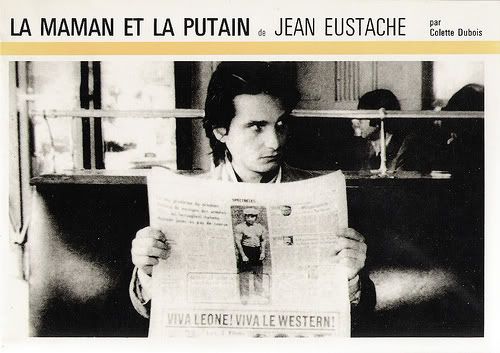
Reaction No. 1:
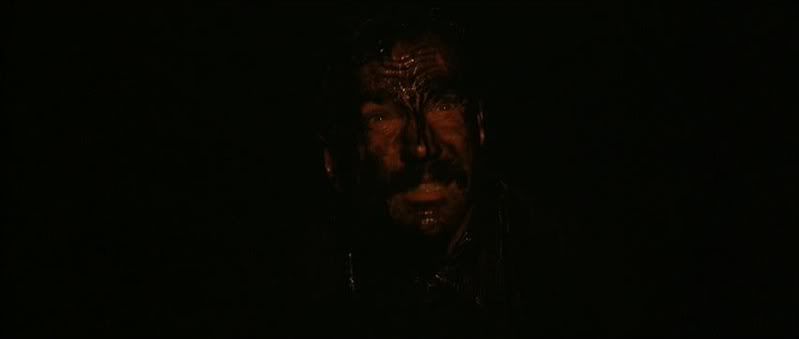
Reaction No. 2:

A summary of a film comedy written and directed by Preston Sturges suffers most in missing the continuous, virtuosic precision and intelligence of his dialogue, in no case more than in that of The Lady Eve. Sturges is one of the most remarkable mids to have found expression in Hollywood. Not until after the end of the Second World War, with the reception in America of the outburst of filmmaking in Europe -- including films of Truffaut, Godard, Fellini, Antonioni, Ingmar Bergman -- did an American audience become accustomed to finding a film written and directed by the same person. And Sturges' tight corpus of comparatively small-scale films occupies a treasure place in the hearts of those who care about the world and art of film; for example, beyond The Lady Eve, there are Sullivan's Travels and The Palm Beach Story and Hail the Conquering Hero. An instance of this esteem is recorded in the title of the Coen brothers' recent film, O Brother Where Art Thou? (with George Clooney and John Turturro), one of the most notable films of the past few years. It is worth taking a minute to say how that title inscribes a Sturges film.
The hero of Sullivan's Travels (played by Joel McRea, who is also the male lead in the remarriage comedy The Palm Beach Story, an interesting actor of considerable range, but less well known than the male stars, his natural competitors, of the remarriage comedies of the period discussed in this book) is a filmmaker whose great success is based on making thrillers with little intellectual or political content, and who wishes to make a film about something true and important, about suffering. The travels of the film's title are those taken by this director, who escapes the world of Hollywood escape in order to experiece the suffering of, after all, most people in the world, in preparation for making his important film of witness. The narrative takes him to the bottom of the world, in the form of being falsely convicted of murder and sentenced to a southern chain gang, where he discovers that the laughter provided by a Hollywood cartoon may provide the only rare moments of respite in a stretch of fully desperate existence. He contrives to be recognized in this place of anonymity, and returns to Hollywood to apply his hard-won insight, which means leaving unrealized his film of suffering.
The title of his projected work was to be O Brother, Where Art Thou? The Coen film, which opens in a southern chain gang, realizes this unrealized work by, as it announces, adapting (or more accurately, silently remembering names, and imaging sequences to realize them, from) episodes of the Odyssey (the Sirens, the Cyclops), taking as the overall adventure the return of an extraordinarily resourceful, or resilient, man to his native town to reclaim his sought-after wife (and children). The challenge the Coens take up, or depart from, in Sturges' fantasy of witnessing suffering, and which they seem to declare as part of their film (indeed of their corpus of fascinating films), is neither to record nor to distract from suffering. It is rather to witness, on the part of people who recognize, despite all, that life may still hold adventure, say hold out a perfectionist aspiration, but that to sustain a desire to meet the fantastic, unpredictable episodes of everyday modern existence, one must, and one can, rationally and practically, imagine that one will, at need, discover in oneself, in the register of passion, the resourceful persistence of Odysseus, and the mixed, but preponderant, favor of the Gods, call it fortune.


My name denies ethnicity at every six-letter stop but I still feel my white skin a needless arbiter, a lie and a limit. I like words, liquids and films -- not necessarily in that reverse-alphabetical order. Rivers are a favorite space, even a lifestyle, as much as a favorite metaphor; and I wish I was in them more and more. For so long I wanted to sing of myself, and I still do, but, as I am plagued by respect for the smartees who came before, I find myself sitting in front of blank pages far too often, dreaming of ways to excise elements of me from my words. Still, I persist. It just takes me a while, a little while longer. The process is the adventure, too. The toughness is to keep words from dying, inert, black on white and staid. The goal is to keep the picture alive and dancing. Thus, a certain navigation of abnegation and disclosure is necessary; this movement between avoidance and acknowledgment. I am more you here than me where I am but untethered letters. Especially in a flux like the internet, this Spinozian series of tubes linking disparate zones and voices and images and hearts and fingers and eyes and organs. My job, such as it is (or may be), is to fold all this into some kind of sense, a meaning made through concretion and flight, through attention, through realization of difference and separation and multitudes bursting past the banister (or, simply, the keyboard). Also, I like to laugh.

I suspect it was the story that had some of the folks in the Film Forum audience sighing, whispering and even snickering uncontrollably. Story-wise, Ballast can be easily mistaken for an entry in the Why We Be Black genre—films which depict underclass African-Americans scratching and surviving and tearing each other apart. Such films are said to exist mainly for the delectation of white liberals who like to think of poor blacks as lovable to the degree that they are irrational, impulsive and self-destructive. Mighty Joe Young in a do-rag. The fallacy of placing Ballast in this genre is as tragic as the critical backlash against Steven Spielberg’s The Color Purple adaptation, which reduced that film’s towering humanism to Song of the South T-N-T.
The first time I saw Ballast, knowing nothing about its maker, I spent no more than a cumulative total of five minutes thinking about the race of its characters or creator. Whenever little Lawrence wielded a gun that weighed more than him; when early on, James sat brooding, an inscrutable black hulk; when Marlee fumed and fretted over a tragic turn of events with the all the negro histrionics of Robert Downey, Jr. in Tropic Thunder — yeah, I thought about race. But that was it. Otherwise, the ethnicity of Marlee, James, and Lawrence rarely factored into my appreciation of their loss, desperation, insecurities, hopes and contradictions. These were Americans, these were human beings. I expect a white upper middle class author on a black working class subject to get some things “wrong”—that’s the way it is. What I hope for in such a film is an honest effort to capture something true.



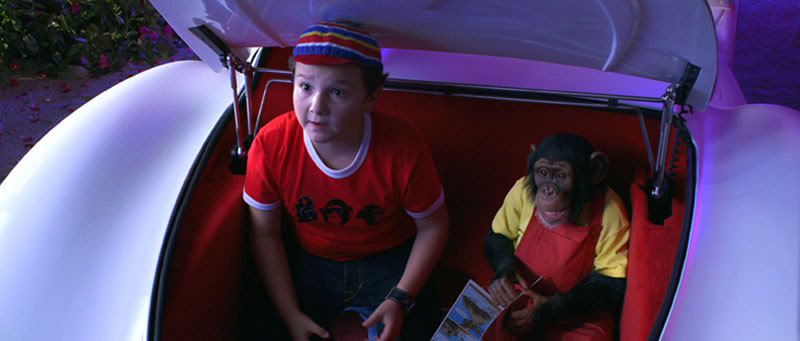
Rob: I'm still working on my thoughts for a piece at The House, but I'd absolutely call it great. I look at Spritle and Chim-Chim as surrogates for the Wachowski's; themselves two kids of crazy antics, absorbed in their own fantasy-land, sometimes annoying (like when Racer X comes to their home -- eesh), but absolutely necessary. And 4 times out of 5, I think they're hilarious.
Seriously: one of the best "kids" films ever. Years from now it'll be appreciating. And I'm downright sick of the shallow write-offs given to the cast. Can we please stop reviewing Episode I, people?
That whole climax is incredible, no doubt. I can't understand why more critics aren't behind this as a beautiful meditation on the role of the artist in society. It's completely personal, and, equally important, free of irony.
Ryland: yup yup. the climax MOVES me.
I dig that reading of the idiots (their LOOK MA stands out against the --blank slate-- of everything/everyone else) but I still can't shake my irritation at their hot air. There's too much. And when you've got so much other great stuff -- so much BEAUTY -- it's hard to be generous to that kind of jumping up and down. If anything, and this is something, I'm certain: they're fucking weird. And weird here is good. Great, even. Spin me, spiral of light!
Rob: It really is videogaming technology used in service of art. And that last shot of the Mach 5's melting wheel is worthy of Cronenberg. My interpretation of his ridiculously wonderful front-tip balancing act post-Beyond the Infinite final lap cum victory, is that the artist is signing his work. And that swirling shot of the car spinning as if on a tie-die canvas.
My favorite quote about the actor who plays Spritle is that he's a 40 year old trapped in a 10 year olds body. Totally weird. Papa Racer says it best: "You're too *pale*!"
Ryland: Yea, that pirouette is another trace Speed leaves on the track (on life!), and that drip is his joy come and spent, another mark left. It's the flash of success that wakes him. Success, of course, being his route to making the world's passage a little easier--if only for the moment. And what a moment! All those pinpoints reflecting, all those bulbs burning. I like to think of the flash as always single use, a tiny life begun and ended in an instant. All those lives out there looking to be lifted!
SO, when the idiots interrupt our revelation, I cannot take it. I revolt. Lemme get consummation! I guess that's the point, tho, right? It's a "kid" movie after all.


1. Follow a few personal obsessions, which are by no means "original" or even "particular to me," like Anthony Randolph, Kobe's legs (pace Tex), Mike Beasley's goof town lifestyle, Rudy Fernandez vs Greg Oden in ROY race (at least on the Blazers), how the Blazers should march through the world heads held high, Kevin Durant's eventual and terrible and hug-him-please cries on the inside under his (we hope) growing ferocity in the fourth, hating the WNBA, hating the Celtics but loving Bill "Sky" Walker, Houston getting big with Ron Ron up front and a vegan at the point, A.I., Melo, J.R. Smith, Josh Smith, Gay-Mayo, the Spurs devolving, the new Pistons, D'antoni running the Animal Apple in 7 sex or less, Chicago's all-backcourt starting five, Joe Alexander slaying the midwest AZN broads (they got those, right?) Yi left behind all clamoring, Yi making jokes with Vince about foolin'em all, LeBron stomping, Caron slicing, D-Wade getting anywhere at any moment to put up any shot possible ignoring the Matrix of possibilities behind him, Larry Brown shackling another flier in GW, Rick Carlisle making the Mavs that much more intolerable, somebody (please, somebody) punching Carlos Boozer's ugly fucking face, Kevin Love's chin strap and Mike Miller's grease-locks, more Beno Udrih push-offs, more Julian Wright--period--and Danny Granger, too, the Turkish Delight's inevitable backslide, Brand getting big with Thaddeus, Amare bouncing past everybody and everything when Shaq rides the bench and Nash tires for good, Baron looking to pass all street a lot more, Chris Bosh getting a hair cut or make over or something. [...]
5.i. Ask "What is basketball?" in a different way each time out.
5.ii. For instance, this time I'm trying to show that it's stupid to plan (or even hope) for much when it comes to something (cough, life) with this many variables. You just gotta enjoy this flux of fun.
5.iii. Keep an eye to seriousness within the nonserious discourse of a goofy blog like this one, which may manifest itself in stuff like, yes, naming life a "flux of fun", thereby invoking philosophical premises I find internal but not integral to my understanding of the game and its place as a social function--on the court, for the fans, in pick up, in relation to rap, as ritual, as theatre, as platform for what's bigger.

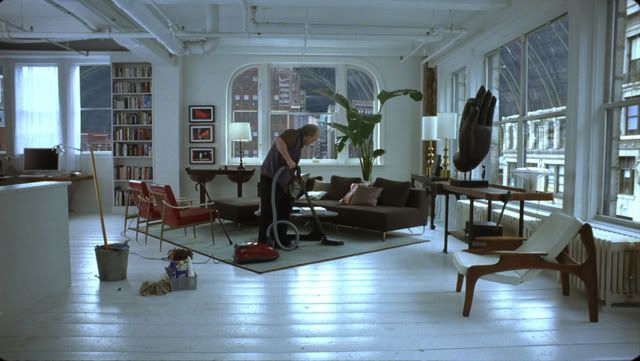
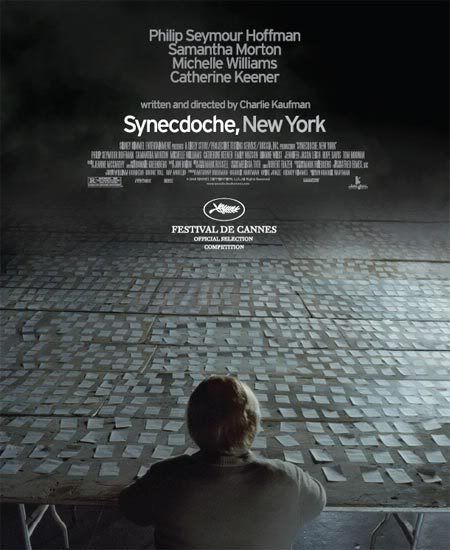 One of the more interesting or, and I hesitate to use this word but here goes, risky elements of Synecdoche is a burning house that nobody seems to recognize as having anything particularly wrong with it. In fact, it's inhabited by Caden's secretary and on-again/off-again lover, Hazel (Samantha Morton). It's the sort of thing that's funny-ish in concept, but (here's why I used it) risks becoming nothing more than Signifier. A house on fire, in this case, could only have meaning. But then Kauffman returns to the burning house, pursues it, prolongs our experience of it—it isn't just a gag, it reappears several times, always in a modified context—almost to the extent that whatever meaning we gave it is emptied out, so that what we see is the inhabitation of a Signifier, much like the process enacted by the title.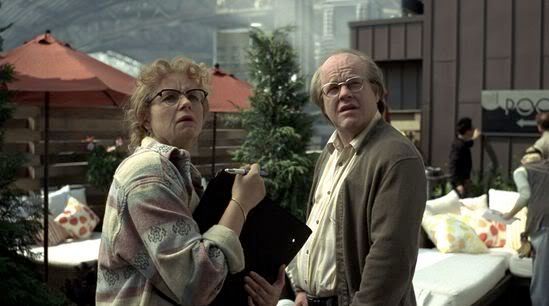
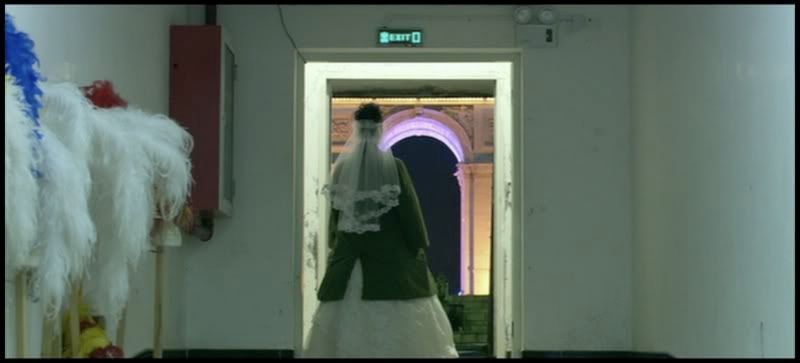



I named this blog Guns Before Butter because I wouldn't have named it anything if that were possible, but it wasn't. The name comes from a Gang of Four song, and is of course a reference to the dilemma of a society being forced to choose between investing in military and civilian products, or more simply, between defending and feeding its people. I'm not sure how this is related to my experience in Vietnam, but for some reason it was the first thing to come to mind when I had to think of a clever title, and it conjures (to me at least) vague notions of postcolonial realpolitik.