 by Mark Haslam
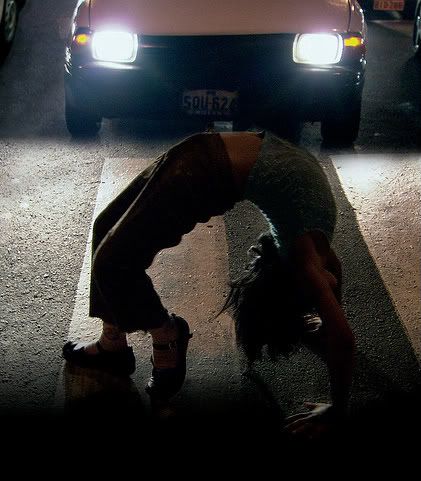
The subject of Heddy Honigmann's new documentary, Oblivion (El olvido), which I saw yesterday afternoon, is broad to say the least: maybe we can call it a history of Peru's modern politics, or an account of the many, many follies of the Peruvian government, or, just, Peru. Honigmann tells the country's story through its people, their memories and their frustrations and their dreams. The camera follows them, integrates itself, for a day or two, into their lives. Among the bartenders and waiters, shop-owners and leather workers, shoe-shiners and panhandlers that populate Oblivion, the most enigmatic to me were the street performers: boys and girls that cartwheel and juggle and handstand through crosswalks, in front of idling cars, hoping to get money from the passengers looking out of their windshields. The dynamic of these moments is amazing. Aren't we like the idling onlookers we movie-goers chastise for penny-pinching? And when they do give money, are they just doing it because of the camera, to look good? But then, aren't the people in the cars the same ones telling this story? So much happens in these crosswalks, as in every other moment of the film: each shot a rich history; each memory, each anectdote a loving cry.
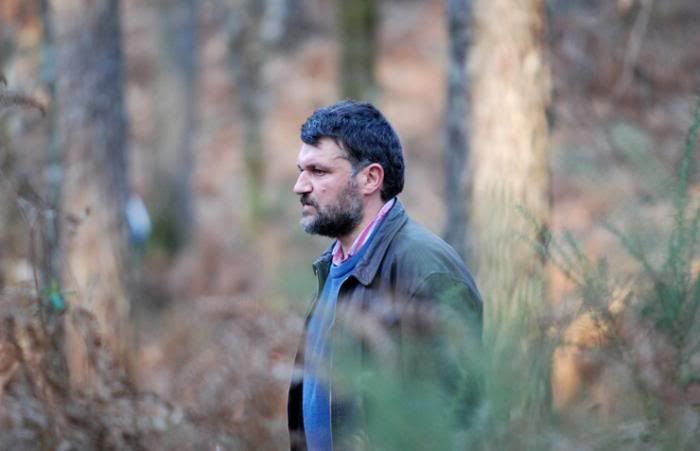 I went to Jaime Rosales's Bullet in the Head for two reasons: one, I'd heard that audiences had been walking out of it in droves, that it was 'difficult'; two, I couldn't get in to see Greenaway's Rembrandt's J'accuse. The 'difficulty' of Bullet is that there is no dialogue: the camera takes an embodied position, so that its position, which is always distanced from our main character, can't hear what anybody is saying. The narrative becomes a document of this man's daily life. Here he is with a friend in a cafe, there using a public telephone, here now at a party, going home with a woman, driving a car, etc. Yet these don't seem like 'difficult' concepts to me: space and voyeurism have been brought to higher levels of consciousness in film many times. Then again, I think (and the film gives you plenty of space to think) that 'voyeurism' might not be the right word—and here enters some 'difficulty'. We don't feel as though we're looking in on a life. The shots are too composed, all too orchestrated, don't feel at all like surveillance. Of course, a film like Rear Window is carefully composed—but there voyeurism lays beneath narrative; isn't, as here, the narrative itself. Moreover, a level of terror enters into each shot because of the title, which announces an event we think we know will happen. But do we want to see it? What agency do we have to not see it apart from leaving the theater all together? We're not voyeurs at all. We're not looking in, we're being shown, being made to watch. It terrorizes its audience, and I wasn't sure how I felt about. It seemed a different kind of terrorizing than that of, say, Michael Haneke, who deals with many of the same issues as Rosales. Where Haneke, for me, is a great success, I'm not sure about Bullet in the Head. I need to give it some space.
How can one reach Mark Haslam.His mail id where one can write to him directly ?
ReplyDeleteTarun
St Thomas Boys Calcutta