Some men dream #2
by Ryland Walker Knight


Small Black Room, Powell & Pressburger, 1949
shot by Christopher Challis
by Ryland Walker Knight
by Ryland Walker Knight

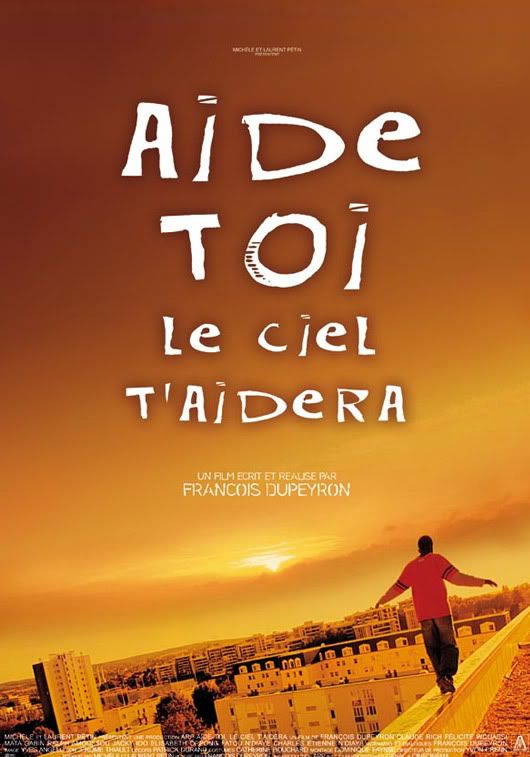
Félicité Wouassi stars as Sonia, mother of three and wife to a deadbeat, in François Dupeyron's Aide-toi le ciel t'aidera. She broils through the picture, fierce and sexy, lending it her always-brimming face and her forever-fighting grace. Routinely shot from a canted angle below, Dupeyron builds a portrait of Sonia as larger than her station—although, of course, she is never quite free from her life's limits. There will always remain an obstacle. What keeps Sonia afloat, we see, is her understanding that, equally, there is always a solution. Sonia's solutions, though, often startle. They hardly look like the right choices, but she owns these choices and she does make things happen, and settle, with an eye to consequence.
Set during the 2003 heat wave, the image washes yellow and red through most of the film, a picture of heat as has yet been captured (as far as I have seen) on a digital format. The beads of sweat on skin glisten and the pools under arms (or across backs) on shirts stick, feel like a too-hot summer. It's not Spike Lee and Ernest Dickerson's celluloid smear, it's some kind of glitchy pop of light punctuating a field of humidity. The weight of the boundless and roving camera rests in the image's diffusion, somehow, where color is like paint, a layer unto itself. This is nothing new, of course, as plenty have proven, like Godard (from Contempt to Eloge), and it's not quite Costa, but this desire to give face to the weight of poverty is another refreshing element reflected in the film's built-on-proximity mise-en-scène. If pressed, I'd say there's more Cassavetes than anything in the background here with all the focus on the face and all the insistence on the event. There's a lot of thisness.
A funny (albeit grave) little film that may, with a little help from this Rendez-vous series exposure, gain a following and blossom into some kind of "art-house hit" or what have you, I saw Aide-toi initially at the Telluride Film Festival last summer. I'm happy it went on to win Wouassi an award at Toronto, and that it appears now, in New York at least, for more to see. When we saw it included in this program, my friend Martha and I asked ourselves, "How come we never wrote about it back then? Or, at least, made more than a passing mention of it to more people than our non-internet friends?" Part of it was due to the rush of that weekend. Another part is that Aide-toi, although it hits all its targets, is not as immediately arresting and demanding (to say complicated and conflicted) a film as, say, Waltz With Bashir. In fact, Dupeyron's film may be too good (too fun?) for its own good. It will likely draw a lot of "sure, I get it's great; so what?" reviews, and could very well attract a certain middlebrow audience, but for some reason I think it will fade into that fog of unjust American neglect.


by Ryland Walker Knight


by Steven Boone

I suspect it was the story that had some of the folks in the Film Forum audience sighing, whispering and even snickering uncontrollably. Story-wise, Ballast can be easily mistaken for an entry in the Why We Be Black genre—films which depict underclass African-Americans scratching and surviving and tearing each other apart. Such films are said to exist mainly for the delectation of white liberals who like to think of poor blacks as lovable to the degree that they are irrational, impulsive and self-destructive. Mighty Joe Young in a do-rag. The fallacy of placing Ballast in this genre is as tragic as the critical backlash against Steven Spielberg’s The Color Purple adaptation, which reduced that film’s towering humanism to Song of the South T-N-T.
The first time I saw Ballast, knowing nothing about its maker, I spent no more than a cumulative total of five minutes thinking about the race of its characters or creator. Whenever little Lawrence wielded a gun that weighed more than him; when early on, James sat brooding, an inscrutable black hulk; when Marlee fumed and fretted over a tragic turn of events with the all the negro histrionics of Robert Downey, Jr. in Tropic Thunder — yeah, I thought about race. But that was it. Otherwise, the ethnicity of Marlee, James, and Lawrence rarely factored into my appreciation of their loss, desperation, insecurities, hopes and contradictions. These were Americans, these were human beings. I expect a white upper middle class author on a black working class subject to get some things “wrong”—that’s the way it is. What I hope for in such a film is an honest effort to capture something true.
by Ryland Walker Knight

 Posts
All Comments
Posts
All Comments


