Showing posts with label phenomenology. Show all posts

Thursday, October 07, 2010

Quick plug: Enter the Void

by Ryland Walker Knight


Knee On Toke Yo!

How about the flimsiest defense possible for an indefensible argument? Well, here you go! I volunteered at the 11th hour to try to wrangle together a "pro" side of a diptych column on the impossible-to-ignore Gaspar Noé wormhole of sense and "good" taste. I should probably say more but it boils down to this: you won't forget seeing Enter The Void. You should see it in a theatre, if it's playing near you, and you should go pee before it starts because it's kind of long and kind of tedious but, you know, that's the point (kind of). In fact, I think the flick could be yet longer and that'd make it better. If it really embraced the sprawl, actually went into a random-fire non-structure, truly hovered at the sidelines. But, as I say (feebly) in that post, it's worth the trip, such as it is, because it's going to make you feel something. It will take over you and your body. It may be pretty idiotic, and it may have an awful script, but its audacity's got to count for something.

For what it's worth, I realize this isn't a work of criticism. If I get some more free time, or the right nudge, I may pop up again to flesh out my thoughts. However, I'd really rather just talk about it. Or, truth be told, I'd rather read something about it written by Martha. Now, to some tacos and some baseball and some beer.

10 minutes later update:
This is because the movie opens in SF tomorrow though it already opened in NYC+LA and is also available On Demand for those unlucky enough to be denied the theatrical experience.

Saturday, January 16, 2010

Represent Repertory #3: Tiers on tires, on tableaux

by Ryland Walker Knight


—Nothing?

Really, if you didn't read Brian's Tati preview, you should. He's got all the links you need and then some, including this one, which points to a translation by Bert Cardullo, complete with introductory table setting, of Bazin's review of M. Hulot's Holiday at Bright Lights. I missed the PFA screening on Thursday because of a certain poodle's stubborn ways and the resulting headache that installed but I am hoping to maybe trek up to the Rafael this week to catch it since that theatre is even better, and easily better than the YBCA screening room and the Red Vic (Jan 28 and Feb 3/4 respectively), not to mention the fact that, despite certain impulses (and my reputation?), I don't want to spend all day Saturday, January 30th, at the PFA.

I do, however, want to spend some time there on that day because, in addition to all the Tati going on around town these first two months of twenty-ten, the PFA will be hosting a Val Lewton series. Last summer I watched a bunch of the films via Netflix, but I've never seen them on a big screen so I'm pretty damned excited for that light and those shadows to meet my eyes all emulsified. What's more, the series is structured around double bills, which seems particularly apt given the B-movie status/history of Lewton's catalog. (Also, as many of you know, I'm a fan of that film-going format.) To a certain extent, I plan to mimic my Dreyer and Resnais format/s for this series, so expect some enthusiastic notes once the series starts next weekend, on the 22nd, with one of the best pairs imaginable: Cat People followed by The Seventh Victim. Not only are both films brisk (neither tops 75 minutes), they're plain bizarre—especially Robson's Victim, which I did not do justice to back at first blush. Flip-side: I'm particularly proud of this Cat People image essay. More to come for sure.


Though I may miss the James Benning night at YBCA on Friday, February 26th, I am marking the Nathaniel Dorsky evening earlier that week, on the 23rd at the PFA, as a must-attend. First billed as a trio, the night is now a full quartet of films. I've been very excited to see Sarabande and Winter since they debuted at TIFF 2008 and spawned a number of great articles, including a pair from The Notebook: Darren Hughes' interview with Dorsky and David Phelps' consideration of Sarabande (from its NYFF showing). If I play the game well enough, I might be able to interview Dorsky as well as have the chance to write about his newer works ahead of the pack as (I'm guessing, since he's bringing them with him) the second pair of films on the program that evening, titled Compline and Aubade, will be enjoying their Bay Area premieres. (I'll get back to you on all that, but, for now know that it's all very exciting. Especially since I've got my own brand-spankin-new copy of Devotional Cinema already broken in, already not-so-spankin-new.


Finally, to round things out, there will be a reprise of Hou Hsiao-hsien's City of Sadness on Saturday February 20th, which follows a putatively rare Ozu the night before, a silent gangster melodrama from 1930 called That Night's Wife. I hope to see both. But now, on this rather gorgeous day, I need to go for a run before I catch Jour de fête a little later on across the Bay.

Wednesday, December 23, 2009

A conjunction of quotations #8

— edited by Ryland Walker Knight


Tod Seelie

1.
Nobody could have predicted that Copenhagen would collapse when the truth is that rich nations fully expect to flourish in a Greenhouse future behind high walls and hard-hearted armies and think that the same billions of humans will die from climate change whose deaths from starvation, unclean water, and cheaply treatable diseases they are cheerfully indifferent to here and now. Nobody could have predicted that Lieberman would betray the Democrats yet again when they have never made him face a real consequence for his serial betrayals in the past. Nobody could have predicted that neoliberals would think unemployment is a secondary consideration to billionaires staying billionaires as a measure of whether or not the economy is in recovery. Nobody could have predicted that California held hostage to an obstructionist Republican minority would rather turn into Somalia than make anybody pay taxes for indispensable services, or that a US Senate held hostage to an obstructionist Republican minority and a handful of Conservadems would destroy any chance for healthcare reform to help millions of their suffering citizens or to address world-destroying climate change or halt the re-emergence via the fraudulent financialization of the economy of a death-dealing immiserating feudal society. Nobody could have predicted that bailed out banksters would hoover up billions in cash to save their skins after squandering trillions in ponzi schemes and then refuse to change their behavior one bit. Nobody could have predicted that sociopaths will actually behave like sociopaths and that a system that celebrates sociopaths would not be a magical paradise.
Dale Carrico

2.

Today is the first day of the rest of your life.
Chuck Dederich

3.

There is no "rest of your life."
Allison Ahlert

4.

Storm the Reality Studio and retake the universe - The
plan shifted and reformed as reports came in from his
electric patrols sniffing quivering down the streets of the
earth - The reality film giving and buckling like a bulkhead
under pressure - Burned metal smell of interplanetary
war in the raw noon streets swept by screaming
glass blizzards of enemy flak.
William S. Burroughs

5.

That night a driving icy rain came up and lying in her bed, awake at midnight, Mrs. Flood, the landlady, began to weep. She wanted to run out into the rain and cold and hunt him and find him huddled in some half-sheltered place and bring him back and say, Mr. Motes, Mr. Motes, you can stay here forever, or the two of us will go where you're going, the two of us will go. She had had a hard life, without pain and without pleasure, and she thought that now that she was coming to the last part of it, she deserved a friend. If she was going to be blind when she was dead, who better to guide her than a blind man? Who better to lead the blind than the blind, who knew what it was like?
Flannery O'Connor

6.

The woman who follows the crowd will usually go no further than the crowd. The woman who walks alone is likely to find herself in places no one has ever been before.
Albert Einstein

7.

Never go on trips with anyone you do not love.
Ernest Hemingway

8.

The words most charged with philosophy are not necessarily those that contain what they say, but rather those that most energetically open upon being, because they more closely convey the life of the whole and make our habitual evidences vibrate until they disjoin. Hence it is a question whether philosophy as reconquest of brute or wild being can be accomplished by the resources of eloquent language, or whether it would not be necessary for philosophy to use language in a way that takes from it its power of immediate or direct signification in order to equal it with what it wishes all the same to say.
Maurice Merleau-Ponty

9.

What kind of beast would turn its life into words?
What atonement is this all about?
—and yet, writing words like these, I'm also living.
Is all this close to the wolverines' howled signals,
that modulated cantata of the wild?
or, when away from you I try to create you in words,
am I simply using you, like a river or a war?
And how have I used rivers, how have I used wars
to escape writing of the worst thing of all—
not the crimes of others, not even our own death,
but the failure to want our freedom passionately enough
so that blighted elms, sick rivers, massacres would seem
mere emblems of that desecration of ourselves?
Adrienne Rich

10.

But if stars shouldn't shine
By the very first time
Then dear it's fine, so fine by me
Cuz we give it time
So much time
With me
The xx

11.

Eventually, all things merge into one, and a river runs through it. The river was cut by the world’s great flood and runs over rocks from the basement of time. On some of the rocks are timeless raindrops. Under the rocks are the words, and some of the words are theirs. I am haunted by waters.
Norman Maclean

12.

The greatness of The River—and the same can be said of the three major films Renoir made after it, The Golden Coach (1953), French Cancan (1955), and The Elusive Corporal (1962)—is inseparable from its modesty, its humility, its consent to limitation. It places itself not above but below politics, at the level of everyday life. The Golden Coach and French Cancan are celebrations of art that cherish its pleasure without pretending they will fix our troubles or transcend our sorrows, without aggrandizing them into anything more than a good time. (Christopher Faulkner thinks the films of Renoir's late period espouse art for art's sake, what he calls an "ideology of aesthetics." This seems to me in error. Renoir's late films remain socially aware even if they no longer contest the social order.They don't elevate art above society, they see it as working within the conditions of society: they are unassuming about the art they celebrate. Faulkner is an Althusserian and his ideology rules out an art that can make its peace with a social situation it neither endorses nor presumes to transcend.)
Gilberto Perez

13.

As she entered the car, her first impression was that she was not on the train at all. It was merely an oblong area, crowded to bursting with men in dun-colored burnouses, squatting, sleeping, reclining, standing, and moving about through a welter of amorphous bundles. She stood still an instant taking in the sight; for the first time she felt she was in a strange land. Someone was pushing her from behind, obliging her to go on into the car. She resisted, seeing no place to move to, and fell against a man with a white beard, who stared at her sternly. Under his gaze, she felt like a badly behaved child. "Pardon, monsieur," she said, trying to bend out of the way in order to avoid the growing pressure from behind. It was useless; she was impelled forward in spite of all her efforts, and staggering over the prostrate forms and the piles of objects, she moved into the middle of the car. The train lurched into motion. She glanced around a little fearfully. The idea occurred to her that these were Moslems, and that the odor of alcohol on her breath would scandalize them almost as much as if she were suddenly to remove all her clothing. Stumbling over the crouched figures, she worked her way to one side of the windowless wall and leaned against it while she took out a small bottle of perfume from her bag and rubbed it over her face and neck, hoping it would counteract, or at least blend with, whatever alcoholic odor there might be about her. As she rubbed, her fingers struck a small, soft object on the nape of her neck. She looked: it was a yellow louse. She had partly crushed it. With disgust she wiped her finger against the wall. Men were looking at her, but with neither sympathy nor antipathy. Nor even with curiosity, she thought. They had the absorbed and vacant expression of the man who looks into his handkerchief after blowing his nose. She shut her eyes for a moment. To her surprise she felt hungry. She took the sandwich out and ate it, breaking off the bread in small pieces and chewing them violently. The man leaning against the wall beside her was also eating—small dark objects which he kept taking out of the hood of his garment and crunching noisily. With a faint shudder she saw that they were red locusts with the legs and heads removed. The babble of voices which had been constant suddenly ceased; people appeared to be listening. Above the rumbling of the train and the rhythmical steady sound of rain on the tin roof of the car. The men were nodding their heads;conversation started up again. She determined to fight her way back to the door in order to be able to get down at the next stop. Holding her head slightly lowered in front of her, she began to burrow wildly though the crowd. There were groans from below as she stepped on sleepers, there were exclamations of indignation as her elbows came in contact with faces. At each step she cried: "Pardon! Pardon!" She had got herself wedged into a corner at the end of the car. Now all she needed was to get to the door. Barring her way was a wild-faced man holding a severed sheep's head, its eyes like agate marbles staring from their sockets. "Oh!" she moaned. The man looked at her stolidly, making no movement to let her by. Using all her strength, she fought her way around him, rubbing her skirt against the bloody neck as she squeezed past. With relief she saw that the door onto the platform was open; she would have only to get by those who filled the entrance. She began her cries of "Pardon!" once more, and charged though. The platform itself was less crowded because the cold rain was sweeping across it. Those sitting there had their heads covered with the hoods of their burnouses. Turning her back to the rain she gripped the iron railing and looked directly into the most hideous human face she had ever seen. The tall man wore cast-off European clothes, and a burlap bag over his head like a haïk. But where his nose should have been was a dark triangular abyss, and the strange flat lips were white. For no reason at all she thought of a lion's muzzle; she could not take her eyes away from it. The man seemed neither to see her nor to feel the rain; he merely stood there. As she stared she found herself wondering why it was that a diseased face, which basically means nothing, should be so much more horrible to look at than a face whose tissues are healthy but whose expression reveals an interior corruption. Port would say that in a non-materialistic age it would not be thus. And he probably would be right.
Paul Bowles

14.

I once claimed that the only audience of philosophy is one performing it.
Stanley Cavell

15.

Comedy is the summit of logic.
Jacques Tati

Monday, December 21, 2009

Get your verdant going electric.

by Ryland Walker Knight


—When I click this...

Like Broken Embraces, you know exactly what you're getting from Avatar. Yet, with Pedro Almodovar, you only get about five great images and one classic finale sight-meld that changes perception. With Cameron's film, a visionary chunk of neon folly if ever there was one, almost every second behind those 3-D goggles got my eyeballs going gaga and groggy with gorgeous goof city grand larceny light shows of gigantic gestures all swooped and folded and lit up beyond pure spectacle into something truly immersive. I was wiped, wiping my eyes walking out of that early-AM, first-possible IMAX showing Friday morning. It's about as tiring an epic as has come out since that other great film of the decade about embodiment, Pirates 2 (and, yes, No. 3, which is more tiring but not quite as good).

By now you probably know what Cameron's movie is about (bad military, good natives; yawn), so I don't need to waste your time with the waste of time story highlights. Rather, we ought to focus on the real excuse for this behemoth: to light your eyeballs full of a frenzy. Because, it goes without saying, though everybody will/has, James Cameron cannot write for shit, has no political sensibility other than guilt, and wouldn't know how to differentiate between myth and cliché if asked in the right (pointed) way. What he can do is make a few images, and build a movie, however silly, with all kinds of cool tools. He's also been pointed in the right direction of a few bits of theory, it seems, and knows a few things not just about feminism but also about game design and, um, phenomenology. At heart, his story is about seeing as a physical action, a full-bodied embrace of the material world. Again: embodiment. I have to admit that, despite what (little) I knew about the whole "stereoscopic" mumbo jumbo Cameron supposedly invented (and the title, duh), I didn't see that one coming. Or, at least I did not expect it to be that explicit—nor for it to work.

You expect Pedro Almodovar, in a movie about a now-blind filmmaker, to make the phenomenological film that moves you, not James Cameron. But, save that final image, and Penelope Cruz's force-of-nature performance, nothing really moved me, though a few things tickled me, as much as any number of sights in Avatar. Physically moved, too: I found myself fudging the 3-D by having to shift my body and cock my head from side to side from time to time just to cope with all that gooey phosphorescence on screen. WIth Pedro's film, I just kept wanting more screen time for that goddess, no matter the narrative cost. See, Pedro's still hung up on plot. But he's only got a few of them to rely on, and the record-skip repeat of this movie is nearly tiring; or, it is whenever Penelope isn't dazzling the frame. All Cameron has to do is push a few motes forward in the "frame" (space? his term, "volume"?) and I get a thrill. That said, only a few of the compositions from the full film linger in my head. It's more about the fluidity of the space, and the visceral invitation it offers, than it is strictly about pictures. In that, I think Sicinski's onto something with that three-tweet rave (starts here) about "making plot just what it should be: an excuse to go nuts on viewers' skulls."


—From here!

Last year I had a similar positive reaction to Speed Racer, but I know that movie, though maybe more adventurous, is nowhere near as successful. It's a little too cut-out cartoony, and its timing is all off. Say what you will, and I know it's long (and there's no getting around that, of course), but Avatar never drags. It just weighs a ton for a fleet film. And that's because it expects your eyes to do things they're not used to doing. —Least of all in a multiplex! In any event, this rapture, though felt, is still nothing compared to the sheer joy of Fantastic Mr. Fox. There's a film jam-packed with detail to keep you pinballing around the frame for daze on end, every frame a treat—and all in under 90 minutes. But that's another story for another time. (Maybe later in the week.) For now, I'm just adding my ramble to the ruckus out there, getting giddy at the thought of fluorescent aerial jellyfish and all kinds of eco-electrical networks of lights to make me and you and everyone dizzy with dumb grins. What a gift!


[Broken Embraces opened on one screen, at the Clay, last Friday here in the Bay Area and will roll out to more screens on Christmas. Avatar's everywhere. Neither needs my endorsement to make oodles of cash. Though, of course, one will make yet more oodles than the other.]

Friday, December 04, 2009

Alain à la recherche #5: Mon oncle d'Amérique

by Ryland Walker Knight


[The Resnais series playing at the PFA this November and December is part of a broader, traveling retrospective with a concurrent run in Chicago at the Gene Siskel Film Center and a proposed stop at the newly renovated Museum of the Moving Image in early 2010.]

Parts of this film get me so giddy, marveling not just at the beautiful photography but also at the beautiful Nicole Garcia (above, on knee) and the silly-smart braiding, that I just don't believe it. Other parts are terrifically moving (i.e., sad). Most parts are didactic; as if its narrative strategy were a form of pedagogy engineered around constant recapitulation; as if Alain's saying, almost like he does throughout Marienbad, that if we say something specific enough times in enough voices then it's bound to burrow in there and register.

Everybody's got a story, and everybody's got dreams. Everybody's got a fantasy, an uncle from America. Except, of course, these people are decidedly French. In fact, we get a full from-birth history for each of our three leads—Garcia, Gerard Depardieu, Roger Pierre—each told a few times over. The film begins more a mosaic than Je t'aime, je t'aime rather literally as our eyes follow a spotlight searching a collage of stills we will know in motion later in the film. Then it's choral, too, our ears parsing these three—no, four—voices recounting their births and their birthplaces and their trajectories all at once all on top of one another—except for some omniscient voice telling us that a being's only purpose is being and/or something else tautological. Shortly, we're given faces to go with the voices, and names, and portraits of their childhood narrated by them. Then the net is cast over this trio: Resnais introduces Henri Laborit (a real-life physician, writer and philosopher) with the same kind of narration, but with "current" footage of Laborit walking around some lab, smiling and scowling. Laborit is a kind of guide, a sage, for the film. Not that the film exactly proves Laborit's theories—a version of evolutionary psychology intent on Explaining It All—but these asides help provide, say, an anatomy for the film to hang stories off of, like limbs.

The film is split, or splintered, or it splits a few times, or it's segmented, though it also finds conjunctions and convergences. In one (dim) light, it's simply didactic and over determined. Resnais never reduces, though, and the repetitions are never played the same—not from the same angle, often it's not even the same exact action but another performance altogether. Even more than the memory game of Marienbad, Mon oncle aims at redetermining events: how new information colors an old event, or a current one, and can influence understanding of putatively unrelated events. Put otherwise, the film is quite clearly about intentionality, and how we think about things, and where we come from when we come to things-people-places. No doubt, there's plenty of Ricoeur's traces in this project, even if it's based in Laborit's mouse traps. It's Resnais' cinematic gusto that frees the film from its unilateral "expertise" echoes and lets time move both—nigh, all—ways at once. Though Alain maps the mice onto the men and one woman we follow, it's not proof; it's a joke. It's a gas that it's a possibility, even a plausibility, in this world. —Jokes can scold!

Though agency seems crushed, to an extent, in this little network of forces, we never feel like life's not open. Rather, life's prone to fantasies, which can, plausibly and paradoxically, be a form of paralysis, an inhibition that blinds us to how we move ourselves (and must) and give each present purpose its purpose. Or, that becomes possible only if (we hope "when") we find a way to gather ourselves, to hold our histories at hand as some ciceroni, and not simply as stained glass. We remember: we tell ourselves stories in order to live.

Friday, November 20, 2009

Alain à la recherche #3: Night and Fog and Muriel

by Ryland Walker Knight


[The Resnais series playing at the PFA this November and December is part of a broader, traveling retrospective with a concurrent run in Chicago at the Gene Siskel Film Center and a proposed stop at the newly renovated Museum of the Moving Image in early 2010.]


The third night showcased a pair of ghost films, Night and Fog and Muriel, that dovetails one phantasmagoria of "history" with another knot of pain to paint a picture of memory as only ever a haunting. It's the dread affect. It's how you don't need to see some scars to feel them line your visage, or your soul. The most alarming thing besides all the hurt bottled in these films is that the duo rush by, clipped in to let time slip away. The earlier documentary acknowledges this pretty basically in that it's a short, a little poem of collocation. One form of representation is pitted against another. One imagines seeing two films at once, and how some current artist, like say Jennifer Reeves, might project both media simultaneously; however, Resnais could have done that, too, but he did not; one would be wise to understand the power of a more "linear" contiguity to better shock, assault and mortify an audience. As the title attests—in spite of its before-and-after death camp images—it's not an ashtray film and it's not a smoke trail film; rather, it's that cloud film, hanging; it's a fog fugue. Of course it hurts.


Muriel extrapolates this reckoning project, but instead of a fog of competing threads, it's all tied up, everything a gnarl, as only a Hitchcock fan could dream. Again, it's a crisp film—blink and you'll lose your bearings—but, like a lot of nightmares, the pacing's off. It lumps on, then flies to a cliffside, then a few months fall away and plans are dropped; life's a gambol as much as a gamble. Nothing really happens but a series of "you hurt me once" rounds of sparring. It's a film of remove set in the port town (a liminal space if ever there was one) of Boulogne, outside Paris, away from Algiers, eons from The War that changed everything. Resnais seems given to dialectics in this early phase (though Marienbad's clearly a prism), and here we have not just past and present but young and old, memories and events. Nonetheless, it's hard to call anything an event in a film this oblique, this hidden, this burled, this tangled. Like all of the best cinema, at bottom Muriel is just images, folding, a string of signals that resist that symbolic. Nothing is so reducible in a Resnais film, it would appear. In fact, what I'm already loving is that he's at the other end, exploding things. He claims lineage with the Surrealists and it makes sense: Muriel may be a cube, not just a knot, built of mirrors; however, unlike Marienbad, those mirrors are corporeal, physiognomies rather than reflections, with pores and creases. —We're back, somehow, at the human.


Wednesday, September 16, 2009

Convergence for your totem trials (9/17/09)

by Ryland Walker Knight


la belle noiseuse

ne touchez pas la hache
—Everybody's got a noiseuse.

Tuesday, April 07, 2009

April showers: a grab bag of links and hints, plus a question.

by Ryland Walker Knight


Wow, this is counterintuitive. But it's a treat nonetheless since the film has no Region 1 DVD. I went ahead and embedded the film here but you should definitely watch it full screen, and loud. It deserves to be seen just like its title declares (asks?) it to be. That way, the outsized colors that feed this melodrama will pack more punch and, we hope, shock you into a powerful feeling. I saw the film last summer before my Telluride trip (see the bottom and the comment thread of this post) and it kick-started a Nick Ray fascination that has only grown since (a recent example). In fact, I've had my favorite of his films, On Dangerous Ground, at home from Netflix for a little too long now. I sure would like to write something coherent about it, but that will probably have to wait since I'm on the hook for a long-form piece about James Gray for a certain publication to be named later. In any case, watch James Mason shiver and rant his way through an illness and addiction whose consequences hit home in more ways than one. New media, baby. It'll take over your life. Get it?

look away

And, a reminder: my last Dreyer Diary shall hit The Notebook shortly, I'm told, and the link will appear in the link dump post below. While I'm here: March was rough stuff for a variety of reasons but the Dreyer films were a fine project to keep my brain active. I'm happy I met the films on the big screen (as with this Ray above, and On Dangerous Ground) since each is meant to be felt with the eyes (as a portal to the heart). For what it's worth: Ordet was/is my favorite. I'd like to write about it again, and better, some day. It has a lot to give. And, to reiterate what I tweeted @ Brian, all that nonsense comparing Silent Light to Ordet misses the fact that, plot point be damned, Reygadas' project is much more about tactility whereas Dreyer's project is about reorientation. You can find the perfect example of this shifting of perspective begin at the 3:55 mark in the clip below. (It occurs to me that I should say this comes a little late in the film, and that I should issue a spoiler warning for those concerned with such things.)

video unavailable; maybe again, some day, in a different form

What's really cool about On Dangerous Ground is that it's about both! I might say that those two films, along with some Hitchcock and Buñuel, are my favorites of the 1950s. I know it's a rich decade, as every one is, and that I cannot compare with some cinephiles' viewing history, but, are there any takers? Or, what's your favorite Nick Ray picture? And, for that matter, which Dreyer?

hit me

—Do we still have readers out there in the sphere? Can I provoke a response? To echo our stooly mope above: hit me.

Wednesday, December 03, 2008

Natural is not in it: White Dog

by Ryland Walker Knight


who the FUCK spilled the ketchup?
[I've been having internet problems of late so this link-through is late, but, well, here we go...]


Sam Fuller's final Hollywood film is so not Hollywood all we can do is say, "Thanks." We have it here, now, in a beautiful new DVD, which I've looked at and then said a few things about over at The Auteurs Notebook. I didn't quite get to everything the movie made me think about, but I think some of the ideas about the phenomenological significance of the close up might be visible to the curious reader. In case that strain of argument is, in fact, buried deep: it's an immediate encounter we viewers cannot ignore, and Fuller never lets us forget this because these close ups often emerge after a zoom (as punctuation, as affective signpost) or a smash cut; the film is unabashedly directing your gaze; but there's nothing maudlin about this man's tears below. All that sentimentality is side-stepped by virtue of Fuller's low angle and looking up kino-eye and Ennio Morricone's meandering ivories and the utter gravity of something so absurd it has to be real; something like, you know, race hate. So if you didn't click that link up there click this one here and when you're done there, or in lieu of that, you might like to look at the images all in a stream-of-argument that says something else with the same materials.

dont go chasin waterfalls

Monday, April 28, 2008

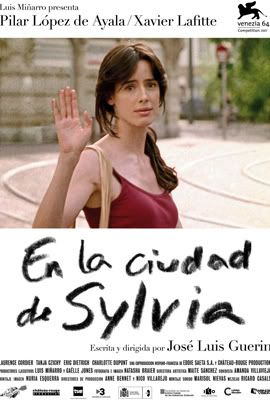
Sketches on Hoberman, Sylvia, looking and difference. [Part 2]


dazed

From: Jennifer Stewart
To: Ryland Walker Knight, Kevin B Lee
Subject: RE: hoberman, sylvia

Kevin and Ryland,

I have just a few comments all inspired by our pre/post film analysis and your fetching essay, Ry. Unfortunately my thoughts are more responsive and fragmented than yours are coherently developed. But I'll let you blogbarians take it from here.

Kevin, while on BART Ry and I spoke more about this phenomenology idea. I think your essay shows, Ry, that the film is more a phenomenology of spectatorship than a phenomenology of thought. What El was doing in the cafe as he looked and sketched, is not what I'd call tantamount to thinking but rather, to fixing a view; really, tantamount to intentionality: he's trying to settle what object his thought is bent on. And his efforts are subject to the interference of occlusion (other heads/objects get in the way), the limits/possibilities of two-dimensional collapse (the 'flat' surface of his sketching page), and the uncanny moment when these objects return his gaze, catch his eye. All goes well with his pursuit of "Sylvia," after all, until she looks back; until they reach the moment when he must account for pursuing her as a cypher for his desire. A moment he calls a disaster never really recovers from.

Two things I don't understand and think analysis of the film should explain:
  • what's significant about El sleeping with that beautiful but weird spaced out/drunk/bad dancer girl?
  • in the last few minutes, through the 'screen' of the train, we see a girl in sunglasses. The entire left side of her face is scared or burned. A few cuts later we see her again, removing her sunglasses to revealno eye (!) on that side. It was pretty gruesome. Kevin, you saw that, right? Ry somehow missed it so please confirm I'm not making this up.

Both these Sylvia dopplegangers (in some sense all the women in the film are) could be read as casualties of El's pursuit. The crevices, lines, and shadows of the scarred woman's disfigurement bears a resemblance to the dark, resistant etchings in El's sketchpad; the consequences of his agenda coming into relief. So we see your point, Ry, about El's fixation on the (absent) avatar of "Sylvia" and his rejection of the (present) abundance of difference. And here I think we add Bunuel's Obscur objet du désir to Kevin's Vertigo reading.

I'm tempted to read the whole film as a cautionary tale about one allegory of film spectatorship: the rich risks of film as fixing its/our gaze on a (lost) object of desire which can never be incarnated. So then we could read Ciudad de Sylvia as loosening this grip (hence my suggestion that it updates the Laura Mulvey thesis) since it refuses to offer an unambiguous object upon which to fix our desiring gaze. Indeed, it offers alternative figures of moving image itself (metaphors of dynamic celluloid frames) and the aesthetic acceptance of occlusion and the uncanny.

One last thing: Kevin, have you read If On A Winter's Night A Traveler by Italo Calvino? En la ciudad de Sylvia could easily be read as a brilliant adaptation of it.
~j

[Note No. 1: You can read my "Part 1" missive by clicking here.]

[Note No. 2: Because the trailer to Bunuel's film and the clip from Hitchcock's were too good to simply link to I'll go ahead and embed them down here. They add to this reading, I think, tremendously.]


[Note No. 3: Kevin's reply can be found by clicking here to his blog. --RWK]

Sketches on Hoberman, Sylvia, looking and difference. [Part 1]

[Note: On Sunday, April 27, 2008, I attended a San Francisco International Film Festival event with my friends Jennifer Stewart and Kevin B. Lee. After the SFIFF presented Jim Hoberman with the Mel Novikoff Award (named for the famed San Francisco film exhibitor), Kent Jones quasi-interviewed Hoberman on stage for about an hour, and then we were lucky enough to watch José Luis Guerin's In the City of Silvia. I wrote this first email to Kevin primarily, as a fellow blogger, and Jen secondarily, as my friend and interlocutor. I thought it might be interesting to others, too. Look for Kevin's response at his blog shortly. -- RWK]

From: Ryland Walker Knight
To: Kevin B. Lee, Jennifer Stewart
Subject: hoberman, sylvia

Yo, Kevin,

Glad we could enjoy that film, and that discussion beforehand, together. Before I talk about the film a bit let me say I remembered (or think I remember as) what Hoberman got mild applause for: he was saying he hoped more online criticism would link to other criticisms, incorporating other texts (and, I imagine, images and sounds) into itself. A very Web 2.0 kind of monadic reading; not simply monadic reading by making associations in writing but actually forging associations with hyperlinks (and images, even videos). It seems like his ideal version of online criticism is exactly what you're after at your blog. Which is a really cool thing! Congrats! Unless, of course, my memory is messing all this up. Which leads me to In the City of Sylvia.

I think I may go ahead and deem the film "a masterpiece" because I do think it's about more (plot-wise and otherwise) than simply a dude stalking some pretty babes. We know dude is visiting this town after a six year absence, trying to recuperate a love/r (or better: a memory of a lover), and not just another passerby inhabitant of this city. And, of course, as you said, that's a thin plot. However, it's a pretty tight little argument about movies, and about watching movies. When we watch a movie we're a foreigner in a familiar terrain (or logic, or vocabulary) trying to piece together different strands that coalesce because we make them (pace Bordwell) into a kind of meaning. For instance, your monadic read incorporates Kiarostami, just as mine incorporates my (potentially wrong, easily vague) understanding of phenomenology. All dude does in this picture is look at things to try to make pictures, to put things together, through imagination and projection and, above all, looking.

Now, the Vertigo analogy is pretty apt, but I definitely don't think this is "art for art's sake" by any stretch. This is an argument for the value of art, of the art of movies, of the art of looking, even the art of understanding (if that can be understood as an art, as I think it can). Of course, that argument would take longer than this brief missive allows. But my sketch, to follow our man from Sylvia (dig that double move!), begins with this: the worthiness of those arts -- of art -- seems to be in what they produce for their participants. I hate to trot this out but Gadamer says we only understand differently if we understand at all so maybe this film is arguing for that kind of openness to difference: our man at the centre is never fulfilled because he cannot accept a rather simple difference in his perception (of a girl, of the world). In a way he's got a greedy nostalgia. Which, of course, translates to our role as spectators: we keep looking, following films, hoping for an outcome. Which ties into something Hoberman said about the different expectations different movie goers bring to films. Some people look for a kind of confirmation entertainment (say, as we discussed, the Apatow pictures and their wish fulfillment drive) whereas other people look for a kind of new perspective, which, we must admit, can easily be another kind of confirmation, if somebody is only applying a certain lens to all films. I'm fairly certain I'm not doing that here. My reading is allegorical, sure, linking his looking to my looking, doubling the remove, but I think the film invites it. As you said, it's a city of surfaces and reflections. Just as movies are a surface projected onto a reflective screen.

But I should hit the hay, or at least read before I hit the hay. Say, you should write me back and I'll post the pair of emails on VINYL. That sound like a cool idea?

Take care,
later, ryland.

____________________

shh!
____________________


Jennifer's reply is posted in the space above (here's a direct link, and look for Kevin's reply over at his blog, Shooting Down Pictures, soon right here.

____________________

Other words worth reading about this picture:

Thursday, February 14, 2008

A thought on "authorial intentionality" in film, in criticism

From Ryland:

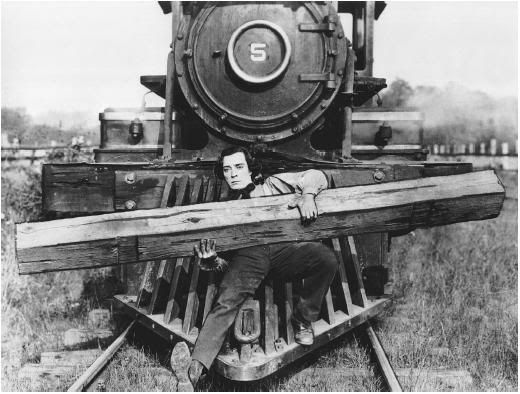
Not sure if I 100% agree with Noel Carroll's reading of The General in Comedy Incarnate* (I have not finished, and I may not finish, reading the book) but I appreciate this brief characterization of "authorial intentionality" he offers in the introduction. Its something I'm hoping to incorporate into my idea of film criticism as a kind of phenomenological hermeneutics. But I really want to stay away from somebody like Heidegger, for now, because, at the least, that would require quite the diversion from my project. This is much more in line with what I'm after:

In addition to being impressed by Merleau-Ponty's work, I was also smitten by the phenomenological criticism of the so-called Geneva school, most especially by the writing of Georges Poulet. For Poulet, an author, by means of his emphases and selections, presents his "intentionality" to the reader -- the way in which his consciousness is directed toward the world. The task of analysis then is to identify these patterns of experience as they emerge in a text -- to notice toward what the author's attention is drawn, and, as well, to characterize the manner in which that attention is articulated. Discussing Balzac, Poulet locates an experiential pattern of recurring physical thrusts forward which he thematizes in terms of a movement toward the future; in Whitman, Poulet finds a mode of consciousness of the world that is marked by infinite receptivity as multitudes crowd into emptiness and things collect, meet up, and fill space. Both authors offer the reader a model of their "intentional consciousness," their fashion of encountering the Lebenswelt through reference to very fundamental modalities of experience.

The notion of "authorial intentionality" is immensely suggestive when it is transposed from the literary author to the film director. For essential to the notion of intentionality is directedness toward the objects of consciousness and that, of course, is arguably what a director does with cinematic apparatuses -- directs cameras towards objects and selects views and perspectives on situations through editing. Thus, cinematic technique can be a way in which a director may objectify, externalize, or incarnate his style of attending to or relating to the world -- articulating the temper of his consciousness of things on celluloid, his intentionality or mind embodied, so to speak, in silver nitrate. Though no allusion to Poulet's idea of authorial intentionality occurs overtly in the text -- perhaps for fear of sounding too literary -- this notion stood behind my analysis of Keaton's visual style, which I unequivocally thought of as rooted in his personal style -- his way of inhabiting the world.

I hope to make a similar argument, although tailored towards a different end (involving other concerns than bodily intelligence, like intelligibility, for instance), in favor of Terrence Malick and Michael Mann and their respective, most recent films (The New World and Miami Vice). Plus some stuff about what this kind of attention in a work of criticism means for the project of criticism and all that jazz. There's a lot at play already so I may wind up ditching my original plan to look at two later Hitchock films (North by Northwest and To Catch a Thief) that fit with the films of Malick and Mann for their individual interests (and the conversation between the films that such interests provoke) in what Stanley Cavell calls the mythical America, that place where pursuits of happiness are encouraged, and possible.

*Thankfully I got a copy from the UC Berkeley library. As is often the case with these "academic" works of criticism, to own a copy means forking over a rather large lump sum of your budget -- as you can see here on Amazon. I don't know why this always astounds me, but it does.