Showing posts with label A Conjunction of Quotations. Show all posts

Friday, May 27, 2011

A conjunction of quotations #13

— edited by Ryland Walker Knight
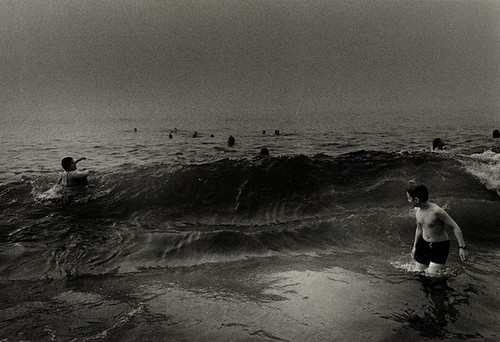

by Paul Nozolino
— Paul Nozolino

1.

We don't even know if what ends in daylight terminates in us as useless grief, or if we are just an illusion among shadows, and reality just this vast silence without wild ducks that fall over the lakes where straight and stiff reeds swoon. We know nothing. Gone is the memory of the stories we heard as children, now so much seaweed; still to come is the tenderness of future skies, a breeze in which imprecision slowly opens into stars. The votive lamp flickers uncertainly in the abandoned temple, the ponds of deserted villas stagnate in the sun, the name once carved into the tree now means nothing, and the privileges of the unknown have been blown over the roads like torn-up paper, stopping only when some object blocked their way. Others will lean out the same window as the rest; those who have forgotten the evil shadow will keep sleeping, longing for the sun they never had; and I, venturing without acting, will end without regret amid soggy reeds, covered with mud from the nearby river and from my sluggish weariness, under vast autumn evenings in some impossible distance. And through it all, behind my daydream, I'll feel my soul like a whistle of stark anxiety, a pure and shrill howl, useless in the world's darkness.
— Fernando Pessoa

2.

C. Bergvall says space is doubt—
What emerges then?
Something cast in aluminum from a one-half scale model of a freight shed
Intrication
The slight smudge of snow in the shadow of each haycock in the still-green field
The hotel of Europe. Its shutters.
Fields and woods oscillate as in Poussin
While the vote is against renewed empire, or at least capital temporarily
Each wants to tell about it but not necessarily in language
— Lisa Robertson

3.

Walked through Covent Garden; there were five of their mimes knocking about. I don't understand why people take pictures of mimes. Everyone looks like a mime in a picture.
— Karl Pilkington

4.

Where were you when I laid the foundations of the earth? Tell me, if you have understanding. Who determined its measurements? Surely you know! Or who stretched the line upon it? To where were the foundations fastened? Or who laid its cornerstone, when the morning stars sang together, and all the sons of God shouted for joy?
— Job, 38:4-7 º

5.

English has a hard time speaking the deed, articulating the event. We can speak actively — I love you — or passively: I am loved. But it's difficult to speak in a way that is neither active nor passive, that is both active and passive: loving. Which is to say, it's difficult to speak with the world because either we're doing things to it or things are being done to us.
— Daniel Coffeen

6.

There’s no need to invoke the Beyond when talking about Dreyer. Neither God, nor master. Just soul, that’s all. A gospel of images, that’s all. That the images happen to be sharp, ultra-sharp, is a plus – a ‘bonus’, as people say these days. The essential thing in Dreyer (as in Fassbinder, the master of cinema after cinema, which obviously needs a master) is what he tells, not how he tells it. What he sings, if you like. Oh, you don't like, you want your short-order review of Ordet. And what does Ordet even mean? It means ‘the word’. And that means there is speech, and that this speech matters. Is that too complicated for you? Tough luck.
— Louis Skorecki

7.

The logic of artistic construction and esthetic appreciation is peculiarly significant because they exemplify in accentuated and purified form the control of selection of detail and of mode of relation, or integration, by a qualitative whole. The underlying quality demands certain distinctions, and the degree in which the demand is met confers upon the work of art that necessary or inevitable character which is its mark. Formal necessities, such as can be made explicit, depend upon the material necessity imposed by the pervasive and underlying quality. Artistic thought is not however unique in this respect but only shows an intensification of a characteristic of all thought. In a looser way, it is a characteristic of all nontechnical, non-"scientific" thought. Scientific thought is, in its turn, a specialized form of art, with its own qualitative control. The more formal and mathematical science becomes, the more it is controlled by sensitiveness to a special kind of qualitative considerations. Failure to realize the qualitative and artistic nature of formal scientific construction is due to two causes. One is conventional, the habit of associating art and esthetic appreciation with a few popularly recognized forms. The other cause is the fact that a student is so concerned with the mastery of symbolic or prepositional forms that he fails to recognize and to repeat the creative operations involved in their construction. Or, when they are mastered, he is more concerned with their further application than with realization of their intrinsic intellectual meaning.
— John Dewey

8.

My difficulty is only an — enormous — difficulty of expression.
— Wittgenstein

9.

Somebody go fetch me a preacher
So I can buy the rights...
I wanna love you!
— The Mighty Hannibal

10.

I’ve been dancing so long, I don't know. Maybe. I don't know, I’m not against the idea. Again, it’s like these guys in the play entering middle age. You say, well, what stopped me from this, and was it the other person, or was it in me? And I don’t have the full answer for that. I was never really settled in being an actor, what I wanted to really do in my mind was think, Okay, let me settle that first because then I’ll do this. Because if you get married and have kids you should shovel shit for them, you really should. When I was 25 or 35, "shoveling shit" in my parlance would mean doing really crappy movies, intentionally making crappy movies I didn't want to do. I mean, I had some that came out crappy, but it was never the ideal.
— Jason Patric

11.

We're going to turn this team around 360 degrees.
— Jason Kidd

12.

Sometimes it’s unfair, because of how strong I am.
— LeBron James

13.

The palm at the end of the mind,
Beyond the last thought, rises
In the bronze distance.

A gold-feathered bird
Sings in the palm, without human meaning,
Without human feeling, a foreign song.

You know then that it is not the reason
That makes us happy or unhappy.
The bird sings. Its feathers shine.

The palm stands on the edge of space.
The wind moves slowly in the branches.
The bird’s fire-fangled feathers dangle down.
— Wallace Stevens

14.

The bowl that emerged was one of those gifts whose first impact produces in the recipient's mind a colored image, a blazoned blur, reflecting with such emblematic force the sweet nature of the donor that the tangible attributes of the thing are dissolved, as it were, in this pure inner blaze, but suddenly and forever leap into brilliant being when praised by an outsider to whom the true glory of the object is unknown.
— Vladimir Nabokov

15.

Forgiving is never as easy as we would like. Apparently quite a lot of people cried.
— Karen Green

Monday, December 20, 2010

A Conjunction of Quotations #12

— edited by Ryland Walker Knight


smart is dead
— Hugo Alexander

1.

She seemed divided about herself and her image right from the beginning. She claimed she never knew she was to do nude scenes in “Ecstasy,” though people on the set said otherwise. On the breast issue, she researched the possibility of glandular augmentation, but later insisted she would never do anything about them. (Hers were perfectly fine except by the increasingly grandiose mammary standards of Hollywood.) She never mentioned her Jewish background, but assisted in the war effort and in later life congregated with fellow European exiles. There’s nothing intrinsically wrong about changing your name or your breasts or your hairline or your voice or your accent, or with suppressing your ethnicity and background, but with Lamarr the process involved whittling away parts of an identity without quite finding a new one to inhabit.
— Molly Haskell

2.

Capitalism is a male construct.
— Tilda Swinton

3.

There is no why for my making films. I just liked the twitters of the machine, and since it was an extension of painting for me, I tried it and loved it. In painting I never liked the staid and static, always looked for what would change the source of light and stance, using glitters, glass beads, luminous paint, so the camera was a natural for me to try—but how expensive!
— Marie Menken

4.

My, and I suspect Nathaniel's, basic concern is with the frame-rate and whether a DVD is capable of emulating his 18fps rate. And of course in electronic modes there is no black out between frames, which is really the fundamental difference between video generated images which are constant and traditional filmic projection in which half the time the screen is black.
— Jon Jost

5.

We’ve had a loss of the sense of the frontier. We have to reclaim that.
— Peter Thiel

6.

I'm not so fond of Foucault, it's because he's always saying, "During this period, people thought 'A,B,C,'; but, after such and such a precise date, it was thought, rather, that '1,2,3'." Fine but can you really be so sure? That's precisely why we're trying to make movies so that future Foucaults won't be able to make such assertions with quite such assurance. Sartre can't escape this reproach, either.
— JLG

7.

J-R-SMITH! WE JUST SAW A MAN FLY!
— Kevin Harlan

8.

Like sittin' on pins and needles
Things fall apart, it's scientific
— Talking Heads

9.

But architecture couldn’t hold him either. Philosophy, he was forced to realize, was his supreme gift, yet when he returned to philosophy in 1929, his mind never settled there. Still, much as he hated Cambridge, he instinctively knew that college life, and the relative freedom it afforded him, was more conductive to his work than a life spent on the Russian steppes, tending an endless line of human misery. But because he couldn’t settle on anything, the young men around him couldn’t really settle, either. And so this, too, was his legacy: to leave them and, later, philosophy deluged with his huge half-conscious will, which, like a sweeping flame, sucked up all the oxygen.
— Bruce Duffy º

10.

The bad poet is usually unconscious where he ought to be conscious, and conscious where he ought to be unconscious. Both errors tend to make him "personal." Poetry is not a turning loose of emotion, but an escape from emotion; it is not the expression of personality, but an escape from personality. But, of course, only those who have personality and emotions know what it means to want to escape from these things.
— T.S. Eliot

11.

It must be done with mirrors
my head that rests on nothing in mid-air.

Where is my body
where oh where?

I can see the stones
hidden in the hands.

O bring back my body to me, to me,
O miracle bring it back
before the mirrors break.
— Maya Deren

12.

The perfect page, the page in which no word can be altered without harm, is the most precarious of all. Changes in language erase shades of meaning, and the “perfect” page is precisely the one that consists of those delicate fringes that are so easily worn away. On the contrary, the page that becomes immortal can traverse the fire of typographical errors, approximate translations, and inattentive or erroneous readings without losing its soul in the process. One cannot with impunity alter any line fabricated by Góngora (according to those who restore his texts), but Don Quixote wins posthumous battles against his translators and survives each and every careless version.
— Borges º

13.

What is a wedding? Webster's Dictionary defines a wedding as "The process of removing weeds from one's garden."
— Homer Simpson

14.

I feel like Gene Wilder is my Marlon Brando or something. He just presents you with an array of emotions and leaves it up to you to decide. You know, when he played Willy Wonka [in Willy Wonka and the Chocolate Factory, 1971], there was always something slightly terrifying and angry and sadistic about that character, all of which you would imagine might take away from the magic of it. But there was something about how he played it that let you see how this guy living alone in this place, as Wonka was, could have been affected by all of that, how it would have affected his emotional state.
— Ryan Gosling

15.

He's the engine that stirs the drink.
— Charles Barkley, on Rajon Rondo

Wednesday, October 20, 2010

A conjunction of quotations #11

— edited by Ryland Walker Knight


Happy


1.

Taking joy in living is a woman’s best cosmetic.
— Rosalind Russell

2.

I don't want to be a silly temptress. I cannot see any sense in getting dressed up and doing nothing but tempting men in pictures.
— Greta Garbo

3.

Elegance has therefore disappeared as the TV spectator's eye expected something else from tennis. The diabolical Connors and the amazing MacEnroe became loved for their bad manners, because these manners were more interesting than the starchy class of the last stylists (from Clerc to Gomez). All this, a very human phenomenon by the way, deepened the scenography of tennis with a new dimension: that of the close up after the rally, of the disarticulated replay, of the stroboscopic ordinariness of the slow motion, of the microphone at court level. The number of events per second inflated with all the affects, tics, drives and silent rages that a body is capable of.
— Serge Daney

4.

Far from the trite expression it usually is, “I don’t know what to say” actually seemed to be an honest and surprisingly accurate description of the problem. When women who have abortions are more closeted than gay people and the absence of abortion leaves a gaping hole in most T.V. and movie narratives, it’s no wonder even solidly pro-choice people are left floundering for a way to talk about it—free of euphemisms—as a real and unique experience instead of a flattened and shameful cliché.
— Maya Dusenbery

5.

Once something must have happened here,
before you were always quoting yourself to sleep,
needing to remember. Gunpowder
boomed in the birch forests,
redcoats flashed like flowers.
The city was narcotic with gold,
derricks stiffened beside wounded ships.
Women wept for the diving bells of dead.
Flames rose along the river, longing—

All that is green must turn to red.
Listen: the dynamite cracks
in the concrete forest.
That echo is the sound of borrowed grace. Believe it,
ask memory to be your burning stake.
— Meghan O'Rourke

6.

When I work together with actors and we try to create brash, obnoxious, strange, brutal, larger characters, it seems to me that the key is not that they are better or bigger than us. What I can see in Jean Renoir’s movies and some of that in François Truffaut and perhaps in a lot of French films which would be French at the end, is the fact that I don’t wake up as a human being and I’m not sure that I am one. Being human I have to work to look like a human being. You know, I have to pretend that I am this or that, even with political issues et cetera. In Renoir’s La regle du jeu (1939) I have to play the part that I’m rich or poor or a worker or angry or a woman, I have to play these feelings. In Renoir they don’t believe in nature, there is only culture. And the thing which is so human is that they are trying to look like a proper human being, a being they dream to be. I try to catch that in a character, this effort of showing off.
— Arnaud Desplechin

7.

A writer must preserve a balance between sensitivity and vitality. Highbrow writers are sensitive but not vital. Commercial writers are vital but not sensitive. Trying to keep this balance is always hard. It is the whole job of living.
— Gertrude Stein

8.

People remain what they are even if their faces fall apart.
— Bertolt Brecht

9.

Originally, there were many varieties of birds on earth. Some have become extinct: the great hawk, the passenger pigeon and the famous dodo bird have all disappeared. —Actually, they didn't exactly disappear. They were simply killed off. But of course [he shrugs] this is nature's way. Man merely hurries the process along whenever he can be of help.
— Alfred Hitchcock

10.

Yes, it is obvious that people now—they trust in the economy. Well, maybe after this week a little less, but still I don’t think it will change much. Economy is presented as some kind of “revealed truth,” it is just like religion for me. There is no logic to what happens in the economy, and still you have politicians, people keep telling you “this is good for the economy, this is how it should be done” because “that’s how the economy works” and so on and so forth, as if it were some kind of truth. And people just swallow it. It’s this kind of logic that there is something bigger than us that is “the economy” that creates a world that is going in a direction no one has any control on, because the economy is some kind of living organism that is taking over people’s lives or the values that are at work within the world where we live our adult lives. What I’m trying to say, or what Frédéric thinks {laughs}, and it’s not very optimistic, is that he reminds that economy is not fact, it is ideology. And as much as you have to respect facts, you are allowed to discuss ideologies; you should be allowed to have your say, because ultimately whatever truth you stand for is as good as whatever truth economy stands for. Ultimately we should be conscious that theoretically we have some space to decide what we want and what we don’t want, we should not be intimidated by economy.
— Olivier Assayas

11.

She broke down and let me in
Made me see where I've been

Been down one time
Been down two times
Never going back again

You don't know what it means to win
Come down and see me again

Been down one time
Been down two times
Never going back again
— Fleetwood Mac

12.

Having a home, husband, and child ought to be enough for any woman’s life. I mean, that’s what we are meant for, isn’t it? But still I think every day [without my work] is a lost day. As if only half of me is alive. The other half is pressed down in a bag and suffocated.
— Ingrid Bergman

13.

Every portrait that is painted with feeling is a portrait of the artist, not of the sitter.
— Oscar Wilde

14.

On verra. On verra si je le fais à la fin.*
— Gabriel Deshayes

15.

Let's go get lost among the ether seekers squinting in despair as people from the 18th century hang brightly in the air dissecting bits of cloud (they're only waiting for a cue from Newton to begin their vague descent). If you could take the square root of this mass that we inhabit you would find a fully fledged motet caught in the shadow of the memories the centrifuge once ravaged as though honoring the dead with a chilled and useless flourish. "It waxeth wet," she says, concealing Vesta's fires in the folds of her new love (she has a passion for Racine). But Crazy Jane just shrugs and love begins to melt away. "Divide the air from air. Divide the castles from the clouds. Divide the light from light, but if you dare sequester my inertia in your tragedy I'll clasp the weary hand of god and let him drag me in a straight line to the back of your cathedral where pentangles are smashed to fit inside the roving spheres the invalids ingest on their way back from the sea." Despite their prayers, it wouldn't part. But if you listened very closely, you could hear the feeble march revive inside their chests. They had wanted to see flames but they could only see a single molecule, a bit deranged and accidentally inspiring the smell of violets from the surrounding air. And still they lurched and dragged their rickety old model up the mountain where they leapt off into the huge distance waving feathers pulled from caps that had dropped below the treeline. Another great wave shook the night, moving flagrantly through nothing, dulling bullets in their flight.
— Elizabeth Marie Young

* = We'll see. We'll see if I make it to the end.

Thursday, July 01, 2010

A conjunction of quotations #10

— edited by Ryland Walker Knight


— Jacob Langvad

1.

The attitude that nature is chaotic and that the artist puts order into it is a very absurd point of view, I think. All that we can hope for is to put some order into ourselves.
— Willem de Kooning

2.

Nature's above art in that respect. There's your press money. That fellow handles his bow like a crow-keeper. Draw me a clothier's yard. Look, look, a mouse! Peace, peace, this piece of toasted cheese will do't. There's my gauntlet. I'll prove it on a giant. Bring up the brown bills. O, well flown, bird; i' th' clout, i' th' clout — whew! Give the word.
...
They flattered me like a dog, and told me I had the white hairs in my beard ere the black ones were there. To say "ay" and "no" to everything that I said "ay" and "no" to was no good divinity. When the rain came to wet me once, and the wind to make me chatter, when the thunder would not peace at my bidding, there I found 'em, there I smelt 'em out. Go to, they are not men o' their words. They told me I was everything; 'this a lie, I am not ague-proof.
— Lear

3.

The divide between Heaven and Hell isn't a gulf of intellect but of sensibility. Detractors balk at the obstacles to comprehension; defenders prize the challenge and excitement of this same intractability. With the recent passing of Stan Brakhage, no other living film maker has so ceaselessly lived up to Pound's great battle cry: Make it new! That's the simple secret to the passion of those of us who love him.
— Nathan Lee

4.

    Fix. Colloquial in America for arrange, prepare, mend. The usage is well established. But bear in mind that this verb is from figere: "to make firm," "to place definitely." These are the preferred meanings of the word.
— Strunk & White

5.

Since the Photograph is pure contingency and can be nothing else (it is always something that is represented)—contrary to the text which, by the sudden action of a single word, can shift a sentence from description to reflection—it immediately yields up those "details" which constitute the very raw material of ethnological knowledge. When William Klein photographs "Mayday, 1959" in Moscow, he teaches me how Russians dress (which after all I don't know): I note a boy's big cloth cap, another's necktie, an old woman's scarf around her head, a youth's haircut, etc. I can enter still further into such details, observing that many of the men photographed by Nadar have long fingernails: an ethnographical question: how long were nails worn in a certain period? Photography can tell me this much better than painted portraits. It allows me to accede to an infra-knowledge; it supplies me with a collection of partial objects and can flatter a certain fetishism of mine: for this "me" which likes knowledge, which nourishes a kind of amorous preference for it. In the same way, I like certain biographical features which, in a writer's life, delight me as much as certain photographs; I have called these features "biographemes"; Photography has the same relation to History that the biographeme has to biography.
— Roland Barthes

6.

I may not cook the best tripe and onions in England, but whoever gets me won't have to worry about his plumbing.
— Cluny Brown

7.

And yet the fact remains that in the broad cultural mainstream of millennial America, men do not wear skirts. If you, the reader, are a US male, and even if you share my personal objections to pants and ream as I do of a cool and genitally unsquishy American Tomorrow, the odds are still 99.9 percent that in 100 percent of public situations you wear pants/slacks/shorts/trunks. More to the point, if you are a US male and also have a US male child, and if that child might happen to come to you one evening and announce his desire/intention to wear a skirt rather than pants to school the next day, I am 100 percent confident that you are going to discourage him from doing so. Strongly discourage him. You could be a Molotov-tossing anti-pants radical or a kilt manufacturer or Dr. Steven Pinker himself—you're going to stand over your kid and be prescriptive about an arbitrary, archaic, uncomfortable, and inconsequentially decorative piece of clothing. Why? Well, because in modern America any little bot who comes to school in a skirt (even, say, a modest all-season midi) is going to get stared at and shunned and beaten up and called a total geekoid by a whole lot of people whose approval and acceptance are important to him.* In our present culture, in other words, a boy who wears a skirt is "making a statement" that is going to have all kinds of gruesome social and emotional consequences for him.
____
* In the case of little Steve Pinker Jr., these people are the boy's peers and teachers and crossing guards. In the case of adult cross-dressers and drag queens who have jobs in the straight world and wear pants to those jobs, it's bosses and coworkers and customers and people on the subway. For the die-hard slob who nevertheless wears a coat and tie to work, it's mostly his boss, who doesn't want his employees' clothes to send clients "the wrong message." But it's all basically the same thing.
— David Foster Wallace

8.

Most women I know are reluctant to say, 'I am better than her, and her, and her - OK, I'll keep going.' And most men I know rely, when necessary, on some formulation of exactly that. Plus women have not only each other to compete against (in devious and exhausting ways, requiring much track-covering and nice-making as they go) but men to envy; because it's still the case that women writers are compared to each other, and the big (as opposed to, say, lyrical) literary novel persists as an essentially male category. Women's books are still not talked about in the same way men's books are, and women are still sensitive to that.
— Kathryn Chetkovich

9.

Go, dumb-born book,
Tell her that sang me once that song of Lawes:
Hadst thou but song
As thou hast subjects known,
Then were there cause in thee that should condone
Even my faults that heavy upon me lie,
And build her glories their longevity.

Tell her that sheds
Such treasure in the air,
Recking naught else but that her graces give
Life to the moment,
I would bid them live
As roses might, in magic amber laid,
Red overwrought with orange and all made
One substance and one colour
Braving time.

Tell her that goes
With song upon her lips
But sings not out the song, nor knows
The maker of it, some other mouth,
May be as fair as hers,
Might, in new ages, gain her worshippers,
When our two dusts with Waller's shall be laid,
Siftings on siftings in oblivion,
Till change hath broken down
All things save Beauty alone.

— Ezra Pound

10.

In short, representation may well become infinite; it nevertheless does not acquire the power to affirm either divergence or decentering. It requires a convergent and monocentric world: a world in which one is only apparently intoxicated, in which reason acts the drunkard and sings a Dionysian tune while none the less remaining 'pure' reason. The ground or sufficient reason is nothing but a means of allowing the identical to rule over infinity itself, and allowing the continuity of resemblance, the relation of analogy and the opposition of predicates to invade infinity. This is the originality of sufficient reason: better to ensure the subjection of difference to the quadripartite yoke. The damage is done not only by the requirement of finite representation, which consists of fixing a propitious moment for difference, neither too large nor too small, in between excess and default; but also by the apparently contrary requirement of infinite representation, which purports to integrate the infinitely large and the infinitely small of difference, excess and default themselves. The entire alternative between finite and infinite applies very badly to difference, because it constitutes only an antinomy of representation.
— Gilles Deleuze

11.

It was rather an opposite frame of mind in which Parmenides found his doctrine of being. On a certain day and in a certain frame of mind he tested his two interactive contradictories, whose mutual desire and hatred constitute the world and all coming-to-be. He tested the existent and the nonexistent, the positive and the negative properties-and suddenly he found that he could not get past the concept of a negative duality, the concept of non-existence. Can some-thing which is not be a quality? Or, more basically, can something which is not, be? For the only single form of knowledge which we trust immediately and absolutely and to deny which amounts to insanity is the tautology A = A. But just this tautological insight proclaims inexorably: What is not, is not. What is, is. And suddently Parmenides felt a monstrous logical sin burdening his whole previous life. Had he not light-heartedly always assumed that there are such things as negative qualities, nonexistent entities, that, in other words, A is not A? But only total perversity of thinking could have done so. To be sure, he reflected, the great mass of people had always made the same perverse judgment; he had merely participated in a universal crime against logic. But the same moment that shows him his crime illuminates him with a glorious discovery. He has found a principle, the key to the cosmic secret, remote from all human illusion. Now, grasping the firm and awful hand of tautological truth about being, he can climb down, into the abyss of all things.
— Nietzsche

12.

To read is to dream, guided by someone else's hand. To read carelessly and distractedly is to let go of that hand. To be only superficially learned is the best way to read well and be profound.
— Pessoa

13.

As the above examples demonstrate, Muriel is cluttered with emblems of itself and its operations. In fact, absolutely everything in the film comes to stand as potential emblem, and Muriel forever runs the risk of seeming utterly overdetermined, an airless and rather literary conceit in which themes and images are forever reflecting back to a central premise. What saves the film from this and sets up its unique tension is its parallel urge to dispersal and expansion—an apparently insatiable and obviously impossible desire to include more and more detail, to record every nook and vantage of the city and to represent the full continuum of the lives of its characters through seemingly random selection, including a fair proportion of the apparently unmarked and "in-between" moments of daily life.
— B. Kite

14.

And I been 'fessing double fast
Addressing questions nobody asked
I'll get this joy off of my chest at last
And I will love you 'til the noise has long since passed

And I did not mean to shout, just drive
Just get us out, dead or alive
A road too long to mention, lord, it's something to see!
Laid down by the good intentions paving company

All the way to the thing we've been playing at, darlin'
I can see that you're wearing your staying hat, darlin'
For the time being all is well
Won't you love me a spell?

This is blindness beyond all conceiving
Well, behind us the road is leaving, yeah, leaving
And falling back
Like a rope gone slack

Well, I saw straight away that the lay was steep
But I fell for you, honey, as easy as falling asleep
And that right there is the course I keep...
— Joanna Newsom

15.

Love has got to stop somewhere short of suicide.
— Sam Dodsworth

Wednesday, February 17, 2010

A conjunction of quotations #9

— edited by Ryland Walker Knight


throw it back
— William Gale Gedney


1.

I believe in me. I’m a little screwed up but I’m beautiful.
— Steve McQueen

2.

As he stood in the darkness outside the church these memories came back with the poignancy of vanished things. Watching Mattie whirl down the floor from hand to hand he wondered how he could ever have thought his dull talk interested her. To him, who was never gay but in her presence, her gaiety seemed plain proof of indifference. The face she lifted to her dancers was the same which, when she saw him, always looked like a window that has caught the sunset. He even noticed two or three gestures which, in his fatuity, he had thought she kept for him: a way of throwing her head back when she was amused, as if to taste her laugh before she let it out, and a trick of sinking her lids slowly when anything charmed or moved her.
— Edith Wharton

3.

[Hats] can be great fun. And it is true that they can put a woman in a good mood. Anyone who laughs at this fact just knows nothing about the finer points of woman’s capacity for survival.
— Marlene Dietrich

4.

In the quotation that both slaves and chastises, language proves the matrix of justice. It summons the word by its name, wrenches it destructively from its context, but precisely thereby calls it back to its origin. It appears, now with rhyme and reason, sonorously, congruously in the structure of a new text. As rhyme it gathers the similar into its aura; as name it stands alone and expressionless. In quotation the two realms—of origin and destruction—justify themselves before language. And conversely, only where they interpenetrate—in quotation—is language consummated.
— Walter Benjamin

5.

Remember Barbara
It was raining nonstop in Brest that day
and you walked smiling
artless delighted dripping wet
in the rain
Remember Barbara
It was raining nonstop in Brest
and I saw you on rue de Siam
You were smiling
and I smiled too
Remember Barbara
You whom I did not know
You who did not know me
Remember
Remember that day all the same
Don't forget
A man was sheltering under a porch
and he called your name
Barbara
and you ran toward him in the rain
Dripping water delighted artless
and you threw yourself in his arms
Remember that Barbara
and don't be angry if I talk to you
I talk to all those I love
even if I've seen them only once
I talk to all those who love
even if I don't know them
Remember Barbara
Don't forget
that wise happy rain
on your happy face
in that happy town
That rain on the sea
on the arsenal
on the boat from Ouessant
Oh Barbara
What an idiot war
What has happened to you now
In this rain of iron
of fire of steel of blood
and the one who held you tight in his arms
lovingly
is he dead vanished or maybe still alive
Oh Barbara
It is raining nonstop in Brest
as it rained before
But it's not the same and everything is ruined
It's a rain of mourning terrible and desolate
It's not even a storm any more
of iron of steel of blood
Just simply clouds
that die like dogs
Dogs that disappear
along the water in Brest
and are going to rot far away
far far away from Brest
where there is nothing left.
— Jacques Prevert

6.

The basic things you've learned stay the same. The world is right there in front of you in more or less dreamlike incarnations: moving water; tall buildings; ridiculous pain; voices singing; people to love. Your job is to imagine yourself in it. When it rains, You rain. When the birds fly, they fly inside of You.
— Ben Polk

7.

It looks like high time baby
to stop our lovin' nickel dime
We're in the high times baby
Where words are lost and tempest tossed in lemon lime.
When times and places effervesce
In words of wonder from down under
I'm no less. I'm fine. It's my time.
— Van Dyke Parks

8

No. [I don't feel like audiences are ever really in danger watching a film.] That's the problem with movies, and that's the problem with watching too many of them. It's not ultimately a suitable substitute for life. You can get a lot out of it—I've spent a lot of time with movies, and I love it. But I think it can warp your perception a little bit.
— Andrew Bujalski

9.

Because when you do a film, it's generally five, six or seven weeks at the most. We had the ambition to do it for a year and a half, and that changes a lot of things and we were not in the same state of mind... When you spend a year and half with the film, you are just there and life is much more together. You have lots of other things. You have people who are born, people who die and seasons change. So the film becomes, really, almost organic. You don't really think about the film. Or you think about the film and life at the same time. So it's good. It's because it brings down the importance of cinema. The balance is more correct, I think. In what you live, that a film should not be the main thing in your life. Perhaps it's one of the things. It's your work. It's like the guy in the office, or the guy who makes food, or the guy who makes shoes. They do it everyday, from 9-7. It should be the same thing... It's like the idea of trying to make it all your life, because I like it, it's what I chose, and make it day to day, everyday... And with this small budget crew and in this place where people are very generous.
— Pedro Costa

10.

Anything that gives us room and allows us to do something gives us a possibility, that is, it gives what enables us. "Possibility" so understood, as what enables, means something else and something more than mere opportunity.
— Martin Heidegger

11.

But I don't wish that I was dead
A very old friend of mine once said
That either way you look at it you have your fits
I have my fits but feeling is good
Confusions not a kiddney stone in my brain
But if we're miscommunicating do we feel the same?
Then either way you look at it you have your fits
I have my fits but feeling is good
— Animal Collective

12.

I go down to the river
Filled with regret
I go down and I wonder
If there was any reason left
I left just before my lungs could get wet
I'm lonely, but I ain't that lonely yet
— The White Stripes

13.

There’s a great deal that’s bad about having a body. If this is not so obviously true that no one needs examples, we can just quickly mention pain, sores, odors, nausea, aging, gravity, sepsis, clumsiness, illness, limits—every last schism between our physical wills and our actual capacities. Can anyone doubt we need help being reconciled? Crave it? It’s your body that dies, after all.

There are wonderful things about having a body, too, obviously—it’s just that these things are much harder to feel and appreciate in real time. Rather like certain kinds of rare, peak-type sensuous epiphanies (“I’m so glad I have eyes to see this sunrise!” etc.), great athletes seem to catalyze our awareness of how glorious it is to touch and perceive, move through space, interact with matter. Granted, what great athletes can do with their bodies are things that the rest of us can only dream of. But these dreams are important—they make up for a lot.
— David Foster Wallace

14.

After all, a girl is…well, a girl. It’s nice to be told you’re successful at it.
— Rita Hayworth

15.

Under that sky find a spread of strange when
you look down on our ochre'd earth holding
the splay in the eye, yielding at my
golden main. Sit, please, on the lip to name
a fawn or see hosts scorch a gorge brown, full
of flowers curled to dirt. A storm of her
decomposing trees is just soot at rest.

The whole whorl wave of blue thunder goads mothers
behind screens. Dads, though, can't fight it, can't save
cellmates from walls: walls and tall trees, poles, beams—
—bars, at bottom, only proxies hacksaw.

—Hard to say, he says, when the clouds light up!
—Heard her playing, she says, over that hill.
—Grass. He shook his head, letting a fistful
fall on her knees. Who knew? Who knew, Blue? You?
She just laughed. They fell facing their faces,
their teeth telling yellow on the green's twill
mat getting matted more matted. Then the
girl, with a bounce, crested a new, left lawn.
— Ryland Walker Knight

Wednesday, December 23, 2009

A conjunction of quotations #8

— edited by Ryland Walker Knight


— Tod Seelie

1.
Nobody could have predicted that Copenhagen would collapse when the truth is that rich nations fully expect to flourish in a Greenhouse future behind high walls and hard-hearted armies and think that the same billions of humans will die from climate change whose deaths from starvation, unclean water, and cheaply treatable diseases they are cheerfully indifferent to here and now. Nobody could have predicted that Lieberman would betray the Democrats yet again when they have never made him face a real consequence for his serial betrayals in the past. Nobody could have predicted that neoliberals would think unemployment is a secondary consideration to billionaires staying billionaires as a measure of whether or not the economy is in recovery. Nobody could have predicted that California held hostage to an obstructionist Republican minority would rather turn into Somalia than make anybody pay taxes for indispensable services, or that a US Senate held hostage to an obstructionist Republican minority and a handful of Conservadems would destroy any chance for healthcare reform to help millions of their suffering citizens or to address world-destroying climate change or halt the re-emergence via the fraudulent financialization of the economy of a death-dealing immiserating feudal society. Nobody could have predicted that bailed out banksters would hoover up billions in cash to save their skins after squandering trillions in ponzi schemes and then refuse to change their behavior one bit. Nobody could have predicted that sociopaths will actually behave like sociopaths and that a system that celebrates sociopaths would not be a magical paradise.
— Dale Carrico

2.

Today is the first day of the rest of your life.
— Chuck Dederich

3.

There is no "rest of your life."
— Allison Ahlert

4.

Storm the Reality Studio and retake the universe - The
plan shifted and reformed as reports came in from his
electric patrols sniffing quivering down the streets of the
earth - The reality film giving and buckling like a bulkhead
under pressure - Burned metal smell of interplanetary
war in the raw noon streets swept by screaming
glass blizzards of enemy flak.
— William S. Burroughs

5.

That night a driving icy rain came up and lying in her bed, awake at midnight, Mrs. Flood, the landlady, began to weep. She wanted to run out into the rain and cold and hunt him and find him huddled in some half-sheltered place and bring him back and say, Mr. Motes, Mr. Motes, you can stay here forever, or the two of us will go where you're going, the two of us will go. She had had a hard life, without pain and without pleasure, and she thought that now that she was coming to the last part of it, she deserved a friend. If she was going to be blind when she was dead, who better to guide her than a blind man? Who better to lead the blind than the blind, who knew what it was like?
— Flannery O'Connor

6.

The woman who follows the crowd will usually go no further than the crowd. The woman who walks alone is likely to find herself in places no one has ever been before.
— Albert Einstein

7.

Never go on trips with anyone you do not love.
— Ernest Hemingway

8.

The words most charged with philosophy are not necessarily those that contain what they say, but rather those that most energetically open upon being, because they more closely convey the life of the whole and make our habitual evidences vibrate until they disjoin. Hence it is a question whether philosophy as reconquest of brute or wild being can be accomplished by the resources of eloquent language, or whether it would not be necessary for philosophy to use language in a way that takes from it its power of immediate or direct signification in order to equal it with what it wishes all the same to say.
— Maurice Merleau-Ponty

9.

What kind of beast would turn its life into words?
What atonement is this all about?
—and yet, writing words like these, I'm also living.
Is all this close to the wolverines' howled signals,
that modulated cantata of the wild?
or, when away from you I try to create you in words,
am I simply using you, like a river or a war?
And how have I used rivers, how have I used wars
to escape writing of the worst thing of all—
not the crimes of others, not even our own death,
but the failure to want our freedom passionately enough
so that blighted elms, sick rivers, massacres would seem
mere emblems of that desecration of ourselves?
— Adrienne Rich

10.

But if stars shouldn't shine
By the very first time
Then dear it's fine, so fine by me
Cuz we give it time
So much time
With me
— The xx

11.

Eventually, all things merge into one, and a river runs through it. The river was cut by the world’s great flood and runs over rocks from the basement of time. On some of the rocks are timeless raindrops. Under the rocks are the words, and some of the words are theirs. I am haunted by waters.
— Norman Maclean

12.

The greatness of The River—and the same can be said of the three major films Renoir made after it, The Golden Coach (1953), French Cancan (1955), and The Elusive Corporal (1962)—is inseparable from its modesty, its humility, its consent to limitation. It places itself not above but below politics, at the level of everyday life. The Golden Coach and French Cancan are celebrations of art that cherish its pleasure without pretending they will fix our troubles or transcend our sorrows, without aggrandizing them into anything more than a good time. (Christopher Faulkner thinks the films of Renoir's late period espouse art for art's sake, what he calls an "ideology of aesthetics." This seems to me in error. Renoir's late films remain socially aware even if they no longer contest the social order.They don't elevate art above society, they see it as working within the conditions of society: they are unassuming about the art they celebrate. Faulkner is an Althusserian and his ideology rules out an art that can make its peace with a social situation it neither endorses nor presumes to transcend.)
— Gilberto Perez

13.

As she entered the car, her first impression was that she was not on the train at all. It was merely an oblong area, crowded to bursting with men in dun-colored burnouses, squatting, sleeping, reclining, standing, and moving about through a welter of amorphous bundles. She stood still an instant taking in the sight; for the first time she felt she was in a strange land. Someone was pushing her from behind, obliging her to go on into the car. She resisted, seeing no place to move to, and fell against a man with a white beard, who stared at her sternly. Under his gaze, she felt like a badly behaved child. "Pardon, monsieur," she said, trying to bend out of the way in order to avoid the growing pressure from behind. It was useless; she was impelled forward in spite of all her efforts, and staggering over the prostrate forms and the piles of objects, she moved into the middle of the car. The train lurched into motion. She glanced around a little fearfully. The idea occurred to her that these were Moslems, and that the odor of alcohol on her breath would scandalize them almost as much as if she were suddenly to remove all her clothing. Stumbling over the crouched figures, she worked her way to one side of the windowless wall and leaned against it while she took out a small bottle of perfume from her bag and rubbed it over her face and neck, hoping it would counteract, or at least blend with, whatever alcoholic odor there might be about her. As she rubbed, her fingers struck a small, soft object on the nape of her neck. She looked: it was a yellow louse. She had partly crushed it. With disgust she wiped her finger against the wall. Men were looking at her, but with neither sympathy nor antipathy. Nor even with curiosity, she thought. They had the absorbed and vacant expression of the man who looks into his handkerchief after blowing his nose. She shut her eyes for a moment. To her surprise she felt hungry. She took the sandwich out and ate it, breaking off the bread in small pieces and chewing them violently. The man leaning against the wall beside her was also eating—small dark objects which he kept taking out of the hood of his garment and crunching noisily. With a faint shudder she saw that they were red locusts with the legs and heads removed. The babble of voices which had been constant suddenly ceased; people appeared to be listening. Above the rumbling of the train and the rhythmical steady sound of rain on the tin roof of the car. The men were nodding their heads;conversation started up again. She determined to fight her way back to the door in order to be able to get down at the next stop. Holding her head slightly lowered in front of her, she began to burrow wildly though the crowd. There were groans from below as she stepped on sleepers, there were exclamations of indignation as her elbows came in contact with faces. At each step she cried: "Pardon! Pardon!" She had got herself wedged into a corner at the end of the car. Now all she needed was to get to the door. Barring her way was a wild-faced man holding a severed sheep's head, its eyes like agate marbles staring from their sockets. "Oh!" she moaned. The man looked at her stolidly, making no movement to let her by. Using all her strength, she fought her way around him, rubbing her skirt against the bloody neck as she squeezed past. With relief she saw that the door onto the platform was open; she would have only to get by those who filled the entrance. She began her cries of "Pardon!" once more, and charged though. The platform itself was less crowded because the cold rain was sweeping across it. Those sitting there had their heads covered with the hoods of their burnouses. Turning her back to the rain she gripped the iron railing and looked directly into the most hideous human face she had ever seen. The tall man wore cast-off European clothes, and a burlap bag over his head like a haïk. But where his nose should have been was a dark triangular abyss, and the strange flat lips were white. For no reason at all she thought of a lion's muzzle; she could not take her eyes away from it. The man seemed neither to see her nor to feel the rain; he merely stood there. As she stared she found herself wondering why it was that a diseased face, which basically means nothing, should be so much more horrible to look at than a face whose tissues are healthy but whose expression reveals an interior corruption. Port would say that in a non-materialistic age it would not be thus. And he probably would be right.
— Paul Bowles

14.

I once claimed that the only audience of philosophy is one performing it.
— Stanley Cavell

15.

Comedy is the summit of logic.
— Jacques Tati

Wednesday, November 11, 2009

A conjunction of quotations #7

by Ryland Walker Knight


— Midtown 120 Blues

1.
Stare. It is the way to educate your eye, and more. Stare, pry, listen, eavesdrop. Die knowing something. You are not here long.
— Walker Evans

2.
Color, at the moment, has, for me, a great importance, and I feel a kind of return to a complete commitment and love of color, and a sense of its relation to the human psyche. I think the kind of film that I have made and that I am most interested in is communicating with these basic sensuous elements of film. Color is also an important element in relation to sound; also how darkness and light are used in relation to color is different than in other visual media — all of these things interest me. We are creating structures and we are also presumably creating narratives that are not dramatic. The structures are more like the forms of other time-based or other measure media such as poetry or music.
— Robert Beavers

3.
There isn't enough mustard to spread on that hot dog.
— Billy North, about former teammate Reggie Jackson

4.
I mean, I brought you all the way out here. It's not like I'm the one who needs swimming lessons. And the fact that you're not even trying? Well that baffles me. Really. I mean, what are you afraid of? There's no sharks in here. Suppose a water dog comes walking down the tracks and sees you. What's he gonna say about you, land dog? I mean, if there's times in the world when it's time to take a chance, it's time right now to take a chance. What's this? Water. Get in it. It's just water. Listen, brother, this river goes two ways: that way, and that way. You know what I'm sayin? It's like a puzzle, with hands, if you think about it.
— Paul

5.
I make people laugh, which is a great gift, but I live in fear.
— Monica Vitti

6.
Being sad is not a crime.
— Arthur Russell

7.
And then but no matter what I do it gets worse and worse, it's there more and more, this filter drops down, and the feeling makes the fear of the feeling way worse, and after a couple weeks it's there all the time, the feeling, and I'm totally inside it, I'm in it and everything has to pass through it to get in, and I don't want to smoke any Bob, and I don't want to work, or go out, or read, or watch TP, or go out, or stay in, or either do anything or not do anything, I don't want anything except for the feeling to go away. But it doesn't. Part of the feeling is being like willing to do anything to make it go away. Understand that. Anything. Do you understand? It's not wanting to hurt myself it's wanting to not hurt.
— Kate Gompert

8.
O for a draught of vintage! that hath been
   Cool'd a long age in the deep-delvèd earth,
Tasting of Flora and the country-green,
   Dance, and Provençal song, and sunburnt mirth!
O for a beaker full of the warm South!
   Full of the true, the blushful Hippocrene,
       With beaded bubbles winking at the brim,
             And purple-stainèd mouth;
   That I might drink, and leave the world unseen,
       And with thee fade away into the forest dim:

Fade far away, dissolve, and quite forget
   What thou among the leaves hast never known,
The weariness, the fever, and the fret
   Here, where men sit and hear each other groan;
Where palsy shakes a few, sad, last grey hairs,
   Where youth grows pale, and spectre-thin, and dies;
       Where but to think is to be full of sorrow
             And leaden-eyed despairs;
   Where beauty cannot keep her lustrous eyes,
       Or new Love pine at them beyond to-morrow.

Away! away! for I will fly to thee,
   Not charioted by Bacchus and his pards,
But on the viewless wings of Poesy,
   Though the dull brain perplexes and retards:
Already with thee! tender is the night,
   And haply the Queen-Moon is on her throne,
       Cluster'd around by all her starry Fays
             But here there is no light,
   Save what from heaven is with the breezes blown
       Through verdurous glooms and winding mossy ways.
— John Keats

9.
The true drama of men consists in the fact that they have always seen the reasons for their anxiety in the external world, defining them as evidence of an enemy structure to struggle against. Men are now on the verge of discovering that the essence of the human dilemma lies within themselves, in that rigid psychological structure of theirs that can no longer hold back its destructive cathexis. ... The self-criticism developed in our culture seems to have taken a path of license and recklessness. Men must leave this path to put an end to their historical role as protagonist. This is the change we are advocating. ... Self-criticism must give way to imagination.
— Carla Lonzi

10.
Jerry: In a half an hour, we'll no longer be Mr. and Mrs. Funny, isn't it.
Lucy: Yes, it's funny that everything's the way it is on account of the way you feel.
Jerry: Huh?
Lucy: Well, I mean, if you didn't feel that way you do, things wouldn't be the way they are, would they? I mean, things could be the same if things were different.
Jerry: But things are the way you made them.
Lucy: Oh, no. No, things are the way you think I made them. I didn't make them that way at all. Things are just the same as they always were, only, you're the same as you were, too, so I guess things will never be the same again.
— The Warriners

11.
Why keep on seeding the chairs
When the future is night and no one knows what
He wants? It would probably be best though
To hang on to these words if only
For the rhyme. Little enough,
But later on, at the summit, it won't
Matter so much that they fled like arrows
From the taut string of a restrained
Consciousness, only that they mattered.
For the present, our not-knowing
Delights them. Probably they won't be devoured
By the lions, like the others, but be released
After a certain time. Meanwhile, keep
Careful count of the rows of windows overlooking
The deep blue sky behind the factory: we'll need them.
— John Ashbery

12.
I like to treat my film as a biological entity. The prints have been deposited, donated or bequested to archives and museums around the world, with the legally stipulated proviso that the film will not be reproduced in any form nor projected with a recorded soundtrack. I hope they will abide to my wishes, but even if they don't, the reproductions will not be handcoloured prints.

The decision to destroy the negative was made back in 2000, when I started the project, so I had plenty of time to get used to the idea. Still, the destruction of the negative was a very emotional moment, something like the ritual slaughter of an animal. I saw one in Central Asia and was struck by the depth of the feelings attached to the gesture.
— Paolo Cherchi Usai

13.
I’m not a believer that hardship makes people stronger, but I do think that too much of certain things can make them weaker. Strong people can be distracted by things that come too easy. Maintaining a career nowadays is extraordinarily complicated, even if you’re just doing your work and showing up for required occasions. You can waste an amazing amount of energy, time and goodwill by chasing after stuff that’s not worth chasing after. Really wise artists know how to make dramatic appearances and how to make dramatic disappearances.
— Robert Storr

14.
Si vous ne m'aimez pas, je peux vous dire que je ne vous aime pas non plus.*
— Maurice Pialat
* If you don't like me, I can tell you I don't like you either.

15.
[The buildings] look normal enough, but they are designed to fall down, like fat men at the opera falling asleep into someone's lap, shortly after the last rivet is driven, the last forms removed from the newly set allegorical statue.
— Thomas Pynchon

Thursday, September 17, 2009

A conjunction of quotations #6

— edited by Ryland Walker Knight


hold it in your hand
— Tropical Malady

1.
To light a candle is to cast a shadow.
— Ursula K Le Guin

2.
One had a lovely face
And two or three had charm,
But charm and face were in vain
Because the mountain grass
Cannot but keep the form
Where the mountain hare has lain.
— W.B. Yeats

3.
But in Monkey Business the enemy has crept into man himself: the subtle poison of the Fountain of Youth, the temptation of infantilism. This we have long known to be one of the less subtle wiles of the Evil One — now in the form of a hound, now in the form of a monkey — when he comes up against a man of rare intelligence. And it is the most unfortunate of illusions which Hawks rather cruelly attacks: the notion of adolescence and childhood as barbarous states from which we are rescued by education. The child is scarcely distinguishable from the savage he imitates in his games: and a most distinguished old man, after he has drunk the precious fluid, takes delight in imitating a chimp. One can find in this a classical conception of man, as a creature whose only path to greatness lies through experience and maturity; at the end of his journey, it is his old age which will be his judge.
— Jacques Rivette

4.
No lists of things to be done. The day providential to itself. The hour. There is no later. This is later. All things of grace and beauty such that one holds them to one's heart have a common provenance in pain. Their birth in grief and ashes. So, he whispered to the boy. I have you.
— Cormac McCarthy

5.
Finish every day and be done with it. You have done what you could. Some blunders and absurdities no doubt have crept in; forget them as soon as you can. Tomorrow is a new day; begin it well and serenely and with too high a spirit to be cumbered with your old nonsense. This day is all that is good and fair. It is too dear, with its hopes and invitations, to waste a moment on yesterdays.
— Emerson

6.
Just fucking do it! Otherwise you'll find yourself in some medieval war zone in the Caucasus with your arse in the air, trying to persuade a group of men in balaclavas that sustained sexual violence is not the fucking way forward!
— Malcolm Tucker

7.
You don't let somebody lie when you know they're lying; you call them a liar!
— George Costanza

8.
It is words that are to blame. They are the wildest, freest, most irresponsible, most un-teachable of all things. Of course, you can catch them and sort them and place them in alphabetical order in dictionaries. But words do not live in dictionaries; they live in the mind. If you want proof of this, consider how often in moments of emotion when we most need words we find none. Yet there is the dictionary; there at our disposal are some half-a-million words all in alphabetical order. But can we use them? No, because words do not live in dictionaries, they live in the mind. Look once more at the dictionary. There beyond a doubt lie plays more splendid than Antony and Cleopatra; poems lovelier than the Ode to a Nightingale; novels beside which Pride and Prejudice or David Copperfield are the crude bunglings of amateurs. It is only a question of finding the right words and putting them in the right order. But we cannot do it because they do not live in dictionaries; they live in the mind. And how do they live in the mind? Variously and strangely, much as human beings live, ranging hither and thither, falling in love, and mating together. It is true that they are much less bound by ceremony and convention than we are. Royal words mate with commoners. English words marry French words, German words, Indian words, Negro words, if they have a fancy. Indeed, the less we enquire into the past of our dear Mother English the better it will be for that lady's reputation. For she has gone a-roving, a-roving fair maid.
— Virginia Woolf

9.
We live today in a world where most of the really important developments in everything from math and physics and astronomy to public policy and psychology and classical music are so extremely abstract and technically complex and context-dependent that it’s next to impossible for the ordinary citizen to feel that they (the developments) have much relevance to her actual life. Where even people in two closely related sub-sub-specialties have a hard time communicating with each other because their respective s-s-s’s require so much special training and knowledge. And so on. Which is one reason why pop-technical writing might have value (beyond just a regular book-market $-value), as part of the larger frontier of clear, lucid, unpatronizing technical communication. It might be that one of the really significant problems of today’s culture involves finding ways for educated people to talk meaningfully with one another across the divides of radical specialization. That sounds a bit gooey, but I think there’s some truth to it. And it’s not just the polymer chemist talking to the semiotician, but people with special expertise acquiring the ability to talk meaningfully to us, meaning ordinary schmoes. Practical examples: Think of the thrill of finding a smart, competent IT technician who can also explain what she’s doing in such a way that you feel like you understand what went wrong with your computer and how you might even fix the problem yourself if it comes up again. Or an oncologist who can communicate clearly and humanly with you and your wife about what the available treatments for her stage-two neoplasm are, and about how the different treatments actually work, and exactly what the plusses and minuses of each one are. If you’re like me, you practically drop and hug the ankles of technical specialists like this, when you find them. As of now, of course, they’re rare. What they have is a particular kind of genius that’s not really part of their specific area of expertise as such areas are usually defined and taught. There’s not really even a good univocal word for this kind of genius—which might be significant. Maybe there should be a word; maybe being able to communicate with people outside one’s area of expertise should be taught, and talked about, and considered as a requirement for genuine expertise.…
— David Foster Wallace

10.
Watching movies on a screen and then reading about them on the same screen is a depressing system to live under. Reading should be a respite from watching; it’s different from watching movies on a screen, even if movies are a form of writing, too. Movies should complement reading, and vice versa. Now they’re being collapsed into the same thing, into television, which makes them into work and not fun. Computers are what we stare into at work. I don’t want to be chained to a device like a heart patient or a rechargeable handyvac. One form should remain different from the other in order to comment on it productively, and that can’t happen if they’re both continuously dripped into us in the form of publicity.
— A.S. Hamrah

11.
We affirm that all sociological and institutional speculations about the audience for the arts must be abandoned. Sociology, and criticism itself, is only and always the auxiliary of Western democracy. Art should not have to worry about its clientele. It is inflexibly addressed to all, and this address has no empirical meaning. Art is made, says what it makes, makes what it says, according to its own discipline, and without consideration for the interests of anyone. This is what I call its proletarian aristocracy: an aristocracy exposed to the judgement of all. The great French director Antoine Vitez had a lovely expression to designate the art of the theatre. He said: “elitist for all.” “Proletarian” designates what, in each, through the discipline of work, belongs to generic humanity. “Aristocratic” designates what is protected, in each, from any evaluation by the average, the majority, similarity, or imitation.
— Alain Badiou

12.
Well you have to remember most movies are made for 16-year-old boys. Maybe that’s changing, but 16-year-old boys have truly had a poor education. Really the point is that people want to make too much money. If you want to make a movie that’s going to make a $100 million, you need all those 16-year-old boys and their dates. You have to start saying, “How do you think smaller?” ...

Let me ask you something. To simply actually stop. I’m just taking this “Your call is important to us” thing as an example because, having visited a large corporation, some executive is getting a $100 million a year and saving money not giving some woman a job for $30,000 a year. And he says we don’t want to take the shareholders’ money. And you say, well, you pay it, deduct it. But there’s no way to enforce that. We all know that that’s true, we all know that that’s bad, and we all know that there’s something about the tiny things in life happening to you that devalues you, that lessens you, that makes you numb. You have to become more and more numb not to get offended. ... But it seems to me, at some point what you really want to say is I won’t deal with a company that doesn’t have a real operator. For one day, I’ll make them lose that much money. For one day, I won’t go to a bookstore where the guy says, “Huh, I don’t know.” For one day I won’t say, it’s so hard. I won’t run home to a rerun of Cheers, I can’t bother with it. For one day, you’ll take the trouble to make trouble for someone else, because it’s the only thing that keeps you from getting sick, from sort of retreating. I think that’s what dumbing-down kind of is. It’s too much trouble. And there is such a thing as too much trouble. ...

So with all of that, you really do start with tiny crimes. I think they’re like crimes, they’re like little insults that you get all the time.
— Elaine May

13.
All of us are, by nature, wild beasts. Our duty as human beings is to become like trainers who keep their animals in check, and even teach them to perform tasks alien to their bestiality.
— Ton Nakajima

14.
The most careless girl in the class had the most exquisite body,
the constant proximity of which exhausted us,
not least because her awkwardness,
so unlike ours, manifested itself as a license
to kick off all consciousness of her limbs
like a branch one smacks out of one's face
in the woods in an act of defiance, almost contempt,
whose ironic outcome was the deepest inhabitation
of flesh I have ever seen. It was through her body
that I wanted to pass close to the bodies of the boys.
She would take me home with her and all but throw me
into the dark dynamics of her empty-seeming household,
which I felt to be hung with heavily stitched draperies
that concealed not only the rooms but the beings inside.
She took me there and spun me into her weird intimacy
in which my own self-consciousness was a pestering
insect— stupid, negligible. She would speak to people, to men,
to anyone in the streets and walk just as quickly off,
implicating me in the desire she aroused,
her uncontainability streaking through me a blazing
trail of lights from high in the whitest part of my head
down into my lungs, my entrails,
the part of me that wasn't breathing.
— Erica Ehrenberg

15.
But the effect of her being on those around her was incalculably diffusive: for the growing good of the world is partly dependent on unhistoric acts; and that things are not so ill with you and me as they might have been, is half owing to the number who lived faithfully a hidden life, and rest in unvisited tombs.
— George Eliot

Friday, July 03, 2009

A conjunction of quotations #5

— edited by Ryland Walker Knight


trop petit, trop mignon
— c'etait ma vie aussi

1.
As a child, Esther had a strange terror of the street in which she lived. She was never sure whether something dreadful had just happened there, or whether it was just going to happen. But she was always in suspense. She was tormented with the fear of knowing what went on behind those nailed shutters. She made up stories about the houses, but the stories never satisfied her. She imagined some great, vague gesture; not an incident, but a gesture; and it hung up in the air, suspended like a shadow. The gestures of people always meant more to her than their words; they seemed to have a secret meaning of their own, which the words never quite interpreted. She was always unconsciously on watch for their meaning.
— Arthur Symons

2.
Writing about photographs is a risk. The first sign of a good photograph is that it makes you want to say something about it. The second sign is that it makes whatever you say seem inadequate. The best photographs entice commentary then demean it, stimulating reaction and then cutting it off, producing noise only to extinguish it. The image actively silences the viewer.
— Mark Wrigley Atley

3.
One can never really give a proof of the reality of anything; reality is not something open to proof, it is something established. It is established just because proof is not enough. It is this characteristic of language, at once indispensable and inadequate, which shows the reality of the external world. Most people hardly ever realize this, because it is rare that the very same man thinks and puts his thought into action.
— Simone Weil

4.
For Emerson, the foundation of morality, of the expression of my freedom, can also be said to be based on a law I give to myself (as the title “Self-Reliance” at once suggests). Of course, Emerson is going to be devious or duplicitous in his formulation, out of his sense of truly satisfying words as ones that have been reclaimed from their counterfeit currency. When he says, for example, “No law can be sacred to me but that of my own nature,” and continues by saying “Good and bad are but names readily transferable to that or this; the only right is what is after my constitution; the only wrong is what is against it,” he means by “constitution,” as he always does, his private makeup as well as the Constitution of the United States, call this the expression of a universalization of that private makeup. So to consult his constitution, sacred laws to which he is subject which at the same time bind (in principle all) others in a realm of ends, is already to invoke a conversation that has to consider not only what is necessary but what is possible, given what is actual, a conversation that is simultaneously a criticism (Kant says “assessment”) of my private projects and of my society’s.
— Stanley Cavell

5.
Human felicity is produced not so much by great pieces of good fortune that seldom happen, as by little advantages that occur every day.
— Benjamin Franklin

6.
I soaked in the heavy nourishing air and this befriending atmosphere like rich life-cake, the kind that encourages love and brings on a mild pain of emotions. A state that lets you rest in your own specific gravity, and where you are not a subject matter but sit in your own nature, tasting original tastes as good as the first man, and are outside of the busy human tamper, left free even of your own habits. Which only lie on you illusory in the sunshine, in the usual relation of your feet or fingers or the knot of your shoestrings and are without power.
— Augie March

7.
Rain and fire crossed that ocean
Another mad man done struck again
— Otis Taylor

8.
Where is it that we were together? Who were you that I lived with? The brother. The friend. Darkness, light. Strife and love. Are they the workings of one mind? The features of the same face? Oh, my soul. Let me be in you now. Look out through my eyes. Look out at the things you made. All things shining.
— Private Edward P. Train

9.
The water for which we may have to look
In summertime with a witching wand,
In every wheelrut's now a brook,
In every print of a hoof a pond.
Be glad of water, but don't forget
The lurking frost in the earth beneath
That will steal forth after the sun is set
And show on the water its crystal teeth.
— Robert Frost

10.
So if you can act the angry girl that's good. If you can't, you're telling us it's embarrassing to shout out in public. You're telling us two truths. You're telling us the truth about loud mouths; you're telling us the truth about embarrassment. Telling us the truth twice over. But there is a third truth. A third very mysterious truth. That is, you're not that girl. And you're not in a tea shop. You're on a stage and there are all those people out there. Now if you can manage just once, to tell the truth that you're here and they're there, you'll be a good actress.
— Nathan Quellen

11.
Nurture your mind with great thoughts; to believe in the heroic makes heroes.
— Benjamin Disraeli

12.
It is part of our understanding of our world, and of what constitutes an historical event for this world, that Luther redefined the world in getting married, and Henry the Eighth—one of the last figures Shakespeare was moved to write about—in getting divorced. It has since then been a more or less open secret in our world that we do not know what legitimizes either divorce or marriage. Our genre [of the comedies of remarriage] emphasizes the mystery of marriage by finding that neither law nor sexuality (nor, by implication, progeny) is sufficient to ensure true marriage and suggesting that what provides legitimacy is the mutual willingness for remarriage, for a sort of continuous reaffirmation, and one in which the couple's isolation from the rest of society is generally marked; they form as it were a world elsewhere. The spirit of comedy in these films depends on our willingness to entertain the possibility of such a world, one in which good dreams come true.
— Stanley Cavell

13.
Henrietta Lowell: They say if you don't scratch, it itches less.
Henry Graham: Well, they're wrong. It only looks like it itches less because you're not scratching.
— Elaine May

14.
A few more words. Nicholas Ray is one of those who fight it out to the finish, and can exhaust the possibilities of a development. Everything always proceeds from a simple situation where two or three people encounter some elementary and fundamental concepts of life. And the real struggle takes place in only one of them, against the interior demon of violence, or of a more secret sin, which seems linked to man and his solitude. It may happen sometimes that a woman saves him; it even seems that she alone can have the power to do so; we are a long way from misogyny.
— Jacques Rivette

15.
Love is an act of endless forgiveness, a tender look which becomes a habit.
— Peter Ustinov

Friday, April 17, 2009

A conjunction of quotations #4

— edited by Ryland Walker Knight


Banister Barrier
— The Yards

1.
Work is a part of life. ...an expression of life.
— Orson Welles

2.
When I began writing, I always said to myself that my ideas were very shallow; that if a reader saw through them, he would despise me. So, I disguised myself. I disguised myself, in the beginning—I try to be a 17th Century Spanish writer with a certain knowledge of Latin. My knowledge of Latin was quite slight; I do not now think of myself as a 17th Century Spanish writer; and my attempts to be Sir Thomas Brown, in Spanish, failed upwardly. So, perhaps, I evolved a quite dozen fine sounding lies. Of course, I was out for purple patches. Now I think purple patches are a mistake. I think they are a mistake because they are a sign of vanity. And so the reader thinks of them as being a sign of vanity. And if the reader thinks of you, and he thinks of your modern affects, then there is no reason, whatever, whether he should admire you or put up with you. Then, I fell into a very common mistake: I did my best to be, of all things, modern. Now, there is a character in Goethe's Wilhelm Meister's Lehrjahre [Apprenticeship]—the character says, "Well, you may say of me what you like, but no one will deny that I am a contemporary." Now, I see no difference whatever between that quite absent character in Goethe's novel and the wish to be modern, because we are modern. We all have to strive to be modern. It is not a case of subject matter, of style.
— Jorge Luis Borges

3.
Maria Callas is someone I can understand. That kind of solitude, of being alone in the world and wanting to be loved...I believe in love, not ideas, nor intelligence. Look where ideas got us! How can anyone believe in ideas after the Shoah? We must be wary of intelligence. This is another paradox, isn't it? Just like Guillaume and Rivette! It is very important to resist. One must always resist. That's what I am, above all: A resister. I will always resist ideas.
— Guillaume Depardieu

4.
All my life I’ve been harassed by questions: Why is something this way and not another? How do you account for that? This rage to understand, to fill in the blanks, only makes life more banal. If we could only find the courage to leave our destiny to chance, to accept the fundamental mystery of our lives, then we might be closer to the sort of happiness that comes with innocence.
— Luis Buñuel

5.
It is the dirty secret of all architecture, even the most debased: deep down all architecture, no matter how naïve and implausible, claims to make the world a better place.
— Rem Koolhaas

6.
There are two basic ways that a filmmaker can relate to film history: to work within an existing tradition or to proceed more radically as if no one else has ever made a film before. I think it would be safe to say that at least 99% of the films we see in theaters are made according to the first way. The Danish narrative filmmaker Carl Dreyer and the American experimental filmmaker Stan Brakhage are two of the rare exceptions who might be said to have followed the second way. Even though they too both worked to some extent in existing traditions, their principles of editing and camera movement and tempo and visual texture are sufficiently different to require viewers to move beyond some of their own habits as spectators in order to appreciate fully what these filmmakers are doing artistically. Without making such an effort at adjustment, one’s encounters with the films of Brakhage and Dreyer are likely to be somewhat brutal in their potentiality for disorientation.

Ghatak, I believe, is another rare exception who followed the second route I have described, and one who provides comparable challenges of his own. And his methods of composing soundtracks for his films as well as his ways of interrelating his sounds and images are among the things I would point to first in order to describe his uniqueness as a filmmaker. One might conclude, in other words, that he reinvented the cinema for his own purposes both conceptually, in terms of his overall working methods, and practically, by rethinking the nature of certain shots he has already filmed—–specifically, by starting and/or stopping certain kinds of sounds at unexpected moments, sometimes creating highly unorthodox ruptures in mood and tone.

It might be argued that these ruptures were not necessarily intentional. At least I’ve found no acknowledgment of them or of many of Ghatak’s other eccentric filmmaking practices in his lectures and essays such as “Experimental Cinema,” “Experimental Cinema and I,” and “Sound in Cinema,” all collected in Rows and Rows of Fences: Ritwik Ghatak on Cinema (Calcutta: Seagull, 2000). But by the same token, I find little if any acknowledgment by Carl Dreyer of his unorthodox editing practices in his own writings. And the issue of artistic intentionality remains a worrisome one in any case, because artists aren’t invariably the best people to consult about their own practices, and it can be argued that what artists do is far more important (at least in most cases) than what they say they do. And the radical effect of Ghatak’s ruptures in his soundtracks strike me as being far better illustrations of his manner of reinventing cinema than any of his theoretical statements. To put it as succinctly as possible, they reinvent cinema precisely by reinventing us as spectators, on a moment-to-moment basis, keeping us far more alert than any conventional soundtrack would. And this makes them moments of creation in the purest sense.
— Jonathan Rosenbaum

7.
Any passion that is not eternal is hideous.
— Balzac

8.
If I had not existed, someone else would have written me, Hemingway, Dostoyevsky, all of us. Proof of that is that there are about three candidates for the authorship of Shakespeare’s plays. But what is important is Hamlet and A Midsummer Night’s Dream, not who wrote them, but that somebody did. The artist is of no importance. Only what he creates is important, since there is nothing new to be said. Shakespeare, Balzac, Homer have all written about the same things, and if they had lived one thousand or two thousand years longer, the publishers wouldn’t have needed anyone since.
— William Faulkner

9.
I don't feel that the cinematograph was just a way of putting the present in a box for the future. There is in these [Lumiere's] films a recreation of the atmosphere of the period that is exactly what we love today in Godard. When we look at the very first films, they're almost all extraordinary. You feel like using the word "genius." But these cameramen weren't geniuses—they were helped by the fact that technique was still difficult. I find more fantasy in certain Lumiere films than in paintings that aspire to fantasy. It's the creation of a world that exists in reality, but also of a world that exists in the imaginations of Theodore Rousseau or the Lumiere cameramen. The angle chosen by the cameraman — a humble servant of reality—is the work of his unconscious talent. Many great works of art are the result of the unconscious. I would even say that when a film we've made works, it's in spite of us.
— Jean Renoir

10.
And though it may be madness, I will take to the grave
Your precious longface
And though our bones they may break, and our souls separate
- why the long face?
And though our bodies recoil from the grip of the soil
- why the long face?
— Joanna Newsom

11.
Just because a person's dead doesn't mean they've changed.
— Bette Davis

12.
To digress briefly, because this is a very nice little story: there was an old professor of film giving a course on direction, and he showed Dreyer's film The Word (1954) to his students. At one moment, a few of the students laughed during the film, and after the end of the film, the professor said to them: ‘Look, if you start laughing when you hear the word 'God,' you're never going to make a film.’

I tell this story because filmmaking is a very real and serious profession. Serious means heavy, and sometimes the weight of things can be very heavy. The weight of feelings is something to handle with balance and common sense, and so we must never laugh when somebody speaks about God or the Devil. In effect, when we speak of God or the Devil in cinema, we're speaking about good and evil, we're talking about people. We're speaking about ourselves, about the Devil and the God in us, because there's no God up on high, and no Devil below.

It's correct because all the things in front of you, all the themes that you can try to film in your lives as directors, these are always very serious things, even the comedies or the gags that Chaplin filmed. These are always very serious things which, at bottom, are related to good and evil.
— Pedro Costa

13.
I write entirely to find out what I’m thinking. What I’m looking at, what I see and what it means. What I want and what I fear. . . .What is going on in these pictures in my mind?
— Joan Didion

14.
I just want four walls and adobe slabs for my girls
— Animal Collective

15.
Many things have happened to me, as to all men. I have found joy in many things—for example in swimming, in writing, in looking (at a sunrise or a sunset), in being in love, and so on. But somehow the central fact of my life has been the existence of words and the possibility of weaving those words into poetry.
— Jorge Luis Borges