Showing posts with label criticism. Show all posts

Sunday, May 08, 2011

SFIFF54 #5: Hear the words in here out there

by Ryland Walker Knight


Onlookers on

Last week I had the pleasure of meeting Toronto's own Adam Nayman as he was in San Francisco on FIPRESCI jury duty for the festival. One of the fruitful conversations we shared was about Kelly Reichardt and her new movie, Meek's Cutoff, which, at first, made me madder than a snake. (What're spoilers?) The finest point to point at in my reaction to the film is its ending, which is exactly the kind of storytelling move that I've grown to detest: that seemingly open-ended "grace note" that feels if not over-determined then a cop-out. I complained to another friend that, if you're going to write a story about life and death consequences (risking starvation) on the road to the frontier, then you ought to make some real choices about trajectory, about what those consequences mean; and that it appeared Reichardt "copped out" on any such choices by opting for a "mystic allegory" that makes the film's alarmingly literal lefty slant unavoidable and, well, without argument beyond what I already know about how confused and confusing humans can be. That is, the political element is as rootless as the characters, awash in reaction not conviction. After all, the majority of the film made me angry because the way Meek is characterized—the ignorant blow hard wearing a red shirt quick to beat The Other he refuses to grant any value, let alone agency—leaves little room for interpretation outside allegory when met at first glance (1). But I must admit that not only was I rapt through the plodding but also that I marvel at Reichardt's gift for film grammar and staging. And, yes, that, while grimacing my way through the post-screening talks, trying and failing to bite my angry tongue, I tried to add to every exchange that I did not trust my basic reaction because it felt reductive and far too broad (funny how those dovetail!) for a film this specific.

When Adam and I started talking about the film a few days later nobody had presented any kind of argument to get me out of my funk with the film. I still explained the anger in terms of expecting the ending: "In that reverse shot through the trees, looking at the Indian, before the penultimate one of Williams, I was thinking, Please don't do it, and then you get Williams' face—did you realize her lips are perfect no matter what?—and she's all 'confused' or whatever before the final reverse, this time with less leaves, and I kept thinking, Don't fucking do it, and then it starts down, starts to fade, and I'm a riot inside, just totally, You fucking did it, didn't you? And I wanted to bolt from the theatre." Adam's reply was as simple as it was brilliant, one of those, ouch, I-should-breathe-better moments where your jaw doesn't drop but your mouth does open. He asked, "Does it matter that it's Williams' point of view, looking through those trees, to you?" My head went click and thud, my eyes widened and I said, "Huh, well, okay. Yes, of course that matters. How did I not think of that?" It's not like that question precipitated a complete reversal but it did open a new way to appreciate the film, or, at the very least, a way to let my useless anger abate. Because I'm still not sold on it, nor Reichardt, though I do like being forced to think about a movie, about a filmmaker, about my criteria, about myself. Thinking about thinking and thinking about how you are thinking are rather indulgent modes, I suppose, but that's all I understand criticism to be at bottom. Or, that's the kind of philosophical criticism I'm attracted to: the kind that brings intentionality into play while guiding a reader through one's experience of an object. I realize that ideal is not always possible, or desirable.

There is nothing as hideous as criteria based on emotion.

Part of what makes it improbable is that sense of duty a critic feels inside a festival's screening schedule not only to see as many films as possible but also to have something to say about all those free tickets she's received (2). "Duty" may be the wrong word, however, when what's really motivating me (I can only speak for me) is that I simply like going to the movies. But, in turn, I guard that enthusiasm by not going to the movies. (In fact, after Meek's, I only saw five films of the fifteen I'd planned (via iCal) to see. There were a lot of reasons, but the truth of the matter is that I wanted to watch basketball more than I wanted to watch movies. Luckily, this is something Adam is amenable to since he is, among other things, a big basketball fan as well. We will return to this.) Which gives me pause on the eve of my first visit to the Cannes Film Festival. I'm in Nice writing this and though my fatigued body wants to stay inside and lay down or get into some stretching, my brain wants to push that body outdoors as often as possible to feel a different sun and speak a different language walking around a city I do not know. Granted, I'll have a running mate in Danny at the festival and I don't doubt some odd kind of competition will push me to see more and write more than normal. Yet, no matter how flat out cool it is to the fan in me that I get to participate in this festival this year, the sun will always tempt me. Which is another motivating factor to pump out this post to wrap up my SFIFF54.

Thus, to regain the thread: I enjoyed Adam's question of perspective because it brought back a rather basic question I'd forgotten in the haze my eyes had created, reacting to the simple story onscreen in Meek's. Because that is the great thing at work in the film: bringing this woman's eyes to the fore. Her gaze may not be clear, or always level, but she's the moral rock of the picture and by the close she has, in fact, been brought from the back of the wagon ditching heirlooms to the center of the frame with a voice and a face for all to reckon. This reading, too, is reductive of course. But I'd much rather value the film for its picture of a woman emerging than disparage a film for its (by my lights) lazy storytelling. Reichardt may not be interested in story the same way I am, I must allow, since she has a certain a-g background that speaks to interests in space and time (both paramount abstractions here), but the fact is she chose to make a narrative feature that is only ever subtle in its patient formal craft, not its ideas, and that still bugs me. Then again, all three of Reichardt's Oregon pictures are on the cynic's side of the table and part of my problem may simply be my desire for a more generous world, my desire to see some new way towards charity. Put otherwise, I know I rate magnanimous movies higher for their obvious alignment with my own values. This may be selfish.


This is also why I love something like Claire Denis' 35 Rhums, which is nothing if not charitable. So imagine my thrill to meet Stuart Staples of Tindersticks prior to their event at the festival, adding a live score to a sort-of clip-reel of films they have worked on with Mme Denis. Our chat was brief but I can assure that Mr Staples is a gentle and patient man. He talked about a duty, too, he feels to the object at hand, to do right by it by the end of the process. On their first score with Mme Denis, for Nenette et Boni, he said the band had the idea that they would follow in Miles Davis' footsteps by trying to play live to the images, to be real jazz musicians, before they realized it would take time to find apt melodies and write real songs where needed. Now, he says, they get ideas earlier thanks to the script and dailies but it really takes seeing a rough assembly to have the kind of emotional reaction necessary to inspire his/their/that responsibility to the object that can produce such wonders as the delicate, lilting rhymes of the opening image-and-score tandem of 35 Rhums, where the train and its tracks shuffle a bit in time with the accordion. Or the title track from the soundtrack to Trouble Every Day, which was a highlight of the live performance (3) along with the song "Tiny Tears" from that first partnership on Nenette et Boni. Lucky for us, somebody talented shot that part of the show, its finale, and put it on youtube:


It was a low-key event. But it was certainly more about the concert than it was about the visuals (or the interplay between stage and screen) from my vantage. Which is fine, of course, since I feel privileged to live in one of the two U.S. tour stops for the show. And the music is really great, no matter how much I wanted to re-order things or at least open with more of a bang than that (admittedly lovely) shot of Alice Houri floating in the pool near the front of N&B. So I'll quit that tact by saying, Thanks.

Some other things I was grateful to catch on a big screen before departure include: Ben Russell's Trypps #7, which really did start its shorts program with a bang (or a bong, or a gong), as it took me forever to figure out we were looking in a mirror at that lady's face stay placid in the quivering frame; T.Marie's Slave Ship was projected smaller than the rest of the series but it still impressed the hell out of me because it flips the "watching paint dry" quip into something productive, forcing us to see an image not take shape but explore its own variance; The Mill and The Cross by Lech Majewski is somewhat confounding, especially from the 2nd row, but its palate is wide and deep and its ideas, though rooted in the narrative structure of the painting, feel yet more modern in how arrayed (not inter-related) they are, but then maybe Breugel was just ahead of his time (in any case I was too tired to offer a more cogent take); Michelangelo Frammartino’s Le Quattro Volte is by turns cute and brilliant, with far more whimsy than any note could prepare me for, which isn't a bad thing since we should welcome some levity inside a largely wordless observation on cycles of life (it's not Disney, ok, though its like-minded brevity is a blessing) that still exist outside cities; Breillat's The Sleeping Beauty is nowhere near Disney and so full of stuff that I can't say what I think other than I like how she sees a dream life in a similar way to Lynch on a thematic level if nowhere close on a stylistic or formal level; and, finally, that big bad momma of some smoke and a shitload of mirrors, RWF's World on a Wire.


Believe me, I'm sorry to have missed plenty, but at the least I saw this large-scale goof of a thesis on modernity that's so funny and smart it's hard to believe people get daunted by its size. It's the kind of movie all cinephiles will enjoy, if not adore, and the kind they can never sell to non-movie-people they love. The running time is unavoidable in any description one might try to entice with due, in part, to the fact that the film just keeps getting better as it goes along, accruing incidents of insanity designed for maximum punchline effect. The gambit is easy enough, though, and largely ripped off: there's a government-funded project to build a computer world that mimics our own with a series of programmers, each holding the (invisible marionette) strings on fabricated subjects, going mad when they realize the very apocryphal truth of their own reality. Sounds familiar, huh? Well part of the joy in the thing is precisely its lower case, 16mm filmmaking that relies on performance and structure and sound design with very minimal set decoration to get at a sense of a future just past our present (even if the costumes are unmistakably 1973)—as well as a world enveloping itself. I'm astounded this is only the second Fassbinder film I've seen. But that just gives me another autodidact project, among so many, for after Cannes.

The trick is to step out of such impulses, though, when you're in a foreign country (4) (5) and look how I've failed today, spilling so many words. Whatever, I say; I say, my body saw the sun this morning—for a stroll to the market and beyond, for a lunch in the park and for a snack on the patio at my hotel with the owner. So out I go again, hoping for a cheap pizza and some good wine on a sidewalk where I can watch people in clean clothes try their best to act like they don't have a million eyes on them at all times, or actually convince themselves their lover's the only one looking at them—and only them!—in the world.

NICE
—Happy Mothers Day, moms

(1) He's an easy Bush stand-in, if I must use that name, and Michelle Williams' character has a line of dialog that only helps cement this link: "I don't know if he's ignorant or just plain evil."

(2) Not to mention the fact that you want to ply press people with clips to quiet at least one chorus of voices ringing in one corner of one ear.

(3) However, the selection of the man-eating scene was, as S.S. promised, shocking. Even when you see that scene in the context of the greater film it's brutal, gross and nigh gratuitous. Here, it rankled more than most and, again, I looked away for the duration, though that didn't spare me the sounds of the horny young dude screaming and choking and bleeding to death.

(4) I'll be in Europe for a while post-Cannes.

(5) That's the trick anywhere, I think, which is part of the point of World on a Wire: you should want to want your own body, you should want to live in it, you should want to move it and slap windows with delight at movement and light.

Sunday, August 30, 2009

Stabbing at jokes, at some current comedy.

by Ryland Walker Knight


sell it

[My friend Miriam Bale asked me to write something about comedy for her Comedy Versus Criticism week a while ago. I just gabbed up some notes about some things not quite near and dear to me, but intriguing nonetheless. This is more like a long jotting, a prompt almost, perhaps a prelude to more like everything on this blog. Maybe you can holler at me in the comments, tell me I'm wrong or tell me I'm right or tell me something new I've forgotten. I should also say that I don't simply dislike Apatow, but I'm kind of puzzled by him. In any case, thanks for reading, and sharing any thoughts. Maybe some jokes? Yes, please! Also, I'll probably go back and add in some links as the week goes on. Just wanted to get the text out there tonight.]

vom it

Writing about comedy is tough. Though some, like Phelps, can theorize and sound really smart and convincing (helps to be super smart), more often it's tough to make an argument about jokes while making jokes and still come off sounding intelligent, not flip. That play between serious and nonserious is a real see-saw. That's why somebody like Nietzsche is so important (to me, for sure): he's got that incisive wit that doesn't pitch low, but isn't so pretentious that it deflates itself. Another part of the problem is how varied our senses of humor can be, and how comedy, maybe more than drama, requires a really peculiar navigation of one's taste. You have to argue from your taste always, but the arrogance of that seems so much more on display when saying, say, that Funny People isn't funny enough, or serious enough, to really work.

Funny People is a weird movie: despite a lot of "plot" and a lot of "jokes" not much happens and not many of the one-liners linger. A bigger problem for me, though, is that it's not all that cinematic. Yes, there's a self-referentiality, a nod to the indexical—and no stronger than in this new one (it's all about its makers)—but everything in an Apatow picture lives to serve the punchline: he covers every scene endlessly, he saps up scenes with music, and hardly anything feels crucial. The camera rarely does anything besides observe, but this isn't some Hou Hsiao-hsien patience; it's television's pragmatism. The picture's got the same body as Sandler, pushing out and sloppy, satisfied. And I couldn't shake this since I wasn't laughing much. Now, some of this may be where I'm at and how I saw the movie (alone, mostly), but, even with a crowd of friendlies I'm doubting how much I would dig the self-congratulatory pats on the back and casual antagonism. However, the funniest bits to me were the ones with Jonah Hill taking up the asshole role and plain running with it—saying "fuck you" to everything—but, even with all the dark jokes about nearing death that Sandler's George Simmons cracks during his faux "farewell tour," Apatow can't commit to the vulgar. This definitely helped develop sympathy for The 40 Year Old Virgin, but here it gets treacly. Nobody's especially "good" here, and if that's part of the point, then, well, I'm way off base and the idea that we don't grow but just amass problems is downright tragic. Yet it's literally a sunny movie! The revelation of Simmons' remission is filmed with all kinds of lens flare emanating from behind (and around) that arbitrarily German doctor's head. It's a fantasy first and foremost but without any modesty.

More vulgar and more chaste at the same time, and maybe less overtly funny, and maybe not even all that funny except in a chuckling way, is I Love You, Man. Talk about a modest movie. The romance is set—sure there's a hiccup, but there's a point made about its triviality—and the real conflict is whether a friendship can survive, let alone blossom. It's easier than Funny People, no doubt. As Danny Kasman mused to me, it's more akin to something out of the studio heyday when you'd see a set of actors appear in about four films a year and every once in a while the film would congeal into something lovely. It may not be quite lovely, but it's easily endearing, and more than competently put together. Mostly, I dig the spirit, say the moral center, of I Love You, Man. Again, this may be due to my current needs and desires from art, but, at bottom, it's a tighter picture with more honest goals than Funny People—and it meets those goals. Also, way fewer montages. Though, of course, there is a bonding montage. Again, it's mostly a pragmatic visual style in service of capturing jokes with everything lit for clarity's sake, but it gets the rhythms of talk thanks to its casual geniality. If anything, it is brisk. But its true cinematic worth is measured in performance, in revealing a person to himself. Paul Rudd has never been more charming—more cute, really—and despite his lumpy wannabe tough act, Jason Segal is largely winning. Segal may instigate some self-awareness, but it's a classic new dawn kind of picture where Rudd's man finds layers within, about how to don the mask that smiles. After all, it's a film about honesty.

Which isn't to say Funny People is dishonest, or only portrays dishonesty—though it's kind of half-assed about its "argument" (is there one?) for living with the web of responsibilities that life presents us with—but its best jokes come from that crass cut-throat dynamic between the roommate-rivals played by Seth Rogen and Jonah Hill and Jason Schwartzman. As evidenced by the opening credits, Apatow knows all about living with comedians (he and Sandler were roommates) and, as any aspiring young dude does, he knows that close quarters bring out boys' competitive nature all the worse. There's a great movie in there somewhere, a really dark one about these idiots back stabbing one another to get a leg up in the rat-fame racket. That is, if Apatow made the anti-I Love You, Man. (Except, that's already been done, for the most part, with Peep Show, a BBC sitcom for the ages about two "best friends" who constantly undercut one another but can't quit the friendship out of a shared misanthropic combination of fear and apathy. It's really great stuff, full of terrible choices and worse behavior. One dude does crack, just a bit of crack, because he can; his name is Super Hans.) What makes the Rudd-Segal dynamic so ingratiating is the pure generosity of their budding friendship: they really want to see each other happy, and they like to jam. It's rare. It's also rare that this works. It's tough to talk about without sounding a sap. (It also flies in the face of loving something like Peep Show.) As with Role Models, it's not good cinema, but it's got good values. There's something about Paul Rudd, something in that self-deprication that carries over. He's no Cary Grant (I know, duh), but he's still a comedic force that stamps every picture he's in and that's got to count for something. Comedy, or this kind of comedy we're experiencing now, is so much about payoffs (as opposed to something like hysteria and absurdity) that all kinds of things set up jokes, including personae. This is, in essence, the premise for Funny People: we can't shuck ourselves.

who'd you eat?

———

hey now, hey now

The best movie of all these recent comedy hits, for my money, is Superbad. It straddles that line between dick jokes and sensitivity really well—and it looks good, too. Framing makes jokes, and spacing makes sense. Greg Mottola followed that up this year with a pet project, of sorts: his everybody's-got-one bildungsroman, Adventureland. It's not as outright funny as Superbad, and it's kind of a same-old-same-old young love story, but, again, it's got some cinematic gusto to go along with its poignancy and its ball-punching. For instance, Mottola punctuates a number of scenes with black outs, effectively working like chapter breaks, and he'll hold on a scene/shot for longer than expected to allow his actors extra beats of performance. He's got a rhythm that Apatow can't match. Further, he's a better storyteller: these two films are so tight they get myopic. They're as miniature as a short story, built on bits of nuance. Adventureland, more than Superbad, relies on its leads signifying with subtlety—the play of postures.

As befits adolescence, the soundtrack (often doubled on t-shirts) matters. The Velvet Underground's "Pale Blue Eyes" plays twice in Adventureland, in different contexts, and it reminds you of just how great a great pop song is—how it can apply to so many emotions, and how we often access many at once. (It helps that the song is about that, too.) Every detail in these Mottola movies adds to the feeling of the endeavor and remind us, focused as these two films are, that we hinge so many hopes on details in our youth. The focused energy only helps this kind of comedy. If Funny People had the balls to really meander into absurdity, its formless route back to the start—things don't quite progress so much as accumulate—might yield better jokes.

The closest to that in this modern pack of comedians comes from those Will Farrell movies, specifically Anchorman, which is just one gag after another, a supreme product of whimsy on set and in the editing. There's really no rules in that movie. It's tiring, but often hilarious; the irreverent won't (can't!) quit. That's the brilliance of Tex Avery: the pile-on. That's the brilliance of Tim and Eric, too: the absurd amplifying absurdity to an absurd pitch of cacophony, or the stymied inadequacy of a blank idiot stare and gaping mouth. Basically, though, all these forms point to a punchline of disbelief. Or exasperation. You have to laugh to keep going. That's probably my baseline taste, too: something that forces me to release because it's so much. It's just that I Love You, Man flips that disbelief on the project of honesty, taking up that stand-up "it's so true" impetus that kills a lot of the Funny People comedy for me, where I'm laughing at a mirror, a parody of my desires. The laughs I liked best in Funny People are parodies of my fears, I suppose. And it seems that this revelation of the hidden is exactly what film offers comedy. The inappropriate is given a voice, and a face. Too bad giving that voice a new voice in criticism is such a self-defeating project; classification is hardly hilarious. Dewey Decimal just sounds funny.

not ready
—For Your Health!

Monday, August 24, 2009

Veiled in movie-blood red.

by Ryland Walker Knight


My new wife, Mélanie Laurent

Despite a plethora of scintillating and smart pre-release reviews from a number of friends, I wrote a little something about Inglourious Basterds for Danny over at The Auteurs Notebook after I saw it Friday night. Today, you can click here to read it. It's a pretty damned insane movie, ballsy and self-immolating and, it seems to me, very personal. I didn't touch on this in the review, but somehow this stretched canvass feels even more personal than Kill Bill, though it springs from similar source: QT loves his women. More specifically, he gives Mélanie Laurent one of the most romantic moments of his career, kissing her black lover (Jacky Ido) goodbye; likewise, Ido's cigarette flick farewell is surprisingly tender. Also worth noting here is that I'm as tired as anybody of the "everything is cinema" refrain, but, if you start there (not end there), you can see that there's a bigger argument at play. It just helps that cinema is a perfect venue to talk about the things Tarantino is obsessed with: women, identity, action, the illusion of agency, the cost violence can rack up on a soul (or not), feet, performance, language and color. I really wanted to see the picture again before writing about it (I may go tomorrow), but it was fun to jam on it and bust out some quick reactions. I hope you like it, too.

change clothes, and go

Some reviews I dig: After Hoberman's mini gauntlet in the Voice, Karina Longworth's reappraisal at Spout, Koresky's enthused Reverse Shot piece, Eileen Jones' halfway there golf clap at Exiled Online, Manohla Dargis' three-quarter counter case in The Times, Walter Chaw's rapture at Film Freak Central, and a couple by Glenn: first and second. Also, in case you loved that Bowie interlude, too, give it a listen over here.

Wednesday, August 19, 2009

A dope with dreams.

by Ryland Walker Knight


rear window

You may remember that I wrote a piece about James Gray for Cargo that got published around the end of May and early June. Well, now that the film is readily available for everybody to see, both here in Region-1 and there in Region-2, the essay now appears in the original English, with minor editorial changes that include some images, at The Auteurs' Notebook.

maternal
death-drive

Monday, August 17, 2009

Reverse Shot 25: Claire Denis

by Ryland Walker Knight


dance, greg, dance!

Readers of this blog by now know my affinity for Claire Denis. I've written a few love letters before, such as that piece on 35 Rhums, but I've always found it difficult. Her grammar eludes the linguistic. Yet I keep trying to find the right words because her films keep seducing me. In any event, she has a lot of fans—including many of the Reverse Shot crew, of which I'm something like a "featured player," making symposium cameos every now and again. So it was a real pleasure to take part in this new one, which Koresky and Reichart have titled The Art of Seduction. My essay, about her hour-long reminiscence of teenage hurt—and celebration of dancing—U.S. Go Home, can be found right here. To look at the others, which I'm hoping to do throughout the week, you can see a table of contents, of sorts, by clicking here. Also worth looking at is my buddy Kevin Lee's video essay about L'intrus, which I helped him brainstorm back in May.

Wednesday, July 22, 2009

Public Enemies: We Spray Spots.

by Ryland Walker Knight


fire away, charioteer

What began in giddy anticipation as Michael Mann's Public Enemies fast approached through June, with talk of something like a symposium, turned out to be that series of set dispatches by Ignatiy Vishnevetsky (one, two, three) and this: a subsequent, massive e-mail exchange between Ignatiy, Kasman and yours very truly. The movie's moment may be past in blog-time but that doesn't stop us from throwing our belated lot in with the crowd of almost equal parts praise and derision. For one thing, for us, it's one of the real highlights of the summer. For another, who says we need to be so timely? In any case, we know this thing is long, but we do hope you like it, and try to read it all. Or, I really do, if only because I know Danny took a lot of time to cobble together these broad range missives. And to think that we could still miss talking about so much.

hold on tight
staring at the sun

For my money—big shocker here—Manohla wrote the best review of the weeklies. And to re-link, here's the Log's post and Martha's enthusiasms.

Monday, March 30, 2009

DREYER at BAM. Links + Words.

by Ryland Walker Knight


wrath
gertrud

Last year, my spring-time cinematheque education plunged me into Pedro Costa. This time, it's Carl Theodor Dreyer. This seems apt. Costa's work brings us past cinema, per se, into a digital world of filmmaking that, though not as radically (to say as abrasively) avant as somebody like Lynch (who I focused on two springs ago), forces one to rethink what images can do in these new forms available. What's intriguing to me about Carl Th. Dreyer's career, beyond the obvious stature his name has grown to, is how it bridges the sound divide, which will be another interesting way to think against Lynch and Costa, who both do so much with such simple sound effects (and affects). These are all things I'm going to pay attention to as tonight's screening of La passion de Jeanne d'arc (Friday, March 13th, 2009) starts the month-long DREYER at BAM series that spans the Danish filmmaker's career from his silent start to his full-arsenal endpoint. I plan on seeing as many as possible (which means all but two) and writing up each for The Auteurs Notebook. David Phelps got things started as only he could and if you click this link, you'll see all the posts under the "Dreyer" category over there, where my little missives will begin to appear (next week? tomorrow?). Additionally: I'll post a list of links to these pieces here so don't forget to check this space as we, ahem, march through the month. If I find other online readings, I'll go ahead and throw them into the mix here, too.

tongue you
[Pic 1: Day of Wrath / Pic 2: Gertrud / Pic 3: The man, tongue out]

Friday, February 13, 2009

Breadlines & Champagne! UPDATED. TWICE.

by Ryland Walker Knight


mimosas?

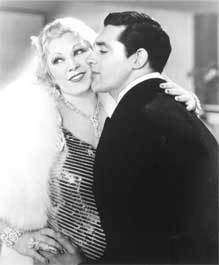
To counter our chill with a laugh (and a hug?), Film Forum has programmed the Breadlines and Champagne series, a month-long celebration of Great Depression cinema. The fun begins this weekend with an opening night screening of Wesley Ruggles' 1933 film, I'm No Angel, which stars Mae West and Cary Grant and costs a mere 35 cents (or a quarter for members). The weekend continues with two Franks: Borzage's Hooverville classic, Man's Castle, and Capra's punchy American Madness. I was lucky enough to catch a screening of the new print of the Borzage and wrote up some quick thoughts for The Auteurs' Notebook, which you will be able to read shortly in that webspace by clicking here. The short of it goes something like this: Borzage smears the frame with light to point beyond it, back at the world, and beyond that, too, to the skies we see and seek, where we are free to dream and project our wishes. (Shhh: at bottom, the film is interested in the freedom the cinema can offer, the uplift possible, and our capacities as agents even in the dark!)

But don't stop there. Scroll down that page and you'll see all kinds of fun double bills, all at a 2-for-1 discount, including one helluva Valentine's Day, programmed by Bruce Goldstein to pair My Man Godfrey (service would save the day, wouldn't it) with Easy Living (perhaps most famous now for its early Sturges screenplay). If that kind of night out (complimented by a meal and drinks, if not flowers, I trust) does not warm the soul, I cannot imagine what will. Of course, two days earlier there's a new print of Young Mister Lincoln screening with The Tall Target, if your soul needs that kind of uplift. Night Nurse plays Feb 17, Hawks' Scarface on the 21st and King Kong helps close the month before five more double bills to start March. I'm going to try to enjoy as many as my meager wallet and my stuffed social calendar will allow. (And if that's not enough for you, there's something called The Human Condition coming back by popular demand April 8th. That one might tell you some things.) [x-posted at the curator corner]

stop. think about it.

UPDATE: My piece on Man's Castle is available over here, and I've left a comment below the "essay" that furthers my thought a bit, or questions what I've written, in an inviting way (I hope).

UPDATE THE SECOND: My first piece published at SpoutBlog can be found through this link. It's called "Valentine's and Breadlines: Love in the Depression" and it concerns a few of the romantic comedies I've seen in the past week at the Film Forum. Please, read it. Please, tell me things. Please, enjoy your Saturday.

Friday, February 06, 2009

Saturday School: The Class Structure, or, Procedures of Breaking Down.

by Mark Haslam


class

It's strange—yet strangely on—to call Laurence Cantet's Entre les murs (The Class) a procedural. Strange mostly because it envisions teaching as improvisation, as precisely those moments when structure and procudure break down. Here, at communication's end, communication can (it hopes) begin.

...

We enter the class through its teacher, François Marin (played by François Bégaudeau, who lived and wrote the book on which the film is based). The camera follows him into the school, maneuvering the halls, picking up movement as profs set up their classrooms: one body bumps into another, darts through a doorway; a table is hoisted up and out of a room. It's exciting, excited, and anticipatory. Of course, much of this has to do with the fact that the kids've yet to arrive.

With the ringing of the first bell, movement/expectation shifts—to the students, yes, but, more importantly (and we can also say, as a result)—to language. The film is constructed around language and its potential to be played. So it's only fitting that the class we attend is a French class. Here, as in our English classes in America, kids are tought to deal with 'proper' language 'properly'. This, as an initial situation, results in tension—a tension immanent to power structures, where the idea of there being a way comes up against multiple, other ways. In The Class, in any class, really, the struggle which emerges from this tension is linguistic. (When Cantet, in an interview with Phillipe Mangeot, refers to a particular “scene where [François] answers that the difference between written and spoken language is a question of intuition,” we should perhaps hear the final word also as institution.) When M. Marin first introduces himself to the class, for example, the students instantly set to punning off of his name, beginning the language game that propells the film.

The teacher, however, plays the game with a disadvantage. He's isolated: spatially, for one—which allows, here, an occassional note to be passed, there, a stifled snicker, whisper, etc.—and second, bound by institution, socially—the constant evolution of language results in “lacunae,” as Bégaudeau calls them, ever opening between student and teacher. Yet François does not take the institution's approach to the emergence of these lacunae. He neither quells nor ignores them as threats to system, but recognizes, pursues, and actively engages their emergence.

Teaching is a navigation of the lacunae and the two bordering spaces. The pursuit of gaps in light of system's failure.

...

A scene's inception: a lesson plan, a question.

raise'm

Follow the gazes: they cross, but don't ever really meet; they branch (but from where?). There's something chaotic about their pattern, as lines in a Bunimovich Stadium. “[A] school is sometimes very chaotic,” Cantet notes, “useless to cover its face, there are moments of discouragement but also moments of grace, immense happiness. And from this great chaos, a lot of intelligence can be born.” Existing between the walls, a bounce and redirection occurs over and again. The lesson plan proposes a direction. Its desire is to impart direction itself. Each gaze, in turn, proposes its own direction, or rather, holds the potential for a shift. With a question, the potential is realized; chaos emerges in/as language.

Cantet's process mirrors these gazes: “...what we planned to do would require three cameras: a first, always on the teacher; a second, on the student at the center of the scene, and a third prepared for digressions....”

raise'm

Each camera, which together compose The Camera, entail both a structure and its unraveling. One eye trained on matters at hand; the other, rolling and wandering as if of glass. Entre les murs builds itself out of its own disregard. Through these cameras, seeing becomes a component of chaos, but also forms chaos into a pattern. When François pursues the students tangents and diversions, it's to make them no longer tangents and diversions. It's to make chaos the thing. He acknowledges a certain flow and flux within (the, this, any) class: the moments before the Big Bang, approaching phase transition, before a something emerged. The scenes that result from transitions aren't a part of any narrative, rather they're (linguistic) events. Parts composing a whole—individual acts of creation and resistance. Random, no doubt—like the appearance of language itself from sound and tone. But taken together they form, even in breaking from system, their own structure. The structure of a game, but nobody wins out. Nobody can, but nobody needs to.

...

So, yeah, structure must be set aside. Teaching must fail in order to continue. Okay. But Entre les murs isn't Dead Poets Society. Nor is it Half Nelson or Finding Forester or whatever. It doesn't want anything to do with life lessons and breaking from tradition and inspiring those poor, underpriveledged kids. Every moment of success is followed by a moment of failure: As soon as the class's official troublemaker, Souleyman, displays a moment of brilliance, or at least a moment of hope...a different incident leads to expulsion proceedings. Teaching's limits frame each image—are, in fact, often conflated with its successes. The film doesn't demystify the profession; it just approaches it without illusions. It documents, in other words. Here, finally, we see it as a procedural. A real desire to show everything about teaching emerges at the center. And though words like “real” or “accurate” may cause some cheeks to blush, I want to use them.

But, then, the reality of a school is performance. To be a teacher, to be a student (in middle-school, no less, where masks are the most colorful and the most varied) is to act. So, really, it's not hard to believe that the teachers and students in the film aren't actors, but are teachers and students—mostly because, well, they're so believable. Improvisation is what their stations already require of them. The film's desire to document, to unfold procedures, reveals this theater. School, sure, but more: “a sounding board, a microcosm of the world...”

...

The film ends with images of the empty classroom. Sounds from outside, where life continues to an impossible order, sift through the windows. Desks remain, but disarrayed—remnants of chaos in pieces of institution. And the cameras which documented the students? The year's procedures and performances having ended, they're just rolling. Or are they waiting? Is this perhaps not a winding down, but a gearing up again? The shouts and screams coming in from beyond are language before language, and so the potential remains between the walls—a space neither in nor out, but within the gaps that emerge between here and there, where chaos, which is seeing, becomes the lesson.

This is where learning happens.

acknowledgment

[The Class opened at The Smith Rafael yesterday after limited runs in New York and Los Angeles. Sony plans to roll out the film further as it has been nominated for Best Foreign Film in this year's Oscars. Check your local listings. Learn something.]

Saturday, January 31, 2009

Quick Plug: Medicine for Melancholy

by Ryland Walker Knight


witnessing

Last Thursday I had the pleasure, first, to finally see Barry Jenkins' debut feature, Medicine for Melancholy, and, second, to meet Barry briefly alongside the film's star (also a Daily Show correspondent), Wyatt Cenac. They proved as affable as their film and it came as no shock that Barry named three lady filmmakers as his favorites, whose influence one can trace in his work: VINYL-favorites Claire Denis and Lynne Ramsay as well as another we here would like to know more about (that is, we would like to see something), but have not yet encountered, Lucrecia Martel. And while I've not seen a Martel film, if pressed I would say that what ties these three filmmakers is their interest in the cinema of sensations, or impressions, built from oblique (yet discrete) moments. There is a delicious passage in Medicine for Melancholy where our leads, Cenac's Micah and Tracey Heggins' Jo, jump aboard a carrousel that can easily be seen (for all its yummy and tender singularity) as bearing a certain tradition's stamp. However, this film's image, made with digital cameras fronted by "old" SLR lenses and pushed in post towards a sepia hue, tends to bleed light in a way more akin to what Jia Zhang-Ke and Yu Lik-wai capture with their kino-eyes. And, like Jia's films, Barry's is definitely about witnessing a space (here San Francisco instead of, say, the World Park) and how its angles and complexities play out in both the private and public spheres, and what's available in both those arenas. Medicine builds into this project an often-angry portrait of how unwelcoming the upper-middle-class skew of San Francisco's demographic can be to its marginal residents, and specifically how one young black guy can't shake his anxieties during what has to be one of the most blissfully ignorant 24 hours of his young life.

tender

It's a love story, see? Only, not so much one of those everlasting kind of things. More like one of those, "This is a one night stand," she says, kind of things. It's about naive assumptions, about willful ignorance to look beyond your lap, about youthful indiscretions many of us have indulged for better or (more likely) worse. It's a really lovely thing to watch. Especially since its vision of young San Francisco is shockingly similar to the one I recently left behind. For instance, Micah and Jo go dancing at the Knockout where we see the guys behind Elbo Room's Saturday Soul Night spinning 45's. (For the record: Barry confirmed in the post-screening Q'n'A that these dudes were spinning their usuals but for the sake of consistency he scored the dancing to "indie stuff"...)

The film opened yesterday at the IFC Center here in NYC with plans to roll out across the country, which you can check up with at this website. So go see it. It may not be earth-shattering but it's easily a lovely, thorny letter to a city I miss and a lot of its often-annoying problems, including but not limited to the consistent shunting of any people of color. I'd love to say more, and dig in, but plenty have already so for more reviews, consult the guru Hudson right here. I just felt good that night so, well, I thought I'd repay the favor and say, Thanks, one more time. I hope all you VINYL readers in the Bay who have yet to see the film (that is, I know Michael was hip before us all) will track it down. I'd love to hear what you have to say. If anything, it'll make you smile with pride that Micha's right: San Francisco is beautiful, and you shouldn't (in fact you do not) have to have money to enjoy that. Here's the tasty trailer:

Wednesday, January 07, 2009

Two thousand weight #7: More reminiscence, more lessons, more laughs. A big leap.

by Ryland Walker Knight


comb snow!
making beds

A bizarre year full of bizarre films and worse turns outside the cinematheque, my 2008 saw our flux drift down into waste for far too long, with far too much fear, before our fall season reminded that we may find flight possible (again) as we recycle another calendar set and cabinet. Events and actions have a history before they happen—and accountability is tricky.

Scoot on over to The House Next Door [click text above] to read my final words on my past year with films. Since I already skimmed the surface, sorta, with my Auteurs' poll (here), I tried to delve a little deeper and offer something a little more, hmn, investigative of my self in this companion piece since, when it comes down to it, as much as we argue for lasting worth in these arbitrary markers, our efforts are perhaps more akin to lock-box diary notes than sea scrolls. Let's push forward with a smile. Let's build homes. Let's love this muck. Let's find facts. Let's get big. Fuggit: let's lift-off.

period
saber sun

Saturday, January 03, 2009

VINYL IS PODCAST #10: An unfocused invitation to holler on criteria. [In two parts]

by Dan Callahan, Ryland Walker Knight, Kevin B Lee, and Keith Uhlich


approaching
[PART ONE]


[Podomatic stream]
[Direct audio download]
[iTunes subscription available]
[Simple syndication subscription]


an experiment in language
[PART TWO]


[Podomatic stream]
[Direct audio download]
[iTunes subscription available]
[Simple syndication subscription]

RWK here. For our first East Coast podcast, I was joined by some of my best friends in this (surprisingly little, and ever tight-knit) critical community that I'm jumping into to talk about, as I thought only natural, our criteria for judgment and evaluation. My initial plan was to ask these gentlemen to provide a brief historical account of how their individual criteria developed to our current conversation and how they navigate the distinction between taste and value in their work. This aim was lead astray. This is a good thing. We four wound up talking around this question, or prompt, and, I hope, answered it in another (that is, less explicit) fashion. The curious listener will find how each of our spoken words signals an evaluation as much as these written words forever perform value judgments. It's all about language, always, it appears—and how we develop different vocabularies for different registers of conversation. These are the things I like to think about. So this was fun for me, even though I talk the least among our party (which is a first, I think, for this podcast). I'm continually more interested in how we think about things rather than why, because the former subtends the latter in a subtle way. The problem, then, as ever, is how to account for that, for everything, and how to argue for your favorites as much as revere them (or the opposite). And I think we do a pretty good job here. Please, tell us things. —Thanks for listening!

multiplicity!

Friday, January 02, 2009

There is only this. A new New World.

by Ryland Walker Knight


solitary

Oh hai, 2009! Thank you, you! I'm more than pleased to offer my first bit of writing of 2009 over at The House Next Door, which operates as an anniversary marker for the site as well as, as ever, an inauguration for our new year. Having just moved to New York City this week, first to the couch at Keith's lovely Slope apartment, the ever hospitable Mr Uhlich and I sat down December 31st and, after watching the Extended Cut of Terrence Malick's masterpiece, The New World, we recorded a podcast. It took us a couple daze to piece together our accompanying words with some handsome stills and arrange it all for you—and now it's ready. You can take in our efforts by clicking this link here if you did not follow the link above. There's plenty more to say, of course, and we look forward to hearing from you all, but for now I'll reiterate myself yet again and say, "Thanks," to Keith and to Matt and to everybody who takes the time to read (however thoughtfully or not) whatever it is I find time to write. Here's to more of this good thing now and further into our future.

a shroom

[An accompanying image essay can be found, and enjoyed, on VINYL IS IMAGES.]

Sunday, December 14, 2008

A Christmas Tale. A house is an outfit. [part one]

by Ryland Walker Knight


touch that sky

Weird: the title of my recent essay about a (possible) Desplechin double bill almost describes this new film. Except, of course, that this house, if it is baggy, is the kind of baggy you see a big man wearing; the kind that you can tell is full of body, full of flesh and torsion and not-quite hidden (not even silent) liquids. The house is the thing in A Christmas Tale, which, in a way, operates as a sequel to La Vie Des Morts, as it was shot in the same house in the same Northern cold in the same giveaway sumptuousness. Were my memory more reliable I might could say something else about the divergences but (suffice to say?) for now, at the least, I can offer that the maximal new film fulfills the precipitate preview-promise of the debut: there will be drama. And—hey, get this!—blood! The focus on blood here is, let's be real, a bald-faced joke. But it's the kind of joke that hides behind the joke that masks another joke; jokes everywhere, always, going in every direction, just like this narrative (if we want to call it that), just like this family sprawls, just like this house opens its hiding places and unmasks the world.

The house is the cinema, too, we gather. It holds histories and stages opportunities for new life, and new love, all kinds of desires and passions. Desplechin's cinema revels in these possibilities. Hoberman writes: "Expansive but cozy, convoluted yet circular, at once avant and retro, and contradictory down to its last scene, the movie ends with a new myth—if not a new cosmology—articulated by the writer Elizabeth." It's easy to point to the quotes in a Desplechin film (they abound) but it's often harder to secure their significance, much less their relevance, in tidy equations; his constellation of associations splays. The most pronounced quotations in A Christmas Tale (amidst the swirl of Funny Face and The Ten Commandments, Cecil Taylor and beat juggling, Emerson, Vertigo and Bergman; hell, Woody Allen and Wes Anderson) are, as is fitting, from two masters of the reversal: the opening of Nietzsche's On The Genealogy of Morals and multiple scenes and motifs and themes from Shakespeare's A Midsummer Night's Dream and an "of course!" nod to A Winter's Tale. This cosmology Hoberman hints at—I cannot but spoil his delicious hints—is Elizabeth's appropriation of Puck's final address in her own final address (via voiceover crossing into diegetic speech, "la parole" as she would say) that reminds us, yes, tomorrow is another day in the world of our choosing. Of course, although some try and some do succeed (adoption), on a basic level it remains unavoidable that we do not choose our family. We build the house about the family and we foster it, nurture it, as best we may in those walls; but we cannot renege our stock in the world. Or, that aim goes nowhere, gets nowhere. And there's nowhere but here.

touch this fire

Committed to contradiction as a form of life as much as a form of cinema (isn't the cinema a form of life?), Desplechin's films are often rightly described as "too much" but I'd like to claim that not as a derision; I'd rather say that most other films are "too little." Of course, don't get me wrong, I dig purity, too: Bresson is, is, like, totally—are you kidding me? And yet, I've always been attracted to the baroque, the proliferating and the layering of the image-and-sound. And, of course—are you kidding me?—Bresson is a king of layering sensations; but austerity is after a different endgame. Maybe that's just it: there's no endgame with Desplechin. Films end but, like all great storytellers, it's easy—hell, it's desirable, luxurious, seductive—to imagine the characters living forward, finding the world and building it again every day. I saw A Christmas Tale twice in two days. The first experience was dictated by my fatigue: lots of silent smiling tears. The second was directed by my exuberant enjoyment: a serious front-row grin. We contain multitudes, right?

Gushing on the phone, I told my friend, "It's a reminder that you can make art about yourself and not be an asshole." What I forgot to add is that, well, even if you are an asshole (it seems pretty unavoidable given enough time), you can aim for grace with the right kind of joke. But then we remember that, no matter how sumptuous the right kind of laugh can feel across our bodies, some jokes hurt. What separates A Christmas Tale from its decidedly more affable cousins, Kings and Queen and My Sex Life... (if not exactly reaching Esther Kahn), is the frightfully simple-looking plait of melodrama and comedy Desplechin mounts here. It's a film of reversals but it's not about simultaneity. It's this and that but those things are neither here nor there nor everywhere but anywhere what so ever as long as its bonds are not severed; the ties do bind; celluloid remains a strip; for all the cubist fades, this is not a film as network; I'm afraid to see Desplechin's digital brain if only because I adore this emulsion and this bleeding so; strands bounce against and into one another but the limits reign in the will to sovereignty. Indeed: as soon as Matthieu Amalric's typically dervish Henri climbs out a window and down the side of the house, he re-enters through the back door—only to leave through the front—we might say, through the mouth—to attend midnight mass with his mother, Junon (the rather-perfect, still-vibrant Catherine Deneuve), whom he hours before called "Le Con Capitain."

touch her body
touch his body

—And I think, "masculine?"

Wednesday, December 03, 2008

Natural is not in it: White Dog

by Ryland Walker Knight


who the FUCK spilled the ketchup?
[I've been having internet problems of late so this link-through is late, but, well, here we go...]


Sam Fuller's final Hollywood film is so not Hollywood all we can do is say, "Thanks." We have it here, now, in a beautiful new DVD, which I've looked at and then said a few things about over at The Auteurs Notebook. I didn't quite get to everything the movie made me think about, but I think some of the ideas about the phenomenological significance of the close up might be visible to the curious reader. In case that strain of argument is, in fact, buried deep: it's an immediate encounter we viewers cannot ignore, and Fuller never lets us forget this because these close ups often emerge after a zoom (as punctuation, as affective signpost) or a smash cut; the film is unabashedly directing your gaze; but there's nothing maudlin about this man's tears below. All that sentimentality is side-stepped by virtue of Fuller's low angle and looking up kino-eye and Ennio Morricone's meandering ivories and the utter gravity of something so absurd it has to be real; something like, you know, race hate. So if you didn't click that link up there click this one here and when you're done there, or in lieu of that, you might like to look at the images all in a stream-of-argument that says something else with the same materials.

dont go chasin waterfalls

Monday, November 17, 2008

A matter of scale and color: Lola Montes

by Ryland Walker Knight


talkin spectacular blues

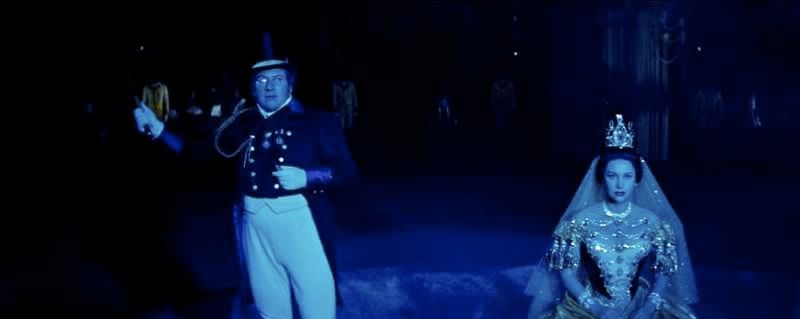
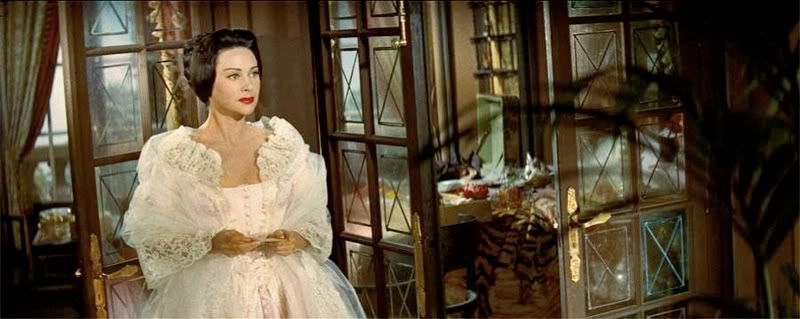
Max Ophuls' final film, the legendary Lola Montes, will grace Bay Area screens starting November 19th: at San Francisco's Castro Theatre, at San Rafael's Smith Rafael and at Berkeley's Rialto Elmwood. I saw it at the Castro. I cannot stress the importance of size enough. On such a grand scale as the Castro offers, all those screens Ophuls shoots through—like curtains, gates, stove pipes—become supple folds in the conjunction of space; his cinema of things is too full to be seen small. Another thought: I couldn't quite shake how much Paul Thomas Anderson seems to inherit from Ophuls' roving, snaking camera that hovers through life's stages. Also, color. Lots of lots of color—as punctuation, as affect, as paint in the image, as a reminder (at every moment) that your eyes are being directed. This issue seems crucial, and unexplored in any explicit terms in my piece, which can be found at The Auteurs' Notebook. I trust some morsels will shine through my hi-jinks.

style and grace, scandal
what a bust
[Martine Carol was teh hottness. Bonus!]

Friday, November 07, 2008

Baggy like a house, and running away. Playing catch-up with Arnaud Desplechin’s My Sex Life... and Kings and Queen.

By Ryland Walker Knight


ma vie sexuellerois et reine

NOTE, 9/24/2011: I decided to repost this in its entirety here because the formatting on the new Slant-housed HND post is all screwy. I trust Keith won't mind.

I am not alone, I am certain, in coming late to the Arnaud Desplechin party poised to jump off this winter. His latest film, A Christmas Tale, already garnered plenty of accolades from those lucky enough to see it at Cannes and/or the NYFF (two takes I dig: GK's gushing and MK's lucidity). It played in San Francisco last month, too, at the Clay, as centerpiece of the San Francisco Film Society’s inaugural French Cinema Now program (dig MG's interview, too). I missed it, on purpose—I was watching Jia Zhang-Ke’s The World across the Bay—because I knew it would be released soon, and would probably be a big deal. Looks like the case; the snowball is gathering speed and size. This election week saw not just something righteous for our country but also, on a decidedly smaller scale (like, minuscule, dude), the start of IFC Center’s current Desplechin retrospective, Every Minute, Four Ideas, as a build-up to next Friday’s New York release of A Christmas Tale. Lucky for me, I got to see two of the other Desplechin films shown at the Clay: his rare debut, the deliciously abrupt La vie des morts (more Maya), and his calling card, perhaps, My Sex Life… or how I got into an argument. Since then I’ve revisited My Sex Life, on Fox Lorber’s abominable DVD release, as well as his 2004 freight-train Kings and Queen. Smart cinephiles that they are over there, the IFC Center has programmed both of these for this weekend, including the possibility of one rich, long, seductive, dark-all-day double bill on Sunday.

Early in My Sex Life, Mathieu Amalric’s Paul Dedalus talks with his cousin, Bob (Thibault de Montalembert can grin), about Bob’s new girlfriend, Patricia (Chiara Mastrionni may be more irresistible than her mom)—specifically about how great her ass looks—and Bob asks Paul to be more inspiring, to quote someone. Paul counters with Kierkegaard: “Is there anything more sparkling, more dizzying than the possible?” It’s easy to see Desplechin in this madness: his films are giddy with cinema, brimming past the point you think they should reach for only to delight you with more, more possibilities and more actual delights, more concrete details to complete the picture. Like Truffaut, whom he acknowledges as monumental and inspirational, Desplechin makes films that look simple at first but (pace Kent Jones) take on a protean charge, eager to move into something new, to grab hold of a moment, if briefly, before rushing forward. My Sex Life... is nearly three hours long but it never flags; it pauses, it fades, but it never halts; it asks to be followed; and it’s so goddamned endearing, so charming, that it would be foolish to resist. Or, that’s how I feel. See, it’s hard for me to separate myself from Desplechin’s films. They invite the viewer, much like Truffaut, very much unlike Godard or Rivette, yet it’s not simple and naïve assimilation. Of course, it’s easy to weep looking at a mirror, and I have, but, for every reflection, Desplechin offers at least three more angles on any given scene-space. It’s that maxim the IFC Center has appropriated, which Desplechin initially appropriated from a letter Truffaut wrote to Jean Gruault, screenwriter of L’enfant sauvage: every minute, four ideas. What makes Desplechin so vibrant (yes, violent, too) is his commitment to the speed of this creed within a grand architecture of cinema.

My Sex Life... should promise, mathematically at least, 688 ideas; I did not count, but it feels like there are more. That’s a lot to contend with, and it’s easier in the watching than in this writing, which is funny because Paul, our ostensible hero, opens the picture sleepwalking, refusing to finish his doctorate, refusing to write, because, well, just because: because it’s tough work. It’s easier to wallow in pretension and hurt than it is to do things. (And, as Stuart Klawans argues, Desplechin is perhaps the most Jewish non-Jew in cinema—and isn’t Judaism a religion of faith in action? —I realize many devotions may argue this point in their favor but it seems inherently Jewish to me; it’s not Kierkegaard’s possible but rather akin to Nietzsche’s allegiance to creativity. This much is true and open to be countered: I have not seen Esther Kahn yet. I do not have the full picture of this argument as does Klawans. But I want to, yes, I want to, as ever, to see more—I’m greedy like that—to grab and digest more, and more. I hear myself in the Kierkegaard as much as in the Nietzsche. I hear and see myself, all too much, all too often, all too human to ignore it, in these Desplechin films.) But, of course, despite its cast of academic types, My Sex Life... isn’t about the ivory columbarium; while he does spout off at length, mostly about pussy, we never see or hear any of the work Paul does; the closest is his late rant that culminates: “It’s not Heidegger climbing some fucking mountain. No, it’s the girl’s face, it’s your fear, as you pull back the elastic, her belly … you see?” If the film is about academia, it understands such a life as a kind of death—as something to shuck, to shake free from, to flee. It’s right there in the title: it’s a film about life, about sex, about me! See? It’s an invitation to look back at your self! It’s no different than any other work of art!

About two-thirds through the picture, we take up the thread of Paul’s put-upon long-time (ex-)lover, Esther, played with fierce liveliness (loveliness!) by Emmanuelle Devos, whom, despite no marital bond, I like to see as Desplechin’s Gena Rowlands. As much as Mathieu Amalric’s goofy grin buoys and motivates this film, Devos anchors its pathos. It was during her direct address speech that I finally began to let the weight of it all fall onto me, curled alone in that fourth-row seat—that I first began to cry—through a smile. The first time I saw the film, it started at noon on a Saturday at the Clay, smack atop Pacific Heights in San Francisco, and I did not know the Blue Angels would be performing patterns in the sky above the city that afternoon. Roughly the moment Esther began reciting her letter, so did the roars of jets leak into the auditorium, and I thought, “Brilliant! It’s a film about love as a flight as much as a fight after all!” The fact that the planes did not cease their aural (and aerial) contortions through the remainder of the film made me question this argument, naturally, but it was too delicious a strand to let loose. It makes sense, after all, however the happenstance played. Love is a flight from the real, or reason at that, into clouds of stupidity and luxurious hurt. It makes the pained descent dig deeper, of course—that return to the ordinary—but, we begin to realize, as does Esther in that shower near the close of the film, that the daily muck makes sense, too, and affords us the next opportunity to fly—a new possibility is forged. Flight remains a thrill and tears are a form of baptism. The world beckons.

Devos and Amalric appear in relationship, again, in Kings and Queen, only further removed. It’s nice and fun to play the cinephilic game and imagine these characters, Nora and Ismaël, as extensions of Esther and Paul, but the fact remains that they feel lively and real, here, and all their own and all too human because Desplechin is so interested in their singularity—and because these are two enormously talented actors. The biggest difference is simple: Devos and Amalric are older, and they bare (and bear) their lives all the more in their gait and their lines and their faces. If we can accept that Devos is a French Gena, then perhaps we can agree that Amalric is some kind of Frog Faulk; but, if Kings and Queen resembles any Cassavetes, it resembles Love Streams, which pits husband John against wife Gena as brother and sister leading a twinned, braided life negotiating how to love one another. At one point, Nora says of Ismaël, “If I’d had a brother, I’d have wanted one like him.” We might say Kings and Queen is about the love available (yes: possible) in a family—and what makes family, where you draw the line. We might also say this later picture is an inverse of the earlier in that My Sex Life details Amalric’s Paul’s love of three different women (all some kind of “wife”) while Kings and Queen muscles through Devos’ Nora’s love of four men (all some kind of “husband,” even her son). Formally, too, they diverge: My Sex Life... operates on a logic of occlusion and expulsion, the frame crowded and held—until the tears and the blood and a shower rain down; Kings and Queen, despite a continued affinity for long lenses and their resultant density, jumps through spaces, cuts frequently, feels more frantic, violent, locomotive. We might say, finally, that Kings and Queen is (like My Sex Life…, I suppose) about what it takes to get mobile in the world—and Desplechin’s continued answer may remain magnanimity.

—Did I mention these films are hilarious? Nora’s half of Kings and Queen is melodramatic, very heavy, full of tears and harsh lessons, full of shouting, full of death, but Ismaël’s half is, in Desplechin’s words, “a burlesque comedy.” Being a smart guy, he’s spot on. The irony is startling, lucid, simple: for all Nora’s mobility and affluence and lightness, it's Ismaël who finds joy in the routine—in captivity, no less—despite being a mopey goof whose posture is so aching, so desirous of Real Life—while it keeps happening Right In Front Of Him. Like, you know, that beautiful and desperate young thing, Arielle (Magali Woch might melt in your hand, not your mouth), whose answer-made-flesh seems too easy to be true at first. Their offhand non-courtship is one of the loveliest and silliest I’ve seen; again, I couldn’t resist its charms. And, again, Amalric’s echo de moi-même (most notably in sessions with his voluminous, infamous psychiatrist, Dr. Devereux, played with great wit by Elsa Wolliaston) makes me wince and aspire in equal measure towards something new and thoughtful. In short, in their hilarity, Desplechin’s films stage, say perform, a moral posture (which subtends invitation and challenge) that echoes (again) Nietzsche, and his forebear Emerson, that argues for gaiety as a form of seriousness. But this is never easy, of course; nor is it quite attainable; it’s something to seek. For Ismaël, this adventure is fraught with a net of troubles of his own creation that, like a cape, he must simply untie and fling off. For Nora, it’s a bit more complicated: she has to kill. This picture of womanhood, however generous, is where you know a man made these films; but, as Ismaël says, in what will prove out (I'm fairly certain) as one of the great film monologues, to Nora’s son, Elias (Valentin Lelong is too cute), “that’s not a failing, that’s a quality.” What’s lovely is that the films know this, too, and, it’s true, they are unabashed: they seem to get off on it.

Cotillard's neck

But a yummy montage of Marion Cotillard dancing in her panties isn’t strictly about the pleasure of looking at her, at the curve of her neck as much as the curve of her breasts or the light in her eyes; no, it’s just as much about how easy (how dumb) it is to fall into thoughtless love with a girl just because you like the way she bounces. She remains a human, impervious and strong, with the force to bowl you over, by virtue of the film’s interest in how fleeting this sight is, despite its lingering imprint. Nakedness is a fact, like rain. When Marianne Denicourt sits naked at the close of My Sex Life..., echoing Cotillard like she echoes her own nudity earlier in the picture, it’s not about turning us on (however much such a sight will titillate us heterosexual males) but rather about impressing us that, yes, we spend some time naked. We play naked. Nakedness is readiness, an acceptance, and shared with another body it's an agreement as much as a delight. (This is, of course, a different picture of nakedness than that of Jean Eustache, but I'll save that argument for later.) It makes sense that My Sex Life... opens with Paul's literal awakening and closes with its deferred significance at bedtime, highlighted by a memory of a game played on the floor, looking down at pieces asking to be picked up with care (I'm talkin' Pixie Stix here), while Denicourt hugs herself across the chest.

I once wrote a free-associative essay for a zine called “Baggy Like A House.” I don’t remember the essay any longer, nor do I possess a copy, but I remember that phrase because it was directed, in the essay, at the reader, and I’d like to rewrite it, say revise it, for you who are here: you hang baggy like a house about me, and I keep running after you just as you keep running after me. I have only offered a few ideas, four maybe, for all the time you've spent reading, so please go soak up some more in that theater if you can. If you’re in New York, do yourself a favor and spend this rainy weekend with some fun frogs trying out life, seeing if it fits, and shucking sheaths as they please, as they run towards the door, towards the clouds, towards some kind of love, some kind of naked, some kind of possible, some kind of life.

Denicourt's nakedness