Viewing Log #81: Dogtooth [Giorgos Lanthimos, 2009]
by Ryland Walker Knight
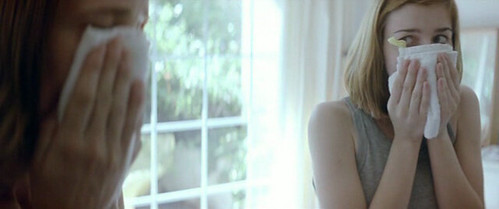
—The only audience for philosophy is the one performing it.
One of those ugly films that looks beautiful, Dogtooth a trouble maker. That is, it's difficult. Abusive and about abuse, controlling and about control, and all kinds of weird in the sexual arena save the hilarious swap of meanings where, at this compound's dinner table, "pussy" means "lightbulb" and, in the bedroom, a lady calls her vagina a keyboard. (My not wanting to use "pussy" twice is another odd linguistic/cultural impulse worth looking into another time.) The film starts with a lesson in words, in fact, with a tape recording made by the mother defining new meanings for words anybody "with language" should already know; so from the start we've got a film about education awry. But this picture of children finding meanings for themselves within a totalizing system they cannot control isn't just an unlearning, nor some new light shone, but a more basic urge—I want to say compulsion—in the human to sublimate one's every day. It just takes more drastic actions, with greater consequences, when one's every day is defined in terms that are outright wrong, plainly false. The exciting thing is Dogtooth doesn't try to redefine the terms for you; the troubling thing is it doesn't exactly open the world.
Such is the risk of the metaphysical, I suppose: languages make the everyday in concrete actions every day. The best way I can describe what I'm failing to say here, because I want these posts to be as quick and dirty as possible, is, and this is a huge idea to toss off in a goofy little blog post, that you learn a language by speaking it, not reading it or writing it. That old game of praxis versus theory. Which is another long-winded way of saying, inside all the gorgeous and irregular compositions in the film, there's a course-load of philosophy to elucidate for those inclined. Not being a grad student, I don't plan to go into it here. But I would gladly read certain people's papers (that ignore the qualitative aspect of criticism) on this film and its ideas. What really got my brain going, to be honest, was that the movies (both home and Hollywood) are manifestly a big part of the education herein. But we don't see the Hollywood ones (though there are grainy clips of the home videos), we see static on the TV and we see a performance, a "third-party" representation/reproduction/redescription as part of our understanding of the worlds colliding inside one tough lady's body and soul.


 Posts
Posts


