Last Lost: "Across the Sea"
by Ryland Walker Knight
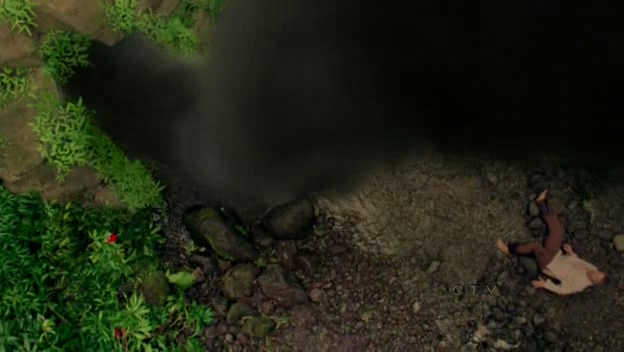
So Lost finally gives us something of a Freudian-like take on a few different histories chopped and screwed together (both biblical and classical; go on a wikipedia adventure to trace traces, maybe) and all we get, really, out of this mythology episode is the origin of the smoke monster. Granted, I really like seeing Titus Welliver and Mark Pellegrino, and their scenes are usually good, but it's mostly just dancing around ideas we already have. It's an episode to prove these writers went to college, mostly, and to keep the lid on the magic box just a little longer. That is, though we know now where these two forces (they're not really characters) came from, we aren't given any angle on the real purpose of the world surrounding them, the island.
What we do know now: That the Man in Black wants to go home because his true mom was Roman or Greek or some kind of sea-faring ancient. That Jacob was born first and that these two are in fact fraternal twins. But that this doesn't make the Man in Black any kind of inverted Esau eager to buy Jacob's birthright; in fact, he wants his own, his home. That the Man in Black killed the mom with no name, which made Jacob angry; so angry, in fact, that Jacob cast his brother into "the light" down what looks like a drain, which doused that light and gave rise to the column of clickety smoke. That it was Jacob's duty to protect this light. That, thus, Jacob failed his first day on the job. That the brothers have been playing a game of one-upsmanship since the beginning involving oppositions. That the protector of the island always sees the same cycle in part because the protector always leads the arrivals in the same direction. That people are people are evil, apparently, and prone only to corruption. That, in essence, the mom and son with no names were the original sinners and that original sin was and is a selfishness.
I'm guessing, then, that "What They Died For," will be more about these two dark forces, though it could easily be about anybody on the show that we've watched die, or it could even be more about "the light." But, to be honest, I appreciate them keeping "the light" vague. It introduces some element of faith into the show that is really about an object of faith, or makes faith directed by objects as much as by actions. Rituals matter, certainly, but that's not the aim as much as finding purpose through this devotion. That certainly seems to be Jack's "arc" so far. But faith is tricky, and Lost seems atheist, not agnostic, which leads me to worry "The End" will prove nihilistic after all. But then I remember how practically any event in Lost is milked for its sentiment and I remember my other fears that it will prove to be "humanistic" after all. That there will be a faith "in people" in the end. Of course, I'd like to believe in that. But it's only set up, here, as an end to oppositions. As if there can be a leveling (in any sense) in the end that sets things in their "right place." What I want is creation. They need to make something of this mess, not reduce it. Thankfully, though, we've seen the show's not afraid to be "unhappy" with its "resolutions" so at least we can wait for some kind of killings that matter, though that's the cynicism it seems largely unhappy with itself.



 Posts


