Showing posts with label Christopher Nolan. Show all posts

Monday, February 28, 2011

Viewing Log #75: Includes the lyrics [2/22/11 - 2/28/11]

by Ryland Walker Knight


Later Light 2

  • Born This Way music video, [Nick Knight, 2011] It's not that I feel confronted and shocked and put off like that; it's that I think it's bad pop music. Comparing it to Prince, say, does it no favors but, holy hell, this isn't even Madonna level though it's aiming for a new century "Express Yourself" and/or "Vogue" thing mixed with Gaga's brand of, um, dada sexuality. Pretty silly, me thinks, to define yourself strictly via your sexuality since we all know that's simply a reaction to some "No!" somewhere along the line despite this song posing as a "Yes!" (though the lyrics are a giveaway, too). How's that for over-thinking it, eh folks?

  • The Oscars It's dumb to complain, but, hell. As Nellie tweeted: worst company picnic ever.
  • Inception [Christopher Nolan, 2010] # I was tired and didn't want to think and it'd already been ordered on our on demand. It's still really stupid and poorly shot.

  • The Fighter [David O. Russell, 2010] # A few scenes to look at all that competition—specifically between the performance styles and what separates the, excuse me this alliteration, brilliant Bale and loathsome Leo.
  • Three Kings [David O. Russell, 1999] # Wanted to make sure of something. Didn't watch the whole thing. It's entertaining, yes. It's also the perfect movie to get obsessed with when you're 17 and you think you're smart but really you can just name effects instead of simply watching a movie.

  • Slings and Arrows First Season, episodes 4-6 [Peter Wellington, 2003] Pretty lovely little wrap up with those kids figuring it all out. Lots of good will here. That's all I got on this.

Lost Bark

Wednesday, July 28, 2010

Viewing Log #52: A Snoot's Pterygium [7/19/10 - 7/27/10]

by Ryland Walker Knight


—Not going to agree out loud

Spent last week in Vail, Colorado visiting family and generally getting zero alone time, either to read or to write, let alone movie time. However, I did manage to get my mom to watch A Christmas Tale. It took us about four sittings but we got through it all. Not sure the sharing accomplished what I wanted it to accomplish but we did wind up talking about me plenty afterwards. I don't really have much to say here about me (or that part of me), nor do I have much "critical" to offer on the subject of Desplechin that you can't read elsewhere on this blog. Some of this is bound to be projection, but it just seems like we've (A.D. and I have) got a pretty similar take on things and for that I feel grateful, flattered, confirmed and challenged, sometimes broken but even more often built up past myself towards the kind of posture with the world I always want: to want the world and to want to be in it. However, it was seeing home videos (and taking a gondola up the mountain) that really got things going upwards.

I often bristle when a camcorder's turned on me, but I also know the impulse to document, as evidenced by my Found Facts series. Readers of this blog have got to know my affinity for the documentary aspect of the image. But it's one thing to record your friend dancing with fire and then play with the images a month later; it's another altogether to see your mom 16 years in the past skiing with her sister and the two of them laughing their butts off (and, consequently, laughing your own butt off with the images). Put otherwise, you often lose the affective weight of time with most home videos. For instance, you can lose them. Or, you can watch them a week later and only a certain kind of joke (the immediate kind) hits. The power of seeing "Feb. 24, 1994" in ghost white over snow is easily bullseyed as nostalgia but there's something else at play besides a banal, wistful mnemonic moment: there's excitement. The video was hilarious, adorable. I was excited to see a different time, to see so much joy from that moment. But this is probably banal, too, and important only to me. Let me put my nostalgia and affection this way and then let's put it behind us for the time being: youth isn't (shouldn't be) restricted to the under-30 crowd.

To test your patience just a little more, I'd like to say that there are certain editing rhythms in home videos, too, that the videographer may not even realize when choosing when to hit that red button. The best running gag in the best twenty minutes of that '94 tape was seeing my mom come down hill after hill after my aunt and uncle (Dana and Guy)—who, as residents of a ski resort town, are obviously much better skiers than my mom—and hearing my mom, out of breath, say, "Guy, will you please shut that camera off?!" She says it at least eight times in those twenty minutes. Every time, "Guy, please will you turn that thing off!" Every time the question becomes less polite, more a demand, until it's a fatigued and frail (naked) little entreaty. And that section ends for good with her, ever harried and embarrassed, just able to get out, "Guy, will you—" before the screen goes blank black for a few minutes before more grainy images begin. I fell out of the couch.

There's something about that era and quality of video that degrades the world enough to create an aura. There's also the psychology involved in sitting in the same room as the subjects of the video, which involves a lot a sussing out of relationships and histories tacitly understood or not. Then, when you're confronted with yourself from another era, the whole arena shifts. Accounting for or grappling with a false mirror is kind of terrifying, though not completely if you allow yourself to see the value in that difference (see the leaps made in the interim). Yes: I saw a lot of myself on another tape, a tape labeled "Ry's 10th birthday party!" I started out embarrassed—at my high-pitched voice, at my clothes, at my chubby cheeks, etc.—but it was just as instructive as it was mortifying. In 1992, I was surprisingly devoid of neuroses. In 1992, I enjoyed the spotlight some. And, as it happens, that 1992 birthday party built to a magic show.

Magic's always appealed to me. Too clumsy to be any good at sleight of hand tricks, and too in love with mystery to let the surprise get spoiled by explanations, I still get a kick out of something I can often "out guess." Call it my openness, call it my generosity. Hell, call it my love of spectacle. I desire to be wowed. (Who doesn't?) As much as I yearn to and aim to believe in this world, I know I seek something else all too often. I rail against metaphysics, as some kind of inheritor or acolyte of Nietzsche's pledge of allegiance to immanence, but I also know that, like plenty, the metaphysical's magic is quite a magnet for my imagination. So, to see a magic show/trick is to tempt or tickle that fascination. I enjoy the "trick" element. And, this being a film blog primarily, though this viewing log isn't much of a viewing log, I'll use all that above to lead into how I think The Prestige, which I also watched in Vail, is a great film.

Now, all this lead-in is also set up for just how the film appeals to me. But I don't think I'm alone in my adoration for the apparent miracle, the making of something out of a nothing. The climax trick at my birthday was my getting cut in half. Except, of course, Magic Steve forgot his saws. Instead, he decided to slice me with ropes. That is, he lead me and 20 other people to believe that he'd get two ropes to cut through my middle after tying me in between them. I can see, now, how he staged the event to let me believe that—and I appreciate that showmanship—but I could also see the doubt in my face as much as the delight on the tape. It seemed to be a choice for me to just go with it and enjoy the catharsis. Earning that, of course, is a real art. Earning that while talking about how you are earning that is an even greater art. That's why I like the Nolan picture.

As I said in the Inception back and forth (I think there'll be a second part) from last week, The Prestige is almost a mea culpa. Nolan's almost tipping his hand, saying, here, take a look at how I play with you. It's also a proud thing, so self-assured of its skill. Most great showmen are proud. Which, of course, is the other dominant trope/topic in The Prestige: how pride eats souls. Nothing new, of course, but the lengths/depths these men go to in order to satisfy their pride is, yes, alarming. Stakes are raised and met and driven into tender places. They call this hubris, and it's often boring, but when it's tied to competition it gets interesting. Then there's Nolan's obsession with symmetry, with doubling things and people, and that's where we get into spoiler territory. Not that the big "surprise" of the film is that big of a surprise. It's the exact kind of "twist" as Shutter Island, in fact, that doesn't slap you awake but rather places a final jigsaw piece with class. As the film says, I enjoy being fooled a little bit. In a way, this is why I like the Desplechin films, too: they confirm just enough of me while leaving other parts up for analysis. What sets Desplechin apart from Nolan, however, isn't just his dialogue or his images but that he doesn't reduce things to that dialog or to one visual style. In fact, he's often (rightly) called a maximalist; he desires the world in all its capacity and sings such a song as loud and long as possible. Nolan, on the other hand, seems to take the "make order of chaos" maxim as an absolute. And any good philosopher, any good Christian, even, knows nothing's absolute. Except dying. That's an event you don't escape. But even that event's undecided, really, when you think empirically. I'd like to think there's wiggle room in a coffin for a reason.

Click through why don't you; I saw this in Harper's, which I read on the plane home
—Sure hope I didn't bore ya!

Monday, July 19, 2010

Always imagine new places. Notes on Inception [part one]

by Jennifer Stewart and Ryland Walker Knight


—Whare'd everybody go?

RY, et al:
When WB encouraged Nolan to produce Inception in 3D, he opted instead for IMAX. Nolan argued that IMAX allowed a more submersive experience than the disjointed, unfocused composition of 3D. Absurd as 3D usually is, Inception's conceit to portray permeable, multivalent dreamworlds might've been the best candidate for it. There is something eerie and wrong about clear edges and sharp detail; where putting a dream on screen reveals the same contingencies and boundaries we know from waking life. Wouldn't the stark relief of foreground and blurred background of 3D better capture the tenuous, indistinct phenomenology of dreams? As Dom (DiCaprio) is at pains to emphasize to Ariadne (Page), it is not the details of the dream that matter, but the feel.

My theatre experience of Inception was hence an appreciative, but partial submersion. The best things to say about it bespeak Nolan's strengths: it looks fantastic, and Nolan is not afraid of challenging the audience to keep up, frame by frame, or risk losing the thread that tracks how we got here. In Momento, we followed the thread backwards to see where Leonard (Guy Pearce) started, and his body bears the inscriptions to trace back our steps. Her name suggests Ariadne herself is Inception's spindle of threat, anchored securely outside before unwinding as we progress deeper and deeper into the labyrinth.

Why these heavy-handed cues, though, Nolan? Given the film's refreshing willingness to dispense with almost any Basil Exposition of how the technology in Inception's world works, I guess Nolan wanted blunt mythos more than techno-speculative theoreticals. Which is great, but so then what's the film about? Part cautionary tale (careful what you manipulate in the dreams of another, lest it come true), part Jungian safari (look, Fischer's P2 subconscious is set on Hoth!), Inception is mostly a chance to give the movie screen a sorta (not really) new kind of depth, inspired by Nolan's idea of how characters in this fictional world might manage and manipulate multilevelled dream reality. In other words, Nolan takes the idea of layers of dream reality (dreams within dreams, where time and resistance slow down exponentially as we descend), and processes it through an onscreen analogy. The analogy is that reality is always checked by the body's morphology: we're assured of coming back up through the layers, so long as we can synchronize the body's kinetic interpretation of its true environment. The body can figure out where it is, even if the mind has lost itself.

It does make for an interesting way of tethering the characters to their various avatars, fragmented through multiple virtualities. Moreover, it lets Nolan design and realize those impressive set pieces (literally) turned upside-down by what's happening in the first dream (and only sometimes by what's happening in waking life, as when Dom is plunged into the bathtub in the opening sequence). It also lets Nolan play around a little with the consequences, in psychological espionage terms, of how 2-dimensional mediums (paper or any flat surface; like, say, a movie screen) can represent 3-dimensionality, but not without accruing paradoxes. And so Arthur (Gordon-Levitt) tips his surprised pursuer off one platform of the Escher-esque staircase, revealed by a camera move to be - hey! - severed from its next segment. These tactics remind us that Inception's frames are all heist genre, right down to the usual dramatic tragedy of the lead character's superlative penchant for deceiving and stealing from others explained by - that's right - his own experience of guilt, loss, and betrayal. Ry is right on that this is geometry morseso than architecture, for we're dealing with the aporias of using 2-dimensional vantage points on 3-dimensional worlds. The problem of what's concealed and revealed how the subconscious interprets and exploits this unstable world, is Nolan's own infectious idea.

That he used this idea to stage a heist genre film is kinda interesting, but unless you find these picture/dreamwork puzzles engaging enough, the film is unsurprisingly generic. The dramatic structure follows Nolan's 2008 blockbuster The Dark Knight, in terms of when and how the real film's peril and threat dawn. In TDK, Nolan designed a gothic urban landscape, reaching a boiling point with the affects of entropic forces. The Joker's maniacal psychopathology twisted Harvey Dent's commitment to procedural justice, producing Two-Face's appetite for impartial, brutal chance. That film got to me, because I felt the peril of its threat to undermine - for real - the faith in the coherency of justice and political right (already shaky, but we avoid worrying about it). I loved that Nolan gave me that experience, and missed it in Inception. Dom (maybe more Wantanabe's Saito) losing himself forever on the shores of P3 dreamworld just didn't have the same urgency and affect, as Joker blowing up our fragile dependence on the legitimacy of political right. Even Dom imperiling the team wasn't enough, because his emotional vulnerability was too cliche. I know it was corny, but TDK scared me and convinced me that those civilians were going to blow up their inmate counterparts. Again, Nolan got me there. Whereas Inception got me to Hoth. Meh.

—JKS


—Off the rack, really?

Jen:
I'm at a disadvantage to start this thing because I simply don't value Nolan as you do. I'm afraid my replies may veer towards simple petulance without a lot of words about what it is I do like in movies as opposed to what it is I don't like in his movies in particular. So I'll just get this out of the way: Nolan's style bugs me, as it did with TDK, because it's mostly a reliance on the volume levels of Hans Zimmer's score and Final Cut's dexterity. Put otherwise, it's loud and choppy. The best shot in the entire film is the one where the camera stays rooted to a dolly track pulling back down a hallway that's getting gimbaled around to fling its action—Joseph Gordon Levitt's the only graceful actor in the piece, too, fwiw, though Tom Hardy charmed me silly—against different surfaces. Which I hope gets us to your initial query: why not 3D?

I'm with you: part of the fun of Avatar was precisely because the 3D helped the immersive feeling, and played into the conceit of putting your mind into another body. Cameron directs the eye plenty, but the depth of field in and around that neon jungle felt great. Inception, as it is, only immerses you by never stopping the soundtrack except to punctuate, making silence a clarity. Sure, the bedroom's often empty when I wake up. But, good grief, this isn't Lynch; Nolan's obsessed with score, not sound, and score's like a pointer; Lynch just drops the dread on you in bass tones; Nolan wants to control you. Yet every single one of Nolan's movies is vague enough that anybody with a hint of imagination can project just enough to fill in the picture. At least Cameron's honest about his authority/autocrat aim. Nolan's a smoke and mirrors man. He already made his thesis statement with The Prestige and it's largely successful because it's about his own methods and tactics, as close to auto-criticism as we'll get from him. That is, it's almost a mea culpa for "playing games" with his audience/s.

You'd think a movie about dreams, not magic, would be the one to offer analysis but if it does hold a mirror all it tells me is that Nolan likes guns, suits, symmetry, action movies, slow motion, the little particles (of glass or liquid, like rain) visible in slow motion, video games, 2001, Raiders, Empire (yes), talking, Michael Caine, being a dad, obvious metaphors and jejune psychology, home, being rich, and handheld cameras at all the wrong times. Can't really blame him. I like almost all those things. Hell, I enjoyed my time with Inception, which I saw in IMAX at 9:30am when I could still swallow. I didn't find it confusing, but I did find it fun to see certain stunts (all the zero-g stuff in the hotel) and I'd feel compromised if I didn't tell you that stories about guilt get at me. But effective (or overpowering) filmmaking/scoring doesn't necessarily ring synonymous with exceptional. Especially when you've got Leo doing his best to sell all of that other kind of exposition.

The most intriguing way into Inception for me is through the other Leo film from earlier this year, Shutter Island. I hadn't read the book (in part because I can't stand Lehane's idea of drama) so it was all a "surprise" (though it wasn't, either) and it all looked great in a way that no Nolan picture ever has, or will. That is, its images are better—and the images feed the other formal elements—and the score's better, too, while we're at it—and so is Leo. All of which is to say that Scorsese is a better director: he actually sets up spaces, limits, characters, and his dream sequences feel like dreams because they blend senses and burn into water through technicolor plasticity. They what? They work like dreams. They confuse but they make sense. They're part of a point of view. (The whole movie adopts Leo's fracturing, actually, which is another feather in its formal, bravura cap.) When that point of view is revealed as compromised it makes sense how it operated and the consequent scene in the lighthouse holds much more movie-movie weight (Kingsley as director/producer, movies as opportunities for emotional catharsis, movies as therapy) than anything in the dive-deep "ideas" behind/inside Inception's take on the movies. —They're all action all the time? Violence everywhere always? A trap? Even idyll? Put otherwise, what's new here? It's a film of its sources exclusively. Anonymous cityscapes still look like cityscapes and an army of snowbound soldiers just looks like a level from Goldeneye. Yet another angle, though Cairns already said it: nothing that follows tops folding Paris into a circuit of no clouds.

But I've strayed from an actual, considerate response. I've just gabbed about me. The point being, I liked this one more than the Batman movies in large part because I like the tropes more. But it still doesn't "excuse" spatial incoherence (I know that it's a dream, but this movie's not interested in representing dreams, as you pointed out) or bad writing (Nolan's brother's not the problem after all) or a propensity to drag things out well past necessary (150 minutes again?).

Tell me I'm missing something.
—Ry


—But I'm from you...

Sunday, July 18, 2010

Viewing Log #51: Vanilla and skunk [7/13/10 - 7/18/10]

by Ryland Walker Knight


Here's another quick narrative for you. Spent a lot of this last week running around town, which seems to be a common theme as I continue to move my life more and more offline, but this was just tiring. I also started a couple new books and saw my sister perform in a play (that she wrote) at Berkeley Rep (in a summer school program); she's 13, if you need to know. I also saw just the one film, the opening night film (John Ford's The Iron Horse from 1924), at the SF Silent Film Festival. This bums me out. I missed Friday because of work and the sister, and was fine with that, but Saturday got away from me and today I couldn't move I was so tired and my throat was so closed. Somewhere in there I made time for a nerdsville 9:30am matinee of Inception, but I'm going to have more to say about that in conversation with my old friend Jen Stewart shortly. (You may remember she and I traded some ideas on The Dark Knight a couple years ago here and here.) The short of it: I enjoyed myself but I don't think it's good or actually smart and, again, I don't think Nolan can direct action at all, which is surprising given his eye for symmetry (and geometry in general; though not "architecture"). In any case, stay tuned.

Earlier today, instead of seeing awesome silent movies in the best theatre I know, I drank a lot of tea and grapefruit juice while watching The Hangover a year after the fact. Zach Galifianakis is great, clearly doing his own thing, but everything else is everything I hate about dudes; what's more, everything comes from fear and/or hate. No wonder it was a hit, eh? The conceit's great, of course, but the movie has no interest in what's interesting about a hangover's lacunae. Like Nolan, actually, Todd Phillips seems to prey on those fears we harbor; except he's a literalist of a different stripe. Nolan's got a thing for writing bad dialogue the way Phillips has a thing for making women intolerable or invisible or, well, whores. Lad mags haven't failed, they've simply been turned into movies. (For that matter, as I txt'd with Danny, Inception's a GQ subscriber's wet—you guessed it—dream; that's the advertisement film, not I Am Love; but I'll table that for now).

Later, I watched The Invention of Lying and, though it's simple, I liked its fantasy. I wish there were more comedies of morals that live in the realm of the concept. You can always count on Ricky Gervais for some teetering-near-mawkish-territory sentimentality, but you can also count on him for honesty. It's not exactly great filmmaking but, as with a lot of comedies I appreciate, its spirit (its philosophy, if you must) is something I respect and admire. That is, the film's moral position (cough) is one I can get behind. However, it's pretty sad that such a thing as thoughtfulness is a rarity; I take it for granted that most thoughtfulness is stuff of stuff like, say, a book (or a "puzzle film") and not a joke. Which brings me back to Nolan, again, and one last gripe before I go to bed: dude's got no funny bone. I have no idea how to imagine how Nolan has fun. Does he play a lot of video games? Seems likely? Ad hominem what!?

Sunday, November 15, 2009

Viewing Log #20: Sporting lint [11/9/09 - 11/15/09]

by Ryland Walker Knight


Autumn's not autumnal here. #1
Autumn's not autumnal here. #2
—All things shining.

Most of the week was spent not watching movies. But, as happens with an active calendar, the wait for the weekend brought me some special sights made richer by my recess. More Resnais, mostly, but also some time for some TV comedy. If you follow me on twitter (@ryknight), you know that I watched some Curb Your Enthusiasm earlier this week, but this week's episode, seen live on the East Coast feed with Cuy, was even better. We laughed hard, we laughed a lot. I also laughed plenty during Stavinsky... [Alain Resnais, 1974] despite its melancholy and its slow downturn. I'll say more in another post. Ditto for Muriel [Resnais, 1963] and Night and Fog [Resnais, 1955], which proved a tough pair. One's a knot, the other a nightmare. You can watch the nightmare "history lesson" by clicking here. The Dark Knight [Christopher Nolan, 2008] # sure still has plenty of night time fire frights, but it's hardly as effective in the bright autumn sunshine of a lazy Sunday afternoon in San Francisco. After a stroll for some Blue Bottle, we caught the big chase, the jailbreak, the wild dog window shot, and the hospital bit; we concurred that Heath was cut, and probably due to his junky habits as much as genetics. Then we watched a couple of Party Down episodes. Not only is Lizzy Caplan too cute and Ryan Hansen a surprise scene stealer, but Steven Weber is too funny in his guest spot creeping up all creepy like with his lazy eye and pitch-perfect accent. Clearly, I've been missing out on something hilarious. Now, naturally, after a doze, I'm fading to sleep under that familiar spell of The Thin Red Line [Terrence Malick, 1998] #.


—of course a sentry

Saturday, July 26, 2008

We burned the forest down. The Dark Knight, back and forth. Part One.


money for nothing and tricks for free

[This is the first part in a rather lengthy email conversation between Jennifer Stewart and Ryland Walker Knight. For readability, the call and response pairs will be split up. I'll update each intro with links as we pump out the rest. For now, though, here we are, looking all around, trying to make some sense of that first weekend. There are
spoilers throughout. Consider yourself warned! Certain forms of hyperbole will not be tolerated in the comments thread although we are curious if you have a thoughtful response to offer in order to continue our conversation. Just, please, don't make me turn on comment moderation. Nobody wants that.]

watch it wash away

Jen --

From the top: I dig it. I don't think it's the masterpiece some have claimed, but neither would I call it a bankrupt endeavor, just complicated. As a picture of the modern city (and its consequent perils), in a time such as ours, this is probably as good as a pop artifact can get. The Dark Knight may not have Michael Mann's poetry of imbalance (an unfair comparison despite the opening heist's nod to Heat), but Christopher Nolan's nearly anonymous Gotham has all the right sheen and transparency, grime and emptiness, shadows and nightfall terrors to scare you of its dark arena of violence. It's the insistence on the city -- in swirling helicopter shots most of the time -- that makes it more than a Batman movie and less a Batman movie than before.

After all, it's the first Batman movie where Batman is just another part of the ensemble. Christian Bale may get top billing but he's by no means the star, much less that interesting (a shame). The real acting fireworks, so to speak, happen between the poles of Heath Ledger's typically hyperbolic Joker and Gary Oldman's beautifully understated Jim Gordon. Oldman's portrayal of decency grounds all the anarchic overflow of Ledger's embodied chaos.

However, all too often chaos is more a talking point than an element of the action. That's probably my biggest problem with the movie: Nolan doesn't really know how to shoot action scenes. Or, more pointedly, he doesn't shoot fight scenes well. For all the kinetic activity, those handheld close ups make these encounters less about movement than about fractured collisions that can't find a visual resolution in space. Which is a silly, hifalutin way to say, it's too often cluttered and fussy, if oddly dynamic. I'm puzzled by his close-in action mise-en-scene, and (I worry) not in a good way. That said, the film is edited pretty well and the timing on the wide shots inside action sequences is pretty spectacular. That mack truck flipping has a real weight -- which is aided by the sound design. Again, it's hard to compare him to Michael Mann, or even Paul Greengrass, but those guys are more interested in space as an arena full of possibilities and energy (something I dig); Nolan's idea of space is more pragmatic, logical, showing an interest in the where but not the how. For instance: I dig that the climactic high rise site is open and under construction, open to plain sight, as it gets at the illusion of spectacle (and how we make or account for appearance in this Gotham) once more. And I dig how the sonar plays into that, too, but all the encounters within that structure are pretty straight forward, a series of scenes of Batman deploying pawns in the way of the final showdown.

What makes the action interesting, in the end, is how Nolan gives each sequence significance before and after, pointing away from the action. (I think this is why I liked The Prestige so much: it isn't an action picture. The Prestige is about magic, about manipulation, about spectacle, about perception; and here all his editing patterns make more sense. He's forming a way of seeing there (looking for details) that doesn't quite cohere in The Dark Knight.) In the most simple sense, the context for the action in The Dark Knight is the current mood of the country: the fear of unknowable threats, of ultimatums without rules. There's a lot of easy allegories to draw. But that's all abstracted enough into ideas about chaos (those talking points) and seriousness so that I trust the film will play when the next administration's getting ushered out of office. However, all that falls to the Joker, in monologue form, which speaks to Nolan's interest in story. I think he fashions himself a storyteller more than a filmmaker; at bottom, it's how Nolan and his brother Jonathan escalate the consequences of the plot with each successive sequence that makes The Dark Knight so compelling. If ever I was to appropriate that Bordwell term, it'd be here: Nolan has mastered "intensified continuity."

Okay. On the one hand, I'm impressed you were so ready to let this film whip you around and rattle your soul. On the other, I don't think the film earns the boat scene with Tiny Lister or Walter Chaw's description of Maggie Gyllenhaal's resigned acceptance as "the single most heartbreaking moment of 2008 cinema." Further, what I find so dark is not really all the terror and wreckage throughout the film but the final lie Batman concocts under the assumption that people won't be able to withstand the morally complex truth of Harvey Dent's rather literal fall.

But this makes it sound like I only dislike the picture. And I don't. For the most part I dig it. I'm just caught up in my formal/aesthetic criteria here and not moving to how this picture, and its popularity, might be significant, if, by nature, blown way out of proportion. Maybe we can get into that a little more as we progress.

--ry

stranger

Ry,
I'm in a strange spot. I've come to the tentative conclusion that my feelings for The Dark Knight are, well, just that. They're oddly resistant to qualification, yet smolder indignantly to hostile, very well-written reviews like Adam Nayman's for Reverse Shot. Not that I'm unthankful for you sending Nayman my way. But somehow it and Dark Knight has spawned a kind of crisis for me. Either I don't know who I am as a viewer, or I don't know what matters in film criticism. So I might be asking you to guide me back to the light. But first, hear my plight.

The problem is that Dark Knight really got to me. And like, 5 movies total have ever gotten to me. One of them was last year, at the Castro Theatre's special advance screening of There Will Be Blood. Previous was David Fincher's Fight Club, which I saw opening week, in 1999's Ottawa. What they all have in common, is that I was really shaken by each of them. And it was sublime.

I knew from Ledger's first scene that DK might deliver another such catharsis. I'm speaking of an intense kind of - for lack of a better word - pleasure, and it makes most or even (*gulp*) every other film experience pale in comparison. No, I think I mean that. I love Contempt and Battle in Heaven and Gosford Park and many other films. I can still conjure Reygadas' 360 sequence shot from Battle; the tingles it and other moments in that film gave me. (Still haven't seen Silent Light....). And I don't want to mitigate what those films are to me. Yet I don't know how to compare them to Nolan's Dark Knight, because DK created moral peril which actually, really threatened me. And that was riveting. I walked out not able to think of precedents, unlike TWBB's immediate conjuring of The Shining and 2001. But, then, on my second screening, when, in the interrogation cell, Joker laughs at Batman's missive fists and desperate demands to know Harvey and Rachel's whereabouts, it came to me like lightening: Tyler Durden. Fincher's and not Mann's or Greengrass' sense of action (more on that shortly).

Unlike Nayman, I had problems with Begins and thought its sequel better realized (casting REALLY helped). I'm tempted to say Nayman's problems with DK can be explained simply as, the film wasn't what he'd decided he wanted. Yet his impressive review made me second-guess my own enjoyment of the film. Could I have been wrong somehow?

A growing problem for me with film criticism is how easily formal concerns along with a kind of privileged ethics are made exclusive and essential. For example, I want to care about your worries over how Nolan realizes action. But I mostly have a hard time following them. I do like your point that if the action is shot closed-in, then we get fractured collisions (of say, body segments) rather than framed total movements. But why is that a problem? To me this simply signals different themes and concerns - quite literally, a different perspective on the action. Does action require a total view of bodily encounters, in order to "find a resolution in space"? You said 'twas all really just complaining the actions shots were cluttered and fussy. I guess I just don't see that. Or, even granting your premise, don't see why something else would necessarily be... better, somehow? In fight sequences, Nolan's camera goes in close so that Batman can appear and disappear suddenly - the sense of his superlative movement is created by these cuts that let his outline outstep the frame, even when centered in it. Fincher liked showing us local reactions to blows, and Nolan may be after something similar, which means the total scene of bodies having room to manifest the forces both impacted and exchanged during a fight just isn't the right profile for the shots. I'm likely in over my head here, so perhaps I should just say: you seem to be assuming there's a way to shoot action scenes, and Nolan ain't done it. Help us (me) scrutinize with your eyes: Who or where does that premise come from, and why should I care about it, especially when in order to see anything amiss in the film, it seems to first need assuming?

That said, I'm happy to say I strongly agree with you that Dark Knight ain't doing anything dark through themes of chaos, and certainly not as film-noir dark as some have hastily claimed. The triumph of DK's big moment is that Joker assumed more chaos than he could engineer: people are more attuned, less individualistic, if a little less civilized (in the bad, Rousseau sense of loosing sympathetic trust) than he imagined. Chaos in the film is simply Joker's attempt to remove some of the (already perhaps flimsy) partitions supporting an ordered edifice of civil morality. (Civil morality as in the ideological commitments to the sense of fairness that underly law, the courts, and the judiciary - also, the related concepts of what one should rationally desire and fear). Joker's desire not just to lay bare but to rip down these partitions - revealing the panic-inducing expanse of amorphous, unscripted moral interpolation - is seen realized in Gotham's inner and outer design. Nothing has proper walls: Dent's office, Bruce Wayne's bunker and penthouse -- all pillars and receding perspective lines, shelves and desks with only open, surface conspicuity. Even in Lau's Hong Kong architectural marvel, the walls and drawers are glass, revealing everything and waiting to be shattered. The precariousness of moral infrastructure: you take a vote on a ferry, but ooops, this isn't enough to resolve the threat. (Wasn't democracy suppose to be our political panacea?) I guess we could call the result 'chaos,' but despite his speech to (by now) Two-Face, Joker is certainly, definitely, a planner. He is an engineer, a scientist, and he'll say what it takes to realize his experiments. Joker's response to the ferry passengers' inadvertent solution to the prisoner's dilemma (why did I have no jade and all cathartic relief at that moment? Is there something wrong with me?), is to lament that all must be done oneself. I agree with Nayman that Gotham is the anonymous hero of the film, for the film sacrifices the false stability and irrational vulnerability of electing heroes to be "the face" of, say Justice. The city needs much more than one "white knight" who is willing to let his face bear the investment of justice. One wall can't hold up an edifice. One face can't take that much.

You said Nolan may be more of a storyteller, than a film maker. Well, I like stories. I like them a lot, because they shake me and I'm not sure but that might be one awesome reason to be alive. Images shake me too, and they can tell a story with images and/or with actors. Ledger and Eckhart and Oldman and those huge empty spaces with transparent partitions, was some of the best shaking I've had.

glass between us

Monday, April 28, 2008

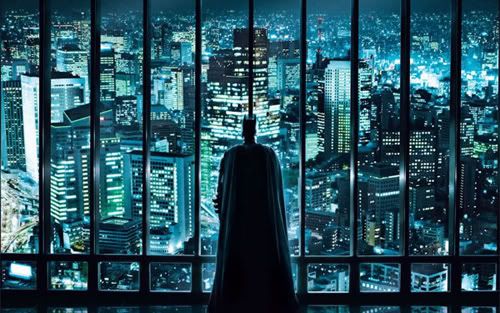
Momentary Geek-Out. The Dark Knight ad campaign returns to form.


burn

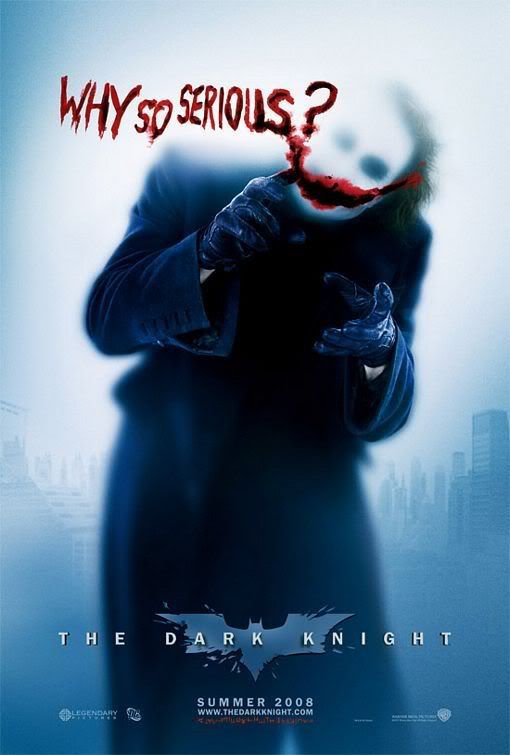
This comes via Rob Humanick, and while it certainly gets my fanboy juices flowing, it's still pretty hard to top those Joker-specific posters from a while ago (look here). But Heath Ledger's unfortunate, left-field death definitely stopped that marketing plan. How fitting is it that the new tagline is "Welcome to a world without rules"? I'm glad the print team, at least, is back to making this a supreme ad campaign (let's forget this hack-job and the worries it instills) because I have faith that this will be one pretty fucking awesome blockbuster with its questions about seriousness (what is the worth of seriousness and unseriousness? isn't unseriousness still a form of seriousness?), its abandonment of rules (think about how rules work, or don't, in The Prestige) and its Joker (RIP) and its mack trucks flipping over. I hope to see it in IMAX. I hope it knocks my socks off. Then again, I don't want to get too excited. It's not like Christopher Nolan knows how to shoot actions scenes like Gore Verbinski or Steven Spielberg. (Yup, I made that link.) --RWK [Cross posted on freeNIKES!]

5/4/2008 UPDATE: A new trailer premiered this weekend. You can view it right here. Heath Ledger was so cool...