Showing posts with label JKS. Show all posts

Thursday, December 22, 2011

BANG BANG: Jenny Stewart

[BANG BANG is our week-long look back at 20!!, or "Twenty-bang-bang," or 2011, with contributions from all over aiming to cover all sorts of enthusiasms from film to music to words and beyond.]


Breaking by Jennifer K Stewart


Even though television serials are the right medium with which to tell immersive character stories, it is still a pretty rare thing to see a show that isn’t primarily plot-driven.  What I mean is that our usual (pedestrian mainstream) experience in front of the screen is to be very quickly clued into certain archetypical/idealized characters, so that we may watch said characters react to a series of events (loosely, ‘plot’).  Nothing explains this better than the Hangover movies, where the whole point is to watch oh-so-subtly differentiated dudes responding to outrageous events.  Note that Hangover’s reverse chronology is just the ideal cinematic contrivance for getting the audience to salivate in anticipation of immanent character reactions.  We want to see that guy being that guy, etc.

And really, I shouldn’t be smug or cynical, because at the very least, all these structural conventions (i.e. beginning the film at its chronological end) are interesting, if only insofar as they get allied to other generic conventions (the dude movie, etc.)  Film itself mentors us into reading character and personality as popular film conventions have conceived them.  A show begins by showing us just enough characterization to clarify precisely what the character will experience and exactly how s/he will and will not change (ex: The Godfather trilogy), so that we may watch a certain stability of who they truly are prevail through all happenstance/fantastical events.  This film shorthand for characterization is itself highly formulaic, though it can still be interesting or even original – think of how There Will Be Blood showed you who Daniel Plainview is through his incredibly tense and impatient dealings with Paul/Eli Sunday.  The innovation being that Plainview was too horrifying to be legibly revealed all at once, and his character so graphically linked with the confusion of blood and oil (insights for another essay never written, alas). 

Motor skills

Anyhow, that this kind of storytelling continues to prevail – namely, 1. introduction of characters  2. embroil characters in plot machine so we can see them being themselves OR turning inevitably into who we suspect they are to be – is easily explained by how much we enjoy watching eccentric, essentialized, and/or idealized personalities undergo life and its passions. 

The past couple years, I’ve been thinking about how the advent of great serial television series has allowed groundbreaks from this tradition.  Pretty simply, serials have the requisite time in which to do so.  Even a film trilogy has such limited space within which to upset the normal character/plot formula.  This is because most of the disruptive work requires defamiliarizing who it was you thought was on screen, and a two-hour film simply hasn’t the time to lay groundwork.  Imagine trying to make a Breaking Bad movie capable of showing any of the central characters (Skyler, Jessie, Gus, Walt Jr, Marie, and Hank, let alone Walter).  Disastrous. 


Breaking Bad is doing something subtle and thrilling.  Think of how cursory the ‘plot’ is – nothing just happens, all events are a precipitated by complex backmoves and antecedents between combinations of characters, and virtually all of these on-the-fly miracles of impulse in the face of struggle and resistance from others.  Even Walt’s vainglorious inability to let Hank mistake Gale for Heisenberg owes to the same uncertainty principle (right?) as rashly swerving into traffic to keep Hank from Gus’ laundry.  If there is anything predictable about Walt, it is that he finds himself – much to his own horror – capable of unpredictability.  It is neither characteristic nor uncharacteristic, and this is what the show has been demonstrating from the start.  Consider Walt’s tortured and circumambulating dispensing of Krazy-8 in the early episodes of Season One.  Attempting to, oh, rationally persuade himself to murder the drug dealer bike-locked by the neck in Jessie’s basement, Walt composes a pro versus con list whilst sitting on the toilet.  But it took a sandwhich, a fall down the stairs, and a shattered plate shard in Walt’s leg; committed decision not being enough, he needed a chance for reactive adrenaline.  

Note how Skyler’s resolve against Walt was at first backed by steadfast principle, only to then just wear away.  She seizes upon the delusion that good (paying for Hank’s rehabilitation) justifies the means.  Welcomes it even, so that the war of attrition is over and she need no longer resist.  On any other show, once established that her character stood for any principled stance, there’d be no need to show any more of her.  Instead, she breaks, just like everyone else on Breaking Bad


By the end of 2011’s fourth season, we can see Walt’s now refined ability to premeditate complex manipulations on equal par with Gus.  Yet recall the heartbreaking scene between Walt and his son in S04E10, “Salud.”  It’s the morning after Walt and Jessie’s physical fight.  Junior’s calling and buzzing as Walt, disorientated, medicated, beaten, pulls back a sheet stuck to his face with dried blood.  The shroud comes away for a few precious minutes and Junior sees his dad unguarded.  At first Walt sticks to the story – “don’t tell your mother, I was gambling, can we just keep this between us?” – but when Junior asks who did you get into a fight with that’s the end of Walt’s posturing.  Walt sees Jessie where Junior is; the possibility of relief, forgiveness.  But as sobriety dawns Walt takes it all back and the layers of blood-caked cover go back on.  Now Walt asks Junior not for connection and forgiveness, but to promise to not take that unshrouded image as defining; the way the “empty spray-paint can” imagine of his rasping father dying of Huntington’s disease, is Walt’s only “real memory” of his father. 

W:  “I don’t want that to be your memory of me when I’m gone.” 
Jr:  “Remembering you that way wouldn’t be so bad.  The bad way to remember you would be the way you’ve been this whole last year.  At least last night, you were real.  Y’know?”

Walt is confusing the revelation of nothing beneath the shroud with emptiness.  RJ Mitte kinda steals this scene, and Walt junior is now the character to watch in Season Five…


p.s. Jessie.  No one’s been broken more than Jessie, in ways he has yet to fully discover.

________________________________

Jennifer K Stewart is a philosopher and yoga instructor living in Canada. She believes in the body.

Monday, July 19, 2010

Always imagine new places. Notes on Inception [part one]

by Jennifer Stewart and Ryland Walker Knight


—Whare'd everybody go?

RY, et al:
When WB encouraged Nolan to produce Inception in 3D, he opted instead for IMAX. Nolan argued that IMAX allowed a more submersive experience than the disjointed, unfocused composition of 3D. Absurd as 3D usually is, Inception's conceit to portray permeable, multivalent dreamworlds might've been the best candidate for it. There is something eerie and wrong about clear edges and sharp detail; where putting a dream on screen reveals the same contingencies and boundaries we know from waking life. Wouldn't the stark relief of foreground and blurred background of 3D better capture the tenuous, indistinct phenomenology of dreams? As Dom (DiCaprio) is at pains to emphasize to Ariadne (Page), it is not the details of the dream that matter, but the feel.

My theatre experience of Inception was hence an appreciative, but partial submersion. The best things to say about it bespeak Nolan's strengths: it looks fantastic, and Nolan is not afraid of challenging the audience to keep up, frame by frame, or risk losing the thread that tracks how we got here. In Momento, we followed the thread backwards to see where Leonard (Guy Pearce) started, and his body bears the inscriptions to trace back our steps. Her name suggests Ariadne herself is Inception's spindle of threat, anchored securely outside before unwinding as we progress deeper and deeper into the labyrinth.

Why these heavy-handed cues, though, Nolan? Given the film's refreshing willingness to dispense with almost any Basil Exposition of how the technology in Inception's world works, I guess Nolan wanted blunt mythos more than techno-speculative theoreticals. Which is great, but so then what's the film about? Part cautionary tale (careful what you manipulate in the dreams of another, lest it come true), part Jungian safari (look, Fischer's P2 subconscious is set on Hoth!), Inception is mostly a chance to give the movie screen a sorta (not really) new kind of depth, inspired by Nolan's idea of how characters in this fictional world might manage and manipulate multilevelled dream reality. In other words, Nolan takes the idea of layers of dream reality (dreams within dreams, where time and resistance slow down exponentially as we descend), and processes it through an onscreen analogy. The analogy is that reality is always checked by the body's morphology: we're assured of coming back up through the layers, so long as we can synchronize the body's kinetic interpretation of its true environment. The body can figure out where it is, even if the mind has lost itself.

It does make for an interesting way of tethering the characters to their various avatars, fragmented through multiple virtualities. Moreover, it lets Nolan design and realize those impressive set pieces (literally) turned upside-down by what's happening in the first dream (and only sometimes by what's happening in waking life, as when Dom is plunged into the bathtub in the opening sequence). It also lets Nolan play around a little with the consequences, in psychological espionage terms, of how 2-dimensional mediums (paper or any flat surface; like, say, a movie screen) can represent 3-dimensionality, but not without accruing paradoxes. And so Arthur (Gordon-Levitt) tips his surprised pursuer off one platform of the Escher-esque staircase, revealed by a camera move to be - hey! - severed from its next segment. These tactics remind us that Inception's frames are all heist genre, right down to the usual dramatic tragedy of the lead character's superlative penchant for deceiving and stealing from others explained by - that's right - his own experience of guilt, loss, and betrayal. Ry is right on that this is geometry morseso than architecture, for we're dealing with the aporias of using 2-dimensional vantage points on 3-dimensional worlds. The problem of what's concealed and revealed how the subconscious interprets and exploits this unstable world, is Nolan's own infectious idea.

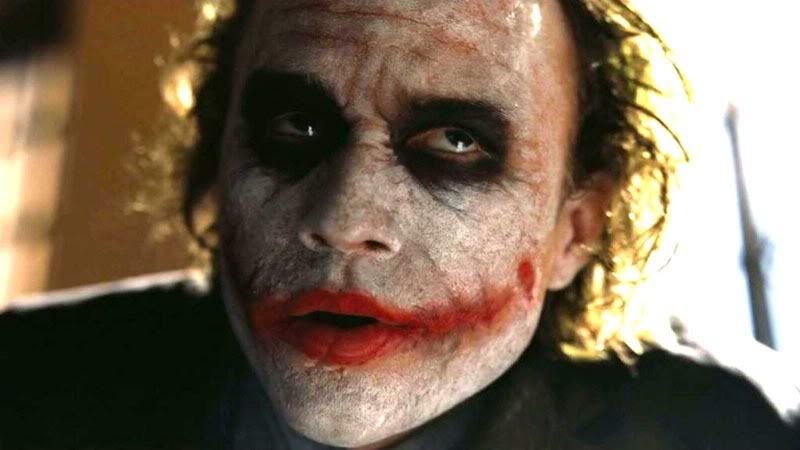
That he used this idea to stage a heist genre film is kinda interesting, but unless you find these picture/dreamwork puzzles engaging enough, the film is unsurprisingly generic. The dramatic structure follows Nolan's 2008 blockbuster The Dark Knight, in terms of when and how the real film's peril and threat dawn. In TDK, Nolan designed a gothic urban landscape, reaching a boiling point with the affects of entropic forces. The Joker's maniacal psychopathology twisted Harvey Dent's commitment to procedural justice, producing Two-Face's appetite for impartial, brutal chance. That film got to me, because I felt the peril of its threat to undermine - for real - the faith in the coherency of justice and political right (already shaky, but we avoid worrying about it). I loved that Nolan gave me that experience, and missed it in Inception. Dom (maybe more Wantanabe's Saito) losing himself forever on the shores of P3 dreamworld just didn't have the same urgency and affect, as Joker blowing up our fragile dependence on the legitimacy of political right. Even Dom imperiling the team wasn't enough, because his emotional vulnerability was too cliche. I know it was corny, but TDK scared me and convinced me that those civilians were going to blow up their inmate counterparts. Again, Nolan got me there. Whereas Inception got me to Hoth. Meh.

—JKS


—Off the rack, really?

Jen:
I'm at a disadvantage to start this thing because I simply don't value Nolan as you do. I'm afraid my replies may veer towards simple petulance without a lot of words about what it is I do like in movies as opposed to what it is I don't like in his movies in particular. So I'll just get this out of the way: Nolan's style bugs me, as it did with TDK, because it's mostly a reliance on the volume levels of Hans Zimmer's score and Final Cut's dexterity. Put otherwise, it's loud and choppy. The best shot in the entire film is the one where the camera stays rooted to a dolly track pulling back down a hallway that's getting gimbaled around to fling its action—Joseph Gordon Levitt's the only graceful actor in the piece, too, fwiw, though Tom Hardy charmed me silly—against different surfaces. Which I hope gets us to your initial query: why not 3D?

I'm with you: part of the fun of Avatar was precisely because the 3D helped the immersive feeling, and played into the conceit of putting your mind into another body. Cameron directs the eye plenty, but the depth of field in and around that neon jungle felt great. Inception, as it is, only immerses you by never stopping the soundtrack except to punctuate, making silence a clarity. Sure, the bedroom's often empty when I wake up. But, good grief, this isn't Lynch; Nolan's obsessed with score, not sound, and score's like a pointer; Lynch just drops the dread on you in bass tones; Nolan wants to control you. Yet every single one of Nolan's movies is vague enough that anybody with a hint of imagination can project just enough to fill in the picture. At least Cameron's honest about his authority/autocrat aim. Nolan's a smoke and mirrors man. He already made his thesis statement with The Prestige and it's largely successful because it's about his own methods and tactics, as close to auto-criticism as we'll get from him. That is, it's almost a mea culpa for "playing games" with his audience/s.

You'd think a movie about dreams, not magic, would be the one to offer analysis but if it does hold a mirror all it tells me is that Nolan likes guns, suits, symmetry, action movies, slow motion, the little particles (of glass or liquid, like rain) visible in slow motion, video games, 2001, Raiders, Empire (yes), talking, Michael Caine, being a dad, obvious metaphors and jejune psychology, home, being rich, and handheld cameras at all the wrong times. Can't really blame him. I like almost all those things. Hell, I enjoyed my time with Inception, which I saw in IMAX at 9:30am when I could still swallow. I didn't find it confusing, but I did find it fun to see certain stunts (all the zero-g stuff in the hotel) and I'd feel compromised if I didn't tell you that stories about guilt get at me. But effective (or overpowering) filmmaking/scoring doesn't necessarily ring synonymous with exceptional. Especially when you've got Leo doing his best to sell all of that other kind of exposition.

The most intriguing way into Inception for me is through the other Leo film from earlier this year, Shutter Island. I hadn't read the book (in part because I can't stand Lehane's idea of drama) so it was all a "surprise" (though it wasn't, either) and it all looked great in a way that no Nolan picture ever has, or will. That is, its images are better—and the images feed the other formal elements—and the score's better, too, while we're at it—and so is Leo. All of which is to say that Scorsese is a better director: he actually sets up spaces, limits, characters, and his dream sequences feel like dreams because they blend senses and burn into water through technicolor plasticity. They what? They work like dreams. They confuse but they make sense. They're part of a point of view. (The whole movie adopts Leo's fracturing, actually, which is another feather in its formal, bravura cap.) When that point of view is revealed as compromised it makes sense how it operated and the consequent scene in the lighthouse holds much more movie-movie weight (Kingsley as director/producer, movies as opportunities for emotional catharsis, movies as therapy) than anything in the dive-deep "ideas" behind/inside Inception's take on the movies. —They're all action all the time? Violence everywhere always? A trap? Even idyll? Put otherwise, what's new here? It's a film of its sources exclusively. Anonymous cityscapes still look like cityscapes and an army of snowbound soldiers just looks like a level from Goldeneye. Yet another angle, though Cairns already said it: nothing that follows tops folding Paris into a circuit of no clouds.

But I've strayed from an actual, considerate response. I've just gabbed about me. The point being, I liked this one more than the Batman movies in large part because I like the tropes more. But it still doesn't "excuse" spatial incoherence (I know that it's a dream, but this movie's not interested in representing dreams, as you pointed out) or bad writing (Nolan's brother's not the problem after all) or a propensity to drag things out well past necessary (150 minutes again?).

Tell me I'm missing something.
—Ry


—But I'm from you...

Sunday, July 18, 2010

Viewing Log #51: Vanilla and skunk [7/13/10 - 7/18/10]

by Ryland Walker Knight


Here's another quick narrative for you. Spent a lot of this last week running around town, which seems to be a common theme as I continue to move my life more and more offline, but this was just tiring. I also started a couple new books and saw my sister perform in a play (that she wrote) at Berkeley Rep (in a summer school program); she's 13, if you need to know. I also saw just the one film, the opening night film (John Ford's The Iron Horse from 1924), at the SF Silent Film Festival. This bums me out. I missed Friday because of work and the sister, and was fine with that, but Saturday got away from me and today I couldn't move I was so tired and my throat was so closed. Somewhere in there I made time for a nerdsville 9:30am matinee of Inception, but I'm going to have more to say about that in conversation with my old friend Jen Stewart shortly. (You may remember she and I traded some ideas on The Dark Knight a couple years ago here and here.) The short of it: I enjoyed myself but I don't think it's good or actually smart and, again, I don't think Nolan can direct action at all, which is surprising given his eye for symmetry (and geometry in general; though not "architecture"). In any case, stay tuned.

Earlier today, instead of seeing awesome silent movies in the best theatre I know, I drank a lot of tea and grapefruit juice while watching The Hangover a year after the fact. Zach Galifianakis is great, clearly doing his own thing, but everything else is everything I hate about dudes; what's more, everything comes from fear and/or hate. No wonder it was a hit, eh? The conceit's great, of course, but the movie has no interest in what's interesting about a hangover's lacunae. Like Nolan, actually, Todd Phillips seems to prey on those fears we harbor; except he's a literalist of a different stripe. Nolan's got a thing for writing bad dialogue the way Phillips has a thing for making women intolerable or invisible or, well, whores. Lad mags haven't failed, they've simply been turned into movies. (For that matter, as I txt'd with Danny, Inception's a GQ subscriber's wet—you guessed it—dream; that's the advertisement film, not I Am Love; but I'll table that for now).

Later, I watched The Invention of Lying and, though it's simple, I liked its fantasy. I wish there were more comedies of morals that live in the realm of the concept. You can always count on Ricky Gervais for some teetering-near-mawkish-territory sentimentality, but you can also count on him for honesty. It's not exactly great filmmaking but, as with a lot of comedies I appreciate, its spirit (its philosophy, if you must) is something I respect and admire. That is, the film's moral position (cough) is one I can get behind. However, it's pretty sad that such a thing as thoughtfulness is a rarity; I take it for granted that most thoughtfulness is stuff of stuff like, say, a book (or a "puzzle film") and not a joke. Which brings me back to Nolan, again, and one last gripe before I go to bed: dude's got no funny bone. I have no idea how to imagine how Nolan has fun. Does he play a lot of video games? Seems likely? Ad hominem what!?

Sunday, December 07, 2008

VINYL IS PODCAST #7: For your milk!

by Ryland Walker Knight and Jennifer Stewart and Mark Haslam


plus one, son!

[Podomatic stream]
[Direct audio download]
[iTunes subscription available]
[Simple syndication subscription]

RWK here. Yes, due to all kinds of life and extra-blogular writing, posting has been light over here on VINYL IS HEAVY. The main culprit, though, is a lack of reliable internet and, like, zero interest in cafés post-work. So stay tuned. There should be a flurry of hot new shit soon; mostly (still!) about Arnaud Desplechin. (In case you didn't know already: I'm freaking out about A Christmas Tale. That's the realness, peoples.)

But today we saw Milk. We saw Milk at the Castro Theatre in the Castro at Castro and Market in San Francisco. All kinds of heightened levels of signification and significance and emotions. Also, it was overcast. It's finally getting cold around this town. And it feels great. Add to all that: it was a packed house and we sat in the third row. Now if only Milk were a little better. I really want to like this prim thing (and I do, for the most part) but it's kinda-sorta inconsistent—and, yes, it would be nothing if it weren't for Sean Penn's sure-to-win lead performance. Everybody's said it, as if it matters, so why not add to this choir of obvious hype: they should bow-tie the Oscar and engrave that shit yesterday. He's great—he really is!—and his joyful posture, even in a frown, is truly something to behold. I want people to see this movie, especially in our current season, precisely because it was designed for everyone. Gus Van Sant set out to make the movie that the most people would find purchase with—and he did just that—without a lot of his recent formal/aesthetic flourishes; although, to be fair, it's not like we're talking Ray or Walk The Line here. But I'm tired, and it's late, so I'm just going to direct you towards some of the sterling words that have already been written in favor of this film's simple virtues. As Steve Brule would say, "For your milk, dummy!"

Finally, here's some songs you should buy.

Sunday, November 16, 2008

VINYL IS PODCAST #6: A waltz is a fault; like, falling.

by Ryland Walker Knight and Mark Haslam and Jennifer Stewart


turn away

[Podomatic stream]
[Direct audio download]
[iTunes subscription available]
[Simple syndication subscription]

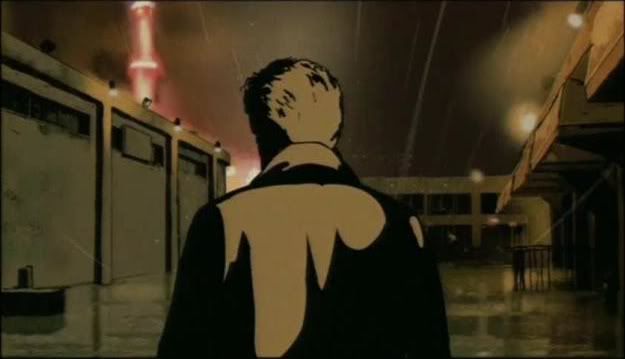
Today we saw Waltz With Bashir at the Landmark Embarcadero as the final film in the 3rd Annual SF International Animation Festival. It took us even longer to get home this time but, after some food, we talked on digital tape again. Last week's podcast saw us working through a very common reaction to Kaufman's film. This week we were more hesitant and disparate, largely because of Waltz With Bashir's traumatic ending. Juxtaposed with stunning animation, we struggled to account for the shock of its ultimate loss. Or at least, some of us did.... Ry's earlier thoughts can be read by clicking here, and we would also recommend the ever-astute Michael Koresky as well. Thanks for listening! Here's some songs; go buy them, too.

The Books - There Is No There
(zshare)
Squarepusher - Massif (Stay Strong)
(zshare)

Sunday, November 09, 2008

VINYL IS PODCAST #5: More synecdoches, more f-words, more more.

by Ryland Walker Knight and Mark Haslam and Jennifer Stewart


a look-see

[Podomatic stream]
[Direct audio download]
[iTunes subscription available]
[Simple syndication subscription]

[SPOILER WARNING IN EFFECT. There's no other way to talk about the thing, is there, Walter? Seriously, if you want to preserve the experience, don't listen. However, as we try to argue in the podcast, there's no way, really, to "spoil" this thing. For one, it's sour to begin with...]


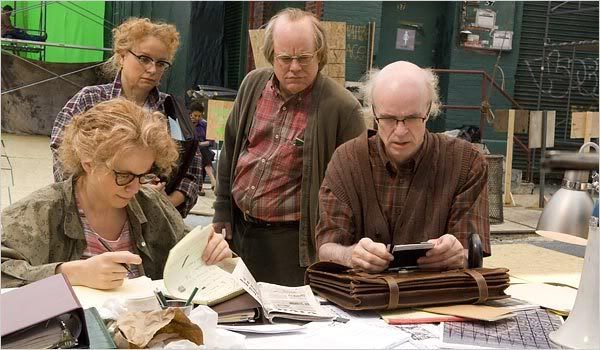
RWK here. On our third podcast, Mark and I discussed his first take on Charlie Kaufman's Synecdoche, New York (as well as Jean Eustache and, briefly, Jia Zhang-Ke), with Mark saying, "I liked it enough to not have an opinion of it right away." (He then put that reaction into some written words.) What I took and take that exit-poll impulse to mean is that he didn't feel it necessary to simply say, "I liked it," or, "I didn't like it," say to make a declaration of value. Because it's undeniable: this is a grand old meditation on major themes and concerns that continue to sprout up in cinema and, yes, in life. It's bound to shake, rattle and roll some souls. It's equally bound to simply turn off a large percentage of its audience, no matter its wit, right up front with some ugly images of festering decay and disease. Literally: dis-ease. There's little comfort in this film, although there are a lot of jokes. So, what does one do with this little beast? Well, we went straight home and talked on digital tape. We tried to form our opinions live. Of course, like the film, our conversation splintered and, in a way, as is always the case with words, it failed; or, it failed to resolve. And yet—even though an hour is a lot to ask of you, our faithful listeners—I think this is our best podcast yet.

The look-see: I'm torn between the two poles. The repugnance of the film is somewhat remarkable, even admirable, but it's still repugnant. It wallows as much as it falls away from the viewer. Not that I know them, but I understand why people like Walter Chaw and Manohla Dargis and Andrew "Filmbrain" Grant rhapsodize Kaufman's achievement, such as it is, with this picture; on the flips, an element of me was eager to indulge the "piss off" stance of my buddy Keith Uhlich, but not the "fuck you" of Rex Reed (no link needed for that bile). For all the yucky destitution of narcissistic projection, for all the death and dying, for all that kinda bores me (as well as Jen) with all that, there are some truly great moments, and cool tropes, as can be expected with Kaufman. The narcissistic projection, for one, works brilliantly: Philip Seymour Hoffman's Caden reading books as he imagines them, seeing himself in pharmaceutical ads and, um, building that massive and ever-receding and ever-multiplying theatre space. Add to that, that unlike Mark, I had an immediate and positive response to the film's negotiation with time: I think its fractal nature, with time splintering, works to exemplify its title; this is not a film about endurance. Caden does not endure lost time, he just keeps living in spite of himself, in spite of all the pills he takes and the cane he adopts and the losses that pile up (in the fucking street, no less) around him on his pathetic plodding towards death. In one way, I could probably develop a passion for this film as an argument in negative, as this is how not to live, since the film seems to understand this, but, at the same time, the film does ask us to spend our time with cumbersome and base decomposition.

If all a critic is to do is to tell you to see a film or not, then there's no two ways about it: I would say go for a run instead. But, as I understand it, my job, such as it is, such as I may be a critic (as much as simply a thoughtful person), is to argue for significance—indeed, for understanding—within the object over against of the object. So it's a tough spot. I'd like you to listen to our conversation, and I'd like it to continue, here in the comments as much as in future episodes, but I'd also like to remind you, that, yes, it's good and fun to go live in the world. And, you know, that Lola Montes talks about all these ideas, too, and it'll be playing at the Castro next week. For more on that film, though, you'll have to wait for a link. So, instead of that recommendation, I can just as easily (yes, with greater ease), turn to the other film I held up (perhaps foolishly) against Synecdoche in our podcast talk: David Lynch's INLAND EMPIRE. About 35 minutes into this hour-long talk we offer to you, I say, "I love INLAND EMPIRE for a lot of the same reasons I think a lot of people will love this movie. And they should. If this movie turns you on, and you find a lot of resonance with you, that is great—I'm not gonna try to take that away from you. Um, this is just, you know, this is just this. It's just three people—two of us are drinking beer—and, you know, but, INLAND EMPIRE, to me, is about everything that's going on in this movie, and it's a much more joyful thing. And a lot of it boils down to that. For me. Definitely. And that gets into a lot of goofy relativism right there, just saying, 'For me.'" But, as I couldn't formulate last night, all art is, in an basic way, experienced narcissistically, for the me that you are wherever you stand in relation to a film or a painting or a screenplay or a song or a novel or a dance. The trickiest part is to account for your self—to question your "me"—in a fun way, to be thoughtful and hilarious at the same time. Now I don't know if we're exactly hilarious here, but you'll here me laugh a lot in this, and, hell, that's good enough for me.

fire is red

This episode's intro and outro songs, for your downloading pleasure:

Tuesday, August 05, 2008

Poem for Mad Men, season two.


Am I to become profligate as if I were a blonde? Or religious as if I were French?

Each time my heart is broken it makes me feel more adventurous (and how the same names keep recurring on that interminable list!), but one of these days there'll be nothing left with which to venture forth.

Why should I share you? Why don't you get rid of someone else for a change?

I am the lest difficult of men. All I want is boundless love.

Even the trees understand me! Good heavens, I lie under them, too, don't I? I'm just like a pile of leaves.

However, I have never clogged myself with the praises of pastoral life, nor with nostalgia for an innocent past of perverted acts in pastures. No. One need never leave the confines of New York to get all the greenery one wishes -- I can't even enjoy a blade of grass unless I know there's a subway handy, or a record store or some other sign that people do not totally regret life. It is more important to affirm the least sincere; the clouds get enough attention as it is and even they continue to pass. Do they know what they're missing? Uh huh.

My eyes are vague blue, like the sky, and change all the time; they are indiscriminate but fleeting, entirely specific and disloyal, so that no one trusts me. I am always looking away. Or again at something after it has given me up. It makes me restless and that makes me happy, but I cannot keep them still. If only i have grey, green, black, brown, yellow eyes; I would sta y at home and do something. It's not that I'm curious. On the contrary, I am bored but it's my duty to be attentive, I am needed by things as they sky must be above the earth. And lately, so great has their anxiety become, I can spare myself little sleep.

Now there is only one man I like to kiss when he is unshaven. Heterosexuality: you are inexorably approaching. (How best discourse her?)

St. Serapion, I wrap myself in the robes of your whiteness which is like midnight in Dostoevsky. Now am I to become legend, my dear? I've tried love, but that holds you in the bosom of another and I'm always springing forth from it like the lotus -- the ecstasy of always bursting forth! (but one must not be distracted by it:) or like a hyacinth, "to keep the filth of life away," yes, even in the heart, where the filth is pumped in and slanders and pollutes and determines. I will my will, though I may become famous for a mysterious vacancy in that department, that greenhouse.

Destroy yourself, if you don't know!

It is easy to be beautiful; it is difficult to appear so. I admire you, beloved, for the trap you've set. It's like a final chapter no one reads because the plot is over.

"Fanny brown is run away -- scampered off with a Cornet of Horse; I do love that little Minx, & hope She may be happy, tho' She has vexed me by this exploit a little too. --Poor silly Cecchina! or F:B: as we used to call her. --I wish She had a good Whipping and 10,000 pounds." --Mrs. Thrale

I've got to get out of here. I choose a piece of shawl and my dirtiest suntans. I'll be back, I'll re-emerge, defeated, from the valley; you don't want me to go where you go, so I go where you don't want me to. It's only afternoon, there's a lot ahead. There won't be any mail downstairs. Turning, I spit in the lock and the knob turns.

Monday, August 04, 2008

We burned the forest down. The Dark Knight, back and forth. Part Two.


hit me

[This is the second part of a rather lengthy email conversation between Jennifer Stewart and Ryland Walker Knight. The first part can be found here. I think there's plenty to continue with after Jen's second response (some things I'd challenge, again, finicky for particulars as I am), but I don't want to keep posting about a film I'm not so certain earns even this much digital ink, much less all the rest that's been, ahmn, generated, when plenty of other, better movies make less money and are seen by even less people but deserve to be seen by everybody because I think they can inspire, too -- and provide even more (substantial) uplift. Also: I didn't give Pirates this much public attention last summer, and that/those movie/s are way cooler, way more interesting. So, as I said before: we encourage more conversation, so long as it's civil. That's what this movie's about, right? Civility in an insane, unstable world of terror? Something like that. Also, again, for redundancy's sake: There are
spoilers throughout. Consider yourself warned!]

growl

Well, well, Jen,

First of all: there's nothing wrong with being affected by a film. I'm not trying to advocate for my experience (in lieu of yours or others) by any means. But I am curious why it's this film -- even, why these films? I don't think I can answer that, fully, nor do I think you really want to dive in deep (in public) into what motivates or attracts you to activating this kind of response; nor do I think it that appropriate, per se, for our aims here. Your investment, however, exposes the straw man of my first missive. It's easy to fall back on issues with Nolan's filmmaking style. After some more careful thought I've come to realize that while I felt a charge at the close of the picture, sure -- it's nervy and long and loud -- my resistance boils down to the fact that I wasn't as immersed in the story as you were, which manifested itself in my gripes with the action scenes.

I still have problems with Nolan's approach to action, but let me first get into your invitation to talk story. The Dark Knight is a fairly straight forward scapegoat myth. For all this talk of it being dark, it's a pretty hopeful film. I think that's why it's such a big hit: unlike those silly Spiderman movies, Nolan's commitment to "realism" really gives the film gravity, which makes the lows that much lower (others say darker) and the highs that much higher. What I've come to realize is that the things I find dark and troubling about the picture are not what's in the story, or how the story is told, but how Nolan points his finger outside the story, the film, through all those cultural signifiers like wiretapping and terrorism. I just don't know if its politics are as right on as the myth framework makes them out to be. And, of course, I think this claim to "realism" is dubious given Nolan's odd mise-en-scene.

timing

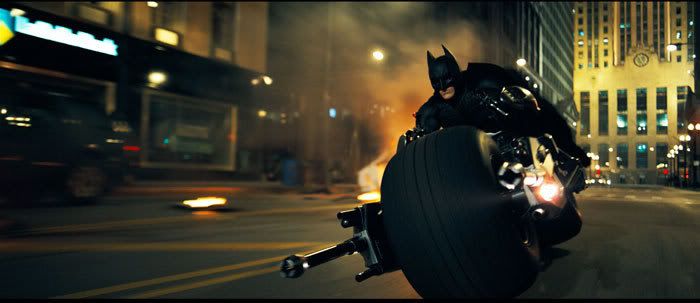
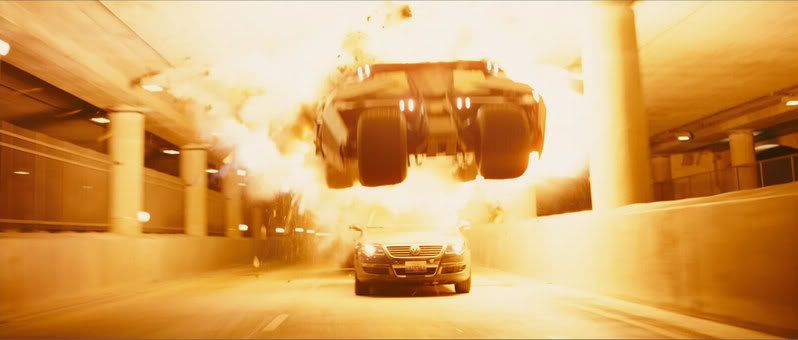
However, Nolan's timing is pretty great, which busts up my prior attacks. If his action sequences are not about movement (doesn't seem to be the case; most of the screen is a dark wash), then they could easily be about timing (he edits not on movement but on impacts and explosions), or, more broadly, about time. Things collide and splinter and fly based on certain speeds in these set pieces. Think of Batman jumping in front of the bazooka, and that mack truck flipping; think of the opening heist's precision. This plays on a thematic level, too: all the Joker's tests, indeed plans, are structured around countdowns. He puts the city on the clock. This gets at finitude. What's complicated about this is that for all his talk of chaos, for lack of rules, the Joker is following one of the biggest rules, and setting a concrete rule, of the world. He laughs at Batman: "It's only a matter of time before you break your one rule." Like you said, Jen, Joker overestimates his understanding of the impulse to do good in the world, thinking time is the best pressure cooker tool. Perhaps this film is arguing that time can work for you as much as against you. Perhaps it is about circumstantial ethics after all. Or, perhaps, this kind of generous reading misses the boat completely by getting away from the power of the myth underlining all this silly action film phenomenology-ontology-hermeneutics.

I don't know. I don't quite think so. I'm still intrigued by how this film, and Fincher's and PTA's, are the ones that activate your intrigue in personal limits, but I don't know what that has to do with time other than how those films figure time (and its loss in Fight Club, in TWBB), but I think it has a lot more to do with myth (even though the two are related; myth seems to stand outside time). I guess what I'm saying is our reactions so far seem to say more about us than they do about the film. Except you've out done me: not only were you moved by the film, you came up with a reason that made sense: all that empty space as indicative of the moral peril of the film. All I can counter is that I find that much more effective, and convincing, in other films about this scapegoat myth; most immediately in something like The Man Who Shot Liberty Valance. (This entails a complicated argument but I'm thinking Rene Girard thanks to talking with FRG, so: cf. "The Unity of Violence" section for a brief gloss.)

But I don't want this to turn into a pissing match. That doesn't get anywhere. What I mean is that I think the lie in Liberty Valence seems darker, and more emotional, to say it comes with more weight and consequence than the lie in The Dark Knight -- all of which may be a product of the construction of the films. And, for me, that starts (but doesn't stop) with the female anchor for these two tales. I didn't buy the love stories of The Dark Knight precisely because I didn't buy that a woman like Maggie Gyllenhaal (as written, as acted, as lit by Wally Pfister) could precipitate that kind of love triangle. Vera Miles may not have that much more to do in Ford's picture but she certainly looks and acts and is motivated to be that kind of woman. And here I go again making unfair comparisons. It's funny: every time I sit down to think about what it is I dig about the picture I come up with other problems I have with it. Maybe I'm thinking too hard about it -- or too harsh. Maybe I'm just not being honest enough with myself. Maybe I do need some theory (affect, time-image, etc) to get at what I dig on a visceral level. Maybe I just had some fanboy in my heart fighting to be heard and I can't listen. Maybe I need to see it in IMAX to really just let go and let it throw me around. What do you think?

the r. knight

prison hurts
free as a bird, now

Ry,

I hope I earned that generous response you gave, my man. Truth be told I'm scared to say much more about TDK, because it would risk more sympathetic invitation which may or may not come off. I think you're right about the story's ability to grip me but let you slip. Somewhere therein is the answer to your question, why this film. I could say more about why this kind of story - or a movie that dealt as it did with these ideas of identity and civic faith - did grip me, but as you suggested, that's probably at best interesting to you in a non-public conversation between us. Indeed, there's a whole dimension of film experience available only to friends in dialogue.

Regretfully I have not yet seen The Man Who Shot Liberty Valance, but I'd be interested to hear how the same kind of myth is told in a way that invites comparison and evaluation with TDK. The myth part sounds right to me, but the scapegoat part sounds a little insufficient. Part of the myth in TDK is the implied logic and consequences of the unique position Bruce Wayne afforded (quite literally) himself. He created an essentially anonymous identity in order to operate outside the law, yet ultimately in the name of justice. So already we have an uncontained excess jeopardizing the balance of the original system (as Rachel corrected Harvey about what happens when you "elect" someone to hold the privilege of power outside democracy: you create a Caesar and power is never restored to the demos). With Batman working for, but outside, the Law, one problem is that the Law gets too dependent on Batman's advantage of being unencumbered by due process (Batman is conveniently if not cheaply able to secure Lau's *ahem* extradition).

Another problem is that other versions of oneself (anonymous figures outside conventions of institutionalized morality) start popping up, the only difference being, these don't necessarily embrace the pretense of working for Justice. As Joker says, Batman completes him. Or he's just too fun to get rid of. The film sees Batman desperately wanting to hand over the power of (re)scaling justice to a properly elected hero. But Joker gets to Harvey Dent first. Here's where I could develop my earlier thought that, ultimately, TDK asks what a face is. The Batman myth is about the consequences of abandoning faith, that justice can be done by the faces its institutions make available. Harvey Dent, an elected DA, restores that faith. But Batman has already caused the jeopardy that ultimately corrodes Dent. Joker wanted Batman to reveal himself: it was only a matter of time before someone operating with Batman's logic exposes the easy vulnerability of his contradiction (you can't be outside the law yet simultaneously constrained by it. All Joker's talk of chaos is that rather simple point). The Dark Knight, then, is a proper Tragedy. Batman isn't scapegoated so much as revealed, and perhaps redeemed. He accepts responsibility by taking the previously unseen truth his masquerade allows: an explanation of moreso than resistance to the corrosion of Justice.

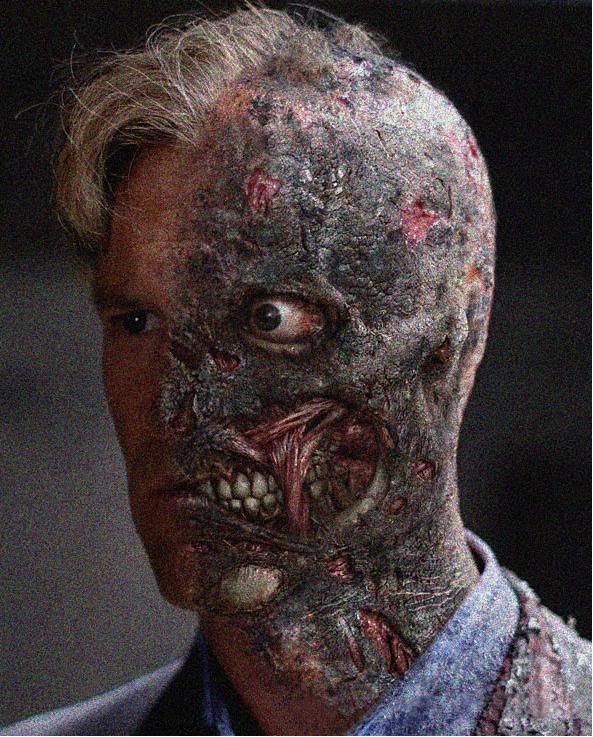
I'm not sure what to say cinematically about all this - the story as such is just that. Hence all my discomfort looking for ways to speak critically of being gripped by the story, for I suspect cinematic quality and story quality are somewhat irrelevant to each other (someone less gentle than I might mention Revenge of the Sith to you here....). In terms of how TDK uses its images to play out this story? Well, it's written plainly on each of Batman and Joker's, and Harvey's two faces. Harvey becomes the anguished split Batman ignored: the reality of only half a sanctioned face. Upon first reveal of the special effects Nolan chose for Dent's face, I was actually a little disappointed (ugh, skeletor face? How cliche). But now I like it more as a symbol of pure erosion as well as revelation: what makes a face (facade) appealing includes concealment, lest those ligaments be seen sufficiently as their own gruesome alternative. This is what Joker was attempting to reveal about Batman: he is just a gruesome enabler, of weakened justice garbed in the masquerade of its Knight.

Thanks, Knight, for making me think a little more. As for my own redemption, there's other films like The Darjeeling Limited, and There Will Be Blood, which aren't really about their ostensible "stories" but which occasion nothing less than an equal pleasure. To wit, perhaps part of my esteem for TDK is that it was totally convention narrative cinema, and I'd forgotten how much pleasure is still possible therein (hence identifying Fight Club as my antecedent).

My trouble is that I am much less confident trying to be a film writer outside the conventions of narrative cinema. Though I haven't given up yet.
~jk

swoop solo

Saturday, July 26, 2008

We burned the forest down. The Dark Knight, back and forth. Part One.


money for nothing and tricks for free

[This is the first part in a rather lengthy email conversation between Jennifer Stewart and Ryland Walker Knight. For readability, the call and response pairs will be split up. I'll update each intro with links as we pump out the rest. For now, though, here we are, looking all around, trying to make some sense of that first weekend. There are
spoilers throughout. Consider yourself warned! Certain forms of hyperbole will not be tolerated in the comments thread although we are curious if you have a thoughtful response to offer in order to continue our conversation. Just, please, don't make me turn on comment moderation. Nobody wants that.]

watch it wash away

Jen --

From the top: I dig it. I don't think it's the masterpiece some have claimed, but neither would I call it a bankrupt endeavor, just complicated. As a picture of the modern city (and its consequent perils), in a time such as ours, this is probably as good as a pop artifact can get. The Dark Knight may not have Michael Mann's poetry of imbalance (an unfair comparison despite the opening heist's nod to Heat), but Christopher Nolan's nearly anonymous Gotham has all the right sheen and transparency, grime and emptiness, shadows and nightfall terrors to scare you of its dark arena of violence. It's the insistence on the city -- in swirling helicopter shots most of the time -- that makes it more than a Batman movie and less a Batman movie than before.

After all, it's the first Batman movie where Batman is just another part of the ensemble. Christian Bale may get top billing but he's by no means the star, much less that interesting (a shame). The real acting fireworks, so to speak, happen between the poles of Heath Ledger's typically hyperbolic Joker and Gary Oldman's beautifully understated Jim Gordon. Oldman's portrayal of decency grounds all the anarchic overflow of Ledger's embodied chaos.

However, all too often chaos is more a talking point than an element of the action. That's probably my biggest problem with the movie: Nolan doesn't really know how to shoot action scenes. Or, more pointedly, he doesn't shoot fight scenes well. For all the kinetic activity, those handheld close ups make these encounters less about movement than about fractured collisions that can't find a visual resolution in space. Which is a silly, hifalutin way to say, it's too often cluttered and fussy, if oddly dynamic. I'm puzzled by his close-in action mise-en-scene, and (I worry) not in a good way. That said, the film is edited pretty well and the timing on the wide shots inside action sequences is pretty spectacular. That mack truck flipping has a real weight -- which is aided by the sound design. Again, it's hard to compare him to Michael Mann, or even Paul Greengrass, but those guys are more interested in space as an arena full of possibilities and energy (something I dig); Nolan's idea of space is more pragmatic, logical, showing an interest in the where but not the how. For instance: I dig that the climactic high rise site is open and under construction, open to plain sight, as it gets at the illusion of spectacle (and how we make or account for appearance in this Gotham) once more. And I dig how the sonar plays into that, too, but all the encounters within that structure are pretty straight forward, a series of scenes of Batman deploying pawns in the way of the final showdown.

What makes the action interesting, in the end, is how Nolan gives each sequence significance before and after, pointing away from the action. (I think this is why I liked The Prestige so much: it isn't an action picture. The Prestige is about magic, about manipulation, about spectacle, about perception; and here all his editing patterns make more sense. He's forming a way of seeing there (looking for details) that doesn't quite cohere in The Dark Knight.) In the most simple sense, the context for the action in The Dark Knight is the current mood of the country: the fear of unknowable threats, of ultimatums without rules. There's a lot of easy allegories to draw. But that's all abstracted enough into ideas about chaos (those talking points) and seriousness so that I trust the film will play when the next administration's getting ushered out of office. However, all that falls to the Joker, in monologue form, which speaks to Nolan's interest in story. I think he fashions himself a storyteller more than a filmmaker; at bottom, it's how Nolan and his brother Jonathan escalate the consequences of the plot with each successive sequence that makes The Dark Knight so compelling. If ever I was to appropriate that Bordwell term, it'd be here: Nolan has mastered "intensified continuity."

Okay. On the one hand, I'm impressed you were so ready to let this film whip you around and rattle your soul. On the other, I don't think the film earns the boat scene with Tiny Lister or Walter Chaw's description of Maggie Gyllenhaal's resigned acceptance as "the single most heartbreaking moment of 2008 cinema." Further, what I find so dark is not really all the terror and wreckage throughout the film but the final lie Batman concocts under the assumption that people won't be able to withstand the morally complex truth of Harvey Dent's rather literal fall.

But this makes it sound like I only dislike the picture. And I don't. For the most part I dig it. I'm just caught up in my formal/aesthetic criteria here and not moving to how this picture, and its popularity, might be significant, if, by nature, blown way out of proportion. Maybe we can get into that a little more as we progress.

--ry

stranger

Ry,
I'm in a strange spot. I've come to the tentative conclusion that my feelings for The Dark Knight are, well, just that. They're oddly resistant to qualification, yet smolder indignantly to hostile, very well-written reviews like Adam Nayman's for Reverse Shot. Not that I'm unthankful for you sending Nayman my way. But somehow it and Dark Knight has spawned a kind of crisis for me. Either I don't know who I am as a viewer, or I don't know what matters in film criticism. So I might be asking you to guide me back to the light. But first, hear my plight.

The problem is that Dark Knight really got to me. And like, 5 movies total have ever gotten to me. One of them was last year, at the Castro Theatre's special advance screening of There Will Be Blood. Previous was David Fincher's Fight Club, which I saw opening week, in 1999's Ottawa. What they all have in common, is that I was really shaken by each of them. And it was sublime.

I knew from Ledger's first scene that DK might deliver another such catharsis. I'm speaking of an intense kind of - for lack of a better word - pleasure, and it makes most or even (*gulp*) every other film experience pale in comparison. No, I think I mean that. I love Contempt and Battle in Heaven and Gosford Park and many other films. I can still conjure Reygadas' 360 sequence shot from Battle; the tingles it and other moments in that film gave me. (Still haven't seen Silent Light....). And I don't want to mitigate what those films are to me. Yet I don't know how to compare them to Nolan's Dark Knight, because DK created moral peril which actually, really threatened me. And that was riveting. I walked out not able to think of precedents, unlike TWBB's immediate conjuring of The Shining and 2001. But, then, on my second screening, when, in the interrogation cell, Joker laughs at Batman's missive fists and desperate demands to know Harvey and Rachel's whereabouts, it came to me like lightening: Tyler Durden. Fincher's and not Mann's or Greengrass' sense of action (more on that shortly).

Unlike Nayman, I had problems with Begins and thought its sequel better realized (casting REALLY helped). I'm tempted to say Nayman's problems with DK can be explained simply as, the film wasn't what he'd decided he wanted. Yet his impressive review made me second-guess my own enjoyment of the film. Could I have been wrong somehow?

A growing problem for me with film criticism is how easily formal concerns along with a kind of privileged ethics are made exclusive and essential. For example, I want to care about your worries over how Nolan realizes action. But I mostly have a hard time following them. I do like your point that if the action is shot closed-in, then we get fractured collisions (of say, body segments) rather than framed total movements. But why is that a problem? To me this simply signals different themes and concerns - quite literally, a different perspective on the action. Does action require a total view of bodily encounters, in order to "find a resolution in space"? You said 'twas all really just complaining the actions shots were cluttered and fussy. I guess I just don't see that. Or, even granting your premise, don't see why something else would necessarily be... better, somehow? In fight sequences, Nolan's camera goes in close so that Batman can appear and disappear suddenly - the sense of his superlative movement is created by these cuts that let his outline outstep the frame, even when centered in it. Fincher liked showing us local reactions to blows, and Nolan may be after something similar, which means the total scene of bodies having room to manifest the forces both impacted and exchanged during a fight just isn't the right profile for the shots. I'm likely in over my head here, so perhaps I should just say: you seem to be assuming there's a way to shoot action scenes, and Nolan ain't done it. Help us (me) scrutinize with your eyes: Who or where does that premise come from, and why should I care about it, especially when in order to see anything amiss in the film, it seems to first need assuming?

That said, I'm happy to say I strongly agree with you that Dark Knight ain't doing anything dark through themes of chaos, and certainly not as film-noir dark as some have hastily claimed. The triumph of DK's big moment is that Joker assumed more chaos than he could engineer: people are more attuned, less individualistic, if a little less civilized (in the bad, Rousseau sense of loosing sympathetic trust) than he imagined. Chaos in the film is simply Joker's attempt to remove some of the (already perhaps flimsy) partitions supporting an ordered edifice of civil morality. (Civil morality as in the ideological commitments to the sense of fairness that underly law, the courts, and the judiciary - also, the related concepts of what one should rationally desire and fear). Joker's desire not just to lay bare but to rip down these partitions - revealing the panic-inducing expanse of amorphous, unscripted moral interpolation - is seen realized in Gotham's inner and outer design. Nothing has proper walls: Dent's office, Bruce Wayne's bunker and penthouse -- all pillars and receding perspective lines, shelves and desks with only open, surface conspicuity. Even in Lau's Hong Kong architectural marvel, the walls and drawers are glass, revealing everything and waiting to be shattered. The precariousness of moral infrastructure: you take a vote on a ferry, but ooops, this isn't enough to resolve the threat. (Wasn't democracy suppose to be our political panacea?) I guess we could call the result 'chaos,' but despite his speech to (by now) Two-Face, Joker is certainly, definitely, a planner. He is an engineer, a scientist, and he'll say what it takes to realize his experiments. Joker's response to the ferry passengers' inadvertent solution to the prisoner's dilemma (why did I have no jade and all cathartic relief at that moment? Is there something wrong with me?), is to lament that all must be done oneself. I agree with Nayman that Gotham is the anonymous hero of the film, for the film sacrifices the false stability and irrational vulnerability of electing heroes to be "the face" of, say Justice. The city needs much more than one "white knight" who is willing to let his face bear the investment of justice. One wall can't hold up an edifice. One face can't take that much.

You said Nolan may be more of a storyteller, than a film maker. Well, I like stories. I like them a lot, because they shake me and I'm not sure but that might be one awesome reason to be alive. Images shake me too, and they can tell a story with images and/or with actors. Ledger and Eckhart and Oldman and those huge empty spaces with transparent partitions, was some of the best shaking I've had.

glass between us

Wednesday, July 16, 2008

A storm of Bastille Day links. An Index. UPDATED.


storming

Here I'll collect links to our own Bastille Day posts and any others our blogging buddies may offer. Just leave me a note in the comments or in an email and I'll be sure to update the list. I will also throw in some links to some pieces about France and French films that I feel should be read around this time of year. But that's for later. For now, here's what we can give you:

Thanks for reading! We hope you enjoy our odd enthusiasms and we look for yours as well. Now we plan to go eat some cheese and drink some wine, maybe even down some moules frites or, um, a ratatouille. If you didn't get around to posting anything today, on the fourteenth proper, don't worry: I'll continue to update this list as things pop up online, here and elsewhere. --RWK

Monday, July 14, 2008

Looking at, for and with desire in Contempt.

by Jennifer Stewart

[Part of VINYL IS HEAVY's Bastille Day celebration. Click here to see our index. Click here to view all the entries at once. Ed's note: Jen plans a few revisions which she hopes to finish sooner rather than later but in the spirit of this enterprise, I thought I'd offer her initial thoughts for now since they're a good starting point and valued contribution to our little project here.]


substitute

Le cinéma substitue à notre regard un monde qui s'accorde à nos desires. Le Meprise est l’histoire de ce monde.

As Contempt’s camera turns on us, its narrator ends the prologue with this claim about cinema and what awaits us on the other end of the lens. Since seeing this stunning-looking film at the Castro Theatre, on a rare hot evening in San Francisco a few weeks ago, I’ve been thinking about its self-proclamation. What follows are my current thoughts – still developing, not quite a reading, but some thoughtful rumination on film and desire. If cinema substitutes for our gaze a world according to our desires, one immediate question should be: how does film know what we desire?

The usual answer is that film does this manifestly. Here, we’d say film presents bodies and dynamics we want to see played out because these confirm stories that offer to stabilize desire into objects and roles we can imagine ourselves in. But it doesn’t take much to see how unsatisfying such an answer quickly becomes, especially for a film like Contempt. If anything, Contempt stages conflicts and problems of desire, collateral with problems and conflicts of film-making. We look at Brigitte, to be sure, and we see her as the kind of beautiful thing film can present. But her presentation is exactly the key, for she (and everyone else in the film) is not a character (to be “identified” with or not) so much as a portrait of the consequences of exchanging (or, failing to exchange) the looks that confirm an understanding of loving and/or desiring, and of being loved and/or desired. What happens between Paul and Camille, arguably, is a breakdown in their ability to return a sustained world between them where desire and love is signaled and consummated. In that moment where Paul blithely hands Camille over to Prokosch, sending her alone with him to his villa, Camille shuts off. The camera shows us the whole silent exchange; a watershed moment between this couple, the precipitating consequences thereof which the rest of the film unfolds. What’s beautiful about Contempt is that this visual language of desire is told as embedded in a world saturated with cinema. It presents the texture and reference of cinema everywhere, as living or naturalized mythology on the walls and in the livelihood of its characters. Contempt enriches the idea of a world in which desire occurs, by showing its fragility.

So why not say, film stages not a manifest but a latent constitution of desire. I mean, it is the emblematic form of cinema itself - a camera 'seeing' in a frame - which has effected the substitution, because it provides a world in which our gaze is directed. The substitution then is simply a world exchanged for a framed world: a world scoped out for us. A world showing us where and how to look. Put that way, pornography is cinema’s logical extension, because it leads and places the eye exclusively (in sex acts made graphic on the screen) – you have no where else to look.

butt

Contempt plays with this. Camille makes a game of asking Paul to look at pieces of her in the mirror – her ankle, her knee, he thighs, her breasts, her face – and asks of each how he likes them. They look into a mirror out of shot while the camera roves along Camille’s naked body. In both senses a body is framed before we look upon it as presented for desire. If pornography is one end of this scale of directing the eye, cinema more usually arouses through affective implication: through shots whose vantage points are themselves part of the suspension of a film’s (if you like) meaning. By suspension, I mean an affective pregnancy, of the fact that the experience of watching will quite literally move through our bodies; provoking, stimulating, arousing, paralyzing, dulling. This is to some extent because watching will simultaneously be an active process of conscious and unconscious connections, as we draw out resources with which to track the film. Most of these will be fleeting and flashed, multifarious and peripheral. And, different occasions of viewing a film can triage a different stream of this fluid. My point is that suspension nicely captures how unqualified watching can be. Its affective power lies in this suspension, for it is this affect we resolve or try to tell, when we try to speak (coherently) about a film.

Contempt is a sequence of suspended desire. The film within it trying to be made (The Odyssey) collapses, and the consummation of desire and love between Paul and Camille collapses, but Contempt looks on.

substitute

Monday, April 28, 2008

Sketches on Hoberman, Sylvia, looking and difference. [Part 2]


dazed

From: Jennifer Stewart
To: Ryland Walker Knight, Kevin B Lee
Subject: RE: hoberman, sylvia

Kevin and Ryland,

I have just a few comments all inspired by our pre/post film analysis and your fetching essay, Ry. Unfortunately my thoughts are more responsive and fragmented than yours are coherently developed. But I'll let you blogbarians take it from here.

Kevin, while on BART Ry and I spoke more about this phenomenology idea. I think your essay shows, Ry, that the film is more a phenomenology of spectatorship than a phenomenology of thought. What El was doing in the cafe as he looked and sketched, is not what I'd call tantamount to thinking but rather, to fixing a view; really, tantamount to intentionality: he's trying to settle what object his thought is bent on. And his efforts are subject to the interference of occlusion (other heads/objects get in the way), the limits/possibilities of two-dimensional collapse (the 'flat' surface of his sketching page), and the uncanny moment when these objects return his gaze, catch his eye. All goes well with his pursuit of "Sylvia," after all, until she looks back; until they reach the moment when he must account for pursuing her as a cypher for his desire. A moment he calls a disaster never really recovers from.

Two things I don't understand and think analysis of the film should explain:
  • what's significant about El sleeping with that beautiful but weird spaced out/drunk/bad dancer girl?
  • in the last few minutes, through the 'screen' of the train, we see a girl in sunglasses. The entire left side of her face is scared or burned. A few cuts later we see her again, removing her sunglasses to revealno eye (!) on that side. It was pretty gruesome. Kevin, you saw that, right? Ry somehow missed it so please confirm I'm not making this up.

Both these Sylvia dopplegangers (in some sense all the women in the film are) could be read as casualties of El's pursuit. The crevices, lines, and shadows of the scarred woman's disfigurement bears a resemblance to the dark, resistant etchings in El's sketchpad; the consequences of his agenda coming into relief. So we see your point, Ry, about El's fixation on the (absent) avatar of "Sylvia" and his rejection of the (present) abundance of difference. And here I think we add Bunuel's Obscur objet du désir to Kevin's Vertigo reading.

I'm tempted to read the whole film as a cautionary tale about one allegory of film spectatorship: the rich risks of film as fixing its/our gaze on a (lost) object of desire which can never be incarnated. So then we could read Ciudad de Sylvia as loosening this grip (hence my suggestion that it updates the Laura Mulvey thesis) since it refuses to offer an unambiguous object upon which to fix our desiring gaze. Indeed, it offers alternative figures of moving image itself (metaphors of dynamic celluloid frames) and the aesthetic acceptance of occlusion and the uncanny.

One last thing: Kevin, have you read If On A Winter's Night A Traveler by Italo Calvino? En la ciudad de Sylvia could easily be read as a brilliant adaptation of it.
~j

[Note No. 1: You can read my "Part 1" missive by clicking here.]

[Note No. 2: Because the trailer to Bunuel's film and the clip from Hitchcock's were too good to simply link to I'll go ahead and embed them down here. They add to this reading, I think, tremendously.]


[Note No. 3: Kevin's reply can be found by clicking here to his blog. --RWK]

Sketches on Hoberman, Sylvia, looking and difference. [Part 1]

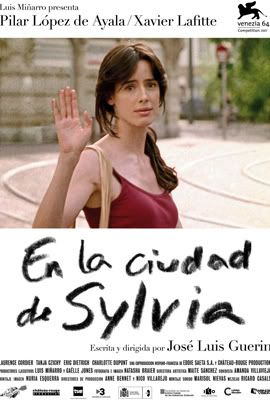
[Note: On Sunday, April 27, 2008, I attended a San Francisco International Film Festival event with my friends Jennifer Stewart and Kevin B. Lee. After the SFIFF presented Jim Hoberman with the Mel Novikoff Award (named for the famed San Francisco film exhibitor), Kent Jones quasi-interviewed Hoberman on stage for about an hour, and then we were lucky enough to watch José Luis Guerin's In the City of Silvia. I wrote this first email to Kevin primarily, as a fellow blogger, and Jen secondarily, as my friend and interlocutor. I thought it might be interesting to others, too. Look for Kevin's response at his blog shortly. -- RWK]

From: Ryland Walker Knight
To: Kevin B. Lee, Jennifer Stewart
Subject: hoberman, sylvia

Yo, Kevin,

Glad we could enjoy that film, and that discussion beforehand, together. Before I talk about the film a bit let me say I remembered (or think I remember as) what Hoberman got mild applause for: he was saying he hoped more online criticism would link to other criticisms, incorporating other texts (and, I imagine, images and sounds) into itself. A very Web 2.0 kind of monadic reading; not simply monadic reading by making associations in writing but actually forging associations with hyperlinks (and images, even videos). It seems like his ideal version of online criticism is exactly what you're after at your blog. Which is a really cool thing! Congrats! Unless, of course, my memory is messing all this up. Which leads me to In the City of Sylvia.

I think I may go ahead and deem the film "a masterpiece" because I do think it's about more (plot-wise and otherwise) than simply a dude stalking some pretty babes. We know dude is visiting this town after a six year absence, trying to recuperate a love/r (or better: a memory of a lover), and not just another passerby inhabitant of this city. And, of course, as you said, that's a thin plot. However, it's a pretty tight little argument about movies, and about watching movies. When we watch a movie we're a foreigner in a familiar terrain (or logic, or vocabulary) trying to piece together different strands that coalesce because we make them (pace Bordwell) into a kind of meaning. For instance, your monadic read incorporates Kiarostami, just as mine incorporates my (potentially wrong, easily vague) understanding of phenomenology. All dude does in this picture is look at things to try to make pictures, to put things together, through imagination and projection and, above all, looking.

Now, the Vertigo analogy is pretty apt, but I definitely don't think this is "art for art's sake" by any stretch. This is an argument for the value of art, of the art of movies, of the art of looking, even the art of understanding (if that can be understood as an art, as I think it can). Of course, that argument would take longer than this brief missive allows. But my sketch, to follow our man from Sylvia (dig that double move!), begins with this: the worthiness of those arts -- of art -- seems to be in what they produce for their participants. I hate to trot this out but Gadamer says we only understand differently if we understand at all so maybe this film is arguing for that kind of openness to difference: our man at the centre is never fulfilled because he cannot accept a rather simple difference in his perception (of a girl, of the world). In a way he's got a greedy nostalgia. Which, of course, translates to our role as spectators: we keep looking, following films, hoping for an outcome. Which ties into something Hoberman said about the different expectations different movie goers bring to films. Some people look for a kind of confirmation entertainment (say, as we discussed, the Apatow pictures and their wish fulfillment drive) whereas other people look for a kind of new perspective, which, we must admit, can easily be another kind of confirmation, if somebody is only applying a certain lens to all films. I'm fairly certain I'm not doing that here. My reading is allegorical, sure, linking his looking to my looking, doubling the remove, but I think the film invites it. As you said, it's a city of surfaces and reflections. Just as movies are a surface projected onto a reflective screen.

But I should hit the hay, or at least read before I hit the hay. Say, you should write me back and I'll post the pair of emails on VINYL. That sound like a cool idea?

Take care,
later, ryland.

____________________

shh!
____________________


Jennifer's reply is posted in the space above (here's a direct link, and look for Kevin's reply over at his blog, Shooting Down Pictures, soon right here.

____________________

Other words worth reading about this picture:

Saturday, May 05, 2007

CINCO DE VINYL!

Drink Tequila

In honor of none other than yours truly's birthday on this holiest of holy drunken days here on the Gold Coast, we thought we'd offer a series of essays about Mexican filmmaking. What with the recent aint-it-cute trend to name Alfonso Cuarón, Guillermo Del Toro and Alejandro González Iñárritu the Three Amigos, I, along with other colleagues, have thought to ask, what about the rest of the Mexican filmmakers that have made or are making seminal works?

My personal investment centers around a film I saw not too long ago, Battle in Heaven, and its director, Carlos Reygadas, who I'd like to argue trumps all Three Amigos. His cinema owes a lot to his admitted hero (and, yes, mine too), Andrei Tarkovsky as well as the hyper-aestheticized quotidian of Bresson's films: (1) the long take is preferred; (2) time in space is foregrounded, situating the film and the viewer inside the film's world; (3) all the actors are non-actors as to retain a level of realism -- and to deny viewers any pre-conceived notions of the actors, and by consequence, the characters, the film; (4) there's a religious aspect, of course, as the title alludes to; (5) there's a transcendence through both sex and violence, which links Reygadas to another Bresson acolyte, Paul Schrader; (6) sex is something of pageant but never exploitative, it happens as would anything else; (7) things just happen. But there's more of that below. For now, I'd like to cede the space to my fellow writers who will explain a bit of their approach to this project, this day, this neighbor of ours.
[Ryland Walker Knight]

* * *


I cannot claim to be an expert on anything related to Mexican cinema. I know that I have enjoyed everything else Mexican that I've experienced so far, including cuisine, music, and literature. Sure, I've seen some of the more modern, mainstream stuff like Y Tu Mama Tambien and Amores Perros. And I am not ashamed to have liked the hell out of those. So, after hearing such good stuff about Carlos Reygadas from RWK, I knew that the time was right to check out something that kinda flew under the radar screen for most of my fellow countrymen. I chose Reygadas' first feature length, Japón, which was released a few years back in 2002. My mind was blown, in the good way. I'll try to show how, below. Viva La Raza!
[Leile One]

* * *


Our first guest column, by Jennifer Stewart, speaks for itself. Her first paragraph:
I've tried to begin Pan's Labyrinth's apologia where the sting of your charge leaves it: namely, that its gory violence is voyeuristic, useless, and empty. This attack is a complicated one, I think. Without a principled objection to onscreen face pulverizing, then you must say what it is about the aesthetic and stylistic terms P'sL gives itself, such that its onscreen violence can't be justified (whereas it could, perhaps, in another film). Having said that, if you think such onscreen gore is never justified, then that's a moral highground which only ends the discussion. Instead, I assume that if I can provide an account of what the onscreen destruction of the rabbit hunter's face is doing, I'll have at least succeeded in providing what your indictment assumes is its lack of structural and thematic content. [What this kind of reading means for the status of a film being "good" or "bad" is - I find - a paralyzing question, but I'd welcome discussion from you less ataxic film buffs.]

* * *


Luis Buñuel ties with Shohei Imamura as my favorite cinema cynic, so, naturally, he's my favorite Mexican director -- even though he was born, raised and educated in upper class Spain. In Mexico, Buñuel was no mere artistic tourist. Some see his years of making cheap Mexican comedies and melodramas as a colorful detour; for me, El, Susana, Illusion Travels by Streetcar, Nazarin, and Los Olvidados represent the director's greatest, most personal work (the Spanish masterpiece Viridiana notwithstanding). His later European provocations may have shown a little more freakish surrealism (and, of course, a lot more leg) but Mexico is where Buñuel really got his groove on -- and left his heart, I dare say. Let me persuade you with some pix and text.
[Steven Boone]

* * *


Easy access: