Showing posts with label The Dark Knight. Show all posts

Saturday, September 19, 2009

INGLOURIOUS SNATCH

by Steven Boone


summer drek

2009 is the year I quit film criticism for the fourth or fifth time. It was sort of like the local crazy homeless guy quitting his post as honorary mayor of the corner. Big whoop. I keep coming back to the block, hoping somebody heard my cry of doom and responded accordingly. The cry goes something like this: Cinema as a popular art form has lost the fundamentals that make its expensive products worth our time. Critics, content that a stubborn minority of classically trained filmmakers still endure at the arthouse and on the festival circuit, happily chalk up the disaster at the multiplex as Other People’s Problem. In other words, caviar for us, scraps for the rabble. It's the blithe attitude of Whole Foods shoppers toward the Food Stamp set, and it's disgusting.

[To read the full article, full of polemic and full of fire, click here to get your snatch on at Boone's baby, BIG MEDIA VANDALISM. ]

Monday, August 04, 2008

We burned the forest down. The Dark Knight, back and forth. Part Two.


hit me

[This is the second part of a rather lengthy email conversation between Jennifer Stewart and Ryland Walker Knight. The first part can be found here. I think there's plenty to continue with after Jen's second response (some things I'd challenge, again, finicky for particulars as I am), but I don't want to keep posting about a film I'm not so certain earns even this much digital ink, much less all the rest that's been, ahmn, generated, when plenty of other, better movies make less money and are seen by even less people but deserve to be seen by everybody because I think they can inspire, too -- and provide even more (substantial) uplift. Also: I didn't give Pirates this much public attention last summer, and that/those movie/s are way cooler, way more interesting. So, as I said before: we encourage more conversation, so long as it's civil. That's what this movie's about, right? Civility in an insane, unstable world of terror? Something like that. Also, again, for redundancy's sake: There are
spoilers throughout. Consider yourself warned!]

growl

Well, well, Jen,

First of all: there's nothing wrong with being affected by a film. I'm not trying to advocate for my experience (in lieu of yours or others) by any means. But I am curious why it's this film -- even, why these films? I don't think I can answer that, fully, nor do I think you really want to dive in deep (in public) into what motivates or attracts you to activating this kind of response; nor do I think it that appropriate, per se, for our aims here. Your investment, however, exposes the straw man of my first missive. It's easy to fall back on issues with Nolan's filmmaking style. After some more careful thought I've come to realize that while I felt a charge at the close of the picture, sure -- it's nervy and long and loud -- my resistance boils down to the fact that I wasn't as immersed in the story as you were, which manifested itself in my gripes with the action scenes.

I still have problems with Nolan's approach to action, but let me first get into your invitation to talk story. The Dark Knight is a fairly straight forward scapegoat myth. For all this talk of it being dark, it's a pretty hopeful film. I think that's why it's such a big hit: unlike those silly Spiderman movies, Nolan's commitment to "realism" really gives the film gravity, which makes the lows that much lower (others say darker) and the highs that much higher. What I've come to realize is that the things I find dark and troubling about the picture are not what's in the story, or how the story is told, but how Nolan points his finger outside the story, the film, through all those cultural signifiers like wiretapping and terrorism. I just don't know if its politics are as right on as the myth framework makes them out to be. And, of course, I think this claim to "realism" is dubious given Nolan's odd mise-en-scene.

timing

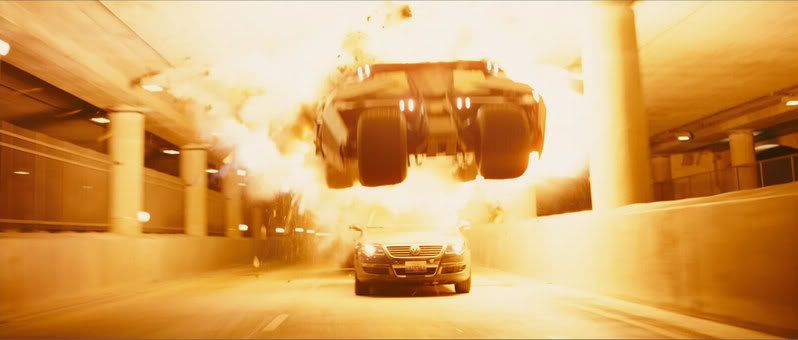
However, Nolan's timing is pretty great, which busts up my prior attacks. If his action sequences are not about movement (doesn't seem to be the case; most of the screen is a dark wash), then they could easily be about timing (he edits not on movement but on impacts and explosions), or, more broadly, about time. Things collide and splinter and fly based on certain speeds in these set pieces. Think of Batman jumping in front of the bazooka, and that mack truck flipping; think of the opening heist's precision. This plays on a thematic level, too: all the Joker's tests, indeed plans, are structured around countdowns. He puts the city on the clock. This gets at finitude. What's complicated about this is that for all his talk of chaos, for lack of rules, the Joker is following one of the biggest rules, and setting a concrete rule, of the world. He laughs at Batman: "It's only a matter of time before you break your one rule." Like you said, Jen, Joker overestimates his understanding of the impulse to do good in the world, thinking time is the best pressure cooker tool. Perhaps this film is arguing that time can work for you as much as against you. Perhaps it is about circumstantial ethics after all. Or, perhaps, this kind of generous reading misses the boat completely by getting away from the power of the myth underlining all this silly action film phenomenology-ontology-hermeneutics.

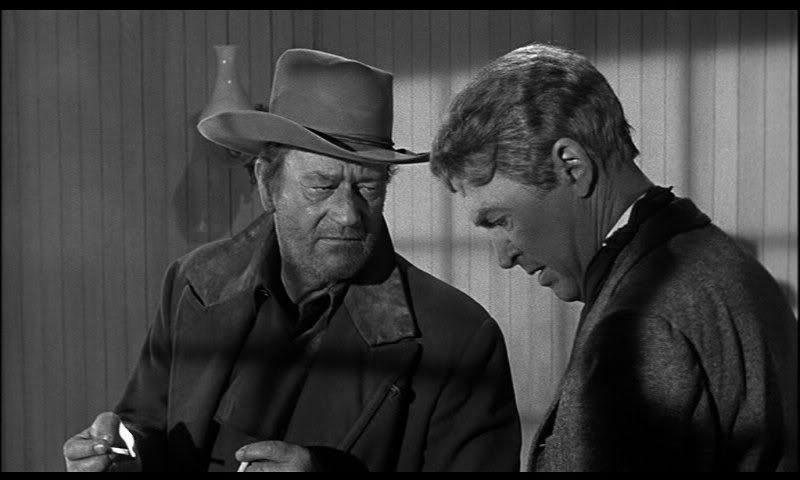
I don't know. I don't quite think so. I'm still intrigued by how this film, and Fincher's and PTA's, are the ones that activate your intrigue in personal limits, but I don't know what that has to do with time other than how those films figure time (and its loss in Fight Club, in TWBB), but I think it has a lot more to do with myth (even though the two are related; myth seems to stand outside time). I guess what I'm saying is our reactions so far seem to say more about us than they do about the film. Except you've out done me: not only were you moved by the film, you came up with a reason that made sense: all that empty space as indicative of the moral peril of the film. All I can counter is that I find that much more effective, and convincing, in other films about this scapegoat myth; most immediately in something like The Man Who Shot Liberty Valance. (This entails a complicated argument but I'm thinking Rene Girard thanks to talking with FRG, so: cf. "The Unity of Violence" section for a brief gloss.)

But I don't want this to turn into a pissing match. That doesn't get anywhere. What I mean is that I think the lie in Liberty Valence seems darker, and more emotional, to say it comes with more weight and consequence than the lie in The Dark Knight -- all of which may be a product of the construction of the films. And, for me, that starts (but doesn't stop) with the female anchor for these two tales. I didn't buy the love stories of The Dark Knight precisely because I didn't buy that a woman like Maggie Gyllenhaal (as written, as acted, as lit by Wally Pfister) could precipitate that kind of love triangle. Vera Miles may not have that much more to do in Ford's picture but she certainly looks and acts and is motivated to be that kind of woman. And here I go again making unfair comparisons. It's funny: every time I sit down to think about what it is I dig about the picture I come up with other problems I have with it. Maybe I'm thinking too hard about it -- or too harsh. Maybe I'm just not being honest enough with myself. Maybe I do need some theory (affect, time-image, etc) to get at what I dig on a visceral level. Maybe I just had some fanboy in my heart fighting to be heard and I can't listen. Maybe I need to see it in IMAX to really just let go and let it throw me around. What do you think?

the r. knight

prison hurts
free as a bird, now

Ry,

I hope I earned that generous response you gave, my man. Truth be told I'm scared to say much more about TDK, because it would risk more sympathetic invitation which may or may not come off. I think you're right about the story's ability to grip me but let you slip. Somewhere therein is the answer to your question, why this film. I could say more about why this kind of story - or a movie that dealt as it did with these ideas of identity and civic faith - did grip me, but as you suggested, that's probably at best interesting to you in a non-public conversation between us. Indeed, there's a whole dimension of film experience available only to friends in dialogue.

Regretfully I have not yet seen The Man Who Shot Liberty Valance, but I'd be interested to hear how the same kind of myth is told in a way that invites comparison and evaluation with TDK. The myth part sounds right to me, but the scapegoat part sounds a little insufficient. Part of the myth in TDK is the implied logic and consequences of the unique position Bruce Wayne afforded (quite literally) himself. He created an essentially anonymous identity in order to operate outside the law, yet ultimately in the name of justice. So already we have an uncontained excess jeopardizing the balance of the original system (as Rachel corrected Harvey about what happens when you "elect" someone to hold the privilege of power outside democracy: you create a Caesar and power is never restored to the demos). With Batman working for, but outside, the Law, one problem is that the Law gets too dependent on Batman's advantage of being unencumbered by due process (Batman is conveniently if not cheaply able to secure Lau's *ahem* extradition).

Another problem is that other versions of oneself (anonymous figures outside conventions of institutionalized morality) start popping up, the only difference being, these don't necessarily embrace the pretense of working for Justice. As Joker says, Batman completes him. Or he's just too fun to get rid of. The film sees Batman desperately wanting to hand over the power of (re)scaling justice to a properly elected hero. But Joker gets to Harvey Dent first. Here's where I could develop my earlier thought that, ultimately, TDK asks what a face is. The Batman myth is about the consequences of abandoning faith, that justice can be done by the faces its institutions make available. Harvey Dent, an elected DA, restores that faith. But Batman has already caused the jeopardy that ultimately corrodes Dent. Joker wanted Batman to reveal himself: it was only a matter of time before someone operating with Batman's logic exposes the easy vulnerability of his contradiction (you can't be outside the law yet simultaneously constrained by it. All Joker's talk of chaos is that rather simple point). The Dark Knight, then, is a proper Tragedy. Batman isn't scapegoated so much as revealed, and perhaps redeemed. He accepts responsibility by taking the previously unseen truth his masquerade allows: an explanation of moreso than resistance to the corrosion of Justice.

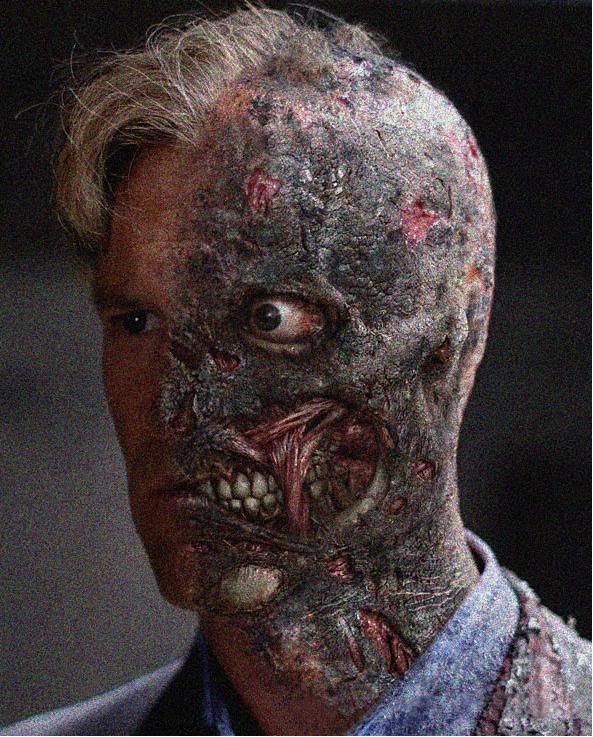
I'm not sure what to say cinematically about all this - the story as such is just that. Hence all my discomfort looking for ways to speak critically of being gripped by the story, for I suspect cinematic quality and story quality are somewhat irrelevant to each other (someone less gentle than I might mention Revenge of the Sith to you here....). In terms of how TDK uses its images to play out this story? Well, it's written plainly on each of Batman and Joker's, and Harvey's two faces. Harvey becomes the anguished split Batman ignored: the reality of only half a sanctioned face. Upon first reveal of the special effects Nolan chose for Dent's face, I was actually a little disappointed (ugh, skeletor face? How cliche). But now I like it more as a symbol of pure erosion as well as revelation: what makes a face (facade) appealing includes concealment, lest those ligaments be seen sufficiently as their own gruesome alternative. This is what Joker was attempting to reveal about Batman: he is just a gruesome enabler, of weakened justice garbed in the masquerade of its Knight.

Thanks, Knight, for making me think a little more. As for my own redemption, there's other films like The Darjeeling Limited, and There Will Be Blood, which aren't really about their ostensible "stories" but which occasion nothing less than an equal pleasure. To wit, perhaps part of my esteem for TDK is that it was totally convention narrative cinema, and I'd forgotten how much pleasure is still possible therein (hence identifying Fight Club as my antecedent).

My trouble is that I am much less confident trying to be a film writer outside the conventions of narrative cinema. Though I haven't given up yet.
~jk

swoop solo

Saturday, July 26, 2008

We burned the forest down. The Dark Knight, back and forth. Part One.


money for nothing and tricks for free

[This is the first part in a rather lengthy email conversation between Jennifer Stewart and Ryland Walker Knight. For readability, the call and response pairs will be split up. I'll update each intro with links as we pump out the rest. For now, though, here we are, looking all around, trying to make some sense of that first weekend. There are
spoilers throughout. Consider yourself warned! Certain forms of hyperbole will not be tolerated in the comments thread although we are curious if you have a thoughtful response to offer in order to continue our conversation. Just, please, don't make me turn on comment moderation. Nobody wants that.]

watch it wash away

Jen --

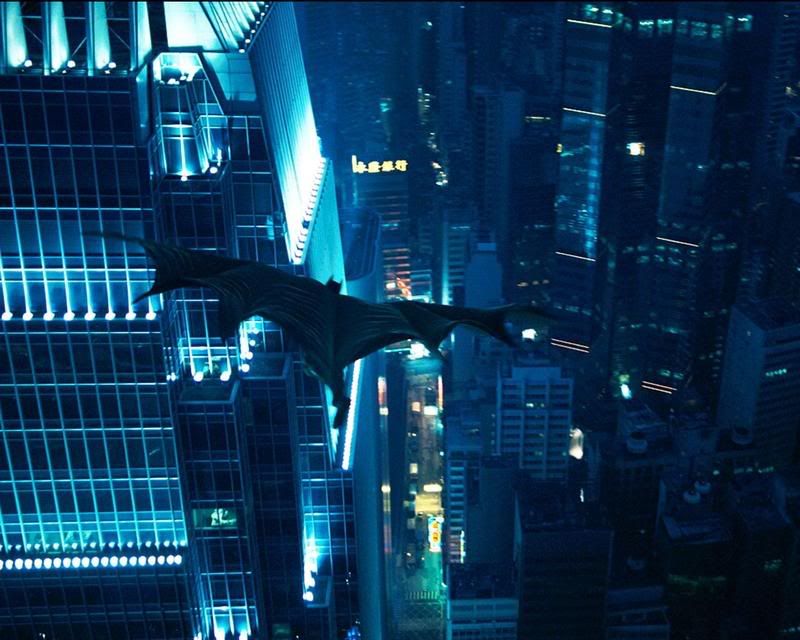
From the top: I dig it. I don't think it's the masterpiece some have claimed, but neither would I call it a bankrupt endeavor, just complicated. As a picture of the modern city (and its consequent perils), in a time such as ours, this is probably as good as a pop artifact can get. The Dark Knight may not have Michael Mann's poetry of imbalance (an unfair comparison despite the opening heist's nod to Heat), but Christopher Nolan's nearly anonymous Gotham has all the right sheen and transparency, grime and emptiness, shadows and nightfall terrors to scare you of its dark arena of violence. It's the insistence on the city -- in swirling helicopter shots most of the time -- that makes it more than a Batman movie and less a Batman movie than before.

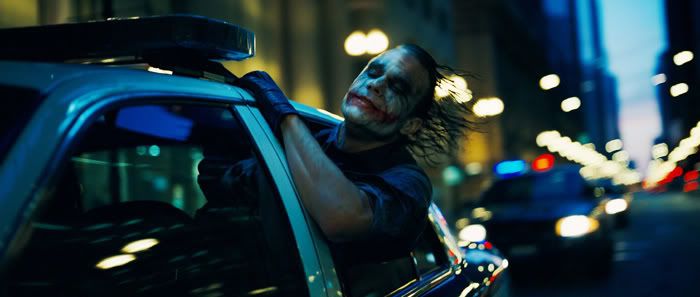
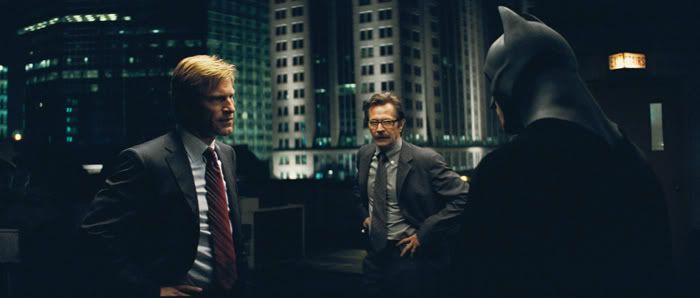
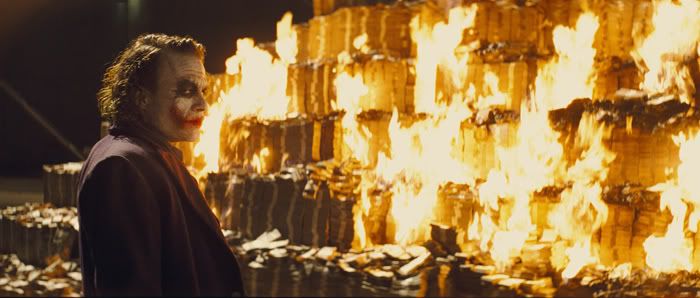
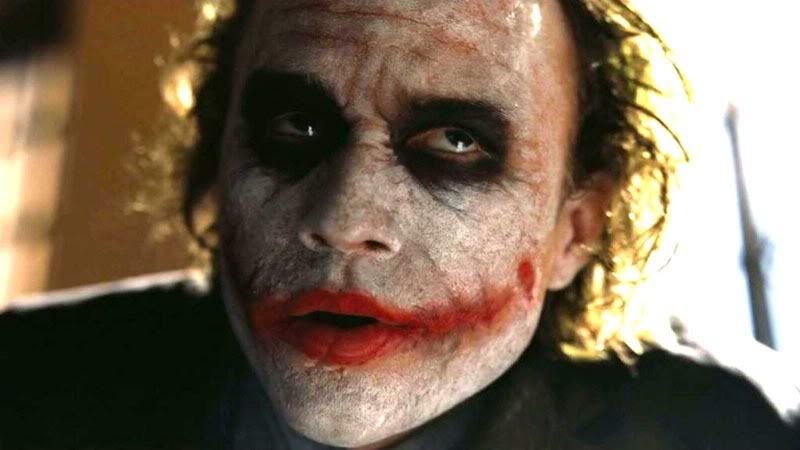
After all, it's the first Batman movie where Batman is just another part of the ensemble. Christian Bale may get top billing but he's by no means the star, much less that interesting (a shame). The real acting fireworks, so to speak, happen between the poles of Heath Ledger's typically hyperbolic Joker and Gary Oldman's beautifully understated Jim Gordon. Oldman's portrayal of decency grounds all the anarchic overflow of Ledger's embodied chaos.

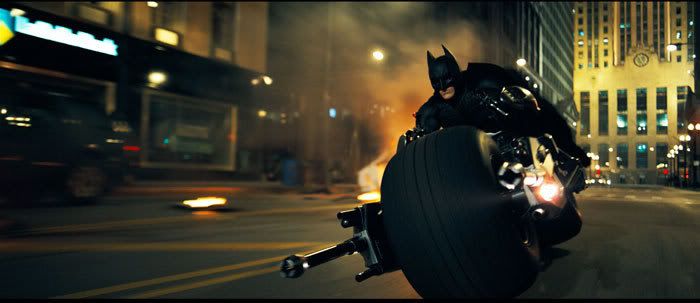
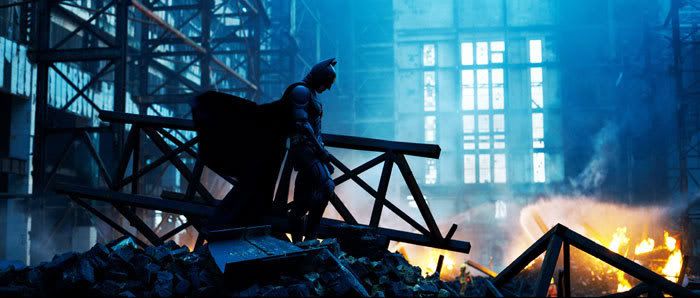
However, all too often chaos is more a talking point than an element of the action. That's probably my biggest problem with the movie: Nolan doesn't really know how to shoot action scenes. Or, more pointedly, he doesn't shoot fight scenes well. For all the kinetic activity, those handheld close ups make these encounters less about movement than about fractured collisions that can't find a visual resolution in space. Which is a silly, hifalutin way to say, it's too often cluttered and fussy, if oddly dynamic. I'm puzzled by his close-in action mise-en-scene, and (I worry) not in a good way. That said, the film is edited pretty well and the timing on the wide shots inside action sequences is pretty spectacular. That mack truck flipping has a real weight -- which is aided by the sound design. Again, it's hard to compare him to Michael Mann, or even Paul Greengrass, but those guys are more interested in space as an arena full of possibilities and energy (something I dig); Nolan's idea of space is more pragmatic, logical, showing an interest in the where but not the how. For instance: I dig that the climactic high rise site is open and under construction, open to plain sight, as it gets at the illusion of spectacle (and how we make or account for appearance in this Gotham) once more. And I dig how the sonar plays into that, too, but all the encounters within that structure are pretty straight forward, a series of scenes of Batman deploying pawns in the way of the final showdown.

What makes the action interesting, in the end, is how Nolan gives each sequence significance before and after, pointing away from the action. (I think this is why I liked The Prestige so much: it isn't an action picture. The Prestige is about magic, about manipulation, about spectacle, about perception; and here all his editing patterns make more sense. He's forming a way of seeing there (looking for details) that doesn't quite cohere in The Dark Knight.) In the most simple sense, the context for the action in The Dark Knight is the current mood of the country: the fear of unknowable threats, of ultimatums without rules. There's a lot of easy allegories to draw. But that's all abstracted enough into ideas about chaos (those talking points) and seriousness so that I trust the film will play when the next administration's getting ushered out of office. However, all that falls to the Joker, in monologue form, which speaks to Nolan's interest in story. I think he fashions himself a storyteller more than a filmmaker; at bottom, it's how Nolan and his brother Jonathan escalate the consequences of the plot with each successive sequence that makes The Dark Knight so compelling. If ever I was to appropriate that Bordwell term, it'd be here: Nolan has mastered "intensified continuity."

Okay. On the one hand, I'm impressed you were so ready to let this film whip you around and rattle your soul. On the other, I don't think the film earns the boat scene with Tiny Lister or Walter Chaw's description of Maggie Gyllenhaal's resigned acceptance as "the single most heartbreaking moment of 2008 cinema." Further, what I find so dark is not really all the terror and wreckage throughout the film but the final lie Batman concocts under the assumption that people won't be able to withstand the morally complex truth of Harvey Dent's rather literal fall.

But this makes it sound like I only dislike the picture. And I don't. For the most part I dig it. I'm just caught up in my formal/aesthetic criteria here and not moving to how this picture, and its popularity, might be significant, if, by nature, blown way out of proportion. Maybe we can get into that a little more as we progress.

--ry

stranger

Ry,
I'm in a strange spot. I've come to the tentative conclusion that my feelings for The Dark Knight are, well, just that. They're oddly resistant to qualification, yet smolder indignantly to hostile, very well-written reviews like Adam Nayman's for Reverse Shot. Not that I'm unthankful for you sending Nayman my way. But somehow it and Dark Knight has spawned a kind of crisis for me. Either I don't know who I am as a viewer, or I don't know what matters in film criticism. So I might be asking you to guide me back to the light. But first, hear my plight.

The problem is that Dark Knight really got to me. And like, 5 movies total have ever gotten to me. One of them was last year, at the Castro Theatre's special advance screening of There Will Be Blood. Previous was David Fincher's Fight Club, which I saw opening week, in 1999's Ottawa. What they all have in common, is that I was really shaken by each of them. And it was sublime.

I knew from Ledger's first scene that DK might deliver another such catharsis. I'm speaking of an intense kind of - for lack of a better word - pleasure, and it makes most or even (*gulp*) every other film experience pale in comparison. No, I think I mean that. I love Contempt and Battle in Heaven and Gosford Park and many other films. I can still conjure Reygadas' 360 sequence shot from Battle; the tingles it and other moments in that film gave me. (Still haven't seen Silent Light....). And I don't want to mitigate what those films are to me. Yet I don't know how to compare them to Nolan's Dark Knight, because DK created moral peril which actually, really threatened me. And that was riveting. I walked out not able to think of precedents, unlike TWBB's immediate conjuring of The Shining and 2001. But, then, on my second screening, when, in the interrogation cell, Joker laughs at Batman's missive fists and desperate demands to know Harvey and Rachel's whereabouts, it came to me like lightening: Tyler Durden. Fincher's and not Mann's or Greengrass' sense of action (more on that shortly).

Unlike Nayman, I had problems with Begins and thought its sequel better realized (casting REALLY helped). I'm tempted to say Nayman's problems with DK can be explained simply as, the film wasn't what he'd decided he wanted. Yet his impressive review made me second-guess my own enjoyment of the film. Could I have been wrong somehow?

A growing problem for me with film criticism is how easily formal concerns along with a kind of privileged ethics are made exclusive and essential. For example, I want to care about your worries over how Nolan realizes action. But I mostly have a hard time following them. I do like your point that if the action is shot closed-in, then we get fractured collisions (of say, body segments) rather than framed total movements. But why is that a problem? To me this simply signals different themes and concerns - quite literally, a different perspective on the action. Does action require a total view of bodily encounters, in order to "find a resolution in space"? You said 'twas all really just complaining the actions shots were cluttered and fussy. I guess I just don't see that. Or, even granting your premise, don't see why something else would necessarily be... better, somehow? In fight sequences, Nolan's camera goes in close so that Batman can appear and disappear suddenly - the sense of his superlative movement is created by these cuts that let his outline outstep the frame, even when centered in it. Fincher liked showing us local reactions to blows, and Nolan may be after something similar, which means the total scene of bodies having room to manifest the forces both impacted and exchanged during a fight just isn't the right profile for the shots. I'm likely in over my head here, so perhaps I should just say: you seem to be assuming there's a way to shoot action scenes, and Nolan ain't done it. Help us (me) scrutinize with your eyes: Who or where does that premise come from, and why should I care about it, especially when in order to see anything amiss in the film, it seems to first need assuming?

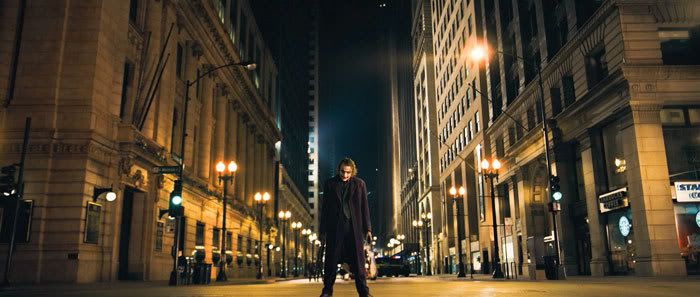
That said, I'm happy to say I strongly agree with you that Dark Knight ain't doing anything dark through themes of chaos, and certainly not as film-noir dark as some have hastily claimed. The triumph of DK's big moment is that Joker assumed more chaos than he could engineer: people are more attuned, less individualistic, if a little less civilized (in the bad, Rousseau sense of loosing sympathetic trust) than he imagined. Chaos in the film is simply Joker's attempt to remove some of the (already perhaps flimsy) partitions supporting an ordered edifice of civil morality. (Civil morality as in the ideological commitments to the sense of fairness that underly law, the courts, and the judiciary - also, the related concepts of what one should rationally desire and fear). Joker's desire not just to lay bare but to rip down these partitions - revealing the panic-inducing expanse of amorphous, unscripted moral interpolation - is seen realized in Gotham's inner and outer design. Nothing has proper walls: Dent's office, Bruce Wayne's bunker and penthouse -- all pillars and receding perspective lines, shelves and desks with only open, surface conspicuity. Even in Lau's Hong Kong architectural marvel, the walls and drawers are glass, revealing everything and waiting to be shattered. The precariousness of moral infrastructure: you take a vote on a ferry, but ooops, this isn't enough to resolve the threat. (Wasn't democracy suppose to be our political panacea?) I guess we could call the result 'chaos,' but despite his speech to (by now) Two-Face, Joker is certainly, definitely, a planner. He is an engineer, a scientist, and he'll say what it takes to realize his experiments. Joker's response to the ferry passengers' inadvertent solution to the prisoner's dilemma (why did I have no jade and all cathartic relief at that moment? Is there something wrong with me?), is to lament that all must be done oneself. I agree with Nayman that Gotham is the anonymous hero of the film, for the film sacrifices the false stability and irrational vulnerability of electing heroes to be "the face" of, say Justice. The city needs much more than one "white knight" who is willing to let his face bear the investment of justice. One wall can't hold up an edifice. One face can't take that much.

You said Nolan may be more of a storyteller, than a film maker. Well, I like stories. I like them a lot, because they shake me and I'm not sure but that might be one awesome reason to be alive. Images shake me too, and they can tell a story with images and/or with actors. Ledger and Eckhart and Oldman and those huge empty spaces with transparent partitions, was some of the best shaking I've had.

glass between us