With little footage to edit, there was only one way for this one to come together. However, I'm rather certain anything I shot there would wind up in a similar arrangement. And the fact (these facts) remain: this is what I culled from that magic. Yet this is hardly a full picture. Just another sliver, a few dots arrayed. To get a broader view (or more personal, too? I dunno), you can take a look at the flickr set my New Good Friend Rebecca has uploaded by clicking right here. There's a lot of sky there, too. More faces, though. And faces are good. Especially these two doing this and mine about to burst past the banister. I think Drew is saying, "Get big, gurh!" past Martha and Rebecca. We laughed a lot. And, I will admit, the 'zza was better than the burritos; and my tacos fell apart real quick. So happy we skipped Hunger to play in the sun.
Note: Ignoramus that I am, I just discovered imeem has video options. I shall continue to upload these to my youtube channel as well, since youtube is mega reliable and (cough) attracts traffic, but I plan on hosting the imeem versions here on the blog because, well, because they look prettier and imeem somehow understands, at a fundamental level, this whole digital is mosaic thing. Oh, and, you can (please) go here to see the previous Found Facts missives a little clearer. Nope: I'm not gonna go back and change the earlier posts.
Here we are, joining the internet radio fray, with our first attempt at a podcast. This is an introductory test run in a lot of ways but I think you might get a kick out of the Eddie Huntington song we've chosen to use as intro/outro music this week. We experimented with a lot of hosting options and finally stumbled on the really cool site, podomatic, thanks to my friend Daniel's usage (he's "casting" his last course at UC Berkeley and you can listen here). We've got our own page there: CLICK HERE TO SEE IT and subscribe to the RSS and, if you like, download the file for your ride into work. As for this episode, there's a lot of rambling, a lot of dead air, and my nasal voice -- all great selling points. Please, listen! You might have guessed, but we talk about Pedro Almodovar, Nicholas Ray, and melodrama with detours into some talk of my Telluride trip and Slavoj Zizek and a little bashful scolding (with a smile) along the way. And, as the song says, don't be shy, let yourself go with the attraction, and talk at us in the comments. If you want the song, you can grab it here and dance your butts off (although, if the owners request its removal, we'll happily and heartily comply).
"Live in the world, or something."
UPDATE: If you want to subscribe in iTunes, please click here and enjoy. To those who already have, we thank you, and await your suggestions, comments, critiques, gripes, enthusiasms. Again: I hope we get liven things up a little more on the next episode. If anything, there will be another (smart, kind) voice to break up our monotone madness.
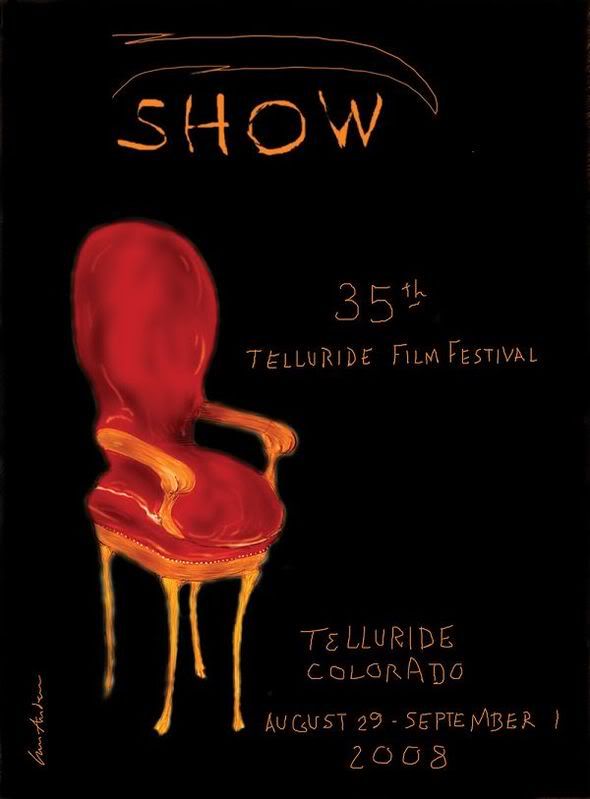
After a raucous eight hour drive complete with lunch stop in Paonia, I had time for the briefest of showers before our first Symposium function where, among other pleasantries, we were given our schedule for the weekend. Suffice to say, this looks to be fun. This morning and early afternoon are our pretty much our only free time so I thought I'd go ahead and detail what I've got in store ahead. And this is just a sliver of what the festival has to offer this year. Still, I don't think I'll be able to offer precise thoughts on all of this, but I'll give it a shot. Stay tuned.
_______________________
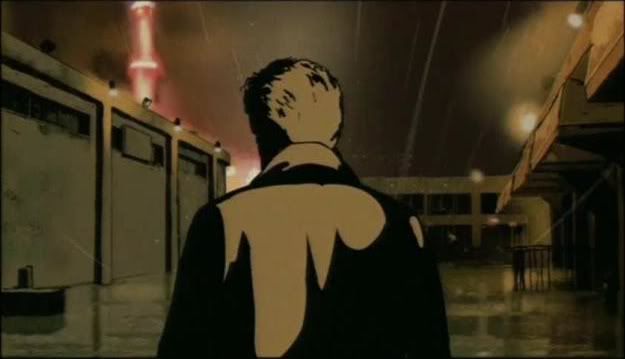
Friday: Most of the afternoon will be spent with the symposium, talking to Ken Burns, Peter Sellars and Paolo Cherchi-Usai. Linda Williams said Burns and Sellars have something of a spiel to impart but she hope we'll be able to ask some questions, and that we'll definitely have the opportunity for good conversation with Cherchi-Usai. Given his involvement with Kevin's project, I hope I can ask him about the role of criticism in film history, and preservation, beyond the obvious "more eyes can't hurt" argument. After that there's the "Opening Night Feed" with the rest of the town. Tonight we get to see Waltz With Bashir (dig) and A Private Century (a series of short films by Jan Sikl about memory using amateur "home movies"). Saturday: We get started early discussing films with the group before seeing The Last Command (Sternberg, 1928) before a quick lunch and an early afternoon screening of Mike Leigh's new film, Happy-Go-Lucky. In the afternoon we get to talk to one the festival's tributary David Fincher (others: Jean Simmons, Jan Troell, Richard Shickel) and Leigh before evening screenings of Youssou Ndour (a profile of the Senegalese musician and his plight to bridge an understanding of Islam outside "the fundamentalist monopoly of discourse surrounding [his religion]") and Innocence Unprotected, brought to Telluride by Festival Guest Director, Slavoj Zizek (this will be my second Makavejev in a cinema; that essay by Gary Morris is featured in the festival guide). Sunday: Another early morning discussion followed by the Indian film Firaaq, which Salman Rushdie has accompanied to help promote. Directly after that we get Laughing Til It Hurts, a group of silent comedies presented by Paolo Cherci Usai and his Pordenone Film Festival; this sounds like a real highlight. I hope there's time for a bite to eat before we hit the next film, With a Little Help from Myself (or, translated literally from French as "Help Yourself, and Heaven Will Help You"), from François Dupeyron, director of Monsieur Ibrahim. Our afternoon discussion features Dupeyron and his lead actress Félicité Wouassi first, followed by a conversation with Rushdie and Firaaq's director, Nandita Das. Sunday night ends with a screening of The Fall of Berlin, another Zizek pick. Monday: Again we discuss over breakfast before our last screening of Nicolas Ray's On Dangerous Ground, another pick by Zizek in his sidebar, "Neglected Noirs." The last official symposium activities are a noon seminar and Labor Day Picnic followed by a two hour block with Zizek to wrap it all up.
I've known for a while now that I'll be attending this year's Telluride Film Festival as part of the Student Symposium. But now that I know I've got my travel arrangements squared away, I thought I'd go ahead and blog about this exciting opportunity to invite recommendations (restaurants, bars, where to run, etc), donations (hey, it ain't cheap), stories (who did you meet?), any and all kinds of enthusiasms for one of the most unique film festivals I know. So unique that it won't announce its lineup for a while yet. But if tradition holds there will probably be a few of the Cannes '08 films, maybe some 2007 hold overs, and perhaps even a Hitchcock screening given Slavoj Zizek's post as Guest Director. Plus, as a member of this Symposium, I'll get the opportunity to meet and talk with the luminary artists of the festival; not to mention hang out with a bunch of peers similarly interested (I presume; to a certain degree) in film and film writing.
What I'm maybe most curious about are these opportunities to meet filmmakers and actors because I'm simply unsure what to ask them. I'm usually so wrapped up in my own reading of films that I hardly think of what I would want to ask a filmmaker. For instance: I joined a Facebook group for the Symposium and there were some pictures of an alumi standing with Eric Bana. First, Eric Bana is huge, like 6'3" -- and buff. Second: the first question I think of asking him is something idiotic and shallow like, "Is Marie-Josée Croze as gorgeous in real life as she is in pictures? What about Jennifer Connelly?" I mean, I could ask something like "What's been your most favorite job? Which director did you enjoy working with the most?" But those are going to lead to pretty canned answers about stuff I don't really care about. I'd rather learn what he likes to eat and drink; what's his favorite movie; what movie does he wish he could have acted in (from any period); whether or not he's gone river rafting. Sure, I could question him about the worth of film as an art and all that but I would only want it to come up in conversation. Maybe that's the problem: it's hard to get to that stage in "regular" interviews. Local hero Michael Guillen is excellent at generating a conversation (in printed interviews and in person) but he's a much more outgoing, lively personality than silly, self-conscious me. If somebody like Marie-Josée Croze shows up in Telluride I'll be happy if I don't blush too red, let alone ask her a question.
Perhaps this speaks to my general interest in film as personal accountability. By my lights, a film writer's job is easier said than done: to account for his or her experience of the film and check it against the associations it produces (which change, screening to screening) to build some kind of evaluation of the picture. More and more I'm beginning to realize just how much of me there is in everything I write. Even when I try to avoid the first person, I'm betraying myself (whether my readers know it or not), which produces this constant stammering: the need to offer as many angles on a sentence as possible. But what's the value in me? I'm trying to talk about the art. That's always the goal: to turn out from in. I spend enough hours a day with myself. When I look back, the essays I'm most proud of either completely absent, or completely embrace, the words "me" and "I" (such as "The Touch", or "2007: It's okay to play catch-up", respectively). This is a prime example of what some people like to call the "subject-object problem" and what a lot of the philosophy I gravitate towards grapples with mostly through form, through these kinds of structural dialectics, through what I've called "stammering." But this kind of heady talk can quickly bore most people I talk to. I don't think Eric Bana or Marie-Josée Croze are all that interested in how we get out of the subject-object relationship through varying practices, such as Cavell's skepticism or Wittgenstein's language games or Gadamer's horizons or Freud's psychoanalysis or Zizek's Lacanian-Marxist approach. Then again, maybe I'm wrong. Maybe Eric Bana sought that role in Munich because he was interested in all the philosophical-theoretical crap at play (besides the obvious political and social agendas) therein. (I could probably write an interesting argument about Munich as a film about tradition as hermeneutics, about how we choose to participate in or diverge from tradition, how we define tradition not as a concept but as a form of life. Of course, you can write that argument about any number of films -- maybe any film, straight up -- but it's pretty unavoidable in Spielberg's almost-masterpiece.) In any event, I could strike up this conversation with Zizek himself, right? Maybe that's what I should mark on the calendar: the possibility of a seminar with the guest director and the attendant opportunity to talk hermeneutics with him. Failing that, there's going to be movies playing, of course, that I can talk about with my fellow symposium participants.
Looking over Telluride's program for last year, I see a lot of the Cannes '07 films, which makes me start to look back at the big films from Cannes '08 that might make their way to Colorado this year. Luckily, Andy Horbal already did something like this, and I can look to his post, titled, simply, "Cannes '08". Of the likely candidates for Telluride, the Cannes pictures I'd most hope to catch in Colorado are (all links to David Hudson's tireless Daily GreenCine round up posts): Un Conte de Noel, 24 City, Waltz With Bashir, Gommorah, La Mujer Sin Cabeza, Synechdoche, New York, and, of course, the uncut version of Che. I'm sure there are others from Cannes '08 that are not on my radar (for whatever reason) and I'm sure there are others not from Cannes '08 that are not on my radar (for the reason that film does not start and stop with Cannes) that will surprise me. One title from the past year of festival circuitry I'm hoping Telluride schedules is Reygadas' Stellet Licht, since it has yet to secure US distribution either for a theatrical run or a home video release; and because I'd love to see it again on as big and wide a screen as possible; and because it might mean an appearance from Carlos Reygadas, a man I would love to talk to about film (sure) and life (more), a man that (I get the sense) has lived*. Another I hope to see is Barry Jenkin's Medicine for Melancholy, which I missed at SFIFF, for all the reasons Michael talked about here and for the other reason that the trailer is oh so charming.
If none of these films happen to show up in Telluride, I trust the experience will be fun and eye opening. I'll be sure to take pictures, and write. I haven't even gotten to the Silent Film Festival yet, and I've been feeling the strain of not earning much money, but with the Pedro Costa retro in March and my private (at home) Hou Hsiao Hsien retro these past two months, not to mention all those hours spent thinking and writing about Michael Mann and Terrence Malick (among other names) for my thesis this past spring semester (still holding onto it), 2008 is shaping up as quite an educational and enjoyable year.
*Also, I could ask him in person what he thought the chances of an America release are now given the shuttering of Tartan US. Looks slim. Such a weird thing, this recession, right? We can't even get screenings of those Mexican films with dialogue in Plautdietsch in the States now. Sheesh! What a world! UPDATE, as if anybody scrolls this far down the page: I got an email from Lawrence Boone with news of the fest and with code for this Festival widget. I think some other bloggers have put it up on their sites so I figured, what the heck, can't hurt to help promote just a bit more. I mean, I am rather excited. So here's the widget, with all kinds of features, like restaurant guides and photos, all in one tiny 350 by 600 pixel package.
I'm not telling you to make the world better, because I don't think that progress is necessarily part of the package. I'm just telling you to live in it. Not just to endure it, not just to suffer it, not just to pass through it, but to live in it. To look at it. To try to get the picture. To live recklessly. To take chances. To make your own work and take pride in it. To seize the moment. And if you ask me why you should bother to do that, I could tell you that the grave's a fine and private place, but none I think do there embrace. Nor do they sing there, or write, or argue, or see the tidal bore on the Amazon, or touch their children. And that's what there is to do and get it while you can and good luck at it. — Joan Didion




 Posts
Posts


