Showing posts with label MH. Show all posts

Tuesday, November 29, 2011

Summer CH Counterpoint

by Mark Haslam and Ryland Walker Knight


Tuesday, May 05, 2009

SFIFF52 #4: Portraits

by Mark Haslam


rear

Raymond Depardon's new documentary Modern Life (La vie moderne) isn't as interested in showing or explaining as it in building relationships: a relationship between director and subject, between viewer and viewed, between camera and household. For the film, Depardon returns to the same farmers of the Ardèche that populated his two previous films, and their continuing struggle to maintain a lifestyle that fast is becoming obsolete.

His visits are those of an old friend come back to catch up. With only his wife to hold the camera and a friend to record sound, Depardon is shown candidness and intimacy in conversing with the farmers. An amazing effect of his style is that, in the long silences that sometimes pass in conversations, it becomes uncomfortable for us to make eye-contact with the person on screen. We come to feel as though we're doing more than watching—as though, instead, we're interacting, a part of the dialogue.

The camera presents a lifestyle equal parts distinct and distant from ours, but it's one that doesn't need, doesn't ask for, and doesn't get an explanation. Depardon has very little interest, here, in the process of farming, apart from the impact it makes on these farmer's lives. Nor does he make points about modernity's forgotten people. Rather what he's interested in is people themselves: the things the say and the little things they do.

people

Modern Life is the third in Depardon's series, Profils Paysans. His films don't get much distribution in the States, so a chance to see on a big screen is an opportunity not to be missed. It plays again one last time on Wednesday.


***

money, baby

A restoration of Sergio Leone's Once Upon a Time in the West played at the Castro yesterday. As I'd never seen this one on the big screen, and as it demands the big screen, I went. I hope all of you made it out, too. The new print was made possible by The Film Foundation and the Rome Film Festival, with assists from Sergio Leone Productions and Paramount. The Film Foundation and American Express are presenting this and other newly restored films across the country. Keep an eye out for anything they bring near you.

***

light

In California Company Town, Lee Ann Schmitt documents the remnants of California's industrial towns—places constructed around business, and abandoned.

empty

The images were captured over a five-year span, and though the film is short, this sense of duration becomes integral to the viewing experience. We linger on objects and the landscapes that house them. Objects are given space and time, which empties them of a single message, of a specific importance.

tree?

We siphon through various meanings to place on the things in images, but they soon fade back into the desertion that has occurred all around them, and resume lifelessness.

cracks

Schmitt weaves these images with archival footage, sound bites, and her own narration—in a tone whose dryness seems to mirror that of these towns—to create a stunning portrait of the ravaged California that is all of our neighbor.

open
bullets

Wednesday, April 29, 2009

SFIFF52 #3: Oblivion + Bullet in the Head

by Mark Haslam

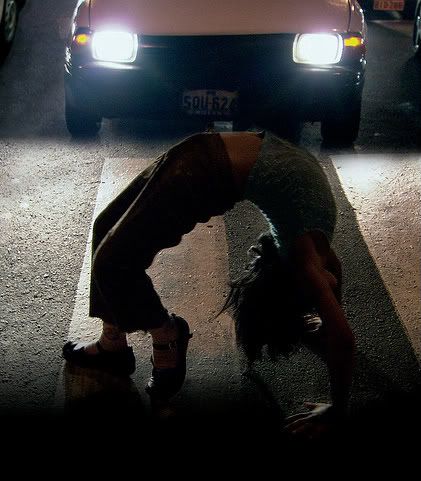
The subject of Heddy Honigmann's new documentary, Oblivion (El olvido), which I saw yesterday afternoon, is broad to say the least: maybe we can call it a history of Peru's modern politics, or an account of the many, many follies of the Peruvian government, or, just, Peru. Honigmann tells the country's story through its people, their memories and their frustrations and their dreams. The camera follows them, integrates itself, for a day or two, into their lives. Among the bartenders and waiters, shop-owners and leather workers, shoe-shiners and panhandlers that populate Oblivion, the most enigmatic to me were the street performers: boys and girls that cartwheel and juggle and handstand through crosswalks, in front of idling cars, hoping to get money from the passengers looking out of their windshields. The dynamic of these moments is amazing. Aren't we like the idling onlookers we movie-goers chastise for penny-pinching? And when they do give money, are they just doing it because of the camera, to look good? But then, aren't the people in the cars the same ones telling this story? So much happens in these crosswalks, as in every other moment of the film: each shot a rich history; each memory, each anectdote a loving cry.
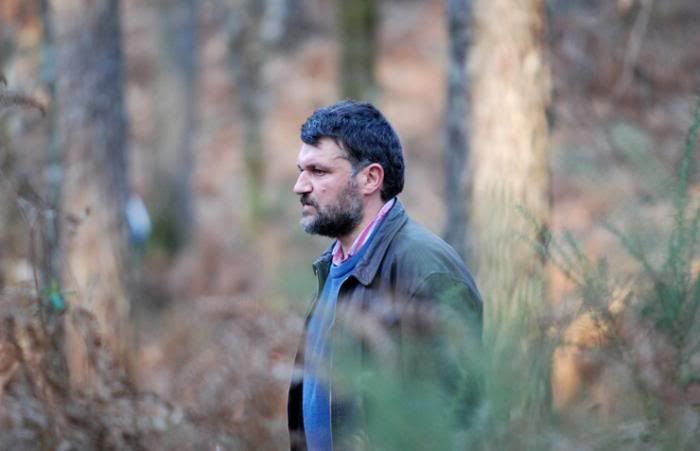
I went to Jaime Rosales's Bullet in the Head for two reasons: one, I'd heard that audiences had been walking out of it in droves, that it was 'difficult'; two, I couldn't get in to see Greenaway's Rembrandt's J'accuse. The 'difficulty' of Bullet is that there is no dialogue: the camera takes an embodied position, so that its position, which is always distanced from our main character, can't hear what anybody is saying. The narrative becomes a document of this man's daily life. Here he is with a friend in a cafe, there using a public telephone, here now at a party, going home with a woman, driving a car, etc. Yet these don't seem like 'difficult' concepts to me: space and voyeurism have been brought to higher levels of consciousness in film many times. Then again, I think (and the film gives you plenty of space to think) that 'voyeurism' might not be the right word—and here enters some 'difficulty'. We don't feel as though we're looking in on a life. The shots are too composed, all too orchestrated, don't feel at all like surveillance. Of course, a film like Rear Window is carefully composed—but there voyeurism lays beneath narrative; isn't, as here, the narrative itself. Moreover, a level of terror enters into each shot because of the title, which announces an event we think we know will happen. But do we want to see it? What agency do we have to not see it apart from leaving the theater all together? We're not voyeurs at all. We're not looking in, we're being shown, being made to watch. It terrorizes its audience, and I wasn't sure how I felt about. It seemed a different kind of terrorizing than that of, say, Michael Haneke, who deals with many of the same issues as Rosales. Where Haneke, for me, is a great success, I'm not sure about Bullet in the Head. I need to give it some space.

Tuesday, April 28, 2009

SFIFF52 #2: Tulpan

by Mark Haslam


hold it high

Camel hooves, a cloud of dust, and a modest yurt on Kazakhstan's vast, desolate Hunger Steppe. Inside the yurt, Asa is describing the terrible sea creatures he probably didn't see during a spell in the Russian Army. To one side of him is his goofy, fidgety friend, nodding along to every word, laughing with his gold teeth; to the other side and rather stern is his brother-in-law, a sheep herder in whose home Asa's crashing. He is speaking to the parents of a young girl, Tulpan, that he desperately wants to marry. The listeners either aren't impressed, or don't have much time for emotion. Tulpan, whose eye flashes briefly from behind a curtain (this is about as much as we and Asa will see of her), is also unimpressed. To Asa, the rejection means more than lost love: his dream of a yurt and a herd and a family of his own, a dream drawn on the underside of his collar, depends on his having a wife. This is the only way he'll be given a herd. This is the only way to pursue his aspirations.

Tulpan is the document of Asa's pursuit. It seems fitting to call it a document, because director Sergey Dvortsevoy focuses just as readily on the land and space around as on character and drama. (Dvortsevoy has made several documentaries, all of which I now want to see.) It is, after all, the land that houses Asa's dreams and frustrations. Dirt kicked up clouds the camera, and we see nothing beyond, are forced into the foreground and into the present. Or, gazing off into the distance, we see everything, which, here, is nothing. And yet, through Asa's eyes, the vastness, the emptiness of the steppe becomes exceedingly beautiful. I couldn't help but dream, while watching the film and even a little now, about a perfect life on the Hunger Steppe....

So much of what makes this life appealing is the animals. Not only are they charming as hell, snorting and snarling and rambling about, but they introduce a level of spontaneity that allows Dvortsevoy's style to flourish, enhancing the sense of documentation that powers the film. In my books, the long sequence of a ewe giving birth on its own makes Tulpan worth seeing.

a globe

I saw it last night at the Kabuki. It plays there again on Thursday. Tomorrow, watch out for Heddy Honigmann's Oblivion, which is playing for the last time. I will be there, and I think I might camp out to see Wild Field and Rembrandt's J'accuse later in the day. It's gonna be a long one!

keep it close

[A note: In case you miss it at SFIFF52, Tulpan will begin playing in the Bay Area May 8th as you can see here at the Zeitgeist Films website.]

Monday, April 27, 2009

SFIFF52 #1: The Weekend

by Mark Haslam


readings

I spent a good week staring at the line-up for the San Francisco International Film Festival, trying to decide what to see, what to skip. Making the decision to not see something, however, was near-impossible, especially with some 150 films from across the globe screening. So, as the fest kicked off last Thursday, I chose to not choose, to not plan. Instead, I'll wake up each morning, see what's playing, and, with perhaps some light research, pick a film to see. I'll report back here with my thoughts and my hopes that you in the Bay are enjoying the SFIFF52 as much as I am.

On Friday I caught Jonathan Parker's (Untitled), a satire of the contemporary art and music scenes. The film fails, I think, where most such satires fail: laughs come from a facile immediacy, from pointing at contemporary art as funny, silly, and stupid in and of itself. Parker knows the dedication that most of these artists have (being an avant-musician himself for many years), not to mention the sense of humor many artists have about their works. But the film misses these things. And when it tries to show them, we've been distanced too much to see the characters as anything but parodies—and ultimately too distanced to care.

Catherine Breillat's new film, Bluebeard, has two threads: one, a version of, “Charles Perault's 17th-century fairytale about a gloomy nobleman with a penchant for murdering his wives,” in Richard Avila's words; and two, a young child (named Catherine) with a penchant for tormenting her squeemish older sister by reading the gruesome story. A double story of sisters—two from the Perault story, two reading—the film wonderfully, subtely, Breillat-ly marries sexuality, wit, and self-consciousness. I'd like to write more extensively on Bluebeard, and I'd like people to see it. There's one last chance, this Wednesday. If it helps, check out Daniel Kasman's words after the film's World Premier in Berlin.

A new print of Antonioni's amazing, rarely screened 1955 film, Le Amiche, is a highlight of the Festival. It plays again on Tuesday at the PFA. It's Antonioni. Go.

ladies!

[A note: Don't forget to check out further, different SFIFF52 coverage from VINYL buddies Brian Darr and Michael Guillen and Darren Hughes as well!]

Friday, February 06, 2009

Saturday School: The Class Structure, or, Procedures of Breaking Down.

by Mark Haslam


class

It's strange—yet strangely on—to call Laurence Cantet's Entre les murs (The Class) a procedural. Strange mostly because it envisions teaching as improvisation, as precisely those moments when structure and procudure break down. Here, at communication's end, communication can (it hopes) begin.

...

We enter the class through its teacher, François Marin (played by François Bégaudeau, who lived and wrote the book on which the film is based). The camera follows him into the school, maneuvering the halls, picking up movement as profs set up their classrooms: one body bumps into another, darts through a doorway; a table is hoisted up and out of a room. It's exciting, excited, and anticipatory. Of course, much of this has to do with the fact that the kids've yet to arrive.

With the ringing of the first bell, movement/expectation shifts—to the students, yes, but, more importantly (and we can also say, as a result)—to language. The film is constructed around language and its potential to be played. So it's only fitting that the class we attend is a French class. Here, as in our English classes in America, kids are tought to deal with 'proper' language 'properly'. This, as an initial situation, results in tension—a tension immanent to power structures, where the idea of there being a way comes up against multiple, other ways. In The Class, in any class, really, the struggle which emerges from this tension is linguistic. (When Cantet, in an interview with Phillipe Mangeot, refers to a particular “scene where [François] answers that the difference between written and spoken language is a question of intuition,” we should perhaps hear the final word also as institution.) When M. Marin first introduces himself to the class, for example, the students instantly set to punning off of his name, beginning the language game that propells the film.

The teacher, however, plays the game with a disadvantage. He's isolated: spatially, for one—which allows, here, an occassional note to be passed, there, a stifled snicker, whisper, etc.—and second, bound by institution, socially—the constant evolution of language results in “lacunae,” as Bégaudeau calls them, ever opening between student and teacher. Yet François does not take the institution's approach to the emergence of these lacunae. He neither quells nor ignores them as threats to system, but recognizes, pursues, and actively engages their emergence.

Teaching is a navigation of the lacunae and the two bordering spaces. The pursuit of gaps in light of system's failure.

...

A scene's inception: a lesson plan, a question.

raise'm

Follow the gazes: they cross, but don't ever really meet; they branch (but from where?). There's something chaotic about their pattern, as lines in a Bunimovich Stadium. “[A] school is sometimes very chaotic,” Cantet notes, “useless to cover its face, there are moments of discouragement but also moments of grace, immense happiness. And from this great chaos, a lot of intelligence can be born.” Existing between the walls, a bounce and redirection occurs over and again. The lesson plan proposes a direction. Its desire is to impart direction itself. Each gaze, in turn, proposes its own direction, or rather, holds the potential for a shift. With a question, the potential is realized; chaos emerges in/as language.

Cantet's process mirrors these gazes: “...what we planned to do would require three cameras: a first, always on the teacher; a second, on the student at the center of the scene, and a third prepared for digressions....”

raise'm

Each camera, which together compose The Camera, entail both a structure and its unraveling. One eye trained on matters at hand; the other, rolling and wandering as if of glass. Entre les murs builds itself out of its own disregard. Through these cameras, seeing becomes a component of chaos, but also forms chaos into a pattern. When François pursues the students tangents and diversions, it's to make them no longer tangents and diversions. It's to make chaos the thing. He acknowledges a certain flow and flux within (the, this, any) class: the moments before the Big Bang, approaching phase transition, before a something emerged. The scenes that result from transitions aren't a part of any narrative, rather they're (linguistic) events. Parts composing a whole—individual acts of creation and resistance. Random, no doubt—like the appearance of language itself from sound and tone. But taken together they form, even in breaking from system, their own structure. The structure of a game, but nobody wins out. Nobody can, but nobody needs to.

...

So, yeah, structure must be set aside. Teaching must fail in order to continue. Okay. But Entre les murs isn't Dead Poets Society. Nor is it Half Nelson or Finding Forester or whatever. It doesn't want anything to do with life lessons and breaking from tradition and inspiring those poor, underpriveledged kids. Every moment of success is followed by a moment of failure: As soon as the class's official troublemaker, Souleyman, displays a moment of brilliance, or at least a moment of hope...a different incident leads to expulsion proceedings. Teaching's limits frame each image—are, in fact, often conflated with its successes. The film doesn't demystify the profession; it just approaches it without illusions. It documents, in other words. Here, finally, we see it as a procedural. A real desire to show everything about teaching emerges at the center. And though words like “real” or “accurate” may cause some cheeks to blush, I want to use them.

But, then, the reality of a school is performance. To be a teacher, to be a student (in middle-school, no less, where masks are the most colorful and the most varied) is to act. So, really, it's not hard to believe that the teachers and students in the film aren't actors, but are teachers and students—mostly because, well, they're so believable. Improvisation is what their stations already require of them. The film's desire to document, to unfold procedures, reveals this theater. School, sure, but more: “a sounding board, a microcosm of the world...”

...

The film ends with images of the empty classroom. Sounds from outside, where life continues to an impossible order, sift through the windows. Desks remain, but disarrayed—remnants of chaos in pieces of institution. And the cameras which documented the students? The year's procedures and performances having ended, they're just rolling. Or are they waiting? Is this perhaps not a winding down, but a gearing up again? The shouts and screams coming in from beyond are language before language, and so the potential remains between the walls—a space neither in nor out, but within the gaps that emerge between here and there, where chaos, which is seeing, becomes the lesson.

This is where learning happens.

acknowledgment

[The Class opened at The Smith Rafael yesterday after limited runs in New York and Los Angeles. Sony plans to roll out the film further as it has been nominated for Best Foreign Film in this year's Oscars. Check your local listings. Learn something.]

Thursday, January 15, 2009

The Che letters. Part One: Questions, Declarations, Navigations

by Mark Haslam


to the people

[Ed Note: Here begins our ensemble attempt to wrangle our, let's be blunt, surprising enthusiasms for this film. Since the film is so large (without ballooning), we thought it appropriate to situate our understanding in this epistolary form, a series of calls and responses, that may speak to the nature of Soderbergh's film and its ostensible subject—and how these braided objects nail their aims across manifold divides. Our aim, it should be obvious, is to make the polymath sing. Update: Click for Part Two and/or the whole series]

cuba
bolivia

[Preamble notes from Mark: (1) Bay Areans, CHE: THE ROADSHOW is coming to us, hitting the Embarcadero tomorrow, Friday the 16th. And as a special treat, cuz you're all special, Soderbergh will be in house to answer our questions. For those in the East Bay not willing to cross the bridge or duck into BART, it will open as two films at the Shattuck Cinemas in Berkeley next Friday, the 23rd. (2) It may be useful to keep Pedro Costa's seminar (at ROUGE) on closed doors in mind. (3) Also owe a look to: The Cry at Zero.]

so wistful
mexico city

“Che is not about Che."

Ry,

After a single viewing of Che, this is all that seemed appropriate to say; the one thing that I (to whom confidence comes but rarely) am pretty damn confident of saying. And here it's remained, at the top of a piece of paper, awaiting the explication it seems to deny. And the question it implies produces a response both silent and choral, a nothing and an everything: “What is it about?”

Our first approach faulters. We stumble, or stop, and wonder, how do we approach Che? So much criticism up to this point, positive and negative, tends to description and observation (itself an impressive feat, given the scope and scale) over analysis or thesis; few attempts at a true approach to understanding the film have been made. But then: do we approach in the first place? And if not...? Aha, an avenue: only in resisting representation does the film approach its figure. The non-approach must be our approach, too.

thru the woods

—certain films...are like doors, even if there are no doors in them. They resemble doors that don't let you enter as the protagonist of the film. You are outside. You see a film, you are something else...

For distance is a thing: tangible, like numbers. Especially for Soderbergh. Gaps, spaces, in-betweens...these are bricks, mortar. An absence or offsetting of one thing in relation to another, we come to see neither—or both, but only in the periphery—as our focus lands on distance. Indeed, it is focus, which seems so central to the film's technique that calls our attention to this: a camera—zooming in, zooming out—enacting distance.

But distance comes in many forms. If Cuba gives us Che, at times, at a physical proximity, distance is produced elsewhere. Take the battle sequences that are overlaid with Guevara discussing the ideologies, tactics, or justifications for the images we're seeing. His words don't explicate but complicate. Che doesn't speak in terms concrete enough for explanation. He is all ideal, totally abstract. Indeed, few figures in recent history have been as subject to abstraction as Ernesto Guevara, because, with him, it's easy: a man so determined by his ideals, so apparently detached from the material world, from his own body, that he already seems a vessel....

So, these sequences which might've been exciting and rousing are emptied out, abstracted. Again and again the image becomes an image of distance.

look at a remove

—that also is very important in the cinema, to love at a distance.

None of this is not distancing. I mean, it isn't aloof to us. We're not cast into indifference. I feel Che precisely because I am not asked to—better yet, I am asked to not feel for Che. The camera builds distances and in doing so builds avenues—long entrances. Entrances that are also closed doors. We see a film, we are something else... And the film, I think, like its subject, finds its center in love. But love undergoes a revision: think of Che's line that nobody is indespensible. This isn't intimate love. It's a re-vision of love—and, for that matter, equally of pain—that requires a response more than just reflex.

Our next approach then is a careful step, in step with the film, backwards. The images are abstracted: image distanced from itself. Meaning has been displaced, and the images, even those of triumph, now emptied out, take on the form of a lament. This is made clear in Bolivia, where everything feels, literally, dry, tapped. Even a downpour has no sense of moisture. In Cuba, death was Guevara's neighbor; present but only in the abstract, as one beyond your wall. Here, death is his house. “To survive here you have to fight like you're already dead.” This is the precise cry, the lament, love—a distance from yourself, an exile from yourself.

I can't help but think of those lovely moments of Che taking photographs of Bolivians. This is how he sees—through people. His revision (a second viewing) of self. Watching his body being carried away in a helicopter, their upward gazes correspond to his gaze, on the boat to Cuba, directed at Fidel.

carried away

—...and there are two distinct entities.

I think, too, of a Caetano Veloso's lyric (one redeployed in Jorge Castaneda's Che biography, Compañero) that says, “Navigating is necessary, living is not.” This is a film to navigate. Because it's a film that navigates with no intention of arrival. It resists. Is itself and not itself. Is exiled within the very place of its exile. The non-approach is seeing the film from over there. And seeing the film as a door at best ajar. The farther back we go, the less that we see, the less that's shown, the more possible it is to open the closed doors. We have to recognize the two ever dividing entities, Che and Che, us and Che, Che and us.

I offer this up as a way, maybe, to begin talking about Che. A way of approaching, and if we're brave, opening, the closed doors. As Costa says, opening these doors is work. So let's work, Ry. I want to navigate. Tell me!

Ever one last re-vision,
Mark

generous

Sunday, December 07, 2008

VINYL IS PODCAST #7: For your milk!

by Ryland Walker Knight and Jennifer Stewart and Mark Haslam


plus one, son!

[Podomatic stream]
[Direct audio download]
[iTunes subscription available]
[Simple syndication subscription]

RWK here. Yes, due to all kinds of life and extra-blogular writing, posting has been light over here on VINYL IS HEAVY. The main culprit, though, is a lack of reliable internet and, like, zero interest in cafés post-work. So stay tuned. There should be a flurry of hot new shit soon; mostly (still!) about Arnaud Desplechin. (In case you didn't know already: I'm freaking out about A Christmas Tale. That's the realness, peoples.)

But today we saw Milk. We saw Milk at the Castro Theatre in the Castro at Castro and Market in San Francisco. All kinds of heightened levels of signification and significance and emotions. Also, it was overcast. It's finally getting cold around this town. And it feels great. Add to all that: it was a packed house and we sat in the third row. Now if only Milk were a little better. I really want to like this prim thing (and I do, for the most part) but it's kinda-sorta inconsistent—and, yes, it would be nothing if it weren't for Sean Penn's sure-to-win lead performance. Everybody's said it, as if it matters, so why not add to this choir of obvious hype: they should bow-tie the Oscar and engrave that shit yesterday. He's great—he really is!—and his joyful posture, even in a frown, is truly something to behold. I want people to see this movie, especially in our current season, precisely because it was designed for everyone. Gus Van Sant set out to make the movie that the most people would find purchase with—and he did just that—without a lot of his recent formal/aesthetic flourishes; although, to be fair, it's not like we're talking Ray or Walk The Line here. But I'm tired, and it's late, so I'm just going to direct you towards some of the sterling words that have already been written in favor of this film's simple virtues. As Steve Brule would say, "For your milk, dummy!"

Finally, here's some songs you should buy.

Sunday, November 16, 2008

VINYL IS PODCAST #6: A waltz is a fault; like, falling.

by Ryland Walker Knight and Mark Haslam and Jennifer Stewart

turn away

[Podomatic stream]
[Direct audio download]
[iTunes subscription available]
[Simple syndication subscription]

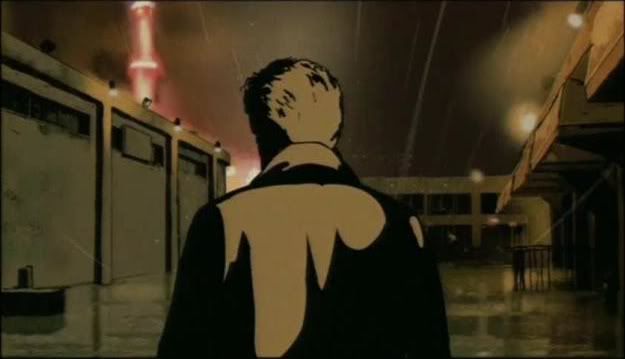
Today we saw Waltz With Bashir at the Landmark Embarcadero as the final film in the 3rd Annual SF International Animation Festival. It took us even longer to get home this time but, after some food, we talked on digital tape again. Last week's podcast saw us working through a very common reaction to Kaufman's film. This week we were more hesitant and disparate, largely because of Waltz With Bashir's traumatic ending. Juxtaposed with stunning animation, we struggled to account for the shock of its ultimate loss. Or at least, some of us did.... Ry's earlier thoughts can be read by clicking here, and we would also recommend the ever-astute Michael Koresky as well. Thanks for listening! Here's some songs; go buy them, too.

The Books - There Is No There
(zshare)
Squarepusher - Massif (Stay Strong)
(zshare)

Sunday, November 09, 2008

VINYL IS PODCAST #5: More synecdoches, more f-words, more more.

by Ryland Walker Knight and Mark Haslam and Jennifer Stewart

a look-see

[Podomatic stream]
[Direct audio download]
[iTunes subscription available]
[Simple syndication subscription]

[SPOILER WARNING IN EFFECT. There's no other way to talk about the thing, is there, Walter? Seriously, if you want to preserve the experience, don't listen. However, as we try to argue in the podcast, there's no way, really, to "spoil" this thing. For one, it's sour to begin with...]


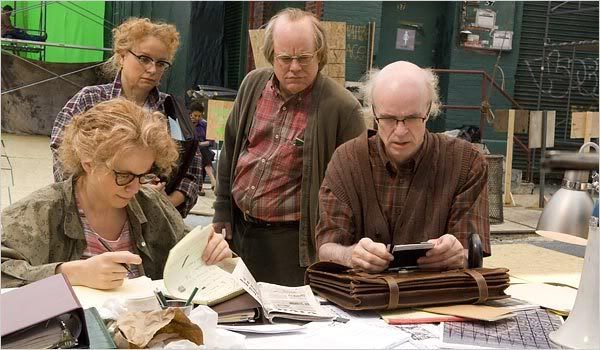
RWK here. On our third podcast, Mark and I discussed his first take on Charlie Kaufman's Synecdoche, New York (as well as Jean Eustache and, briefly, Jia Zhang-Ke), with Mark saying, "I liked it enough to not have an opinion of it right away." (He then put that reaction into some written words.) What I took and take that exit-poll impulse to mean is that he didn't feel it necessary to simply say, "I liked it," or, "I didn't like it," say to make a declaration of value. Because it's undeniable: this is a grand old meditation on major themes and concerns that continue to sprout up in cinema and, yes, in life. It's bound to shake, rattle and roll some souls. It's equally bound to simply turn off a large percentage of its audience, no matter its wit, right up front with some ugly images of festering decay and disease. Literally: dis-ease. There's little comfort in this film, although there are a lot of jokes. So, what does one do with this little beast? Well, we went straight home and talked on digital tape. We tried to form our opinions live. Of course, like the film, our conversation splintered and, in a way, as is always the case with words, it failed; or, it failed to resolve. And yet—even though an hour is a lot to ask of you, our faithful listeners—I think this is our best podcast yet.

The look-see: I'm torn between the two poles. The repugnance of the film is somewhat remarkable, even admirable, but it's still repugnant. It wallows as much as it falls away from the viewer. Not that I know them, but I understand why people like Walter Chaw and Manohla Dargis and Andrew "Filmbrain" Grant rhapsodize Kaufman's achievement, such as it is, with this picture; on the flips, an element of me was eager to indulge the "piss off" stance of my buddy Keith Uhlich, but not the "fuck you" of Rex Reed (no link needed for that bile). For all the yucky destitution of narcissistic projection, for all the death and dying, for all that kinda bores me (as well as Jen) with all that, there are some truly great moments, and cool tropes, as can be expected with Kaufman. The narcissistic projection, for one, works brilliantly: Philip Seymour Hoffman's Caden reading books as he imagines them, seeing himself in pharmaceutical ads and, um, building that massive and ever-receding and ever-multiplying theatre space. Add to that, that unlike Mark, I had an immediate and positive response to the film's negotiation with time: I think its fractal nature, with time splintering, works to exemplify its title; this is not a film about endurance. Caden does not endure lost time, he just keeps living in spite of himself, in spite of all the pills he takes and the cane he adopts and the losses that pile up (in the fucking street, no less) around him on his pathetic plodding towards death. In one way, I could probably develop a passion for this film as an argument in negative, as this is how not to live, since the film seems to understand this, but, at the same time, the film does ask us to spend our time with cumbersome and base decomposition.

If all a critic is to do is to tell you to see a film or not, then there's no two ways about it: I would say go for a run instead. But, as I understand it, my job, such as it is, such as I may be a critic (as much as simply a thoughtful person), is to argue for significance—indeed, for understanding—within the object over against of the object. So it's a tough spot. I'd like you to listen to our conversation, and I'd like it to continue, here in the comments as much as in future episodes, but I'd also like to remind you, that, yes, it's good and fun to go live in the world. And, you know, that Lola Montes talks about all these ideas, too, and it'll be playing at the Castro next week. For more on that film, though, you'll have to wait for a link. So, instead of that recommendation, I can just as easily (yes, with greater ease), turn to the other film I held up (perhaps foolishly) against Synecdoche in our podcast talk: David Lynch's INLAND EMPIRE. About 35 minutes into this hour-long talk we offer to you, I say, "I love INLAND EMPIRE for a lot of the same reasons I think a lot of people will love this movie. And they should. If this movie turns you on, and you find a lot of resonance with you, that is great—I'm not gonna try to take that away from you. Um, this is just, you know, this is just this. It's just three people—two of us are drinking beer—and, you know, but, INLAND EMPIRE, to me, is about everything that's going on in this movie, and it's a much more joyful thing. And a lot of it boils down to that. For me. Definitely. And that gets into a lot of goofy relativism right there, just saying, 'For me.'" But, as I couldn't formulate last night, all art is, in an basic way, experienced narcissistically, for the me that you are wherever you stand in relation to a film or a painting or a screenplay or a song or a novel or a dance. The trickiest part is to account for your self—to question your "me"—in a fun way, to be thoughtful and hilarious at the same time. Now I don't know if we're exactly hilarious here, but you'll here me laugh a lot in this, and, hell, that's good enough for me.

fire is red

This episode's intro and outro songs, for your downloading pleasure:

Wednesday, October 29, 2008

VINYL IS PODCAST #4: Burning Through Coen Country

by Ryland Walker Knight and Mark Haslam


America is a two way street

[Podomatic stream]
[Direct audio download]
[iTunes subscription available]
[Simple syndication subscription]

RWK here. Tonight Mark and I saw Burn After Reading at the Cerrito Speakeasy's 2-for-1 night where we enjoyed not just the film but some beers and some yummy 'zza. We decided that it would be a lot of fun to record some thoughts all immediate, so we tried our darn'dest to get back to my computer as quick as public transportation would aid us. It took a little longer than expected, and then we got sidetracked with songs, so our energy level was at a delirious low by the time I hit the record button. This episode is easily the funniest because it's a couple of tired goofballs joking through some scattered thoughts about a lot of things without much coherence. (In fact, Mark takes us on one helluva left turn at one point.) If anything, we hope this gets you goofin in the right way so that, while I may reiterate a lot of what I typed at Rob's place, and dominate our discussion, you might make your own sense of my/our argument in favor of this nasty, sad, hilarious film. That, or, you know, you could read this, maybe, since I share some thoughts with that smart alec. Or, failing purchase there, there's this witty dude, too. Finally: the songs in this episode speak for themselves, and you can find them here and here if, for some silly reason, you don't already have them. (Full disclosure: The Misfits track is all Mark, and, yes, I had to go find it to compliment our efforts here.) Oh, and, yeah, here's the quote from Cavell, ported over from this old post, and this book.
A summary of a film comedy written and directed by Preston Sturges suffers most in missing the continuous, virtuosic precision and intelligence of his dialogue, in no case more than in that of The Lady Eve. Sturges is one of the most remarkable mids to have found expression in Hollywood. Not until after the end of the Second World War, with the reception in America of the outburst of filmmaking in Europe -- including films of Truffaut, Godard, Fellini, Antonioni, Ingmar Bergman -- did an American audience become accustomed to finding a film written and directed by the same person. And Sturges' tight corpus of comparatively small-scale films occupies a treasure place in the hearts of those who care about the world and art of film; for example, beyond The Lady Eve, there are Sullivan's Travels and The Palm Beach Story and Hail the Conquering Hero. An instance of this esteem is recorded in the title of the Coen brothers' recent film, O Brother Where Art Thou? (with George Clooney and John Turturro), one of the most notable films of the past few years. It is worth taking a minute to say how that title inscribes a Sturges film.

The hero of Sullivan's Travels (played by Joel McRea, who is also the male lead in the remarriage comedy The Palm Beach Story, an interesting actor of considerable range, but less well known than the male stars, his natural competitors, of the remarriage comedies of the period discussed in this book) is a filmmaker whose great success is based on making thrillers with little intellectual or political content, and who wishes to make a film about something true and important, about suffering. The travels of the film's title are those taken by this director, who escapes the world of Hollywood escape in order to experiece the suffering of, after all, most people in the world, in preparation for making his important film of witness. The narrative takes him to the bottom of the world, in the form of being falsely convicted of murder and sentenced to a southern chain gang, where he discovers that the laughter provided by a Hollywood cartoon may provide the only rare moments of respite in a stretch of fully desperate existence. He contrives to be recognized in this place of anonymity, and returns to Hollywood to apply his hard-won insight, which means leaving unrealized his film of suffering.

The title of his projected work was to be O Brother, Where Art Thou? The Coen film, which opens in a southern chain gang, realizes this unrealized work by, as it announces, adapting (or more accurately, silently remembering names, and imaging sequences to realize them, from) episodes of the Odyssey (the Sirens, the Cyclops), taking as the overall adventure the return of an extraordinarily resourceful, or resilient, man to his native town to reclaim his sought-after wife (and children). The challenge the Coens take up, or depart from, in Sturges' fantasy of witnessing suffering, and which they seem to declare as part of their film (indeed of their corpus of fascinating films), is neither to record nor to distract from suffering. It is rather to witness, on the part of people who recognize, despite all, that life may still hold adventure, say hold out a perfectionist aspiration, but that to sustain a desire to meet the fantastic, unpredictable episodes of everyday modern existence, one must, and one can, rationally and practically, imagine that one will, at need, discover in oneself, in the register of passion, the resourceful persistence of Odysseus, and the mixed, but preponderant, favor of the Gods, call it fortune.

I hope Eileen likes some more eyes, cuz, well, I want to share a couple links to some smart things she's written recently: her review of BAR and a defense of The Simpsons as, well, a picture of faith: "Because The Simpsons is more that just a great show, perhaps the greatest TV show ever made. The Simpsons is bigger than that. It’s a model of the world as observed by a god that loves humanity, if such a thing were possible, which Chistianity claims it is."

Monday, October 13, 2008

Brief and Preliminary Thoughts on Complications in Synecdoche, New York (and Myself?)

by Mark Haslam

[Note: I guess we were wrong on our podcast: Synecdoche, New York opens in limited release in NY/LA October 24th, with a roll out schedule to follow, thanks to Sony Picture Classics. Still, Mark has successfully avoided spoilers.]
suck it up!

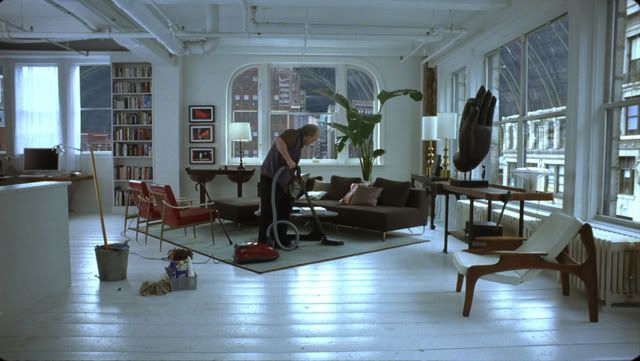
Synecdoche, New York had always seemed to me a great title. Not because of the claims it may make about film or image as inherently synecdochic or metonymic, which does seem just a bit easy, if not facile; rather, I liked it because of the simple play it makes on Schenectady, one that had never occurred to me. (Not like I sit around thinking up every pun possible, but while I'm at it, here's one I kinda dig on: 'fiancee' and 'faience'.) In light of the title, we have to think, in part, of place as a part of its inhabitant, as a part of a person's whole. Here, a place is not made up of humans, or not just, but a human is made up of, among other things, place. The film solidifies this in its presentation of the title, which appears subtilely at the bottom of the screen, as though a mere identification of setting. So 'Synecdoche' is not just a joke about 'Schenectady': synecdoche is the location: the location is representation. It makes sense, then, that Caden Cotard (Phillip Semore Hoffman), the film's protagonist, would spend a majority of his time in (re)building his surroundings as a means of creating something “personal,” a massive self-portrait. The act itself—of building and constructing; of acting in the first place, of performing—is fundamental to the creation of self. However it's also alienating and exclusionary: all relations that aren't Myself and My City are diverted away ('fiancee'/'faience'?). Caden can't commit and can't keep his women from slipping away, obscuring, then dying.

One of the more interesting or, and I hesitate to use this word but here goes, risky elements of Synecdoche is a burning house that nobody seems to recognize as having anything particularly wrong with it. In fact, it's inhabited by Caden's secretary and on-again/off-again lover, Hazel (Samantha Morton). It's the sort of thing that's funny-ish in concept, but (here's why I used it) risks becoming nothing more than Signifier. A house on fire, in this case, could only have meaning. But then Kauffman returns to the burning house, pursues it, prolongs our experience of it—it isn't just a gag, it reappears several times, always in a modified context—almost to the extent that whatever meaning we gave it is emptied out, so that what we see is the inhabitation of a Signifier, much like the process enacted by the title.
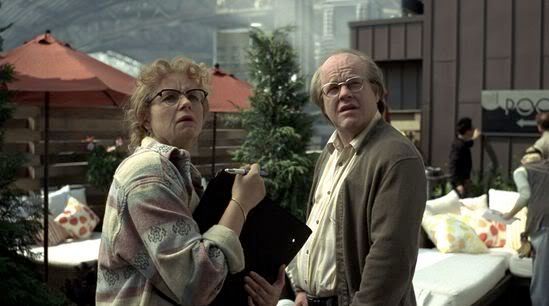
Yet Kauffman only “almost” does this. I mean, he does it, but it gets obscured by everything else he does. (Which doesn't even raise the question, If he hadn't done it, would it be there anyway simply because of the nature of film?) For as much as the film is about building and/as solipsism, it's about time, which like relationships keep slipping away, and death, whose approach never falters. Both are portrayed in a particularly Kauffmanesque structuration, which can jump decades without a flinch. But where this technique was successful in Eternal Sunshine, it's not so much here, because we rely on overt cues to tell us we've performed this temopal leap—things like, “It's been sixteen years.” The structure itself doesn't really communicate the idea of time, and so we feel lost. And it's not a good kind of lost.

Especially given that structures and their construction are such a major part of the film, it's hard to not see this as at best a missed opportunity, at worst as evidence of Synecdoche's ultimate failure: that it doesn't utilize form. No doubt, it's got some great ideas, ideas about space and time which seem natural to film; but they're not put together in any cohesive way. Things are jumbled, uneven. Leaving the theater, I couldn't escape the thought of what would've been if Kauffman had given things more time, allowed the form to unfold itself, gradually over time, so that we feel time slipping away from us as it slips away from Caden, so that the approach of the film's end really is that gradual approach of Death.

wait for it...

Saturday, October 11, 2008

VINYL IS PODCAST #3: Synecdoche, Eustache

by Ryland Walker Knight and Mark Haslam
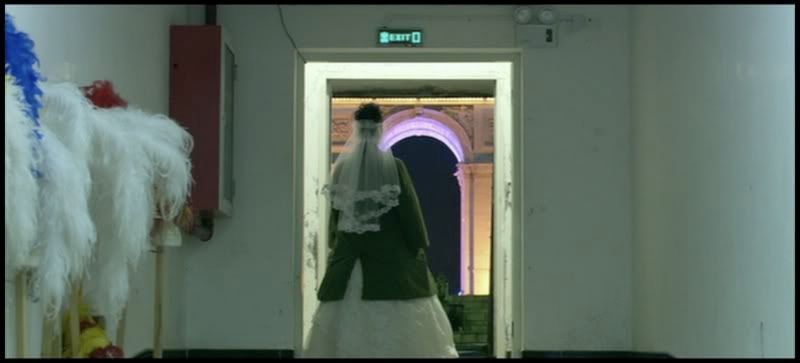

looking out
looking around
looking through

[Podomatic stream]
[Direct audio download]
[iTunes subscription available]
[Simple syndication subscription]

RWK here. We're back this episode to talk about some films we've seen but haven't finished writing about despite our due diligence (we promise) and a certain setback specific to Mark, which you'll just have to hear to believe. The episode starts with a talk of a recent advance screening in Berkeley of Synecdoche, New York that Mark was able to attend, which leads to a host of issues, including that trope of the/a title. In fact, I make passing reference to Michael Sicinski's review of Hunger, in which he makes passing reference to Charlie Kaufman's "regrettable" appropriation of the term as opposed to Steve McQueen's "mindbogglingly simple" solution to making the "Issue picture" viable though "cinema as synecdoche," which I then turn into talk about Bresson's cinema of metonymy, even metonymy of sensation, which somehow leads into (an altogether too brief) talk of our recent adventures with the current Jean Eustache series at PFA, which continues this weekend with, yes, a soft-titled presentation of Numéro Zéro on Sunday evening. There's also room for more talk of On Dangerous Ground and the Jia Zhang-Ke films I've been seeing, too, with special attention (at the close) to The World, which I hope to write about soon. Oh, and, there's two songs this episode, which you can find on my imeem page right here. (Again, if you want them gone, just shake a hand via email.) So, please, listen and tell us things. First, though, while our words (down)load, maybe look at these things--


Monday, September 22, 2008

VINYL IS PODCAST #2: Future calendar highlights, with Brian Darr.

by Ryland Walker Knight and Mark Haslam


let's talk money

RWK here. This episode: we're joined by local hero and blogging buddy Brian Darr, of Hell on Frisco Bay, to talk the upcoming rep calendar. Of course, any talk about movies, especially a talk meant to cover so much, will spill over into other topics and other films other than the films and film series at hand. We even divert into a talk about Cut Copy and their upcoming, sold-out show in San Francisco on Sunday, October 5th, as well as Gus Van Sant and Michael Haneke, among other things, including my trip to Telluride, again, of course. Speaking of: a big apology to Howie Movshovitz, one of the real cool pair of moderators/hosts for our Student Symposium (the other: Linda Williams), whose name I totally blanked on during our recording session. If you make it that far, you'll hear me grasping, failing, griping -- and coming up with Harvey. The reason I didn't follow Brian's "on air" advice and splice in some kind of edit correction is because I just want to let the tape run. As I say at one point, this is not planned. I like it that way. I did a better job of projecting my voice this week, I think, which might make it easier to listen to, but I still dig how un-NPR we are on these experiments. Thanks for indulging us. We're still trying to make this mic work, but it's tough. I've got a (pretty cheap) directional mic so it really needs you to talk at it -- it doesn't record the space of the room all that well -- and, as is natural, Brian and Mark turned towards me to talk, to perform our conversation, so their voices are a little lower than mine in the mix. So turn it up.

Once again, we've got some dance music to introduce and end the episode, and you can grab it here. Yes, it's Cut Copy. Oh, you want a link to the podcast itself? Well, you can click this link to load iTunes and subscribe there or you can click this link to find our podomatic page or you can click this link to download the file directly from podomatic or you can click this link to subscribe to the RSS feed. The choice is yours. And, of course, please tell us things in the comments. If you're in the Bay, tell us what you're most interested in, what we may have forgotten. For one, I know there's a certain en vogue auteur we didn't talk about that will be exhibited in San Francisco in October. Do you know who? Where? When, exactly?

Since this episode is about twice as long as the previous one, and I always appreciate Rob's breakdowns, here's some minute markers for our rambling talk:

Monday, September 15, 2008

Melodrama Mondays: All About My Mother

by Mark Haslam


red
"Since an ineluctable part of being a human self is suffering, part of what we humans come to art for is an experience of suffering, necessarily a vicarious experience . . . We all suffer alone in the real world; true empathy's impossible. But if a piece of fiction can allow us imaginatively to identify with a character's pain, we might then also more easily conceive of others identifying with our own. This is nourishing, redemptive; we become less alone inside."
-David Foster Wallace
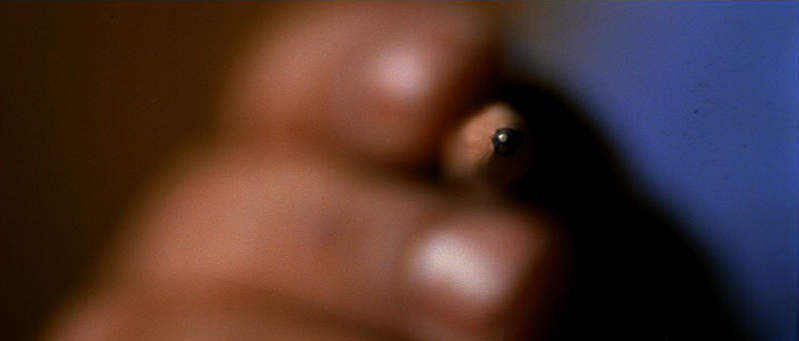
writing

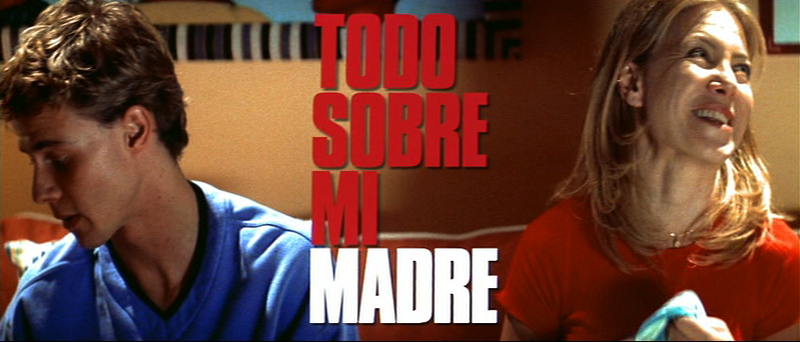
When it was released in 1999, critics hailed Todo sobre mi madre (All About My Mother) as an indication of Pedro Almadovar's "maturation" as a filmmaker. Return to those reviews and find the likes of “sobriety” and “depth” and “conviction” peppered about as evidence of this newfound maturity—all of which are placed in stark contrast to, as Andrew Sarris remarked in The New York Observer, “Almadovar's overtly gay sensibility..., canny distancing...[and] flair for voluptuous color compositions and sinuous camera movements” that made his films (cringe) “guilty pleasure[s].” Return to the film itself, however, and these estimations don't seem quite right: to shortchange Almadovar's style in this way is to ignore the fact that it's absolutely present in Todo. I'll concede—not that I'm actually debating with nine year-old reviews, but I'll concede that Todo sobre mi madre doesn't have the manic feel of Almadovar's previous films. But the style, that visual “flair,” as nebulous and uncertain as that word is, most certainly remains. I'll go so far as to say that it's exactly that “flair” (and I'll search for a better word in a moment), rather than some sort of self-restraint or self-censuring on the director's, is part of what makes Todo sobre mi madre what it is—that made that one teary-eyed critic shout, with the credits rolling, “Wring me out!”

What then is this “flair”? It's pretty easy, in naming it, to deploy terms like pizazze and passion and grandiosity, and even easier to makes terms up, like over-the-topness, and, you know what, they're all decent descriptions of Almadovar's style. Yet we know, at the same time, that they're insufficient, that they don't really describe the thing we're feeling: a feeling that I see as a trait of all melodrama, a feeling that I hope to explore more over the course of this column. I think Almadovar tries to elaborate on this style—our feeling—in the first twenty minutes of the film, which form a sort of prologue, an introduction to the narrative that begins after them. I want to focus specifically on the sequences that lead to the first death in the film, the incitement of narrative, that of Esteban, only son of our main character, Manuela. So let's see what it is we're feeling. Let's try to recapture it, as best we can. Let's watch.

Huma's watching
Esteban's writing

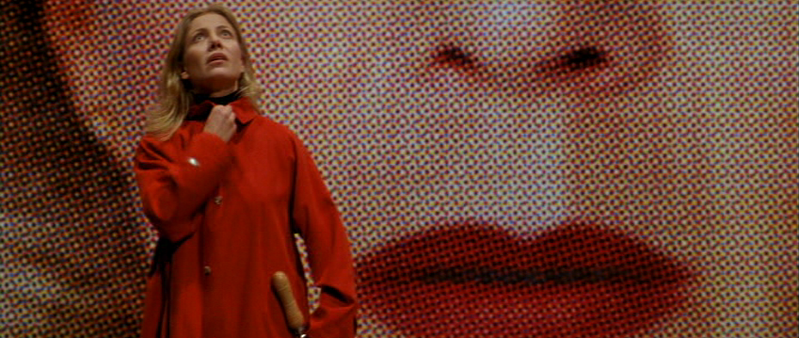
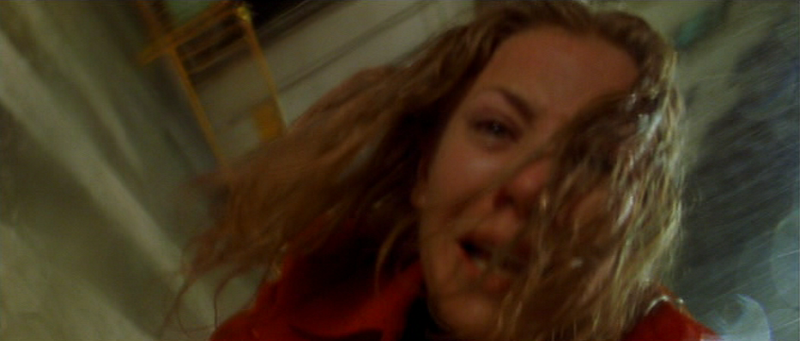
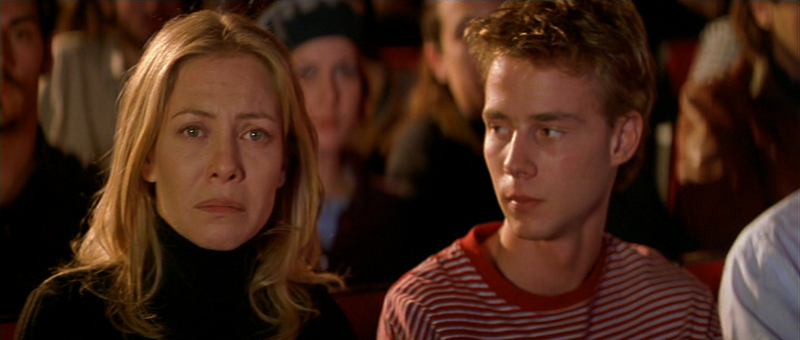
It's the night of Esteban's seventeenth birthday. He sits, writing, in a cafe, waiting for his mother to arrive. In the background is a giant poster for the play he and Manuela are about to see. The focus of the poster are the two massive blue eyes of Huma Rojo, staring at Esteban, at us. Indeed, the poster (the eyes) begins in focus, shifting second to Esteban in the foreground (a perspectival shift seemingly enacted by Huma's eyes). Manuela comes in, looking for her son. The head of Huma (which could almost be confused for Manuela's) looms behind and dominates her in the frame. And yet we see, now, with Manuela in the picture, the 'pixels' that compose the poster—that is, we see the artifice. Or, better still, we see the things that make it big, at the very moment that we note the bigness of the shot itself: Manuela's bright red coat and those red red lips, even the pixels are red: so, we're not only seeing different (practically competing) red things, we're seeing Red, itself: we're zooming in to the point that we just see Color: or, we zoom in just enough that we're shown the abstractions that composes the image. The image, in this way, interrogates itself. And, really, isn't that what Huma's eyes seem to be doing? Interrogating. Observiving. But that interrogation isn't simply the interrogation of self-reflexivity. This is why Almadovar begins the film with consciousness. Here, to me, is the brilliance of these opening minutes, for the self-awareness (mostly) disappears after them, so that it's not so much deconstruction as it is construction we witness—a building up to and of the film. We have to see, in the first twenty minutes, the production of fictions, but especially of this fiction. (Recall Esteban, writing down what is presumably the title of the film—a moment of inspiration—and then immediately after the title appearing on the screen.) Yet it's a fiction that hasn't really begun. That won't begin until Esteban dies.

broken shield

What, then—or is it, who?—is being interrogated? Of course, there's no single answer to that question. Two possible answers, though, would have to be: Melodrama and the Mother: or, consolidated, the figure of the mother in melodrama. Because it's Manuela's presence that seems to give away the artifice. Her entrance into the frame, the camera's focus on her, does not give space to the poster. But it is also the poster that threatens Manuela's hold over her son, precisely because it's big, because it's artificial. As we continue after the play, Esteban wants to get Huma's autograph. He and Manuela wait by the stage door. At her son's request, Manuela acquiesces to tell Esteban “all about [his] father.” Excitedly, joyously and lovingly he kisses Manuela on the cheek—but at that moment, Huma appears from backstage, the red of her name now fully apparent in her vibrant hair. How can Manuela compete with this red? She grips her son's arm, as if to hold him in place, but he runs to Huma's car. Through the window, they stare at one another, and the car drives off. Huma turns, peers through the back window. Her eyes (those eyes—to say nothing of those lips) appear clear through the pouring rain. Beacons whose pull is irresistable to Esteban, and so he takes off after them.

The camera pulls away from Manuela, but whose perspective is this? Is this the final glance back that Esteban never gave to his mother? Or is this Huma's perspective from the car? Is it Manuela she's been looking at? Both and neither: the camera communicates from its own 'perspective'. First an avenue for interrogation (possessing a certain skepticism, a sentience or awareness), it now enters into a realm of emotion. It emotes: pulling away from Manuela, it focuses on her, sympathizes with her. That move is, to me, nothing short of heartbreaking. Almadovar's style, the style of melodrama, is so much about form, not content, as the communicator of emotion.

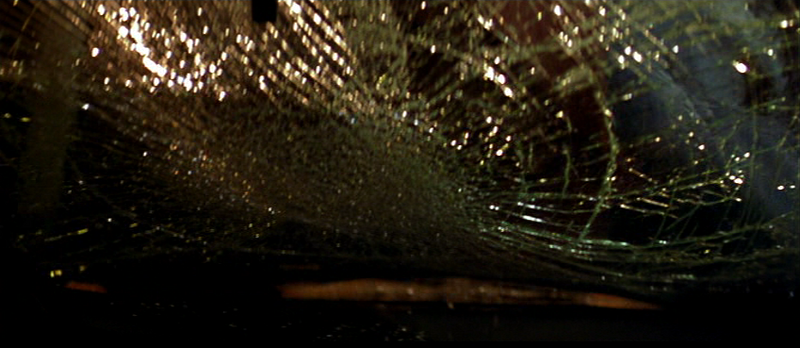
We switch then into Esteban's POV as he's hit; the camera spins, twirls, lands on the ground, and we get the final image, sideways on the wet pavement, of Manuela, her son now truly gone from her grasp, running to him.

What was Esteban seeking? Huma is the objet petit a, yes, but I think it's actually performance he's seeking. That is the unattainable object of desire. Esteban seeks the performance in (and of) life (his mother acting in her youth, and now, simulating the transplant situations). Huma is simply the manifestation of that desire. So it makes sense that Esteban seems to be writing this film, that he's Almadovar's alterego, and that his death represents a passing into narrative: Manuela sets off to find Esteban's father, to fulfill her promise to tell “all about [his] father.” (Note, though, that immediately after Esteban dies, he passes into voice over, a sort of ghostly presence that comes from 'behind' the camera.)

hit1
hit2
hit3
hit4
hit5

The awareness that we see in the opening minutes of Todo sobre mi madre is not the awareness of the post-modernist, ever distant, ever desiring to expose artifices; not really. It is instead an awareness that emotion is in construction and form. Melodrama is a genre whose tropes are so familiar and so transparent to us, but it's a genre whose form acknowledges and delights in these transparencies, these fictions and performances, and presents them as though they weren't transparent at all, as though they were every bit as real. The argument laid out in these first twenty minutes is an argument for the validity of artifice as a window into experience. Think of Agrado's speech about her various cosmetic surgeries. Or of Manuela, crying in the performance of A Streetcar Named Desire because of Stella, because she's lived Stella's life. Almadovar encacts, here, the vicarious experiences that melodrama (and fiction in general) offer to us: the “experience of suffering,” as David Foster Wallace said, that brings us to art. An experience that may be impossible in reality, but on which reality desperately depends.

reaction
all about

[Look at Ryland's companion image essay.]