Showing posts with label travels. Show all posts

Friday, March 25, 2011

Heft in here like still cold in the pipes water hitting your face

by Ryland Walker Knight


The visible and the invisible
—Like a ruler it both measures and defines the object

It's official, folks: I'm going to Cannes this year. I've been accredited as a correspondent/critic for the film magazine Cargo*, which is German in print but open to English on its blog, where I hope to write as often as possible about the films I see. Odds favor that I'll contribute some things to The Notebook for/with Danny, and I may have some other opportunities to write about my experience/s, but more on all that later. Hell, I don't know yet what we'll be seeing with any certainty. I sure do hope we see Tree of Life but all I can do right now is cross my fingers. (Well, that and save money.) In any event, what plays the festival and what doesn't play the festival—or, what I get to see, what I don't—doesn't matter to me as much as, simply, my good fortune to be in a position to make the trip. Not everybody gets to go to Cannes. So I promise to enjoy it, first of all, and, second of all, I promise to make my reports (whatever form they take) worthy of your time. That is, they won't just be tossed off viewing logs. I'll try to make real, cogent arguments for my Cargo blogging. I still might post a stray log (with links) here at home base, for fun, but I'm going to try to focus my energies outside my current, little routines.

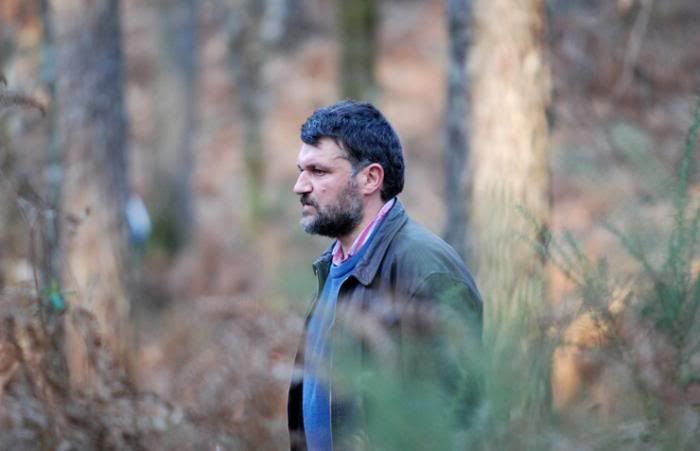
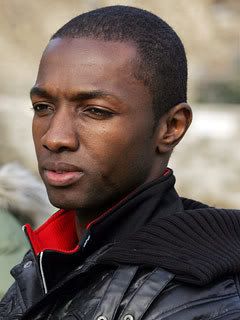
Since I know you're super curious (doubt it) and since my parents like this photo, here's the picture that will grace my festival badge for Cannes and for the SF Int'l just prior to my departure. I suppose offering the image is not just narcissism but also a reference if, by some miracle, you happen to spot me at either festival and want to say hi. Funds are slim (cough, we do have a tip jar on the side bar), but I'd be willing to buy you a free drink and talk about things beyond the silver screen. Otherwise, you can find me on twitter, as ever. I don't begrudge twitter haters, or people who've grown bored with my shtick in said arena, but I will say that I may (though I may not) tweet my way through the two fests and you might want to tune in (follow? subscribe?) to keep abreast of all my observations in a more immediate, two-point-oh way. Odds are good on the twitter angle, too—San Francisco in particular as it's kind of like a warm up round before the real plunge (and I do hope to swim some, I'll have you know)—but I've still got a day job in the meantime and it requires a lot of energy so posting, as it has for a while, will remain largely light around here. Just so we're clear. Until such time as I may say grace again at your table, or just post a viewing log, I bid you fond farewells.


* My latest essay for the magazine, on David O. Russell and The Fighter in particular, can sort of be seen by clicking here. The title in German is "Demolierte Pathosformeln" and Google does me a hilarious service by translating it as "Demolished pathos formulas" (I did not submit a title, fwiw).

Monday, October 04, 2010

Go, ye giddy goose, so should I be sure to be heart-burned.

by Ryland Walker Knight


A shout long silent across the sky
—A shout long silent across the sky


...

Do not believe his vows; for they are brokers,
Not of that dye which their investments show,
But mere implorators of unholy suits,
Breathing like sanctified and pious bawds,
The better to beguile.

...


Stocks shoot a nest
Warble and rise like a yellow willow
—Nesting habits armed with folios like fingers


...


Along the lithia, shot


...

Peace, good pint-pot; peace, good tickle-brain.
Harry, I do not only marvel where thou spendest thy
time, but also how thou art accompanied: for though
the camomile, the more it is trodden on the faster
it grows, yet youth, the more it is wasted the
sooner it wears. That thou art my son, I have
partly thy mother's word, partly my own opinion,
but chiefly a villanous trick of thine eye and a
foolish-hanging of thy nether lip, that doth warrant
me. If then thou be son to me, here lies the point;
why, being son to me, art thou so pointed at? Shall
the blessed sun of heaven prove a micher and eat
blackberries? a question not to be asked. Shall
the sun of England prove a thief and take purses? a
question to be asked. There is a thing, Harry,
which thou hast often heard of and it is known to
many in our land by the name of pitch: this pitch,
as ancient writers do report, doth defile; so doth
the company thou keepest: for, Harry, now I do not
speak to thee in drink but in tears, not in
pleasure but in passion, not in words only, but in
woes also: and yet there is a virtuous man whom I
have often noted in thy company, but I know not his name.

...


Ready to wear


...


Heaven's blush
—Thaw, and resolve yourself into a dew

Wednesday, December 23, 2009

A conjunction of quotations #8

— edited by Ryland Walker Knight


— Tod Seelie

1.
Nobody could have predicted that Copenhagen would collapse when the truth is that rich nations fully expect to flourish in a Greenhouse future behind high walls and hard-hearted armies and think that the same billions of humans will die from climate change whose deaths from starvation, unclean water, and cheaply treatable diseases they are cheerfully indifferent to here and now. Nobody could have predicted that Lieberman would betray the Democrats yet again when they have never made him face a real consequence for his serial betrayals in the past. Nobody could have predicted that neoliberals would think unemployment is a secondary consideration to billionaires staying billionaires as a measure of whether or not the economy is in recovery. Nobody could have predicted that California held hostage to an obstructionist Republican minority would rather turn into Somalia than make anybody pay taxes for indispensable services, or that a US Senate held hostage to an obstructionist Republican minority and a handful of Conservadems would destroy any chance for healthcare reform to help millions of their suffering citizens or to address world-destroying climate change or halt the re-emergence via the fraudulent financialization of the economy of a death-dealing immiserating feudal society. Nobody could have predicted that bailed out banksters would hoover up billions in cash to save their skins after squandering trillions in ponzi schemes and then refuse to change their behavior one bit. Nobody could have predicted that sociopaths will actually behave like sociopaths and that a system that celebrates sociopaths would not be a magical paradise.
— Dale Carrico

2.

Today is the first day of the rest of your life.
— Chuck Dederich

3.

There is no "rest of your life."
— Allison Ahlert

4.

Storm the Reality Studio and retake the universe - The
plan shifted and reformed as reports came in from his
electric patrols sniffing quivering down the streets of the
earth - The reality film giving and buckling like a bulkhead
under pressure - Burned metal smell of interplanetary
war in the raw noon streets swept by screaming
glass blizzards of enemy flak.
— William S. Burroughs

5.

That night a driving icy rain came up and lying in her bed, awake at midnight, Mrs. Flood, the landlady, began to weep. She wanted to run out into the rain and cold and hunt him and find him huddled in some half-sheltered place and bring him back and say, Mr. Motes, Mr. Motes, you can stay here forever, or the two of us will go where you're going, the two of us will go. She had had a hard life, without pain and without pleasure, and she thought that now that she was coming to the last part of it, she deserved a friend. If she was going to be blind when she was dead, who better to guide her than a blind man? Who better to lead the blind than the blind, who knew what it was like?
— Flannery O'Connor

6.

The woman who follows the crowd will usually go no further than the crowd. The woman who walks alone is likely to find herself in places no one has ever been before.
— Albert Einstein

7.

Never go on trips with anyone you do not love.
— Ernest Hemingway

8.

The words most charged with philosophy are not necessarily those that contain what they say, but rather those that most energetically open upon being, because they more closely convey the life of the whole and make our habitual evidences vibrate until they disjoin. Hence it is a question whether philosophy as reconquest of brute or wild being can be accomplished by the resources of eloquent language, or whether it would not be necessary for philosophy to use language in a way that takes from it its power of immediate or direct signification in order to equal it with what it wishes all the same to say.
— Maurice Merleau-Ponty

9.

What kind of beast would turn its life into words?
What atonement is this all about?
—and yet, writing words like these, I'm also living.
Is all this close to the wolverines' howled signals,
that modulated cantata of the wild?
or, when away from you I try to create you in words,
am I simply using you, like a river or a war?
And how have I used rivers, how have I used wars
to escape writing of the worst thing of all—
not the crimes of others, not even our own death,
but the failure to want our freedom passionately enough
so that blighted elms, sick rivers, massacres would seem
mere emblems of that desecration of ourselves?
— Adrienne Rich

10.

But if stars shouldn't shine
By the very first time
Then dear it's fine, so fine by me
Cuz we give it time
So much time
With me
— The xx

11.

Eventually, all things merge into one, and a river runs through it. The river was cut by the world’s great flood and runs over rocks from the basement of time. On some of the rocks are timeless raindrops. Under the rocks are the words, and some of the words are theirs. I am haunted by waters.
— Norman Maclean

12.

The greatness of The River—and the same can be said of the three major films Renoir made after it, The Golden Coach (1953), French Cancan (1955), and The Elusive Corporal (1962)—is inseparable from its modesty, its humility, its consent to limitation. It places itself not above but below politics, at the level of everyday life. The Golden Coach and French Cancan are celebrations of art that cherish its pleasure without pretending they will fix our troubles or transcend our sorrows, without aggrandizing them into anything more than a good time. (Christopher Faulkner thinks the films of Renoir's late period espouse art for art's sake, what he calls an "ideology of aesthetics." This seems to me in error. Renoir's late films remain socially aware even if they no longer contest the social order.They don't elevate art above society, they see it as working within the conditions of society: they are unassuming about the art they celebrate. Faulkner is an Althusserian and his ideology rules out an art that can make its peace with a social situation it neither endorses nor presumes to transcend.)
— Gilberto Perez

13.

As she entered the car, her first impression was that she was not on the train at all. It was merely an oblong area, crowded to bursting with men in dun-colored burnouses, squatting, sleeping, reclining, standing, and moving about through a welter of amorphous bundles. She stood still an instant taking in the sight; for the first time she felt she was in a strange land. Someone was pushing her from behind, obliging her to go on into the car. She resisted, seeing no place to move to, and fell against a man with a white beard, who stared at her sternly. Under his gaze, she felt like a badly behaved child. "Pardon, monsieur," she said, trying to bend out of the way in order to avoid the growing pressure from behind. It was useless; she was impelled forward in spite of all her efforts, and staggering over the prostrate forms and the piles of objects, she moved into the middle of the car. The train lurched into motion. She glanced around a little fearfully. The idea occurred to her that these were Moslems, and that the odor of alcohol on her breath would scandalize them almost as much as if she were suddenly to remove all her clothing. Stumbling over the crouched figures, she worked her way to one side of the windowless wall and leaned against it while she took out a small bottle of perfume from her bag and rubbed it over her face and neck, hoping it would counteract, or at least blend with, whatever alcoholic odor there might be about her. As she rubbed, her fingers struck a small, soft object on the nape of her neck. She looked: it was a yellow louse. She had partly crushed it. With disgust she wiped her finger against the wall. Men were looking at her, but with neither sympathy nor antipathy. Nor even with curiosity, she thought. They had the absorbed and vacant expression of the man who looks into his handkerchief after blowing his nose. She shut her eyes for a moment. To her surprise she felt hungry. She took the sandwich out and ate it, breaking off the bread in small pieces and chewing them violently. The man leaning against the wall beside her was also eating—small dark objects which he kept taking out of the hood of his garment and crunching noisily. With a faint shudder she saw that they were red locusts with the legs and heads removed. The babble of voices which had been constant suddenly ceased; people appeared to be listening. Above the rumbling of the train and the rhythmical steady sound of rain on the tin roof of the car. The men were nodding their heads;conversation started up again. She determined to fight her way back to the door in order to be able to get down at the next stop. Holding her head slightly lowered in front of her, she began to burrow wildly though the crowd. There were groans from below as she stepped on sleepers, there were exclamations of indignation as her elbows came in contact with faces. At each step she cried: "Pardon! Pardon!" She had got herself wedged into a corner at the end of the car. Now all she needed was to get to the door. Barring her way was a wild-faced man holding a severed sheep's head, its eyes like agate marbles staring from their sockets. "Oh!" she moaned. The man looked at her stolidly, making no movement to let her by. Using all her strength, she fought her way around him, rubbing her skirt against the bloody neck as she squeezed past. With relief she saw that the door onto the platform was open; she would have only to get by those who filled the entrance. She began her cries of "Pardon!" once more, and charged though. The platform itself was less crowded because the cold rain was sweeping across it. Those sitting there had their heads covered with the hoods of their burnouses. Turning her back to the rain she gripped the iron railing and looked directly into the most hideous human face she had ever seen. The tall man wore cast-off European clothes, and a burlap bag over his head like a haïk. But where his nose should have been was a dark triangular abyss, and the strange flat lips were white. For no reason at all she thought of a lion's muzzle; she could not take her eyes away from it. The man seemed neither to see her nor to feel the rain; he merely stood there. As she stared she found herself wondering why it was that a diseased face, which basically means nothing, should be so much more horrible to look at than a face whose tissues are healthy but whose expression reveals an interior corruption. Port would say that in a non-materialistic age it would not be thus. And he probably would be right.
— Paul Bowles

14.

I once claimed that the only audience of philosophy is one performing it.
— Stanley Cavell

15.

Comedy is the summit of logic.
— Jacques Tati

Friday, October 16, 2009

We Live OK: 22 Selections, 07.09 + 10.09

by Ryland Walker Knight


sunsetting 1
fielding
—Lucky clouds (return)

This eddy ends now, and I'd like to share my final collage of imaginary reportage. These weeks have seen me see plenty. However, I worry I saw more inside than out. But that's why I'm finding a line back to a coast—in fact, back to the gold coast. That is, back home. Time to own up to that: I'm a Californian. So with my smile widening, I look forward to playing basketball in the winter, to eating fresh vegies as often as I can, to the PFA's healthy calendar, to trips up to Truckee's snowbanks, to a quick flight south or north, to The Trappist, to pho, to the Mission, to yelping my way around more dance floors, to breaking that habit of you. Here's to the steps taken, and the leaps yet; to footfalls, maybe, turning into feathered-up flights from our hard-earthed dirt and from our tubes of infotainment. We must remember to move amongst! Thus, there might be a little less frequency here (and elsewhere) as the calendar year winds-grinds to a close. Priorities will be re-arranged and if I'm to live alone by my next birthday I will have to make some kind of living happen quicker outside this site.

So, enjoy this latest and last collection over at VINYL IS IMAGES.


—I see your light touch my eyes.

Friday, September 25, 2009

We Live OK: 9 Selections, 09.09

by Ryland Walker Knight


(i)
pink lady
—blame blur


(ii)
lil dog, big glasses
upside down
—rocks right sides


(iII)
had at
behind it
shine
—bling


(iv)
apple cobbler
—hot on the cobb


(v)
don't think
work out after dark
—patch'd, deck'd + gass'd

Friday, August 28, 2009

We Live OK: 5 Selections, 08.09

by Ryland Walker Knight


(i)
under a tent
—big top


(ii)
sheep
—who's left?


(iii)
stand tall, wrap
fall away
—wrapping route


(iv)
430am
—hours unto hours

Wednesday, April 29, 2009

SFIFF52 #3: Oblivion + Bullet in the Head

by Mark Haslam

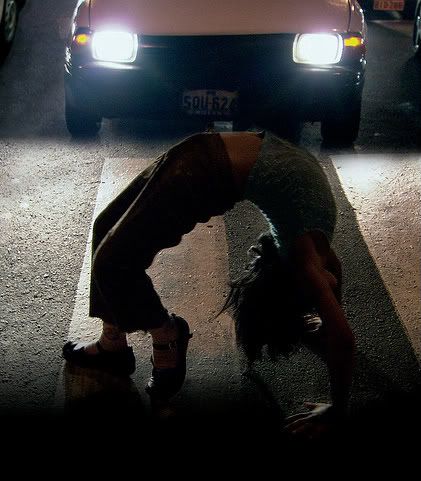
The subject of Heddy Honigmann's new documentary, Oblivion (El olvido), which I saw yesterday afternoon, is broad to say the least: maybe we can call it a history of Peru's modern politics, or an account of the many, many follies of the Peruvian government, or, just, Peru. Honigmann tells the country's story through its people, their memories and their frustrations and their dreams. The camera follows them, integrates itself, for a day or two, into their lives. Among the bartenders and waiters, shop-owners and leather workers, shoe-shiners and panhandlers that populate Oblivion, the most enigmatic to me were the street performers: boys and girls that cartwheel and juggle and handstand through crosswalks, in front of idling cars, hoping to get money from the passengers looking out of their windshields. The dynamic of these moments is amazing. Aren't we like the idling onlookers we movie-goers chastise for penny-pinching? And when they do give money, are they just doing it because of the camera, to look good? But then, aren't the people in the cars the same ones telling this story? So much happens in these crosswalks, as in every other moment of the film: each shot a rich history; each memory, each anectdote a loving cry.

I went to Jaime Rosales's Bullet in the Head for two reasons: one, I'd heard that audiences had been walking out of it in droves, that it was 'difficult'; two, I couldn't get in to see Greenaway's Rembrandt's J'accuse. The 'difficulty' of Bullet is that there is no dialogue: the camera takes an embodied position, so that its position, which is always distanced from our main character, can't hear what anybody is saying. The narrative becomes a document of this man's daily life. Here he is with a friend in a cafe, there using a public telephone, here now at a party, going home with a woman, driving a car, etc. Yet these don't seem like 'difficult' concepts to me: space and voyeurism have been brought to higher levels of consciousness in film many times. Then again, I think (and the film gives you plenty of space to think) that 'voyeurism' might not be the right word—and here enters some 'difficulty'. We don't feel as though we're looking in on a life. The shots are too composed, all too orchestrated, don't feel at all like surveillance. Of course, a film like Rear Window is carefully composed—but there voyeurism lays beneath narrative; isn't, as here, the narrative itself. Moreover, a level of terror enters into each shot because of the title, which announces an event we think we know will happen. But do we want to see it? What agency do we have to not see it apart from leaving the theater all together? We're not voyeurs at all. We're not looking in, we're being shown, being made to watch. It terrorizes its audience, and I wasn't sure how I felt about. It seemed a different kind of terrorizing than that of, say, Michael Haneke, who deals with many of the same issues as Rosales. Where Haneke, for me, is a great success, I'm not sure about Bullet in the Head. I need to give it some space.

Sunday, October 05, 2008

Found Facts. Telluride 2008.
Telluride #5

by Ryland Walker Knight


With little footage to edit, there was only one way for this one to come together. However, I'm rather certain anything I shot there would wind up in a similar arrangement. And the fact (these facts) remain: this is what I culled from that magic. Yet this is hardly a full picture. Just another sliver, a few dots arrayed. To get a broader view (or more personal, too? I dunno), you can take a look at the flickr set my New Good Friend Rebecca has uploaded by clicking right here. There's a lot of sky there, too. More faces, though. And faces are good. Especially these two doing this and mine about to burst past the banister. I think Drew is saying, "Get big, gurh!" past Martha and Rebecca. We laughed a lot. And, I will admit, the 'zza was better than the burritos; and my tacos fell apart real quick. So happy we skipped Hunger to play in the sun.

__________

Thomas Bangalter & DJ Falcon - So Much Love To Give (CD Promo Club Mix) (zshare)
Thomas Bangalter & DJ Falcon - So Much Love To Give (CD Promo Club Mix) (imeem)
[To whom it may concern: If you'd like me to remove these, let me know. I'm gonna trust it's cool for now. We got lots of love to give here, and that includes this song. So, thanks!]

__________

Note: Ignoramus that I am, I just discovered imeem has video options. I shall continue to upload these to my youtube channel as well, since youtube is mega reliable and (cough) attracts traffic, but I plan on hosting the imeem versions here on the blog because, well, because they look prettier and imeem somehow understands, at a fundamental level, this whole digital is mosaic thing. Oh, and, you can (please) go here to see the previous Found Facts missives a little clearer. Nope: I'm not gonna go back and change the earlier posts.

Monday, July 14, 2008

Fireworks. Pierrot le fou.

by Claire Twisselman

[Part of VINYL IS HEAVY's Bastille Day celebration. Click here to see our index. Click here to view all the entries at once. Click here to see Claire's accompanying image essay.]


left
right

Seeing Pierrot le fou in a big, dark theatre was a turning point for me with movies. I don't think my story is particularly out of the ordinary (see here). Godard is an often-traveled road into more serious film interest. His films are fun, playful, smart, rigorous, sometimes boring, hip, sexy, gorgeous and contradictory candy. And I eat it up. I've read -- and heard others say -- that Godard is a young person's filmmaker; that he's more important to young people than older people. I don't know if this is true, but I do know that his exuberance in the 1960s (like most young people, I haven't yet seen much past Week End) is pretty infectious. His movies are giddy for movies. I've since grown to like Masculin-Feminin more than Pierrot, but Pierrot will always remain dear for kick starting my fascination with a lot of French cinema. Or, at least, what the Criterion Collection has made available.

Originally, I told Master Knight that I wanted to write this when Pierrot was released by Criterion. But, as can be the case, I put school first, hanging out with friends second, reading the internet third and writing about movies for the internet a quite distant fourth. (Something I hope to "correct" in the coming year.) Part of my interest has been that the Criterion Collection has played a big part in my burgeoning cinephilia -- along with the ever-expanding blogosphere, Netflix, certain friends' eager recommendations and the rep scene I'm starting to pay attention to. The other reason I wanted to write about Pierrot is because the first time I saw it was in Berkeley, at the Pacific Film Archive, while visiting a friend who insisted we go (1) because the film was rare and is hilarious and (2) because film historian David Thomson introduced the film. Ryland has since told me that he was at the same screening.

All I knew going in was it was going to be a cool French New Wave film with jump cuts and widescreen images and a doomed love story. That's what my friend told me at least. What I didn't expect was how funny the film is. There's a lot of sight gags but my favorite may be up front when Jean-Paul Belmondo's Ferdinand, so mad at the banal "party" his wife has dragged him to, winds up throwing cake at her.

cake

That is, until the final moment with cartoon dynamite and Ferdinand's last second realization that he doesn't want to go up in smoke. Of course, he's too late. If love affairs are all about timing, and this film is certainly about love (that is, an idea or myth of love), then Ferdinand is at once a brilliant, terrible, hopeless and athletic romantic-comic. Or maybe that's just Jean-Paul Belmondo. Who, of course, is Godard's stand-in (his ideal or mythic alter ego), who Godard kills with tongue planted firmly in (blue painted) cheek.

blue
yellow
red
technicolor

It's certainly easy to think of this movie as Godard killing his already-ended marriage to Anna Karina. It's no doubt a turning point for the director, an awakening to new dimensions of cinema's duty to its audience: which is to say to the world. But, of course, part of what makes Godard interesting is how unsubtle his films shift. Things abut, they don't bleed. He's no Eisenstein but his movies rely on juxtapositions so that it's easy to ignore the in-camera mise-en-scene. Think of the central relationship of Pierrot, a cute flake and her hapless devotee. They're doomed from the beginning. They are their own fireworks. Everywhere they go they leave wreckage. They are ill at ease. In one light, they are Godard's cinema, his bi-polar desires for politically and philosophically aware films over against a B-movie impulse for guns and cars and pure sensation. In another light, the couple is simply an argument about what love does to people, how its impulses sway and push and pull and distort and blow up the world.

But they, that perfectly not perfect couple, brim with possibilities. And that's the appeal of the cinema, too. Furthermore: like Godard's cinema, they take and take and take: they steal their way south. Everything they do is commented on as from some place else, be it a movie or a country or a book or a song. Pierrot le fou is a great argument for recycling! How vomiting up your psyche can be sexy! How theft can turn into production! How (not) to fall in love. And how to look good doing it (or not doing it). The bottom line: keep moving. My favorite Godard movies are the ones that insist on pushing forwards. Although kind of brilliant, La Chinoise is like a stuck-in-a-rutt headache, its Leaud analog, Masculin-Feminin, runs all over the place, even if it spends a lot of time indoors. Also fitting that after his Technicolor adventure here with Pierrot he went back to cheap black and white (with Willy Kurant instead of Raoul Coutard lensing) for a more "documentary" approach. In a lot of ways it seems Pierrot le fou, and not Week End, is the real turning point for Godard's career. The last ditch effort to purge the romance from his system before he could concentrate on more rigorously formal, um, "exercises" -- not fun like the old days, the received wisdom tells me. But I seem to miss or refuse to hear those things. I'm certain that as I continue to look beyond the Criterion Collection and the distinctly New Wave period films I'll find yet more rich material from Godard. Except, I'll have to forge ahead knowing he left a lot of that goofy giveaway pop sensibility behind when he traded in Karina for Wiazemsky. In any event, there's bound to be fireworks in my future, just a different style.

dead
look
cherry cola
blood

Sunday, May 18, 2008

Commencement: Cleaving, floating and waving forward.


horizons
line of flight
wave

Monday, April 28, 2008

Sketches on Hoberman, Sylvia, looking and difference. [Part 2]


dazed

From: Jennifer Stewart
To: Ryland Walker Knight, Kevin B Lee
Subject: RE: hoberman, sylvia

Kevin and Ryland,

I have just a few comments all inspired by our pre/post film analysis and your fetching essay, Ry. Unfortunately my thoughts are more responsive and fragmented than yours are coherently developed. But I'll let you blogbarians take it from here.

Kevin, while on BART Ry and I spoke more about this phenomenology idea. I think your essay shows, Ry, that the film is more a phenomenology of spectatorship than a phenomenology of thought. What El was doing in the cafe as he looked and sketched, is not what I'd call tantamount to thinking but rather, to fixing a view; really, tantamount to intentionality: he's trying to settle what object his thought is bent on. And his efforts are subject to the interference of occlusion (other heads/objects get in the way), the limits/possibilities of two-dimensional collapse (the 'flat' surface of his sketching page), and the uncanny moment when these objects return his gaze, catch his eye. All goes well with his pursuit of "Sylvia," after all, until she looks back; until they reach the moment when he must account for pursuing her as a cypher for his desire. A moment he calls a disaster never really recovers from.

Two things I don't understand and think analysis of the film should explain:
  • what's significant about El sleeping with that beautiful but weird spaced out/drunk/bad dancer girl?
  • in the last few minutes, through the 'screen' of the train, we see a girl in sunglasses. The entire left side of her face is scared or burned. A few cuts later we see her again, removing her sunglasses to revealno eye (!) on that side. It was pretty gruesome. Kevin, you saw that, right? Ry somehow missed it so please confirm I'm not making this up.

Both these Sylvia dopplegangers (in some sense all the women in the film are) could be read as casualties of El's pursuit. The crevices, lines, and shadows of the scarred woman's disfigurement bears a resemblance to the dark, resistant etchings in El's sketchpad; the consequences of his agenda coming into relief. So we see your point, Ry, about El's fixation on the (absent) avatar of "Sylvia" and his rejection of the (present) abundance of difference. And here I think we add Bunuel's Obscur objet du désir to Kevin's Vertigo reading.

I'm tempted to read the whole film as a cautionary tale about one allegory of film spectatorship: the rich risks of film as fixing its/our gaze on a (lost) object of desire which can never be incarnated. So then we could read Ciudad de Sylvia as loosening this grip (hence my suggestion that it updates the Laura Mulvey thesis) since it refuses to offer an unambiguous object upon which to fix our desiring gaze. Indeed, it offers alternative figures of moving image itself (metaphors of dynamic celluloid frames) and the aesthetic acceptance of occlusion and the uncanny.

One last thing: Kevin, have you read If On A Winter's Night A Traveler by Italo Calvino? En la ciudad de Sylvia could easily be read as a brilliant adaptation of it.
~j

[Note No. 1: You can read my "Part 1" missive by clicking here.]

[Note No. 2: Because the trailer to Bunuel's film and the clip from Hitchcock's were too good to simply link to I'll go ahead and embed them down here. They add to this reading, I think, tremendously.]


[Note No. 3: Kevin's reply can be found by clicking here to his blog. --RWK]

Monday, April 21, 2008

Blogs as public transportation, conversation and self-examination.

by Ryland Walker Knight


peeking out

Girish asks every blogger's favorite question, "Why do you blog?" and there's already a lot of generous, thoughtful replies, as ever. Here's my rambling auto-critique. It doesn't do itself justice. It doesn't even answer the question that well. But I figured it'd been a while since I put anything up over here so here y'are. Now, back to work on that blasted Honors Thesis.

I dropped out of college four years ago. My college career has been one long, stupid story that began eight years ago at UC Santa Cruz in 2000. After that waste of time, I had a part-time pit stop at a junior college from 2001-03 before transferring to UC Berkeley for the 03-04 school year. I finally realized, with the help of some financial headaches, that I had never enjoyed any of my university level learning. I was, for the most part, happiest in auto-didact mode. I left school and began bouncing around, away from Berkeley, to Seattle and New York and back, not really "doing" much beyond working, reading on public transportation and watching movies.

Like many young people, or so I imagine, I put a lot of value in my taste during that period of my life. I was proud to like this or that; angry if you did not. I bullied my ex-girlfriend and our friends into new opinions, routinely steered conversation back to those silly topics of movies and music and books only to show off some new bit of knowledge I'd gleaned. I think my impulse to return to school, in the summer of 06, stemmed from that snobbery, when I'm honest with myself. I noticed that I hadn't written anything in a long time and before that I'd only written fiction outside of school. (Like the good drop out I was, I wrote a novel--a really awful novel--during my time away.) At work, I spent a lot of time arguing movies on the craigslist forums, where I first encountered, and struck an accord with, Steven Boone and Brian Darr. So, with encouragement from my forum friend Suzi, I went over to that blogspot account I'd started after dropping out and decided I would blog about movies, if only to try to hone my writing skills for my return to school. Looking back at some of those early entries it's a wonder to see how much stronger my writing is, how much more comfortable a writer I am, now. I tried not to self-promote my blog out of timidity, really, although I was much more active on certain blogs' comments threads then. Never did I think I could attract an audience. Much less the eyes of Matt Zoller Seitz, who, by November that year, asked me (and Steve) to start writing for The House Next Door. I think that's when I started to get serious about the blog, about writing.

Then I went back to school. The other day my good friend Cuyler said, "Surprisingly? We've learned a lot in a year and a half." I replied, "Yeah, but it feels like intangibles." School taught me, more than anything, a humility and generosity (that I'm still trying to put into practice) I did not have before. I think I'm a better reader now, sure -- I'm definitely a more generous reader, even though, on occasion, kneejerk habits pop up -- but I think I have a better take on living, too. Even if I still procrastinate; and even if get turned off by certain things (ahem, fellow students/sections) to the detriment of my studies (ahem, GPA).

So why blog? It's a question I ask a lot, too. Part of it, I'll admit, is a kind of careerism. I'm hanging on to that pipe dream that I may, one day, get paid real money to write something. (Or, more simply, that I may write for more outlets when I'm done with schoolwork in the coming months and I get to choose what I write about and when I want to write it.) In the meantime I can throw together little arguments when I please and maybe strike up a conversation about the object at hand. But I often find that the comments threads on other blogs are rarely as generous or humble as the threads we enjoy here at your blog, Girish. Even at my own, when I do get a random thought shared. For this reason I've kind of retreated from blogging in 2008. As much as blogs offer one a public forum to practice writing, there's always the danger of trolls and nihilist cretins out there trying to shut down conversations with posture. I stifle those urges, generally, because I don't want to perpetuate pointless arguments of taste. What I hope to offer is good criticism that argues for the real value of a film, or a book, or a song, or a poem, or a play, or a photograph; that is to say, of life. I'd like my blog to incorporate as much of my worldly interests as possible. I hope I go river rafting this summer. And if I do, I hope to share. Cuz, as fun as movies are, there's a lot else out there. Like Michael Jackson's Off The Wall. Say, Girish, while we're in the arena of almost-dance music, have you happened to listen to Cut Copy? Over on that other (silly) blog Cuyler and I started, freeNIKES!, I've linked to some of their songs. I wholly recommend both of their full length records. They're very 80s in a good way: not glib or facile but smart and fun. Here's my favorite song on their new album. It's superficially saccharine but these boys really know some things.

Thanks again for the stimulating post. It's a big question ("why?"s generally are, aren't they?) so I hope this epic, tangential, indulgent answer isn't boring. Also, thanks, Michael and Tucker, for your honest, open replies. Made me comfortable to share mine.

Thursday, April 10, 2008

Thursday, April 03, 2008

Costa Rica for the day.


a colorful wheel
coffee beans
a truck

A friend just returned from a trip through Costa Rica -- a place I, too, would like to see first hand. These pictures stood out to me, among the 200 or so that were forwarded my way, for their composition and intrigue. I've never seen coffee beans before roasting, for instance. And that truck looks like something one might see in a Claire Denis movie. My hope is this small selection does not make my friends' trip, our the country itself, look too precious. These are just a stranger's impressions; it's as simple as that. --RWK

Monday, February 11, 2008

The Monday Evening Wire. Just a Step Behind.
Episode 56, "The Dickensian Aspect"

by Cuyler Ballenger


dire
empty chair

The first half of this season effectively made me not only not care, but not even want to watch what goes down in "the hall." But the timing of this series is always so spectacular, what with Super Tuesday and all, that the re-emegernce of the passionate Carcetti was not only necessary, but inspirational. In Obama-like fashion, Carcetti threw down on the mic(s), making a stand for those without a voice, those "who slipped through the cracks" of society, those homeless who are being picked off by a sick and twisted, uh... McNulty? And although the serial killer is (was never) real, and the speech was delivered out of a fit of rage, Carcetti cracked open a window looking in on Annapolis that he just may be able sneak through.

In (or rather out) another window, in a less publicized part of town, Omar is alive, though hurt, both physically and mentally. His crew is mostly dead and his leg mostly broken. I'm not sure how he will actually get to Marlo (no matter how fucking scary it is seeing him crying the whole hour). The thing about Omar is, and has always been, he's an idea as much as he's a dude. I mean where were those voices yelling "Omar's here, Omar's here!" in the middle of night when he blew up one of Marlo's black SUV's? It's like he's got a bunch of child-sirens walking the rooftops above him everywhere he goes. I'm not trying to say the show is losing its usually solid handle on "reality" -- not in the slightest -- just that my assumptions last week, about him being just another fool with a gun, may have been shortsighted. I wasn't raised in the streets, what the hell do I know about certain fellas like Mr. Little? If D. Simon is going to imbue Omar with some sort of transcendental killing ability, I, like Chris, will be aware and await his surge with open eyes.

Following the episode, Ryland said, "This is the first week I wish I had On Demand." I agreed. I'll have to wait and see, but the iNet tells me next week will leave us with the same sort of taste for more blood. Ryland (again) called Dickensian "dire," and, if I had to guess, it was those last five minutes (in the Richmond homeless clinic) of Jimmy watching that poor deranged man he's going to use to further his serial killer narrative that had Ryland use such a word. The almost inevitable ending of Jimmy, Freamon (and now Syndor) being investigated themselves is nerve-racking. The pace at which they have moved through the system illegally, from chomping corpses with fake teeth to tapping Marlo's cell (not to mention they're drinking the whole time) hasn't given them the opportunity to take a breath, a step back, and feel the weight they're trying to lift. That trip Jimmy takes, out of Baltimore into Richmond, not so unlike the trip Mike and Dukie took, removed him from this whole fiasco and let him see the hole he is, in fact, rapidly digging. It was an awkward ending, a conflicted feeling, but one that won't last as the final shot has Jimmy re-entering his cruiser to return to Baltimore and his mess.

In a strange way, Templeton is becoming almost, just maybe, likable? He is relentless: I mean, Jesus, the faces he makes when listening to a story that isn't quite juicy enough are hilarious. A couple weeks ago I thought the focus of the Sun was going to be Alma, and I was happy about that, but Templeton is good; he has the face of a liar, but kind of a redeeming smile. Somehow I despise him and feel for him simultaneously. This final season has a magnifying glass on the press, obviously, and in the past (most definitely last season), there was an argument made about that certain aspect of the city which was examined. With the schools, the argument was complicated: What does it mean to be a teacher, an educator, in a city (or part of a city) where most of the learning happens in the hours between after school and the next morning before it? How can relationships be formed that allow for these students to find refuge in the classroom and not make them feel like they are doing time? There was a success story in Namond. But it was mostly grim, as we were reminded this week with Randy's cameo. Seeing his thinned-out face sitting atop defined shoulders popping out of a beater, using language that sounded foreign coming out of his mouth was disappointing. Of course, only disappointing in that he was forced into his new role, that even off of the streets, the street mentality prevails. This sort of complicated view of what it means to be young in Baltimore was depressing, yes, but smart and intriguing (just like the actors who represented it). The argument about the press, the Sun specifically, up to this point is not just sort of simple, but somewhat uninteresting. I've come to realize this as each week when I sit down to think about this aspect of the show, it's the actors who are notable. Clark Johnson (Gus), Michelle Paress (Alma) and Tom McCarthy (the above-noted Templeton) are easy to watch, and they are often funny, but what they represent as the press, as reporters, really, is still as muddled as it was in Week One. It would be great if, in the coming weeks, we were given something solid to wrestle with about the role of the small-time paper -- either in general, or in its struggle to stay afloat in the age of picture messages.

Shit (read: like Clay Davis would say it), picture message upper-hand be damned, Marlo is crazy! I don't even know what he's about anymore, other than he's wearing a figurative crown, I think; now he's in control of the West and East sides, I think; and he's seen Spiderman. The Wire has always done well to prove that nothing lasts on the street except the game. Gangstas die young because power is mishandled constantly, but the drugs keep coming. Marlo has earned some enemies, but, oddly enough, aside from Omar, none seem to have any idea how to do anything about it. I'm of course neglecting Jimmy and Lester, who, in a weird (and unknown to the competitors) race, may beat Omar and whoever else to taking that crown off Omar's dome. Nevertheless, in the (final) co-op meeting, Marlo made it clear that he doesn't do this: he doesn't "meet: Anyone got a problem from here on out, bring it to me, or sit on that shit." Marlo's issue with the meetings, and Joe himself, was always that they weren't "doing" anymore, they just talk, like they lost focus of what is important. Joe and Stringer and a handful of others in the meetings were, in a sense, using drugs to clean up their act, to buy real estate or something. Marlo doesn't see the world that way, I think. Being the king of the street is his ticket to being the king of streets, only. He works hard at it and when he's killed (or arrested), for he will eventually be killed (or arrested), Daniels won't find a paper a trail.

Photobucket

"If you have a problem with this, I understand completely." -- Freamon