Showing posts with label hermeneutics. Show all posts

Sunday, January 10, 2010

Viewing Log #28: Shape the way you play [1/4/10 - 1/10/10]

by Ryland Walker Knight


—Won't help to hold inside

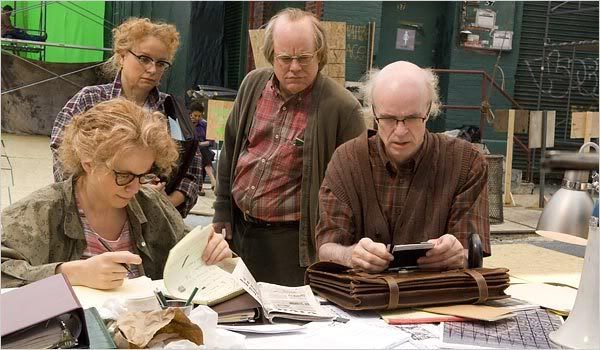
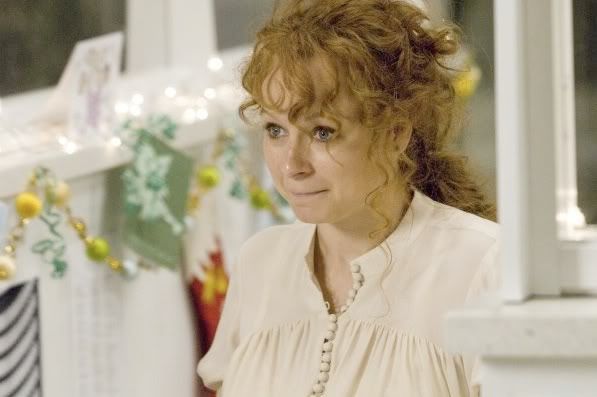
  • The Headless Woman [Lucrecia Martel, 2008] # I don't know why people said this was inscrutable. It seems perfectly open to me. Every edit matters and, though nothing's explicit, you have all the tools/information you need to reassemble this brain, this so-called mystery. There is no mystery, in fact, there's only the frame—windows, doorways, sometimes doors are windows, even a car is a frame filled in—and our Vero is forever pushed to its side. Sometimes she gets to throng up an image, but even then her eyes are often off to one side, or looking past this box of light she's in and making brim. I'd love to teach this film in a hermeneutics seminar. We'd read Ricouer and Bazin and Borges and Gadamer. I could keep watching this movie for the next month, but I won't; I'll probably just watch it once more then wait for it to screen in a cinematheque. I watched it with headphones, which certain felt apt and enveloping, but I can only imagine it packs more punch in the dark, sitting alone. (If I'd seen this in time for our double bills, I might have entertained the idea of writing about this flick and Gertrud, or Day of Wrath. It would have been the opposite of the pairing I did come up with—a true vision of light, of lightness even (however colored by hurt)—but sometimes you need the weight to better frame what bubbles up.)

  • Up in the Air [Jason Reitman, 2009] Sure, that was fine; there were things to like. But, come on, how many condescending pats on the back do we need? I'm not advocating for some muddy road, per se, but Clooney's charisma can only do so much to make a shiny object, like this riveted thing all aligned, feel spontaneous. What's more, Vera Farmiga is gorgeous and talented and I wish to hell she would get a role that didn't flip her, however strong, into such an easy mark.
  • The Sopranos, "Join The Club" (S6,E2) [David Nutter, 2006] # The best acting the show's got. Easily one of the best episodes ever, too. Would love to talk about this show and its silly brand of surrealism with Alain Resnais.
  • The Sopranos, "Members Only" (S6,E1) [Tim Van Patten, 2006] # So good. Starts with Burroughs, ends with one of the biggest shocks in the series. I was surprised, again, at the ferocity of Junior's dementia. More inspired is the subtlety of that final segment's true structuring device: the pasta. We cut from Gene's suicide by hanging to Tony pouring spaghetti (I think) into boiling water, singing, and the episode ends with Tony gurgling in close-up as dinner continues to bubble under the image, signaling not only that this could, truly, be the end for Tony but that we've reached a definite point of no return; no matter what happens (we know now that Tony lives, duh) things will never be the same. Which, of course, goes against the whole ethos of the series finale (the whole series, really) which is all about how patterns so easily calcify while life marches on. I guess we're just talking a narrative turning point more than anything. And, again, the thing that separates this series from, say, The Wire is that its narrative is as brisk as it is brutal; i.e., its sidewinding always pushes something—some dread, some death, some delusions—forward.
  • Tyson [James Toback, 2008] Mellow Mike is an amazing human being. Hell, Iron Mike was, too. The movie may be "so-so" but its story, his story, should be heard/seen. And in monologue form, what else can you ask for? Indeed, there's some cinematic play, here, too, with all this shifting and polyphony, but the real value of the film/video is its enduring status as a love letter.

  • The Headless Woman [Lucretia Martel, 2008] So, yeah. This one. Best of the decade? Up there for sure. More soon, I trust. Until then, here's some of my favorite people/writers on this marvel (1) Martha (2) Danny (3) David (4) Koresksy [at No.2] (5) Glenn (6) Fernando (7) Sicinski (8) Nathan (9) Danny talking to Ms Martel. —Quick poll: where you at on the other two this lady's made?

  • Death Becomes Her [Robert Zemeckis, 1992] Waiting for the plumber, I reacquainted myself with a few chunks (here and there) from this barf bag of grotesqueries. Maybe Phelps and Kehr are onto something: maybe Zemeckis really is some kind of special image'n'myth maker. I remember really digging the flick when my dad and I saw it in theatres, but, now, wow, it's like brand new (though still the same?). It's almost a toilet, though a shiny one, complete with shit and piss and pissy face-making. And in HD!

  • In The Mood For Love [WKW, 2000] # Cuz of everybody's lists, and to wash that exacting movie out of my brain a bit before bed. I mean, wouldn't you rather dream about Maggie Cheung in form-fitting dresses more than eye-gouging and barn burning?
  • The White Ribbon [Michael Haneke, 2009] # I don't want to say I saw through it the second time around but I think I saw through it the second time around. I've tried again and again to be charitable to this dude's movies since a couple people I love kinda love these flicks, but, at this point, fuck it. More soon, when it opens here in the Bay, but if you want to read a pan I nod with then you should read this bit of bile from Mr. Waggish.

Tyson 4

Weisse 1

Thursday, December 10, 2009

Alain à la recherche #7: SHORTS

by Ryland Walker Knight


—The halls have eyes

[The Resnais series playing at the PFA this November and December is part of a broader, traveling retrospective with a concurrent run in Chicago at the Gene Siskel Film Center and a proposed stop at the newly renovated Museum of the Moving Image in early 2010.]


Though I arrived halfway into Le chant de styrène, it still tickled me into the goofiest posture possible all teeth, every limb under another, as if pushing into the chair hard enough would help release the giddy brio building up in my bones. Put otherwise, Queneau's puns (oh to be actually fluent!) and Alain's balletic geometry pretzel'd me up into a great mood. Then Toute la mémoire du monde grumbled onscreen out of focus and an odd English voice started escorting me around the Bibliothèque Nationale in Paris, trying its damnedest to not "do a Borges," to just present a topographical index, we can suppose. However, Alain's image-making inflects this portrait—everything's a tracking shot—with both pride and unnerved anxiety, a weird fear of the calculation of this repository. Each structure our Alain encounters seems to strike him as a possible tomb, and every system a trap, however useful it may be, for any system can ossify. Next: Guernica's a dirge. Solemn though fiery and sometimes mannered, its idea of barbarism will be further fleshed with "real" documentary work in the opening salvo (anti-salve) of Hiroshima, mon amour (still some of the hardest images for me to watch; the sexy sand-shower just prior must play a role, of course, in that reaction). Then the treasure of the night, the very rare (and neglected) Statues Also Die, whose title sounds so much more elegant in French, Les statues meurent aussi, with that "aussi" dangling, like a tsk. Talk about angry: as Rosenbaum already lined out, the final reel of this bad boy is one of the most direct anti-imperialist/anti-racist screeds in cinema—and in 1953! It's a text by Chris Marker, which is another level of cool (and smarts), which is another reason to root with it, which is (of course) really easy. It's also a fine object lesson outside of the polemic, though the political is unavoidable (I must remind myself), as we see just how loaded every thing is in these so-called aboriginal cultures; how histories are most often mythologies; how tradition cannot be ignored; how, ultimately, revolution is a dream and hardly a reality; that is, how little we fight these worlds we're locked into every day. Another way at this idea is right up front in Night and Fog: that, yes, weeds grow but scars and train tracks remain reminders, and nothing's been razed. I quickly realized I was too tired to let that movie work me over (as it always does), and I tipped out in the dark to a misty rain outside.

Friday, December 04, 2009

Alain à la recherche #5: Mon oncle d'Amérique

by Ryland Walker Knight


[The Resnais series playing at the PFA this November and December is part of a broader, traveling retrospective with a concurrent run in Chicago at the Gene Siskel Film Center and a proposed stop at the newly renovated Museum of the Moving Image in early 2010.]

Parts of this film get me so giddy, marveling not just at the beautiful photography but also at the beautiful Nicole Garcia (above, on knee) and the silly-smart braiding, that I just don't believe it. Other parts are terrifically moving (i.e., sad). Most parts are didactic; as if its narrative strategy were a form of pedagogy engineered around constant recapitulation; as if Alain's saying, almost like he does throughout Marienbad, that if we say something specific enough times in enough voices then it's bound to burrow in there and register.

Everybody's got a story, and everybody's got dreams. Everybody's got a fantasy, an uncle from America. Except, of course, these people are decidedly French. In fact, we get a full from-birth history for each of our three leads—Garcia, Gerard Depardieu, Roger Pierre—each told a few times over. The film begins more a mosaic than Je t'aime, je t'aime rather literally as our eyes follow a spotlight searching a collage of stills we will know in motion later in the film. Then it's choral, too, our ears parsing these three—no, four—voices recounting their births and their birthplaces and their trajectories all at once all on top of one another—except for some omniscient voice telling us that a being's only purpose is being and/or something else tautological. Shortly, we're given faces to go with the voices, and names, and portraits of their childhood narrated by them. Then the net is cast over this trio: Resnais introduces Henri Laborit (a real-life physician, writer and philosopher) with the same kind of narration, but with "current" footage of Laborit walking around some lab, smiling and scowling. Laborit is a kind of guide, a sage, for the film. Not that the film exactly proves Laborit's theories—a version of evolutionary psychology intent on Explaining It All—but these asides help provide, say, an anatomy for the film to hang stories off of, like limbs.

The film is split, or splintered, or it splits a few times, or it's segmented, though it also finds conjunctions and convergences. In one (dim) light, it's simply didactic and over determined. Resnais never reduces, though, and the repetitions are never played the same—not from the same angle, often it's not even the same exact action but another performance altogether. Even more than the memory game of Marienbad, Mon oncle aims at redetermining events: how new information colors an old event, or a current one, and can influence understanding of putatively unrelated events. Put otherwise, the film is quite clearly about intentionality, and how we think about things, and where we come from when we come to things-people-places. No doubt, there's plenty of Ricoeur's traces in this project, even if it's based in Laborit's mouse traps. It's Resnais' cinematic gusto that frees the film from its unilateral "expertise" echoes and lets time move both—nigh, all—ways at once. Though Alain maps the mice onto the men and one woman we follow, it's not proof; it's a joke. It's a gas that it's a possibility, even a plausibility, in this world. —Jokes can scold!

Though agency seems crushed, to an extent, in this little network of forces, we never feel like life's not open. Rather, life's prone to fantasies, which can, plausibly and paradoxically, be a form of paralysis, an inhibition that blinds us to how we move ourselves (and must) and give each present purpose its purpose. Or, that becomes possible only if (we hope "when") we find a way to gather ourselves, to hold our histories at hand as some ciceroni, and not simply as stained glass. We remember: we tell ourselves stories in order to live.

Tuesday, December 01, 2009

A Christmas Tale. A house is an outfit. [part three]

by Ryland Walker Knight


Today you can go out and buy one of my favorite movies not only of last year but of all time: Arnaud Desplechin's A Christmas Tale. I'll have more to say over in The Auteurs Notebook shortly, but for here, for now, know now that it's worth every finger-lickin cent you have to spare. Not only is the single-platter transfer beautiful (I'm sure the Blu-Ray disc looks great, too, as looking at the standard DVD on a BR player with HDMI-upconverting made it all the more crisp and lovely), but the second disc offers up Desplechin's short, L'aimée, which he made a couple years prior, and after Kings and Queen, about the sale of his family home in Roubaix. It offers a nice companion angle on the sense of home a home can give somebody—here, Arnaud's dad as he tells his history, his story riddled with familial lacunae—despite the inevitable hurt we accrue in families (in life). It's a terrifically sad picture. Yet, as with all of Arnaud's movies, its collaging impetus broadens the world; his focus somehow enlarges his scope; his world, forever cinematic, is maximal. In fact, you might say he's greedy for life. And, you might say I am, too, which might explain my ardor for his films.

I will never shy from the fact that I see myself in his art, and that this recognition—instead of devaluing—enriches these experiences. It's a form of flattery, sure, where I can pat myself on the back a bit, but it's also a challenge; his movies forever push me back, make me ask myself questions. Understanding is never one-way. My Sex Life... makes me question my formative relationships and long-delayed undergraduate degree; La Sentinelle makes me question my isolation, and my occasional impulse towards solipsism; Kings and Queen makes me throw up my hands and love my mom; A Christmas Tale makes me cry, and shows that, yes, life is hard, but it's just life—that you don't get to wallow, that you have to keep going, and will, despite your selfishness—that the world, and life, will accommodate a lot more than you ever expect. Also, there's a lot of formal fun, and the rush of it is exhilarating: life can fly by and still be rich every second. If you're lucky, you'll get some help (some love) along the way, and giving it back will only make things better. Take the gift and relish it now.

Friday, December 19, 2008

A conjunction of quotations #3

— edited by Ryland Walker Knight


gait, not gate
— Petulia, from Tom

1.
Nor is there singing school, but studying
Monuments of its own magnificence.
— W. B. Yeats

2.
We must meet reverses boldly, and not suffer them to frighten us, my dear. We must learn to act the play out. We must live misfortune down, Trot!
— Betsy Trotwood

3.
Consent is, on earth, always a risk, as democracy is, and hence is always accompanied by a knowledge of being compromised. So understood, consent is the show of a readiness for change, of allegiance to a state of society responsive to a call for change. This is how I present the enduring comedies of remarriage in their conversation with society, and how I see Astaire's farewell gesture, as he merges into the shifting crowd on the pavement outside the Arcade. The question is therefore how compromised consent is shown, is made—in Locke's use of the terms—express as opposed to tacit. The idea is not to hedge consent, as if your commitment were incomplete, but to give it in the knowledge that its object is still in essential part idea, its existence incomplete. This creates a romance of America, but it tends to make those who are not ambassadors into boosters, the former uneasy about the future, and somewhat guilty because of it, the latter refusing uneasiness, and proud of it.
— Stanley Cavell

4.
Foucault—
In the most recent upheaval [May 1968], the intellectual discovered that the masses no longer need him to gain knowledge: they know perfectly well, without illusion; they know far better than he and they are certainly capable of expressing themselves. But there exists a system of power which blocks, prohibits, and invalidates this discourse and this knowledge, a power not only found in the manifest authority of censorship, but one that profoundly and subtly penetrates an entire societal network. [Intellectuals are themselves agents of this system of power-the idea of their responsibility for “consciousness” and discourse forms part of the system. The intellectual’s role is no longer to place himself “somewhat ahead and to the side” in order to express the stifled truth of the collectivity; rather, it is to struggle against the forms of power that transform him into its object and instrument in the sphere of “knowledge,” “truth,” “consciousness,” and “discourse."

In this sense theory does not express, translate, or serve to apply practice: it is practice. But it is local and regional, as you said, and not totalising. This is a struggle against power, a struggle aimed at revealing and undermining power where it is most invisible and insidious. It is not to “awaken consciousness” that we struggle (the masses have been aware for some time that consciousness is a form of knowledge; and consciousness as the basis of subjectivity is a prerogative of the bourgeoisie), but to sap power, to take power; it is an activity conducted alongside those who struggle for power, and not their illumination from a safe distance. A “theory ” is the regional system of this struggle.

Deleuze—
Precisely. A theory is exactly like a box of tools. It has nothing to do with the signifier. It must be useful. It must function. And not for itself. If no one uses it, beginning with the theoretician himself (who then ceases to be a theoretician), then the theory is worthless or the moment is inappropriate. We don’t revise a theory, but construct new ones; we have no choice but to make others. It is strange that it was Proust, an author thought to be a pure intellectual, who said it so clearly: treat my book as a pair of glasses directed to the outside; if they don’t suit you, find another pair; I leave it to you to find your own instrument, which is necessarily an investment for combat.

— In "conversation"

5.
I don't believe you. You're a liar.
— Bob Dylan

6.
Yeah, you don’t have the second plot in order to relieve the pressures of the first plot. Now, in theater that works. In Shakespeare it certainly works. But there’s something about film I don’t think it works, because film is a solid, plastic form – a solid piece of time form – and there’s something about breaking that time form. In Ordet the point of view is actual. We’re actually some place rather than the point of view being images from a more literary form of cinema. [...]

I’m the kind of person who doesn’t take life for granted. I don’t even take the premise for granted. I love not even taking the premise for a moment for granted. Like, let’s say, even knowing what this is, us talking to each other. This is a common experience for filmmakers. There’s an interviewer, and, say, we’re doing an interview for some puff piece after a screening. But that’s never been my sense of reality, of getting absorbed in the societal belief of things. I’ve always felt a little out of it, a little bit like a ghost. So I’m like a ghost and society is a phantom. They’re phantoms but somebody made them. I’m a ghost and I’m not even here. At a certain point I decided, “Well, I’m going to make films from my point of view. What would they think if I started to express my point of view? Would it mean anything to anybody?” So I decided to make films about my point of view. How I feel and see cinema. And then it turns out I end up being invited to Toronto.
— Nathaniel Dorsky

7.
Though Silent Light owes a strong, self-conscious debt to Carl Theodor Dreyer’s eccentric 1955 masterpiece, Ordet, another story about faith and love, the new film also recalls some of the more pastoral passages in Terrence Malick’s New World, yet another tour de force about love and faith (in other people, in the cinematic image). In one of the loveliest sequences in Silent Light, Johan’s family idles in and around a creek that serves as its communal bathing pool. As some of the children drift languorously in the water, their bodies modestly covered and blond heads floating like lilies, the parents tenderly wash the younger ones, scrubbing one child’s head with soap, massaging another’s feet with oil and exchanging small endearments and instructions.

It’s a gorgeous, innocent yet sensuous scene, a glimpse of the prelapsarian with a hint of the viper that Mr. Reygadas closes with a shot of a pink blossom, an image that begins as a blur of color and gently comes into focus. He holds on the image a few beats — much as he often does — not only because, I imagine, he wants us to appreciate its metaphoric resonance but also because he wants us to see its glory. There are a handful of ways to understand the meaning of Silent Light, words that I read as an allusion to love, but this is also very much a film about that ordinary light that sometimes still passes through a camera and creates something divine.
— Manohla Dargis

8.
A picture lives by companionship. Expanding and quickening in the eyes of the sensitive observer. It dies by the same token; it is therefore a risky and unfeeling act to send it out into the world.
— Rothko

9.
What voice is this that speaks within me? That guides me towards the best?
— Captain John Smith

10.
Beneath her the tiles rippled and breathed. The pulpy surfaces of the walls ripened uncontrollably under her observation, inhaling endlessly like lungs preparing to blast her face with a calling or a message. Stripes and pyramids fell across the air in nearly comprehensible organization, writing that changed just before she understood it, and the room itself became a vast insinuation, swollen with filthy significance. She wanted to catch her breath and wail, but realized that her own lungs were already full. When she exhaled, the room seemed relieved of its tension momentarily: she was crushed to remember that this very same action of ballooning and diminishing had been linked to all her other breaths. This terrible, terrible thing that was happening was her breathing.
     The beat of things, their steady direction, had dissolved into nothing--this room wasn't happening then, it isn't happening now; maybe it's a dream of what's going to happen or what will happen never. The sound of her own voice injures her like a shock of electricity through her ears, but screaming herself to hoarse exhaustion is the only reprieve from breathing.
     She looked up out of her voice and saw the angel.
     He will have ears like a cartoon of organic growth. He is yellow with light but covered with mobile shadows, animated tattoos. His face kept changing. His voice will come from far off, like a train's. His body is steady and beautiful and hairless, the wings white, incinerating, and pure, but the head changes rapidly--the head of an eagle, a goat, an insect, a mouse, a sheep with spiraling horns that turn and lengthen almost imperceptively--and the entire message had no words. The entire message will be only the beat and direction of time. Yes is Now.
     The angel who says, "It's time."
     "Is it time?" she asked. "Does it hurt?" He will have the most beautiful face she has ever seen.
     "Oh, babe." The angel starts to cry. "You can't imagine," he said.
— Denis Johnson

11.
Just like the tiptoe moth
That dance before the flame
They burn their hearts so much
That death is just a name
And if love calls again
So foolishly they run, they run, they run
They run, they run, they run, they run
They run without a sound
The desperate ones
— Nina Simone [the drip-drop (pure) dope]

12.
Well... There is a vast network, right? An ocean of possibilities. I like dogs. I used to raise rabbits. I've always loved animals. Their nature. How they think. I have seen dogs reason their way out of problems. Watched them think through the trickiest situations. Do you have a couple of bucks I could borrow? I've got this damn landlord.
— Freddie Howard

13.
Sometimes just making yourself at home is revolutionary.
— Paul Beatty

14.
On the one side, freedom confronts squarely the ancient claims of rationality, with its inescapable exlusionary logic—for example, the idea that "membership in a particular type of moral community, one from which fundamental dissent has to be excluded, is a condition for genuinely rational inquiry" (Three Rival Versions of Moral Inquiry, p. 60). This idea cannot be wrong, which oddly may be why the ethical and reflective interests of hermeneutics, committed as they are to things like openness to the non-identical, are at the receiving end of this logic. Hermeneutics, like freedom itself, may not be compatible with ontological security. On the other side, freedom confronts ironic modernity, or the idea that once we understand that history is the history of obsolescence, that we are only so many webs of belief and that the point is, Penelope-like, to unweave and reweave these so as not to get caught by them, there is really nothing left to call freedom, unless it is just being mistress in one's own house, full of undesirable hangers-on as it is likely to be. This cannot be wrong, either, but it makes an interest in the question of freedom seem, well, quaint, which must be ironic liberalism's ironic point. If this book shows anything at all, it is that a point of this sort is bound to be lost on hermeneutics.
— Gerald L. Bruns

15.
This grandson of fishes holds inside him
A hundred thousand small black stones.
This nephew of snails, six feet long, lies naked on a bed
With a smiling woman, his head throws off light
Under marble, he is moving toward his own life
Like fur, walking. And when the frost comes, he is
Fur, mammoth fur, growing longer
And silkier, passing the woman's dormitory,
Kissing a stomach, leaning against a pillar,
he moves toward the animal, the animal with furry head!

What a joy to smell the flesh of a new child!
Like new grass! And this long man with the student girl,
Coffee cups, her pale waist, the spirit moving around them,
Moves, dragging a great tail into the darkness.
In the dark we blaze up, drawing pictures
Of spiny fish, we throw off the white stones!
Serpents rise from the ocean floor with spiral motions,
A man goes inside a jewel, and sleeps. Do
Not hold my hands down! Let me raise them!
A fire is passing up through the soles of my feet!
— Robert Bly

Sunday, November 09, 2008

VINYL IS PODCAST #5: More synecdoches, more f-words, more more.

by Ryland Walker Knight and Mark Haslam and Jennifer Stewart


a look-see

[Podomatic stream]
[Direct audio download]
[iTunes subscription available]
[Simple syndication subscription]

[SPOILER WARNING IN EFFECT. There's no other way to talk about the thing, is there, Walter? Seriously, if you want to preserve the experience, don't listen. However, as we try to argue in the podcast, there's no way, really, to "spoil" this thing. For one, it's sour to begin with...]


RWK here. On our third podcast, Mark and I discussed his first take on Charlie Kaufman's Synecdoche, New York (as well as Jean Eustache and, briefly, Jia Zhang-Ke), with Mark saying, "I liked it enough to not have an opinion of it right away." (He then put that reaction into some written words.) What I took and take that exit-poll impulse to mean is that he didn't feel it necessary to simply say, "I liked it," or, "I didn't like it," say to make a declaration of value. Because it's undeniable: this is a grand old meditation on major themes and concerns that continue to sprout up in cinema and, yes, in life. It's bound to shake, rattle and roll some souls. It's equally bound to simply turn off a large percentage of its audience, no matter its wit, right up front with some ugly images of festering decay and disease. Literally: dis-ease. There's little comfort in this film, although there are a lot of jokes. So, what does one do with this little beast? Well, we went straight home and talked on digital tape. We tried to form our opinions live. Of course, like the film, our conversation splintered and, in a way, as is always the case with words, it failed; or, it failed to resolve. And yet—even though an hour is a lot to ask of you, our faithful listeners—I think this is our best podcast yet.

The look-see: I'm torn between the two poles. The repugnance of the film is somewhat remarkable, even admirable, but it's still repugnant. It wallows as much as it falls away from the viewer. Not that I know them, but I understand why people like Walter Chaw and Manohla Dargis and Andrew "Filmbrain" Grant rhapsodize Kaufman's achievement, such as it is, with this picture; on the flips, an element of me was eager to indulge the "piss off" stance of my buddy Keith Uhlich, but not the "fuck you" of Rex Reed (no link needed for that bile). For all the yucky destitution of narcissistic projection, for all the death and dying, for all that kinda bores me (as well as Jen) with all that, there are some truly great moments, and cool tropes, as can be expected with Kaufman. The narcissistic projection, for one, works brilliantly: Philip Seymour Hoffman's Caden reading books as he imagines them, seeing himself in pharmaceutical ads and, um, building that massive and ever-receding and ever-multiplying theatre space. Add to that, that unlike Mark, I had an immediate and positive response to the film's negotiation with time: I think its fractal nature, with time splintering, works to exemplify its title; this is not a film about endurance. Caden does not endure lost time, he just keeps living in spite of himself, in spite of all the pills he takes and the cane he adopts and the losses that pile up (in the fucking street, no less) around him on his pathetic plodding towards death. In one way, I could probably develop a passion for this film as an argument in negative, as this is how not to live, since the film seems to understand this, but, at the same time, the film does ask us to spend our time with cumbersome and base decomposition.

If all a critic is to do is to tell you to see a film or not, then there's no two ways about it: I would say go for a run instead. But, as I understand it, my job, such as it is, such as I may be a critic (as much as simply a thoughtful person), is to argue for significance—indeed, for understanding—within the object over against of the object. So it's a tough spot. I'd like you to listen to our conversation, and I'd like it to continue, here in the comments as much as in future episodes, but I'd also like to remind you, that, yes, it's good and fun to go live in the world. And, you know, that Lola Montes talks about all these ideas, too, and it'll be playing at the Castro next week. For more on that film, though, you'll have to wait for a link. So, instead of that recommendation, I can just as easily (yes, with greater ease), turn to the other film I held up (perhaps foolishly) against Synecdoche in our podcast talk: David Lynch's INLAND EMPIRE. About 35 minutes into this hour-long talk we offer to you, I say, "I love INLAND EMPIRE for a lot of the same reasons I think a lot of people will love this movie. And they should. If this movie turns you on, and you find a lot of resonance with you, that is great—I'm not gonna try to take that away from you. Um, this is just, you know, this is just this. It's just three people—two of us are drinking beer—and, you know, but, INLAND EMPIRE, to me, is about everything that's going on in this movie, and it's a much more joyful thing. And a lot of it boils down to that. For me. Definitely. And that gets into a lot of goofy relativism right there, just saying, 'For me.'" But, as I couldn't formulate last night, all art is, in an basic way, experienced narcissistically, for the me that you are wherever you stand in relation to a film or a painting or a screenplay or a song or a novel or a dance. The trickiest part is to account for your self—to question your "me"—in a fun way, to be thoughtful and hilarious at the same time. Now I don't know if we're exactly hilarious here, but you'll here me laugh a lot in this, and, hell, that's good enough for me.

fire is red

This episode's intro and outro songs, for your downloading pleasure:

Friday, November 07, 2008

Baggy like a house, and running away. Playing catch-up with Arnaud Desplechin’s My Sex Life... and Kings and Queen.

By Ryland Walker Knight


ma vie sexuellerois et reine

NOTE, 9/24/2011: I decided to repost this in its entirety here because the formatting on the new Slant-housed HND post is all screwy. I trust Keith won't mind.

I am not alone, I am certain, in coming late to the Arnaud Desplechin party poised to jump off this winter. His latest film, A Christmas Tale, already garnered plenty of accolades from those lucky enough to see it at Cannes and/or the NYFF (two takes I dig: GK's gushing and MK's lucidity). It played in San Francisco last month, too, at the Clay, as centerpiece of the San Francisco Film Society’s inaugural French Cinema Now program (dig MG's interview, too). I missed it, on purpose—I was watching Jia Zhang-Ke’s The World across the Bay—because I knew it would be released soon, and would probably be a big deal. Looks like the case; the snowball is gathering speed and size. This election week saw not just something righteous for our country but also, on a decidedly smaller scale (like, minuscule, dude), the start of IFC Center’s current Desplechin retrospective, Every Minute, Four Ideas, as a build-up to next Friday’s New York release of A Christmas Tale. Lucky for me, I got to see two of the other Desplechin films shown at the Clay: his rare debut, the deliciously abrupt La vie des morts (more Maya), and his calling card, perhaps, My Sex Life… or how I got into an argument. Since then I’ve revisited My Sex Life, on Fox Lorber’s abominable DVD release, as well as his 2004 freight-train Kings and Queen. Smart cinephiles that they are over there, the IFC Center has programmed both of these for this weekend, including the possibility of one rich, long, seductive, dark-all-day double bill on Sunday.

Early in My Sex Life, Mathieu Amalric’s Paul Dedalus talks with his cousin, Bob (Thibault de Montalembert can grin), about Bob’s new girlfriend, Patricia (Chiara Mastrionni may be more irresistible than her mom)—specifically about how great her ass looks—and Bob asks Paul to be more inspiring, to quote someone. Paul counters with Kierkegaard: “Is there anything more sparkling, more dizzying than the possible?” It’s easy to see Desplechin in this madness: his films are giddy with cinema, brimming past the point you think they should reach for only to delight you with more, more possibilities and more actual delights, more concrete details to complete the picture. Like Truffaut, whom he acknowledges as monumental and inspirational, Desplechin makes films that look simple at first but (pace Kent Jones) take on a protean charge, eager to move into something new, to grab hold of a moment, if briefly, before rushing forward. My Sex Life... is nearly three hours long but it never flags; it pauses, it fades, but it never halts; it asks to be followed; and it’s so goddamned endearing, so charming, that it would be foolish to resist. Or, that’s how I feel. See, it’s hard for me to separate myself from Desplechin’s films. They invite the viewer, much like Truffaut, very much unlike Godard or Rivette, yet it’s not simple and naïve assimilation. Of course, it’s easy to weep looking at a mirror, and I have, but, for every reflection, Desplechin offers at least three more angles on any given scene-space. It’s that maxim the IFC Center has appropriated, which Desplechin initially appropriated from a letter Truffaut wrote to Jean Gruault, screenwriter of L’enfant sauvage: every minute, four ideas. What makes Desplechin so vibrant (yes, violent, too) is his commitment to the speed of this creed within a grand architecture of cinema.

My Sex Life... should promise, mathematically at least, 688 ideas; I did not count, but it feels like there are more. That’s a lot to contend with, and it’s easier in the watching than in this writing, which is funny because Paul, our ostensible hero, opens the picture sleepwalking, refusing to finish his doctorate, refusing to write, because, well, just because: because it’s tough work. It’s easier to wallow in pretension and hurt than it is to do things. (And, as Stuart Klawans argues, Desplechin is perhaps the most Jewish non-Jew in cinema—and isn’t Judaism a religion of faith in action? —I realize many devotions may argue this point in their favor but it seems inherently Jewish to me; it’s not Kierkegaard’s possible but rather akin to Nietzsche’s allegiance to creativity. This much is true and open to be countered: I have not seen Esther Kahn yet. I do not have the full picture of this argument as does Klawans. But I want to, yes, I want to, as ever, to see more—I’m greedy like that—to grab and digest more, and more. I hear myself in the Kierkegaard as much as in the Nietzsche. I hear and see myself, all too much, all too often, all too human to ignore it, in these Desplechin films.) But, of course, despite its cast of academic types, My Sex Life... isn’t about the ivory columbarium; while he does spout off at length, mostly about pussy, we never see or hear any of the work Paul does; the closest is his late rant that culminates: “It’s not Heidegger climbing some fucking mountain. No, it’s the girl’s face, it’s your fear, as you pull back the elastic, her belly … you see?” If the film is about academia, it understands such a life as a kind of death—as something to shuck, to shake free from, to flee. It’s right there in the title: it’s a film about life, about sex, about me! See? It’s an invitation to look back at your self! It’s no different than any other work of art!

About two-thirds through the picture, we take up the thread of Paul’s put-upon long-time (ex-)lover, Esther, played with fierce liveliness (loveliness!) by Emmanuelle Devos, whom, despite no marital bond, I like to see as Desplechin’s Gena Rowlands. As much as Mathieu Amalric’s goofy grin buoys and motivates this film, Devos anchors its pathos. It was during her direct address speech that I finally began to let the weight of it all fall onto me, curled alone in that fourth-row seat—that I first began to cry—through a smile. The first time I saw the film, it started at noon on a Saturday at the Clay, smack atop Pacific Heights in San Francisco, and I did not know the Blue Angels would be performing patterns in the sky above the city that afternoon. Roughly the moment Esther began reciting her letter, so did the roars of jets leak into the auditorium, and I thought, “Brilliant! It’s a film about love as a flight as much as a fight after all!” The fact that the planes did not cease their aural (and aerial) contortions through the remainder of the film made me question this argument, naturally, but it was too delicious a strand to let loose. It makes sense, after all, however the happenstance played. Love is a flight from the real, or reason at that, into clouds of stupidity and luxurious hurt. It makes the pained descent dig deeper, of course—that return to the ordinary—but, we begin to realize, as does Esther in that shower near the close of the film, that the daily muck makes sense, too, and affords us the next opportunity to fly—a new possibility is forged. Flight remains a thrill and tears are a form of baptism. The world beckons.

Devos and Amalric appear in relationship, again, in Kings and Queen, only further removed. It’s nice and fun to play the cinephilic game and imagine these characters, Nora and Ismaël, as extensions of Esther and Paul, but the fact remains that they feel lively and real, here, and all their own and all too human because Desplechin is so interested in their singularity—and because these are two enormously talented actors. The biggest difference is simple: Devos and Amalric are older, and they bare (and bear) their lives all the more in their gait and their lines and their faces. If we can accept that Devos is a French Gena, then perhaps we can agree that Amalric is some kind of Frog Faulk; but, if Kings and Queen resembles any Cassavetes, it resembles Love Streams, which pits husband John against wife Gena as brother and sister leading a twinned, braided life negotiating how to love one another. At one point, Nora says of Ismaël, “If I’d had a brother, I’d have wanted one like him.” We might say Kings and Queen is about the love available (yes: possible) in a family—and what makes family, where you draw the line. We might also say this later picture is an inverse of the earlier in that My Sex Life details Amalric’s Paul’s love of three different women (all some kind of “wife”) while Kings and Queen muscles through Devos’ Nora’s love of four men (all some kind of “husband,” even her son). Formally, too, they diverge: My Sex Life... operates on a logic of occlusion and expulsion, the frame crowded and held—until the tears and the blood and a shower rain down; Kings and Queen, despite a continued affinity for long lenses and their resultant density, jumps through spaces, cuts frequently, feels more frantic, violent, locomotive. We might say, finally, that Kings and Queen is (like My Sex Life…, I suppose) about what it takes to get mobile in the world—and Desplechin’s continued answer may remain magnanimity.

—Did I mention these films are hilarious? Nora’s half of Kings and Queen is melodramatic, very heavy, full of tears and harsh lessons, full of shouting, full of death, but Ismaël’s half is, in Desplechin’s words, “a burlesque comedy.” Being a smart guy, he’s spot on. The irony is startling, lucid, simple: for all Nora’s mobility and affluence and lightness, it's Ismaël who finds joy in the routine—in captivity, no less—despite being a mopey goof whose posture is so aching, so desirous of Real Life—while it keeps happening Right In Front Of Him. Like, you know, that beautiful and desperate young thing, Arielle (Magali Woch might melt in your hand, not your mouth), whose answer-made-flesh seems too easy to be true at first. Their offhand non-courtship is one of the loveliest and silliest I’ve seen; again, I couldn’t resist its charms. And, again, Amalric’s echo de moi-même (most notably in sessions with his voluminous, infamous psychiatrist, Dr. Devereux, played with great wit by Elsa Wolliaston) makes me wince and aspire in equal measure towards something new and thoughtful. In short, in their hilarity, Desplechin’s films stage, say perform, a moral posture (which subtends invitation and challenge) that echoes (again) Nietzsche, and his forebear Emerson, that argues for gaiety as a form of seriousness. But this is never easy, of course; nor is it quite attainable; it’s something to seek. For Ismaël, this adventure is fraught with a net of troubles of his own creation that, like a cape, he must simply untie and fling off. For Nora, it’s a bit more complicated: she has to kill. This picture of womanhood, however generous, is where you know a man made these films; but, as Ismaël says, in what will prove out (I'm fairly certain) as one of the great film monologues, to Nora’s son, Elias (Valentin Lelong is too cute), “that’s not a failing, that’s a quality.” What’s lovely is that the films know this, too, and, it’s true, they are unabashed: they seem to get off on it.

Cotillard's neck

But a yummy montage of Marion Cotillard dancing in her panties isn’t strictly about the pleasure of looking at her, at the curve of her neck as much as the curve of her breasts or the light in her eyes; no, it’s just as much about how easy (how dumb) it is to fall into thoughtless love with a girl just because you like the way she bounces. She remains a human, impervious and strong, with the force to bowl you over, by virtue of the film’s interest in how fleeting this sight is, despite its lingering imprint. Nakedness is a fact, like rain. When Marianne Denicourt sits naked at the close of My Sex Life..., echoing Cotillard like she echoes her own nudity earlier in the picture, it’s not about turning us on (however much such a sight will titillate us heterosexual males) but rather about impressing us that, yes, we spend some time naked. We play naked. Nakedness is readiness, an acceptance, and shared with another body it's an agreement as much as a delight. (This is, of course, a different picture of nakedness than that of Jean Eustache, but I'll save that argument for later.) It makes sense that My Sex Life... opens with Paul's literal awakening and closes with its deferred significance at bedtime, highlighted by a memory of a game played on the floor, looking down at pieces asking to be picked up with care (I'm talkin' Pixie Stix here), while Denicourt hugs herself across the chest.

I once wrote a free-associative essay for a zine called “Baggy Like A House.” I don’t remember the essay any longer, nor do I possess a copy, but I remember that phrase because it was directed, in the essay, at the reader, and I’d like to rewrite it, say revise it, for you who are here: you hang baggy like a house about me, and I keep running after you just as you keep running after me. I have only offered a few ideas, four maybe, for all the time you've spent reading, so please go soak up some more in that theater if you can. If you’re in New York, do yourself a favor and spend this rainy weekend with some fun frogs trying out life, seeing if it fits, and shucking sheaths as they please, as they run towards the door, towards the clouds, towards some kind of love, some kind of naked, some kind of possible, some kind of life.

Denicourt's nakedness

Wednesday, November 05, 2008

Reclamation #1: Yes we will. We did.
Reclamation #2, Songs #29: I'm so grateful!

by Ryland Walker Knight


first!

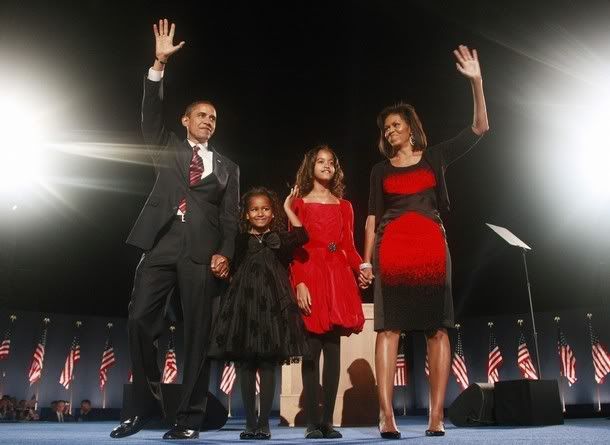
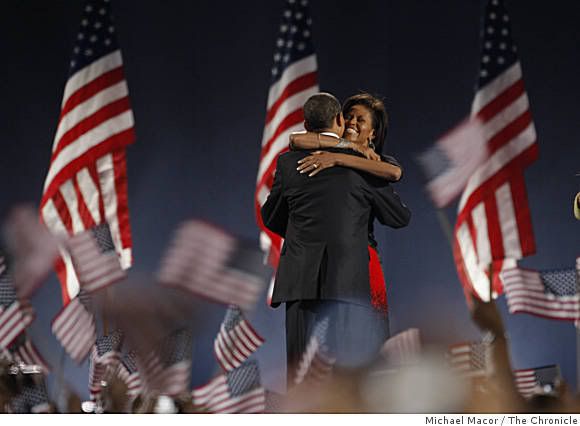
Although the haters of my home state, that odd paradise on the gold coast, seem nearly victorious pushing Prop 8 into legislation, we do, indeed, have our first black president in President-Elect Barack Obama. Yes: this is our first black first family. Yes: there are still hurdles--there's a ton. But: fuck that. This is awesome. This is big, like HUGE. And his speech was so well written it was hard not to smile and tear and laugh and raise my flute more than a few times. I went on a run at midnight last night, then I stayed up late reading all kinds of reactions and watching the Prop 8 results slowly reveal their terrible (as well as the sad loss of Al Franken, who I was pulling for for a variety of reasons). I didn't sleep much. I read the transcript of our man's speech and I brimmed again. I re-read some Cavell that stirs my soul, that I sent around the internet the past week in emails, and then I put on Happy-Go-Lucky and then I fell asleep smiling. This morning brings those realizations of defeat home a little harder, yes, but it equally reminds us of that trope everybody is loving right now: a new dawn. Yes: the idealist in me only wants to weep, to celebrate, to dance in the streets of Chicago and show the world love, to remind my friends that, well, it's just a law and while we must subscribe to that law if we live in this society we may also see some brave body say, "No," and appeal his and his and her and her rights to build a more perfect union along with the rest of America, this America that, for at least a speech's length, was, Yes, my head.

If there is anyone out there who still doubts that America is a place where all things are possible; who still wonders if the dream of our founders is alive in our time; who still questions the power of our democracy, tonight is your answer.

It’s the answer told by lines that stretched around schools and churches in numbers this nation has never seen; by people who waited three hours and four hours, many for the very first time in their lives, because they believed that this time must be different; that their voice could be that difference.

It’s the answer spoken by young and old, rich and poor, Democrat and Republican, black, white, Latino, Asian, Native American, gay, straight, disabled and not disabled – Americans who sent a message to the world that we have never been a collection of Red States and Blue States: we are, and always will be, the United States of America.

It’s the answer that led those who have been told for so long by so many to be cynical, and fearful, and doubtful of what we can achieve to put their hands on the arc of history and bend it once more toward the hope of a better day.

It’s been a long time coming, but tonight, because of what we did on this day, in this election, at this defining moment, change has come to America.

I just received a very gracious call from Senator McCain. He fought long and hard in this campaign, and he’s fought even longer and harder for the country he loves. He has endured sacrifices for America that most of us cannot begin to imagine, and we are better off for the service rendered by this brave and selfless leader. I congratulate him and Governor Palin for all they have achieved, and I look forward to working with them to renew this nation’s promise in the months ahead.

I want to thank my partner in this journey, a man who campaigned from his heart and spoke for the men and women he grew up with on the streets of Scranton and rode with on that train home to Delaware, the Vice President-elect of the United States, Joe Biden.

I would not be standing here tonight without the unyielding support of my best friend for the last sixteen years, the rock of our family and the love of my life, our nation’s next First Lady, Michelle Obama. Sasha and Malia, I love you both so much, and you have earned the new puppy that’s coming with us to the White House. And while she’s no longer with us, I know my grandmother is watching, along with the family that made me who I am. I miss them tonight, and know that my debt to them is beyond measure.

To my campaign manager David Plouffe, my chief strategist David Axelrod, and the best campaign team ever assembled in the history of politics – you made this happen, and I am forever grateful for what you’ve sacrificed to get it done.

But above all, I will never forget who this victory truly belongs to – it belongs to you.

I was never the likeliest candidate for this office. We didn’t start with much money or many endorsements. Our campaign was not hatched in the halls of Washington – it began in the backyards of Des Moines and the living rooms of Concord and the front porches of Charleston.

It was built by working men and women who dug into what little savings they had to give five dollars and ten dollars and twenty dollars to this cause. It grew strength from the young people who rejected the myth of their generation’s apathy; who left their homes and their families for jobs that offered little pay and less sleep; from the not-so-young people who braved the bitter cold and scorching heat to knock on the doors of perfect strangers; from the millions of Americans who volunteered, and organized, and proved that more than two centuries later, a government of the people, by the people and for the people has not perished from this Earth. This is your victory.

I know you didn’t do this just to win an election and I know you didn’t do it for me. You did it because you understand the enormity of the task that lies ahead. For even as we celebrate tonight, we know the challenges that tomorrow will bring are the greatest of our lifetime – two wars, a planet in peril, the worst financial crisis in a century. Even as we stand here tonight, we know there are brave Americans waking up in the deserts of Iraq and the mountains of Afghanistan to risk their lives for us. There are mothers and fathers who will lie awake after their children fall asleep and wonder how they’ll make the mortgage, or pay their doctor’s bills, or save enough for college. There is new energy to harness and new jobs to be created; new schools to build and threats to meet and alliances to repair.

The road ahead will be long. Our climb will be steep. We may not get there in one year or even one term, but America – I have never been more hopeful than I am tonight that we will get there. I promise you – we as a people will get there.

There will be setbacks and false starts. There are many who won’t agree with every decision or policy I make as President, and we know that government can’t solve every problem. But I will always be honest with you about the challenges we face. I will listen to you, especially when we disagree. And above all, I will ask you join in the work of remaking this nation the only way it’s been done in America for two-hundred and twenty-one years – block by block, brick by brick, calloused hand by calloused hand.

What began twenty-one months ago in the depths of winter must not end on this autumn night. This victory alone is not the change we seek – it is only the chance for us to make that change. And that cannot happen if we go back to the way things were. It cannot happen without you.

So let us summon a new spirit of patriotism; of service and responsibility where each of us resolves to pitch in and work harder and look after not only ourselves, but each other. Let us remember that if this financial crisis taught us anything, it’s that we cannot have a thriving Wall Street while Main Street suffers – in this country, we rise or fall as one nation; as one people.

Let us resist the temptation to fall back on the same partisanship and pettiness and immaturity that has poisoned our politics for so long. Let us remember that it was a man from this state who first carried the banner of the Republican Party to the White House – a party founded on the values of self-reliance, individual liberty, and national unity. Those are values we all share, and while the Democratic Party has won a great victory tonight, we do so with a measure of humility and determination to heal the divides that have held back our progress. As Lincoln said to a nation far more divided than ours, "We are not enemies, but friends...though passion may have strained it must not break our bonds of affection." And to those Americans whose support I have yet to earn – I may not have won your vote, but I hear your voices, I need your help, and I will be your President too.

And to all those watching tonight from beyond our shores, from parliaments and palaces to those who are huddled around radios in the forgotten corners of our world – our stories are singular, but our destiny is shared, and a new dawn of American leadership is at hand. To those who would tear this world down – we will defeat you. To those who seek peace and security – we support you. And to all those who have wondered if America’s beacon still burns as bright – tonight we proved once more that the true strength of our nation comes not from our the might of our arms or the scale of our wealth, but from the enduring power of our ideals: democracy, liberty, opportunity, and unyielding hope.

For that is the true genius of America – that America can change. Our union can be perfected. And what we have already achieved gives us hope for what we can and must achieve tomorrow.

This election had many firsts and many stories that will be told for generations. But one that’s on my mind tonight is about a woman who cast her ballot in Atlanta. She’s a lot like the millions of others who stood in line to make their voice heard in this election except for one thing – Ann Nixon Cooper is 106 years old.

She was born just a generation past slavery; a time when there were no cars on the road or planes in the sky; when someone like her couldn’t vote for two reasons – because she was a woman and because of the color of her skin.

And tonight, I think about all that she’s seen throughout her century in America – the heartache and the hope; the struggle and the progress; the times we were told that we can’t, and the people who pressed on with that American creed: Yes we can.

At a time when women’s voices were silenced and their hopes dismissed, she lived to see them stand up and speak out and reach for the ballot. Yes we can.

When there was despair in the dust bowl and depression across the land, she saw a nation conquer fear itself with a New Deal, new jobs and a new sense of common purpose. Yes we can.

When the bombs fell on our harbor and tyranny threatened the world, she was there to witness a generation rise to greatness and a democracy was saved. Yes we can.

She was there for the buses in Montgomery, the hoses in Birmingham, a bridge in Selma, and a preacher from Atlanta who told a people that "We Shall Overcome." Yes we can.

A man touched down on the moon, a wall came down in Berlin, a world was connected by our own science and imagination. And this year, in this election, she touched her finger to a screen, and cast her vote, because after 106 years in America, through the best of times and the darkest of hours, she knows how America can change. Yes we can.

America, we have come so far. We have seen so much. But there is so much more to do. So tonight, let us ask ourselves – if our children should live to see the next century; if my daughters should be so lucky to live as long as Ann Nixon Cooper, what change will they see? What progress will we have made?

This is our chance to answer that call. This is our moment. This is our time – to put our people back to work and open doors of opportunity for our kids; to restore prosperity and promote the cause of peace; to reclaim the American Dream and reaffirm that fundamental truth – that out of many, we are one; that while we breathe, we hope, and where we are met with cynicism, and doubt, and those who tell us that we can’t, we will respond with that timeless creed that sums up the spirit of a people:

Yes We Can. Thank you, God bless you, and may God Bless the United States of America.

[There will be something embeddable in the near future, I'm sure (as evidenced above), but for now look here to see these words performed, passsionately.]


grateful

As Mark and Kate and I cleaned up a bit last night, before our free can of PBR downstairs and my joyful departure home, I put on this Dennis Ferrer song that Cam sent my way because, really, what else were we to listen to? Fuck. Yes. FUCK YES! Maybe, fuggit, I'll eat some bacon. Or, hell, I'll go get coffee and donuts. Whatever it is, I'm feelin it already.

Dennis Ferrer ft Kenny Bobien - Grateful (Df's Raise Yo Hands Vox Mix)
(zshare)

[x-posted on freeNIKES!]

Monday, June 30, 2008

Going to Telluride 2008. UPDATED.

by Ryland Walker Knight

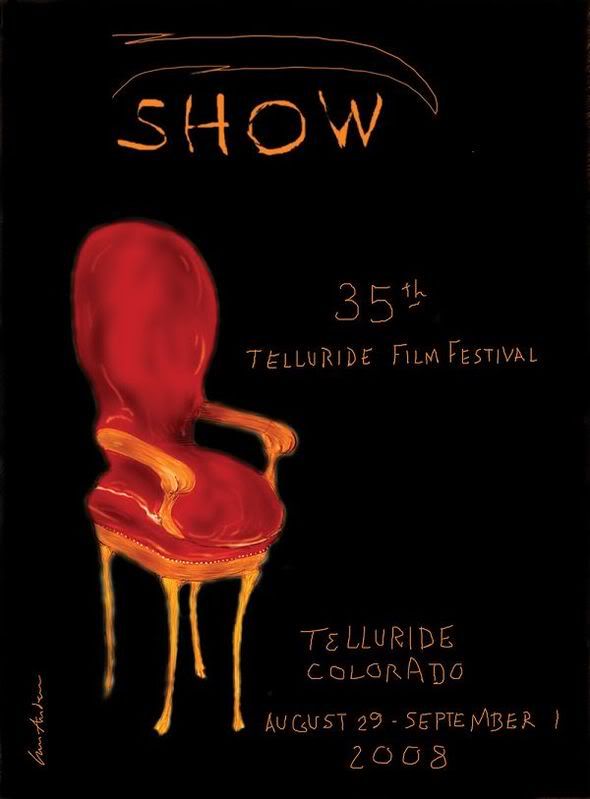
I've known for a while now that I'll be attending this year's Telluride Film Festival as part of the Student Symposium. But now that I know I've got my travel arrangements squared away, I thought I'd go ahead and blog about this exciting opportunity to invite recommendations (restaurants, bars, where to run, etc), donations (hey, it ain't cheap), stories (who did you meet?), any and all kinds of enthusiasms for one of the most unique film festivals I know. So unique that it won't announce its lineup for a while yet. But if tradition holds there will probably be a few of the Cannes '08 films, maybe some 2007 hold overs, and perhaps even a Hitchcock screening given Slavoj Zizek's post as Guest Director. Plus, as a member of this Symposium, I'll get the opportunity to meet and talk with the luminary artists of the festival; not to mention hang out with a bunch of peers similarly interested (I presume; to a certain degree) in film and film writing.

What I'm maybe most curious about are these opportunities to meet filmmakers and actors because I'm simply unsure what to ask them. I'm usually so wrapped up in my own reading of films that I hardly think of what I would want to ask a filmmaker. For instance: I joined a Facebook group for the Symposium and there were some pictures of an alumi standing with Eric Bana. First, Eric Bana is huge, like 6'3" -- and buff. Second: the first question I think of asking him is something idiotic and shallow like, "Is Marie-Josée Croze as gorgeous in real life as she is in pictures? What about Jennifer Connelly?" I mean, I could ask something like "What's been your most favorite job? Which director did you enjoy working with the most?" But those are going to lead to pretty canned answers about stuff I don't really care about. I'd rather learn what he likes to eat and drink; what's his favorite movie; what movie does he wish he could have acted in (from any period); whether or not he's gone river rafting. Sure, I could question him about the worth of film as an art and all that but I would only want it to come up in conversation. Maybe that's the problem: it's hard to get to that stage in "regular" interviews. Local hero Michael Guillen is excellent at generating a conversation (in printed interviews and in person) but he's a much more outgoing, lively personality than silly, self-conscious me. If somebody like Marie-Josée Croze shows up in Telluride I'll be happy if I don't blush too red, let alone ask her a question.

Perhaps this speaks to my general interest in film as personal accountability. By my lights, a film writer's job is easier said than done: to account for his or her experience of the film and check it against the associations it produces (which change, screening to screening) to build some kind of evaluation of the picture. More and more I'm beginning to realize just how much of me there is in everything I write. Even when I try to avoid the first person, I'm betraying myself (whether my readers know it or not), which produces this constant stammering: the need to offer as many angles on a sentence as possible. But what's the value in me? I'm trying to talk about the art. That's always the goal: to turn out from in. I spend enough hours a day with myself. When I look back, the essays I'm most proud of either completely absent, or completely embrace, the words "me" and "I" (such as "The Touch", or "2007: It's okay to play catch-up", respectively). This is a prime example of what some people like to call the "subject-object problem" and what a lot of the philosophy I gravitate towards grapples with mostly through form, through these kinds of structural dialectics, through what I've called "stammering." But this kind of heady talk can quickly bore most people I talk to. I don't think Eric Bana or Marie-Josée Croze are all that interested in how we get out of the subject-object relationship through varying practices, such as Cavell's skepticism or Wittgenstein's language games or Gadamer's horizons or Freud's psychoanalysis or Zizek's Lacanian-Marxist approach. Then again, maybe I'm wrong. Maybe Eric Bana sought that role in Munich because he was interested in all the philosophical-theoretical crap at play (besides the obvious political and social agendas) therein. (I could probably write an interesting argument about Munich as a film about tradition as hermeneutics, about how we choose to participate in or diverge from tradition, how we define tradition not as a concept but as a form of life. Of course, you can write that argument about any number of films -- maybe any film, straight up -- but it's pretty unavoidable in Spielberg's almost-masterpiece.) In any event, I could strike up this conversation with Zizek himself, right? Maybe that's what I should mark on the calendar: the possibility of a seminar with the guest director and the attendant opportunity to talk hermeneutics with him. Failing that, there's going to be movies playing, of course, that I can talk about with my fellow symposium participants.


Looking over Telluride's program for last year, I see a lot of the Cannes '07 films, which makes me start to look back at the big films from Cannes '08 that might make their way to Colorado this year. Luckily, Andy Horbal already did something like this, and I can look to his post, titled, simply, "Cannes '08". Of the likely candidates for Telluride, the Cannes pictures I'd most hope to catch in Colorado are (all links to David Hudson's tireless Daily GreenCine round up posts): Un Conte de Noel, 24 City, Waltz With Bashir, Gommorah, La Mujer Sin Cabeza, Synechdoche, New York, and, of course, the uncut version of Che. I'm sure there are others from Cannes '08 that are not on my radar (for whatever reason) and I'm sure there are others not from Cannes '08 that are not on my radar (for the reason that film does not start and stop with Cannes) that will surprise me. One title from the past year of festival circuitry I'm hoping Telluride schedules is Reygadas' Stellet Licht, since it has yet to secure US distribution either for a theatrical run or a home video release; and because I'd love to see it again on as big and wide a screen as possible; and because it might mean an appearance from Carlos Reygadas, a man I would love to talk to about film (sure) and life (more), a man that (I get the sense) has lived*. Another I hope to see is Barry Jenkin's Medicine for Melancholy, which I missed at SFIFF, for all the reasons Michael talked about here and for the other reason that the trailer is oh so charming.


If none of these films happen to show up in Telluride, I trust the experience will be fun and eye opening. I'll be sure to take pictures, and write. I haven't even gotten to the Silent Film Festival yet, and I've been feeling the strain of not earning much money, but with the Pedro Costa retro in March and my private (at home) Hou Hsiao Hsien retro these past two months, not to mention all those hours spent thinking and writing about Michael Mann and Terrence Malick (among other names) for my thesis this past spring semester (still holding onto it), 2008 is shaping up as quite an educational and enjoyable year.

*Also, I could ask him in person what he thought the chances of an America release are now given the shuttering of Tartan US. Looks slim. Such a weird thing, this recession, right? We can't even get screenings of those Mexican films with dialogue in Plautdietsch in the States now. Sheesh! What a world!

UPDATE, as if anybody scrolls this far down the page:
I got an email from Lawrence Boone with news of the fest and with code for this Festival widget. I think some other bloggers have put it up on their sites so I figured, what the heck, can't hurt to help promote just a bit more. I mean, I am rather excited. So here's the widget, with all kinds of features, like restaurant guides and photos, all in one tiny 350 by 600 pixel package.

param>

Monday, April 28, 2008

Sketches on Hoberman, Sylvia, looking and difference. [Part 1]

[Note: On Sunday, April 27, 2008, I attended a San Francisco International Film Festival event with my friends Jennifer Stewart and Kevin B. Lee. After the SFIFF presented Jim Hoberman with the Mel Novikoff Award (named for the famed San Francisco film exhibitor), Kent Jones quasi-interviewed Hoberman on stage for about an hour, and then we were lucky enough to watch José Luis Guerin's In the City of Silvia. I wrote this first email to Kevin primarily, as a fellow blogger, and Jen secondarily, as my friend and interlocutor. I thought it might be interesting to others, too. Look for Kevin's response at his blog shortly. -- RWK]

From: Ryland Walker Knight
To: Kevin B. Lee, Jennifer Stewart
Subject: hoberman, sylvia

Yo, Kevin,

Glad we could enjoy that film, and that discussion beforehand, together. Before I talk about the film a bit let me say I remembered (or think I remember as) what Hoberman got mild applause for: he was saying he hoped more online criticism would link to other criticisms, incorporating other texts (and, I imagine, images and sounds) into itself. A very Web 2.0 kind of monadic reading; not simply monadic reading by making associations in writing but actually forging associations with hyperlinks (and images, even videos). It seems like his ideal version of online criticism is exactly what you're after at your blog. Which is a really cool thing! Congrats! Unless, of course, my memory is messing all this up. Which leads me to In the City of Sylvia.

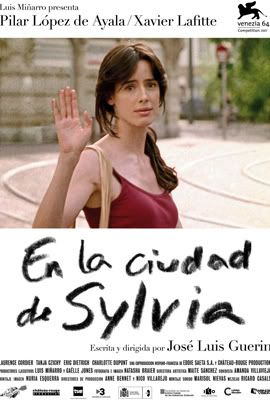
I think I may go ahead and deem the film "a masterpiece" because I do think it's about more (plot-wise and otherwise) than simply a dude stalking some pretty babes. We know dude is visiting this town after a six year absence, trying to recuperate a love/r (or better: a memory of a lover), and not just another passerby inhabitant of this city. And, of course, as you said, that's a thin plot. However, it's a pretty tight little argument about movies, and about watching movies. When we watch a movie we're a foreigner in a familiar terrain (or logic, or vocabulary) trying to piece together different strands that coalesce because we make them (pace Bordwell) into a kind of meaning. For instance, your monadic read incorporates Kiarostami, just as mine incorporates my (potentially wrong, easily vague) understanding of phenomenology. All dude does in this picture is look at things to try to make pictures, to put things together, through imagination and projection and, above all, looking.

Now, the Vertigo analogy is pretty apt, but I definitely don't think this is "art for art's sake" by any stretch. This is an argument for the value of art, of the art of movies, of the art of looking, even the art of understanding (if that can be understood as an art, as I think it can). Of course, that argument would take longer than this brief missive allows. But my sketch, to follow our man from Sylvia (dig that double move!), begins with this: the worthiness of those arts -- of art -- seems to be in what they produce for their participants. I hate to trot this out but Gadamer says we only understand differently if we understand at all so maybe this film is arguing for that kind of openness to difference: our man at the centre is never fulfilled because he cannot accept a rather simple difference in his perception (of a girl, of the world). In a way he's got a greedy nostalgia. Which, of course, translates to our role as spectators: we keep looking, following films, hoping for an outcome. Which ties into something Hoberman said about the different expectations different movie goers bring to films. Some people look for a kind of confirmation entertainment (say, as we discussed, the Apatow pictures and their wish fulfillment drive) whereas other people look for a kind of new perspective, which, we must admit, can easily be another kind of confirmation, if somebody is only applying a certain lens to all films. I'm fairly certain I'm not doing that here. My reading is allegorical, sure, linking his looking to my looking, doubling the remove, but I think the film invites it. As you said, it's a city of surfaces and reflections. Just as movies are a surface projected onto a reflective screen.

But I should hit the hay, or at least read before I hit the hay. Say, you should write me back and I'll post the pair of emails on VINYL. That sound like a cool idea?

Take care,
later, ryland.

____________________

shh!
____________________


Jennifer's reply is posted in the space above (here's a direct link, and look for Kevin's reply over at his blog, Shooting Down Pictures, soon right here.

____________________

Other words worth reading about this picture:

Wednesday, April 09, 2008

More eternity. More Mirror talk.

by Ryland Walker Knight


looking at yourself

[Note: I recently mailed in my application to take part in this year's Student Symposium at the Telluride Film Festival. Part of the application involved writing a brief essay on the following topic: "If you were being sent into the distant future, and you could take just one film with you, what would you take, and why? Please give this question serious consideration in terms of your passion for film as an art." This may be a little redundant given the essay I wrote for Reverse Shot (click here), but there's some other stuff happening, I think, that's worth sharing — at least in part because that stuff echoes recently completed passages of my thesis. Please, tell me what you think.]

looking at fire in rain

If we understand film as an art then it should follow that we find the most value in those films that stand up to repeated viewings, as do great paintings and photographs, as we witness recurring performances of great plays, as we read great books again and more. It comes to me, hypothetically of course, to pick a single film to take into the distant future, to bear our history and film’s history (our history with film) forward. This is a fraught decision. What do we value most in film? I say “we” because the film and its contingent particulars must accompany me forward: I bring an object loaded with intention and worth all its own, signaling many others than myself alone. I should choose a film that marks me of an era of humanity (as of thought as of action as of time) more than I should choose a film that marks simply a preference. For this I turn to a film that has, viewing after viewing, withstood time and scrutiny, yielding new riches (of insight, of beauty, of provocation) from its mysteries with each encounter. It is a film I enjoy without fully understanding — I intuit its argument — as I will never fully understand myself. And I find this fitting as this is integral to the film itself: Andrei Tarkovsky’s Mirror is as first person and subjective a film, while simultaneously questioning the subject-object relationship (or structure as it is often called), as I have encountered.

The film does not have a narrative through line, although it begins with what might be understood as a birth and ends with a kind of death (of the body, if not the spirit). Built of moments, some like vignettes, some like passing observations, Mirror can confound sense at first. Elsewhere I have argued that the film is after a kind of eternity: that we may pass from this world and somehow remain in it, either in spirit or other manifestations, as in a light on a field (and through the woods) or as in a family inheritance one passes down (and leaves behind). Mirror tells a story of a man, perhaps Tarkovsky himself (we see a poster of the director's Andrei Rublev on the wall of the narrator’s home), and his tenuous hold on memories of his mother and his wife (both played by the same actress) and his son and himself as a boy (both played by the same young actor) and certain stages of childhood in a country cottage during the first World War. Digressions abound as Tarkovsky imports footage from early in the 20th century of balloons floating above a field and children fleeing Spain for Russia and the Red Army marching across Manchuria. As much as it confounds, Mirror aims to situate itself within a certain historical tradition, or a certain approach to history, that fuses the horizons of history. This fusion of horizons (pace Gadamer) is where eternity comes into play.

Mirror’s eternity is not born strictly from film stock but other film grammar, like the poetry read over passages of montage. Tarkovsky’s father wrote the poems, and reads them on the soundtrack, but, as intriguing as this background may be, it is irrelevant. The poems in the film exist unto the film as far as the film is concerned. The audible poetry, as opposed to the visual, is simply another horizon matched in Mirror’s eternal plane of activity. But to parse just what these poems “mean” in relation to the images Tarkovsky marries them to proves difficult after an initial, affective intuition: it is a rich artistic gesture designed to color the image. As much as it marries words to image, Mirror is a film, through and through, concerned with images. In this sense, the poems, as passages designed to trigger emotions, can be seen as no different than — perhaps even equivalent to — the images themselves.

To bring such a film forward means another fusion of horizons where our further understanding of Mirror’s mysteries (hidden in our plain view of the moving picture) may help us understand the mysteries that abound in life here, in 2008, and there, in that whenever of the future. Who knows, we may not even be able to play my DVD copy when I get there.

Monday, March 24, 2008

A conjunction of quotations #1

— edited by Ryland Walker Knight


look up

1.
Explanations come to an end somewhere.
— Ludwig Wittgenstein

2.
Beyond this explicitness in recognizing an end of words, implicitly the form of the principle part of the Investigations manifests this fate (namely, of being silenced in the face of the other) throughout, in which, in its 693 sections, philosophy comes to an end 693 times.
— Stanley Cavell

3.
Criticism has nothing to do with hierarchies.
— Manny Farber

4.
A synthetic approach corrects the critic's literary bias towards portentous narrative and his purist bias towards visual bombast. In the process it centres our attention on the normal function of the director: not to devise stories and not to construct painterly patterns but to realize given material and organize it into significant form. In order to comprehend whole meanings, rather than those parts of the meaning which are present in verbal synopsis or visual code, attention must be paid to the whole content of shot, sequence and film. The extent to which a movie rewards this complete attention is an index of its achievement.
— VF Perkins

5.
Überhaupt hat der Fortschritt das an sich, daß er viel größer ausshant, als er wirklich ist.*
— Johann Nepomuk Nestroy
*It is the nature of every advance, that it appears much greater than it actually is.


6.
My temporality belongs to this larger temporality, and this belonging-to no longer seems capable of being submitted to the Kantian criterion of the distinction between a sequence indifferent to order and a rule-governed sequence. If the physical object may still be constituted by this distinction, the historical object calls for another sort of constitution, a constitution that would take into account a multitude of temportal fields themselves placed into relations of contemporaneity, precedence, and descendence, within an all-encompassing temporal field which is history itself.
— Paul Ricoeur

7.
The nostalgia affect

The image may not first and foremost be a mnemonic but it bares its history, it bares history. The grain of the image tears and tears. Edith Piaf, of course.
— Daniel Coffeen

8.
Citizen Kane, in 1941, antedated by several years a crucial change in films from the old flowing naturalistic story, bringing in an iceberg film of hidden meanings. Now the revolution wrought by the exciting by hammy Orson Welles film, reaching its zenith in the 1950's, has run its course and has been superceded by a new film technique that turns up like an ugly shrub even in the midst of films that are preponderantly old gems. Oddly enough the film that starts the breaking away is a middle-1950's film, that seems on the surface to be as traditional as Greed. Kurosawa's Ikiru is a giveaway landmark, suggesting a new self-centering approach. It sums up much of what termite art aims at : buglike immersion in a small area without point or aim, and, over all, concentration on nailing down one moment without glamorizing it, but forgetting this accomplishment as soon as it has been passed; the feeling that all is expendable, that it can be chopped up and flung down in a different arrangement without ruin.
— Farber, again.

9.
[Hermeneutics] is not a method or system or theory or any position to be defended or advanced but exactly a context of argument about understanding -- a context whose boundaries are determined not by conceptual traditions, much less by school disciplines, but by the thing itself, that is, by the question of what it is that happens (what the practical consequences are) when we try to make sense of something. What sense this question will have for us, however, is determined by how we frame it, and there are multiple, intersecting, and conflicting frames. Hermeneutics, as I understand it, is this whole network of lines and angles on the question of verstehen.* There is no getting outside of this network and giving a comprehensive view of it, which is one reason why it is not easy to give a conceptually coherent account of what hermeneutics is.
. . .
So with respect to a discourse or a text, verstehen is less knowing what the text means in itself than it is knowing how we stand with respect to it in the situation in which we find ourselves.
— Gerald L Bruns
*understanding


10.
Philosophy simply puts everything before us, and neither explains nor deduces anything.--Since everything lies open to view there is nothing to explain. For what is hidden, for example, is of no interest to us. One might also give the name "philosophy" to what is possible before all new discoveries and inventions.
— Wittgenstein, again

11.
If the description does not move, then criticism is no more than a dull copy or repetition of the object. The kind of descriptive act required cannot be determined before the encounter with a particular object, but certain guidelines (at least those that work for me) seem to emerge through this writing. One is to ride an impulsive move toward whatever draws one to something in the object—a color, a gesture, a phrase, an edit point, a glance, a rhythm, a whatever. Enter the film through this and describe exactly what is heard and seen, and then begin to describe the film in any order whatsoever rather than the order in which it unravels itself. Soon one’s own description begins not only to mimic the object, as a preliminary move, but also to redraw the object. This is not a betrayal of the object through an enthroning of the primacy of the subject’s narcissistic projection but rather the activation of an encounter, a means of entering the object, though not necessarily through the door marked “Enter.” An eccentric, impulsive, descriptive drive will cut the film up and link the fragments differently from the way the film is itself organized. It is through this montage of description that a reading might emerge.
— Laleen Jaymanne

12.
On my better days, I still think of film as the quintessential artform of the last century--a medium for expression uniquely suited to our Modernist Yeatsian decomposition, what with its malleability beneath the knife, as it were, cut and spliced back together again as the un-spooling literalization of some patchwork Prometheus. Likewise, in its 24 flickers a second, it's an illusion of life, teased from the amber of still photography, drawing, painting; mixed with symphonies; blended with dance and movement; enslaved to the syncopation of words and imaginary drum beats. It's a miracle, a golem, capable of illuminating the rawest humanity in one stroke and of exhuming the most abject failure of human impulse in the very next. Its tractability is astonishing--protean, not too much to say magical; in describing his first film experience as a visit to "the kingdom of shadows," Maxim Gorky brushes up against the ineffable sublimity of a medium that mimics the eye, stimulates the ear, and has as one of the key elements of its academic study a concept that suggests the moment a viewer finds himself "sutured" into the text. Like all fine art, then, when it's right, its "rightness" is indescribable--Frank Zappa's "dancing about architecture." And like the stratification of art imposed by some in varying orders to describe the proximity of each to the inexpressibility of their souls (prose to dance to painting to poesy to music, for me), when film aspires to combine the more abstract elements of human expression in its melange, the results, always mixed, at least have the potential to be grand.
— Walter Chaw

13.
Instead of Durgnat’s list (which is a fascinating one!), I personally would propose these three words, which are certainly at the driving heart of my own practice: richness, intensity and gesture. Each word responds to a very different ‘level’ of the cinematic experience. I value (as probably most critics do) richness in cinema: the richness of great works that repay endless viewings, works with a complex logic, works that demand a real effort of ‘reading’, interpretation, deciphering, films that are ‘deep and meaningful’. But not all good, important, worthwhile cinema is rich or complex. We also have to make a place – a large place – for everything that is strikingly and memorably excessive, mad, spectacular, breathtaking, in a word intense, in cinema (and our experiences of it): phenomena that happen more on the surface of a work, rather than in its depths. This investment in intensity has led me to the popular forms and genres I love: crazy comedies, teen movies, horror, action etc .., but also the avant-garde! Lastly, gesture relates to a more politico-historical, socio-cultural dimension of cinema: that powerful wave of significance when we sense that a film is making a move in relation to all those other works with which it forms a ‘family’: when an entrenched stereotype is being lifted or twisted, when a taboo is finally being broken, when two hitherto separate ideas or genres are suddenly being fused together … Only a few people, such as Jim Hoberman, have tried to write fragments of a history of cinema beginning from these kinds of moves or gestures, which sometimes have little to do with either ‘art’ (richness) or the ‘cinematic’ (intensity).
— Adrian Martin

14.
What is this prepossession of the visible, this art of interrogating it according to its own wishes, this inspired exegesis?
— Maurice Merleau-Ponty

15.
I suspect I am, far more than not, in your own situation: deeply interested in moving pictures, considerably experienced from childhood on in watching them and thinking and talking about them, and totally, or almost totally without experience or even much second-hand knowledge of how they are made. It is my business to conduct one end of a conversation, as an amateur critic among amateur critics. And I will be of use and of interest only in so far as my amateur judgment is sound, stimulating, or illuminating.
— James Agee