Showing posts with label violence. Show all posts

Friday, December 23, 2011

BANG BANG: Ryland Walker Knight

[BANG BANG is our week-long look back at 20!!, or "Twenty-bang-bang," or 2011, with contributions from all over aiming to cover all sorts of enthusiasms from film to music to words and beyond.]


Observations

My, How Impermanent by Ryland Walker Knight

Earlier this week my Indiewire ballot appeared. I still stand by it, I suppose, but even just a week after publication I itch to change things. In fact, the whole enterprise gives me hives to a certain degree. The whole idea of absolutes in general, in any context. If you take a look at that list, you'll see a collection of films, I'd wager, premised on contingency, or some form of mystery or mess or exuberance. Even the more "straight" narratives (Cronenberg's & Jacobs' portrait-films) exhibit an interest in how things do not fit, or ever fix into reliable—much less accepted, normal—forms. Perhaps the best term I can reduce this idea to is a favorite on this blog: navigation. Life's not a maze, but there are hurdles every day, including waking up, not to mention the unexpected tidal wave every so often. We're so used to the narratives we're given or that we give ourselves that eluding the unwanted can wreck a day, a month, a year. (Lucky me: my year saw hiccups and headaches but nothing got wrecked. Truth is, I had a fantastic year. And I'm grateful.) Naturally, I'm attracted to films about finding ways through life.

———

Finding a way to make movie-going more a part of my movie-watching has been difficult this year, the past couple years. Granted, I got to attend Cannes. But the pleasures of that were certainly "extracurricular" as much as within the salles and theaters. The dinners, the new friends, the jokes over whiskey and rosé with Danny and Adrian after long days. But I still cherish movie-going.


Early last week, in fact, I had the supreme pleasure to take in one of the best double bills in recent memory at the Roxie Theatre (with Brian, yes): the early show was Borzage's Moonrise followed by Renoir's first H'wood venture, the insanely under-seen and apparently under-recognized Swamp Water. Two films about the south made by not-southerners that understand the south and southerners in ways you rarely see anymore. (Of course, I'm not a southerner; I'm a Californian. My Okie roots are roots and my relationship to GA/SC is tertiary at best.) But aside from any obtuse anthropological/ethnological reading I can offer, the films exist and excel simply as films. Borzage's at his Murnau best and Renoir is at his dollies-everywhere (and "people as people") best. And they spoke to one another in delicious ways the way a double bill is supposed to work. Steve Seid usually knows what he's doing but this was a special program. The swamp has different narrative functions in the films, but in both the swamp is a hunting ground, a space of violence, something untamable that few can master or at least negotiate (or inhabit!). Again, this speaks to how I see the world at large. Life takes skills we never anticipate requiring, but nonetheless accrue. True to this optimism I harbor—inside an unavoidable but I hope healthy cynicism w/r/t life's obstacles, including people (above all people?)—both protagonists of these films find ways to join the world by their stories' ends.


Then again, not every path is a success. The film I felt worst about leaving off my "official" top ten was Edward Yang's A Brighter Summer Day. That movie's all about the disconnect we're forced to confront as we grow through adolescence. It's about a lot more, too, including light, but there's a violence in adolescence that it understands (something Haz and I talk about as he is a teacher). This is true of all the Yang pictures I've seen, but this one is obviously special. Its length affords its narrative the space for us to observe characters rationalize their way through choices good and bad alike (though mostly bad) all the way. This is what critics mean when they call a film novelistic: time affording space for character. Granted, that's a limited view of what "the novel" is or can be, but this film in particular, as with many likewise classified films, is after a Dickensian kind of scope forever grounded in place and details. This, too, is how best to think of something like Breaking Bad, which Jen talked about yesterday.

Television, after all, is serialized much how the early money-making novels were; both are strategized as much as constructed with plot doled out in delimited chunks. But, as Jen noted, one of the pleasures of BB is just how digressive it is, how much air time is given to behavior and go-nowhere episodes of bickering. And it's not like this show's hopeful. It's got a pretty grim take on human desire and nature and intelligence. As I've said before, these characters are idiots. Walter White seems to have figured out a few things watching Gus operate, like the cost of survival in such a dangerous game as the drug racket, but he's still a bald, selfish, myopic stranger to himself and his oh-so-beloved family by the end of this last season. And the person he's closest to has every reason in the world to want to slit his throat.

———

I've been using my tumblr more than this home base throughout the year. Part of it is simply ease of use. Another is desire. The last is time. I like the scrapbook/notebook feel of the microblog. It feels like a repository of reminders. And it usually takes very little effort. Writing here is more work. (Writing anything is work!) Not sure what the new year will bring, but I'm not quite ready to quit my baby. But I quit making zines to make this blog and I may wind up quitting this blog to wind up making more films. Even if they're just little goofs about the sounds of seagulls or odd poems about light and memory. The future has more answers than me.

———


One thing I know for sure: though I've made some great friends via emails (cf. this week), there's a lot I'm proud of from this past year outside the walls and tubes of the internet. Thank you to everybody who helped make those realities real. You know who you are.

________________________________

Ryland Walker Knight is a writer and filmmaker living in San Francisco. He has three names, which you can read above, at left, and all over this blog.

Wednesday, March 03, 2010

Last Lost: "Sundown"

by Ryland Walker Knight


Well, cool. There were some risks taken, some serious crazy, and some killings. Brutal fucking murders, even. A ruthless episode that started slow and crescendoed somewhere beyond Apocalypse Now with this new Kurtz I'm calling Dark Locke not a raving nobody stuck in his temple of doom but heading out into the jungle, ready, smiling at his good fortune to gather a crowd and, it seems, pull the wool a little over a lot of eyes. That is, this week was a big step forward towards real consequence and conclusion. Not only that, we got to see the end of that goofy odd couple, Dogen and Lennon, and we didn't have to really deal with Jack. Bonus: Kate's looking a fool, and useless, a sheep forever and hardly clothed wolf-like.

But Locke's that reversed, and easy, or more: not just a wolf wrapped in a smile but a smoke monster aching to wreak havoc. And, like a good chess player, he parried and fell back and then struck from a new angle to topple the other side. Of course he chose the arrival of darkness as his deadline.

This was the first week since the opener that the sideways, 2004-prime story-line held much interest for me, even if it was later in the episode as things lead to a different (and decidedly smaller) execution. Sayid's new story seems the most like his old one, which sets him apart again, though to be fair we haven't had much of Jin and Sun in 2004 yet—and you just know they'll play a major role in the pathetic appeal of the finale. (A finale, the promos remind us, only 10 episodes away. Time flies indeed. Not that I'm really counting down things.) After all, when Sun appeared by surprise late in the episode, it was easy to get a jolt of "almost!" when she asked Kate if Jin was present at the temple. I'm ready for this reunion to be cornball but I also wouldn't be surprised if, like with Sayid, it to turn on dark histories.


Most of the show was about Sayid trying and failing to prove his worth as "good" in situations set up by "evil" men. His whole storyline hinges on that declaration to his lost love, who is now his brother's wife, that he spends his days trying to wash his hands of his past actions. Of course, when he's asked to forget some wrong doing, he answers, "But I can't," and kills the man who asked. (Funny to see the tables turned on that smarmy Martin Keamy who, in his time before on the show, was just as ruthless.) On the island, Sayid flips his relationship with Dogen around, no longer at his mercy; after allowing Hiroyuki Sanada a monologue about his not-fateful arrival on the island (Jacob beckoned him, too, after a tragedy he caused), Sayid says he elects to stay in the temple, which we clearly see wasn't in Dogen's mind. Further, it suggests all good is gone, as predicted, and Dark Locke has recruited another all-too-willing bruised soul.

Lost has always loved its dichotomies. But what's fun is that the show always fudges those lines. Nothing's so arbitrary as a strict either/or on the show. Somebody's transgressing something, making "sides" look closer (or more mirrored) than they appear. Also, it's clearer all the time just how little agency's afforded in this show. Most people are manipulable; especially our "Losties." In fact, when was there a time when one of these dudes acted completely on his or her own? Has it happened? Or was Dark Locke right in that cave? Has everything been orchestrated until now? Was Charlie supposed to die by making that choice? His hand sure seemed forced if he was to protect the girl and the baby he loved. And look where that got them. The baby's an orphan, practically, though he's living with some relative, and the girl (the mom) is a lunatic hell bent on killing anybody who may or may not have had a hand in disappearing her baby boy.


I'll say this: Emilie de Ravin was much better this episode. She ate the walls around her, but at least she looked like she was having fun hamming it up as Cooky Claire. Maybe acting opposite Terry O'Quinn opened her up a bit. She's only got about one move, or maybe two, but she really went for the one note of nutso this week. The way she looks up at Kate says "calculation" as much as "sheer enmity." And that was followed up by "cookoo" when she beckoned Kate with a promise of safety away from the onrush of the smoke monster's hurtling trail of electric clicks and, well, slaughter.


It's amazing how much of the show has been setting up massacres, building an association only to rob you of it so you leave it, lost. (Yep.) Everybody's blanched now. I dig it.


Tuesday, January 19, 2010

Convergence for your mind drips (1/19/10)

by Ryland Walker Knight


—deadbeat summer smack center in winter

Monday, January 04, 2010

Convergence for slangin rocks (1/4/10)

by Ryland Walker Knight


— What The Po-Po's Hate

Thursday, November 26, 2009

Convergence for your Thanksgivings [ii] (11/26/09)

by Ryland Walker Knight


fire fight fire light

fall be kind, leak

Light fire with fight
Axe at it til you see sky
Graze a highway wail

Monday, November 16, 2009

Vinyl is heavy and Vitti is forever #16

bry Ryland Walker Knight


—...on the rich kids.

Wednesday, September 09, 2009

Convergence for his patsy hands (9/9/09)

by Ryland Walker Knight


la bete humaine


regress
—can't get the stink off

Monday, August 24, 2009

Veiled in movie-blood red.

by Ryland Walker Knight


My new wife, Mélanie Laurent

Despite a plethora of scintillating and smart pre-release reviews from a number of friends, I wrote a little something about Inglourious Basterds for Danny over at The Auteurs Notebook after I saw it Friday night. Today, you can click here to read it. It's a pretty damned insane movie, ballsy and self-immolating and, it seems to me, very personal. I didn't touch on this in the review, but somehow this stretched canvass feels even more personal than Kill Bill, though it springs from similar source: QT loves his women. More specifically, he gives Mélanie Laurent one of the most romantic moments of his career, kissing her black lover (Jacky Ido) goodbye; likewise, Ido's cigarette flick farewell is surprisingly tender. Also worth noting here is that I'm as tired as anybody of the "everything is cinema" refrain, but, if you start there (not end there), you can see that there's a bigger argument at play. It just helps that cinema is a perfect venue to talk about the things Tarantino is obsessed with: women, identity, action, the illusion of agency, the cost violence can rack up on a soul (or not), feet, performance, language and color. I really wanted to see the picture again before writing about it (I may go tomorrow), but it was fun to jam on it and bust out some quick reactions. I hope you like it, too.

change clothes, and go

Some reviews I dig: After Hoberman's mini gauntlet in the Voice, Karina Longworth's reappraisal at Spout, Koresky's enthused Reverse Shot piece, Eileen Jones' halfway there golf clap at Exiled Online, Manohla Dargis' three-quarter counter case in The Times, Walter Chaw's rapture at Film Freak Central, and a couple by Glenn: first and second. Also, in case you loved that Bowie interlude, too, give it a listen over here.

Tuesday, April 14, 2009

Looks that scar. Or, Once there were eyes.

by Ryland Walker Knight


If you've seen Once Upon A Time In The West before, you'll recognize these dazzling blue eyeballs as some of the most sadistic peepers to hit a screen. If you remember this flashback, you will remember that they are alarmingly gleeful, and their appearance is blink-quick, punctuated by a slow-mo fall into dust by the younger version of Charles Bronson's Harmonica. You will also remember this flashback is the clue to why he's named Harmonica; or, at least, why he wears a harmonica. What's cool about a harmonica is that it's a wide instrument split into sections, or frames, of sound. You could say the same thing about cinema. Also, Fonda gets his comeuppance in a splendid composition.


Spoiler? Not really. This is Leone we're talking about here. You don't watch it for the plot, really. Or, you shouldn't; you should watch for how wide screen it is, how super saturated the frame is with color and activity and blood. I watch it for the geometry.

Wednesday, March 04, 2009

Gangster violence and some language. Sold.

by Ryland Walker Knight


this man is in jail
[This man is in jail.]

Wherein the fan side of things gets tickled into action. Thank you, Michael Mann. (And the ad people at Universal.) Why? The teaser trailer for his summer tentpole, Public Enemies, is now available for viewing. After last night's waste, I'm happy to be excited about Ho'wood product because I can trust that, unlike that bloated advertisement masquerading as a "movie," this feature will only get better the longer it lingers on screen. Also, it will be gorgeous without a ton of digital paint. It will weigh something, too, I imagine, despite its speed. [fN!]

this lady is sexy
this man is the law
break out
of jail
in style
see the wide country side
wave to the public

Tuesday, January 20, 2009

Ray at night.

by Ryland Walker Knight


dont hide, fight

It occurred to me about 4:00 PM Wednesday the 22nd, that I have been in a continuous blackout from sometime between 1957 or earlier until now. I misplaced my soul and I don’t know where I left it.
- Nicholas Ray, 1976

smoke

This essay that I link to above, by Carloss James Chamberlin, from the way back machine at Senses of Cinema (which has a good new issue if you haven't looked at it), is something special. Thanks to Zach for turning me on to its smarts and its beauties. I think it's a good reminder for today. That the reason we have to pick ourselves up and dust ourselves off is because, perpetually, we fail. It's a nice reminder that tomorrow I'll be the same guy with the same stink and the same bank account and the same unhealthy patterns as much as some new and vital routines built this fall; that we gotta fight. The thing that may get lost in the hoopla today is that inside that complicated and fiercely intelligent speech our first black President delivered with great passion there was a note struck to signal that, yes, we have to work hard every singly day we step forward. The world does not always stand arms open to meet you. Sometimes, the ones you love and depend on will hurt you. All the time, there's this life. So live. You will lose things. You will misplace passions. You will fall on your face. You may lose an eye. But you may also find some kind of grace pushing up and pulling up and dusting up and building up—even if you're throwing up. Own your peapods. Stuff them full and let them bud, let them flower; let light spill everywhere. Look around you. Forget the weights, or push up past them, and know: this is good.

a pea in a pod

Saturday, September 20, 2008

Cutting into the world: La Passion de Jeanne d'Arc tears and tears, bleeds.

by Ryland Walker Knight


sang
l'eglise
recoil

Dreyer cuts space apart to the point that it isn't even something to talk about. La Passion de Jeanne d'Arc has no need for spatial (or, for that matter, temporal) terms. Of course we're given the unity of the single day, and the stations of the cross, as it were, but every image in the film is expression; there's no real interest in representation. "The close-up is the face." It's a film of faces big and small and brimming and dead and burnt and crying and alive and inanimate. Hooks jutting across a frame are a face of terror and pain; the stake aflame with a cross behind, a face lifting us out of the world; the sacrament raised in prayer, a face of dignity; Jeanne's torn blanket a metonymic version of her, an echo of her arm's pump. It's as pure a film, as purely affective a film, as I have ever seen. But its grammar is miles from what PTA's been developing. In fact, not that this is fair or equivalent, his grammar seems much more akin to something like what Tony Scott habitually falls just short of despite his best efforts. It helps to have something to say, but, and I mean this, those last three Tony Scott movies, tied as they are to plot, deliver a lot of goods in purely formal registers; it reaches an apogee in Deja Vu's little room, and then loses itself, but pretty much the whole of Domino is fascinating, lively, expressive filmmaking. And Dreyer edits fast. (Much more interesting, though, than Tony over there.) In ten seconds you can see a baby suckling, Jeanne clutching a crucifix, the baby pull away from the tit, a man without a face pull away the cross from Jeanne's clutches, and the baby returning to the milk. A tidy circuit of give and take. It's phenomenal, really. I can't believe it's taken me so long to find my way to this master of cinema. Also, a hilarious footnote here: what a political film!

rend it open

[We need reasons to believe in this world, even as we rend it open. Find more by clicking here.]

Monday, February 04, 2008

The Monday Evening Wire. Just a Step Behind.
Episode 55, "React Quotes"

by Cuyler Ballenger


peep the new toys, son
react, son

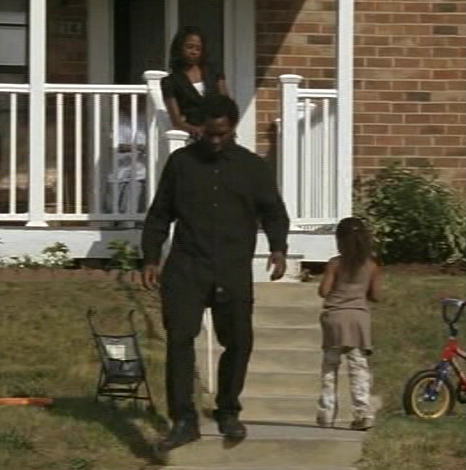
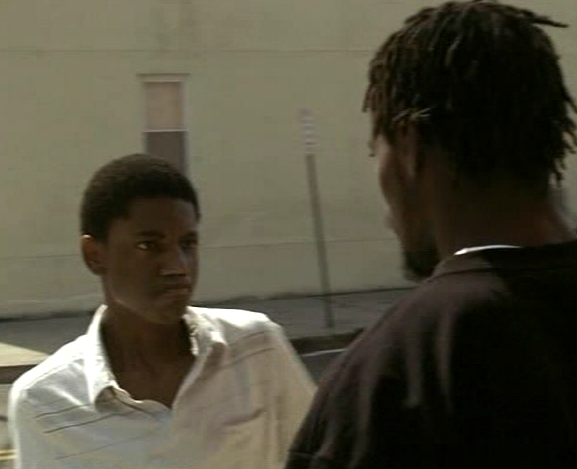
There was a sort serene glow to last night's Baltimore: something oddly peaceful about the light, a sort of calm after the storm that was the previous two weeks. Vondas brought a newly crowned Marlo up to speed on the alternate functions of a cell phone as birds chirped in the trees above them. Mr. Stanfield smiled as he and Chris walked triumphantly away from the meeting, a bright sun shining down on them both. It was equally strange to see Marlo's teeth as it was to be introduced to a family Chris was never known to have. As his son waved goodbye to him from their front yard, Chris let his girl know that he's gonna be gone for a couple weeks, "that's all it should be," says Marlo, and, "it better be," Chris responded. As last night's episode strolled along, we're at the halfway point in this final season, I, too, remembered there is only weeks left, and I questioned my previous thought, "It's not calm at all is it? Only the eye of the storm." The quick pace of "React Quotes" was deceiving. There were none of the deafening silences as Marlo or Snoop stared into the eyes of their latest victims, no shots of a young boy with post-trauma blankness, and no difficult confrontations between a cracked-out mother and her hardened son. Rather, this week moved at a speed indicative of the show's comfort. Plot lines developed, seriousness and hilarity walked hand in hand. Tensions and anticipations of what is to come are perfectly high.

The Wire is a show that, in my mind, at least in retrospect, I always see as happening at night. All the sunshine and t-shirts in "React Quotes" masked well an episode that offered so much more than simply reactions to the last two weeks. McNulty and Freamon were seemingly able to make progress on their "case," getting overtime (though limited) and a wire tap on Marlo's cell. Maury, and, in fact, Herc and Carver, all saw great opportunities in holding that same number. But they were all just a step behind Vondas, who, whether he was conscious of it or not, provided Marlo with the means of communication perfect for his style -- no talking -- therefore no interruptions, no middle men -- strictly business via email. What the effect of the now-insignificant tap on Marlo's phone will be is unclear, though the future of Jimmy's "long con" is most likely in jeopardy. (Although the two exchanges between Jimmy and Templeton, first at the bar, then at the Sun, were smart and hilarious, it's important to remember he's been drunk the whole fucking season. Bunk on the other hand, is exercising an unusual sobriety in his attempts to dissuade the crazed McNulty).

Omar is definitely back! But his short time away saw a dramatic change in the streets, and the final shootout of last night's episode positioned him in an entirely foreign territory; he was not only outgunned and out-manned, Omar was caught by surprise. After last week's "Transitions," my buddy said, "I'm not sure why he (Omar) should be feared anymore -- he's just got a gun like every other person Snoop and Chris killed before." And I do somewhat agree now. What separated Omar from his counterparts in the past was his ability to know what was going down before it does, to be prepared, to be the aggressor. Chris and Snoop, like their boss, are workers now, with a certain understanding of the game they didn't have before. I can recall a poignant scene from early in Season 4 when a package was delivered to the old corner store that Fat-Face Andre owned and ran. Outside, Kima and Sydnor watched the delivery; but behind the two detectives, Omar sat, in his van, watching the watchers. That level of removal (and resultant, advantageous vantage point) is no longer available to him -- and his main sources of information (Butchie and Joe) are, well, you know. With his new right hand man Donnie (who we know from Omar's brief stint in the joint last season) wearing a bullet between his eyes (and will miss now), and Omar's own miraculous four story fall, his revenge may, in fact, go unrealized.

The interruption of Dukie's and Bug's father-son conversation by the hateful and pathetic Kenard set in motion a string of events that I (and Ry Knight) believe (hope) will lead to a Prezbo spot in this season. Boxing and shooting proved (thank God) hopeless for Dukie, and his question to "Mr Dennis" Cutty, "like, how do you get from here to the rest of world?" couldn't be answered by someone who only knows the ring and the corner. The constant references to Dukie's brain being his ticket off the street will hopefully register in the quickly-maturing (and growing!) young guy. And though his role in Bug's life is no doubt preferred to corner, he seems uncomfortable no matter where he is. A sad truth easily attributed to his lack of ever having a place in his own home. The sweet, but somewhat ambiguous, re-emergence of Bubbles may have been the only lagging part of the episode. I'm not so sure what his unfinished story is attempting to communicate. Walon tells him, after revealing to him a negative result on a blood test, that it's important to not attribute false significance to the past, but to understand his healthy future to be just that. If that is to be the only message transmitted through such an incredible character, I might end up feeling a bit short changed. Conversely, if I really listen to what it is Walon is saying, I might just accept that Bubbles is not that tour-de-force (of conflicted morality) he once was, and just accept the potentially anti-climactic, though successful, bow-out D. Simon is offering him.

I hate to think Marlo basking in the sun of his own glory is anything even semi-permanent, but seeing him fall like Clay Davis is about to appears rather unlikely. Again, and most likely for another couple weeks, I'm forced to end on a note of blind anticipation as it would be a push to make an argument for the entire season (and all 5 seasons really) just yet. That day will come, though, with a promised series-ending blogged-out conversation with my editor-in-chief that we should make good on. For now, I'd say this week, while not as immediately striking as the two preceding it, was the best of the three. It proved that this show can move through daytime with as much grace as it trudges through those seemingly endless street-lit nights, privileging nothing except that "things happen," when they are clear as summer or as reticent, raspy (and somehow spritely?) as Snoop's voice -- and that it's our duty as citizen-watchers to pay attention to The Wire's Baltimore.

fear
blankness

"Just 'cause they're in the street
doesn't mean they lack opinion."
-- Haynes

[Note: All apologies to AJ and MZS for stealing their pix.]