Showing posts with label looking. Show all posts

Monday, December 21, 2009

Get your verdant going electric.

by Ryland Walker Knight


—When I click this...

Like Broken Embraces, you know exactly what you're getting from Avatar. Yet, with Pedro Almodovar, you only get about five great images and one classic finale sight-meld that changes perception. With Cameron's film, a visionary chunk of neon folly if ever there was one, almost every second behind those 3-D goggles got my eyeballs going gaga and groggy with gorgeous goof city grand larceny light shows of gigantic gestures all swooped and folded and lit up beyond pure spectacle into something truly immersive. I was wiped, wiping my eyes walking out of that early-AM, first-possible IMAX showing Friday morning. It's about as tiring an epic as has come out since that other great film of the decade about embodiment, Pirates 2 (and, yes, No. 3, which is more tiring but not quite as good).

By now you probably know what Cameron's movie is about (bad military, good natives; yawn), so I don't need to waste your time with the waste of time story highlights. Rather, we ought to focus on the real excuse for this behemoth: to light your eyeballs full of a frenzy. Because, it goes without saying, though everybody will/has, James Cameron cannot write for shit, has no political sensibility other than guilt, and wouldn't know how to differentiate between myth and cliché if asked in the right (pointed) way. What he can do is make a few images, and build a movie, however silly, with all kinds of cool tools. He's also been pointed in the right direction of a few bits of theory, it seems, and knows a few things not just about feminism but also about game design and, um, phenomenology. At heart, his story is about seeing as a physical action, a full-bodied embrace of the material world. Again: embodiment. I have to admit that, despite what (little) I knew about the whole "stereoscopic" mumbo jumbo Cameron supposedly invented (and the title, duh), I didn't see that one coming. Or, at least I did not expect it to be that explicit—nor for it to work.

You expect Pedro Almodovar, in a movie about a now-blind filmmaker, to make the phenomenological film that moves you, not James Cameron. But, save that final image, and Penelope Cruz's force-of-nature performance, nothing really moved me, though a few things tickled me, as much as any number of sights in Avatar. Physically moved, too: I found myself fudging the 3-D by having to shift my body and cock my head from side to side from time to time just to cope with all that gooey phosphorescence on screen. WIth Pedro's film, I just kept wanting more screen time for that goddess, no matter the narrative cost. See, Pedro's still hung up on plot. But he's only got a few of them to rely on, and the record-skip repeat of this movie is nearly tiring; or, it is whenever Penelope isn't dazzling the frame. All Cameron has to do is push a few motes forward in the "frame" (space? his term, "volume"?) and I get a thrill. That said, only a few of the compositions from the full film linger in my head. It's more about the fluidity of the space, and the visceral invitation it offers, than it is strictly about pictures. In that, I think Sicinski's onto something with that three-tweet rave (starts here) about "making plot just what it should be: an excuse to go nuts on viewers' skulls."


—From here!

Last year I had a similar positive reaction to Speed Racer, but I know that movie, though maybe more adventurous, is nowhere near as successful. It's a little too cut-out cartoony, and its timing is all off. Say what you will, and I know it's long (and there's no getting around that, of course), but Avatar never drags. It just weighs a ton for a fleet film. And that's because it expects your eyes to do things they're not used to doing. —Least of all in a multiplex! In any event, this rapture, though felt, is still nothing compared to the sheer joy of Fantastic Mr. Fox. There's a film jam-packed with detail to keep you pinballing around the frame for daze on end, every frame a treat—and all in under 90 minutes. But that's another story for another time. (Maybe later in the week.) For now, I'm just adding my ramble to the ruckus out there, getting giddy at the thought of fluorescent aerial jellyfish and all kinds of eco-electrical networks of lights to make me and you and everyone dizzy with dumb grins. What a gift!


[Broken Embraces opened on one screen, at the Clay, last Friday here in the Bay Area and will roll out to more screens on Christmas. Avatar's everywhere. Neither needs my endorsement to make oodles of cash. Though, of course, one will make yet more oodles than the other.]

Wednesday, November 11, 2009

A conjunction of quotations #7

by Ryland Walker Knight


Midtown 120 Blues

1.
Stare. It is the way to educate your eye, and more. Stare, pry, listen, eavesdrop. Die knowing something. You are not here long.
Walker Evans

2.
Color, at the moment, has, for me, a great importance, and I feel a kind of return to a complete commitment and love of color, and a sense of its relation to the human psyche. I think the kind of film that I have made and that I am most interested in is communicating with these basic sensuous elements of film. Color is also an important element in relation to sound; also how darkness and light are used in relation to color is different than in other visual media — all of these things interest me. We are creating structures and we are also presumably creating narratives that are not dramatic. The structures are more like the forms of other time-based or other measure media such as poetry or music.
Robert Beavers

3.
There isn't enough mustard to spread on that hot dog.
Billy North, about former teammate Reggie Jackson

4.
I mean, I brought you all the way out here. It's not like I'm the one who needs swimming lessons. And the fact that you're not even trying? Well that baffles me. Really. I mean, what are you afraid of? There's no sharks in here. Suppose a water dog comes walking down the tracks and sees you. What's he gonna say about you, land dog? I mean, if there's times in the world when it's time to take a chance, it's time right now to take a chance. What's this? Water. Get in it. It's just water. Listen, brother, this river goes two ways: that way, and that way. You know what I'm sayin? It's like a puzzle, with hands, if you think about it.
Paul

5.
I make people laugh, which is a great gift, but I live in fear.
Monica Vitti

6.
Being sad is not a crime.
Arthur Russell

7.
And then but no matter what I do it gets worse and worse, it's there more and more, this filter drops down, and the feeling makes the fear of the feeling way worse, and after a couple weeks it's there all the time, the feeling, and I'm totally inside it, I'm in it and everything has to pass through it to get in, and I don't want to smoke any Bob, and I don't want to work, or go out, or read, or watch TP, or go out, or stay in, or either do anything or not do anything, I don't want anything except for the feeling to go away. But it doesn't. Part of the feeling is being like willing to do anything to make it go away. Understand that. Anything. Do you understand? It's not wanting to hurt myself it's wanting to not hurt.
Kate Gompert

8.
O for a draught of vintage! that hath been
   Cool'd a long age in the deep-delvèd earth,
Tasting of Flora and the country-green,
   Dance, and Provençal song, and sunburnt mirth!
O for a beaker full of the warm South!
   Full of the true, the blushful Hippocrene,
       With beaded bubbles winking at the brim,
             And purple-stainèd mouth;
   That I might drink, and leave the world unseen,
       And with thee fade away into the forest dim:

Fade far away, dissolve, and quite forget
   What thou among the leaves hast never known,
The weariness, the fever, and the fret
   Here, where men sit and hear each other groan;
Where palsy shakes a few, sad, last grey hairs,
   Where youth grows pale, and spectre-thin, and dies;
       Where but to think is to be full of sorrow
             And leaden-eyed despairs;
   Where beauty cannot keep her lustrous eyes,
       Or new Love pine at them beyond to-morrow.

Away! away! for I will fly to thee,
   Not charioted by Bacchus and his pards,
But on the viewless wings of Poesy,
   Though the dull brain perplexes and retards:
Already with thee! tender is the night,
   And haply the Queen-Moon is on her throne,
       Cluster'd around by all her starry Fays
             But here there is no light,
   Save what from heaven is with the breezes blown
       Through verdurous glooms and winding mossy ways.
John Keats

9.
The true drama of men consists in the fact that they have always seen the reasons for their anxiety in the external world, defining them as evidence of an enemy structure to struggle against. Men are now on the verge of discovering that the essence of the human dilemma lies within themselves, in that rigid psychological structure of theirs that can no longer hold back its destructive cathexis. ... The self-criticism developed in our culture seems to have taken a path of license and recklessness. Men must leave this path to put an end to their historical role as protagonist. This is the change we are advocating. ... Self-criticism must give way to imagination.
Carla Lonzi

10.
Jerry: In a half an hour, we'll no longer be Mr. and Mrs. Funny, isn't it.
Lucy: Yes, it's funny that everything's the way it is on account of the way you feel.
Jerry: Huh?
Lucy: Well, I mean, if you didn't feel that way you do, things wouldn't be the way they are, would they? I mean, things could be the same if things were different.
Jerry: But things are the way you made them.
Lucy: Oh, no. No, things are the way you think I made them. I didn't make them that way at all. Things are just the same as they always were, only, you're the same as you were, too, so I guess things will never be the same again.
The Warriners

11.
Why keep on seeding the chairs
When the future is night and no one knows what
He wants? It would probably be best though
To hang on to these words if only
For the rhyme. Little enough,
But later on, at the summit, it won't
Matter so much that they fled like arrows
From the taut string of a restrained
Consciousness, only that they mattered.
For the present, our not-knowing
Delights them. Probably they won't be devoured
By the lions, like the others, but be released
After a certain time. Meanwhile, keep
Careful count of the rows of windows overlooking
The deep blue sky behind the factory: we'll need them.
John Ashbery

12.
I like to treat my film as a biological entity. The prints have been deposited, donated or bequested to archives and museums around the world, with the legally stipulated proviso that the film will not be reproduced in any form nor projected with a recorded soundtrack. I hope they will abide to my wishes, but even if they don't, the reproductions will not be handcoloured prints.

The decision to destroy the negative was made back in 2000, when I started the project, so I had plenty of time to get used to the idea. Still, the destruction of the negative was a very emotional moment, something like the ritual slaughter of an animal. I saw one in Central Asia and was struck by the depth of the feelings attached to the gesture.
Paolo Cherchi Usai

13.
I’m not a believer that hardship makes people stronger, but I do think that too much of certain things can make them weaker. Strong people can be distracted by things that come too easy. Maintaining a career nowadays is extraordinarily complicated, even if you’re just doing your work and showing up for required occasions. You can waste an amazing amount of energy, time and goodwill by chasing after stuff that’s not worth chasing after. Really wise artists know how to make dramatic appearances and how to make dramatic disappearances.
Robert Storr

14.
Si vous ne m'aimez pas, je peux vous dire que je ne vous aime pas non plus.*
Maurice Pialat
* If you don't like me, I can tell you I don't like you either.

15.
[The buildings] look normal enough, but they are designed to fall down, like fat men at the opera falling asleep into someone's lap, shortly after the last rivet is driven, the last forms removed from the newly set allegorical statue.
Thomas Pynchon

Tuesday, July 07, 2009

Found Facts. UPDATE.

by Ryland Walker Knight


It came to my attention late last night that my videos hosted at imeem were gone. Thus, in my distrust of youtube and love of design, I uploaded this to Vimeo, where I have a profile, and where I hope to add the rest of the videos found through this label link, as their uploading limits allow, in the coming weeks. Also, this is a good reminder to finish the few I have half-formed and to really motivate me to get cracking on other essay-ish projects. Until then, click that link above, or go visit my youtube channel, to see previous FF missives. Don't forget Andrei, either.

A day later, another is up: Sing seeing, sing, starring Daniel Coffeen (and Felix).

Wednesday, April 29, 2009

SFIFF52 #3: Oblivion + Bullet in the Head

by Mark Haslam

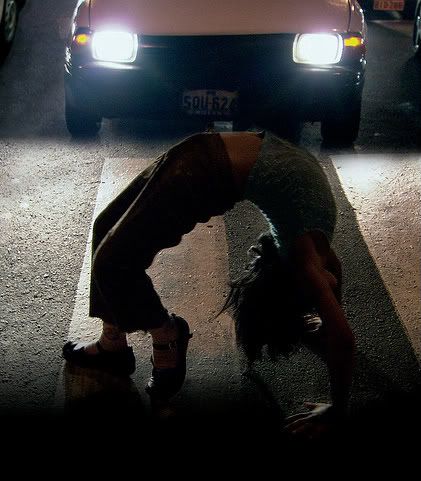
The subject of Heddy Honigmann's new documentary, Oblivion (El olvido), which I saw yesterday afternoon, is broad to say the least: maybe we can call it a history of Peru's modern politics, or an account of the many, many follies of the Peruvian government, or, just, Peru. Honigmann tells the country's story through its people, their memories and their frustrations and their dreams. The camera follows them, integrates itself, for a day or two, into their lives. Among the bartenders and waiters, shop-owners and leather workers, shoe-shiners and panhandlers that populate Oblivion, the most enigmatic to me were the street performers: boys and girls that cartwheel and juggle and handstand through crosswalks, in front of idling cars, hoping to get money from the passengers looking out of their windshields. The dynamic of these moments is amazing. Aren't we like the idling onlookers we movie-goers chastise for penny-pinching? And when they do give money, are they just doing it because of the camera, to look good? But then, aren't the people in the cars the same ones telling this story? So much happens in these crosswalks, as in every other moment of the film: each shot a rich history; each memory, each anectdote a loving cry.

I went to Jaime Rosales's Bullet in the Head for two reasons: one, I'd heard that audiences had been walking out of it in droves, that it was 'difficult'; two, I couldn't get in to see Greenaway's Rembrandt's J'accuse. The 'difficulty' of Bullet is that there is no dialogue: the camera takes an embodied position, so that its position, which is always distanced from our main character, can't hear what anybody is saying. The narrative becomes a document of this man's daily life. Here he is with a friend in a cafe, there using a public telephone, here now at a party, going home with a woman, driving a car, etc. Yet these don't seem like 'difficult' concepts to me: space and voyeurism have been brought to higher levels of consciousness in film many times. Then again, I think (and the film gives you plenty of space to think) that 'voyeurism' might not be the right word—and here enters some 'difficulty'. We don't feel as though we're looking in on a life. The shots are too composed, all too orchestrated, don't feel at all like surveillance. Of course, a film like Rear Window is carefully composed—but there voyeurism lays beneath narrative; isn't, as here, the narrative itself. Moreover, a level of terror enters into each shot because of the title, which announces an event we think we know will happen. But do we want to see it? What agency do we have to not see it apart from leaving the theater all together? We're not voyeurs at all. We're not looking in, we're being shown, being made to watch. It terrorizes its audience, and I wasn't sure how I felt about. It seemed a different kind of terrorizing than that of, say, Michael Haneke, who deals with many of the same issues as Rosales. Where Haneke, for me, is a great success, I'm not sure about Bullet in the Head. I need to give it some space.

Tuesday, April 14, 2009

Looks that scar. Or, Once there were eyes.

by Ryland Walker Knight


If you've seen Once Upon A Time In The West before, you'll recognize these dazzling blue eyeballs as some of the most sadistic peepers to hit a screen. If you remember this flashback, you will remember that they are alarmingly gleeful, and their appearance is blink-quick, punctuated by a slow-mo fall into dust by the younger version of Charles Bronson's Harmonica. You will also remember this flashback is the clue to why he's named Harmonica; or, at least, why he wears a harmonica. What's cool about a harmonica is that it's a wide instrument split into sections, or frames, of sound. You could say the same thing about cinema. Also, Fonda gets his comeuppance in a splendid composition.


Spoiler? Not really. This is Leone we're talking about here. You don't watch it for the plot, really. Or, you shouldn't; you should watch for how wide screen it is, how super saturated the frame is with color and activity and blood. I watch it for the geometry.

Tuesday, April 07, 2009

April showers: a grab bag of links and hints, plus a question.

by Ryland Walker Knight


Wow, this is counterintuitive. But it's a treat nonetheless since the film has no Region 1 DVD. I went ahead and embedded the film here but you should definitely watch it full screen, and loud. It deserves to be seen just like its title declares (asks?) it to be. That way, the outsized colors that feed this melodrama will pack more punch and, we hope, shock you into a powerful feeling. I saw the film last summer before my Telluride trip (see the bottom and the comment thread of this post) and it kick-started a Nick Ray fascination that has only grown since (a recent example). In fact, I've had my favorite of his films, On Dangerous Ground, at home from Netflix for a little too long now. I sure would like to write something coherent about it, but that will probably have to wait since I'm on the hook for a long-form piece about James Gray for a certain publication to be named later. In any case, watch James Mason shiver and rant his way through an illness and addiction whose consequences hit home in more ways than one. New media, baby. It'll take over your life. Get it?

look away

And, a reminder: my last Dreyer Diary shall hit The Notebook shortly, I'm told, and the link will appear in the link dump post below. While I'm here: March was rough stuff for a variety of reasons but the Dreyer films were a fine project to keep my brain active. I'm happy I met the films on the big screen (as with this Ray above, and On Dangerous Ground) since each is meant to be felt with the eyes (as a portal to the heart). For what it's worth: Ordet was/is my favorite. I'd like to write about it again, and better, some day. It has a lot to give. And, to reiterate what I tweeted @ Brian, all that nonsense comparing Silent Light to Ordet misses the fact that, plot point be damned, Reygadas' project is much more about tactility whereas Dreyer's project is about reorientation. You can find the perfect example of this shifting of perspective begin at the 3:55 mark in the clip below. (It occurs to me that I should say this comes a little late in the film, and that I should issue a spoiler warning for those concerned with such things.)

video unavailable; maybe again, some day, in a different form

What's really cool about On Dangerous Ground is that it's about both! I might say that those two films, along with some Hitchcock and Buñuel, are my favorites of the 1950s. I know it's a rich decade, as every one is, and that I cannot compare with some cinephiles' viewing history, but, are there any takers? Or, what's your favorite Nick Ray picture? And, for that matter, which Dreyer?

hit me

—Do we still have readers out there in the sphere? Can I provoke a response? To echo our stooly mope above: hit me.

Friday, March 06, 2009

One for you and one for me: Everlasting Moments. UPDATED.

by Ryland Walker Knight


swing into light

Some of you may remember our friend Martha's glowing essay about Jan Troell's Everlasting Moments from a little while back. Well, I've seen the film now, too, and I threw together a little review for Spout Blog. Knowing how much the film means to my friend makes it resound that much more with me but I do think, independent of that association, that it is a refined film: gentle, curious and quite lovely. I'm told Troell was something of a to-do in the 1970s, when his film, The Emigrants, was nominated for Best Picture despite its foreign tongue (cough, subtitles). Given all the "he's back!" profiles (such as this one in the Times) leading up to this new film's release, perhaps we can expect it to rightfully garner an audience and earn some money away from the latest so-called "film adaptation" of a comic book that happens to open today as well. Because, for all its easily dismissable "prestige" qualities (and one goofy icicle gleam), Troell's work is so careful and so loving that his film develops into the exact opposite: something filled with wonder, brimming past hurt and swinging into life with open eyes.

UPDATE:
Martha's new piece on this film can be found at The Auteurs' Notebook.

Friday, February 13, 2009

LOW BUDGET EYE CANDY #1: THX-1138

by Steven Boone


[New note (8/6/09): A new and improved, to say operational, version is now ready and available for your viewing pleasure above as part of our VINYL-wide switch to Vimeo. —rwk]

[New note (2/14/09): A new and improved, to say tighter and cleaner, version is now ready and available. If pressed, or not, Steve might say I jumped the gun on posting the original iteration of this video. What can I say? I was excited; I was impressed. In fact, I still am. This little thing is cool and I'm happy to host it here. —rwk]

[Original note (2/2/09): Steve's credit at the close is for BIG MEDIA VANDALISM. However, as the Odienator has taken over that space for Black History Mumf, we decided to post this video here for the time being. Hope you digg it as much as we do. —rwk]

Friday, February 06, 2009

Saturday School: The Class Structure, or, Procedures of Breaking Down.

by Mark Haslam


class

It's strange—yet strangely on—to call Laurence Cantet's Entre les murs (The Class) a procedural. Strange mostly because it envisions teaching as improvisation, as precisely those moments when structure and procudure break down. Here, at communication's end, communication can (it hopes) begin.

...

We enter the class through its teacher, François Marin (played by François Bégaudeau, who lived and wrote the book on which the film is based). The camera follows him into the school, maneuvering the halls, picking up movement as profs set up their classrooms: one body bumps into another, darts through a doorway; a table is hoisted up and out of a room. It's exciting, excited, and anticipatory. Of course, much of this has to do with the fact that the kids've yet to arrive.

With the ringing of the first bell, movement/expectation shifts—to the students, yes, but, more importantly (and we can also say, as a result)—to language. The film is constructed around language and its potential to be played. So it's only fitting that the class we attend is a French class. Here, as in our English classes in America, kids are tought to deal with 'proper' language 'properly'. This, as an initial situation, results in tension—a tension immanent to power structures, where the idea of there being a way comes up against multiple, other ways. In The Class, in any class, really, the struggle which emerges from this tension is linguistic. (When Cantet, in an interview with Phillipe Mangeot, refers to a particular “scene where [François] answers that the difference between written and spoken language is a question of intuition,” we should perhaps hear the final word also as institution.) When M. Marin first introduces himself to the class, for example, the students instantly set to punning off of his name, beginning the language game that propells the film.

The teacher, however, plays the game with a disadvantage. He's isolated: spatially, for one—which allows, here, an occassional note to be passed, there, a stifled snicker, whisper, etc.—and second, bound by institution, socially—the constant evolution of language results in “lacunae,” as Bégaudeau calls them, ever opening between student and teacher. Yet François does not take the institution's approach to the emergence of these lacunae. He neither quells nor ignores them as threats to system, but recognizes, pursues, and actively engages their emergence.

Teaching is a navigation of the lacunae and the two bordering spaces. The pursuit of gaps in light of system's failure.

...

A scene's inception: a lesson plan, a question.

raise'm

Follow the gazes: they cross, but don't ever really meet; they branch (but from where?). There's something chaotic about their pattern, as lines in a Bunimovich Stadium. “[A] school is sometimes very chaotic,” Cantet notes, “useless to cover its face, there are moments of discouragement but also moments of grace, immense happiness. And from this great chaos, a lot of intelligence can be born.” Existing between the walls, a bounce and redirection occurs over and again. The lesson plan proposes a direction. Its desire is to impart direction itself. Each gaze, in turn, proposes its own direction, or rather, holds the potential for a shift. With a question, the potential is realized; chaos emerges in/as language.

Cantet's process mirrors these gazes: “...what we planned to do would require three cameras: a first, always on the teacher; a second, on the student at the center of the scene, and a third prepared for digressions....”

raise'm

Each camera, which together compose The Camera, entail both a structure and its unraveling. One eye trained on matters at hand; the other, rolling and wandering as if of glass. Entre les murs builds itself out of its own disregard. Through these cameras, seeing becomes a component of chaos, but also forms chaos into a pattern. When François pursues the students tangents and diversions, it's to make them no longer tangents and diversions. It's to make chaos the thing. He acknowledges a certain flow and flux within (the, this, any) class: the moments before the Big Bang, approaching phase transition, before a something emerged. The scenes that result from transitions aren't a part of any narrative, rather they're (linguistic) events. Parts composing a whole—individual acts of creation and resistance. Random, no doubt—like the appearance of language itself from sound and tone. But taken together they form, even in breaking from system, their own structure. The structure of a game, but nobody wins out. Nobody can, but nobody needs to.

...

So, yeah, structure must be set aside. Teaching must fail in order to continue. Okay. But Entre les murs isn't Dead Poets Society. Nor is it Half Nelson or Finding Forester or whatever. It doesn't want anything to do with life lessons and breaking from tradition and inspiring those poor, underpriveledged kids. Every moment of success is followed by a moment of failure: As soon as the class's official troublemaker, Souleyman, displays a moment of brilliance, or at least a moment of hope...a different incident leads to expulsion proceedings. Teaching's limits frame each image—are, in fact, often conflated with its successes. The film doesn't demystify the profession; it just approaches it without illusions. It documents, in other words. Here, finally, we see it as a procedural. A real desire to show everything about teaching emerges at the center. And though words like “real” or “accurate” may cause some cheeks to blush, I want to use them.

But, then, the reality of a school is performance. To be a teacher, to be a student (in middle-school, no less, where masks are the most colorful and the most varied) is to act. So, really, it's not hard to believe that the teachers and students in the film aren't actors, but are teachers and students—mostly because, well, they're so believable. Improvisation is what their stations already require of them. The film's desire to document, to unfold procedures, reveals this theater. School, sure, but more: “a sounding board, a microcosm of the world...”

...

The film ends with images of the empty classroom. Sounds from outside, where life continues to an impossible order, sift through the windows. Desks remain, but disarrayed—remnants of chaos in pieces of institution. And the cameras which documented the students? The year's procedures and performances having ended, they're just rolling. Or are they waiting? Is this perhaps not a winding down, but a gearing up again? The shouts and screams coming in from beyond are language before language, and so the potential remains between the walls—a space neither in nor out, but within the gaps that emerge between here and there, where chaos, which is seeing, becomes the lesson.

This is where learning happens.

acknowledgment

[The Class opened at The Smith Rafael yesterday after limited runs in New York and Los Angeles. Sony plans to roll out the film further as it has been nominated for Best Foreign Film in this year's Oscars. Check your local listings. Learn something.]

Tuesday, January 27, 2009

A Christmas Tale. A house is an outfit. [part two]
Found Facts: A touching image

by Ryland Walker Knight


[This was made the day I left California. This is fair use, I promise. Also, I'm not homeless anymore. That makes me feel great. Makes me feel like all those millions of bucks I don't have. Now all I need is a lamp and a desk and, uh-oh, a bed. In case you forgot, I've made other videos, too.]

Tuesday, January 20, 2009

Ray at night.

by Ryland Walker Knight


dont hide, fight

It occurred to me about 4:00 PM Wednesday the 22nd, that I have been in a continuous blackout from sometime between 1957 or earlier until now. I misplaced my soul and I don’t know where I left it.
- Nicholas Ray, 1976

smoke

This essay that I link to above, by Carloss James Chamberlin, from the way back machine at Senses of Cinema (which has a good new issue if you haven't looked at it), is something special. Thanks to Zach for turning me on to its smarts and its beauties. I think it's a good reminder for today. That the reason we have to pick ourselves up and dust ourselves off is because, perpetually, we fail. It's a nice reminder that tomorrow I'll be the same guy with the same stink and the same bank account and the same unhealthy patterns as much as some new and vital routines built this fall; that we gotta fight. The thing that may get lost in the hoopla today is that inside that complicated and fiercely intelligent speech our first black President delivered with great passion there was a note struck to signal that, yes, we have to work hard every singly day we step forward. The world does not always stand arms open to meet you. Sometimes, the ones you love and depend on will hurt you. All the time, there's this life. So live. You will lose things. You will misplace passions. You will fall on your face. You may lose an eye. But you may also find some kind of grace pushing up and pulling up and dusting up and building up—even if you're throwing up. Own your peapods. Stuff them full and let them bud, let them flower; let light spill everywhere. Look around you. Forget the weights, or push up past them, and know: this is good.

a pea in a pod

Thursday, January 15, 2009

The Che letters. Part One: Questions, Declarations, Navigations

by Mark Haslam


to the people

[Ed Note: Here begins our ensemble attempt to wrangle our, let's be blunt, surprising enthusiasms for this film. Since the film is so large (without ballooning), we thought it appropriate to situate our understanding in this epistolary form, a series of calls and responses, that may speak to the nature of Soderbergh's film and its ostensible subject—and how these braided objects nail their aims across manifold divides. Our aim, it should be obvious, is to make the polymath sing. Update: Click for Part Two and/or the whole series]

cuba
bolivia

[Preamble notes from Mark: (1) Bay Areans, CHE: THE ROADSHOW is coming to us, hitting the Embarcadero tomorrow, Friday the 16th. And as a special treat, cuz you're all special, Soderbergh will be in house to answer our questions. For those in the East Bay not willing to cross the bridge or duck into BART, it will open as two films at the Shattuck Cinemas in Berkeley next Friday, the 23rd. (2) It may be useful to keep Pedro Costa's seminar (at ROUGE) on closed doors in mind. (3) Also owe a look to: The Cry at Zero.]

so wistful
mexico city

Che is not about Che."

Ry,

After a single viewing of Che, this is all that seemed appropriate to say; the one thing that I (to whom confidence comes but rarely) am pretty damn confident of saying. And here it's remained, at the top of a piece of paper, awaiting the explication it seems to deny. And the question it implies produces a response both silent and choral, a nothing and an everything: “What is it about?”

Our first approach faulters. We stumble, or stop, and wonder, how do we approach Che? So much criticism up to this point, positive and negative, tends to description and observation (itself an impressive feat, given the scope and scale) over analysis or thesis; few attempts at a true approach to understanding the film have been made. But then: do we approach in the first place? And if not...? Aha, an avenue: only in resisting representation does the film approach its figure. The non-approach must be our approach, too.

thru the woods

—certain films...are like doors, even if there are no doors in them. They resemble doors that don't let you enter as the protagonist of the film. You are outside. You see a film, you are something else...

For distance is a thing: tangible, like numbers. Especially for Soderbergh. Gaps, spaces, in-betweens...these are bricks, mortar. An absence or offsetting of one thing in relation to another, we come to see neither—or both, but only in the periphery—as our focus lands on distance. Indeed, it is focus, which seems so central to the film's technique that calls our attention to this: a camera—zooming in, zooming out—enacting distance.

But distance comes in many forms. If Cuba gives us Che, at times, at a physical proximity, distance is produced elsewhere. Take the battle sequences that are overlaid with Guevara discussing the ideologies, tactics, or justifications for the images we're seeing. His words don't explicate but complicate. Che doesn't speak in terms concrete enough for explanation. He is all ideal, totally abstract. Indeed, few figures in recent history have been as subject to abstraction as Ernesto Guevara, because, with him, it's easy: a man so determined by his ideals, so apparently detached from the material world, from his own body, that he already seems a vessel....

So, these sequences which might've been exciting and rousing are emptied out, abstracted. Again and again the image becomes an image of distance.

look at a remove

—that also is very important in the cinema, to love at a distance.

None of this is not distancing. I mean, it isn't aloof to us. We're not cast into indifference. I feel Che precisely because I am not asked to—better yet, I am asked to not feel for Che. The camera builds distances and in doing so builds avenues—long entrances. Entrances that are also closed doors. We see a film, we are something else... And the film, I think, like its subject, finds its center in love. But love undergoes a revision: think of Che's line that nobody is indespensible. This isn't intimate love. It's a re-vision of love—and, for that matter, equally of pain—that requires a response more than just reflex.

Our next approach then is a careful step, in step with the film, backwards. The images are abstracted: image distanced from itself. Meaning has been displaced, and the images, even those of triumph, now emptied out, take on the form of a lament. This is made clear in Bolivia, where everything feels, literally, dry, tapped. Even a downpour has no sense of moisture. In Cuba, death was Guevara's neighbor; present but only in the abstract, as one beyond your wall. Here, death is his house. “To survive here you have to fight like you're already dead.” This is the precise cry, the lament, love—a distance from yourself, an exile from yourself.

I can't help but think of those lovely moments of Che taking photographs of Bolivians. This is how he sees—through people. His revision (a second viewing) of self. Watching his body being carried away in a helicopter, their upward gazes correspond to his gaze, on the boat to Cuba, directed at Fidel.

carried away

—...and there are two distinct entities.

I think, too, of a Caetano Veloso's lyric (one redeployed in Jorge Castaneda's Che biography, Compañero) that says, “Navigating is necessary, living is not.” This is a film to navigate. Because it's a film that navigates with no intention of arrival. It resists. Is itself and not itself. Is exiled within the very place of its exile. The non-approach is seeing the film from over there. And seeing the film as a door at best ajar. The farther back we go, the less that we see, the less that's shown, the more possible it is to open the closed doors. We have to recognize the two ever dividing entities, Che and Che, us and Che, Che and us.

I offer this up as a way, maybe, to begin talking about Che. A way of approaching, and if we're brave, opening, the closed doors. As Costa says, opening these doors is work. So let's work, Ry. I want to navigate. Tell me!

Ever one last re-vision,
Mark

generous

Sunday, January 21, 2007

Born Under Punches: Véronique's Hands

by Ryland Walker Knight


before sunset
furthest from
nothing
everything
sex appeal
yet more
control freak
the other way
hang up already
metal arms cherry pickin hollow shells
I Can Feel The Heart Beating As One

Audrey is fine but gimme Irène any day. I think it's odd people forget how much LE FABULEUX DESTIN D'AMELIE POULIN actually apes LA DOUBLE VIE DE VERONIQUE, from the haircut to the colors to the mystery love affair. And how Kieslowski's is much better. Its spontaneity slays Jeunet's art-directed-to-death whimsy.