Showing posts with label Charlie Kaufman. Show all posts

Sunday, November 09, 2008

VINYL IS PODCAST #5: More synecdoches, more f-words, more more.

by Ryland Walker Knight and Mark Haslam and Jennifer Stewart
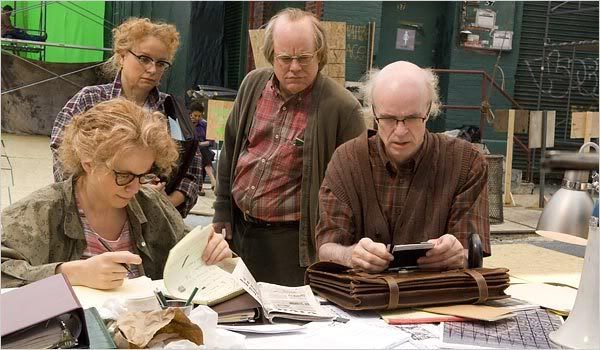

a look-see

[Podomatic stream]
[Direct audio download]
[iTunes subscription available]
[Simple syndication subscription]

[SPOILER WARNING IN EFFECT. There's no other way to talk about the thing, is there, Walter? Seriously, if you want to preserve the experience, don't listen. However, as we try to argue in the podcast, there's no way, really, to "spoil" this thing. For one, it's sour to begin with...]


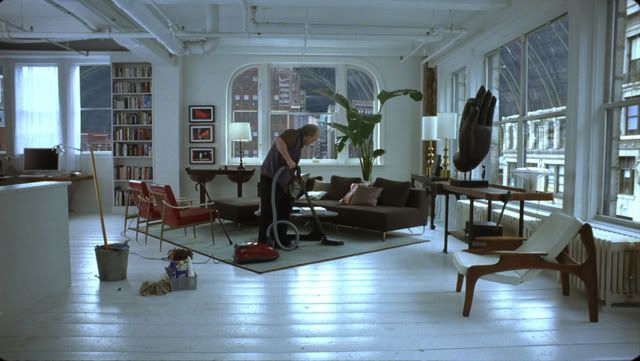
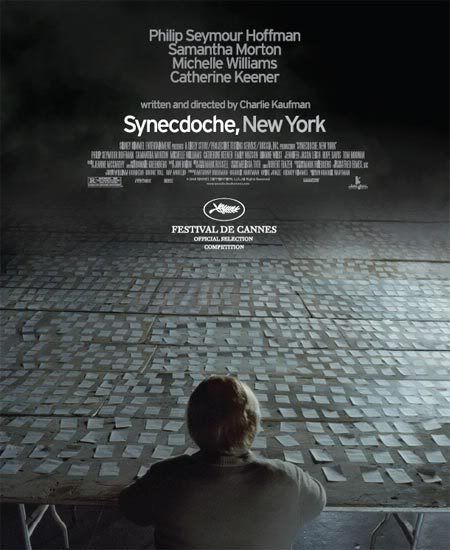
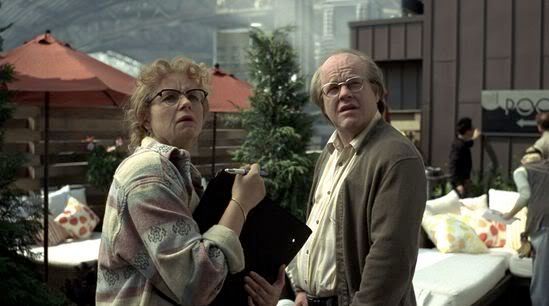
RWK here. On our third podcast, Mark and I discussed his first take on Charlie Kaufman's Synecdoche, New York (as well as Jean Eustache and, briefly, Jia Zhang-Ke), with Mark saying, "I liked it enough to not have an opinion of it right away." (He then put that reaction into some written words.) What I took and take that exit-poll impulse to mean is that he didn't feel it necessary to simply say, "I liked it," or, "I didn't like it," say to make a declaration of value. Because it's undeniable: this is a grand old meditation on major themes and concerns that continue to sprout up in cinema and, yes, in life. It's bound to shake, rattle and roll some souls. It's equally bound to simply turn off a large percentage of its audience, no matter its wit, right up front with some ugly images of festering decay and disease. Literally: dis-ease. There's little comfort in this film, although there are a lot of jokes. So, what does one do with this little beast? Well, we went straight home and talked on digital tape. We tried to form our opinions live. Of course, like the film, our conversation splintered and, in a way, as is always the case with words, it failed; or, it failed to resolve. And yet—even though an hour is a lot to ask of you, our faithful listeners—I think this is our best podcast yet.

The look-see: I'm torn between the two poles. The repugnance of the film is somewhat remarkable, even admirable, but it's still repugnant. It wallows as much as it falls away from the viewer. Not that I know them, but I understand why people like Walter Chaw and Manohla Dargis and Andrew "Filmbrain" Grant rhapsodize Kaufman's achievement, such as it is, with this picture; on the flips, an element of me was eager to indulge the "piss off" stance of my buddy Keith Uhlich, but not the "fuck you" of Rex Reed (no link needed for that bile). For all the yucky destitution of narcissistic projection, for all the death and dying, for all that kinda bores me (as well as Jen) with all that, there are some truly great moments, and cool tropes, as can be expected with Kaufman. The narcissistic projection, for one, works brilliantly: Philip Seymour Hoffman's Caden reading books as he imagines them, seeing himself in pharmaceutical ads and, um, building that massive and ever-receding and ever-multiplying theatre space. Add to that, that unlike Mark, I had an immediate and positive response to the film's negotiation with time: I think its fractal nature, with time splintering, works to exemplify its title; this is not a film about endurance. Caden does not endure lost time, he just keeps living in spite of himself, in spite of all the pills he takes and the cane he adopts and the losses that pile up (in the fucking street, no less) around him on his pathetic plodding towards death. In one way, I could probably develop a passion for this film as an argument in negative, as this is how not to live, since the film seems to understand this, but, at the same time, the film does ask us to spend our time with cumbersome and base decomposition.

If all a critic is to do is to tell you to see a film or not, then there's no two ways about it: I would say go for a run instead. But, as I understand it, my job, such as it is, such as I may be a critic (as much as simply a thoughtful person), is to argue for significance—indeed, for understanding—within the object over against of the object. So it's a tough spot. I'd like you to listen to our conversation, and I'd like it to continue, here in the comments as much as in future episodes, but I'd also like to remind you, that, yes, it's good and fun to go live in the world. And, you know, that Lola Montes talks about all these ideas, too, and it'll be playing at the Castro next week. For more on that film, though, you'll have to wait for a link. So, instead of that recommendation, I can just as easily (yes, with greater ease), turn to the other film I held up (perhaps foolishly) against Synecdoche in our podcast talk: David Lynch's INLAND EMPIRE. About 35 minutes into this hour-long talk we offer to you, I say, "I love INLAND EMPIRE for a lot of the same reasons I think a lot of people will love this movie. And they should. If this movie turns you on, and you find a lot of resonance with you, that is great—I'm not gonna try to take that away from you. Um, this is just, you know, this is just this. It's just three people—two of us are drinking beer—and, you know, but, INLAND EMPIRE, to me, is about everything that's going on in this movie, and it's a much more joyful thing. And a lot of it boils down to that. For me. Definitely. And that gets into a lot of goofy relativism right there, just saying, 'For me.'" But, as I couldn't formulate last night, all art is, in an basic way, experienced narcissistically, for the me that you are wherever you stand in relation to a film or a painting or a screenplay or a song or a novel or a dance. The trickiest part is to account for your self—to question your "me"—in a fun way, to be thoughtful and hilarious at the same time. Now I don't know if we're exactly hilarious here, but you'll here me laugh a lot in this, and, hell, that's good enough for me.
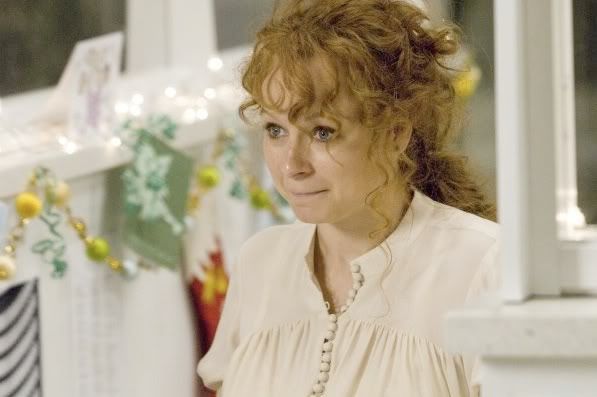
fire is red

This episode's intro and outro songs, for your downloading pleasure:

Monday, October 13, 2008

Brief and Preliminary Thoughts on Complications in Synecdoche, New York (and Myself?)

by Mark Haslam

[Note: I guess we were wrong on our podcast: Synecdoche, New York opens in limited release in NY/LA October 24th, with a roll out schedule to follow, thanks to Sony Picture Classics. Still, Mark has successfully avoided spoilers.]


suck it up!

Synecdoche, New York had always seemed to me a great title. Not because of the claims it may make about film or image as inherently synecdochic or metonymic, which does seem just a bit easy, if not facile; rather, I liked it because of the simple play it makes on Schenectady, one that had never occurred to me. (Not like I sit around thinking up every pun possible, but while I'm at it, here's one I kinda dig on: 'fiancee' and 'faience'.) In light of the title, we have to think, in part, of place as a part of its inhabitant, as a part of a person's whole. Here, a place is not made up of humans, or not just, but a human is made up of, among other things, place. The film solidifies this in its presentation of the title, which appears subtilely at the bottom of the screen, as though a mere identification of setting. So 'Synecdoche' is not just a joke about 'Schenectady': synecdoche is the location: the location is representation. It makes sense, then, that Caden Cotard (Phillip Semore Hoffman), the film's protagonist, would spend a majority of his time in (re)building his surroundings as a means of creating something “personal,” a massive self-portrait. The act itself—of building and constructing; of acting in the first place, of performing—is fundamental to the creation of self. However it's also alienating and exclusionary: all relations that aren't Myself and My City are diverted away ('fiancee'/'faience'?). Caden can't commit and can't keep his women from slipping away, obscuring, then dying.

One of the more interesting or, and I hesitate to use this word but here goes, risky elements of Synecdoche is a burning house that nobody seems to recognize as having anything particularly wrong with it. In fact, it's inhabited by Caden's secretary and on-again/off-again lover, Hazel (Samantha Morton). It's the sort of thing that's funny-ish in concept, but (here's why I used it) risks becoming nothing more than Signifier. A house on fire, in this case, could only have meaning. But then Kauffman returns to the burning house, pursues it, prolongs our experience of it—it isn't just a gag, it reappears several times, always in a modified context—almost to the extent that whatever meaning we gave it is emptied out, so that what we see is the inhabitation of a Signifier, much like the process enacted by the title.

Yet Kauffman only “almost” does this. I mean, he does it, but it gets obscured by everything else he does. (Which doesn't even raise the question, If he hadn't done it, would it be there anyway simply because of the nature of film?) For as much as the film is about building and/as solipsism, it's about time, which like relationships keep slipping away, and death, whose approach never falters. Both are portrayed in a particularly Kauffmanesque structuration, which can jump decades without a flinch. But where this technique was successful in Eternal Sunshine, it's not so much here, because we rely on overt cues to tell us we've performed this temopal leap—things like, “It's been sixteen years.” The structure itself doesn't really communicate the idea of time, and so we feel lost. And it's not a good kind of lost.

Especially given that structures and their construction are such a major part of the film, it's hard to not see this as at best a missed opportunity, at worst as evidence of Synecdoche's ultimate failure: that it doesn't utilize form. No doubt, it's got some great ideas, ideas about space and time which seem natural to film; but they're not put together in any cohesive way. Things are jumbled, uneven. Leaving the theater, I couldn't escape the thought of what would've been if Kauffman had given things more time, allowed the form to unfold itself, gradually over time, so that we feel time slipping away from us as it slips away from Caden, so that the approach of the film's end really is that gradual approach of Death.

wait for it...

Saturday, October 11, 2008

VINYL IS PODCAST #3: Synecdoche, Eustache

by Ryland Walker Knight and Mark Haslam


looking out
looking around
looking through

[Podomatic stream]
[Direct audio download]
[iTunes subscription available]
[Simple syndication subscription]

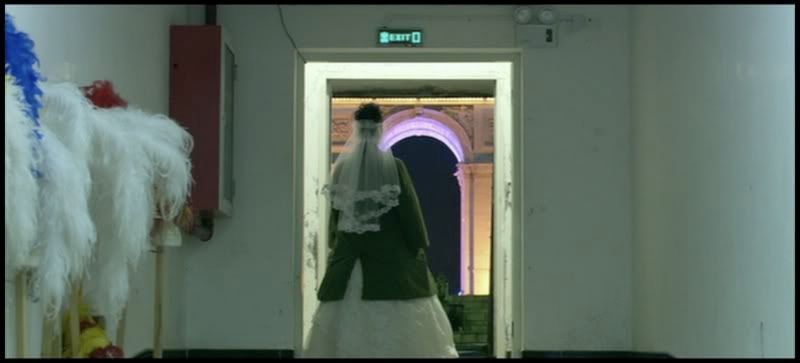
RWK here. We're back this episode to talk about some films we've seen but haven't finished writing about despite our due diligence (we promise) and a certain setback specific to Mark, which you'll just have to hear to believe. The episode starts with a talk of a recent advance screening in Berkeley of Synecdoche, New York that Mark was able to attend, which leads to a host of issues, including that trope of the/a title. In fact, I make passing reference to Michael Sicinski's review of Hunger, in which he makes passing reference to Charlie Kaufman's "regrettable" appropriation of the term as opposed to Steve McQueen's "mindbogglingly simple" solution to making the "Issue picture" viable though "cinema as synecdoche," which I then turn into talk about Bresson's cinema of metonymy, even metonymy of sensation, which somehow leads into (an altogether too brief) talk of our recent adventures with the current Jean Eustache series at PFA, which continues this weekend with, yes, a soft-titled presentation of Numéro Zéro on Sunday evening. There's also room for more talk of On Dangerous Ground and the Jia Zhang-Ke films I've been seeing, too, with special attention (at the close) to The World, which I hope to write about soon. Oh, and, there's two songs this episode, which you can find on my imeem page right here. (Again, if you want them gone, just shake a hand via email.) So, please, listen and tell us things. First, though, while our words (down)load, maybe look at these things--