Showing posts with label Cinco de Vinyl. Show all posts

Saturday, May 05, 2007

CINCO DE VINYL!

Drink Tequila

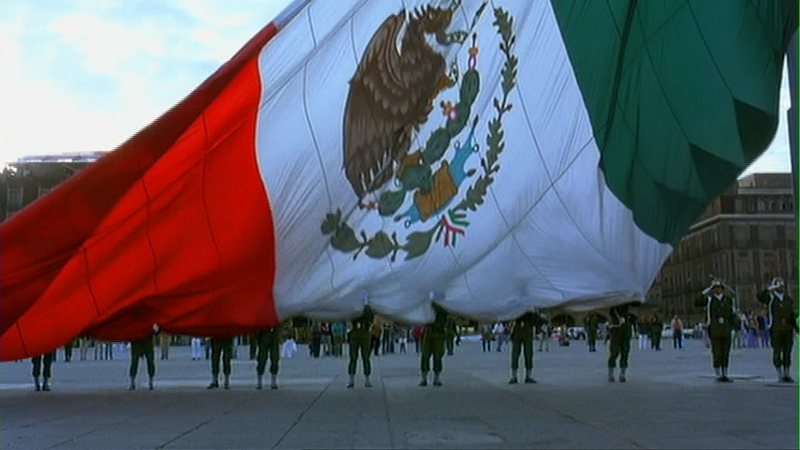
In honor of none other than yours truly's birthday on this holiest of holy drunken days here on the Gold Coast, we thought we'd offer a series of essays about Mexican filmmaking. What with the recent aint-it-cute trend to name Alfonso Cuarón, Guillermo Del Toro and Alejandro González Iñárritu the Three Amigos, I, along with other colleagues, have thought to ask, what about the rest of the Mexican filmmakers that have made or are making seminal works?

My personal investment centers around a film I saw not too long ago, Battle in Heaven, and its director, Carlos Reygadas, who I'd like to argue trumps all Three Amigos. His cinema owes a lot to his admitted hero (and, yes, mine too), Andrei Tarkovsky as well as the hyper-aestheticized quotidian of Bresson's films: (1) the long take is preferred; (2) time in space is foregrounded, situating the film and the viewer inside the film's world; (3) all the actors are non-actors as to retain a level of realism -- and to deny viewers any pre-conceived notions of the actors, and by consequence, the characters, the film; (4) there's a religious aspect, of course, as the title alludes to; (5) there's a transcendence through both sex and violence, which links Reygadas to another Bresson acolyte, Paul Schrader; (6) sex is something of pageant but never exploitative, it happens as would anything else; (7) things just happen. But there's more of that below. For now, I'd like to cede the space to my fellow writers who will explain a bit of their approach to this project, this day, this neighbor of ours.
[Ryland Walker Knight]

* * *


I cannot claim to be an expert on anything related to Mexican cinema. I know that I have enjoyed everything else Mexican that I've experienced so far, including cuisine, music, and literature. Sure, I've seen some of the more modern, mainstream stuff like Y Tu Mama Tambien and Amores Perros. And I am not ashamed to have liked the hell out of those. So, after hearing such good stuff about Carlos Reygadas from RWK, I knew that the time was right to check out something that kinda flew under the radar screen for most of my fellow countrymen. I chose Reygadas' first feature length, Japón, which was released a few years back in 2002. My mind was blown, in the good way. I'll try to show how, below. Viva La Raza!
[Leile One]

* * *


Our first guest column, by Jennifer Stewart, speaks for itself. Her first paragraph:
I've tried to begin Pan's Labyrinth's apologia where the sting of your charge leaves it: namely, that its gory violence is voyeuristic, useless, and empty. This attack is a complicated one, I think. Without a principled objection to onscreen face pulverizing, then you must say what it is about the aesthetic and stylistic terms P'sL gives itself, such that its onscreen violence can't be justified (whereas it could, perhaps, in another film). Having said that, if you think such onscreen gore is never justified, then that's a moral highground which only ends the discussion. Instead, I assume that if I can provide an account of what the onscreen destruction of the rabbit hunter's face is doing, I'll have at least succeeded in providing what your indictment assumes is its lack of structural and thematic content. [What this kind of reading means for the status of a film being "good" or "bad" is - I find - a paralyzing question, but I'd welcome discussion from you less ataxic film buffs.]

* * *


Luis Buñuel ties with Shohei Imamura as my favorite cinema cynic, so, naturally, he's my favorite Mexican director -- even though he was born, raised and educated in upper class Spain. In Mexico, Buñuel was no mere artistic tourist. Some see his years of making cheap Mexican comedies and melodramas as a colorful detour; for me, El, Susana, Illusion Travels by Streetcar, Nazarin, and Los Olvidados represent the director's greatest, most personal work (the Spanish masterpiece Viridiana notwithstanding). His later European provocations may have shown a little more freakish surrealism (and, of course, a lot more leg) but Mexico is where Buñuel really got his groove on -- and left his heart, I dare say. Let me persuade you with some pix and text.
[Steven Boone]

* * *


Easy access:

CINCO DE VINYL: Negotiating Battle in Heaven

by Ryland Walker Knight

Marcos
Ana


Upon its release, first at the Cannes film festival and subsequently here in America, Carlos Reygadas’ film Battle In Heaven was under imminent attack. It is a difficult film to attend to and it does nothing one has come to expect from films, even from foreign art house films. It refuses easy categorization or qualification or mediation. Even in positive reviews I read of the film there was an uneasiness, a resistance to approach the film and its imminent attack on an audience’s pre-conceived notions and perceptions of what film does, and how. I understand the resistance. What I don’t understand is the dismissal, the refusal to ask why there is a resistance, and what we are to do with that resistance. I’ve taken that route before — and been called on it — but I’m always trying to (get better and) base my reactions on some kind of aesthetic or formal judgments as well as my personal tastes. Plus, I like to think I know how to think about what a movie is doing beyond the simple dramatic elements; at bottom, when I get serious, I am a forever formalist. Battle In Heaven is a formal masterpiece. The film is so structured, so rigorous in its execution, I find it unendingly fascinating. Yet it is a difficult film to watch. At once drab and lush, bleak and optimistic, profane and divine, and despite a tendency to dwell on (and utilize) the “negative” end of those polarities, it occupies the middle ground, that space of negotiation, and this makes it a wholly beautiful master work of art. It uses those ugly tropes to negotiate, and move towards, the sublime.


Its very title alludes to that movement. It announces this will be rough, yet transcendent. The fight does not simply happen, it happens in the space it tries to negotiate, that ethereal space of the sublime we all define for ourselves: Heaven. For Reygadas, it would appear, Mexico and Mexico City are a kind of Heaven. And so is a blowjob. And a foggy valley. And the act of fixing an antenna, which by design is a means to mediate celestial waves of information.

As much as I do love the film, that affection makes the writing that much more difficult. How am I supposed to sound engaged intellectually when all I'm really doing is saying, Lookee here, this is beautiful, this is grand, this is life? In lieu of further effusive praise, and because school is kicking my butt here at the end, I’m offering some of Battle In Heaven’s more safe-for-work indelible images. All I ask is for you to look at what’s happening. And if you find yourself recoiling ask why, and how. Hopefully I’ll have more “answers” in the future.


CINCO DE VINYL: Everything is Everything: Beauty, Ugliness, and Universality in Reygadas' Japón

by Leile One


I wish we had more of a Mexican presence here in Boston. In case you didn’t know, Mexico is the best. Mexican food is the bombest substance on the planet. All the funniest, coolest kids I hung out with in high school back in Cali were descendants of the almighty Aztecs: funky fresh Vatos who could school you on American shit while maintaining a culture supreme. Hell, what would California be without the vast contributions of our Chicano brethren? And people are always talking about immigration reform...please. The West Coast wasn’t yours to begin with.

But how does it play out in New England? For the most part, the scene is non-existent. Indeed, La Raza is represented to a decent extent in a sizable Brazilian population in certain sectors of Boston, but there definitely isn’t much Mexican action going on. Which is why it seems weird that the city is hyping Cinco de Mayo so hard this year. Some of the local Irish Pubs are boasting celebrations for the holiday, which amount to discounted prices on bottles of Corona and perhaps a special on Margaritas. In special cases you may even get a live mariachi band (for a cover fee), but the whole thing seems kind of bizarre and out of place. Maybe Bostonians are just down to get drunk for whatever occasion? There’s my idea of a good time: a bunch of frat boys and blond chicks slamming Coronas and getting loud.

I’d give my left arm to be in the Mission District in SF this afternoon, fucking with some al pastor at El Farolito and getting in on the real celebration. Alas, it isn’t really an option, so I’ve elected to skip the weird bar scene here and instead take in some Carlos Reygadas cinema in the privacy of my own living room. I have rented a copy of his first feature, Japón, which is perhaps the closest you can get to visiting Mexico itself without moving an inch. Tell Tommy O’Doyle’s Pub I’ll take a rain check.

Japón is about decisions, actions, and consequences. It’s also about mountains. Additionally, the film contains graphic footage of horses copulating, and an extended scene featuring sex with the elderly. There’s a lot going on here.

This is my first experience with Reygadas’ work, and I find it challenging to say the least. Japón hits hard from multiple angles, reflected in stunning, spinning 360-degree camera shots of the Mexican landscape, as well as the multi-dimensionality of each situation presented. The film continually demands questions of morality, right and wrong, without giving any answers as to how the audience should categorize what’s happening in each scene. The result is confusion for the spectator, leading to an examination of one’s own beliefs, and it’s entirely intentional on the part of Reygadas.

Painter


The surface story is of a painter who leaves Mexico City in order to commit suicide on the countryside. Almost to the site of his mission, he stops in a village and ends up falling in love with an aging peasant woman with the heart of a Mother Theresa. The old woman gives and gives, and in the end it is this over-giving that results in tragic consequences. Her generosity may prove to be her downfall, but in the end we are unsure whether to conclude that we should therefore strive to avoid giving. Like I say, it’s complicated stuff. But I like that. I’d prefer for a film to test my reactionary tendencies to the point of moral confusion than to tell me how to feel. There is beauty here, no doubt, and there is ugly too. Sometimes the boundaries blur within the same image. When asked in an interview why he tends to favor the ultra-long shots, Reygadas responds with perfect justification: “To anyone who doesn’t like the long shots...deal with it. There’s so much going on within the frame; look at it.”

Elderly


At times the sheer lengthiness of the landscape shots seems to stretch time itself, making each scene seem to last even longer than it does in terms of clock-time. This can be disorienting to your average American moviegoer, who may become restless and wish for dialogue or tits or explosions. Sorry, dude. There’s a lot going on in that there canyon-side panorama, if it’s any consolation.

When there is dialogue, the picture appears at times even stranger. The protagonist’s sexual advances upon his elderly host may be disquieting, but even more surprising is her rather casual agreement to go through with the deed. She agrees out of a sense of generous holiness, not because she finds him attractive or thinks it’s a great idea. She believes that by committing this selfless act, despite her discomfort, she may be saving him from ending his own life. It all culminates in what is perhaps the most uncomfortable sex scene ever committed to film. Only to be followed by more glorious revolving shots of the Mexican countryside.

country


It is fitting that a film which insists on invoking such a wide range of emotional responses would be titled after a land as distant yet somehow similar as Japan itself. Why Japan? When one envisions Tokyo, do the images that come up seem synonymous with a tiny, barren village in rural Mexico? Or is it the mountain itself, towering over the characters in the film, like Mount Fuji which plagued the haiku masters time and time again. Perhaps we could apply the metaphor of Seppuku, the ancient Japanese suicide ritual, to the film’s protagonist whose aim is to end his own life. In the end, after spinning one’s head 360 degrees over this puzzle and all of the others in Japón, viewers potentially come to the conclusion that “everything is everything and let’s not worry our pretty little heads about it.” After all, Reygadas himself has mentioned that he would have rather left this film untitled.

Confounding title or no, the images are plenty evocative. Not only did I get to visit Mexico by visiting Japón, I feel as though I’ve in some ways visited an entirely different universe. This rugged landscape, desolate yet detailed, is a place where the subconscious shows better judgmental instinct than the intellect in most cases. I propose a toast, to the Cinco, and to our poetic and sensible neighbors down south, who often show an understanding of life that, if not better than your average gringo, wills a questioning of, and illumination of, how complex life is for everybody, from doomed Mexican painters to generous elders to copulating horses to your average gringo...

CINCO DE VINYL: Pan's Labyrinth's Apologia

proceed with caution

[Our first guest column! The ever-erudite Jennifer Stewart instructs us on how to read Guillermo Del Toro's Pan's Labyrinth. Ms Stewart is a graduate student in the Rhetoric department at UC Berkeley. Recently, she was plain shocked by my flippant and hate-filled dismissal of the film and offered to write a defense for its virtues. Apparently this is the first written film analysis she has performed but she's a good reader, a good Rhetor, so, naturally, this is an excellent and generous reading. I still retain my stance against the film in spirit but cannot delve into it again without sounding off all ire and limbs flown. SO! If you're curious what the hell a Rhetoric major does, this is it: this is the real deal. Enjoy! (-RWK)]
I've tried to begin Pan's Labyrinth's apologia where the sting of your charge leaves it: namely, that its gory violence is voyeuristic, useless, and empty. This attack is a complicated one, I think. Without a principled objection to onscreen face pulverizing, then you must say what it is about the aesthetic and stylistic terms P'sL gives itself, such that its onscreen violence can't be justified (whereas it could, perhaps, in another film). Having said that, if you think such onscreen gore is never justified, then that's a moral highground which only ends the discussion. Instead, I assume that if I can provide an account of what the onscreen destruction of the rabbit hunter's face is doing, I'll have at least succeeded in providing what your indictment assumes is its lack of structural and thematic content. [What this kind of reading means for the status of a film being "good" or "bad" is - I find - a paralyzing question, but I'd welcome discussion from you less ataxic film buffs.]

What's interesting about this scene of horrific destruction is that although it is explicitly a spectacle (the characters in the scene are watching, too), the camera shows the pulverizing blows rather than reactions from the troops or the son's father (who let us not forget is also forced to see). Everyone is watching, but the camera is not interested in this pathos. The Captain delivers the first blow after the son declares, "If my father says he was hunting rabbits, then he was hunting rabbits." The camera initially shows us the calm, cool face of the Captain as he delivers the first couple blows, then the darkening face of the son as his nose and cheekbones yield to the force of the Captain's blunt will. What provokes the Captain is precisely the son's hubris, not at talking back to him, but at declaring his father's power to nominally shape the world: if he says he's a rabbit hunter, then he's a rabbit hunter. What the Captain won't tolerate is this tautological claim from a competing will. The whole film can be read as showing us character foils operating in a fundamentally mutable world - a world that does bend and yield to a shaping will, and the Captain knows this.

What's perverse is that the Captain is trying to impose the kind of will which hordes that shaping power for itself. When asked by the doctor how he can be sure his bride's unborn child is a son, the Captain replies "don't fuck with me." When his supper guests countenance his "need" to confront what remains of the rebellion, he corrects them by declaring he is there not by need but by choice, since:

The war is over and we won. If we need to kill every one of these vermin to settle it, then we'll kill them all and that's that.

Technical military victory is insufficient to impose a Totalitarian order, so he must eradicate all those who do not act accordingly. The Captain is less a figure standing for the tyranny of uncritical obedience, so much as a figure who recognizes that the world can accommodate multiple interpretive claims, but attempts to collapse this by imposing a Totalitarian order. In other words, he is the figure who says, it doesn't matter what people believe, I will intervene and establish whatever order I want, imposing and sustaining it by sheer repetition: by insisting on rigid obedience to the mundane; a beaurocratized distribution of resources (Franco's daily bread, etc.), a hierarchy of manners (precise dress and punctuality; declaring his wife's caravan 15 minutes late on a multiple hour journey, and so on). Everything about the Captain involves absent repetition of routine (he rises, shaves, and dresses the same way every day, threatens his prisoners with the same speech, tortures them with the same instruments in the same order, etc.).

Yet his mistake is thinking an order can be established and maintained simply by instituted repetition. The problem is that this leaves too much room within those strict rules of daily life for free thought. You can run his household or stand in line for Franco's daily bread without obeying in your thoughts. Indeed, you can be dreaming about being a princess in an underworld. The Captain errs because he doesn't recognize what's undermining about this level of disobedience (he misses why it might matter that Mercedes ostensibly obeys him but is not loyal). It doesn't even matter to him, in the end, that he will die, as long as his son "knows what time his father died" - as long as his totalitarian influence remains as repetition (at the same time of day, etc) continually observed. Like all totalitarians, he errs precisely by not caring what people think, only that they obey.

The film fetishizes resistance to such a Totalitarian will, because revolution is what can be planned all the while looking like you are obeying. Mercedes and Ofelia represent this disobedient will because they share the ability to see and move through the "cracks" such a scopic regime leaves room for. Mercedes keeps the letters of the Revolutionary's correspondence in a hiding place purloined in the outlines of the floor tile, just as Ofelia reveals doorways by drawing their outlines with chalk.

More specifically, Ofelia can see through the outlines of this world, into the world described in her treasured books. Her second scene features the fragmented piece of stone statue she finds on the road and intuitively replaces - an act which in turn summons the flying stick-bug that Ofelia tells Mercedes is "a fairy." Of course later, this creature morphs itself when prompted to do so by Ofelia pointing to a profile in her book and declaring "this is a fairy." Unlike the Captain, Ofelia shapes the world by recognizing its ability to take on other forms. In short, Ofelia is the celebration of vision disobedient to the pretensions of one regime, and Pan (the Faun) is there to test her: although he ostensibly prescribes strict orders, the point is always to solicit a certain disobediance: What Ofelia's prophecy (to restore her spirit to the underworld kingdom) actually requires as its condition of fulfillment is resistance (it's Alice In Wonderland as Sophocles might have penned it). Pan's "Labyrinth" is precisely the bewildering complexity it would be to trying to satisfy conditions of fulfillment purloined in strict orders.

That said, the film de-centers Ofelia's fairytale story, for she and her unborn brother are really the parables of Mercedes and her adult brother leading the guerrilla force hiding in the forest. It is not her brother but Mercedes, after all, that the film positions as the true political revolutionary, since it is thanks to her guise of obedience that a revolution can be strategized and carried out in the first place. Just as Ofelia is comfortable occupying a world where one scopic regime can be penetrated by another (fairies and fawns appear, chalk can draw functioning doors, text appears in blank books), Mercedes is, too: by "finding" doors in the floor and she enables essential communication (not to mention medical supplies and other provisions) thanks to which the revolution continues to be possible. Mercedes is capable of the improvisation which takes place in the cracks and spaces opened up by an imposed rigid order (that of running the Captain's household just so). Ofelia's story is the mythic dramatization of how one learns, when one is gifted with the right visibility, to use those cracks and spaces (now it's Alice in Wonderland as Michel de Certeau might have penned it). Mercedes is the grown counterpart of this disobedient will.

In the end, Ofelia's blood is the triumph of the Captain's own conceit undoing him: he takes his son from her at the center of the Labyrinth, and shoots her in cold blood, right after Pan (once again) tests her ability to know when to disobey: she refuses to let Pan draw her infant brother's blood in the ritual which restores her as princess of the underworld by first sacrificing the blood "of the innocent." Ofelia instinctively refuses ("my brother stays with me"), and in apparently refusing to satisfy the conditions of prophecy, precisely meets them. The world is too mutable to insist on the strict interpretation of her brother's (an infant's) blood, since her innocent blood (thanks to the Captain) will do just fine. Except it is here, of course, that the film fetishizes disobedience, all echoed in the eulogy of Ofelia's mother: don't mistake the divine for its ostensible laws. What matters is the spirit who knows how to improvise an interpretation befitting the spaces and cracks. Precisely through the absence of strict law can innocence - an uncorrupted will - seek to act in a mutable world.

In conclusion, what happens when a corrupted, totalitarian will tries to act in this world? He must collapse it, and what better way to portray this than to show the Captain literally disfiguring a resisting countenance. The face - in some way the very metaphor of mutability - that declares the same power he wants to claim only for himself, is ruthlessly destroyed, and what matters in this scene is precisely to show the horrific violence it is (or so the film wants to say) to collapse mutability itself.

look, nerd
[Illustration by Arthur Rackham, from Wikipedia]

CINCO DE VINYL: Buñuel's Travelling Illusions

by Steven Boone

At the end of the Spanish Civil War in 1939, Luis Buñuel and family fled their newly fascist homeland for the United States. The rising 39-year-old filmmaker suddenly found himself in a marginal position in world cinema — as a dubber for Hollywood films and New York's Museum of Modern Art. Mexico provided the unlikely stage for his return to directing when the Russian-born producer Oscar Dancigers offered him the Mexican "political musical" Gran Casino (1946). Buñuel would spend the next 13 years churning out Mexican comedies and melodramas aimed at a mass audience. Accordingly, his triumphs and failures in this period were judged primarily by box office receipts.

Buñuel's third film for Dancigers, the devastating Los Olvidados (1950), forced world attention back onto the former surrealist upstart, whose Un chien andalou (1929) and L'age d'or (1930) were now distant pinpoints in the rearview mirror. Los Olvidados, a story of ghetto kids in Mexico City, won Best Director and the Grand Prize at Cannes in 1951. This established Buñuel's pattern of alternating between commercial films and riskier artistic projects that were his reward for the former. For example, the international success of his Adventures of Robinson Crusoe (1952) provided for Wuthering Heights and Buñuel's most personal film, the obsessive masterpiece El (both from 1953). (Ironically, the poor box office performance of Los Olvidados temporarily halted Buñuel's partnership with Dancigers; the low-budget Buñuel quickies that immediately followed it were produced by others.)

Mexico has often been described as the place where man-without-a-country Buñuel "made do" — making art on slim budgets in between more crass, popular projects. Along with El, Wuthering Heights and Los Olvidados, counted among the "art" are Nazarin, El Bruto (1952), The Criminal Life of Archibaldo de la Cruz (1955), and the Mexican evil twin of his Spanish Viridiana (1961), The Exterminating Angel (1962). Bill Krohn's assessment in the book Luis Buñuel: The Complete Films (Taschen) typifies this attitude: "Shipwrecked in Mexico, Buñuel had found a way to keep working and had become, like Crusoe, 'Governor of the Isle'."

But what about the dozen Mexican films — potboilers, capers, screwball comedies, soapy tragedies — that get such short shrift from critics and historians? Do the box office receipts really tell the whole story? Were Buñuel's heart and mind truly elsewhere when he was hammering out these, the cinematic equivalent of page-turners?

I propose that, high and low, Buñuel's Mexican films are his most personal and enduring. In Mexico, he learned to tell stories in the "invisible" visual style perfected in Viridiana (and often either overindulged or neglected in his subsequent European classics). Though the plots in his Mexican programmers typically followed proven formulas, Buñuel's class politics, his surreal, fetishistic imagery, his private fears, and, above all, the abiding humanism that his atheistic cynicism tends to obscure, are bursting out of these films — but only if you're watching.
Here are some images from one of his forgotten Mexican cheapies, the lighthearted Illusion Travels by Streetcar (1953). In the film, two drunk, frustrated streetcar mechanics take one of the vehicles on a nighttime joyride but get mistaken for an on-duty car. They have no choice but to continue the charade into the work day, giving free rides to working stiffs all over Mexico City. The caper unfolds like a lucid dream.