Wow, this is counterintuitive. But it's a treat nonetheless since the film has no Region 1 DVD. I went ahead and embedded the film here but you should definitely watch it full screen, and loud. It deserves to be seen just like its title declares (asks?) it to be. That way, the outsized colors that feed this melodrama will pack more punch and, we hope, shock you into a powerful feeling. I saw the film last summer before my Telluride trip (see the bottom and the comment thread of this post) and it kick-started a Nick Ray fascination that has only grown since (a recent example). In fact, I've had my favorite of his films, On Dangerous Ground, at home from Netflix for a little too long now. I sure would like to write something coherent about it, but that will probably have to wait since I'm on the hook for a long-form piece about James Gray for a certain publication to be named later. In any case, watch James Mason shiver and rant his way through an illness and addiction whose consequences hit home in more ways than one. New media, baby. It'll take over your life. Get it?
And, a reminder: my last Dreyer Diary shall hit The Notebook shortly, I'm told, and the link will appear in the link dump post below. While I'm here: March was rough stuff for a variety of reasons but the Dreyer films were a fine project to keep my brain active. I'm happy I met the films on the big screen (as with this Ray above, and On Dangerous Ground) since each is meant to be felt with the eyes (as a portal to the heart). For what it's worth: Ordet was/is my favorite. I'd like to write about it again, and better, some day. It has a lot to give. And, to reiterate what I tweeted@ Brian, all that nonsense comparing Silent Light to Ordet misses the fact that, plot point be damned, Reygadas' project is much more about tactility whereas Dreyer's project is about reorientation. You can find the perfect example of this shifting of perspective begin at the 3:55 mark in the clip below. (It occurs to me that I should say this comes a little late in the film, and that I should issue a spoiler warning for those concerned with such things.)
video unavailable; maybe again, some day, in a different form
What's really cool about On Dangerous Ground is that it's about both! I might say that those two films, along with some Hitchcock and Buñuel, are my favorites of the 1950s. I know it's a rich decade, as every one is, and that I cannot compare with some cinephiles' viewing history, but, are there any takers? Or, what's your favorite Nick Ray picture? And, for that matter, which Dreyer?
—Do we still have readers out there in the sphere? Can I provoke a response? To echo our stooly mope above: hit me.
How about a bit of counter programming? After yesterday's noon:forty-five viewing of everybody'sfavorite thingto talk aboutright now, I needed some stillness, some light, some reserve, some duration, some real matter, some water. You know, some good old timey long take mise-en-scene. Phew! However: I'll be seeing big fussy over there in the multiplexes again, probably (I think it's got its merits; they just look like anathema to this brand of heartbreak, which looks like antivenin to that brand of terror), and writing something. So stay tuned. You wouldn't want to miss it, right? We all need more, right? Right? Or, you could follow Glenn's lead and actually see The Red and the White at the PFA tomorrow night at 7pm. I know I will. --RWK
It is a characteristic criticism of Emerson to say that he lacks a sense of tragedy; for otherwise how can he seem so persistently to preach cheerfulness? But suppose that what Emerson perceives, when he speaks of his fellow citizens as existing in a state of secret melancholy, is that in a democracy, which depends upon a state of willingness to act for the common good, despair is a political emotion, discouraging both participation and patience. So when Emerson asks of the American Scholar that he and she raise and cheer us, he is asking for a step of political encouragement, one that assures us that we are not alone in our sense of compromise with justice, that our sense of an unattained self is not an escape from, it is rather an index of, our commitment to the unattained city, one within the one we sustain, one we know there is no good reason we perpetually fail to attain. -- Stanley Cavell, Cities of Words: Pedagogical Letters on a Register of the Moral Life
Go to The House to read a kinda-lengthy wrap up of what tickled me in 2007. While it's got pretty much the same format as what I used last year, this time I actually made a list at the end. Still can't rank anything, though, so it's an alphabetical list. I figure that most of the year-end lists and awards are redundant and silly to start with so why not throw my lot in with them? I guess the impetus to not make a list is because it's the same tired grammar most of film criticism continues to use. Not that I think a Better-Than List is worth much; it's still a posture. Not that my awards aren't a posture; my argument is with overbearing seriousness. (For example: I think it's awesome that my buddy Keith lists the Aqua Teen movie-film alongside The Horse.) Not that I'm not serious, but I like some levity; I like to laugh. Every film on my list, even the Reygadas, gave me a chuckle. But there's more of this over there so click this link if you didn't click that link at the beginning.
Also worth reading is Brian Darr's terrific Bay Area rep round up at Hell On Frisco Bay. It helps me to realize that as cool as New York City is (and it's definitely cool), San Francisco and the greater Bay Area have a lot to brag about. It helps to have a blogging buddy like Brian, too, with his calendar-scouring acumen pointing at things I don't always think to check up on. However, during this, my final, semester, I will probably only find time to attend screenings at the PFA. Thankfully, though, their newest calendar is pure dope: on Friday I got to go see Andrei Rublev on a big screen for the first time and during the afternoon of February the 17th I will see Out 1: Spectre, the shorter version (240 minutes) of the best film I saw and hardly wrote a thing about in 2007, Out 1: Noli me tangre (773 minutes). Plus: La Chinoise on my mom's birthday and a mini Terrence Davies retrospective (with the auteur in person at almost every screening, including a shot-by-shot discussion of Distant Voices, Still Lives). On to more merry movie watching and illuminating film writing in 2008.
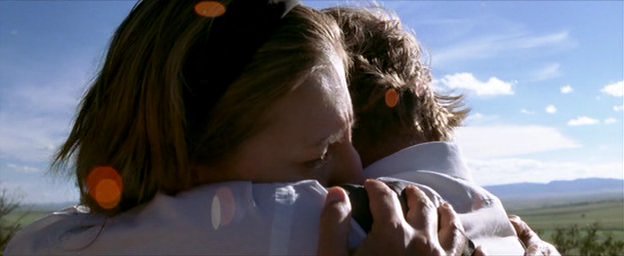
While Carlos Reygadas' first two pictures are without a doubt more immediately impressive (to say more shocking) than his third film, neither Japòn nor Battle in Heaven have anything on Stellet Licht when it comes to ebullient photography. For all the flashy formalism, though, Reygadas has made a quieter, more tender film than before because of this picture's remediation (evolution?) of his signature aesthetic preoccupations. If Battle in Heaven shuttered the broken wall country vistas of Japòn in Mexico City’s urban myopia, Stellet Licht nearly strips the world of material frameworks: here, the glass of windows (and of the camera lens), coupled with the light of the sun, and its splayed presence (or its dark absence), are enough for Reygadas to round the pleated space of his films (of the spirit). Sure, frank sex still plays a part. But those unabashed lens flares, as well as the film’s impeccable and complex sound design, background Reygadas’ concerns with the messiness of sex and desire to foreground the relative purity of, and paramount confusion between, love and faith. Perhaps it’s Stellet Licht’s gentility that shocks most of all.
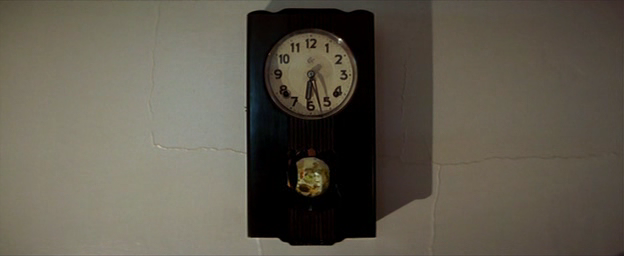
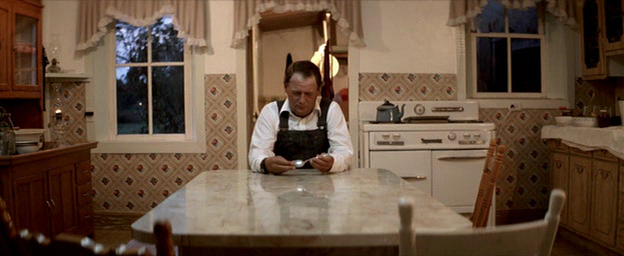
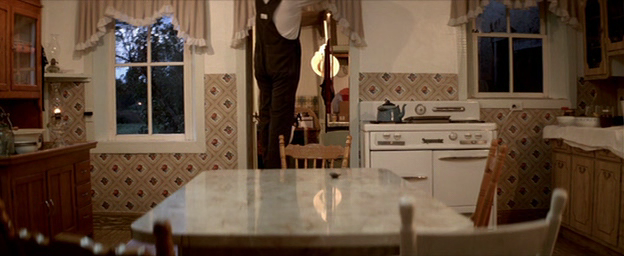
The film opens gentle enough with a protracted time-lapse dawn accompanied by sounds of the world awakening. Yes, Genesis. The single-take sunrise is gorgeous, to be sure, but the exaggerated sounds (as in a Bresson offering) frame the film as much as the light of a new day: animals bleat, wind whips, and, once indoors at a breakfast table silent with prayer, a clock ticks. The prayer lasts long enough for Reygadas to introduce us to patriarch Johan, his wife Esther, and their stable of six children, in perfect compositions that isolate the parents and group the children. After a mostly-silent breakfast, and a reminder “I love you” goodbye, Esther and the children leave Johan alone, at the end of the table, in the middle of the image, directly underneath that won't-quit clock. Johan sits quiet, staring at a spoon. Then he stands, retrieves a footstool, and steps up to stop the clock. Sitting again in the still of the room, the camera pushes in closer, and Johan cries.
The story is simple: Johan has fallen in love with another woman, Marianne. The complication is Johan still loves Esther, and he has been completely open about his affair from the beginning. This proves too much for Esther’s heart to bear, naturally, but the amazing thing about Reygadas’ film is its lack of judgment. There’s no scolding. Or, even when there is a scold, it’s undercut by empathy a second later.
I am told the great act of humility that closes Stellet Licht owes a debt to Dreyer’s Ordet, which I have not seen (nor have I seen any of his films, for that matter). Some critics have used this against the picture; others do not. I imagine Reygadas is smart enough that as much as he may inherit from Dreyer, his vision of the scene is singular. For instance, I doubt the Swedish film uses Jacques Brel as a touchstone for humble, beautiful, sexy gallantry. The inclusion of Brel’s 1967 performance of “Les Bonbons” (look below), viewed in a van with the doors closed, says as much about the gentle spirit of Stellet Licht and its characters, as does the supposed Dreyer quote. For one, it’s a song, a combination of storytelling and music. For another, it’s a filmed version of the song, introduced first on a television, then, bookended by fades up from and down into black, reprised across the full widescreen as a cropped television image. In a film about a remote group of Mennonites (a Christian Anabaptist denomination that resists pictorial representations) in Northern Mexico, this minor movie watching is an immanently suspect activity for its characters. But if Johan is testing his faith by falling in love with Marianne, what should stop him from pushing the boundaries of his faith with music videos, as he loves music, too. Earlier in the film we see Johan at his most excited singing along to a song on the radio, circling the camera, and his best friend, in his truck, in a patented Reygadas 360 (or a dizzying 1080 as it is here). Perhaps the overriding thematic question thus far in Reygadas’ films is “Where and how do love and faith intersect and interact?” The hilariously baffling thing about his films is that Reygadas wants to answer that question with every single shot he composes: he sees the beauty in everything.
Filmbrain’s mid-essay assertion points towards how I find myself drawn to these three marvels Reygadas has provided us with, as it speaks to certain filmic obsessions I harbor:
As with his other films, Stellet Licht’s tremendous power comes not from its narrative, but from Reygadas’ aesthetics; a masterful, poetic blending of son et image. The film exists at the intersection of John Ford and Terrence Malick, what with its epic landscapes, use of shadow, and depiction of nature and the elements as almost sentient beings.
It’s this regard for the “real matter” of the natural world, in tandem with his generosity towards his characters, that makes Reygadas’ films so special. You’re as likely to see a close up of a dog, or an orchid, or catch an umbrella flying through the corner of the frame, as you are likely to encounter a human face (or other body parts of humans, for that matter) front and center. In that regard, it’s easy to identify why finding Apichatpong Weerasethakul, along with Reygadas, this year has meant so much to me as a viewer, and a thinker. Their brand of what I want to call philosophy in film is one born not simply of humanistic striving for transcendence (although you can see that struggle in both filmmakers’ oeuvres thus far), but from how humans live in a world filled with things that are not human—spiritual or material, aural or visual, it makes no difference. So when Johan’s father starts the clock again at the close of Stellet Licht, it signals a choice of how to live in such a world. Ignoring the world doesn’t work. Faith and love are about respectful, thoughtful attention—to the world, to the spirit, to the life lead here on earth under the sun and stars among all cries of pain and delight heard across all time, clock or no clock.
[Final Notes: I wish I could have shown you more from the film but this will have to do. Also, I saw the picture at the Yerba Beuna Center for the Arts Screening Room on Sunday night and the projection was a little wonky, which made it a little harder to gauge certain scenes, as Reygadas plays with focal points in this picture in distinct way. So, as nice as it was nice to see in a theatre, I look forward to my DVD copy so I can play with screenshots and revisit all I missed. Even this post didn't get to talking in earnest about all that goes on in this. I promise that one day down the line I'll get into it real serious with his films. (Still learning, always learning, right?) Until then, can't wait for the next one, Carlos!]
When Matt announced his idea for "The Close-Up Blog-a-thon" I got excited. I thought I would contribute a whole bunch of posts like Odie. School, alas, takes a lot of time away from blogging since my schooling is a bunch of reading and a bunch of writing. Combine that with a renewed Netflix account and you've got a lot of time filling up. But I'm trying to slow my roll on the Netflix Q, and move from near-constant consumption to more respective production via reflection. That is, I want to write more about more of the movies I watch.
For instance, I'm taking a course called "The Action Film." It's a ton of fun. The filmography is packed with cool movies and we get to watch them in a big room on campus complete with powerful surround sound that was built in honor of the man who started UC Berkeley's Film department. Last week we watched John Woo's Hard Boiled. It was perhaps the most riotous screening yet, which is saying something a week after jailbird McTiernan's Predator. I thought I might try to write about that close-up at the end of the first firefight, where Chow Yun Fat gets blood splattered all over his flour-covered white face after he shoots a dude in the face at close range. It's a shocking moment and my classmates sure did jump. What's cool about it, though, is it's just another moment for Woo to color his melodrama. It's really no different from how Pedro Almodovar shoots a lot of Matador, which is also after the melodrama of classic Hollywood (like Sirk, like Duel in the Sun). But a whole essay seemed too much.
In the end I wrote up a music video. When they work, music videos can be really alive and beautiful, not just shill tactics. And it's really weird (cool?) to me that Juvenile's first hit single, "Ha," was even chosen as a marketable single. Sure, it's got a killer hook, but the fact that you can't hear/understand fuck-all he's saying around the hook (at least at first) is pretty odd for a lead single. On top of that, the video is a kind of minor masterpiece blending the artificial performances with this queasy-distanced "documentary" footage. So I fumbled around with it and came up with this piece.
Another thing that flashed in my head when thinking about close-ups were past posts here that focused on screenshots of close-ups (or any striking compositions) as a visual kind of criticism. I'll let the images do the talking, so I grouped some links to those here, in chronological order:
Evergreen syrup screenshot/s for the day peeks at a delicious moment in Claire Denis' Trouble Every Day that seems to get forgotten amongst all the bloodletting.
On A Dime Screenshots for the day delights in Zhang Ziyi's multifaceted facial expressions in one sequence from Wong Kar Wai's 2046.
You can also simply click the tag "screenshot" below and see all these posts simultaneously, plus some others. But this looks pretty good, right? Oh yeah, here's the Juvenile video:
When Ed Copeland asked us to nominate 25 non-English films for a list to be voted upon by others I kind of dashed off my list. I have expressed some of my issues with lists here before. They rarely feel complete. Which is an impossible goal anyways, right? So my thought process was: I'll type out a bunch and then whittle it down to 25 or so. I initially only had about 30. I was surprised. Losing five wasn't too tough, actually, it was coming up with 30 I felt I could stand behind without any qualms that I found most difficult. So here's my list, silly as it may be, in the order they appeared in the email sent to Ed. After the first two the order is rather arbitrary but you can probably follow my train of thought.
Mirror Rules of the Game Playtime Out 1 Celine & Julie Go Boating L'eclisse Persona Fanny & Alexander The Enigma of Kaspar Hauser Stalker Diary of a Country Priest Au Hasard Balthazar Contempt Pierrot le fou Masculin-Feminin La Dolce Vita 8 1/2 2046 Talk to Her Double Life of Veronique Seven Samurai Beau Travail Law of Desire Chung Kuo Cina J'ai Pas Sommeil
I guess a fair ammount of my choices did not make the final list. The most shocking, to me, at least, was the absence of a single Claire Denis film (where you at Travis?!), and Bresson's Diary of a Country Priest. (And, yes, this list means I have now seen both Playtime and Celine and Julie. I cannot begin to express myself yet. I may have to shell out for both, though, when that fall disbursement comes through the pipeline.) But, you know, whatever, the list is good, fun. Lists are good and fun, even when they are frustrating endeavors for nerds like me who can obsess over idiotically banal, and minor, details. That is, nerds who niggle. (What a fun phrase! Alliteration!) If I were to spend more than five minutes on a list it would probably strain to look a lot "cooler" with less director repetitions and a broader scope of time, perhaps stretching back to include something like Le Million or throwing in one of those Mizoguchi films I fretted about a couple months, or so, ago. Or, if only we could stretch the timeline to include some Carlos Reygadas and Apichatpong Weerasethakul up in this. See: it's all silly. So, there's my list, for what it's worth. I know I'll think harder, and probably longer, about my next ballot for this project.
BTW: Jim Emerson is hosting the individual lists in the comments of this post on Scanners. He's a kind fellow. Enjoy. This is a helluva learning tool for a young film nut looking to broaden his or her horizons beyond the googleplex and Coca Cola. There's shit like art houses and red wine out there, too, and they're both delicious. But then again so is Coca Cola. Also, as Darren Hughes points out in the comments at Ed's site, this list shows how much the Criterion Collection has effected the shaping of the modern canon (notice the links above?). But let's not bring that word up again. That was really silly, right Zach?
In honor of none other than yours truly's birthday on this holiest of holy drunken days here on the Gold Coast, we thought we'd offer a series of essays about Mexican filmmaking. What with the recent aint-it-cute trend to name Alfonso Cuarón, Guillermo Del Toro and Alejandro González Iñárritu the Three Amigos, I, along with other colleagues, have thought to ask, what about the rest of the Mexican filmmakers that have made or are making seminal works?
My personal investment centers around a film I saw not too long ago, Battle in Heaven, and its director, Carlos Reygadas, who I'd like to argue trumps all Three Amigos. His cinema owes a lot to his admitted hero (and, yes, mine too), Andrei Tarkovsky as well as the hyper-aestheticized quotidian of Bresson's films: (1) the long take is preferred; (2) time in space is foregrounded, situating the film and the viewer inside the film's world; (3) all the actors are non-actors as to retain a level of realism -- and to deny viewers any pre-conceived notions of the actors, and by consequence, the characters, the film; (4) there's a religious aspect, of course, as the title alludes to; (5) there's a transcendence through both sex and violence, which links Reygadas to another Bresson acolyte, Paul Schrader; (6) sex is something of pageant but never exploitative, it happens as would anything else; (7) things just happen. But there's more of that below. For now, I'd like to cede the space to my fellow writers who will explain a bit of their approach to this project, this day, this neighbor of ours. [Ryland Walker Knight]
* * *
I cannot claim to be an expert on anything related to Mexican cinema. I know that I have enjoyed everything else Mexican that I've experienced so far, including cuisine, music, and literature. Sure, I've seen some of the more modern, mainstream stuff like Y Tu Mama Tambien and Amores Perros. And I am not ashamed to have liked the hell out of those. So, after hearing such good stuff about Carlos Reygadas from RWK, I knew that the time was right to check out something that kinda flew under the radar screen for most of my fellow countrymen. I chose Reygadas' first feature length, Japón, which was released a few years back in 2002. My mind was blown, in the good way. I'll try to show how, below. Viva La Raza! [Leile One]
* * *
Our first guest column, by Jennifer Stewart, speaks for itself. Her first paragraph: I've tried to begin Pan's Labyrinth's apologia where the sting of your charge leaves it: namely, that its gory violence is voyeuristic, useless, and empty. This attack is a complicated one, I think. Without a principled objection to onscreen face pulverizing, then you must say what it is about the aesthetic and stylistic terms P'sL gives itself, such that its onscreen violence can't be justified (whereas it could, perhaps, in another film). Having said that, if you think such onscreen gore is never justified, then that's a moral highground which only ends the discussion. Instead, I assume that if I can provide an account of what the onscreen destruction of the rabbit hunter's face is doing, I'll have at least succeeded in providing what your indictment assumes is its lack of structural and thematic content. [What this kind of reading means for the status of a film being "good" or "bad" is - I find - a paralyzing question, but I'd welcome discussion from you less ataxic film buffs.]
* * *
Luis Buñuel ties with Shohei Imamura as my favorite cinema cynic, so, naturally, he's my favorite Mexican director -- even though he was born, raised and educated in upper class Spain. In Mexico, Buñuel was no mere artistic tourist. Some see his years of making cheap Mexican comedies and melodramas as a colorful detour; for me, El, Susana, Illusion Travels by Streetcar, Nazarin, and Los Olvidados represent the director's greatest, most personal work (the Spanish masterpiece Viridiana notwithstanding). His later European provocations may have shown a little more freakish surrealism (and, of course, a lot more leg) but Mexico is where Buñuel really got his groove on -- and left his heart, I dare say. Let me persuade you with some pix and text. [Steven Boone]
Upon its release, first at the Cannes film festival and subsequently here in America, Carlos Reygadas’ film Battle In Heaven was under imminent attack. It is a difficult film to attend to and it does nothing one has come to expect from films, even from foreign art house films. It refuses easy categorization or qualification or mediation. Even in positive reviews I read of the film there was an uneasiness, a resistance to approach the film and its imminent attack on an audience’s pre-conceived notions and perceptions of what film does, and how. I understand the resistance. What I don’t understand is the dismissal, the refusal to ask why there is a resistance, and what we are to do with that resistance. I’ve taken that route before — and been called on it — but I’m always trying to (get better and) base my reactions on some kind of aesthetic or formal judgments as well as my personal tastes. Plus, I like to think I know how to think about what a movie is doing beyond the simple dramatic elements; at bottom, when I get serious, I am a forever formalist. Battle In Heaven is a formal masterpiece. The film is so structured, so rigorous in its execution, I find it unendingly fascinating. Yet it is a difficult film to watch. At once drab and lush, bleak and optimistic, profane and divine, and despite a tendency to dwell on (and utilize) the “negative” end of those polarities, it occupies the middle ground, that space of negotiation, and this makes it a wholly beautiful master work of art. It uses those ugly tropes to negotiate, and move towards, the sublime.
Its very title alludes to that movement. It announces this will be rough, yet transcendent. The fight does not simply happen, it happens in the space it tries to negotiate, that ethereal space of the sublime we all define for ourselves: Heaven. For Reygadas, it would appear, Mexico and Mexico City are a kind of Heaven. And so is a blowjob. And a foggy valley. And the act of fixing an antenna, which by design is a means to mediate celestial waves of information.
As much as I do love the film, that affection makes the writing that much more difficult. How am I supposed to sound engaged intellectually when all I'm really doing is saying, Lookee here, this is beautiful, this is grand, this is life? In lieu of further effusive praise, and because school is kicking my butt here at the end, I’m offering some of Battle In Heaven’s more safe-for-work indelible images. All I ask is for you to look at what’s happening. And if you find yourself recoiling ask why, and how. Hopefully I’ll have more “answers” in the future.
I'm not telling you to make the world better, because I don't think that progress is necessarily part of the package. I'm just telling you to live in it. Not just to endure it, not just to suffer it, not just to pass through it, but to live in it. To look at it. To try to get the picture. To live recklessly. To take chances. To make your own work and take pride in it. To seize the moment. And if you ask me why you should bother to do that, I could tell you that the grave's a fine and private place, but none I think do there embrace. Nor do they sing there, or write, or argue, or see the tidal bore on the Amazon, or touch their children. And that's what there is to do and get it while you can and good luck at it. — Joan Didion




 . (And, yes, this list means I have now seen both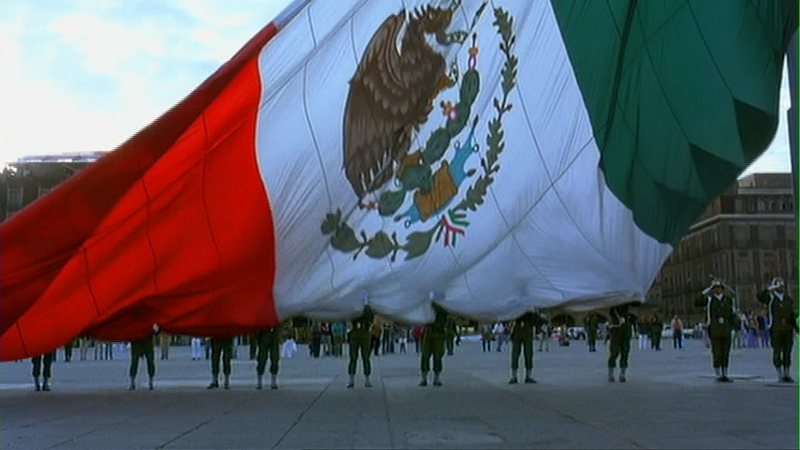


 Posts
Posts


