Showing posts with label Mad Men. Show all posts

Monday, December 13, 2010

Viewing Log #63: You stab yourself [12/8/10 - 12/13/10]

by Ryland Walker Knight
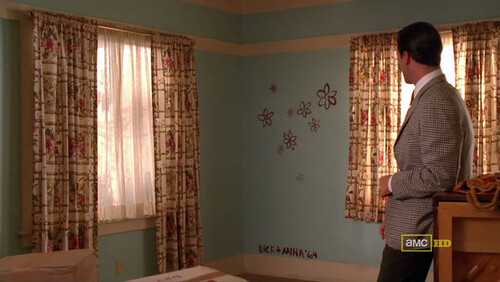

'64

—Though I did see some movies this week and though it was not ideal to battle insomnia with seven straight episodes last night, I barreled through Season Four in the past few days. So that's what I'll talk at below. But I did want to note that I saw that stupid ballerina movie, and I actually tried to like it, but I don't know how I could like it. I also watched some of Domino again, and it's wholly stupid, too, but it's not really aiming for anything profound; its main fault is its sentimentality; but that's almost an endearing through-line for Tony Scott now. In any case, they make a funny pair and it should be no surprise that the one that commits 100% to its lunacy (that is, doesn't try it on like a costume at arbitrary lengths) is the one that wins. But enough. There's bigger idiot winds to brave against.
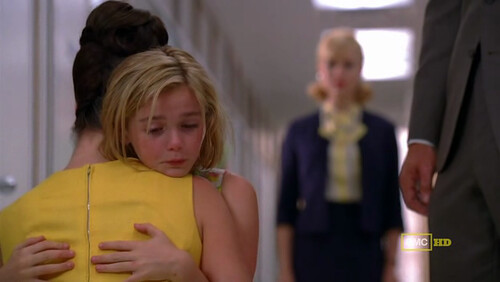
No, it's not

Suffice to say, I was compelled. At this stage, I am drinking some kind of kool aid. However, compulsively entertaining as this season was, I must air some complaints. My major complaint, in the wake of what I wrote last week, is that the show simplified Betty a little too tidily. Sally was complicated almost to replace (rather than refract) what seemed to go on in her mom, but that's a different kind of relationship to a television character than I was looking for; and I was perhaps too easily skeezed out by the idea of people making that scene/those images of Sally's, um, transgression at the sleep over. Which is another way of saying that there was a lot more about work and about Don's sex life in this season than I'd anticipated. Yet, all that fed one of the best things about watching Don's trajectory: the tension in him between acting and being*.

Don is tired of acting. But Don's impulses at being, at responding to himself, are the most confused actions he takes. It's what got him into the pickle of a relationship with Anna Draper, before all, even though that was the first bit of acting he had to do. But even that sentence gets at what a mess it can be to delineate these two strains of behavior. That is, they're always woven.

Recognizing what idea feeds another idea and how we have responded or will respond or are responding is about as difficult an element of becoming a person as I know of. And that's all this show's about at bottom. That's part of the joke, of course: advertising is selling ideas to people, and the show does a great job to feed certain fantasies, as all mass media entertainment can (and more often does, duh). That's why I want to see Betty's complications instead of her press-button immaturity. I want to know there's more to that creature. It makes me feel shallow. I think that may be the point.

Even more fascinating, however, was Peggy's role in this season. She's really given a lot to do, for a lot of reasons, including sex and power and both at the same time and telling a lot of boys to shove it, even Don in a way; and the fantasy that this little lady lived and thrived back then in the mid-60s is one I want to believe as well. This one makes me feel something close to proud, some might say inspired, and I dont doubt that's the point.
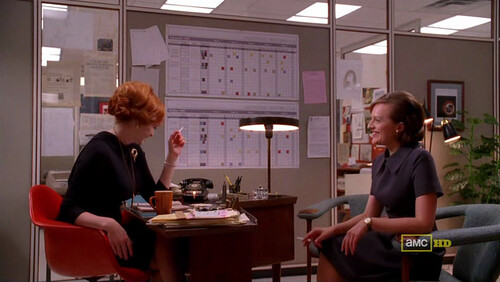
That's bullshit
—That's bullshit

Just as Joan's continued abasement at the hands of the writers continues to baffle me. Not that she can't stand on her own. Not that she doesn't have plans and dreams and boobs worth dying for. But one phone call to Vietnam in the finale is nothing compared to that whole birthday episode Peggy gets. Don't get me wrong: Joan gets to turn down Roger, she gets to flare up at Lane, she gets to do all kinds of Strong and Powerful acts. But they're forever undercut by what motivated them or what is consequent to them. There's got to be another avenue for her than another sign post that says sexuality was still circumscribed (and chastised, as highlighted by the Sally masturbation fallout), as well as circumscription for certain kinds of sexy ladies, in this era.

Which is why Don's choice of Megan over Faye is so sad, I suppose. We're reminded of his limits, of his inability to separate trains of thought; or, we see his rationalizations play out. We see she was right: she failed "the kids test" and Megan passed it better than should be expected. Faye was so appealing precisely because of the compliments Peggy gives her the same way Megan is so appealing precisely because she's allowed wrinkles and background the way Jane was not. (And because she never gives off that ugly gold digger pony bride vibe.) All these confusions in Don of course make me question my romantic confusions but I also have the luxury of some truly valuable time spent with professional that have helped me better understand all the strands woven through my life. Naturally, I'm still not an expert on myself, nor living, but I do take pride in how much attention I pay to differences that make a difference. I can see that California is a safe place for Don, a place where none of the expectations of New York matter; I see how he sees "a fresh start" not unlike his ex-wife; and I see how he conflates certain forms of happiness into a ball of expectations nobody will be able to make good on in the long run. When he figures out how to return to himself, once and for all, we might not have a show to watch anymore. But we also may not get there at this rate.
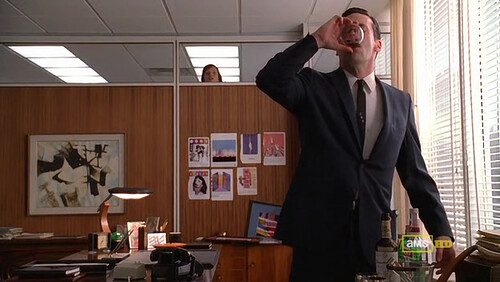
I spy

* = This construction is Martha's, I feel compelled to note, and it also describes some of the fun of the show where Weiner got his start, the irreplaceable Sopranos, which I feel compelled to mention in part because I can see how I've drawn a parallel between Betty and Carmella because I realize that my attraction to both of these characters is just that they are so complicated at times, just like anybody, though they can also be obtuse imbeciles with no grip on how to behave as adults.
Blankenship

Wednesday, December 08, 2010

Viewing Log #62: Indivisible has a lot of "I"s [11/29/10 - 12/7/10]

by Ryland Walker Knight


Cartoon chuckle

—Though I did watch Broken Embraces again with Martha (ahem), and Prisoner of Azkaban again with Haz, I didn't watch much else last week besides the third season of Mad Men. So that's all I'm going to talk about here.

Call the kids

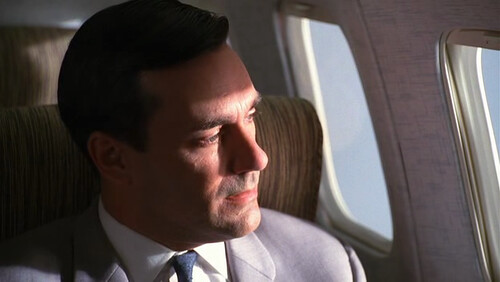
On my first night in Brooklyn last week, after an unexpected and unwelcome tour of the west side, I went to dinner with some friends. Talk turned to movies and TV, as should be expected with this crowd, and I brought up my recent plunge into Mad Men in part because I watched an episode on the flight and in part because I wanted to talk to one of these four people in particular about my reactions and assessments so far. Unfortunately, we two were the only people familiar with the show and the talk was short. Fortunately, it afforded us a private set of words to gush with: when I said, "What about that dance Pete and Trudy do at Roger's wedding?" we both lit up and shook our heads with delight. And we both agreed, out loud, turning to our friends, that it's one of the rare shows that gets markedly better as it goes along.

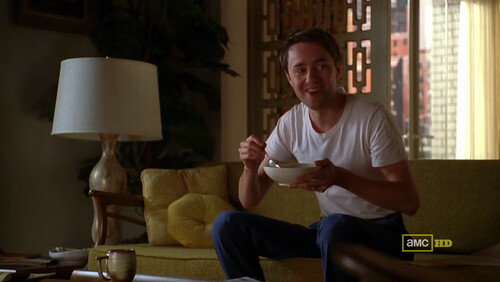
This is not a result of simple familiarity. Sure, we know these characters more/better by the time this third season gets started. But there's a tone, a dynamic between expectation and action, that sets this set of thirteen apart. The biggest factor is the show's sense of humor. The ridiculous is an easy target but when you mix horror into that you get a messier laughter. Disbelief is a basic reaction to absurdity and laughter's an easy way to paper over uncomfortable social interactions but I don't think that's the only thing that motivates the jokes and laughs in this show. (And yet, what else can you do but throw up your hands and laugh when somebody beautiful and smarmy gets his foot cut off and his foot blood sprays across a crowd of slack-jawed drunks?) I'm fairly certain there's some poking fun at certain characters going on in some of the jokes—and it's mostly these men the show makes fun of; you see Pete, above, eating cereal and watching cartoons while Trudy's gone—but there's also a dry wit and there's also a righteous "aha!" every now and again, like when Joan smashes that vase on her self-pitying dolt of a gorgeous husband.

Put another way: for all the damage done, this season was fun. Especially the finale. (Save, of course, that late-night scene when drunk Don calls Betty "a whore" and means it.) If this show's really about television as advertising—that is, how television's medium advertises fantasies and sets up expectations of a world you want to join—the same way The Sopranos is about television as therapy—as a perfect arena to get advice on how not to live—then this season finale did the best job selling me my American dream: to build something successful of my own, using talents I'm proud of, in a world beset by vultures.

Headlights?

Yet it's also telling that one success is met with another failure, as happens with Don's home, though that nuclear dissolution could hardly be a surprise to anybody with a brain. The show remains replete with tidy plot points. The surprises aren't the arcs, though Duck's new role in Peggy's life is a wrinkle I didn't expect until "Seven Twenty Three" (3x7) started with all those "awakenings" (again, the bluntness!). This is the most curious aspect of Weiner's world, I'm finding: one step forward is always meted by another step back. It's hard to say who's ever getting ahead—to the point that you think that isn't the point here. Then again, when "happiness" is the point, and when the show's selling us a world where happiness is a fantasy or at least fleeting, getting ahead may only be as simple as dealing with unhappiness better than the next guy or gal. And maybe that's the American they're selling so well at this moment: we deal with things, sometimes better than other times, and we find ways to live. Living, here, isn't just meeting an image of yourself or what's expected of that image (ie, buying something or fucking somebody); living is balancing on your own two feet in the role you've chosen.

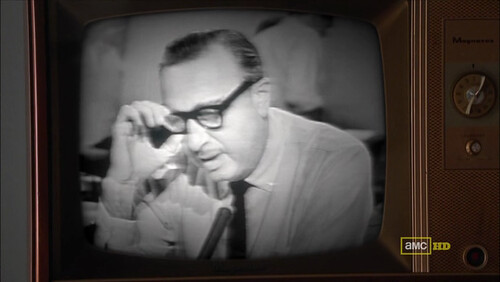
A different friend said, "Don wants his children to be children," when I said, "This Grandpa character's a trip." And I think he was correct. Don wants everybody to fall in line, really. It'd read more autocratic and asshole if it weren't tempered by the love he so clearly holds for every single person he has a relationship with, even that senile Grandpa; however, lies rot bonds and/or lies sever ties. Proof positive that love is never enough, and money certainly is not. When Ruby shoots Oswald on live television and Don tells Sally that "nothing" happened, Sally knows it's a lie. It's those lies than doom Don. Because it's admirable in some ways to want your children to be children and nothing else but it's ignorant to ignore (look at the root!) your daughter's burgeoning brain powers. One can hope Don learned this when he groveled for Peggy, in a truly affecting scene thanks to some wet eyes and smart dialog, but I'm not holding my breath. In fact, I'd be surprised if Sally and Bobby and Lil Gene are anywhere near as big a part of Season Four as they were in Three. (Am I wrong? Don't tell me?) At any rate, the kids are hardly as interesting as their mother.

Rag bets

Betty Draper, soon to be Betty Francis I suppose, is probably the most interesting character of all. But I am forever at a loss at how to articulate why since I'm just so damned involved in finding out what she'll do next in her myopia-mirrored-mired life. Makes me think another shoe will drop soon. For all of Don's lies, he's pretty dependable. Betty, on the other hand, seems stuck inside her competing emotions, playing a role she doesn't know the stage directions for, counting all her chickens before they hatch (which last season made literal, which continued this season with her dad's arrival). So I'm quick to hold back judgment. And I'll withhold it yet longer still because Betty's mostly a child and the charitable person would have you believe children can learn things, like how to grow up, as they attempt to rudder their pursuits of happiness.

Walter falters

After all, we are a young country.

Sunday, November 28, 2010

Viewing Log #61: Nothing's arrears [11/22/10 - 11/28/10]

by Ryland Walker Knight


Joan's dissolve

  • The second season of Mad Men [2008]. Compromise is the name of the game in this season. Life's full of it, or so it would appear in Matthew Weiner's world of tropes, and the joy to be had here isn't flight; it's here, if anywhere. The schematism of the writing in this show is really something. It often works, really. But it's also so tidy in the structure that characters, however well drawn, are reduced to ideas. I think it has to do with the period setting as much as the actual writing. Something about signifiers that I'm too lazy to read closer here beyond a favorite damning word of many so-called intellectuals like myself: over-determination. The allure of the show may be its sheen and its ludicrously gorgeous cast (television's a medium of faces at its best and at its worst), but I keep watching because of those moments when things fudge and because there's way less exposition in this season than last. For instance, the low-light of the season, which I lead with above: Joan's rape. It's a terrifying scene in part because it's about competing perceptions, and because of its final dissolve, which is easily the most striking image so far in the show. Joan's looking at her future in that shot: an idle man waiting for his mess to be cleaned. And I don't think my sympathies for Joan and her continued belittlement over the course of these thirteen episodes stems from Christina Hendricks' beauty but her talent at quivering, and my amazement at what these writers want to put her character through in order to counterpoint Peggy's ascension. It's no secret that Peggy's the biggest success (so far) because she's self reliant. What's doubly amazing is that she is, in fact, our model for America in the show, which may be its home run trot in the end. She loves popsicles, she asks for what she wants, she believes in a loving God, she's great at her job, she continues to out-do herself, and she's open to life for all her tight-lipped interactions with the world. Don's fascinating and Hamm's beautiful, too, but his "arc" is the hanger the suit drapes from, as that line in San Pedro attests; no, this show belongs to its ladies, including both Mrs. Drapers. Can't wait to see how Betty—that dingbat—fords the future.

  • Inglourious Basterds [QT, 2009] # I do love this movie, lumpy though it may be, and the BluRay looks pretty incredible. The colors aren't quite celluloid rich but they still impress the eye at interesting wavelengths. Plus, the editing in this movie tickles synapses so well. (And not just bc RIP S.M.) Awful close to a masterpiece.

  • Shadow of a Doubt [Alfred Hitchcock, 1943] # Well, the first half hour. Then we went to dinner, to give thanks. (Chloe wasn't impressed, by the way, though she did find Cotten's drawl creepy.)

  • The second half of the first season of Mad Men [2007]. Seems like an unavoidable set-up season, with plenty to play out, but there were some moments I really dug: Betty shouldering the BB gun without a shred of affect save the smoke from her cigarette, that way John Slattery can be a total asshole but still charming, Joan's/C.Hendrick's eye brimming, Peggy's rise, Harry Crane, and the first glimpses of Duck Phillips' brand of creep. Not to mention Don's ability to, well, be a man despite also being another brand of louse prone to self-delusion and good old fashioned alcoholism.

Window seat
—Come on back from way out west

Sunday, November 21, 2010

Viewing Log #60: Vitalism dialectics [11/15/10 - 11/21/10]

by Ryland Walker Knight


Top right
—On your way up to poetry

  • The first half of the first season of Mad Men [2007]. When we all lived in Berkeley, we watched the pilot and I was beside myself with (obtuse and undue) disbelief at how on-the-nose all the anachronisms were, how the jokes felt forced. And I kept bad mouthing it, wrote it off. And I still hate its weird cultural cache. But because of a certain someone I decided to go for a second try. And it's not bad. But I still don't get why people, including so-and-so, think it's so great. Jon Hamm's something, sure, but it's not all that cinematic (slick art direction isn't image-making, really) nor is it written all that well. Yet I am entertained. I cannot front on that front. It's easy to gobble up on rainy days. I'll have more to say, maybe, when I finish the season. I'll have even more to say, I imagine, once I get a few talking points (or just plain pointers) from that goof who goosed me onto this path. For now? It makes perfect sense why Christina Hendricks got famous. (Hamm, too, duh.)

  • 30 Rock "College" [wr: Josh Siegal & Dylan Morgan, 2010] I thought she was saying, "Lizzard." Was she saying, "Lizzard"?

  • Sauve qui peut (la vie) [JLG, 1979] Love the aesthetic, as ever, and wish I could make a feature with this much freeze-frame "animation," but I just don't think it's all that interesting; nor do I think it's any great leap beyond, say, Vivre Sa Vie in terms of ideas. The real treat, as I can tell, is Nathalie Baye's fits and fights and her tank top at the breakfast table. Also, her first appearance on the bike is one of the more beautiful things I've ever seen in moving images precisely because he (JLG) arrests it so.

  • Unstoppable [Tony Scott, 2010] Yet "purer" than Pelham, as Danny said, because of its focus; yet obviously more mobile as well. But at bottom this thing wins due to its actors and their charisma as much as the all-over always-moving cover-everything Scott style I adore. It's a good time, Chris Pine's got a good career ahead, and Denzel's getting fat. See it in a theatre while you can. But don't think too hard on it ya loons.

Exodus
—We go where?

Tuesday, August 05, 2008

Poem for Mad Men, season two.


Am I to become profligate as if I were a blonde? Or religious as if I were French?

Each time my heart is broken it makes me feel more adventurous (and how the same names keep recurring on that interminable list!), but one of these days there'll be nothing left with which to venture forth.

Why should I share you? Why don't you get rid of someone else for a change?

I am the lest difficult of men. All I want is boundless love.

Even the trees understand me! Good heavens, I lie under them, too, don't I? I'm just like a pile of leaves.

However, I have never clogged myself with the praises of pastoral life, nor with nostalgia for an innocent past of perverted acts in pastures. No. One need never leave the confines of New York to get all the greenery one wishes -- I can't even enjoy a blade of grass unless I know there's a subway handy, or a record store or some other sign that people do not totally regret life. It is more important to affirm the least sincere; the clouds get enough attention as it is and even they continue to pass. Do they know what they're missing? Uh huh.

My eyes are vague blue, like the sky, and change all the time; they are indiscriminate but fleeting, entirely specific and disloyal, so that no one trusts me. I am always looking away. Or again at something after it has given me up. It makes me restless and that makes me happy, but I cannot keep them still. If only i have grey, green, black, brown, yellow eyes; I would sta y at home and do something. It's not that I'm curious. On the contrary, I am bored but it's my duty to be attentive, I am needed by things as they sky must be above the earth. And lately, so great has their anxiety become, I can spare myself little sleep.

Now there is only one man I like to kiss when he is unshaven. Heterosexuality: you are inexorably approaching. (How best discourse her?)

St. Serapion, I wrap myself in the robes of your whiteness which is like midnight in Dostoevsky. Now am I to become legend, my dear? I've tried love, but that holds you in the bosom of another and I'm always springing forth from it like the lotus -- the ecstasy of always bursting forth! (but one must not be distracted by it:) or like a hyacinth, "to keep the filth of life away," yes, even in the heart, where the filth is pumped in and slanders and pollutes and determines. I will my will, though I may become famous for a mysterious vacancy in that department, that greenhouse.

Destroy yourself, if you don't know!

It is easy to be beautiful; it is difficult to appear so. I admire you, beloved, for the trap you've set. It's like a final chapter no one reads because the plot is over.

"Fanny brown is run away -- scampered off with a Cornet of Horse; I do love that little Minx, & hope She may be happy, tho' She has vexed me by this exploit a little too. --Poor silly Cecchina! or F:B: as we used to call her. --I wish She had a good Whipping and 10,000 pounds." --Mrs. Thrale

I've got to get out of here. I choose a piece of shawl and my dirtiest suntans. I'll be back, I'll re-emerge, defeated, from the valley; you don't want me to go where you go, so I go where you don't want me to. It's only afternoon, there's a lot ahead. There won't be any mail downstairs. Turning, I spit in the lock and the knob turns.