Showing posts with label storytelling. Show all posts

Thursday, December 22, 2011

BANG BANG: Jenny Stewart

[BANG BANG is our week-long look back at 20!!, or "Twenty-bang-bang," or 2011, with contributions from all over aiming to cover all sorts of enthusiasms from film to music to words and beyond.]


Breaking by Jennifer K Stewart


Even though television serials are the right medium with which to tell immersive character stories, it is still a pretty rare thing to see a show that isn’t primarily plot-driven.  What I mean is that our usual (pedestrian mainstream) experience in front of the screen is to be very quickly clued into certain archetypical/idealized characters, so that we may watch said characters react to a series of events (loosely, ‘plot’).  Nothing explains this better than the Hangover movies, where the whole point is to watch oh-so-subtly differentiated dudes responding to outrageous events.  Note that Hangover’s reverse chronology is just the ideal cinematic contrivance for getting the audience to salivate in anticipation of immanent character reactions.  We want to see that guy being that guy, etc.

And really, I shouldn’t be smug or cynical, because at the very least, all these structural conventions (i.e. beginning the film at its chronological end) are interesting, if only insofar as they get allied to other generic conventions (the dude movie, etc.)  Film itself mentors us into reading character and personality as popular film conventions have conceived them.  A show begins by showing us just enough characterization to clarify precisely what the character will experience and exactly how s/he will and will not change (ex: The Godfather trilogy), so that we may watch a certain stability of who they truly are prevail through all happenstance/fantastical events.  This film shorthand for characterization is itself highly formulaic, though it can still be interesting or even original – think of how There Will Be Blood showed you who Daniel Plainview is through his incredibly tense and impatient dealings with Paul/Eli Sunday.  The innovation being that Plainview was too horrifying to be legibly revealed all at once, and his character so graphically linked with the confusion of blood and oil (insights for another essay never written, alas). 
Motor skills

Anyhow, that this kind of storytelling continues to prevail – namely, 1. introduction of characters  2. embroil characters in plot machine so we can see them being themselves OR turning inevitably into who we suspect they are to be – is easily explained by how much we enjoy watching eccentric, essentialized, and/or idealized personalities undergo life and its passions. 

The past couple years, I’ve been thinking about how the advent of great serial television series has allowed groundbreaks from this tradition.  Pretty simply, serials have the requisite time in which to do so.  Even a film trilogy has such limited space within which to upset the normal character/plot formula.  This is because most of the disruptive work requires defamiliarizing who it was you thought was on screen, and a two-hour film simply hasn’t the time to lay groundwork.  Imagine trying to make a Breaking Bad movie capable of showing any of the central characters (Skyler, Jessie, Gus, Walt Jr, Marie, and Hank, let alone Walter).  Disastrous. 
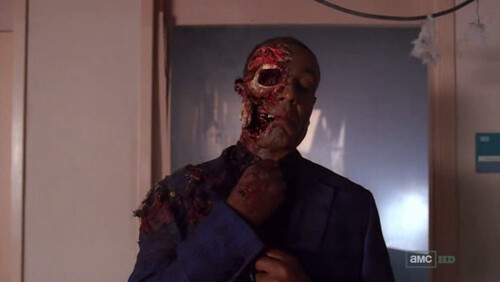

Breaking Bad is doing something subtle and thrilling.  Think of how cursory the ‘plot’ is – nothing just happens, all events are a precipitated by complex backmoves and antecedents between combinations of characters, and virtually all of these on-the-fly miracles of impulse in the face of struggle and resistance from others.  Even Walt’s vainglorious inability to let Hank mistake Gale for Heisenberg owes to the same uncertainty principle (right?) as rashly swerving into traffic to keep Hank from Gus’ laundry.  If there is anything predictable about Walt, it is that he finds himself – much to his own horror – capable of unpredictability.  It is neither characteristic nor uncharacteristic, and this is what the show has been demonstrating from the start.  Consider Walt’s tortured and circumambulating dispensing of Krazy-8 in the early episodes of Season One.  Attempting to, oh, rationally persuade himself to murder the drug dealer bike-locked by the neck in Jessie’s basement, Walt composes a pro versus con list whilst sitting on the toilet.  But it took a sandwhich, a fall down the stairs, and a shattered plate shard in Walt’s leg; committed decision not being enough, he needed a chance for reactive adrenaline.  

Note how Skyler’s resolve against Walt was at first backed by steadfast principle, only to then just wear away.  She seizes upon the delusion that good (paying for Hank’s rehabilitation) justifies the means.  Welcomes it even, so that the war of attrition is over and she need no longer resist.  On any other show, once established that her character stood for any principled stance, there’d be no need to show any more of her.  Instead, she breaks, just like everyone else on Breaking Bad


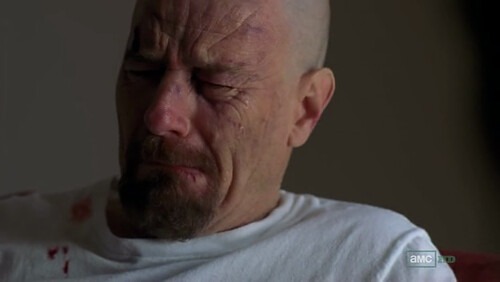
By the end of 2011’s fourth season, we can see Walt’s now refined ability to premeditate complex manipulations on equal par with Gus.  Yet recall the heartbreaking scene between Walt and his son in S04E10, “Salud.”  It’s the morning after Walt and Jessie’s physical fight.  Junior’s calling and buzzing as Walt, disorientated, medicated, beaten, pulls back a sheet stuck to his face with dried blood.  The shroud comes away for a few precious minutes and Junior sees his dad unguarded.  At first Walt sticks to the story – “don’t tell your mother, I was gambling, can we just keep this between us?” – but when Junior asks who did you get into a fight with that’s the end of Walt’s posturing.  Walt sees Jessie where Junior is; the possibility of relief, forgiveness.  But as sobriety dawns Walt takes it all back and the layers of blood-caked cover go back on.  Now Walt asks Junior not for connection and forgiveness, but to promise to not take that unshrouded image as defining; the way the “empty spray-paint can” imagine of his rasping father dying of Huntington’s disease, is Walt’s only “real memory” of his father. 

W:  “I don’t want that to be your memory of me when I’m gone.” 
Jr:  “Remembering you that way wouldn’t be so bad.  The bad way to remember you would be the way you’ve been this whole last year.  At least last night, you were real.  Y’know?”

Walt is confusing the revelation of nothing beneath the shroud with emptiness.  RJ Mitte kinda steals this scene, and Walt junior is now the character to watch in Season Five…


p.s. Jessie.  No one’s been broken more than Jessie, in ways he has yet to fully discover.

________________________________

Jennifer K Stewart is a philosopher and yoga instructor living in Canada. She believes in the body.

Sunday, April 24, 2011

SFIFF54 #2: Waking up to life sometimes seems worse

by Ryland Walker Knight


— Getting naked with clothes on

Despite the worst projection/presentation I have ever experienced at the Kabuki*, Hahaha proved once again all you need to make a fabulous movie is a sense of humor and a couple of good actors. This flick has more than just a couple, though, with at least seven fully realized characters criss-crossing, eluding each other even, over a rainy week in the port town of Tongyeong. I don't need to really tell you who these characters are, though, nor what really happens, since the charm of the picture is just how conceptual it is without being clever or, as is often the case in Hong, overtly structural. Granted, there is a device: the present tense of the story is rendered in black and white still photographs, heard as narration, as two friends meet for drinks to talk about their recent visits to Tongyeong, ignorant of the peripheral role each played in the other's vacation. However, it becomes more of a tool for rhythm than anything else as these two stories cohere around the perpetually liminal space of the port with one friend finding a way to leave untethered to anything or anybody and the other finding his way towards the commitment he's been avoiding. True to its blood as a comedy, it ends in a marriage of sorts—let's call it a pledge—and a laugh.

Though the majority of the film is spent observing the problems boys encounter when they wear the bodies of men, the women somehow matter more even though we're never granted a look from inside their eyes. One lady keeps saying, "You see me," without realizing this boy-man does not know her, truly; rather, he knows how to compliment her—not to mention stalk her, to the point of breaking into her apartment while she's gone. Almost an axiom: men in a Hong picture, even when they are True, are always creeps. That is, they all drink too much and they all seem mainly interested in sex, not love, to say nothing of work. Which is odd since Hong's the ultimate professional. He debuted two pictures in 2010 for Heaven's sake. And this one is just superb. It's casual, like a good dinner: one story leads into another and after a couple hours you're full or you're wasted and it's time for one last joke before you hit the road satisfied you understand your friend, and maybe life, a little better.


A movie at opposite ends—not once does it picture a better world—Christoph Hochhäusler's The City Below is practically apocalyptic from the get-go. As lucid an interpretation of a certain Mille plateaux perspective on our recent global crash climate, the film isn't strictly a political engine though its main structure as far as I can see is to de-center everything, to expose how this fiberobtic planet of moving monies is as thin as a glass wall is a look-don't-touch denial. To that end, I'm slightly sympathetic to the people who find the film "cold," but, that's a starting point not an argument. And, in fact, its distance is simply part of its Resnais-like openness. Its Biblical coda is (I'd like to think D&G would approve) crazy multivalent with significance moving in a million directions thanks to its oblique construction. A "complete" read is impossible for me at this point in part because I was so seduced by the aesthetics.

Looking forward to exploring more of Hochhäusler's work with the help of my Cargo editor, Ekkehard Knörer, who interviewed the filmmaker and his writing partner here (in German, but you can hit "translate" in Chrome and get the gist), who agrees I could probably make an argument about the apocalyptic gloom of this easy-to-allegorize but still-rich tower of depravity. (Bonus: any movie that makes Gang Gang Dance** a part of its characterization of the lead earns lots of points.) And I've said nothing about how excellent the acting is, nor the economy of the script, or any other thing I might want to praise, because I don't really need to, I'd hope; after all, compliments are nice but often boring. The most thrilling moments of this film are the ones where characters literally or metaphorically wake up because it's great to watch a face recognize a shift in the world they live in.


Which reminds me, it's okay to love somebody and tell a story about it. And Mysteries of Lisbon is nothing but stories. In fact, Ruiz makes a joke about the length and breadth of his film right at the start of the second part, presumably experienced after an intermission as we relished, by having one character tell another that he has a long story to tell and it will be mystifying as to why he's telling the story but that if his audience of one is patient and keeps listening everything will be told in the proper order for maximum cathartic effect. This is the film, of course, talking to us in the seats***. Because the film takes its time. And it repeats itself. We hear one story after another, with stories within stories, making audiences of every character at almost every encounter; or every character has a chance to play narrator. Which reminds me, the voice is a powerful tool.

This polyphony is a way to bend your ear, the same way that the way Ruiz circles scenes bends the space, and because we learn so many histories, motivations get bent into new senses or understandings of the world. The entire film is trying to bend you to its formal will, put you in a place, force you into roles you hear inside your own head, make you lose yourself as much as our first/primary narrator winds up losing himself through the course of his maze of a life. With most of the movie taking place indoors, a series of interlocking chambers, this makes rigorous sense thanks to Ruiz's roving eye so nimble to traverse a wall or glance past a hidden stairwell with a face gone sour listening to evil perpetrated beyond this private box of echoes. Again, audiences; again, multiplied; again, again. It's so interior that locales beyond walls remain concepts, fantasies, stages. And we remember the dioramas that double the scenes here and there where everything's a cut-out, a make believe, and you begin to wonder just how much of any of these stories are—here's a dumb word—real. Real is necessary, though, since it's the root of surreal and that's just what this labyrinth winds up: a magic mirror dolly into the light of a new life yet to be dreamt.

To the moon!

* The center of the frame was out of focus for long stretches and at two separate points in the last third of the film, the SFIFF digital slideshow of sponsor ads popped up in purple and pink to cover the screen.

** I feel like GGD is what I always wanted from Deerhoof and never got.

*** SFIFF, like any film festival, has a number of grey hairs who think they're retaining some grasp on high culture by coming to "obscure" foreign movies only to talk their way through whatever it is they've forked over however many dollars they had to in order to spend, as was the case here, four hours in the dark. My complaint is an old one: let the movie tell you how to watch it. And shut up. Asking, "Does this mean he's his son?" right before the reveal is announced (we all felt it, lady) is one hell of a way to not be subsumed by the images in front of your eyes. Which is a long, stupid rant shoved into a footnote so I could include a likely-useless bit of blogging tid bit saying that, thanks to a mom and a daughter under the impression that movie time is gab time, I switched seats at intermission from a perfectly good seat with a decent neck-bending ratio to the front row, which, though it is recessed thanks to a rather deep stage in K1, forced a slouch I did not want to make my body perform. I know, boo-fricking-hoo. At least my ticket was free and the movie itself didn't suffer because of my pet peeves.