by Ryland Walker Knight
 [Note: I recently mailed in my application to take part in this year's Student Symposium at the Telluride Film Festival. Part of the application involved writing a brief essay on the following topic: "If you were being sent into the distant future, and you could take just one film with you, what would you take, and why? Please give this question serious consideration in terms of your passion for film as an art." This may be a little redundant given the essay I wrote for Reverse Shot (click here), but there's some other stuff happening, I think, that's worth sharing — at least in part because that stuff echoes recently completed passages of my thesis. Please, tell me what you think.]

If we understand film as an art then it should follow that we find the most value in those films that stand up to repeated viewings, as do great paintings and photographs, as we witness recurring performances of great plays, as we read great books again and more. It comes to me, hypothetically of course, to pick a single film to take into the distant future, to bear our history and film’s history (our history with film) forward. This is a fraught decision. What do we value most in film? I say “we” because the film and its contingent particulars must accompany me forward: I bring an object loaded with intention and worth all its own, signaling many others than myself alone. I should choose a film that marks me of an era of humanity (as of thought as of action as of time) more than I should choose a film that marks simply a preference. For this I turn to a film that has, viewing after viewing, withstood time and scrutiny, yielding new riches (of insight, of beauty, of provocation) from its mysteries with each encounter. It is a film I enjoy without fully understanding — I intuit its argument — as I will never fully understand myself. And I find this fitting as this is integral to the film itself: Andrei Tarkovsky’s
Mirror is as first person and subjective a film, while simultaneously questioning the subject-object relationship (or structure as it is often called), as I have encountered.

The film does not have a narrative through line, although it begins with what might be understood as a birth and ends with a kind of death (of the body, if not the spirit). Built of moments, some like vignettes, some like passing observations,
Mirror can confound sense at first. Elsewhere I have argued that the film is after a kind of eternity: that we may pass from this world and somehow remain in it, either in spirit or other manifestations, as in a light on a field (and through the woods) or as in a family inheritance one passes down (and leaves behind).
Mirror tells a story of a man, perhaps Tarkovsky himself (we see a poster of the director's
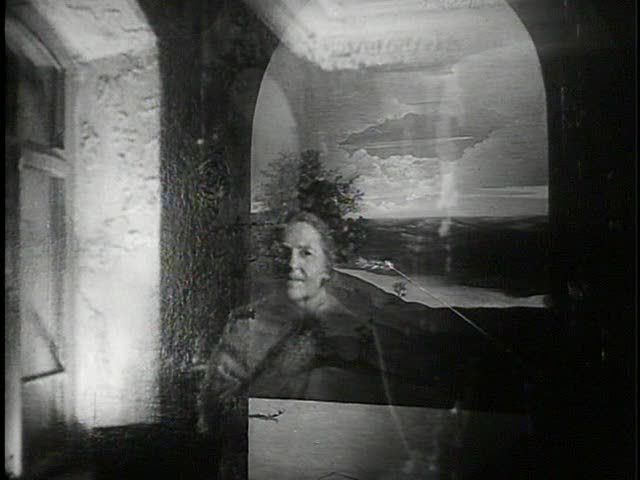
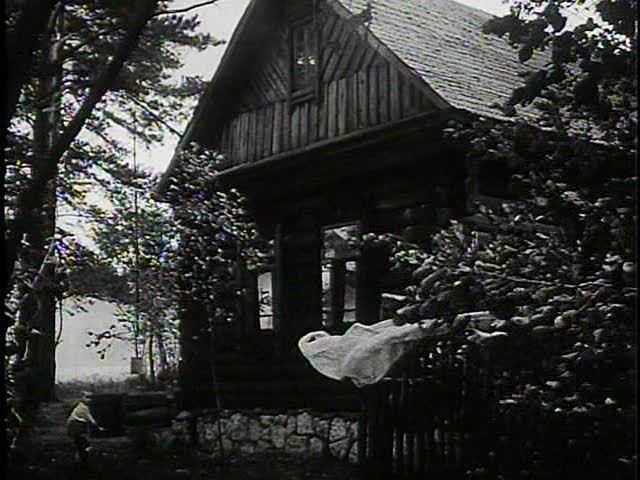
Andrei Rublev on the wall of the narrator’s home), and his tenuous hold on memories of his mother and his wife (both played by the same actress) and his son and himself as a boy (both played by the same young actor) and certain stages of childhood in a country cottage during the first World War. Digressions abound as Tarkovsky imports footage from early in the 20th century of balloons floating above a field and children fleeing Spain for Russia and the Red Army marching across Manchuria. As much as it confounds,
Mirror aims to situate itself within a certain historical tradition, or a certain approach to history, that fuses the horizons of history. This fusion of horizons (pace
Gadamer) is where eternity comes into play.
 Mirror
’s eternity is not born strictly from film stock but other film grammar, like the poetry read over passages of montage. Tarkovsky’s father wrote the poems, and reads them on the soundtrack, but, as intriguing as this background may be, it is irrelevant. The poems in the film exist unto the film as far as the film is concerned. The audible poetry, as opposed to the visual, is simply another horizon matched in
Mirror’s eternal plane of activity. But to parse just what these poems “mean” in relation to the images Tarkovsky marries them to proves difficult after an initial, affective intuition: it is a rich artistic gesture designed to color the image. As much as it marries words to image,
Mirror is a film, through and through, concerned with images. In this sense, the poems, as passages designed to trigger emotions, can be seen as no different than — perhaps even equivalent to — the images themselves.
To bring such a film forward means another fusion of horizons where our further understanding of
Mirror’s mysteries (hidden in our plain view of the moving picture) may help us understand the mysteries that abound in life here, in 2008, and there, in that whenever of the future. Who knows, we may not even be able to play my DVD copy when I get there.




 Posts
Posts