Showing posts with label Deleuze. Show all posts

Saturday, November 07, 2009

Alain à la recherche #1: Marienbad

by Ryland Walker Knight
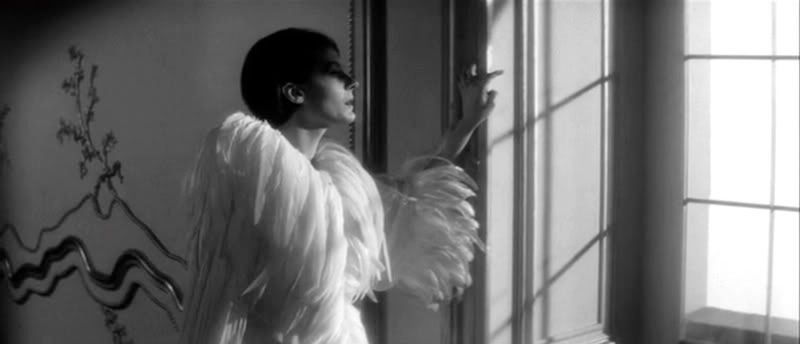


[The Resnais series playing at the PFA this November and December is part of a broader, traveling retrospective with a concurrent run in Chicago at the Gene Siskel Film Center and a proposed stop at the newly renovated Museum of the Moving Image in early 2010.]
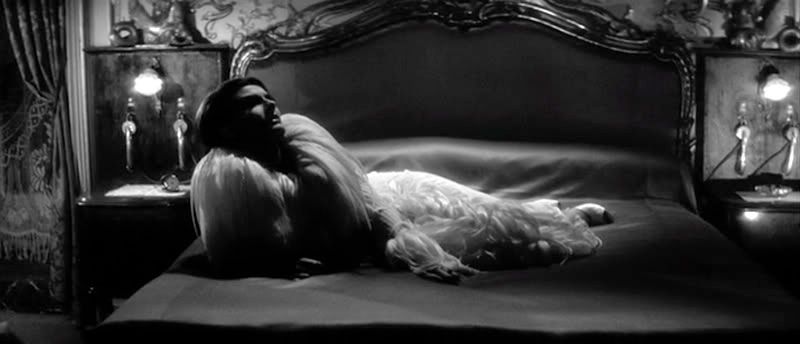

This was the third time I've seen Marienbad. As with the first, and the second, it feels like the first time I've seen Marienbad. I don't know if that will persist as I keep seeing Marienbad, as I have, year after year, or one screening one year followed by a pair of years of gap, then a pair of screenings spaced by a year. Last year, I saw Marienbad at The Castro. Before that, a few years before that, I saw Marienbad on a shitty DVD. Needless to say, a year ago was optimal, and new. This time, a year later, unlike last year, the print was a little more travelled, and weathered, but every image still crackles and every edit whips. In any year, it seems, Resnais is a crisp filmmaker. This year, too, the jokes kept hitting harder and harder. Marienbad is easily and stupidly misinterpreted as a dead bore, as nothing but pretension, when, in fact, every repetition is a redetermination of the same joke. The film is one big repetition, or one repetition after another—a Deleuze wet dream, maybe—which means it's one big joke, or one great joke over and over. And every joke is about repetition, and how that can cheapen the serious, and how cheap that can look and feel—and how it piles on—despite being dressed up in the classiest clothes and setting and ornamentation and gloomy mirrors and feathered collars imaginable. Imagination, it seems, is what our Man lacks; or, what he's got in spades; but if he's got it in spades, he's got a poor, somber capacity for it, for fun; that is, it's in spades. He sees a maze as a maze. We might say Resnais sees the maze as the stage, or an arena of invention. You don't map your way out—you look around, you turn corners. But Marienbad, for everything above (inside?), like its jokes and its mirrors, all its doubles and triples and quadruples, all of that remains, in any time, at any rate and in any event, some hopelessly walled-in picture of present tense stasis. —Now, though, I wonder: how come I find that this hilarious this year?

Tuesday, December 16, 2008

VINYL IS PODCAST #8: Find the best thing possible.

by Ryland Walker Knight and Daniel Coffeen


[Podomatic stream]
[Direct audio download]
[iTunes subscription available]
[Simple syndication subscription]

RWK here. When people ask me why I started this podcast, I routinely answer that producing these episodes is, in the most basic sense, a creative and fun way to hang out with smart people I like to talk to and to laugh with and to learn from—to just plain enjoy—aside from the fact that it's kinda easier (lazier? nah...) to just get together and rap on mess than it is to form coherent sentences that do not ramble and tumble and spill everywhere. As I wrangle my life into boxes and suitcases, I found time today to talk with my Good Personal Friend (and former professor) Daniel Coffeen. We had a few ideas and a few directions to try to pursue, but, as this fell together rather quickly (that is, last minute), we just winged it and let our talk meander all over our mind-maps through all kinds of topics: speed, affect, The Bourne Ultimatum, figures, Faces, cubist film, Esther Kahn, hurt, laughing, fear, Bad Lieutenant, the architecture of seeing, separation, Lola Montes, looking for a projection, creativity, pedagogy (and its failure) and glasses and a will to passion, among other jokes. The talk may get off topic (and veer too far into me), but I think this works (despite my constant stammering through a billion associations at once) for the simple fact that it was fun and we rully do enjoy each other's thoughtful (and hilarious) company. That, and I think we share some real good thinks. We hope you feel the same! Please, tell us things. For instance: don't you kinda agree with Nathan Lee? Please read more from the ever-estimable Craig Keller.

As for the songs this week: I'm too tired (defo too lazy) to load them up tonight. If you really want them, let me know. Otherwise, just enjoy the show! Cast that smile along with those ears over this way. Because, of course, that word "possible" is both an outcome and a value-judgment. Just like "catastrophe"...

vom yr mom!

Saturday, September 20, 2008

Cutting into the world: La Passion de Jeanne d'Arc tears and tears, bleeds.

by Ryland Walker Knight


sang
l'eglise
recoil

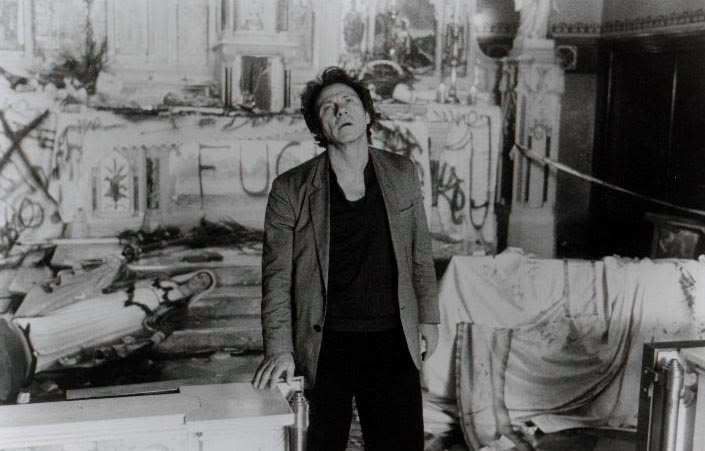
Dreyer cuts space apart to the point that it isn't even something to talk about. La Passion de Jeanne d'Arc has no need for spatial (or, for that matter, temporal) terms. Of course we're given the unity of the single day, and the stations of the cross, as it were, but every image in the film is expression; there's no real interest in representation. "The close-up is the face." It's a film of faces big and small and brimming and dead and burnt and crying and alive and inanimate. Hooks jutting across a frame are a face of terror and pain; the stake aflame with a cross behind, a face lifting us out of the world; the sacrament raised in prayer, a face of dignity; Jeanne's torn blanket a metonymic version of her, an echo of her arm's pump. It's as pure a film, as purely affective a film, as I have ever seen. But its grammar is miles from what PTA's been developing. In fact, not that this is fair or equivalent, his grammar seems much more akin to something like what Tony Scott habitually falls just short of despite his best efforts. It helps to have something to say, but, and I mean this, those last three Tony Scott movies, tied as they are to plot, deliver a lot of goods in purely formal registers; it reaches an apogee in Deja Vu's little room, and then loses itself, but pretty much the whole of Domino is fascinating, lively, expressive filmmaking. And Dreyer edits fast. (Much more interesting, though, than Tony over there.) In ten seconds you can see a baby suckling, Jeanne clutching a crucifix, the baby pull away from the tit, a man without a face pull away the cross from Jeanne's clutches, and the baby returning to the milk. A tidy circuit of give and take. It's phenomenal, really. I can't believe it's taken me so long to find my way to this master of cinema. Also, a hilarious footnote here: what a political film!

rend it open

[We need reasons to believe in this world, even as we rend it open. Find more by clicking here.]

Thursday, May 01, 2008

Recommendation for the day: Paola Marrati.

by Ryland Walker Knight

Like most books written by professors and published by university presses, the English-language translation of Paola Marrati's book, Gilles Deleuze: Cinema and Philosophy is really expensive. Unfortunately, only the original publication, in French, is available in the whole of the UC library system. So, I have to figure out how to get Berkeley to buy a copy so I can read it. I tried reading Cinema 1: The Movement-Image and Cinema 2: The Time-Image a year ago and didn't get very far. So the prospect of this book, which comes with a sterling recommendation from none other than Stanley Cavell, sounds very welcome as I imagine her text will live up to his characterization. Here it is:


The claims upon philosophy by the explosive consciousness of the fact and the art of cinema -- not alone claims upon the philosophy of art but upon philosophical thinking at large, upon what is to be called thinking -- are, still surprisingly to me, not something that has attracted the sustained attention of most philosophers. However intensely and consecutively and concretely I recognized these claims to be met with in the work of Gilles Deleuze, I had in several attempts over the years not been able to find my way into a convincing draw through the manner of it. The appearance of Paola Marrati's admiring and sustained attention to this thinking, placing and featuring Deleuze's principal volumes on cinema (it is essential to her view that these are indeed featured, in important ways climactically, in Deleuze's expansive body of work), changes the intellectual odds in this demanding challenge. I imagine that many others will also find education in Marrati's sophisticated and generous and clarifying articulation of Deleuze's educative venture over the entire constellation of the major cinema of the world, but I think no one could be more grateful to her achievement than I am. It is a relief to be in the presence of Deleuze's intellectual originality and Paola Marrati's meticulous responsiveness to it, free of the many fashionable repetitions in the field of film study (e.g., film is a language, film is unconscious of its ideological slants and economic drags), and to watch other of its slogans (e.g., film is a mass art, film is a producer of dreams, Hollywood never appreciated its geniuses), given surprising derivations that release a sequence of genii from their jarred formulas.

The coolest thing about this recommendation is how he says her work sidesteps the usual invocations of Deleuze as a rather simple (to say fashionable) model to start a reading that does not, in practice, pay strict attention to the object (the film) at hand (on display) but rather uses the object as illustrative of Deleuze's theories of cinema and its movement- and time-images. Looking at the beginning to her chapter in a 2001 book called Religion and Media (available on Google Books), I can see why Cavell likes her writing: like Mulhall before, Marrati's prose is clear and unfussy, evidence of a thoughtful, career-long investment in the subjects she chooses to write about. (Her CV is pretty impressive, btw.) This is, of course, what draws me to Cavell, too, although his prose can sometimes madden a reader with its endless clauses-sentences-paragraphs; he stretches (ordinary) language to perform, so to speak, his argument, or his project, about the necessity to defamiliarize the familiar (to step out of the ordinary) in order to approach it again. It's similar to notions of distanciation but I like Cavell and Wittgenstein better than Paul Ricoeur or Mikhail Bakhtin (here's an essay that links these latter two thinkers) mainly because Cavell is an inheritor of Ordinary Language Philosophy and uses rather ordinary language (that is, little theoretical jargon) in his work. In any event, my taste aside, it's fitting that the book Marrati is readying next should be called The Event and the Ordinary: On the Philosophy of Gilles Deleuze and Stanley Cavell. Seems like that bridging will be the next "trend" in academic writing, as far as my limited perspective can discern, because, I must admit, it's a bridge I'd like to see erected; indeed, a bridge I'd like to understand.