by Mark Haslam
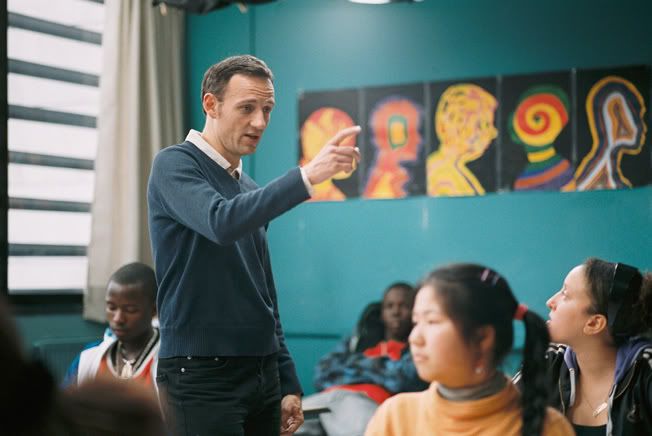
It's strange—yet strangely on—to call Laurence Cantet's
Entre les murs (The Class) a procedural. Strange mostly because it envisions teaching as improvisation, as precisely those moments when structure and procudure break down. Here, at communication's end, communication can (it hopes) begin.
...We enter the class through its teacher, François Marin (played by François Bégaudeau, who lived and wrote the book on which the film is based). The camera follows him into the school, maneuvering the halls, picking up movement as profs set up their classrooms: one body bumps into another, darts through a doorway; a table is hoisted up and out of a room. It's exciting, excited, and anticipatory. Of course, much of this has to do with the fact that the kids've yet to arrive.
With the ringing of the first bell, movement/expectation shifts—to the students, yes, but, more importantly (and we can also say, as a result)—to language. The film is constructed around language and its potential to be played. So it's only fitting that the class we attend is a French class. Here, as in our English classes in America, kids are tought to deal with 'proper' language 'properly'. This, as an initial situation, results in tension—a tension immanent to power structures, where the idea of there being a way comes up against multiple, other ways. In
The Class, in any class, really, the struggle which emerges from this tension is linguistic. (When Cantet, in an interview with Phillipe Mangeot, refers to a particular “scene where [François] answers that the difference between written and spoken language is a question of intuition,” we should perhaps hear the final word also as institution.) When M. Marin first introduces himself to the class, for example, the students instantly set to punning off of his name, beginning the language game that propells the film.
The teacher, however, plays the game with a disadvantage. He's isolated: spatially, for one—which allows, here, an occassional note to be passed, there, a stifled snicker, whisper, etc.—and second, bound by institution, socially—the constant evolution of language results in “lacunae,” as Bégaudeau calls them, ever opening between student and teacher. Yet François does not take the institution's approach to the emergence of these lacunae. He neither quells nor ignores them as threats to system, but recognizes, pursues, and actively engages their emergence.
Teaching is a navigation of the lacunae and the two bordering spaces. The pursuit of gaps in light of system's failure.
...A scene's inception: a lesson plan, a question.
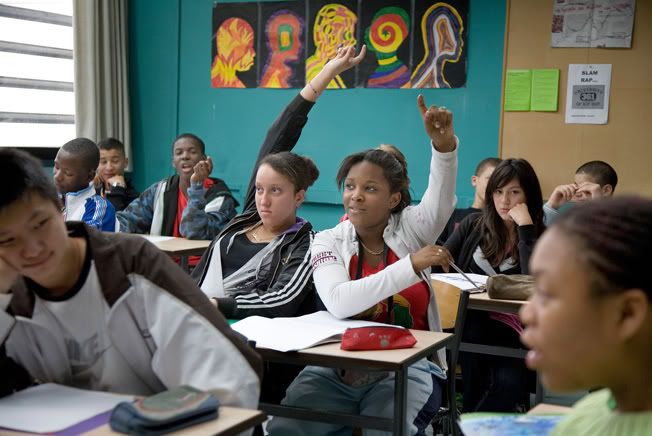
Follow the gazes: they cross, but don't ever really meet; they branch (but from where?). There's something chaotic about their pattern, as lines in a Bunimovich Stadium. “[A] school is sometimes very chaotic,” Cantet notes, “useless to cover its face, there are moments of discouragement but also moments of grace, immense happiness. And from this great chaos, a lot of intelligence can be born.” Existing between the walls, a bounce and redirection occurs over and again. The lesson plan proposes a direction. Its desire is to impart direction itself. Each gaze, in turn, proposes its own direction, or rather, holds the potential for a shift. With a question, the potential is realized; chaos emerges in/as language.
Cantet's process mirrors these gazes: “...what we planned to do would require three cameras: a first, always on the teacher; a second, on the student at the center of the scene, and a third prepared for digressions....”
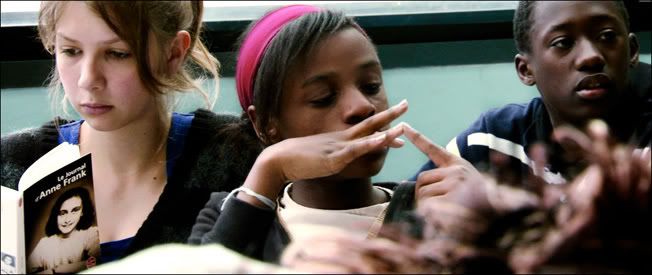
Each camera, which together compose The Camera, entail both a structure and its unraveling. One eye trained on matters at hand; the other, rolling and wandering as if of glass.
Entre les murs builds itself out of its own disregard. Through these cameras, seeing becomes a component of chaos, but also forms chaos into a pattern. When François pursues the students tangents and diversions, it's to make them no longer tangents and diversions. It's to make chaos the thing. He acknowledges a certain flow and flux within (the, this, any) class: the moments before the Big Bang, approaching phase transition, before a something emerged. The scenes that result from transitions aren't a part of any narrative, rather they're (linguistic) events. Parts composing a whole—individual acts of creation and resistance. Random, no doubt—like the appearance of language itself from sound and tone. But taken together they form, even in breaking from system, their own structure. The structure of a game, but nobody wins out. Nobody can, but nobody needs to.
...So, yeah, structure must be set aside. Teaching must fail in order to continue. Okay. But
Entre les murs isn't
Dead Poets Society. Nor is it
Half Nelson or
Finding Forester or whatever. It doesn't want anything to do with life lessons and breaking from tradition and inspiring those poor, underpriveledged kids. Every moment of success is followed by a moment of failure: As soon as the class's official troublemaker, Souleyman, displays a moment of brilliance, or at least a moment of hope...a different incident leads to expulsion proceedings. Teaching's limits frame each image—are, in fact, often conflated with its successes. The film doesn't demystify the profession; it just approaches it without illusions. It documents, in other words. Here, finally, we see it as a procedural. A real desire to show everything about teaching emerges at the center. And though words like “real” or “accurate” may cause some cheeks to blush, I want to use them.
But, then, the reality of a school is performance. To be a teacher, to be a student (in middle-school, no less, where masks are the most colorful and the most varied) is to act. So, really, it's not hard to believe that the teachers and students in the film aren't actors, but are teachers and students—mostly because, well, they're so believable. Improvisation is what their stations already require of them. The film's desire to document, to unfold procedures, reveals this theater. School, sure, but more: “a sounding board, a microcosm of the world...”
...The film ends with images of the empty classroom. Sounds from outside, where life continues to an impossible order, sift through the windows. Desks remain, but disarrayed—remnants of chaos in pieces of institution. And the cameras which documented the students? The year's procedures and performances having ended, they're just rolling. Or are they waiting? Is this perhaps not a winding down, but a gearing up again? The shouts and screams coming in from beyond are language before language, and so the potential remains between the walls—a space neither in nor out, but within the gaps that emerge between here and there, where chaos, which is seeing, becomes the lesson.
This is where learning happens.
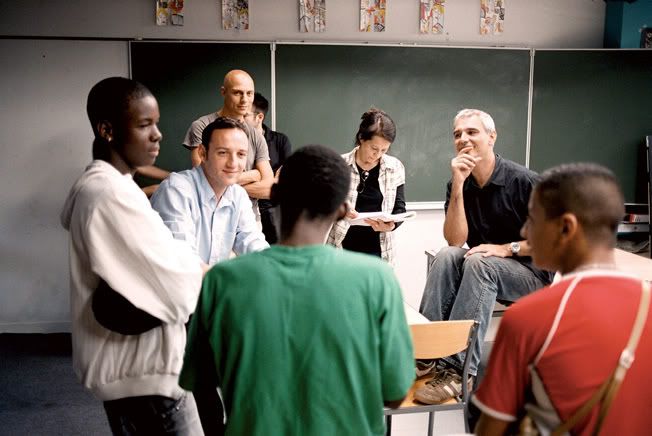
[The Class opened at The Smith Rafael yesterday after limited runs in New York and Los Angeles. Sony plans to roll out the film further as it has been nominated for Best Foreign Film in this year's Oscars. Check your local listings. Learn something.]



 Posts
Posts


