Showing posts with label rhetoric. Show all posts

Thursday, May 01, 2008

Recommendation for the day: Paola Marrati.

by Ryland Walker Knight

Like most books written by professors and published by university presses, the English-language translation of Paola Marrati's book, Gilles Deleuze: Cinema and Philosophy is really expensive. Unfortunately, only the original publication, in French, is available in the whole of the UC library system. So, I have to figure out how to get Berkeley to buy a copy so I can read it. I tried reading Cinema 1: The Movement-Image and Cinema 2: The Time-Image a year ago and didn't get very far. So the prospect of this book, which comes with a sterling recommendation from none other than Stanley Cavell, sounds very welcome as I imagine her text will live up to his characterization. Here it is:


The claims upon philosophy by the explosive consciousness of the fact and the art of cinema -- not alone claims upon the philosophy of art but upon philosophical thinking at large, upon what is to be called thinking -- are, still surprisingly to me, not something that has attracted the sustained attention of most philosophers. However intensely and consecutively and concretely I recognized these claims to be met with in the work of Gilles Deleuze, I had in several attempts over the years not been able to find my way into a convincing draw through the manner of it. The appearance of Paola Marrati's admiring and sustained attention to this thinking, placing and featuring Deleuze's principal volumes on cinema (it is essential to her view that these are indeed featured, in important ways climactically, in Deleuze's expansive body of work), changes the intellectual odds in this demanding challenge. I imagine that many others will also find education in Marrati's sophisticated and generous and clarifying articulation of Deleuze's educative venture over the entire constellation of the major cinema of the world, but I think no one could be more grateful to her achievement than I am. It is a relief to be in the presence of Deleuze's intellectual originality and Paola Marrati's meticulous responsiveness to it, free of the many fashionable repetitions in the field of film study (e.g., film is a language, film is unconscious of its ideological slants and economic drags), and to watch other of its slogans (e.g., film is a mass art, film is a producer of dreams, Hollywood never appreciated its geniuses), given surprising derivations that release a sequence of genii from their jarred formulas.

The coolest thing about this recommendation is how he says her work sidesteps the usual invocations of Deleuze as a rather simple (to say fashionable) model to start a reading that does not, in practice, pay strict attention to the object (the film) at hand (on display) but rather uses the object as illustrative of Deleuze's theories of cinema and its movement- and time-images. Looking at the beginning to her chapter in a 2001 book called Religion and Media (available on Google Books), I can see why Cavell likes her writing: like Mulhall before, Marrati's prose is clear and unfussy, evidence of a thoughtful, career-long investment in the subjects she chooses to write about. (Her CV is pretty impressive, btw.) This is, of course, what draws me to Cavell, too, although his prose can sometimes madden a reader with its endless clauses-sentences-paragraphs; he stretches (ordinary) language to perform, so to speak, his argument, or his project, about the necessity to defamiliarize the familiar (to step out of the ordinary) in order to approach it again. It's similar to notions of distanciation but I like Cavell and Wittgenstein better than Paul Ricoeur or Mikhail Bakhtin (here's an essay that links these latter two thinkers) mainly because Cavell is an inheritor of Ordinary Language Philosophy and uses rather ordinary language (that is, little theoretical jargon) in his work. In any event, my taste aside, it's fitting that the book Marrati is readying next should be called The Event and the Ordinary: On the Philosophy of Gilles Deleuze and Stanley Cavell. Seems like that bridging will be the next "trend" in academic writing, as far as my limited perspective can discern, because, I must admit, it's a bridge I'd like to see erected; indeed, a bridge I'd like to understand.

Tuesday, March 11, 2008

Poems for the month (visual style):
Untitled 1, Lafia
Où gît votre sourire enfoui?, Costa

by Marc Lafia


***

by Pedro Costa


[I think these speak to one another. --RWK]

Tuesday, January 29, 2008

There is really no overcoming one's fascination with particulars.


[Hermeneutics] is not a method or system or theory or any position to be defended or advanced but exactly a context of argument about understanding -- a context whose boundaries are determined not by conceptual traditions, much less by school disciplines, but by the thing itself, that is, by the question of what it is that happens (what the practical consequences are) when we try to make sense of something. What sense this question will have for us, however, is determined by how we frame it, and there are multiple, intersecting, and conflicting frames. Hermeneutics, as I understand it, is this whole network of lines and angles on the question of verstehen.* There is no getting outside of this network and giving a comprehensive view of it, which is one reason why it is not easy to give a conceptually coherent account of what hermeneutics is.

-- Gerald L. Bruns, Hermeneutics Ancient & Modern --

That, too, is what my understanding of rhetoric, as this department has taught me, is: a thorough inhabitation of, not simply engagement with, an argument. And, you know, knowing how to act accordingly. This applies to everything, not just reading texts, like living life. Should be a good seminar. (The title of this post comes from somewhere near the end of the introduction to Bruns' book, and the quote from somewhere earlier in the introduction.)

*understanding

Wednesday, January 16, 2008

Joker for the day.


poster 1
poster 2
poster 3
this is my game face
lick it up, clown

As I questioned over at Free Nikes, is this my most anticipated film of 2008? Right now I think it is. How can you resist that tagline? Or that third poster? --RWK

Friday, November 23, 2007

Late night notes: criticism of criticism, or something, via Run, Lola, Run.

by Ryland Walker Knight

Michael threw up some words about Tom Tykwer's infamous Run, Lola, Run the other day. If you click this link you can see his initial post, plus some comments from yours truly, Cuyler, and Michael, in regards to the film, and criticism in general. It's kind of a mini preview of one of the things I'm concerned with in my Thesis, too. As such, I decided to go ahead and cross post my most recent comment here. Please, feel free to comment on it here, or there.

Here's what I've come to think: if you choose to write something about a film, or about anything, you have chosen to deem it worthy of a comprehensive investment. It's part of why I've slowed my roll on the blog. Sometimes you have to write about things you know are not "worth your time," though, as is often the case in school, which can complicate the task of writing. But I figure you should approach any writing project with a mind to make it fun, to feel comfortable to write whatever you want. I've simply chosen to try to limit my writing to things I want to praise. This does not mean complete adoration; no, some films, or albums, or paintings, do not work (and this bears attention, too), but when approaching such an object I think the admirable writing is one which refuses categorical value judgments. The evaluation element in criticism is not simply whether an object is worthy of time and thought but evaluating what of the object itself is worthy (in relation to itself). This is why I'm averse to lists. Criticism is not about what's better than what. It's about how things work; and if they do not work, it's not about how it should have worked, nor how it could have worked, nor how the object of criticism's failure/s to work diminish its worth of the object; the writing itself makes the object worthy. (When a film fails its ambitions it can make for an intriguing essay, too, as if offers the critic the opportunity to take up certain possibilities in thought for him/herself. Such as: what's at stake in choosing the soccer ball to open _Lola_? if the film fails that trope, what might that say about the trope itself and not the film? what if the trope is simply games, and not soccer?) Also, criticism is an invitation to share the critic's experience of the film. The best works of criticism give the reader (1) a picture of the film (2) as it relates to the critic (3) and how the critic finds associations from what is given to him/her. As I find (the great) films to be works of philosophy, I find a passage of Wittgenstein so apt I get giddy thinking I get to share it with you (that is, reiterate it): 126. Philosophy simply puts everything before us, and neither explains nor deduces anything.--Since everything lies open to view there is nothing to explain. For what is hidden, for example, is of no interest to us. One might also give the name "philosophy" to what is possible before all new discoveries and inventions. What else is a film but a phenomenon where everything lies open to view before us? We do not add to the film in criticism. We add up our experience of the film. Our experience of the film triggers associations, which we can explore in relation to the film, but the burden of criticism, as an elucidation and not as an explanation, is not to build a film up (trumpet its many virtues) nor to tear a film down (harp its many deficiencies) -- it is to simply offer the best (say the most interesting and comprehensive) picture of the object at criticism for the reader. I do not think I live up to this definition yet. Or, it's real hard to table certain urges.

So: if you choose to write about, think about, talk about, _Lola_, then the burden of your work is to explode the film. Altho I would suspect he does, Thoret may not even like _MiVi_: it's not about that: it's about how he sees the object and attends to its functionality as an object of intentionality. Which brings me to the other big complication inherent to criticism: how to deal with the object in its relation to other objects (by its author/s and by other author/s it invokes, or inherits from). As Felipe said best, or better (more concise?) than me: "For me, this is an essential element of criticism; the expression of the singular value of a text always locates that text's singularity in relation to other texts. Criticism as monadic reading." Phew! This is a lot to struggle with, clearly, and makes blogging that much more difficult, or appear incomplete in many instances, as many blogs simply offer opinions of their authors, not actual criticism. It's enough to give me hives. So I try not to stress it. I try to make each writing experience fun, without ignoring how serious the practice really is.

Thursday, October 11, 2007

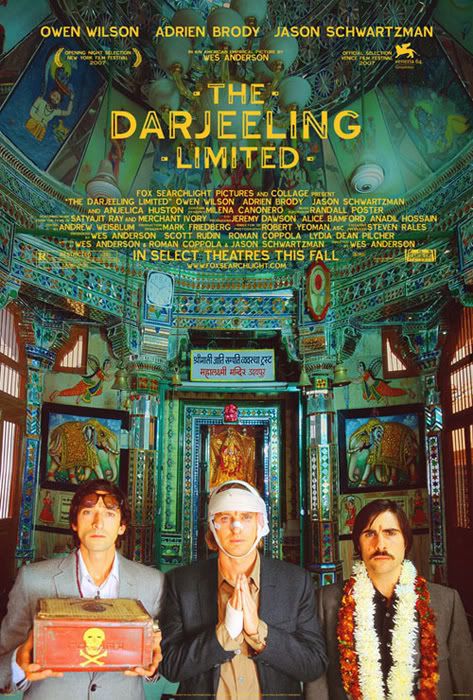
Life is full, life is funny. An appetite for Wes Anderson's The Darjeeling Limited.

turquoise heaven
____________________

[Editor's Note: This is a slightly-edited email conversation between Steven Boone and Ryland Walker Knight. Clearly a lot was discussed. But as descendants of another Whitman, we contain multitudes, much like this film, and there was plenty more to talk about. But two call-and-responses seemed like a good enough jump off. Please help us continue the conversation in the comments. As Steve says, it's kind of sloppy but it's cool. It's good enough for now.]

____________________
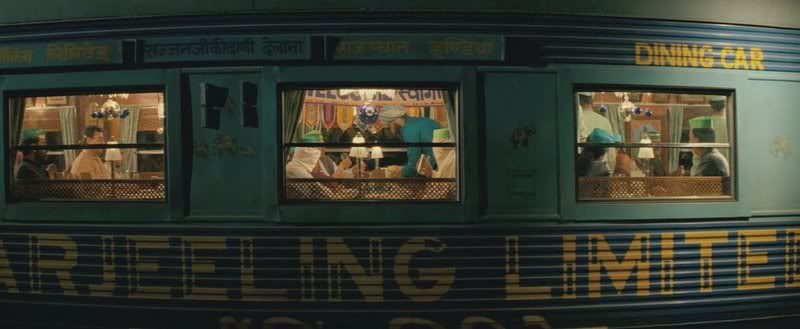
the title is everywhere
____________________


Ry,

“We're all sensitive people/with so much to give.” Marvin Gaye may have been singing that just to get into a girl's drawers, but those two phrases also inadvertently define the great film directors: Sensitivity and generosity. It takes an audience of similar temperament to get into their films. Wes Anderson is one of the greats.

I had punkass tears leaking out of my eyes from the moment Owen Wilson stood up and said the first thing he thought about when he came to (after a near-death experience) was his brothers, and they all hugged a little awkwardly. Why is this moment so great, or special? We've seen brothers bonding like this in 10,000 other flicks. Actually, looking back at my description of it, it sounds like some TV movie shit. What sells it (other than Anderson's (or maybe Jason Schwartzman's or Roman Coppola's) dialogue writing, which lays out torturous, hilarious roadblocks of cynicism and petty grievances on the path to true understanding) is Anderson's camera eye. (That's the other thing that makes a great director: Gotta know what shots and cuts can really do.) Owen declares his love to his brothers in a kind of wobbly, sloppy shot taken from a long lens way down the train car. In a film of rock-solid compositions and tense pinpong cutting, this image is a fuzzy anomaly. It's like a little kid scribbling “I Luv Yoo” in crayon on his daddy's manuscript. Even if Wes Anderson is an asshole in real life, shots like that one assure me there's something better buried in his soul.

The camera is everything. Anderson knows that his selection of lenses and camera movements are as critical to conveying his wiseass charm and humanist worldview as his casting, dialogue, music and production design. (Those latter four are what most critics choose to fixate upon.) Like, why does he use lateral dolly shots to do the job normally left for pans? Because they bear a certain weight that offsets the loopy/mopey, boyish/world-weary comedic atmosphere in his compositions. These shots have their soul mates in the hollow, heartbroken eyes of his three male leads.

All of this to conjure up a miracle: A big, splashy widescreen film about three obnoxious rich shits... that made me, a working stiff, feel for them. Let's face it: Wes makes movies about spoiled rich kids, about white adults suffering abrasions to their sense of entitlement. I love Bottle Rocket and Rushmore, but the sense of elitist angst and preciousness in The Royal Tenenbaums and The Life Aquatic pushed me away in their first acts. Darjeeling reached out to me. It was a personal breakthrough because I arrived at the simple understanding that nobody can help what they were born into; essence is everything. These little snotty punks are used to being waited on and catered to, but they are not bad people. Yes, there are sociopaths, tyrants and American psychos out in the world, but there are so many more decent folk wearing an asshole's uniform only for survival's sake.

There's too much to share about this movie. Any conversation we have about it is doomed to be random and sloppy. Cool.

--Steve

____________________
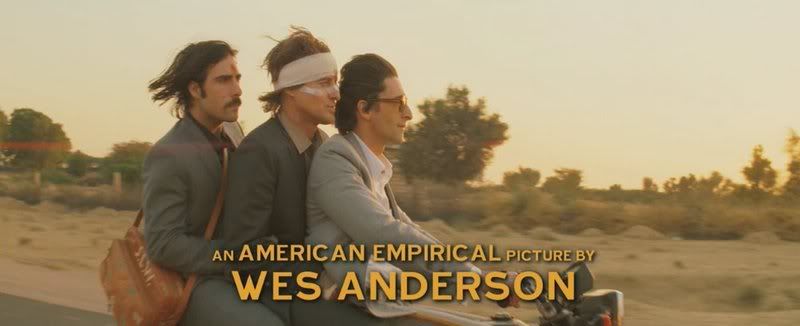
everyone on the bike
____________________


My fellow fun-lover,

"The camera is everything." Perhaps nothing else needs to be said to understand the joy of this film. Still a prop in The Life Aquatic, and working more as a detached omniscience than as a personality in the three films prior, the camera in Wes Anderson films has always been conspicuous, and distinctive; but in The Darjeeling Limited it becomes a member of the cast as much as instrument of the crew. More specifically, the camera is a (non-) member of the trinity of brothers. Each of the brothers addresses the camera, and by consequence the audience. The camera takes a spot among the lineup of the brothers when they are seen from behind: two brothers to the left, one to the right, with a spot just off-center for the camera to push in among the fraternity. Reverse shots of the brothers eclipse this space, placing the three side-by-side without the gap, but the visual discontinuity makes sense, oddly, because Wes Anderson's camera is not here to document: it is here to make pretty pictures to tell a sometimes-silly, sometimes-somber story from a perspective that marries the know-it-all style of his earlier films with the on-the-edge style of The Life Aquatic. Surrendering to this hilarious tension of contrivance is, perhaps (again), the first step to enjoying The Darjeeling Limited, or any movie Wes has made (or may make).
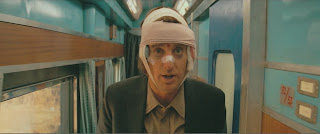
What I find most frustrating reading negative reviews of the picture is that each writer of such essays seems determined not to enjoy him or herself. Which is not to say I prize an essay where it's all about the writer and his or her reaction to the film. Rather, I wish more writers spent a little more time reflecting upon their reactions in as generous a manner as possible. Suppose there might be a reason, within the rubric of the film, that Wes Anderson choses to shoot scenes the way he does. Where the hell is this odd, almost-fish-eyed camera? Is it a point-of-view? Is it not? What's with all the tacky zooms? Why is the camera moving laterally, or panning 180, or 360, degrees? Why all this slow-motion? Why is the camera everything? The easiest answer to that summation-question would be: the camera is not a tool, really, for Wes Anderson, but another set of eyes. What complicates this notion is how we in the audience are continually confronted in Darjeeling by the eyes of the characters: the camera becomes not just another set of Wes-eys but, at the same time, audience-eyes. You there in your seat -- yeah, you -- you're here, too, onscreen (and in the page) -- you are at once audience member, brother, absent father, absent mother, a businessman, a girlfriend, a wife, a steward, a man-eating tiger. And, to echo something I've written before, they are all happening, always (and already).

This is why I find myself welling up: it's beautiful, this present tense. To invoke the present tense is a little redundant, I know, given we don't necessarily live in the past (though we carry it) or the future (though we reach for it) right here and now. However, all those slow-motion shots are the elongated present, a delicious unveiling of (almost) every detail of right here and now, of every plane of activity. (Maybe, in as general a sense as possible, that's simply what movies are?) And what happens at the end of one of these slo-mo scenes?! We match-cut back in time! All because of a look! (These exclamation points are to signify my delight that something as simple as looking at your brother can spur a story. And to make this paragraph as silly as it needs to be to get you to care about what I felt while looking at the movie.)

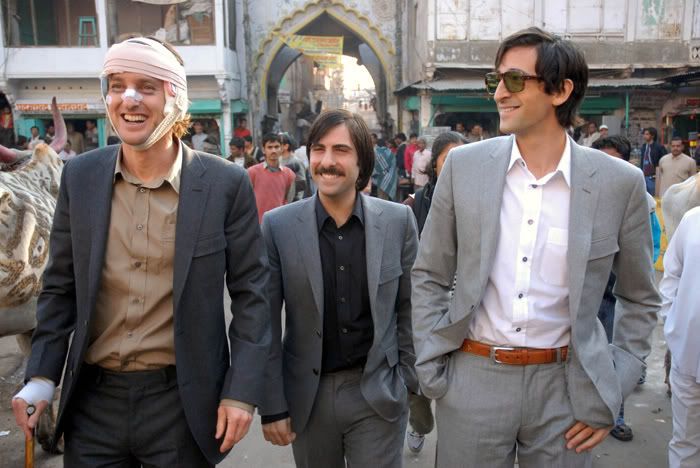
Adrien Brody's look across Jason Schwartzman at Owen Wilson (as brothers Peter, Jack and Francis Whitman) triggers a memory, which is a mini-movie unto itself, wrapped up inside the bigger, whole movie. We know from earlier in the film that this memory also serves as material for a short story Schwartzman's Jack has written, and shown to Peter, about the day of their father's funeral. Later, Jack will read to his brothers the ending of a new short story he has begun writing, without knowing the beginning; the lines of dialogue are direct quotes from Darjeeling's companion "Part 1" film, Hotel Chevalier. Jack insists throughout that all his characters are fictional until this moment, when he accepts his brother's compliment (Peter says he likes how mean Jack is in the story), which is more validation than if they simply said it was well written, as Francis does earlier.

I think the best “commercial” review of the picture thus far has been from Glenn Kenny, of Premiere. His last two grafs seem apt here:

This movie is as much, if not more, about the construction of fictions as it is about its ostensible plot. Wilson's Francis, trying to put his life back together after a suicide attempt, constructs the India trip, with its laminated itineraries, as a potential happy ending to his family saga. Brody's Peter seeks a continuance of the narrative of his late father (the last time the brothers all saw each other was at his funeral) by furtively, obsessively, hanging on to the patriarch's old possessions. Schwartzman's Jack is a writer of short stories — stories he insists are "entirely fictional." Much of the film's subtext is devoted to both peeling away and reinforcing that claim.

But The Darjeeling Limited is as much about fiction as it is about family. That it succeeds so well and so slyly even while dealing with these topics in its own stylish but unsparing way is reason for moviegoers to rejoice.

Of course, this quote echoes a few things for me, including my own dealings with Wes Anderson's beguiling, and delightful, films. I think you can make this argument about storytelling with any of his films: it is as major a theme as family or death or theatricality are for Anderson. Think of Dignan's fiction about Mr. Henry, and vice-versa. Or Max Fischer's dad-as-doctor lie. Or all the books in The Royal Tenenbaums. Or, hell, all of The Life Aquatic and its constant movie set setting. Think of his TV ads. Think of how Schwartzman prepares his room for Natalie Portman's entrance in Hotel Chevalier. The effectiveness of these offerings, while propelled more by dialogue than visuals the earlier you go in his filmography, is tied, at least partially, into how Anderson uses his camera. He's not making a representation of a world -- he makes the world as he would have it, as a movie. (No d'uh, right?) Complaints about his films as contrived are as wrong-headed as can be: to invent a fiction, in any medium, is a contrivance, an artifice from the get-go. To tether it to some kind of “reality” is a limitation not of scope or imagination (that's tough work to make "real" humanist stories) but of understanding.

(This is similar to what makes Werner Herzog so interesting: he does not delineate between "fiction" and "non-fiction" films. He simply makes films. He understands that even a "documentary" is a fiction. It has its own rules, sure, but the documentary in Herzog's hands is not about actually documenting the events. In The White Diamond, maybe his greatest film, he does not show the balloon when it is first dubbed such, he lets a man sitting on an inflatable chair smoking a joint call it a “white diamond.” A lesser filmmaker would have cut immediately to the balloon. Herzog simply holds on the man as he soaks in the scene. The fiction of the object is as important as the object itself.)

For Wes Anderson, he makes sure his films are fake-ish (or overtly self-reflexive) by, among other things, stuffing them with these details and whip-pans and sudden narrative tangents. He does not write three-act structures. He writes happenings, constant happenings, constant unravelings. Things don't add up as they would in a “traditional narrative.” Things just keep happening. They go left, they go right, they go up the mountain (via a staircase?), their train gets lost, there is a death, there is another train, the movie starts over again.

I saw the movie two times in as many days and I could see it again right now. In lieu, may the sun shine bright on us all. Let's get into it!

later, ryland.

____________________
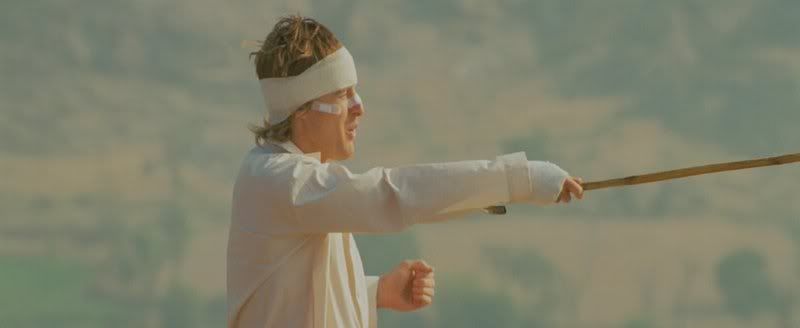
whoo!
____________________


Ry,

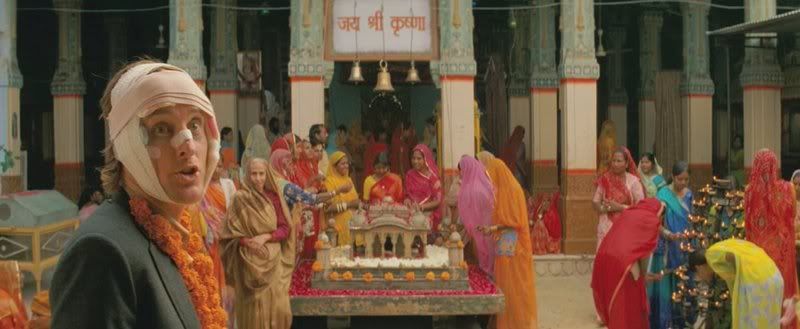
No, the camera's not the whole show, but the objects and Anderson's dollhouse placement of them are largely about "subjectivity" as well. Critics have already sucked their teeth at the literal "baggage" that trails the brothers everywhere they go. Well, the obviousness that they're so up in arms about is what fleshes these characters out. The props and bric-a-brac convey plot/character/backstory nuggets (like Bill Murray's family portrait in Rushmore) not just for efficiency's sake. They trouble and redirect some of our less charitable tendencies. Wes has a crucial understanding about people: We size each other up, from head to toe, mercilessly. We make instant judgments. Ry, you mention that he makes his own worlds. Yes, and in his worlds, people are exactly what they wear, eat, carry or cast off. It's plain to see who's up to what in Wesworld, even though the characters are mostly flying blind as if they're in our prismatic, deceitful world. (And, of course, psychologically, they are.) Owen's bandages, Schwartzman's cheesy ‘stache and Brody's shades tell us up front what these guys are dealing with. Their journey in the film is toward seeing each other the way Anderson presents them to us -- as lost boys.

Oh, brother, right? I don't know too many people who would put up with such preciousness. I'm picturing Darjeeling playing on Comedy Central in the day room at Rikers Island a few years from now. Not much of a draw. But on the big, wide screen, this movie smashes prejudices against creampuff elites by the sheer force of gravity (the mise-en-scene) and inertia (the camera movement). In real life you can probably knock these dudes over with a light shove (well, probably not Brody) but Anderson's compositions ain't laying down for nobody. They are imposing, and yet nimble and feathery as needed. Athletes train forever to get this combination of power and grace.
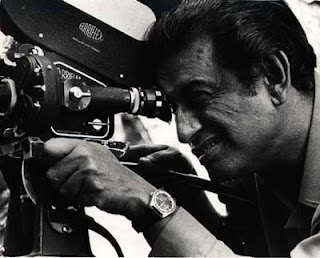
Which brings me to Satyajit Ray. You haven't seen too much (or any?) of his stuff, and it is absolutely not necessary for blissing out on this flick. But having watched Ray's Apu trilogy as many times as you are bound to see Darjeeling, I can say that Ray is Mr. Power and Grace. Anderson pays him tribute throughout this film, mostly by using film music composed by Ray and Ravi Shankar. However, the scene where the brothers take a whiff of the perfume and the joke about trains in the distance will both become even prettier when you see how affectionately they bow to Ray. I can't wait to send you these Apu films, along with his Devi, from 1960. I'm in the middle of that one right now, and it has all the rapture of that overhead baby shot in Darjeeling--arguably--no, no argument here: In-damn-disputably the most wondrous shot of an infant ever presented in a film. Those feet in the margins of the frame.

But that's all side stuff. The real fun of looking back on Darjeeling is how Anderson cleared that tightrope of silliness, reflexivity, grave seriousness and irony without a sweat. Let's get into that.

--Steve

____________________
incredible!
____________________


My man,

During our exchange I was directed to Carina Chocano's positive review of Darjeeling, which opens with a remarkably smart paragraph that summarizes some of the problems of the criticism of Wes Anderson and echoes some of what you were getting into at the start of your last missive:

It's hard to approach a new film by Wes Anderson without feeling like you've walked into an argument. There's something about his dollhouse aesthetic, his storybook formality, his miniaturist's attention to detail and his dogged belief in the power of objects to elicit the most oblique and recondite emotions that seriously sets people off. Why is a question for another paragraph, but needless to say it's exactly this staunch commitment to artificiality that makes his work what it is.

In addition to the surface-as-essence approach to dressing characters and scenes in Wesworld, there's something about how that subjective camera shoots those objects that imbues them with character. How things are arranged, perhaps staged, to echo myself again, matters, because this new film, like all his others, is still “cluttered” with detail, for all its acclaimed “maturity” (from its supporters). How the details accrue in the picture is probably a good indicator of how Wes “clears the tightrope” of storytelling. As a practice, storytelling relies on affective details that trigger a response. If we can agree that art is about life, why shouldn't something this artful (and artificial) be as resonant as a piece of art that is artful in its artlessness? Is it just a matter of taste at that point? To argue aesthetics seems a silly dead end, especially since I don't know much about it outside thinking, “Well, that sure is pretty and it looks like it was a thoughtful choice -- on the part of the artist and consistent with the rest of the work of art.” Plus, “aesthetics” is such a broad topic to whittle down to film style. We can table that. What I'm curious about is why Wes Anderson's rhetoric ticks people off. Because I can eat it all day. His world is full of things. Even in slow motion the world is alive with motion and speed.

The idea that objects (including people) can "elicit the most oblique and recondite emotions" in and of themselves and their appearance should be a delight, not something to harp on: it is an offering. Walking out of the film on Friday my friend said, “I feel like I've been given a thoughtful gift.” I think this kind of reaction is what Wes is aiming for in how he shoots objects with his camera. The objects carry history that can produce associations. Opening this film with Bill Murray's Businessman missing the train in slow motion, while a young man, Adrian Brody's Peter, runs past him, is not meant as an inciting incident in some kind of narrative but simply to trigger a response and tell you how things are arranged in this movie (this world): it's all about the train. The train is the name of the movie. The train is the movie. So when Bill Murray can't catch the train, Anderson is showing you, in as simple terms as possible, this movie is also all about youth. That is, as much as a movie so fearful of death can be about youth, and vigor. When the brothers chuck their, ahem, luggage at the end (to catch the train), the act is not simply some metaphor about mourning sons finally getting rid of their fatherly baggage. Rather, the film is saying that it is more important to watch the movie (to catch the train) than to hold on to things; those things (or their ephemeral essence?) stay with you no matter what, forever. Owen Wilson's Francis says, “Dad's luggage isn't going to make it” and the three brothers smile, and they run faster. Just like his missing loafer, the luggage doesn't matter, in the end. Those things are just distractions anyways. This both calls attention to the objects and tells you not to get hung up on them. I guess what I'm trying to say is: sure, you can read the scene as a blatant metaphor for “growth” or something but that belittles what happens, and the things that matter are those characters and their actions. Besides, the characters are still covered with details, they still carry a lot on their faces and bodies. And having seen them through a whole film with those suitcases and handbags you know that they're more mnemonics than anything. And if we understand that memories are forever inside us then we realize that we don't need mnemonic aids. (Think of the funeral within the funeral: lives within lives and stories within stories.)

Still, Wes Anderson is of a tradition of filmmakers like Quentin Tarantino (or the French New Wave that so inspires both artists' work) that metabolize cinema. They take it up (all the time, from everywhere), digest it, and reproduce new films. This is perhaps most apparent in Darjeeling in the musical cues Anderson borrows from Satyajit Ray. (But the only reason I know that this music is from those films is because I was told ahead of time. I look forward to understanding the homage better, and I thank you for the offering.) What's funny is I can also understand the music as a signifier for this odd Western ideal of India the boys are seeking. The music in Wes Anderson is an object weighted with (and by) history as much as things like suitcases. Think of the British Invasion tunes, too: in a story about youthful brothers on a journey into the spiritual unknown, the first song with lyrics in the film is by The Kinks (a band comprised of brothers), called “This Time Tomorrow.” It's all about not knowing where the journey will take the passengers. The song, like Peter catching the train in slow motion, knows that to get anywhere you simply have to start going.

Which brings me back to thinking about how well the movie works. Most importantly, I think it's wicked smart: it understands movies, and stories, and how they work (internally as well as on an audience); the philosophy of the film is affirmative; it does not overplay its hand, or shoot for too big; every detail has a purpose (for story or for its affective resonance); it's fucking funny. However, one could argue I'm a biased party. I feel I “get” Wes Anderson movies. They “speak” to me. But what I've come to realize is that this affection I feel for them is not about identifying with the characters (the way I thought I did with Max in Rushmore back when I first saw it). More so that, in as much as art is about life, I find my life affirmed in these films: my dreams, my loves, my fears, and my understanding of all that -- my understanding and enjoyment of life. One might argue this is all we ever look for in films and that is not a criteria but I would also like to posit, in as uncontroversial a stance as possible, I hope, that as much as art is about life, so is philosophy about life -- and in that film is a work of art, film can be a work of philosophy. So when I say Wes Anderson films speak to me, perhaps I mean that I am attuned to his brand of philosophy (pace Cavell). Perhaps I've realized that life is never fixable, or able to be fixed, even in narrative; that life refuses itineraries, even if it is good to plan some things, or at least be prepared to deal with the unexpected turns in the night; that life keeps going, for everybody, always, before and after them, and especially during the present (no d’uh); that life is weighted but fast; that life can surprise and delight; that life is worth it, even if it's scary, and dangerous; and that life is funny.

Laugh with me,
Ry

____________________
incredible!

Tuesday, September 04, 2007

Maurice Merleau-Ponty = ballin out of control.

RWK says: Phenomenology late at night might not make much sense (you need some lamps) but it still tickles the brain. I read an essay by Maurice Merleau-Ponty over the weekend called "The Intertwining -- The Chiasm" and it rocked me silly. I decided I would make myself a little crazy and type in a foundational paragraph. It's long, as you will see. And, as you will see, the words are images as much as any jpg would be in here so sit up close and read closer still. But I won't blame you for tuning out and scrolling (or clicking) away real quick: it's not easy. But it sure is beautiful.


If we turn now to the seer, we will find that this is no analogy or vague comparison and must be taken literally. The look, we said, envelops, palates, espouses the visible things. As though it were in a relation of pre-established harmony with them, as thought it knew them before knowing them, it moves in its own way with its abrupt and imperious style, and yet the views taken are not desultory—I do not look at a chaos, but at things—so that finally one cannot say if it is the look or if it is the things that command. What is this prepossession of the visible, this art of interrogating it according to its own wishes, this inspired exegesis? We would perhaps find the answer in the tactile palpation where the questioner and the questioned are closer, and of which, after all, the palpation of the eye is a remarkable variant. How does it happen that I give to my hands, in particular, that degree, that rate, and that direction of movement that are capable of making me feel the textures of the sleek and the rough? Between the exploration and what it will teach me, between my movements and what I touch, there must exist some relationship by principle, some kinship, according to which they are not only, like the pseudopods of the amoeba, vague and ephemeral deformations of the corporeal space, but the initiation to and the opening upon a tactile world. This can happen only if my hand, while it is felt from within, is also accessible from without, itself tangible, for my other hand, for example, if it takes its place among the things it touches, is in a sense one of them, opens finally upon a tangible being of which it is also a part. Through this crisscrossing within it of the touching and the tangible, its own movements incorporate themselves into the universe they interrogate, are recorded on the same map as it; the two systems are applied upon one another, as the two halves of an orange. It is no different for the vision—except, it is said, that here the exploration and the information it gathers do not belong “to the same sense.” But this delimitation of the senses is crude. Already in the “touch” we have just found three distinct experiences which subtend one another, three dimensions which overlap but are distinct: a touching of the sleek and of the rough, a touching of the things—a passive sentiment of the body and its space—and finally a veritable touching of the touch, when my right hand touches my left hand while it is palpating the things, where the “touching subject” passes over to the rank of the touched, descends into the things, such that the touch is formed in the midst of the world and as it were in the things. Between the massive sentiment I have of the sack in which I am enclosed, and the control from without that my hand exercises over my hand, there is as much difference as between the movements of my eyes and the changes they produce in the visible. And as, conversely, every experience of the visible has always been given to me within the context of the movements of the look, the visible spectacle belongs to the touch neither more nor less than do the “tactile qualities.” We must habituate ourselves to thinking that every visible is cut out in the tangible, every tactile being in some manner promised to visibility, and that there is encroachment, infringement, not only between the touched and the touching but also between the tangible and the visible, which is encrusted in it, as, conversely, the tangible itself is not a nothingness of visibility, is not without visual existence. Since the same body sees and touches, visible and tangible belong to the same world. It is a marvel too little noticed that every movement of my eyes—even more, every displacement of my body—has its place in the same visible universe that I itemize and explore with them, as, conversely, every vision takes place somewhere in the tactile space. There is double and crossed situating of the visible in the tangible and of the tangible in the visible; the two maps are complete, and yet they do not merge into one. The two parts are total parts and yet are not superposable.

Sunday, September 02, 2007

Big face, small razor for the day.

by Ryland Walker Knight


I'm not a red herring

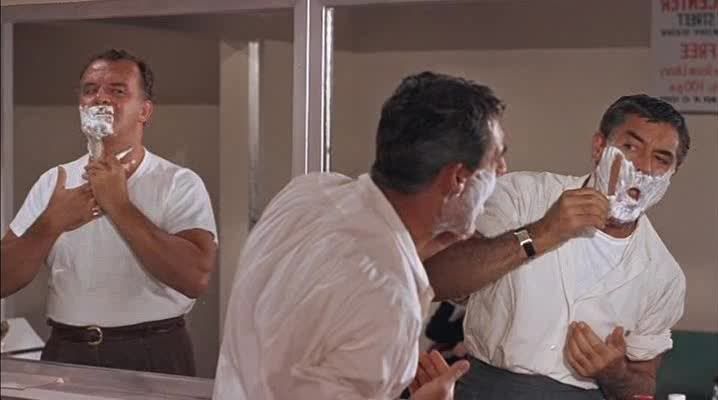
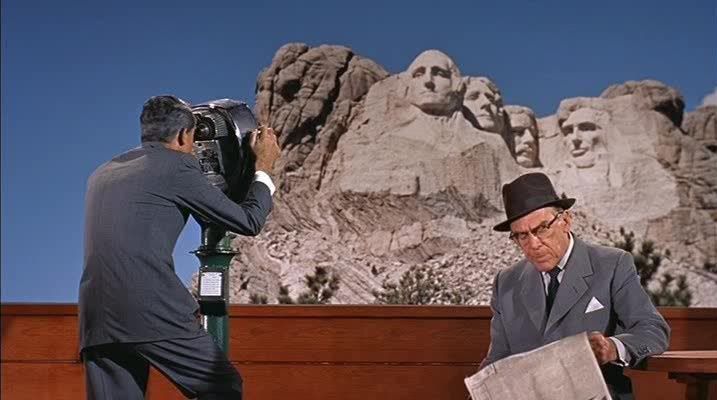
I'm thinking I located a good primary object of interpretation for my Honors Thesis, which holds so many more objects within that it will take a lot of elucidation. Especially if I relate the conversation to, oh, say, Michael Mann's Miami Vice and Stanley Cavell and VF Perkins and the nature of film style on screen and in criticism. There's a lot at stake, and a lot riding, in that big face. Now, don't get me wrong, Hitchcock's film is almost unreal in how good it is and Miami Vice is far from that brand of perfection, but there's a lot of dialogue here. Like, how these directors are constantly referencing themselves and their own work, and how they exist in those oppositional genres Cavell set up: Comedy of Remarriage VS Melodrama of the Unknown Woman. For a primer, of sorts, check out this nifty site about Cavell's essay (found in Themes out of School) on North by Northwest. They have more pictures, including one of Eva Marie Saint, the statue, crying; it kills me.

Saturday, September 01, 2007

Sunset for the evening.

that's all you
[Willie, standing on a roof.]

Wednesday, August 08, 2007

Who matters to me.

by Ryland Walker Knight


TLA

Today Jim Emerson asked, "Who matters?" I tried to answer in the comments but failed miserably. I simply glossed over some possibilities. I didn't give it much thought. I was simply diverting myself from homework; I've got a take-home final due on Friday. Then I went back to doing some homework. As I reread some Derrida my mind wandered (right?) and I realized that one director I singled out, among the others I listed, really has mattered to me, and I think will continue to matter, as time passes, because his films are so damned smart. And funny. Who? Wes Anderson, that's who. Now, don't get me wrong: I still think David Lynch is rather amazing and will live on in discussion for some time; and I still think Michael Mann understands what it means to be a man, and what it means to make a movie; but Wes Anderson's got a little more mischief up his sleeve and a certain kind of jouissance that infects his sense of humor, his camera, his storytelling, his film style, his world, his being in the world. Which is why I wrote about The Life Aquatic with Steve Zissou for my seminar paper last semester. I'm very proud to report that I earned a very positive grade in the course on the strength of this essay. However, for some reason I cannot pinpoint, I did not feel comfortable offering it to the blogosphere back in May. Odder still, for some other reason I do not know, or understand quite fully, I now feel comfortable offering it to the blogosphere here in August. You can download it from zshare by clicking here, if you like. But I will warn you ahead of time: it's over 7000 words, and if you don't really like The Life Aquatic, or Stanley Cavell, or "academic" writings, it's probably not for you. All that said, and aside, I still think you might like my work even if you don't really like The Life Aquatic, or Stanley Cavell, or "academic" writings.

WSZ

[Of note: I've been in such a school bubble that I didn't learn about the Battle of the Andersons at The Castro until a couple days ago when I visited Brian Darr's indispensable blog, Hell on Frisco Bay. Tonight's double bill? _The Life Aquatic_ with _Punch Drunk Love_. Damn you, school! Oh well, I could program it here, at home, whenever I want. Right? (Oh yeah, Brian, I like _Magnolia_ more than _Royal Tenenbaums_ at this point.)]

[Also cool: if you like Cassavetes and/or Altman and you're curious about Stanley Cavell, read this. It's a decent primer for all involved, I think. And it made me want to give _Nashville_ a second look, some six-to-eight years after my initial encounter.]

Sunday, May 27, 2007

Cavell for the Day

by Ryland Walker Knight


Many of you know of my newfound love of the great Stanley Cavell thanks to a seminar course I took this semester. I fell for him, for his work and his words, like, uh, hard. I have my issues with his work, as with anything, yet he synthesized a lot of what I've been reaching for in how to approach film as an art, and myself as a reader of film, or any art -- and subsequently identifying myself as a critic of the arts, and life. In one of his many welcomed verbal pats on my back, my professor told me I'm doing a good job of getting there. These words made me smile and I feel a tad silly putting them up here but they are offered with complete humility, I promise:
"I like what you're doing with your criticism. Like all good criticism, it not only values the object of interpretation, it also affirms the importance (and difficulty) of paying attention to the object of interpretation."

I'm trying my best. As he said, it's difficult. But I feel like I'm gaining ground -- and getting comfortable in my own critical skin. I point to my recent Revenge of the Sith appreciation. On Tuesday, I hope you read my defense of the Pirates of the Caribbean films. A lot of this new philosophy is in that work.

So, to better help explain my varied, complex shifts in perspective this semester, in regards to criticism and to life as well, I'm offering some choice quotes from the books we read of Cavell's this semester. I'm hoping to re-read Pursuits of Happiness sometime soon and write up a full-book response of an appropriate length. I may even pitch it to Mssr MZS & KU over at The House as it would be some kind of mission statement for me, one of their writers. But, honestly, with all the schooling I'm engaged in right now, I refuse a timeline on such a project. In lieu, here's the quotes:

________________________________


"I have wished to understand philosophy not as a set of problems but as a set of texts." [Claim of Reason]

"I am not insensible, whatever defenses I may deploy, of an avenue of outrageousness in considering Hollywood films in the light, from time to time, of major works of thought." [Pursuits of Happiness]

"But when I thought about these eminent theories in connection with the lives depicted in the grand movies I had been immersed in, the theories and the depicted lives passed one another by, appeared irrelevant to each other. Yet these lives seemed and seem to me ones pursued by thoughtful, mature people, heavily in conversation with one another about the value of their individual or their joint pursuits. I could not understand my interest in them as unrelated to moral reflection. I claim for these films that they are masterpieces of the art of film, primary instances of America's artistic contribution to world cinema, and that their power is bound up in their exploration of a strain of moral urgency for which film's inherent powers of transfiguration and shock and emotionality and intimacy have a particlar affinity." [Cities of Words]

"It is a characteristic criticism of Emerson to say that he lacks a sense of tragedy; for otherwise how can he seem so persistently to preach cherrfulness? But suppose that what Emerson perceives, when he speaks of his fellow citizens as existing in a state of secret melancholy, is that in a democracy, which depends upon a state of willingness to act for the common good, despair is a political emotion, discouraging both participation and patience. So when Emerson asks of the American Scholar that he and she raise and cheer us, he is asking for a step of political encouragements, one that assures us that we are not alone in our sense of compromise with justice, that our sense of an unattained self is not an escape from, it is rather an index of, our commitment to the unattained city, one within the one we sustain, one we know there is no good reason we perpetually fail to attain." [Cities of Words]

"I am always saying that we must let the films themselves teach us how to look at them and how to think about them." [Pursuits of Happiness]

"Here is a place we come unprotectedly upon the limitations of criticism by the fact of something that is called personal taste. About It Happened One Night I said that its appreciation depended on a certain acceptance of Claudette Colbert; but my sense of The Awful Truth is that if one is not willing to yield to Irene Dunne's temperament, her talents, her reactions, follwing their detail almost to the loss of one's own identity, one will not know, and will not care, what the film is about. Pauline Kael, for instance, in her Profile of Cary Grant, has this to say about Irene Dunne in The Awful Truth: "though she is often funny, she overdoes the coy gurgles, and that bright toothy smile of hers -- she shows both rows of teeth, prettily held together -- can make one want to slug her." Whatever the causes of this curious response, it disqualifies whatever she has to say as a response to The Awful Truth." [Pursuits of Happiness]

"Who is this man, C. K. Dexter Haven/Cary Grant? When George, furious and confused at Tracy's refuseal, or rather acceptance, of his suggestion to let bygones be bygones, turns to Haven with the accusation, "Somehow I feel you had more to do with this than anyone," and Dexter replies, "Maybe, but you were a great help," we laugh both at the victory of light over darkness and also at the truth, hard to locate, of Dexter's power, apparently some mysterious power to control events. The magic invoked by the genre seems localized in this figure. Surely this has to do with the sheer physical attractiveness; he is after all, or before all, Cary Grant." [Pursuits of Happiness]

"I have also acknowledged that Dexter is more literally the magical Cary Grant. But who is Cary Grant? I mean, what becomes of this mortal on film? It seems to me that George Cukor is calling upon the quality of Grant's photogenesis discovered, as I suggested earlier, in the comedies Grant made with Howard Hawks -- I mean the air he can convey of mental preoccupation, of a continuous thoughtfulness that makes him spiritually inaccessible to those around him. This quality of the sage gives to his privacy, his aliveness to himself, a certainty and a depth." [Pursuits of Happiness]

"The question would be, as the question often is about philosophy, how to bring a reading to an end. And this should be seen as a problem internal to criticism, not a criticism of it from the outside. In my experience people worried about reading in, or overtinterpretation, or going too far, are, or were, typically afraid of getting started, of reading as such, as if afraid that texts -- like people, like times and places -- mean things and moreover mean more than you know. This is accordingly a fear of something real, and it may be a healthy fear, that is, a fear of something fearful. It strikes me as a more discerning reaction to texts than the cheerier opinion that the chase of meaning is just as much fun as man's favorite sport (also presumably a thing with no fear attached). Still, my experience is that most texts, like most lives, are underread, not overread. And the moral I urge is that this assessment be made the subjet of arguments about particular texts." [Pursuits of Happiness]

________________________________


I wanted this to have a little more variation but time only permitted thus. Still, my hope is this may have been a happy read.

Saturday, May 05, 2007

CINCO DE VINYL: Pan's Labyrinth's Apologia

proceed with caution

[Our first guest column! The ever-erudite Jennifer Stewart instructs us on how to read Guillermo Del Toro's Pan's Labyrinth. Ms Stewart is a graduate student in the Rhetoric department at UC Berkeley. Recently, she was plain shocked by my flippant and hate-filled dismissal of the film and offered to write a defense for its virtues. Apparently this is the first written film analysis she has performed but she's a good reader, a good Rhetor, so, naturally, this is an excellent and generous reading. I still retain my stance against the film in spirit but cannot delve into it again without sounding off all ire and limbs flown. SO! If you're curious what the hell a Rhetoric major does, this is it: this is the real deal. Enjoy! (-RWK)]
I've tried to begin Pan's Labyrinth's apologia where the sting of your charge leaves it: namely, that its gory violence is voyeuristic, useless, and empty. This attack is a complicated one, I think. Without a principled objection to onscreen face pulverizing, then you must say what it is about the aesthetic and stylistic terms P'sL gives itself, such that its onscreen violence can't be justified (whereas it could, perhaps, in another film). Having said that, if you think such onscreen gore is never justified, then that's a moral highground which only ends the discussion. Instead, I assume that if I can provide an account of what the onscreen destruction of the rabbit hunter's face is doing, I'll have at least succeeded in providing what your indictment assumes is its lack of structural and thematic content. [What this kind of reading means for the status of a film being "good" or "bad" is - I find - a paralyzing question, but I'd welcome discussion from you less ataxic film buffs.]

What's interesting about this scene of horrific destruction is that although it is explicitly a spectacle (the characters in the scene are watching, too), the camera shows the pulverizing blows rather than reactions from the troops or the son's father (who let us not forget is also forced to see). Everyone is watching, but the camera is not interested in this pathos. The Captain delivers the first blow after the son declares, "If my father says he was hunting rabbits, then he was hunting rabbits." The camera initially shows us the calm, cool face of the Captain as he delivers the first couple blows, then the darkening face of the son as his nose and cheekbones yield to the force of the Captain's blunt will. What provokes the Captain is precisely the son's hubris, not at talking back to him, but at declaring his father's power to nominally shape the world: if he says he's a rabbit hunter, then he's a rabbit hunter. What the Captain won't tolerate is this tautological claim from a competing will. The whole film can be read as showing us character foils operating in a fundamentally mutable world - a world that does bend and yield to a shaping will, and the Captain knows this.

What's perverse is that the Captain is trying to impose the kind of will which hordes that shaping power for itself. When asked by the doctor how he can be sure his bride's unborn child is a son, the Captain replies "don't fuck with me." When his supper guests countenance his "need" to confront what remains of the rebellion, he corrects them by declaring he is there not by need but by choice, since:

The war is over and we won. If we need to kill every one of these vermin to settle it, then we'll kill them all and that's that.

Technical military victory is insufficient to impose a Totalitarian order, so he must eradicate all those who do not act accordingly. The Captain is less a figure standing for the tyranny of uncritical obedience, so much as a figure who recognizes that the world can accommodate multiple interpretive claims, but attempts to collapse this by imposing a Totalitarian order. In other words, he is the figure who says, it doesn't matter what people believe, I will intervene and establish whatever order I want, imposing and sustaining it by sheer repetition: by insisting on rigid obedience to the mundane; a beaurocratized distribution of resources (Franco's daily bread, etc.), a hierarchy of manners (precise dress and punctuality; declaring his wife's caravan 15 minutes late on a multiple hour journey, and so on). Everything about the Captain involves absent repetition of routine (he rises, shaves, and dresses the same way every day, threatens his prisoners with the same speech, tortures them with the same instruments in the same order, etc.).

Yet his mistake is thinking an order can be established and maintained simply by instituted repetition. The problem is that this leaves too much room within those strict rules of daily life for free thought. You can run his household or stand in line for Franco's daily bread without obeying in your thoughts. Indeed, you can be dreaming about being a princess in an underworld. The Captain errs because he doesn't recognize what's undermining about this level of disobedience (he misses why it might matter that Mercedes ostensibly obeys him but is not loyal). It doesn't even matter to him, in the end, that he will die, as long as his son "knows what time his father died" - as long as his totalitarian influence remains as repetition (at the same time of day, etc) continually observed. Like all totalitarians, he errs precisely by not caring what people think, only that they obey.

The film fetishizes resistance to such a Totalitarian will, because revolution is what can be planned all the while looking like you are obeying. Mercedes and Ofelia represent this disobedient will because they share the ability to see and move through the "cracks" such a scopic regime leaves room for. Mercedes keeps the letters of the Revolutionary's correspondence in a hiding place purloined in the outlines of the floor tile, just as Ofelia reveals doorways by drawing their outlines with chalk.

More specifically, Ofelia can see through the outlines of this world, into the world described in her treasured books. Her second scene features the fragmented piece of stone statue she finds on the road and intuitively replaces - an act which in turn summons the flying stick-bug that Ofelia tells Mercedes is "a fairy." Of course later, this creature morphs itself when prompted to do so by Ofelia pointing to a profile in her book and declaring "this is a fairy." Unlike the Captain, Ofelia shapes the world by recognizing its ability to take on other forms. In short, Ofelia is the celebration of vision disobedient to the pretensions of one regime, and Pan (the Faun) is there to test her: although he ostensibly prescribes strict orders, the point is always to solicit a certain disobediance: What Ofelia's prophecy (to restore her spirit to the underworld kingdom) actually requires as its condition of fulfillment is resistance (it's Alice In Wonderland as Sophocles might have penned it). Pan's "Labyrinth" is precisely the bewildering complexity it would be to trying to satisfy conditions of fulfillment purloined in strict orders.

That said, the film de-centers Ofelia's fairytale story, for she and her unborn brother are really the parables of Mercedes and her adult brother leading the guerrilla force hiding in the forest. It is not her brother but Mercedes, after all, that the film positions as the true political revolutionary, since it is thanks to her guise of obedience that a revolution can be strategized and carried out in the first place. Just as Ofelia is comfortable occupying a world where one scopic regime can be penetrated by another (fairies and fawns appear, chalk can draw functioning doors, text appears in blank books), Mercedes is, too: by "finding" doors in the floor and she enables essential communication (not to mention medical supplies and other provisions) thanks to which the revolution continues to be possible. Mercedes is capable of the improvisation which takes place in the cracks and spaces opened up by an imposed rigid order (that of running the Captain's household just so). Ofelia's story is the mythic dramatization of how one learns, when one is gifted with the right visibility, to use those cracks and spaces (now it's Alice in Wonderland as Michel de Certeau might have penned it). Mercedes is the grown counterpart of this disobedient will.

In the end, Ofelia's blood is the triumph of the Captain's own conceit undoing him: he takes his son from her at the center of the Labyrinth, and shoots her in cold blood, right after Pan (once again) tests her ability to know when to disobey: she refuses to let Pan draw her infant brother's blood in the ritual which restores her as princess of the underworld by first sacrificing the blood "of the innocent." Ofelia instinctively refuses ("my brother stays with me"), and in apparently refusing to satisfy the conditions of prophecy, precisely meets them. The world is too mutable to insist on the strict interpretation of her brother's (an infant's) blood, since her innocent blood (thanks to the Captain) will do just fine. Except it is here, of course, that the film fetishizes disobedience, all echoed in the eulogy of Ofelia's mother: don't mistake the divine for its ostensible laws. What matters is the spirit who knows how to improvise an interpretation befitting the spaces and cracks. Precisely through the absence of strict law can innocence - an uncorrupted will - seek to act in a mutable world.

In conclusion, what happens when a corrupted, totalitarian will tries to act in this world? He must collapse it, and what better way to portray this than to show the Captain literally disfiguring a resisting countenance. The face - in some way the very metaphor of mutability - that declares the same power he wants to claim only for himself, is ruthlessly destroyed, and what matters in this scene is precisely to show the horrific violence it is (or so the film wants to say) to collapse mutability itself.

look, nerd
[Illustration by Arthur Rackham, from Wikipedia]

Thursday, May 03, 2007

Collapsing Space in Club Silencio, in Mulholland Dr.

by Ryland Walker Knight

Silencio

David Lynch’s Mulholland Dr is a collage, an assemblage of rhymes and multiples, of dreams, from beginning to end, using every cinematic layering technique available, chief among them the manipulation of its ever-insistent soundtrack. Sound is often employed in film to cue a viewer’s eyes or emotions, a kind of pathetic trigger, directing our emotional investment. Lynch, however, uses sound to disrupt its own illusion, discomfitting the viewer by foregrounding that inherent artifice it seeks to dismantle. Each move the film makes tells us this is all an illusion, reality and artifice alike, by breaking down the sound, by exposing its primary illusion. Thus, Lynch forces the audience to confront itself and how it approaches not just film (artifice) but life (reality) and our movements with and within both realms. Lynch employs sound design in that classical sense that he wants to trigger an emotional response in his audience but his use of sound never cements the space of the film. Rather, this refusal of spatial-temporal-cinematic unification disperses the film and its artifice invades (and colors the read of) every scene, every glance, every encounter: nothing is certain. The resultant anxiety that typifies Lynch’s films, and Mulholland Dr. in particular, comes from that self-reflexive rupture and layering of the illusion.

Mary Ann Doane’s essay “The Voice in the Cinema” argues, if not for a primacy of sound, for an equalizing of sound and image, which dovetails with Lynch’s filmic instincts and practices. Both approach the use of sound as an equal compliment to the image. There is hardly an image in a Lynch film that isn’t colored by sound — even silence has a color, a body, in Lynch’s oeuvre — which is exemplified by the use of an ambient score of synthesizers and synthesized sound effects that layer and unfix the images, the films. As in Mulholland Dr., when Lynch links scenes with that anxious and uneasy score, an ugly grumble of sine and square waves, conflating the skyline of Los Angeles with an apartment’s interior, the sound doesn’t define or localize the space, as Doane defines the job of the soundtrack, but works as a dissolve, even within a hard cut transition. In the act of conflation, it rather multiplies spaces within the networked composite of the film and its world. Space is at once dispersed and collapsed.

In Mulholland Dr.’s Club Silencio sequence, Lynch makes this illusory and confounding dichotomy explicit through a disembodied voice calling attention to itself. As her title says, Doane’s essay is focused on the sound of the voice, and how it holds a film together in space. For my purposes, it is crucial we understand, “In the cinematic situation, [which] three types of space are put into play:

1) The space of the diegesis. This space has no physical limits, it is not contained or measurable. It is a virtual space constructed by the film and is delineated as having both audible and visible traits (as well as implications that its objects can be touched, smelled, and tasted).
2) The visible space of the screen as receptor of the image. It is measurable and ‘contains’ the visible signifiers of the film. Strictly speaking, the screen is not audible although the placement of the speaker behind the screen constructs that illusion.
3) The acoustical space of the theatre or auditorium. It might be argued that this space is also visible, but the film cannot visually activate signifiers in this space unless a second projector is used. Again, despite the fact that the speaker is behind the screen and therefore sound appears to be emanating from a focused point, sound is not ‘framed’ in the same way as the image. In a sense, it envelops the spectator.” (166)

Club Silencio would appear designed to composite these spaces. First, visually, through a series of frames: (1) the frame of the film itself tells us this is a fake, unreliable; (2) the curtained frame of Club Silencio’s stage echoes that first frame, the frame of the film we are watching, which doubles the artifice; (3) the raked auditorium opposite the stage, where the twin protagonists sit, directs our attention back onto us, where we sit, as a doubled audience in a double auditorium, placing us inside a frame, inside the artifice; (4) the frame of the balcony above the stage acts as another frame within a frame: all these frames collapse the space so the audience is one with the film. Second, aurally, through playing with sound and sound design within this composite space, which is just as dizzying as those multiplied Russian-doll framing devices, and yet more complicated.

As the sequence begins, the diegesis of the film is unified in speech through the spectral master of ceremonies’ voice since his lips are the perfect dummy, reciting his lines. However, his dialogue is about how his dialogue is fake, how all sound on the stage of Club Silencio (and by proxy in the formal frame of film) is artificial. With a scowl he declares, “No ay banda! There is no band. Il n’y a pas de orchestra. This is all a tape recording. No ay banda. And yet, we hear a band.” After tossing aside his cane, which makes no tumbling clatter once it exits the film frame, he calls upon a trumpet and a trombone at will, summoning their sound as proof that, “It is all an illusion.” From this, the first space of Doane’s is imminently complicated: the aural diegesis is disassociated from the visual diegesis, implying their relationship is both symbiotic and disassociated all at once. Doane’s model proposes a definite link, despite the obvious dichotomy: “This space has no physical limits, it is not contained or measurable. It is a virtual space constructed by the film and is delineated as having both audible and visible traits.” Club Silencio and Mulholland Dr. tell us, yes, the space is constructed by both aural and visual components, yet work as they may in tandem, there is a definite line between the two, one which, in the collapsed space of Club Silencio, may privilege the aural as it informs sight. Doane’s third space is then present in the first diegetic space in Club Silencio as the “sound is not ‘framed’ in the same way as the image. In a sense, it envelops the spectator.” Therefore, only the film, only Lynch and his proxy MC, can turn off sound, not the spectator. And it would also appear, for Lynch, to be at the mercy of sound, as we are in life, is a frightening experience.

The sequence continues, and shifts course, when the MC demands, “Listen!” This interpellation calls to attention not just Club Silencio but the film’s physical, live audience as well: we can do nothing but listen. But his speech is over. He raises his hands and, as he summoned the horns before, he summons a storm of thunder and lightning inside the club. His face turns demonic and one of the protagonists in the audience begins to shake involuntarily, her torso convulsing along with the flashes of light while she grips her seat, held down doubly by her twin companion. A smoke seeps into the frame around the MC and he shifts position, momentarily stopping the storm. His expression is now nothing but evil and the light show continues as the smoke surrounds his face, enveloping him. The smoke subsumes him and he disappears. In his and the lightning’s place, an aqueous blue light washes over the Club, the film, and us in the audience, while the thunder cedes to a typical low-register synthesized groan. We’re shown the empty space of the Club, the solitary microphone glinting in the inconsistent light: sight is mediated by light, and fixable, while sound only keeps going, extending the moment — and the space.

Space is again collaged and layered in the collapse of those different realms of space Doane lays out. What’s curious is this collapse also works as a multiplication, of objects and spaces and objects within spaces. A collage is, by definition (and practice), an assemblage of disparate images and texts (and sometimes sounds): it is premised on a multiplicity. Film is, by definition (and practice), an assemblage of images and sounds (and sometimes texts), disparate and not, alike and not: it is premised on a culling of multiple elements. Therefore, film is collage is film. As Club Silencio mimics the film-going experience, and comments on such an experience, it’s performance is that of a film’s as well as being within a film. As a film, then, Club Silencio is a collage of film effects, chiefly the sound. And if Club Silencio is a collage, its host film is a collage, and, of course, a film, too.

The beginning images of Mulholland Dr. are a cut-out collage of swing dancers, many of the couples are twin or triple couples of the same man and woman doing different moves at different spots in the frame, multiplied across a diffuse purple background in time to a jazzy snare-kit beat and a spare trumpet riff. This marriage of sound and image is, retrospectively, a metaphorical prediction of the Club Silencio sequence's explicit explanation. From this first moment we are given a world where sound is tied inextricably to how images move. The viewer’s eyes are confused where to look, and for what? The film is simply colliding images, collapsing worlds, as would a collage. This opening sequence is complicated further when a washed out, all-smiles blonde is super-imposed over the syncopated pageant, layering the images and sounds, as, along with the spectral blonde, a low-frequency white-noise groan and mild applause seep into the film. The images work in tandem with the sounds, layered as they are upon one another, much like the jitterbug partners work together, playing off the other’s movements. The jitterbug composite quickly evaporates, though, after the blonde’s own jittery first appearance (that super-imposition is ragged and blurry, dancing its way onto the screen in its own right), and, briefly, all that’s left is the applause and that bleach blonde before the lumbering synthesizers melt into the soundtrack again, and the images fade into an out-of-focus close-up on rumpled red bed sheets. The space is collapsed between the two nowhere-regions. The camera, handheld and myopic, crawls across the bed into a pillow, further blurring the image — and our perception of it, and of the film itself. This descent into sleep dictates all that follows. Everything we see is dreamt. Everything is distorted and artificial, forged from the warped perceptions of a dreamer. Everything is a sign and not: as soon as we think we understand a sign, its resonance and relevance disappear, lost in the film’s enveloping dream dis-logic, like Club Silencio's MC. Everything — the film, the characters, the sensory imbalance — is a dream. As in a dream, the space of Mulholland Dr. is diffuse and anxious. The camera floats and bobs, the soundtrack grumbles and bleats. The film is collaged as a dream, too, in that it collapses and conflates seemingly disparate images into a loaded composite space which follows the through-line of sound, not image.

Calling the film Mulholland Dr., Lynch says everything in the film is that street, is that restless winding mood, is that space above Los Angeles, looking down; yet that street is a part of Los Angeles as well: the film is at once inside and outside itself, simultaneously looking out from within and looking back in from without. Everything is collapsed and conflated, including sound and image, de-centering and displacing the audience and all the while implicating them as well. The space is collapsed. We are present not only watching the film, we are in the film. Everything — Mulholland Dr., the film, its tri-partial space, the audience — is a composite, a collage. And we the audience are at once constituent in its terror and simultaneously at its mercy.

_________________________________________________


[Written for a Film course on sound in cinema, this is a belated Lynch Mob entry, I suppose, in some sense, but it stands alone, as well. I think I did the film and the assignment justice. At the least I enjoyed spending yet more time with one of my favorite films and its puzzles. Also, an editorial note: I chose not to put in screenshots or stills because I wanted to let the language do it for you, if that's possible, if I'm that good. I'm banking that's the case. Tell me if it's not, if there should be pix. I may go ahead and put some in later but for now I kind of like it all text. It's kind of the opposite of the Grindhouse review, which is all pix. Or maybe I'm just plain lazy right now.]

Tuesday, March 20, 2007

Falling up inside the fugue.

by Ryland Walker Knight


Rooting around inside "Borges & I," identity becomes unfixed and mutable, a liquid temporality. By the end of the single-page, two-paragraph essay, the first-person "narrator" has evaporated. In this diffusion the text moves beyond a simple separation of Author (Borges) and words (I) to a realm where there is no "I" and words fold back to define both Borges & I, enveloping the two in a catch-all network of language outside human being. The distinction, so clear at the outset, does not blur as much as fork, and the text, at the end, blossoms into "a point-counterpoint, a kind of fugue, and a falling away—everything winds up being lost...everything falls into oblivion." Each sentence branches off from the previous one, building a latticework of words.

While the first sentence may still ring true at the end, “It’s Borges, the other one, that things happen to,” that division is no longer defined by the last line, which reads, “I am not sure which of us it is that is writing this page.” The syntax of the final sentence tells us there are at least two people struggling to claim these words but it also renders that fight moot and misguided. In fact, it could be more than the duality of the title. The word “us” is not limited to Borges & I since the word “I” is a shifting pronoun; instead, it casts a broader net including all readers because when the reader reads the word “I” the reader becomes that “I” as well. So, at the close, its knotted roots overlap and confuse the play between Borges & I. The push-pull give-and-take eventually yields:

It would be an exaggeration to say our relationship is hostile — I live, I allow myself to live, so that Borges can spin out his literature, and that literature is my justification. I willingly admit that he has written a number of sound pages, but those pages will not save me, perhaps because the good in them no longer belongs to any individual, not even to that other man, but rather to language itself, or to tradition.

Each movement in “Borges & I” takes the central pair and obliterates them. Here its impetus is Borges “[spinning] out his literature” and not the narrator. But the narrator says not even Borges can claim “those pages” — they belong “rather to language itself, or to tradition.” Therefore, words are forever autonomous, yet still within the grid of traditional language. It’s a limited free play but it’s one neither Borges nor the narrator can control, per se, only build on and contribute to. And yet, they both must let go each branching sentence they render (if, of course, one or the other or either did, in fact, set this text down in words). To spin out literature is not to write but to perform a culling creation — an intricate organization ever expanding. There’s a constant mutation like in a fugue (as referenced above) and the latticework becomes a spider web’s net, a more fragile and fluid framework.

These obliterating movements all stem, ever nimbly, from that initial theme of a duality inside Borges’ character. There’s Borges, the academic literati and there’s “I,” the narrator, on a “walk through Buenos Aires” which stops and starts, “mechanically now, perhaps”. The walk immediately moves the reader through “the arch of an entryway” to a home where the narrator collects mail, then further to an academy where Borges’ name adorns a list, and then at last to a library where you can find Borges “in some biographical dictionary.” The discontinuous list in this second sentence lays the groundwork for the essay, an odd overview of this tour Borges (& his "I") will spin out for the reader.

As readers, we’re paused, somewhat mechanically, scanning the page and the arch of its argument (entryway). This news-history-difficulty of Borges and his other, more intimate “I” reached us through this sheaf of letters (mail). Borges is joined by other academics in this text, if briefly (Stevenson, Spinoza). And the essay itself is a kind of biographical dictionary, delineating the difference between Borges the academic/writer/other and his subjective, narrator “I,” aiming to define the space they both occupy and move through, sometimes together, sometimes apart; however, their world and text are equally riddled with complications that require specificity.

This mechanical pause, to reflect or qualify, comes to define the text. Littered with asides, “Borges & I” takes its time. Sometimes an aside appears an outright tangent, like when Spinoza pops, late, into the first paragraph: “Spinoza believed that all things wish to go on being what they are — stone wishes eternally to be stone, and tiger to be tiger.” What grounds it is the next sentence — a crucial juncture that reads, “I shall endure in Borges, not in myself (if, indeed, I am anybody at all).” Borges is eternal and will eternally be Borges. Thus, the “I” cedes power and legacy to the name taking over his life: "Little by little I've been turning everything over to him" so that he is “falling away…into oblivion” where he does not even exist. By the end, no individuals exist. The text, Borges and the narrator are a mosaic as watercolor, a confounded miasma. After leapfrogging through the time and space of Buenos Aires, “hourglasses, maps, eighteenth-century typefaces, etymologies, the taste of coffee, and the prose of Robert Louis Stevenson” the tour’s destination is a curious nothing, an eternal oblivion where identity is lost. When the mass paragraph ends and the next, a one-liner indented underneath, reads “I’m not sure which of us it is that’s writing this page,” it’s an alarming shift. After twenty-six lines of packed-in text, the reader has to jump

to the next paragraph for one sentence, shocking the eye.

It’s another mechanical pause (one similar to turning the page of a book, in fact), an almost flippant aside toying with the reader. The page ends in a lurch, a final move that, at once concludes and confuses the piece. This last offering is an explicit illustration of the text's complicated identity game of diffusion and proliferation. Throughout, the narrator is creating a tangible history with Borges, layering sentence-branch over sentence-branch, spinning webs of words that catch time — briefly and awkward — to distill it, forever as mythology. The world of “Borges & I” is a fluid compound reality that will never cease to re-invent itself in all those who take it up, into their hands and heads, only to wrestle it back down, into sense and sensibility, even when the trellis of words grows only taller, eternally.