Showing posts with label Pedro Almodovar. Show all posts

Wednesday, December 08, 2010

Convergence for your silver eyes (12/8/10)

by Ryland Walker Knight
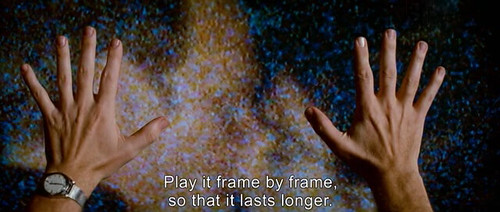

Lasts longer

Table it

Monday, December 21, 2009

Get your verdant going electric.

by Ryland Walker Knight


—When I click this...

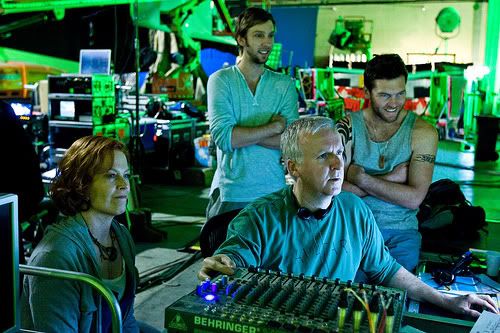
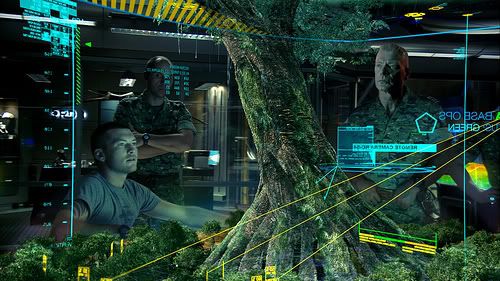
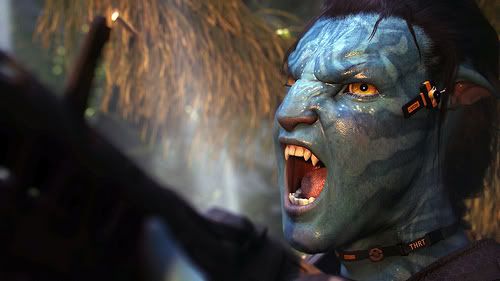
Like Broken Embraces, you know exactly what you're getting from Avatar. Yet, with Pedro Almodovar, you only get about five great images and one classic finale sight-meld that changes perception. With Cameron's film, a visionary chunk of neon folly if ever there was one, almost every second behind those 3-D goggles got my eyeballs going gaga and groggy with gorgeous goof city grand larceny light shows of gigantic gestures all swooped and folded and lit up beyond pure spectacle into something truly immersive. I was wiped, wiping my eyes walking out of that early-AM, first-possible IMAX showing Friday morning. It's about as tiring an epic as has come out since that other great film of the decade about embodiment, Pirates 2 (and, yes, No. 3, which is more tiring but not quite as good).

By now you probably know what Cameron's movie is about (bad military, good natives; yawn), so I don't need to waste your time with the waste of time story highlights. Rather, we ought to focus on the real excuse for this behemoth: to light your eyeballs full of a frenzy. Because, it goes without saying, though everybody will/has, James Cameron cannot write for shit, has no political sensibility other than guilt, and wouldn't know how to differentiate between myth and cliché if asked in the right (pointed) way. What he can do is make a few images, and build a movie, however silly, with all kinds of cool tools. He's also been pointed in the right direction of a few bits of theory, it seems, and knows a few things not just about feminism but also about game design and, um, phenomenology. At heart, his story is about seeing as a physical action, a full-bodied embrace of the material world. Again: embodiment. I have to admit that, despite what (little) I knew about the whole "stereoscopic" mumbo jumbo Cameron supposedly invented (and the title, duh), I didn't see that one coming. Or, at least I did not expect it to be that explicit—nor for it to work.

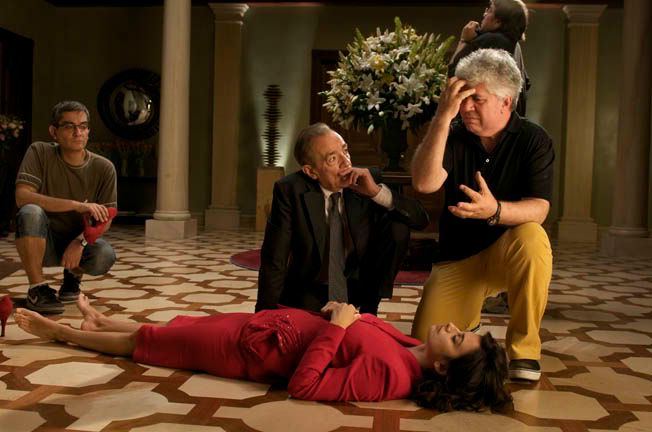
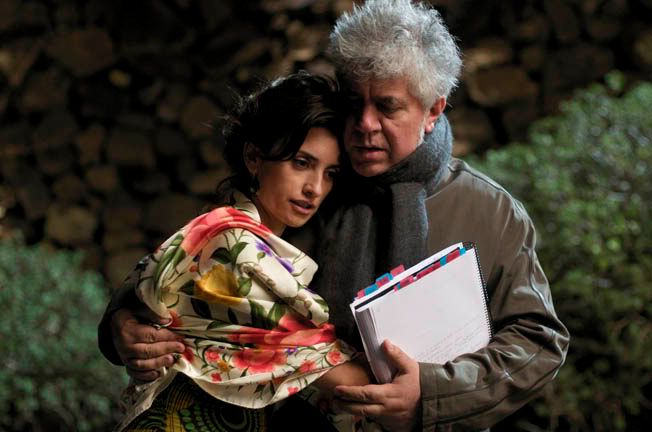
You expect Pedro Almodovar, in a movie about a now-blind filmmaker, to make the phenomenological film that moves you, not James Cameron. But, save that final image, and Penelope Cruz's force-of-nature performance, nothing really moved me, though a few things tickled me, as much as any number of sights in Avatar. Physically moved, too: I found myself fudging the 3-D by having to shift my body and cock my head from side to side from time to time just to cope with all that gooey phosphorescence on screen. WIth Pedro's film, I just kept wanting more screen time for that goddess, no matter the narrative cost. See, Pedro's still hung up on plot. But he's only got a few of them to rely on, and the record-skip repeat of this movie is nearly tiring; or, it is whenever Penelope isn't dazzling the frame. All Cameron has to do is push a few motes forward in the "frame" (space? his term, "volume"?) and I get a thrill. That said, only a few of the compositions from the full film linger in my head. It's more about the fluidity of the space, and the visceral invitation it offers, than it is strictly about pictures. In that, I think Sicinski's onto something with that three-tweet rave (starts here) about "making plot just what it should be: an excuse to go nuts on viewers' skulls."


—From here!

Last year I had a similar positive reaction to Speed Racer, but I know that movie, though maybe more adventurous, is nowhere near as successful. It's a little too cut-out cartoony, and its timing is all off. Say what you will, and I know it's long (and there's no getting around that, of course), but Avatar never drags. It just weighs a ton for a fleet film. And that's because it expects your eyes to do things they're not used to doing. —Least of all in a multiplex! In any event, this rapture, though felt, is still nothing compared to the sheer joy of Fantastic Mr. Fox. There's a film jam-packed with detail to keep you pinballing around the frame for daze on end, every frame a treat—and all in under 90 minutes. But that's another story for another time. (Maybe later in the week.) For now, I'm just adding my ramble to the ruckus out there, getting giddy at the thought of fluorescent aerial jellyfish and all kinds of eco-electrical networks of lights to make me and you and everyone dizzy with dumb grins. What a gift!


[Broken Embraces opened on one screen, at the Clay, last Friday here in the Bay Area and will roll out to more screens on Christmas. Avatar's everywhere. Neither needs my endorsement to make oodles of cash. Though, of course, one will make yet more oodles than the other.]

Sunday, December 20, 2009

Viewing Log #25: Get on the bus [12/14/09 - 12/20/09]

by Ryland Walker Knight


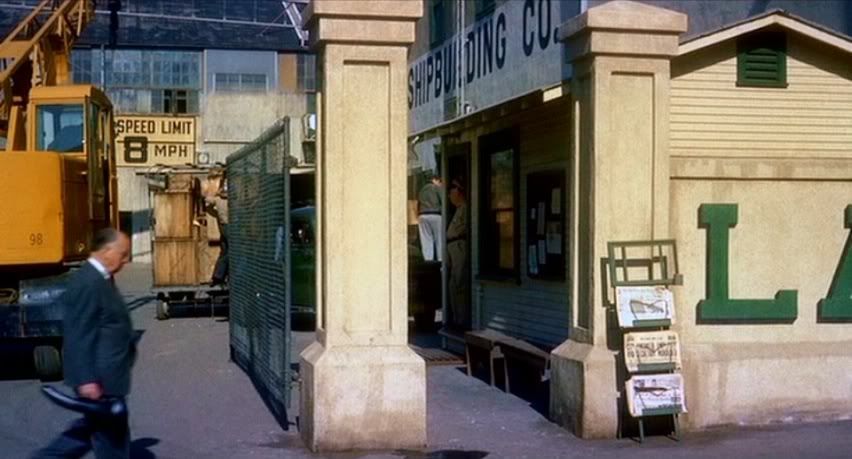
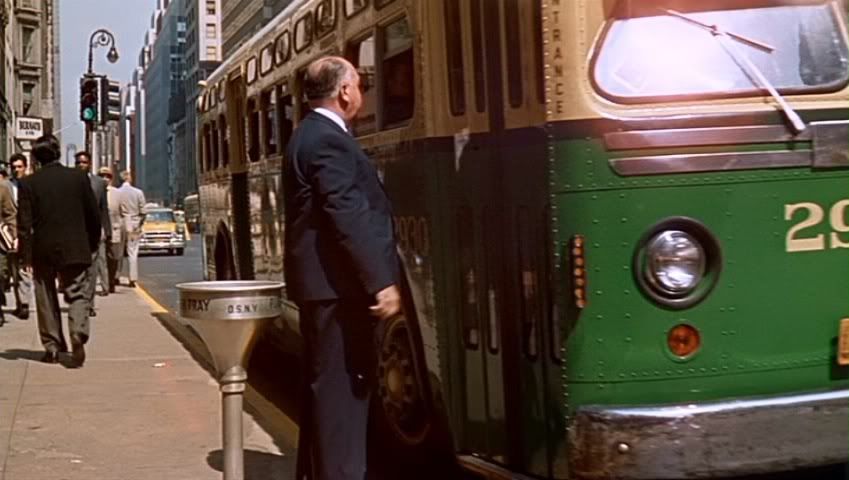
  • North by Northwest [Alfred Hitchcock, 1959] # All in all, a gas. Simply one of the most fun movies of all time. And smart, too. Stanley Cavell would have you believe that this picture, by consistently referencing Hamlet, is Hitch telling you he's as good at making movies as Shakespeare was at writing plays. If you run with the idea that, as a film obsessed with performance, and whose plot spurs on from a poisoning at town's end, in a hamlet called Glen Cove, as we see "TOWNSEND" spelled on screen and pronounced "Towns-end" by Grant, then this makes sense.

  • Paprika [Satoshi Kon, 2006] # Trippy and funny and scary, as ever. I still want Soft Pack to remix the opening credits song.

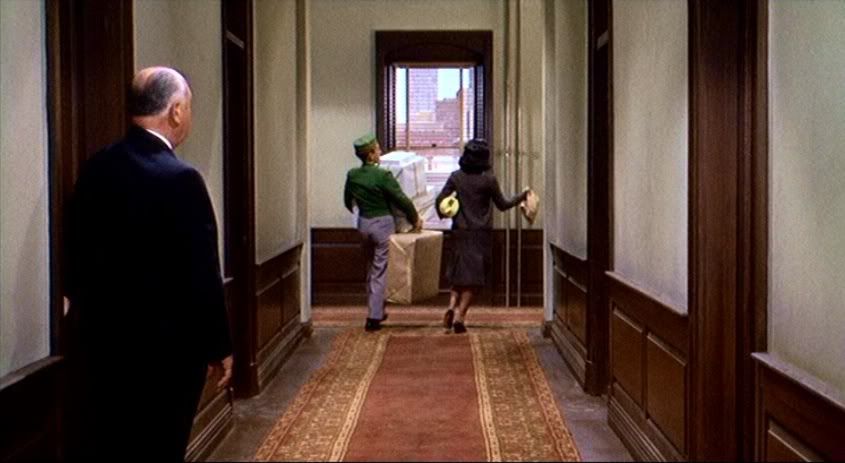
  • Vertigo [Alfred Hitchcock, 1958] # Too bad the print was a 1996 restoration antique and some scenes were too dark. But, still, gorgeous and haunting, as ever. Danny said, "Every single shot is sad." And he's right. Jimmy-Scottie's the worst detective in the world and it shows right off the bat—he even says so!—"It's not my line..."—which makes us complicit in the worst case of not-seeing this side of Jim Crow. My entire body hurt walking out of this one this time.
  • Avatar [James Cameron, 2009] More to come in a dedicated post both for the simple fact that it might garner some traffic and also because I thought the thing was, well, kind of awesome. And, just watch, it'll win Best Picture. [click here]

  • Au hasard Balthazar [Robert Bresson, 1966] # Sometimes I feel compelled to immediately watch some Bresson after some Hitchcock. Can't explain it. But this movie rules, duh. I fell asleep almost instantaneously.
  • Marnie [Alfred Hitchcock, 1964] # Still so frightening. That shot of Marnie's mom ill-lit atop the stairs, beckoning her to dinner, gives me shivers as she struggles back down those stairs, one shuffle-grunt at a time. The print was beautiful. [A quick hit.]

  • Law of Desire [Pedro Almodovar, 1987] # Genuinely sad and maybe Pedro's best movie. I continue to find it hilarious how America never understood the real treasure that is Antonio Banderas: he's completely crazy. There's a reason Pedro kept casting him as an amor loco. He's so pretty that you believe he's dumb enough to follow his heart to such idiotic, devoted, mostly unrequited ends each and every time.

  • La guerre est finie [Alain Resnais, 1966] A dead-end, all dopey with dreams of revolution long since calcified; nobody works for good, or achieves much of it. All the game's a jumble. The young bend around anarchy and the old hold tight old night moves. Yves Montand just beds babes with a frown and talks around his life, one scene using one name and then another scene plying another name, eventually slipping nearer that grave he's evaded so long. His star, his guiding light so he says, is fading with the age. [Here's the final '09 recherche.]

Sunday, December 13, 2009

Viewing Log #24: Exact xylophone xerox extract [12/7/09 - 12/13/09]

by Ryland Walker Knight


—Multiply. Make it happen.

  • Baby Mama [Michael McCullers, 2008] Sure, that was fine. I laughed enough. [Cough.]
  • The Hurt Locker [Kathryn Bigelow, 2008] Puts other Iraq movies to shame, no doubt, and makes Jarhead in particular, despite its strong cast and factual basis, feel all the more counterfeit. For one, it's an actual action film: its subject is action and action, here, dictates character. Pathologies dominate, but it's not a psychological film—we only see surfaces, and our visibility is poor. Still not sure if the film deserves all of its accolades since its tertiary characters and subplots are rather broad and the final "act" (so to speak) is expected, but it makes sense why it's such a favorite: terse, spatially aware, and, in one way, a very "safe" narrative structure built on camaraderie that plays to our vicarious thrill—way more than horror—at seeing these set-pieces go boom or whisk away from the safety of our hometown haunts.
  • False Aging [Lewis Klahr, 2008] A lovely little ode to relics remaining relevant, and alive, through art. Viewable here, with thanks to Matt for the tip.

  • The San Francisco Silent Film Festival's Winter Event, 2009. More to come in a dedicated post. But here's a few words on each of the films, each one a pleasure to take in, even with some beyond-brazen yakkers behind me for the Keaton segment.
  • West of Zanzibar [Tod Browning, 1928] Depraved, as ever with these guys. A hell of an ending.
  • Sherlock Jr. [Buster Keaton, 1924] # Movies inspire life, duh, on top of recording it or creating havens from it; also, "objective reality" can, without a doubt, be a lie.
  • The Goat [Buster Keaton and Malcolm St. Clair, 1921] That shot of Buster riding the train up to the camera is something special: hilarious, daring, a tad ludicrous, seemingly unreal and yet wholly real.
  • J'accuse [Abel Gance, 1919] Unbelievably gorgeous print; insane, great fantastical final third.
  • Chang: A Drama of the Wilderness [Merian C. Cooper and Ernest B. Schoedsack, 1927] Talking animals, and lots of them, made this a blast.

  • All of these Resnais shorts listed below are recounted and read, maybe even narrativized, over here.
  • Statues Also Die [Alain Resnais and Chris Marker, 1953] 27min, 35mm, a blemish.
  • Guernica [Alain Resnais and Robert Hessens, 1950] 12min, in English, 35mm, crisp.
  • Toute la mémoire du monde [Alain Resnais, 1956] 20min, English version, 16mm, kinda grubby.
  • Le chant de styrène [Alain Resnais, 1958] 19min, projected digitally, looked great.

  • Whatever Works [Woody Allen, 2009] Pretty damned bilious, though it tries its hand at sweet. Still, its fantasyland made me laugh and Evan Rachel Wood in white pants is a vision. Also, it's simple, and that helps. Maybe the best movie Woody's made since, um, Sweet and Lowdown? It's still such a mystery to me how little he trusts his comedy in these later years. Don't get me wrong, a lot of his 00s comedies aren't exactly hilarious, but they're always more interesting/enjoyable than those dunderheaded "tragedies" he dreams up.

  • Mélo [Alain Resnais, 1986] # For the recherche; it was just as painful.
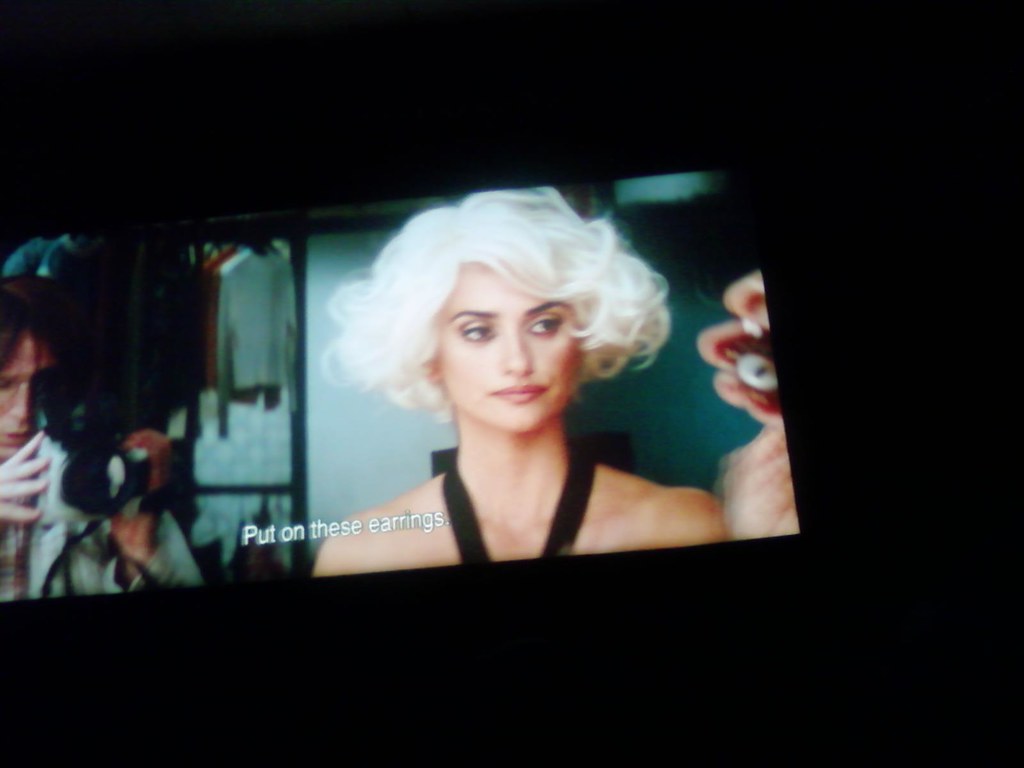
  • Broken Embraces [Pedro Almodovar, 2009] What else? A fiction about fictions, an onion that wants you to cry so bad it chops itself, a film about a woman (or her trace) as not just fatal but fated. Almodovar's got style on tap and colors that pop and perhaps the sexiest, most beautiful lead actress in pictures—who is most game with her maestro mate—but the picture's almost rote. Nothing surprised me, though Pene always excites me, except the site of Chus Lampreve still kicking jokes like a champ. You know the tropes, and you know the wistful feelings—you even know Pene's body—by now, so the biggest pleasure to be had with the film is watching it construct itself and peel off its trappings.
  • You Can Count On Me [Kenneth Lonergan, 2000] # I've been needing this. Up there with A Man Escaped and Kings and Queen for those "it's gonna be okay" moments.

  • Beowulf [Robert Zemeckis, 2007] Zemeckis calls his motion capture company Image Movers, which is pretty perfect, since all he wants to do, it seems, is fly his images all over the map from wherever he sees fit. A truly bizarre, prurient, silly spectacle. Maybe I'm just tired, but beyond the obvious myth riffing (self-mythologizing, historicity, etc) I have zero idea why the man would make the film other than some kind of nerd macho impetus. That is, a nerd's idea of macho seems to motivate this balloon of a "cartoon" the way a bro's idea of cool seems to motivate Bay's movies. That and what I'm guessing some trumpet as cinematic freedom. Probably should have seen it in a theatre, with 3-D goggles. Phelps is a big fan, and you can read why over here.
  • Kill Bill: Volumes 1 + 2 [Quentin Tarantino, 2003 + 2004] # A few bits and pieces, in HD on Spike, while on commercial breaks from a few basketball games. Boy did it look good (Uma, too), and boy does QT know how to light a scene. But, boy, this sure is a one-note kind of movie. Also, I continually ask myself: Who did what to wrong this dude? And when? How early on?

Abrazos 2

Monday, September 15, 2008

Melodrama Mondays: All About My Mother

by Mark Haslam


red
"Since an ineluctable part of being a human self is suffering, part of what we humans come to art for is an experience of suffering, necessarily a vicarious experience . . . We all suffer alone in the real world; true empathy's impossible. But if a piece of fiction can allow us imaginatively to identify with a character's pain, we might then also more easily conceive of others identifying with our own. This is nourishing, redemptive; we become less alone inside."
-David Foster Wallace
writing

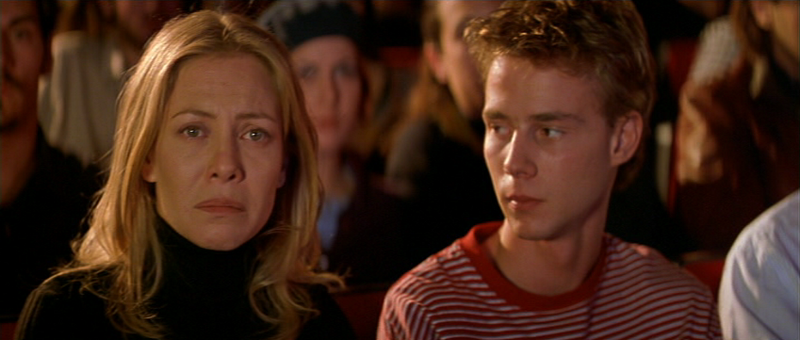
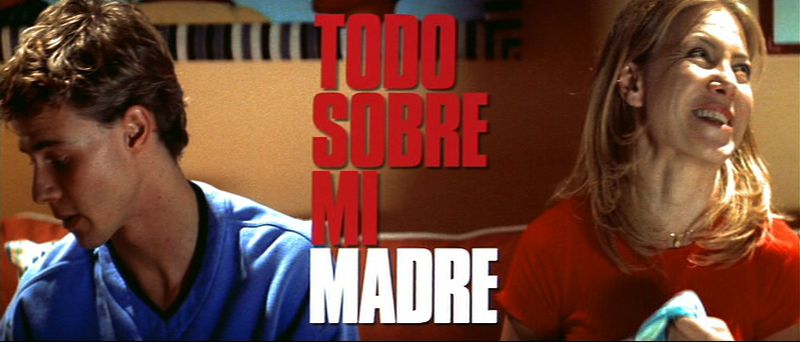
When it was released in 1999, critics hailed Todo sobre mi madre (All About My Mother) as an indication of Pedro Almadovar's "maturation" as a filmmaker. Return to those reviews and find the likes of “sobriety” and “depth” and “conviction” peppered about as evidence of this newfound maturity—all of which are placed in stark contrast to, as Andrew Sarris remarked in The New York Observer, “Almadovar's overtly gay sensibility..., canny distancing...[and] flair for voluptuous color compositions and sinuous camera movements” that made his films (cringe) “guilty pleasure[s].” Return to the film itself, however, and these estimations don't seem quite right: to shortchange Almadovar's style in this way is to ignore the fact that it's absolutely present in Todo. I'll concede—not that I'm actually debating with nine year-old reviews, but I'll concede that Todo sobre mi madre doesn't have the manic feel of Almadovar's previous films. But the style, that visual “flair,” as nebulous and uncertain as that word is, most certainly remains. I'll go so far as to say that it's exactly that “flair” (and I'll search for a better word in a moment), rather than some sort of self-restraint or self-censuring on the director's, is part of what makes Todo sobre mi madre what it is—that made that one teary-eyed critic shout, with the credits rolling, “Wring me out!”

What then is this “flair”? It's pretty easy, in naming it, to deploy terms like pizazze and passion and grandiosity, and even easier to makes terms up, like over-the-topness, and, you know what, they're all decent descriptions of Almadovar's style. Yet we know, at the same time, that they're insufficient, that they don't really describe the thing we're feeling: a feeling that I see as a trait of all melodrama, a feeling that I hope to explore more over the course of this column. I think Almadovar tries to elaborate on this style—our feeling—in the first twenty minutes of the film, which form a sort of prologue, an introduction to the narrative that begins after them. I want to focus specifically on the sequences that lead to the first death in the film, the incitement of narrative, that of Esteban, only son of our main character, Manuela. So let's see what it is we're feeling. Let's try to recapture it, as best we can. Let's watch.

Huma's watching
Esteban's writing

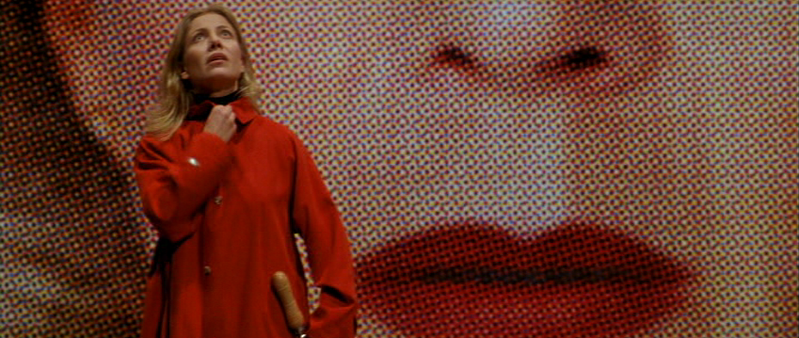
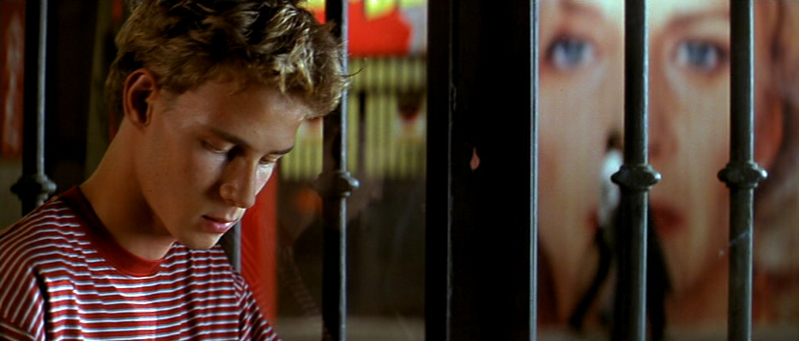
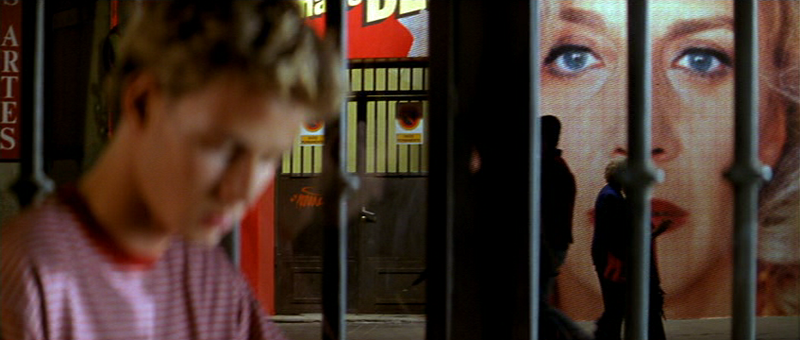
It's the night of Esteban's seventeenth birthday. He sits, writing, in a cafe, waiting for his mother to arrive. In the background is a giant poster for the play he and Manuela are about to see. The focus of the poster are the two massive blue eyes of Huma Rojo, staring at Esteban, at us. Indeed, the poster (the eyes) begins in focus, shifting second to Esteban in the foreground (a perspectival shift seemingly enacted by Huma's eyes). Manuela comes in, looking for her son. The head of Huma (which could almost be confused for Manuela's) looms behind and dominates her in the frame. And yet we see, now, with Manuela in the picture, the 'pixels' that compose the poster—that is, we see the artifice. Or, better still, we see the things that make it big, at the very moment that we note the bigness of the shot itself: Manuela's bright red coat and those red red lips, even the pixels are red: so, we're not only seeing different (practically competing) red things, we're seeing Red, itself: we're zooming in to the point that we just see Color: or, we zoom in just enough that we're shown the abstractions that composes the image. The image, in this way, interrogates itself. And, really, isn't that what Huma's eyes seem to be doing? Interrogating. Observiving. But that interrogation isn't simply the interrogation of self-reflexivity. This is why Almadovar begins the film with consciousness. Here, to me, is the brilliance of these opening minutes, for the self-awareness (mostly) disappears after them, so that it's not so much deconstruction as it is construction we witness—a building up to and of the film. We have to see, in the first twenty minutes, the production of fictions, but especially of this fiction. (Recall Esteban, writing down what is presumably the title of the film—a moment of inspiration—and then immediately after the title appearing on the screen.) Yet it's a fiction that hasn't really begun. That won't begin until Esteban dies.

broken shield

What, then—or is it, who?—is being interrogated? Of course, there's no single answer to that question. Two possible answers, though, would have to be: Melodrama and the Mother: or, consolidated, the figure of the mother in melodrama. Because it's Manuela's presence that seems to give away the artifice. Her entrance into the frame, the camera's focus on her, does not give space to the poster. But it is also the poster that threatens Manuela's hold over her son, precisely because it's big, because it's artificial. As we continue after the play, Esteban wants to get Huma's autograph. He and Manuela wait by the stage door. At her son's request, Manuela acquiesces to tell Esteban “all about [his] father.” Excitedly, joyously and lovingly he kisses Manuela on the cheek—but at that moment, Huma appears from backstage, the red of her name now fully apparent in her vibrant hair. How can Manuela compete with this red? She grips her son's arm, as if to hold him in place, but he runs to Huma's car. Through the window, they stare at one another, and the car drives off. Huma turns, peers through the back window. Her eyes (those eyes—to say nothing of those lips) appear clear through the pouring rain. Beacons whose pull is irresistable to Esteban, and so he takes off after them.

The camera pulls away from Manuela, but whose perspective is this? Is this the final glance back that Esteban never gave to his mother? Or is this Huma's perspective from the car? Is it Manuela she's been looking at? Both and neither: the camera communicates from its own 'perspective'. First an avenue for interrogation (possessing a certain skepticism, a sentience or awareness), it now enters into a realm of emotion. It emotes: pulling away from Manuela, it focuses on her, sympathizes with her. That move is, to me, nothing short of heartbreaking. Almadovar's style, the style of melodrama, is so much about form, not content, as the communicator of emotion.

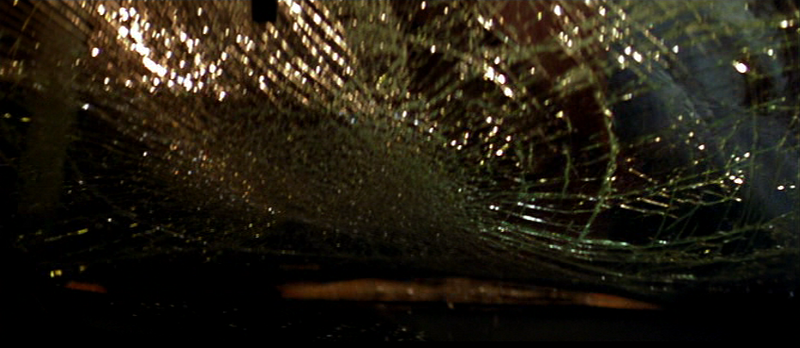
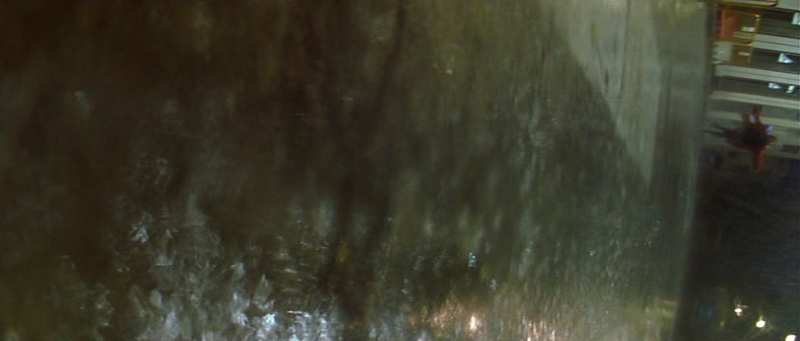
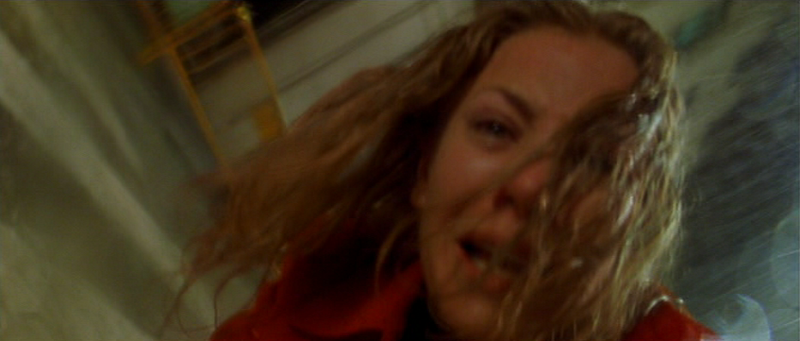
We switch then into Esteban's POV as he's hit; the camera spins, twirls, lands on the ground, and we get the final image, sideways on the wet pavement, of Manuela, her son now truly gone from her grasp, running to him.

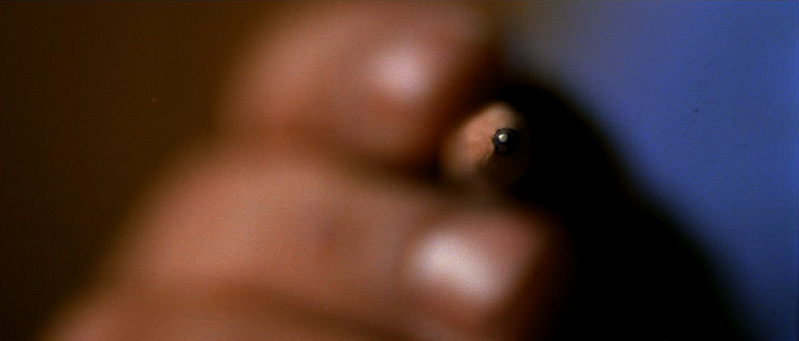
What was Esteban seeking? Huma is the objet petit a, yes, but I think it's actually performance he's seeking. That is the unattainable object of desire. Esteban seeks the performance in (and of) life (his mother acting in her youth, and now, simulating the transplant situations). Huma is simply the manifestation of that desire. So it makes sense that Esteban seems to be writing this film, that he's Almadovar's alterego, and that his death represents a passing into narrative: Manuela sets off to find Esteban's father, to fulfill her promise to tell “all about [his] father.” (Note, though, that immediately after Esteban dies, he passes into voice over, a sort of ghostly presence that comes from 'behind' the camera.)

hit1
hit2
hit3
hit4
hit5

The awareness that we see in the opening minutes of Todo sobre mi madre is not the awareness of the post-modernist, ever distant, ever desiring to expose artifices; not really. It is instead an awareness that emotion is in construction and form. Melodrama is a genre whose tropes are so familiar and so transparent to us, but it's a genre whose form acknowledges and delights in these transparencies, these fictions and performances, and presents them as though they weren't transparent at all, as though they were every bit as real. The argument laid out in these first twenty minutes is an argument for the validity of artifice as a window into experience. Think of Agrado's speech about her various cosmetic surgeries. Or of Manuela, crying in the performance of A Streetcar Named Desire because of Stella, because she's lived Stella's life. Almadovar encacts, here, the vicarious experiences that melodrama (and fiction in general) offer to us: the “experience of suffering,” as David Foster Wallace said, that brings us to art. An experience that may be impossible in reality, but on which reality desperately depends.

reaction
all about

[Look at Ryland's companion image essay.]

VINYL IS PODCAST #1: Almodovar, Ray, Melodrama
Telluride #4
UPDATED: iTunes link.

by Ryland Walker Knight and Mark Haslam


Here we are, joining the internet radio fray, with our first attempt at a podcast. This is an introductory test run in a lot of ways but I think you might get a kick out of the Eddie Huntington song we've chosen to use as intro/outro music this week. We experimented with a lot of hosting options and finally stumbled on the really cool site, podomatic, thanks to my friend Daniel's usage (he's "casting" his last course at UC Berkeley and you can listen here). We've got our own page there: CLICK HERE TO SEE IT and subscribe to the RSS and, if you like, download the file for your ride into work. As for this episode, there's a lot of rambling, a lot of dead air, and my nasal voice -- all great selling points. Please, listen! You might have guessed, but we talk about Pedro Almodovar, Nicholas Ray, and melodrama with detours into some talk of my Telluride trip and Slavoj Zizek and a little bashful scolding (with a smile) along the way. And, as the song says, don't be shy, let yourself go with the attraction, and talk at us in the comments. If you want the song, you can grab it here and dance your butts off (although, if the owners request its removal, we'll happily and heartily comply).

"Live in the world, or something."

UPDATE: If you want to subscribe in iTunes, please click here and enjoy. To those who already have, we thank you, and await your suggestions, comments, critiques, gripes, enthusiasms. Again: I hope we get liven things up a little more on the next episode. If anything, there will be another (smart, kind) voice to break up our monotone madness.

Thursday, November 23, 2006

Volver

Pedro and his womens
by Ryland Walker Knight

The voluptuous precision of Volver

For all the expansion to be enjoyed in Pedro Almodóvar’s recent string of excellent films, his newest, Volver, is his narrowest effort since 01995’s rare misfire, The Flower of My Secret. After laboring with, and firmly executing, Bad Education’s labyrinthine noir (its convolutions span three decades of lies and betrayals and trannies and heroin) it’s fitting Pedro would scale down to a story that, at bottom, only needs five principal sets and five principal characters. Even his broadened, widescreen palate is compressed within the frame: certain close-ups of his luminous cast are shot with such long lenses that a minor movement by the actress fuzzies up her ears or her perfectly mangled coif like a distant spotlight straining to keep a stage actor lit. This technique reflects the precision one has come to expect, and take for granted, in each new joy Almodóvar gifts us.

[To read the rest of the review, click here, and you will be forwarded to The House Next Door for the full article.]

02006: 121 minutes: written & directed by Pedro Almodóvar

Friday, October 13, 2006

The Flower of My Secret

shattered
by Ryland Walker Knight

This is the first Pedro Almodóvar movie I have actively disliked. It was the only film from the Viva Pedro! series I had not seen that Netflix had to offer so I quickly queued it after having enjoyed his MATADOR so much. The romanticism is there, the palatte as vibrant as any of his recent works and plenty of humor from Chus Lampreave as yet another strong-willed, stubborn mother. Yet, for all that flair, I wasn't distracted from the cliche-ridden, hackneyed plotline. I know, all of his films have cliches and spin out melodramatic stories. However the other films spin those tropes around and attack them, sometimes schematically, but always to lend pathos to otherwise outrageous characters. None of that is present here. It's a slight work by a major filmmaker who seemed to have one or two great ideas for images (a rally against the university's president is gorgeous & hilarious in spite of the tears Leo tries to hide) but no good angles on his transparent plot to flesh it out. All we get is a committed performance from Marisa Paredes as Leo, a performance plummed from real hurt and anger but is, ultimately, a pain to watch given how trite and humorless her dialogue is written. Perhaps he was trying to make a movie like the romance novels Leo writes under the pseudonym Amanda Gris but that does not work either: an attempt to comment on how fiction can inform us, teach us, but there are no valuable lessons here, which is a shame. Manuela Vargas plays Leo's faithful housekeeper Blanca with another obvious secret and Joaquin Cortes is her complicit son, Antonio. By the time all truths are revealed, little else is except allusions to classics spoken out loud by the overly jolly Juan Echanove as Angel, Leo's editor and unlikely love interest. Do yourself a favor and watch Paredes in ALL ABOUT MY MOTHER to see her inhabit a far superior role tailored to her skills and personality, and where we first saw Pedro's ambition--and success--to elevate his characters above caricatures and cliches to a place where his meta textual aims hit their targets.

01995: 103 minutes: dir. by Pedro Almodóvar: written by Almodóvar
Monday, September 25, 2006

Viva Pedro: Matador

First blood
by Ryland Walker Knight

Sony Pictures Classics is earning mega points this fall by touring 8 new prints of 8 of Pedro Almodóvar's finest films. This unlucky guy only got to see one, MATADOR, but boy was it fun. Released in Spain in 1986 it is the earliest of the series despite its American release two years later in '88. Many critics have bemoaned Pedro for classing it up and going mainstream with a few movies about trannies, pedophilia, necrophilia, HIV-positive nuns finding out they're pregnant and plenty of sweaty gay sex. They've said he's tamed himself, and that's true, to an extent, but the major difference I can see between his 80s films and this recent string of excellence is his writing has matured. The 80s films are all just as lively and colorful yet their characters are not as fully formed: he's developed an uncanny ability to turn a melodramatic archetype into a poignant character study. In MATADOR, for example, we have all the familiar caricatures but none of the emotional depth found in, say, TALK TO HER.

Antonio Banderas plays Angel, a naive young man eager to rebel against his Opus Dei mother (a hilariously oblivious Julieta Serrano) and become a bullfighter because, he says, he is "drawn to danger." He takes classes from Diego (Nacho Martinez), a matador forced into retirement after a brutal goring limited his mobility. When Diego asks Angel if he is homosexual, Angel explodes and declares he'll prove he's not gay. Later that evening he attempts to rape his next door neighbor Eva (Eva Cobo), who also happens to be Diego's girlfriend. However, it's all wrong: Angel can't open his Swiss Army knife to threaten Eva and can't pull her panties down before prematurely ejaculating between her legs. A thunderstorm begins as Angel slides off Eva and apologizes. Eva stands up, straightens herself and slaps him. Turning to go, she trips and falls to the ground, cutting her temple. At the sight of blood, Angel faints, alone in the rain.

Here, the scene is the blackest humor, nearly slapstick, all nerves and pratfalls but one imagines the scene might play earnest in a later film; in TALK TO HER we're horrified when Benigno rapes the comatose Alicia. Risk and consequence are very much at play in MATADOR nevertheless. According to Diego, "not to kill is to die" for him now that he has been forced to leave the ring. Diego finds a kindred spirit in Maria (Assumpta Serna) who, fascinated by matadors--and Diego in particular it seems--has been seducing men and killing them during sex with a deadly hairpin to the back of the neck. She also happens to be Angel's lawyer once he impulsively confesses to her murders as well as two others strangely linked to him through his class under Diego.

With all the coincidences piling up, it would be easy to dismiss the writing as a series of cheap, fortuitous devices were it not for Almodóvar's direction and the great acting by his cast until he takes it one step further than I had expected. That's where he genius lies, I think: finding that line to step over and leap across. It's a tricky proposition that many directors fail at (the most recent example is DePalma's BLACK DAHLIA) but Almodóvar's heedless love of movies and expert melodrama raises his pulp to art.

Being a relative neophytic world cinema fan (I discovered Pedro just prior to TALK TO HER's stateside release), it's a wonder to slowly discover all the foreign sources many successful American directors steal from and remember they, too, were borrowing and re-inventing American movies that came before them. Almodóvar tips his hand when Diego and Maria meet in a movie theatre at the climax of King Vidor's DUEL IN THE SUN, wherein Jennifer Jones and Gregory Peck kill each other, and all four characters on screen are smiling. And despite the depravity onscreen throughout any of Pedro's films I always find myself joining him, celebrating all things cinematic and beautiful. I don't think MATADOR can compete with his later, "tamer" movies on an emotional level but as far as sheer entertainment goes, you won't be disappointed by any of the plot's unlikely and abrupt twists and turns and stabs in every direction imaginable but impossible to predict. Except that last one.
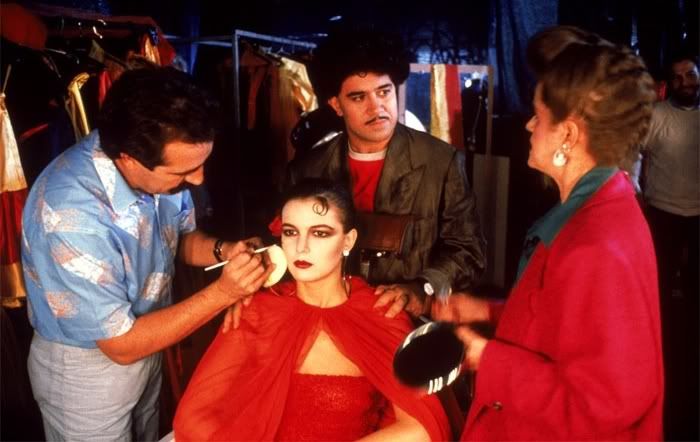
The fashion show
(Check out the sweet stache on Pedro, flanked by Eva Cobo & Chus Lampreave, plus make up dude)

01986: 110 minutes: dir. Pedro Almodóvar: written by Almodóvar & Jesús Ferrero