Showing posts with label SF. Show all posts
Showing posts with label SF. Show all posts
Saturday, October 04, 2008


Friday, February 16, 2007
EMPIRE Burlesque, or: Obfuscation and Its Discontents

by Stephen Farrell
I’ll be the first to admit it: I’ve never been a huge David Lynch fan. I don’t mean that in a sarcastic way, like I’m understating my dislike for the man and his work, I mean it to be taken at face value: I’ve never been a huge David Lynch fan. I’ve seen Blue Velvet and Lost Highway and a smattering of Twin Peaks episodes back when they used to show reruns on cable, but other than that I don’t have too much knowledge of his work. INLAND EMPIRE is without a doubt the most “difficult” Lynch film I’ve seen, and is probably one of the more bizarre cinematic experiences I’ve ever had. It is also maddeningly hard to describe. It is ostensibly a story about an actress and the role she lands in a film which turns out to be cursed, but to call it a “movie-within-a-movie” would be an absurd understatement. Is it about
It seems that with this type of film, where there is no coherent narrative, where identities are unstable and dialogue tends to conceal more than it reveals, the best way to watch it is simply to sit back and let it wash over you, to allow the images and sounds and symbols to hit you on a visceral level and work their magic in the unlit corners of your subconscious. The problem is, every scene, every moment of INLAND EMPIRE is so obscure, so murky and ambiguous, I found my cerebrum working twice as hard just trying to figure out what it was all about, searching for clues in the sets, in the actors’ words, in the silences. Exposition being more or less jettisoned after the fourth or fifth scene, I spent the rest of the film scouring every detail and word, constantly trying to fit them into the semblance of plot that existed in those initial few minutes. Knowing that linear narrative is not going to supply a framework for the piece, every visual cue becomes a symbol and every furtive glance a semaphore that must be deciphered if one is to “get it.”
And that’s the problem with David Lynch movies. People like to say that you either love him or hate him, but that’s not true. No, with Lynch, you either get it or you don’t. For every one of his films (and indeed, for his oeuvre as a whole) there are always those who champion it as the most brilliant, creative, evocative work of art since…well, since the last one. And then there’s everyone else, divided between those who don’t get it, those who didn’t see it, and those who don’t know who the fuck David Lynch is (most of the moviegoing public). The problem is, among those who do see his movies, there can’t be any dialogue between the two groups, because those that get it will consider any criticism from those who don’t get it to simply be due to the others’ not getting it. Those that don’t get it will, for their part, think that anyone who gets it must be a dishonest, pretentious fanboy. And they’re both right.
David Lynch has been vocally silent about how he wants INLAND EMPIRE, and in fact all his films, to be interpreted. This is of course the right thing to do. The creator of a work has said all he or she needs to say about it in the work itself; talking about it or offering interpretations for one’s work implies that something has been left out. And as I explored in a previous post on this site, ambiguity is something which I greatly appreciate in storytelling. But ambiguity is not an end in itself. Without a concrete grounding in reality and narrative, the flights of fancy become meaningless. Surrealism must juxtapose familiar symbols in unexpected ways; if the symbols are not familiar or non-representative, it is abstractionism. People often talk about David Lynch’s work having a “dreamlike” quality, and this is particularly true of INLAND EMPIRE. The non-sequitor dialogue, haunting imagery and muted digital color palate all lend themselves to this. But just as one wakes from a dream perhaps disturbed but resigned to go on with life without learning what it all means, one leaves INLAND EMPIRE shaken and intrigued, but left without much to work with in making sense of it all. Or maybe I just don’t get it.

Thursday, February 01, 2007
Top Ten Turkey Tidbits Two Thousand Six

be, the physical symbols of Islam are much more pervasive than their counterparts elsewhere in the world, or than one would expect from a society that prides itself on its secularity. The most obvious outward example is the sheer number of mosques in
 y Muslims offended by representations of humans—particularly religious figures). They served as a fascinating reminder that this Muslim land had once been a center of Christendom, both in Christianity’s nascent “outlaw” period and later in its rise to dominance in the Western world. The greatest of these church-cum-mosques is

 Space Issues: I never realized how uptight Americans are until I saw grown Turkish men walking down the street arm in arm (or, perhaps more remarkably, adolescent boys doing the same). This speaks to two ways in which American and Turkish norms stand in stark contrast: we are much less secure in our sexuality, and much more uptight about our personal space. I’m not exactly sure where to point the finger for the latter except at all the usual suspects and easy targets like, say, Puritanism? the social awkwardness of the Founding Fathers? Er…Manifest Destiny? Whatever the reason, one thing is for sure: we like our space. Or, we do not like it when people get all up in our grills. The Turks, however, do not seem to have a problem with this.
 Cigarettes: As I said, 98 per cent of Turks are Muslim. If that surprises you, get this: After doing my own research I concluded that 126 per cent of the Turkish population smokes cigarettes. And I don’t mean some “one or two after dinner or when I’m stressed out” nonsense. I’m talking about full-on two to three packs a day, have-a-cigarette-to-celebrate-finishing-a-cigarette smoking. Nowhere I’ve been (in the
 Food: One thing about Turkish food is that it covers a lot of ground. While old standby cuisines like Mexican and Italian are great, we all know that there’s not much difference ingredient-wise, between, say, cannelloni and enchiladas. Turkish food, on the other hand, combines the best of Mediterranean and Middle Eastern cuisines, but they mix it up a little more than you might expect. Instead of the typical pita (pide in Turkish) outer shell for the doner (what we would call gyro) sandwich, you can get the spit-roasted lamb wrapped in a tortilla-like flatbread – or served on an American-style sandwich bun, which was my favorite. It was hard not to eat these for at least two meals a day since they went for as little as 1.50 lire (about one dollar) a pop. Also represented are regional crowd pleasers like dolmas, kebabs (kebaps), and all kinds of yogurt and olive concoctions. The tapas-style meze appetizers were also delicious, as well as, of course, a dizzying array of deserts, the most well-known of which is baklava—whether baklava was invented by the Turks or the Greeks is a bone of contention between the two nations as big as Cyprus. Supposedly, the dessert culture in
 The EU: Although we naively assume that

Efes Pilsen: Efes Pilsen is the Budweiser of Turkish beers. It can be found in every restaurant and liquor store in the land, and you can go into any of these joints, ask for “a beer,” and be confident that you will be served none other than a nice cold Efes. It costs about as much as a pricey microbrew in the States (not price adjusted for the GDP difference between the two countries—all booze is really expensive in
 Graffiti: While we complain about the co-optation of urban art culture by the mainstream and debate the merits of graffiti moving from the streets to the art gallery, the Turks have a bigger problem: their graffiti sucks. Most of the stuff that I saw was on some strictly middle school shit: triple-sixes and pentagrams, the ubiquitous anarchy logo, strange, vaguely threatening non sequitors (“LETHAL MAFIA MASSACRE”), and my personal favorite, “Love is Nothing Without FUCKING,” scrawled on the gates of the nineteenth century Ottoman Domabache Palace. More disturbing were the swastikas and other Nazi imagery which always seemed to accompany the anarchy symbols (“SS anarchy PUNK”). The strange thing is, the graffiti didn’t look as out of place as it usually does in American cities—something about seeing quasi-political things written sloppily on the walls of narrow medieval streets struck me as weirdly appropriate.

Fashion: On paper, Turkish style leaves something to be desired. The hot shit this season seemed to be pointy shoes, vintage-style army coats, and fauxhawk-mullets—all on both guys and girls. Yet what struck me was how their fashion sense is refreshingly less “cliquey”, and more homogenous than we’re used to. For instance, I saw very few people that in the States would be considered to be dressed “hip-hop” or “indie” or whatever. Everyone there just looked like they were drawing from the same huge pool of style options, instead of from the countless tiny (limited) pools here at home. There seemed to generally be less of the sense that someone’s personal style reflects his or her lifestyle/musical preferences/political leanings, and in so doing they have managed to do what no one in

A Bridge Between East and West: When Westerners think of Turkey (if they think of it at all), they tend to view it as some sort of middle ground between East and West, between

Ataturk: If Efes Pilsen is the Budweiser of Turkish beers, Ataturk is the Efes Pilsen of Turkish national heroes—which is to say, he’s inescapable. He was a military hero who led
Honorable Mention: Turkish baths, Turkish bathrooms (surprisingly clean), Turkish hip-hop, denial of the Armenian genocide, stray dogs, Santa Claus
Wednesday, October 18, 2006
Burn Out/Fade Away
by steviesellout
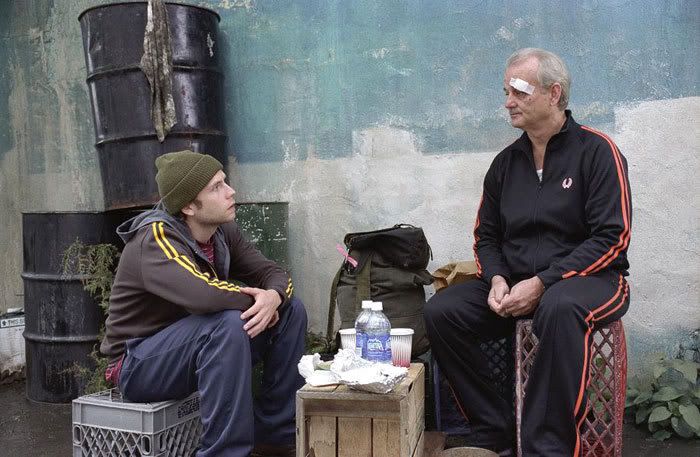
I watched BROKEN FLOWERS for the second time last night, and aside from a few things that bothered me a bit this time around (the fact that Bill Murray plays a "Don Juan" who happens to be named Don Johnston struck me as sillier and more pointless than it did before, and the “stalker in a Taurus” one-liner awkwardly standing out as the only joke of this sort in the movie), I still liked it. It's not great--I think it was one of those films that people wanted to like more than they did, the idea of Jim Jarmusch and Murray working together perhaps better than the thing itself. Still, I thought it was a good, small movie, with everyone's favorite late-career-success-story doing pretty much exactly what we've come to expect from him: turning in a performace so minimal that to call it "extremely understated" is, well, an extreme understatement. As tends to be the case with the second time around, the things I found to like and dislike about the movie this time were the small things, which I had either not noticed the first time or that had faded from my memory in the interim. Christopher McDonald's performance as the husband of one of Don's exes is amazing in that he manages to somehow get the used-car-dealer-ness (he's a realtor, which I suppose may or may not be a step up the career-respectability ladder) so pitch-perfectly, and simultaneously showing you the basic humanity of the character, and making him somehow likeable, although perhaps in a sort of pathetic way--and all within his 10-odd minutes of screen time. This is impressive because it would have been easier for McDonald to simply play up the repellant aspects of the character and just be an obnoxious parody of a realtor, rather than being someone who you feel like you've met.
But this wasn't supposed to be the point. What I wanted to touch on was a disagreement my girlfriend and I had immediately after watching the movie. During the final scene, she, sensing the way the movie was headed, declared, “I have a feeling I'm going to be frustrated with the end of this movie, and sure enough, when the credits rolled came the obligatory “That's it?!!” For those of you who haven’t seen it, the movie ends without Don figuring out which one of his old girlfriends is the mother of his son, and without meeting the son either (or rather, not knowing whether he’s met his son or not, and for that matter, suspecting the whole thing might have been a hoax), which is admittedly a somewhat unresolved ending. But what struck me was this hadn’t struck me at all; to me it seemed perfectly natural that the film ended the way it did—in fact, I can't imagine it going any differently. The only argument I could come up with was the old "in real life, things don't end up in tidy little packages," line, to which she naturally replied with the standard response: people see movies to get away from real life, and part of the reason people like to see movies with resolutions is because they so rarely get them in real life. Of course I agree with that in theory. After all, would we really want to watch an action or adventure or other “nonserious” movie where you don't know if the hero lives or dies in the last scene? But we don't watch those types of movies for realism anyway, and you wouldn't find me complaining that STAR WARS or BACK TO THE FUTURE is unrealistic. But with a movie like BROKEN FLOWERS, where the film's strengths lie in its refusal to abide by standard movie conventions, where there are no heroes or villains or even any real climax, I think it would sort of cheapen the whole thing to have a resolution
"But all the movies do that now. I feel like it's kind of a new thing," my girlfriend argued. For a second, I thought of making the observation that the same thing could be said about talkies in 1930, but thought better of it. I replied that with a tidy resolution, you would have no reason to ever think about the movie again, nothing to talk about when it was over, no reason to wonder what it all means or try to piece together the clues and solve the mystery, even though you know that’s not the point.
So then it’s just a ploy to get you to see the movie again?” She was making me look bad at this point. But it made me realize something: I’ve always liked unresolved stories, or at least stories where there’s a lot of room for interpretation (and I’d say this extends to music, art, etc.) to the point where I think I’ve come to take it for granted that this sort of story is better than one where everything is explained—I regard ambiguity as a sort of end in itself, and I think a lot of people I know are the same way. But at what point does this become lazy filmmaking, or lazy storytelling? I suppose it is easier in a way to write a story that just ends abruptly without explaining things or offering a proper resolution, but is this really the case? And does “easiness” make something any less valid? People might accuse Jim Jarmusch of not knowing how to write an ending to BROKEN FLOWERS, which reminds me of a conversation I had with someone once where he referred to fade outs in music as being used because the songwriter “doesn’t know how to finish the song.” The absurdity of this statement is I think self-evident—it’s not like this guy was a music snob who only listened to songs without fade outs or anything—but it’s worth explaining anyway. The fade out is finishing the song, and Jarmusch did write an ending, it’s just not the ending that you may have wanted or expected. The fade out in the song, like the abrupt, unresolved ending in the film, is a tool, and nothing more. Used correctly (and I’m not trying to say there’s any sort of universal absolute for correctness), I think it can enhance the experience of the work, and in the case of BROKEN FLOWERS, I don’t think there was really any other option.
What does everybody else think?
02005: 106 minutes: dir. Jim Jarmusch: written by Jarmusch
Subscribe to:
Posts (Atom)

 Posts


