Showing posts with label David Lynch. Show all posts

Monday, June 14, 2010

Viewing Log #46: Collecting returns [5/17/10 - 6/13/10]

by Ryland Walker Knight


—What do I know?

Yesterday, a friend told me I ought to bring back the Viewing Log. As a result of this flattery, I do plan on it. But, as you can see, this is the second log in a row where I won't run down what, exactly, I watched. This time, however, it's both because I haven't been watching much and also because I haven't been keeping track. Been trying, with varying degrees of success, to simply enjoy watching things. Not everything's something to take note of; or, not everything's something.

To get naked on this dance floor: the whole blogging experience has turned into something I don't necessarily relish. Not because I make more money at my "real job" nor because I'm too tired to keep it up as a result of such work but just because I feel a door shut a while ago and now it's (the 'sphere is) a closed room full of loud voices talking about the most boring topics imaginable with not enough levity and not enough intelligence. Put otherwise, I stopped reading a lot of/on the 'net. For the most part. I still spend too much time "surfing," but I've begun to rediscover real paper-bound books in a serious way. For example, I've bought more books than movies (or movie stubs) this year and I've probably read about 85% of them. There is a backlog, despite my tendency to read five things at once, and I plan on bumping that number up—though it might go down if I stumble upon the right thrift store book section. This is not a novel idea: it plain feels better to not sit with this black box on my chest or my lap or the table and instead hold a book and a beer in the afternoon. My eyes love me more, my brain feels better, I get less angry at useless targets. You may have noticed that I still use twitter*, still tweet (and I've even started to use tumblr, to tumble), but I stopped following more than half the people I followed on twitter because, rather simply, it made sense for my life.**

Another part of the shift has been to writing things besides film criticism because, when it gets down to it, I am sick of all that. Not that I've outgrown it, but I don't get much from it either in terms of entertainment or in terms of edification, though posts like this one by Mubarak today are pretty great—but great because they're rare. I still plan on writing about movies from time to time (especially if somebody wants to pay me to do that), but I don't know anymore what, exactly, this purpose serves. Take, for example, that recent bit on Varda that I wrote. It was fine. I appreciate that people appreciated it (and by extension me). But I didn't get too-great a thrill writing it (in fact, it caused me more stress than pleasure, as can happen all too often), and I don't know if it helps people understand her any better; I just hope it was fun to read. That's all I really want to offer, when it comes down to it: some fun times with words. I don't really know anything. Or, I don't know anything you can't know. I just know how to string some words together in unusual ways. Generally speaking, I'm not in this mix to prove anything. In fact, I like being mostly ignorant of a lot of stuff. It's something like a maxim that these blind spots simply mean I've got more goodies ahead. And that's the only kind of life I want to lead: ready for what's next, and excited. Even if I settle into a family routine some day down the line I hope to meet every day ready for something new. It should be obvious one of the books I've bought in 2010 is Deleuze's Difference and Repetition. And that I dig it.


But enough about me me me. What about some movies. I still love the movies. We still love the movies! Don't we? For example, I'm stoked to see the above-cited Bluebeard at ybca this coming weekend (more here), and the second-to-newest Oliveira with that great title, Eccentricities of a blonde hair girl, the following weekend. And, as Brian has blogged (scroll to the bottom for a schedule, but read the whole thing, duh; I did), there's a bunch of Mizoguchi up at Viz Cinema that I'll try to take in one way or another. That's just to round out June. In July there's the Silent Fest (more coming) and a new PFA calendar and a bunch of those movies I loved at SFIFF coming to a SF theatre near you. I'm getting exciting just typing this. Expect more, but not too much more, soon.


* Danny urges me to quit twitter altogether, but, as I tumbled (shudder), I like the challenge of the medium. I may not make everybody laugh the way, say, Conan can, but I do enjoy that it's mostly a place for me to try out text-based jokes. I should add that this, too, is not a novel idea.

** Worth noting: I quit facebook and that's cleared a lot of mental space, lifted a lot off my brain. And, really, do you want most of your social interactions (over-) determined by some website? It doesn't feed you; it's not even a beautiful representation of your life; just an informational one; it's simply a device; a device for pain as much as pleasure (what doesn't straddle that, I hear you saying) and a device for more false flattery and more false avenues to debase legitimate communication. Again, not a novel idea.

Thursday, December 31, 2009

Make a deal with your shine blocker.

by Ryland Walker Knight


A legend

a.
It doesn't hurt me
We block back the dark, moony
Dedicate, hound

b.
All the men she knew
None were fair or true
So she ran away and up
And up past the board blue

c.
Dance and flight and plain naked
alone, one's own property
purposed to light, to home, but not
done with that flipp'd flicker's flapp'n
all wind, wind post'd by you
who will not cannot shall not
sit still
in any calendar.

Friday, October 30, 2009

MOONWALK: THE ADAPTATION

by Steven Boone

It all comes down to what you believe, because none of us knew the man.

I believe Michael Jackson was a good guy. I believe he never harmed anyone's child. I believe he was one of those rare people who tried to apply his otherworldly talent to healing some of the basic, eternal problems of humanity. I believe he was a great man of strong constitution and boundless vision. I believe that the incessant lies told about him were his indirect murderer.

Moonwalk is the autobiography he wrote in 1988.

I believe David Lynch is the filmmaker who should make the inevitable Moonwalk movie. Lynch's capacity for empathy; his ability to describe alienation, suffering and loneliness in spiritual, visual terms; his American ear; his understanding of corporate show business as a place where dreams are nourished with candied arsenic... make Lynch the best equipped among marquee-value auteurs to say something vital about Michael's life and death.

Here are some notes and sketches for the Lynch adaptation:


Originally posted at BIG MEDIA VANDALISM

Thursday, February 12, 2009

10 Personal Touchstones in American Cinema

by Ryland Walker Knight


[Originally posted at the curator corner, where you can read the full post.]

the end?

Sunday, November 09, 2008

VINYL IS PODCAST #5: More synecdoches, more f-words, more more.

by Ryland Walker Knight and Mark Haslam and Jennifer Stewart


a look-see

[Podomatic stream]
[Direct audio download]
[iTunes subscription available]
[Simple syndication subscription]

[SPOILER WARNING IN EFFECT. There's no other way to talk about the thing, is there, Walter? Seriously, if you want to preserve the experience, don't listen. However, as we try to argue in the podcast, there's no way, really, to "spoil" this thing. For one, it's sour to begin with...]


RWK here. On our third podcast, Mark and I discussed his first take on Charlie Kaufman's Synecdoche, New York (as well as Jean Eustache and, briefly, Jia Zhang-Ke), with Mark saying, "I liked it enough to not have an opinion of it right away." (He then put that reaction into some written words.) What I took and take that exit-poll impulse to mean is that he didn't feel it necessary to simply say, "I liked it," or, "I didn't like it," say to make a declaration of value. Because it's undeniable: this is a grand old meditation on major themes and concerns that continue to sprout up in cinema and, yes, in life. It's bound to shake, rattle and roll some souls. It's equally bound to simply turn off a large percentage of its audience, no matter its wit, right up front with some ugly images of festering decay and disease. Literally: dis-ease. There's little comfort in this film, although there are a lot of jokes. So, what does one do with this little beast? Well, we went straight home and talked on digital tape. We tried to form our opinions live. Of course, like the film, our conversation splintered and, in a way, as is always the case with words, it failed; or, it failed to resolve. And yet—even though an hour is a lot to ask of you, our faithful listeners—I think this is our best podcast yet.

The look-see: I'm torn between the two poles. The repugnance of the film is somewhat remarkable, even admirable, but it's still repugnant. It wallows as much as it falls away from the viewer. Not that I know them, but I understand why people like Walter Chaw and Manohla Dargis and Andrew "Filmbrain" Grant rhapsodize Kaufman's achievement, such as it is, with this picture; on the flips, an element of me was eager to indulge the "piss off" stance of my buddy Keith Uhlich, but not the "fuck you" of Rex Reed (no link needed for that bile). For all the yucky destitution of narcissistic projection, for all the death and dying, for all that kinda bores me (as well as Jen) with all that, there are some truly great moments, and cool tropes, as can be expected with Kaufman. The narcissistic projection, for one, works brilliantly: Philip Seymour Hoffman's Caden reading books as he imagines them, seeing himself in pharmaceutical ads and, um, building that massive and ever-receding and ever-multiplying theatre space. Add to that, that unlike Mark, I had an immediate and positive response to the film's negotiation with time: I think its fractal nature, with time splintering, works to exemplify its title; this is not a film about endurance. Caden does not endure lost time, he just keeps living in spite of himself, in spite of all the pills he takes and the cane he adopts and the losses that pile up (in the fucking street, no less) around him on his pathetic plodding towards death. In one way, I could probably develop a passion for this film as an argument in negative, as this is how not to live, since the film seems to understand this, but, at the same time, the film does ask us to spend our time with cumbersome and base decomposition.

If all a critic is to do is to tell you to see a film or not, then there's no two ways about it: I would say go for a run instead. But, as I understand it, my job, such as it is, such as I may be a critic (as much as simply a thoughtful person), is to argue for significance—indeed, for understanding—within the object over against of the object. So it's a tough spot. I'd like you to listen to our conversation, and I'd like it to continue, here in the comments as much as in future episodes, but I'd also like to remind you, that, yes, it's good and fun to go live in the world. And, you know, that Lola Montes talks about all these ideas, too, and it'll be playing at the Castro next week. For more on that film, though, you'll have to wait for a link. So, instead of that recommendation, I can just as easily (yes, with greater ease), turn to the other film I held up (perhaps foolishly) against Synecdoche in our podcast talk: David Lynch's INLAND EMPIRE. About 35 minutes into this hour-long talk we offer to you, I say, "I love INLAND EMPIRE for a lot of the same reasons I think a lot of people will love this movie. And they should. If this movie turns you on, and you find a lot of resonance with you, that is great—I'm not gonna try to take that away from you. Um, this is just, you know, this is just this. It's just three people—two of us are drinking beer—and, you know, but, INLAND EMPIRE, to me, is about everything that's going on in this movie, and it's a much more joyful thing. And a lot of it boils down to that. For me. Definitely. And that gets into a lot of goofy relativism right there, just saying, 'For me.'" But, as I couldn't formulate last night, all art is, in an basic way, experienced narcissistically, for the me that you are wherever you stand in relation to a film or a painting or a screenplay or a song or a novel or a dance. The trickiest part is to account for your self—to question your "me"—in a fun way, to be thoughtful and hilarious at the same time. Now I don't know if we're exactly hilarious here, but you'll here me laugh a lot in this, and, hell, that's good enough for me.

fire is red

This episode's intro and outro songs, for your downloading pleasure:

Monday, July 28, 2008

Float my boat. A double bill for the ages.

by Ryland Walker Knight


steps
sidewalk

Sight and Sound asked 52 film critics and programmers and professors to put together a dream double bill and write a few words about their choices. You can see them all here in a pdf. I wrote something similar over a year ago for The House, a 5 for the Day post. I was proud my selections were adventurous and intuitive links between the films. Since then I think I've refined my ideas about the double bill and am not quite as interested in those kinds of outlandish pairings, although I dig the idea of cinephile parlour games like how can you link this film with that (real nerd shit). Also, those I chose were all relatively recent pictures. One of the cool things about this Sight & Sound group is that it skews towards older cinema as much as current cinema. But, still, there's one in particular, from Brad Stevens, that I would gladly pay money for: Céline et Julie vont en bateau with INLAND EMPIRE. Here's his little graf --
"Nothing analyses a film better than another film," wrote French critic Nicole Brenez. And, although the result would run for an unwieldy six hours, the best way to fully appreciate Inland Empire [sic]--among the most misunderstood films of recent years--may be to watch it with Céline et Julie vont en bateau. These masterpieces set out to liberate women from the narrative traps in which cinema has traditionally imposed them. Both Rivette and Lynch deconstruct the act of storytelling from an explicitly feminist perspective, showing their heroines negotiating, and ultimately escaping from, houses of fiction. But whereas Rivette takes female solidarity as his starting point and ends by suggesting that the narrative is about to begin again, Lynch brings in female solidarity only during the final stages: the prerequisite for its existence being an acknowledgment, both devastating and joyous, that narratives are no longer possible.

A few things pop to mind: This bill would definitely run more than six hours; that word deconstruct sure does make me itch; I dig the term negotiate; his final sentence is a killer. One can only hope that New Yorker releases that DVD of Céline et Julie before too long, before everything switches again to Blu-Ray, before I plop down that money for BFI's Region 2 disc or pirate some other whack copy. Seriously: how come I missed it twice inside a year right before I moved back to the Bay? When are you going to show it again, PFA? I feel like I need to see it in a theatre. Right? I saw INLAND EMPIRE twice in two days at the California. I think that's another aspect to the double bill that doesn't get talked about enough: where you see the pictures matters. Because, for all my home programming, there's nothing quite like seeing a double bill big and loud in the dark with other people and little time for bathroom breaks. Last spring's pairing of Où gît votre sourire enfoui? and Sicilia! (with the short 6 bagatellas in between) was pure bliss: the entire program's running time (188 minutes) is less than one sitting of either the Rivette or the Lynch and packs just as much joyful whallop as either of those lengthier master works, although this pair is very much about how we don't escape narrative despite our desires to stand apart and strike new ground. Marriage is a story. Life is a story. We tell stories. Also: both these pairs could be seen as "about" their media, too: what do film and digital offer that the other does not? It seems significant that Costa's picture is a video work about editing celluloid, "starring" two older, married people just as much as the brazen surrealism of Lynch seems that much more unbounded in digital form. (Just as Miami Vice makes an argument on behalf of the speed of video; just as The Dark Knight's use of IMAX makes an argument for the requisite size of cinema as analogous to its impact/effectiveness; just as, to complete the circle, William Lubtchansky's photography argues for the tangible grain of celluloid as realer than real, an inherently film-specific kind of pictorial beauty that surpasses reality into sublimity; just as you could make that last clause's argument for any of these filmmakers.)

So, again, what double bills would you want to see? Look at this transition while you think about it:

laughs
flakes

UPDATE: The internet is beautiful, nefarious.

hidden
sought

Monday, May 26, 2008

Poems for the month: Wordsworth.
"To Sleep" (3 from 1806)
"Animal Tranquillity and Decay" (1798)


TO SLEEP


lost girl found


I.
O GENTLE SLEEP! do they belong to thee,
These twinklings of oblivion? Thou dost love
To sit in meekness, like the brooding Dove,
A captive never wishing to be free.
This tiresome night, O Sleep! thou art to me
A Fly, that up and down himself doth shove
Upon a fretful rivulet, now above
Now on the water vexed with mockery.
I have no pain that calls for patience, no;
Hence am I cross and peevish as a child:
Am pleased by fits to have thee for my foe,
Yet ever willing to be reconciled:
O gentle Creature! do not use me so,
But once and deeply let me be beguiled.

II.
A FLOCK of sheep that leisurely pass by,
One after one; the sound of rain, and bees
Murmuring; the fall of rivers, winds and seas,
Smooth fields, white sheets of water, and pure sky;
I have thought of all by turns, and yet do lie
Sleepless! and soon the small birds' melodies
Must hear, first uttered from my orchard trees;
And the first cuckoo's melancholy cry.
Even thus last night, and two nights more, I lay,
And could not win thee, Sleep! by any stealth:
So do not let me wear to-night away:
Without Thee what is all the morning's wealth?
Come, blessed barrier between day and day,
Dear mother of fresh thoughts and joyous health!

III.
FOND words have oft been spoken to thee, Sleep!
And thou hast had thy store of tenderest names;
The very sweetest, Fancy culls or frames,
When thankfulness of heart is strong and deep!
Dear Bosom-child we call thee, that dost steep
In rich reward all suffering; Balm that tames
All anguish; Saint that evil thoughts and aims
Takest away, and into souls dost creep,
Like to a breeze from heaven. Shall I alone,
I surely not a man ungently made,
Call thee worst Tyrant by which Flesh is crost?
Perverse, self-willed to own and to disown,
Mere slave of them who never for thee prayed,
Still last to come where thou art wanted most!

ANIMAL TRANQUILLITY AND DECAY


tell him something pretty


THE little hedgerow birds,
That peck along the roads, regard him not.
He travels on, and in his face, his step,
His gait, is one expression: every limb,
His look and bending figure, all bespeak
A man who does not move with pain, but moves
With thought.--He is insensibly subdued
To settled quiet: he is one by whom
All effort seems forgotten; one to whom
Long patience hath such mild composure given,
That patience now doth seem a thing of which
He hath no need. He is by nature led
To peace so perfect that the young behold
With envy, what the Old Man hardly feels.

richter falls

[Poems taken from this site, which hosts his complete poetical works. Image 1: The lost girl from INLAND EMPIRE; Image 2: Al Swearengen cleaning up his own mess, as ever, denying Johnny something pretty; Image 3: Gerhard Richter's Niagra Falls.]

Monday, April 28, 2008

The New World: Reverse Shot Goes Digital


spots
smoke
focus

It should probably come as no surprise that I wrote about Michael Mann for Reverse Shot's newest issue. He's been on my brain for a while now thanks to my thesis work and, well, his excellent films that invite scrutiny. You can read my contribution, "The Touch," by clicking here. And, of course, the intro is always a nice place to start, to give you an idea of what we were after in this latest symposium. You can read it clicking here. Hope you like. I invite any comments on my piece here since the main site does not; there's plenty to talk about. Or, if you read another, like Leo Goldsmith on VINYL-favorite David Lynch or Chris Wisniewski on VINYL-favorite Terrence Malick or my buddy Kevin B Lee on the immortal Ingmar Bergman, let me know. This is a very thoughtful and plain cool issue. --RWK

Monday, January 14, 2008

Catching up with 2007.

by Ryland Walker Knight


her blinding face
boy faces out
faces of brothers
his hidden face
It is a characteristic criticism of Emerson to say that he lacks a sense of tragedy; for otherwise how can he seem so persistently to preach cheerfulness? But suppose that what Emerson perceives, when he speaks of his fellow citizens as existing in a state of secret melancholy, is that in a democracy, which depends upon a state of willingness to act for the common good, despair is a political emotion, discouraging both participation and patience. So when Emerson asks of the American Scholar that he and she raise and cheer us, he is asking for a step of political encouragement, one that assures us that we are not alone in our sense of compromise with justice, that our sense of an unattained self is not an escape from, it is rather an index of, our commitment to the unattained city, one within the one we sustain, one we know there is no good reason we perpetually fail to attain.
-- Stanley Cavell, Cities of Words: Pedagogical Letters on a Register of the Moral Life

Go to The House to read a kinda-lengthy wrap up of what tickled me in 2007. While it's got pretty much the same format as what I used last year, this time I actually made a list at the end. Still can't rank anything, though, so it's an alphabetical list. I figure that most of the year-end lists and awards are redundant and silly to start with so why not throw my lot in with them? I guess the impetus to not make a list is because it's the same tired grammar most of film criticism continues to use. Not that I think a Better-Than List is worth much; it's still a posture. Not that my awards aren't a posture; my argument is with overbearing seriousness. (For example: I think it's awesome that my buddy Keith lists the Aqua Teen movie-film alongside The Horse.) Not that I'm not serious, but I like some levity; I like to laugh. Every film on my list, even the Reygadas, gave me a chuckle. But there's more of this over there so click this link if you didn't click that link at the beginning.

Also worth reading is Brian Darr's terrific Bay Area rep round up at Hell On Frisco Bay. It helps me to realize that as cool as New York City is (and it's definitely cool), San Francisco and the greater Bay Area have a lot to brag about. It helps to have a blogging buddy like Brian, too, with his calendar-scouring acumen pointing at things I don't always think to check up on. However, during this, my final, semester, I will probably only find time to attend screenings at the PFA. Thankfully, though, their newest calendar is pure dope: on Friday I got to go see Andrei Rublev on a big screen for the first time and during the afternoon of February the 17th I will see Out 1: Spectre, the shorter version (240 minutes) of the best film I saw and hardly wrote a thing about in 2007, Out 1: Noli me tangre (773 minutes). Plus: La Chinoise on my mom's birthday and a mini Terrence Davies retrospective (with the auteur in person at almost every screening, including a shot-by-shot discussion of Distant Voices, Still Lives). On to more merry movie watching and illuminating film writing in 2008.

Mais oui!
look at her
Does this look fake to you?
confetti junk comes alive
green world
up is down
swarm, flap, peck, kill
burn!
the end!
explode!
new lenses

Thursday, May 03, 2007

Collapsing Space in Club Silencio, in Mulholland Dr.

by Ryland Walker Knight

Silencio

David Lynch’s Mulholland Dr is a collage, an assemblage of rhymes and multiples, of dreams, from beginning to end, using every cinematic layering technique available, chief among them the manipulation of its ever-insistent soundtrack. Sound is often employed in film to cue a viewer’s eyes or emotions, a kind of pathetic trigger, directing our emotional investment. Lynch, however, uses sound to disrupt its own illusion, discomfitting the viewer by foregrounding that inherent artifice it seeks to dismantle. Each move the film makes tells us this is all an illusion, reality and artifice alike, by breaking down the sound, by exposing its primary illusion. Thus, Lynch forces the audience to confront itself and how it approaches not just film (artifice) but life (reality) and our movements with and within both realms. Lynch employs sound design in that classical sense that he wants to trigger an emotional response in his audience but his use of sound never cements the space of the film. Rather, this refusal of spatial-temporal-cinematic unification disperses the film and its artifice invades (and colors the read of) every scene, every glance, every encounter: nothing is certain. The resultant anxiety that typifies Lynch’s films, and Mulholland Dr. in particular, comes from that self-reflexive rupture and layering of the illusion.

Mary Ann Doane’s essay “The Voice in the Cinema” argues, if not for a primacy of sound, for an equalizing of sound and image, which dovetails with Lynch’s filmic instincts and practices. Both approach the use of sound as an equal compliment to the image. There is hardly an image in a Lynch film that isn’t colored by sound — even silence has a color, a body, in Lynch’s oeuvre — which is exemplified by the use of an ambient score of synthesizers and synthesized sound effects that layer and unfix the images, the films. As in Mulholland Dr., when Lynch links scenes with that anxious and uneasy score, an ugly grumble of sine and square waves, conflating the skyline of Los Angeles with an apartment’s interior, the sound doesn’t define or localize the space, as Doane defines the job of the soundtrack, but works as a dissolve, even within a hard cut transition. In the act of conflation, it rather multiplies spaces within the networked composite of the film and its world. Space is at once dispersed and collapsed.

In Mulholland Dr.’s Club Silencio sequence, Lynch makes this illusory and confounding dichotomy explicit through a disembodied voice calling attention to itself. As her title says, Doane’s essay is focused on the sound of the voice, and how it holds a film together in space. For my purposes, it is crucial we understand, “In the cinematic situation, [which] three types of space are put into play:

1) The space of the diegesis. This space has no physical limits, it is not contained or measurable. It is a virtual space constructed by the film and is delineated as having both audible and visible traits (as well as implications that its objects can be touched, smelled, and tasted).
2) The visible space of the screen as receptor of the image. It is measurable and ‘contains’ the visible signifiers of the film. Strictly speaking, the screen is not audible although the placement of the speaker behind the screen constructs that illusion.
3) The acoustical space of the theatre or auditorium. It might be argued that this space is also visible, but the film cannot visually activate signifiers in this space unless a second projector is used. Again, despite the fact that the speaker is behind the screen and therefore sound appears to be emanating from a focused point, sound is not ‘framed’ in the same way as the image. In a sense, it envelops the spectator.” (166)

Club Silencio would appear designed to composite these spaces. First, visually, through a series of frames: (1) the frame of the film itself tells us this is a fake, unreliable; (2) the curtained frame of Club Silencio’s stage echoes that first frame, the frame of the film we are watching, which doubles the artifice; (3) the raked auditorium opposite the stage, where the twin protagonists sit, directs our attention back onto us, where we sit, as a doubled audience in a double auditorium, placing us inside a frame, inside the artifice; (4) the frame of the balcony above the stage acts as another frame within a frame: all these frames collapse the space so the audience is one with the film. Second, aurally, through playing with sound and sound design within this composite space, which is just as dizzying as those multiplied Russian-doll framing devices, and yet more complicated.

As the sequence begins, the diegesis of the film is unified in speech through the spectral master of ceremonies’ voice since his lips are the perfect dummy, reciting his lines. However, his dialogue is about how his dialogue is fake, how all sound on the stage of Club Silencio (and by proxy in the formal frame of film) is artificial. With a scowl he declares, “No ay banda! There is no band. Il n’y a pas de orchestra. This is all a tape recording. No ay banda. And yet, we hear a band.” After tossing aside his cane, which makes no tumbling clatter once it exits the film frame, he calls upon a trumpet and a trombone at will, summoning their sound as proof that, “It is all an illusion.” From this, the first space of Doane’s is imminently complicated: the aural diegesis is disassociated from the visual diegesis, implying their relationship is both symbiotic and disassociated all at once. Doane’s model proposes a definite link, despite the obvious dichotomy: “This space has no physical limits, it is not contained or measurable. It is a virtual space constructed by the film and is delineated as having both audible and visible traits.” Club Silencio and Mulholland Dr. tell us, yes, the space is constructed by both aural and visual components, yet work as they may in tandem, there is a definite line between the two, one which, in the collapsed space of Club Silencio, may privilege the aural as it informs sight. Doane’s third space is then present in the first diegetic space in Club Silencio as the “sound is not ‘framed’ in the same way as the image. In a sense, it envelops the spectator.” Therefore, only the film, only Lynch and his proxy MC, can turn off sound, not the spectator. And it would also appear, for Lynch, to be at the mercy of sound, as we are in life, is a frightening experience.

The sequence continues, and shifts course, when the MC demands, “Listen!” This interpellation calls to attention not just Club Silencio but the film’s physical, live audience as well: we can do nothing but listen. But his speech is over. He raises his hands and, as he summoned the horns before, he summons a storm of thunder and lightning inside the club. His face turns demonic and one of the protagonists in the audience begins to shake involuntarily, her torso convulsing along with the flashes of light while she grips her seat, held down doubly by her twin companion. A smoke seeps into the frame around the MC and he shifts position, momentarily stopping the storm. His expression is now nothing but evil and the light show continues as the smoke surrounds his face, enveloping him. The smoke subsumes him and he disappears. In his and the lightning’s place, an aqueous blue light washes over the Club, the film, and us in the audience, while the thunder cedes to a typical low-register synthesized groan. We’re shown the empty space of the Club, the solitary microphone glinting in the inconsistent light: sight is mediated by light, and fixable, while sound only keeps going, extending the moment — and the space.

Space is again collaged and layered in the collapse of those different realms of space Doane lays out. What’s curious is this collapse also works as a multiplication, of objects and spaces and objects within spaces. A collage is, by definition (and practice), an assemblage of disparate images and texts (and sometimes sounds): it is premised on a multiplicity. Film is, by definition (and practice), an assemblage of images and sounds (and sometimes texts), disparate and not, alike and not: it is premised on a culling of multiple elements. Therefore, film is collage is film. As Club Silencio mimics the film-going experience, and comments on such an experience, it’s performance is that of a film’s as well as being within a film. As a film, then, Club Silencio is a collage of film effects, chiefly the sound. And if Club Silencio is a collage, its host film is a collage, and, of course, a film, too.

The beginning images of Mulholland Dr. are a cut-out collage of swing dancers, many of the couples are twin or triple couples of the same man and woman doing different moves at different spots in the frame, multiplied across a diffuse purple background in time to a jazzy snare-kit beat and a spare trumpet riff. This marriage of sound and image is, retrospectively, a metaphorical prediction of the Club Silencio sequence's explicit explanation. From this first moment we are given a world where sound is tied inextricably to how images move. The viewer’s eyes are confused where to look, and for what? The film is simply colliding images, collapsing worlds, as would a collage. This opening sequence is complicated further when a washed out, all-smiles blonde is super-imposed over the syncopated pageant, layering the images and sounds, as, along with the spectral blonde, a low-frequency white-noise groan and mild applause seep into the film. The images work in tandem with the sounds, layered as they are upon one another, much like the jitterbug partners work together, playing off the other’s movements. The jitterbug composite quickly evaporates, though, after the blonde’s own jittery first appearance (that super-imposition is ragged and blurry, dancing its way onto the screen in its own right), and, briefly, all that’s left is the applause and that bleach blonde before the lumbering synthesizers melt into the soundtrack again, and the images fade into an out-of-focus close-up on rumpled red bed sheets. The space is collapsed between the two nowhere-regions. The camera, handheld and myopic, crawls across the bed into a pillow, further blurring the image — and our perception of it, and of the film itself. This descent into sleep dictates all that follows. Everything we see is dreamt. Everything is distorted and artificial, forged from the warped perceptions of a dreamer. Everything is a sign and not: as soon as we think we understand a sign, its resonance and relevance disappear, lost in the film’s enveloping dream dis-logic, like Club Silencio's MC. Everything — the film, the characters, the sensory imbalance — is a dream. As in a dream, the space of Mulholland Dr. is diffuse and anxious. The camera floats and bobs, the soundtrack grumbles and bleats. The film is collaged as a dream, too, in that it collapses and conflates seemingly disparate images into a loaded composite space which follows the through-line of sound, not image.

Calling the film Mulholland Dr., Lynch says everything in the film is that street, is that restless winding mood, is that space above Los Angeles, looking down; yet that street is a part of Los Angeles as well: the film is at once inside and outside itself, simultaneously looking out from within and looking back in from without. Everything is collapsed and conflated, including sound and image, de-centering and displacing the audience and all the while implicating them as well. The space is collapsed. We are present not only watching the film, we are in the film. Everything — Mulholland Dr., the film, its tri-partial space, the audience — is a composite, a collage. And we the audience are at once constituent in its terror and simultaneously at its mercy.

_________________________________________________


[Written for a Film course on sound in cinema, this is a belated Lynch Mob entry, I suppose, in some sense, but it stands alone, as well. I think I did the film and the assignment justice. At the least I enjoyed spending yet more time with one of my favorite films and its puzzles. Also, an editorial note: I chose not to put in screenshots or stills because I wanted to let the language do it for you, if that's possible, if I'm that good. I'm banking that's the case. Tell me if it's not, if there should be pix. I may go ahead and put some in later but for now I kind of like it all text. It's kind of the opposite of the Grindhouse review, which is all pix. Or maybe I'm just plain lazy right now.]
Friday, February 16, 2007

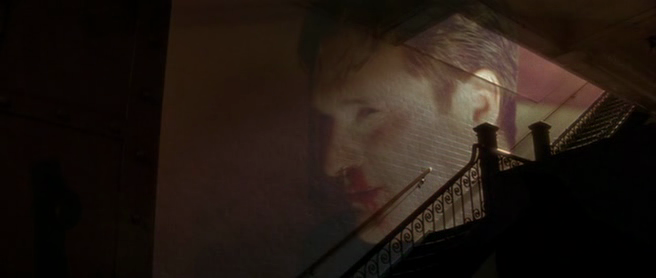
THE LYNCH MOB: Lynch Links

Our man in Inglewood -- Get your ass in here!

LYNCH MOB LINKS:

The INLAND EMPIRE reviews. For, against and befuddlement:
Fernando F. Croce, Manohla Dargis, David Edelstein, Jim Emerson, Jurgen Fauth [(1) (2) (3)], Owen Gleiberman, Ed Gonzalez, J. Hoberman, Rob Humanick, Andrew O'Hehir, Keith Phipps, Jonathan Rosenbaum, Michael Joshua Rowin, Nick Schager, Keith Uhlich.

Lynch Links. Random fire.

[If you have a link you would like to see listed--something you've written or something somebody else has written or something from YouTube or whatever--feel free to leave it in the comments or email it to Ryland.]

EMPIRE Burlesque, or: Obfuscation and Its Discontents

honies

by Stephen Farrell

I’ll be the first to admit it: I’ve never been a huge David Lynch fan. I don’t mean that in a sarcastic way, like I’m understating my dislike for the man and his work, I mean it to be taken at face value: I’ve never been a huge David Lynch fan. I’ve seen Blue Velvet and Lost Highway and a smattering of Twin Peaks episodes back when they used to show reruns on cable, but other than that I don’t have too much knowledge of his work. INLAND EMPIRE is without a doubt the most “difficult” Lynch film I’ve seen, and is probably one of the more bizarre cinematic experiences I’ve ever had. It is also maddeningly hard to describe. It is ostensibly a story about an actress and the role she lands in a film which turns out to be cursed, but to call it a “movie-within-a-movie” would be an absurd understatement. Is it about Hollywood? Sure, but it’s also about early-twentieth century Poland. There are scenes of arresting, undeniable beauty, and scenes of talking, laugh-tracked rabbits. If someone asked me to describe what I saw in the (almost) three hours of my life it took to watch this film, I wouldn’t know where to start.

It seems that with this type of film, where there is no coherent narrative, where identities are unstable and dialogue tends to conceal more than it reveals, the best way to watch it is simply to sit back and let it wash over you, to allow the images and sounds and symbols to hit you on a visceral level and work their magic in the unlit corners of your subconscious. The problem is, every scene, every moment of INLAND EMPIRE is so obscure, so murky and ambiguous, I found my cerebrum working twice as hard just trying to figure out what it was all about, searching for clues in the sets, in the actors’ words, in the silences. Exposition being more or less jettisoned after the fourth or fifth scene, I spent the rest of the film scouring every detail and word, constantly trying to fit them into the semblance of plot that existed in those initial few minutes. Knowing that linear narrative is not going to supply a framework for the piece, every visual cue becomes a symbol and every furtive glance a semaphore that must be deciphered if one is to “get it.”

And that’s the problem with David Lynch movies. People like to say that you either love him or hate him, but that’s not true. No, with Lynch, you either get it or you don’t. For every one of his films (and indeed, for his oeuvre as a whole) there are always those who champion it as the most brilliant, creative, evocative work of art since…well, since the last one. And then there’s everyone else, divided between those who don’t get it, those who didn’t see it, and those who don’t know who the fuck David Lynch is (most of the moviegoing public). The problem is, among those who do see his movies, there can’t be any dialogue between the two groups, because those that get it will consider any criticism from those who don’t get it to simply be due to the others’ not getting it. Those that don’t get it will, for their part, think that anyone who gets it must be a dishonest, pretentious fanboy. And they’re both right.

David Lynch has been vocally silent about how he wants INLAND EMPIRE, and in fact all his films, to be interpreted. This is of course the right thing to do. The creator of a work has said all he or she needs to say about it in the work itself; talking about it or offering interpretations for one’s work implies that something has been left out. And as I explored in a previous post on this site, ambiguity is something which I greatly appreciate in storytelling. But ambiguity is not an end in itself. Without a concrete grounding in reality and narrative, the flights of fancy become meaningless. Surrealism must juxtapose familiar symbols in unexpected ways; if the symbols are not familiar or non-representative, it is abstractionism. People often talk about David Lynch’s work having a “dreamlike” quality, and this is particularly true of INLAND EMPIRE. The non-sequitor dialogue, haunting imagery and muted digital color palate all lend themselves to this. But just as one wakes from a dream perhaps disturbed but resigned to go on with life without learning what it all means, one leaves INLAND EMPIRE shaken and intrigued, but left without much to work with in making sense of it all. Or maybe I just don’t get it.


a map for the road

Thursday, February 15, 2007

Outlandish Empire

smoke, mirrors, tits, hallways, movies, life

by Ryland Walker Knight

In the beginning, David Lynch went to art school to paint, and movies were an afterthought. Now, movies are everything. By the end of its 172 minutes, Lynch’s newest film, INLAND EMPIRE, lays down for viewers an explicit claim: We use movies to build our lives, our dreams and enact fantasies, idealized and horrific alike. The film is rooted in Hollywood (visually name-checked twice), yet its aim is not to skewer. If anything, it’s a celebration of the possibilities of the movies.

As is a beast, INLAND EMPIRE is unruly. It may provide an answer to Andre Bazin’s critical imperative, “What is cinema?”, but that answer is entirely present-tense, rooted here and now in our 21st century (cinema’s second). And it starts with the medium itself, digital video. Yet this is not a pristine, candy-colored DV like Superman Returns, but a handheld, grain-heavy DV captured by a “prosumer” camcorder; the images are both buoyant and cumbersome. This may, in the end, prove too much for casual viewers, but if you can let go any aesthetic (or personal) ties to emulsified film, you can see how the digital blur bleeds whites and hot tones much as a painter would blend colors. The look will aggravate you at first—some actors are flatly kept out of focus—but as you proceed and find a rhythm with this wild brutality, you wind up seeing the beauty in the murky, dank world onscreen.

The choice to shoot on video frees the film to embrace any surreal tangent, and they abound. In fact, they build the narrative, if you want to call it that; if you don’t, call it a fiction, à la Borges. Laura Dern plays Nikki Grace, a successful actress newly cast in a banner film called “On High in Blue Tomorrows”. Her co-star is Devon Berk (lady-killer Justin Theroux) and their director is Kingsley Stewart (an unflappable yet off kilter Jeremy Irons). But all exposition is quickly swept aside once shooting begins and Nikki starts seeing herself in her meta-movie alter-ego, Susan, and, of course, vice-versa, beginning the freefall into, yes, the INLAND EMPIRE.

Cinema, at its best, is a poetic art, one which not only reflects our reality but refracts it through a prism of assembled images and choreographed sounds. That doesn’t preclude linear movies, though, as there are many poetic forward-motion narrative films, including Lynch’s own The Straight Story. INLAND EMPIRE, though, is anything but linear and wholly surreal—quite legitimately the opposite of The Straight Story’s brevity. By embracing multiplicity, one of Lynch’s strong suits, there’s no single answer to “What’s going on?” or “What is cinema?” to be found here. What can be found is a wonderland of right and left turns, bitch-slapping, whores, low-life con artists, a byzantine network of hallways populated by doorways leading who-knows-where?, dreams, lusty songs that menace under the titillation, cinema, blood & guts, dirty blondes and busty brunettes, subtitles and man-sized rabbits. Enter the maze if you dare: you won’t come out the same, but you will re-emerge.

INLAND EMPIRE tied my throat into a knot that has yet to let loose. It’s not a clarity his art provides: this film reaches out, through the screen, with two hands plunging into your chest, massaging your beating heart. This is felt in the film’s opening shot: a projector’s beam illuminates the all-caps title, which then bleeds into a close-up of a needle on a record, tying image and sound together. The film is an exaltation, an orgasm, a little scary death celebrating the multivalent mysteries of life. Any worthwhile art should grab your hand, take you into the looking glass, and point your eyes around.

[The review is supposed to be available here but The Daily Californian's website is mostly unreliable. Big ups to Aaron Bothman on the illustration!]

02006: 172 minutes: dir. David Lynch: written by Lynch

Wednesday, February 14, 2007

On the DL: Why Lynch's Latest is the One we’ve been Waiting For

by Leile One

I had prepared myself for the worst. Rumors had been circulating within the local media and amongst my friends that INLAND EMPIRE was David Lynch’s toughest film to watch yet. Avowed lifetime Lynch fans were saying that unlike his other movies from the past 15 years, which are, for the most part, complicated experiments into the unconscious and surreal; this one perhaps has no payoff in its conclusion, whereas the other films have a brilliant “method to their madness”, so to speak. To which my response came effortlessly, well-rehearsed after many discussions on Mr. Lynch: “Whatevs. Everything the guy’s done since Twin Peaks is a fucking piece of shit. This should come as no surprise.” And inevitably an argument on the undeniable artistic merit of every single project His Majesty David Lynch has laid a finger upon would ensue.

Finally, I thought, with the opportunity to review his newest film, I could systematically break down why Lynch is a hack. To me, every film the dude has put out since 1991 amounts to nothing more than a couple visually appealing scenes tucked inside a mess of bad dialogue, lighting, and music, with no payoff at the end. INLAND EMPIRE seemed the perfect victim upon which to launch my assault, especially at three hours length--and given the mixed reviews I’d been hearing. When I found out that the film had already concluded its two-week run in the Boston area, and that I would have to travel to Manhattan to see the film, I was all the more secretly delighted. It was to be the perfect conditions under which to write the ultimate scathing review: a long, grainy, shaky camcorder movie with no linear plot to speak of, along with a ten-hour round trip on a stuffy Greyhound bus as prelude and epilogue. I could feel my blood boiling just thinking about the day-long process I was committing to.

Upon completion of phase one (the bus ride down), I approached the box office of the IFC Center like a rabid bulldog. I was ready to rip this film to shreds, to pull it off the projection platter with my teeth and destroy it frame by celluloid frame. I took note of a promotion taped to the glass window which surely could only be considered by theater management in the case of a David Lynch film: “Buy Nine Admissions to INLAND EMPIRE and Get the Tenth One Free! Just show us nine ticket stubs and the next one’s on us!” Seriously? Yes, confirmed the cashier, she’s printed some freebies herself. When I walked into the main lobby and saw that they are exclusively selling “David Lynch Signature Cup Whole Bean Organic Coffee”, presumably the only stuff good enough to drink for a director of his magnitude, at 30 bucks per 12-ounce tin, I had to bite my tongue to keep from doubling over with cackles. This shit was getting unbelievable.

At long last, I took my seat in theater two, pulled out the pen and pad, and prepared to do some venomous scribblin’. It had not yet occurred to me that it can be really hard to take legible notes in a pitch-black theater, but I knew I wanted to be as specific as possible when jotting down different things to hate on in my final analysis. Locating what I believed would be my first example didn’t take long. The IFC Center has included as an introduction to INLAND EMPIRE a short featuring a Q-and-A session with David Lynch, from the night of the film’s premiere back in early December. In it, an audience member asks something to the effect of, “What are you trying to say with this movie?” Lynch’s response is cryptic at best, and he basically says he’d rather not go into that; he wants people to draw their own interpretations of the film. Aha! I thought. It’s just like old DL not to step up and justify his sloppy ass finished product ... I am going to be in for a real nightmare here ...


* * * * * * * * * * * * * * * * * *

A nightmare indeed, although I am astonished to report that INLAND EMPIRE is a truly enjoyable "bad trip" when it’s all said and done. This is the film that David Lynch has been trying (and failing) to pull off since Blue Velvet, but in this puzzle the pieces finally fall into place to make a compelling work of art. Some will argue that its sister films Lost Highway and Mulholland Dr. offer more coherent, complete visions of a darkly surreal mindfuck within the ever present Los Angeles landscape. I will go out on a limb and say that the opposite is true. INLAND EMPIRE is the real deal.

If you like bugged-out shit, as any Lynch fan must, there is no shortage of it here. INLAND EMPIRE features some of the most straight-up scary audio-visual juxtapositions ever committed to film, including a genuinely chilling sex scene featuring leads Laura Dern and Justin Theroux. This is one area in particular where INLAND EMPIRE triumphs over its brethren: much of the sexual content in Lynch’s other films seems gratuitous or overly directed in order to achieve a certain response from the viewer. The sex scenes in this film, however, truly add to the overall craziness. All of the more bizarre imagery in the surrealist scenes stands not in isolation as merely a neat thing to look at (a la “dumpster man” in Mulholland Dr.), but as building up to a truly complete conceptual vision.


Gone are the cheesy synthesizer audio score backgrounds which fail to properly set the mood for each scene in Mulholland Dr. and Lost Highway. Aurally, INLAND EMPIRE deals more in bass-heavy frequencies and subtle strings, which succeed in subliminally enhancing the cinematic experience. In fact, nearly everything on the audio side is incorporated effectively: even if it’s just the sound of a hooker’s fingers snapping it seems epic, and proper. Decisions for musical accompaniments from actual bands for the soundtrack seem less ill-advised than in past Lynch projects as well, even in an unlikely slow-motion scenario scored to Beck’s “Black Tambourine” featuring the prostitutes of Hollywood Boulevard.

While I am up against the firing squad here, another unpopular view: INLAND EMPIRE is better looking photographically than its immediate predecessors, despite the digital medium. Firstly, the set design is immaculate, each room containing a given scene providing the perfect backdrop for the characters to illuminate. The furniture, carpet, and even the windows help to lay the groundwork for the desired ultimate effect of a Los Angeles carnival funhouse on acid. The underlying grainy quality of the digital camerawork (not as shitty-looking as you might expect, and at times you can convince yourself it was indeed shot on 35mm) only serves to help further this vision. Perhaps using the digital format has also allowed Lynch to achieve better lighting for his subjects. Looking back on the over-the-top neon blasts of illumination, which presumably help “set the mood” in a film like Lost Highway, I am even more convinced that this is an ultimately prettier film aesthetically than anything Lynch has done in recent memory.

Finally, Lynch gets the dialogue right this time around. Whereas the viewer is forced to reckon with long pauses and corny one-liners as the bulk of the script in most cases of his recent work, INLAND EMPIRE offers some truly interesting abstract prose from its players. From the haunting warning monologue proffered by the spooky neighbor (Grace Zabriskie) at the beginning, to supporting character Freddie’s peculiar speech about dogs (delivered with excellence by Harry Dean Stanton), you will be anything but bored by what’s being said onscreen. In the end, this is where the film most convincingly triumphs and entertains: it’s full of bizarre, thought-provoking lines being delivered by actors at the top of their game. And, yes, Laura Dern deserves the Oscar for best actress for her work here. The fact that she received no nomination is further proof that the Academy Awards are a waste of time.

By the time the curtain was raised three hours later on that chilly Saturday afternoon, I realized that I was not going to be able to write the review that I was planning on for this. But I’m glad – I’m happy to experience once again a project I can respect fully from the man who brought us Blue Velvet. I still think his coffee bean marketing scheme is rather hilarious, and upon fresh viewings of Lost Highway and Mulholland Dr. I have to say my opinion of those remains the same. In fact, to me they only serve to clarify the long list of what works in INLAND EMPIRE. As for Lynch, I think I agree with his stance on not explaining exactly how he wants you to interpret the film. It’s something you should probably just experience yourself. And, yes, do it while it’s still on the big screen if it is at all within your means.