Showing posts with label SB. Show all posts

Tuesday, November 24, 2009

Wolf Like Me


by Steven Boone

Hippy dippy Woodstock director Michael Wadleigh made only one narrative feature film, the majestically weird horror fable Wolfen. Having not seen it since Late Late Show screenings in the 1980's, I remembered Wolfen, faintly, as that other, lesser, wolf flick of 1981.

Not until screening it recently with a horror afficionado pal did I come to understand it as a reeling peyote vision of New York City's Third World future, the one I'm staggering through presently. Damn. This video is my parting shot as I prepare to join a sad, strange exodus from the city that used to feel like home.


Originally posted at BIG MEDIA VANDALISM

Friday, October 30, 2009

MOONWALK: THE ADAPTATION

by Steven Boone

It all comes down to what you believe, because none of us knew the man.

I believe Michael Jackson was a good guy. I believe he never harmed anyone's child. I believe he was one of those rare people who tried to apply his otherworldly talent to healing some of the basic, eternal problems of humanity. I believe he was a great man of strong constitution and boundless vision. I believe that the incessant lies told about him were his indirect murderer.

Moonwalk is the autobiography he wrote in 1988.

I believe David Lynch is the filmmaker who should make the inevitable Moonwalk movie. Lynch's capacity for empathy; his ability to describe alienation, suffering and loneliness in spiritual, visual terms; his American ear; his understanding of corporate show business as a place where dreams are nourished with candied arsenic... make Lynch the best equipped among marquee-value auteurs to say something vital about Michael's life and death.

Here are some notes and sketches for the Lynch adaptation:


Originally posted at BIG MEDIA VANDALISM

Tuesday, October 13, 2009

NYFF09: Moments Out of Time

by Steven Boone


dont change nuthin

Film Festivals come and go. What's important is what stays with you. I saw some things at this year's New York Film Festival. Moments out of time, as they say (and used to say in a provocative yearly Film Comment roundup). Here are some fragments that are still stuck to my shoe:
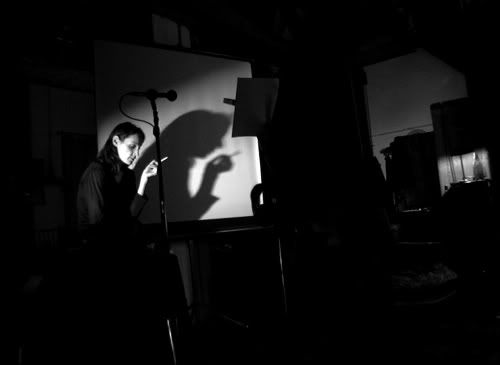
A Dutch-angle, chiaroscuro long-take of singer Jeanne Balibar recording a drunkenly sexy number with her two leathery pet guitarists. All we hear of the song is whatever they coo into their mikes and whatever leaks, like a whisper, from their studio headphones. As the music builds and Balibar's narrow hips become possessed, the session gathers all the heat of an inspired ménage à trois. They even smoke afterwards.
—on Ne Change Rien

no order, no law, no rules
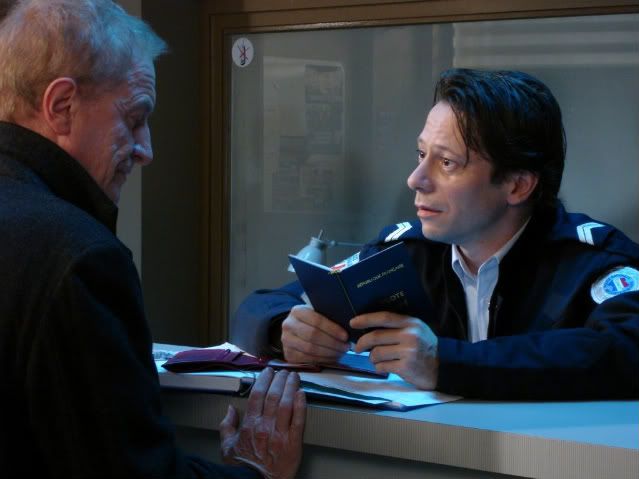
His soul as restless as a kid at recess, a dapper retiree (André Dussollier) descends into a mall parking garage to the busy chickawa-thump-thumps of a Bruckheimer techno-thriller. The camera glides along in anamorphic widescreen, soaking up the garage's teal fluorescents. So mesmerizing and intense—but why are we laughing? Alain Resnais is a master of appropriating styles to fit/bedevil/brazen his characters' lovesick delirium, that's why. At the NYFF press conference, he noted The Shield and Law and Order among his favorite TV shows. In many places, his camera swoops and hovers with the abandon of Hitchcock, of The Conformist, of Branded to Kill, all in the service of a dream, the kind you wake from with a stupid grin and a thousand thoughts.
—on Wild Grass

Saturday, September 19, 2009

INGLOURIOUS SNATCH

by Steven Boone


summer drek

2009 is the year I quit film criticism for the fourth or fifth time. It was sort of like the local crazy homeless guy quitting his post as honorary mayor of the corner. Big whoop. I keep coming back to the block, hoping somebody heard my cry of doom and responded accordingly. The cry goes something like this: Cinema as a popular art form has lost the fundamentals that make its expensive products worth our time. Critics, content that a stubborn minority of classically trained filmmakers still endure at the arthouse and on the festival circuit, happily chalk up the disaster at the multiplex as Other People’s Problem. In other words, caviar for us, scraps for the rabble. It's the blithe attitude of Whole Foods shoppers toward the Food Stamp set, and it's disgusting.

[To read the full article, full of polemic and full of fire, click here to get your snatch on at Boone's baby, BIG MEDIA VANDALISM. ]

Thursday, August 06, 2009

More Vimeo switching for your visual sweet tooth.

by Ryland Walker Knight (for Steven Boone)


After I learned that my imeem videos were gone, I alerted my boy Steve about it and he said, "Sure, sure, I'll switch when I have the time." Well, time has come. By popular demand, his inaugural Low Budget Eye Candy video on George Lucas' debut feature THX-1138 is now available above and on vimeo proper, where, Steve assures me, more are in the pipeline. And they sound amazing. Hopefully I'll be joining him soon with some moving image essays (as noted here, as hosted here). For now, though, eat your heart out, Lamar Odom.

Sunday, April 26, 2009

HUNGER vs the infotainment telesector

by Steven Boone + Ryland Walker Knight


[A note: Some of you out there may already be hip to this video through its appearance on SpoutBlog last week. If it's news to you, feel free to click that link and see it there. We embed it here because, besides the obvious friend trumpeting, well, we think it's great. It's the kind of stuff we would like to see more of here (and elsewhere on this interweb). Below you can read Steve's typically on-point intro, which we, perversely, of course, have made our follow-up context for the images above. We've done this for the simple fact that we like the idea that their relationship can be switched, flipped, overlaid, uprooted, found and forged in new ways. We find this fact to be self-evident. And, as members of this fancy web, a right of (even a will to) our power. We know this power is miniscule; we do what we can.]

little spaces

In the 1996 book Jihad vs. McWorld (1), political science braniac Benjamin Barber coined the term “infotainment telesector” to describe the conglomerates controlling print journalism, television, music, film and advertising. He could have just said, “the media,” but noooo. Infotainment telesector sounds like something from ’50s sci-fi, but its weird, metallic ring is just about right for 2009. In a social climate where no one bats an eyelash at baseball stadiums named after rapacious banks, we are living out previous eras’ dystopian visions of the future. It’s just hard to tell because everybody’s so animated, far from dehumanized, and we have a participatory comfort toy Orwell and the others couldn’t predict,the Internet (2).

In the following video appreciation of the acclaimed art film Hunger, I don’t deal with Barber’s work at all but use his clanky term to evoke what British artist Steve McQueen’s film is up against: A metronome set by the infotainment telesector that nearly everybody, even those artists who proclaim themselves radical (or disengaged) outsiders, marches to. It’s a spectacular con, and so many of us are falling for it, but not McQueen. He’s in a minority of filmmakers worldwide who let their images and sounds move at a natural pace.

What the hell am I talking about? What’s a “natural” pace?

pain

(1) Read the original 1992 article by Barber by clicking here and heading over to The Atlantic's surprisingly well archived internet back catalogue.

(2) You gotta love that Andy Rector put this Daney-tennis-Godard-slaphappy-Lewis bit together right around the same time.

Friday, February 13, 2009

LOW BUDGET EYE CANDY #1: THX-1138

by Steven Boone


[New note (8/6/09): A new and improved, to say operational, version is now ready and available for your viewing pleasure above as part of our VINYL-wide switch to Vimeo. —rwk]

[New note (2/14/09): A new and improved, to say tighter and cleaner, version is now ready and available. If pressed, or not, Steve might say I jumped the gun on posting the original iteration of this video. What can I say? I was excited; I was impressed. In fact, I still am. This little thing is cool and I'm happy to host it here. —rwk]

[Original note (2/2/09): Steve's credit at the close is for BIG MEDIA VANDALISM. However, as the Odienator has taken over that space for Black History Mumf, we decided to post this video here for the time being. Hope you digg it as much as we do. —rwk]

Friday, October 24, 2008

In defense of Ballast

by Steven Boone


looking up
I suspect it was the story that had some of the folks in the Film Forum audience sighing, whispering and even snickering uncontrollably. Story-wise, Ballast can be easily mistaken for an entry in the Why We Be Black genre—films which depict underclass African-Americans scratching and surviving and tearing each other apart. Such films are said to exist mainly for the delectation of white liberals who like to think of poor blacks as lovable to the degree that they are irrational, impulsive and self-destructive. Mighty Joe Young in a do-rag. The fallacy of placing Ballast in this genre is as tragic as the critical backlash against Steven Spielberg’s The Color Purple adaptation, which reduced that film’s towering humanism to Song of the South T-N-T.

The first time I saw Ballast, knowing nothing about its maker, I spent no more than a cumulative total of five minutes thinking about the race of its characters or creator. Whenever little Lawrence wielded a gun that weighed more than him; when early on, James sat brooding, an inscrutable black hulk; when Marlee fumed and fretted over a tragic turn of events with the all the negro histrionics of Robert Downey, Jr. in Tropic Thunder — yeah, I thought about race. But that was it. Otherwise, the ethnicity of Marlee, James, and Lawrence rarely factored into my appreciation of their loss, desperation, insecurities, hopes and contradictions. These were Americans, these were human beings. I expect a white upper middle class author on a black working class subject to get some things “wrong”—that’s the way it is. What I hope for in such a film is an honest effort to capture something true.

[A note from RWK: Idiot me missed Lance Hammer's film when it played at the luxurious Sundance Cinema last week. Click here to see if/when it will be playing near you. Hopefully the film will find its way to my eyes and ears soon. With all the love Steve's given this film, it's hard not to kick myself in my butt. But, then again, I've been busy with other cine-stars I'm more than happy to have encountered.]

Reminder: Mirror tonight at PFA.

by Ryland Walker Knight


looking at fire in rain

Tonight at 6:30 to be precise. Why does this get special mention among all the cinema I've been enjoying recently? Well, because. Just because. Because it's great; it's where the water's at; it's beautiful; it's a favorite. And I can link to some stuff I've written before on this masterpiece.

Do yourself a favor if you live near by and see one of the great things tonight.

Tuesday, June 24, 2008

Saluting is like pointing, kinda. Steven Boone on SpoutBlog.

by Ryland Walker Knight


sky

So my buddy Steven Boone has been writing for Spout Blog every Friday for a little more than a month, in case you had yet to see. You can check his archive here. But last week's "Felon Fest: Notes on Camp" is my favorite so far. And not just because he references a favorite film at the close of the piece but for Steve's careful, yet lively, prose. I told him via email that I want to read more of this kind of writing from him, that incorporates narrative into the criticism; if you can call this criticism. I guess this is closer to the Phillip Lopate personal essay. Which, I guess, is where Steve is going with his work for this column (and beyond; but I'll leave that to him to disclose). In any event -- not that it needs my recommendation -- I simply want to salute my friend. And point anybody who visits this blog (if there are some who still check in here) towards his recent output.

I also wanted to say that, like Steve, I'm always blown away by the encounters between Jim Caviezel and Sean Penn in The Thin Red Line. Those scenes are the heart of the picture. Trying to see what spark is left in the light of the world. Or how we may rekindle.

strike
look

Sunday, April 13, 2008

turkey and cheese

by Steven Boone


Sunday, March 30, 2008

Nina Eats the Soul

by Steven Boone


Shamelessly sentimental mashup of Nina Simone and Rainer Werner Fassbinder. The idea is that Ali: Fear Eats the Soul is two films. The first is about two lovers dealing with the terrible, disapproving world. The second is about the two lovers, having conquered the world, dealing with what poison it has left in each other's system. Nina sings a song for each "film."

MILES GODARD NOCTURNE

by Steven Boone


Jean-Luc Godard's Alphaville is a gorgeously photographed low-budget science-fiction film with an okay story. What it could use is some Miles Davis. If you've seen Louis Malle's Elevator to the Gallows, you know what I'm talking about. This Alphaville montage is set to Black Satin, from the Davis album On the Corner.

Wednesday, March 12, 2008

Three "Fake" Trailers

by Steven Boone

1. Teaser for Chungking Express.
A short celebration of Wong Kar-wai's ageless gem, with assist from the Beach Boys.


____________________________


2. Trailer for Bring Me the Head of Alfredo Garcia.
If I were a trailer editor for United Artists in 1974, um, my promo for Sam Peckinpah's masterpiece might look something like this. The music is Danse Macabre by Camille Saint-Saëns.


____________________________


3. Trailer for Bullet in the Head.
Arguably action director John Woo's worst film, Bullet in the Head nevertheless makes amazing trailer/montage fodder. Good music helps: Here it's Roland Kirk's cover of Marvin Gaye's "What's Going On?"


Tuesday, December 18, 2007

Steve's Armond White Conversation: easy links.

Steven Boone just posted his third and final installment in a lengthy but oh-so-fun conversation with Armond White. The first installment: "In a world that has The Darjeeling Limited, Sidney Lumet should be imprisoned!". The second installment: Phonies, Cronies, American Ironies, American Gangsters. The third installment: Sweet Lime and "Sour Grapes". I finally commented on the last one. It's in line with all the usual obsessions, plus with some notes on my own take on Margot at the Wedding. So, please read their conversation if you have yet to: it's worth it. And the installments make it easier to get through in pieces. As much as White rankles, he comes off as a congenial fellow who loves movies, and loves the world, despite all the deficiencies apparent in both. There's also Steve's Ten favorite AW quotes. Once again, I'm sure you've seen all this before, since you are so cool, but Steve is my buddy and I thought I'd throw him yet more eyes, even the same ones a second time. --RWK

Monday, December 03, 2007

Two Stars (Tormatozz/Possession mashup)

by Steven Boone


The Russian band Tormatozz asked me to make them a video along the lines of my Tarkovsky mashup. So here's pieces of Andrzej Zulawski's 1981 "horror" film Possession, set to Tormatozz's song "Two Stars." Both works are about love and separation, but one's a dream, the other a nightmare. Dig the contrast.

Thursday, October 11, 2007

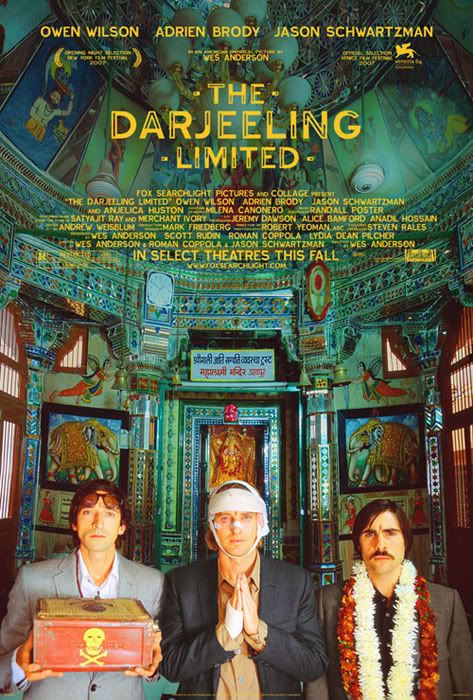
Life is full, life is funny. An appetite for Wes Anderson's The Darjeeling Limited.

turquoise heaven
____________________

[Editor's Note: This is a slightly-edited email conversation between Steven Boone and Ryland Walker Knight. Clearly a lot was discussed. But as descendants of another Whitman, we contain multitudes, much like this film, and there was plenty more to talk about. But two call-and-responses seemed like a good enough jump off. Please help us continue the conversation in the comments. As Steve says, it's kind of sloppy but it's cool. It's good enough for now.]

____________________
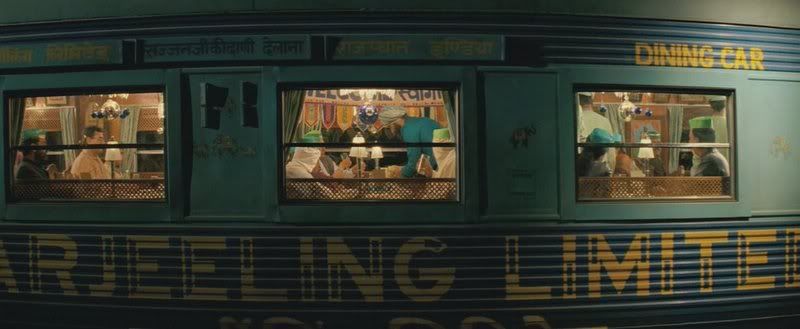
the title is everywhere
____________________


Ry,

“We're all sensitive people/with so much to give.” Marvin Gaye may have been singing that just to get into a girl's drawers, but those two phrases also inadvertently define the great film directors: Sensitivity and generosity. It takes an audience of similar temperament to get into their films. Wes Anderson is one of the greats.

I had punkass tears leaking out of my eyes from the moment Owen Wilson stood up and said the first thing he thought about when he came to (after a near-death experience) was his brothers, and they all hugged a little awkwardly. Why is this moment so great, or special? We've seen brothers bonding like this in 10,000 other flicks. Actually, looking back at my description of it, it sounds like some TV movie shit. What sells it (other than Anderson's (or maybe Jason Schwartzman's or Roman Coppola's) dialogue writing, which lays out torturous, hilarious roadblocks of cynicism and petty grievances on the path to true understanding) is Anderson's camera eye. (That's the other thing that makes a great director: Gotta know what shots and cuts can really do.) Owen declares his love to his brothers in a kind of wobbly, sloppy shot taken from a long lens way down the train car. In a film of rock-solid compositions and tense pinpong cutting, this image is a fuzzy anomaly. It's like a little kid scribbling “I Luv Yoo” in crayon on his daddy's manuscript. Even if Wes Anderson is an asshole in real life, shots like that one assure me there's something better buried in his soul.

The camera is everything. Anderson knows that his selection of lenses and camera movements are as critical to conveying his wiseass charm and humanist worldview as his casting, dialogue, music and production design. (Those latter four are what most critics choose to fixate upon.) Like, why does he use lateral dolly shots to do the job normally left for pans? Because they bear a certain weight that offsets the loopy/mopey, boyish/world-weary comedic atmosphere in his compositions. These shots have their soul mates in the hollow, heartbroken eyes of his three male leads.

All of this to conjure up a miracle: A big, splashy widescreen film about three obnoxious rich shits... that made me, a working stiff, feel for them. Let's face it: Wes makes movies about spoiled rich kids, about white adults suffering abrasions to their sense of entitlement. I love Bottle Rocket and Rushmore, but the sense of elitist angst and preciousness in The Royal Tenenbaums and The Life Aquatic pushed me away in their first acts. Darjeeling reached out to me. It was a personal breakthrough because I arrived at the simple understanding that nobody can help what they were born into; essence is everything. These little snotty punks are used to being waited on and catered to, but they are not bad people. Yes, there are sociopaths, tyrants and American psychos out in the world, but there are so many more decent folk wearing an asshole's uniform only for survival's sake.

There's too much to share about this movie. Any conversation we have about it is doomed to be random and sloppy. Cool.

--Steve

____________________
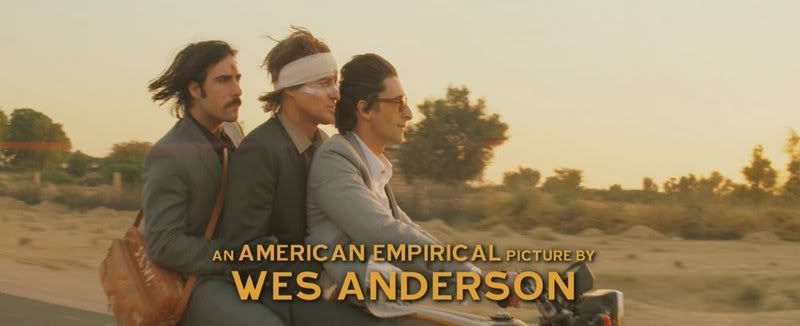
everyone on the bike
____________________


My fellow fun-lover,

"The camera is everything." Perhaps nothing else needs to be said to understand the joy of this film. Still a prop in The Life Aquatic, and working more as a detached omniscience than as a personality in the three films prior, the camera in Wes Anderson films has always been conspicuous, and distinctive; but in The Darjeeling Limited it becomes a member of the cast as much as instrument of the crew. More specifically, the camera is a (non-) member of the trinity of brothers. Each of the brothers addresses the camera, and by consequence the audience. The camera takes a spot among the lineup of the brothers when they are seen from behind: two brothers to the left, one to the right, with a spot just off-center for the camera to push in among the fraternity. Reverse shots of the brothers eclipse this space, placing the three side-by-side without the gap, but the visual discontinuity makes sense, oddly, because Wes Anderson's camera is not here to document: it is here to make pretty pictures to tell a sometimes-silly, sometimes-somber story from a perspective that marries the know-it-all style of his earlier films with the on-the-edge style of The Life Aquatic. Surrendering to this hilarious tension of contrivance is, perhaps (again), the first step to enjoying The Darjeeling Limited, or any movie Wes has made (or may make).
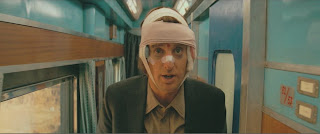
What I find most frustrating reading negative reviews of the picture is that each writer of such essays seems determined not to enjoy him or herself. Which is not to say I prize an essay where it's all about the writer and his or her reaction to the film. Rather, I wish more writers spent a little more time reflecting upon their reactions in as generous a manner as possible. Suppose there might be a reason, within the rubric of the film, that Wes Anderson choses to shoot scenes the way he does. Where the hell is this odd, almost-fish-eyed camera? Is it a point-of-view? Is it not? What's with all the tacky zooms? Why is the camera moving laterally, or panning 180, or 360, degrees? Why all this slow-motion? Why is the camera everything? The easiest answer to that summation-question would be: the camera is not a tool, really, for Wes Anderson, but another set of eyes. What complicates this notion is how we in the audience are continually confronted in Darjeeling by the eyes of the characters: the camera becomes not just another set of Wes-eys but, at the same time, audience-eyes. You there in your seat -- yeah, you -- you're here, too, onscreen (and in the page) -- you are at once audience member, brother, absent father, absent mother, a businessman, a girlfriend, a wife, a steward, a man-eating tiger. And, to echo something I've written before, they are all happening, always (and already).

This is why I find myself welling up: it's beautiful, this present tense. To invoke the present tense is a little redundant, I know, given we don't necessarily live in the past (though we carry it) or the future (though we reach for it) right here and now. However, all those slow-motion shots are the elongated present, a delicious unveiling of (almost) every detail of right here and now, of every plane of activity. (Maybe, in as general a sense as possible, that's simply what movies are?) And what happens at the end of one of these slo-mo scenes?! We match-cut back in time! All because of a look! (These exclamation points are to signify my delight that something as simple as looking at your brother can spur a story. And to make this paragraph as silly as it needs to be to get you to care about what I felt while looking at the movie.)

Adrien Brody's look across Jason Schwartzman at Owen Wilson (as brothers Peter, Jack and Francis Whitman) triggers a memory, which is a mini-movie unto itself, wrapped up inside the bigger, whole movie. We know from earlier in the film that this memory also serves as material for a short story Schwartzman's Jack has written, and shown to Peter, about the day of their father's funeral. Later, Jack will read to his brothers the ending of a new short story he has begun writing, without knowing the beginning; the lines of dialogue are direct quotes from Darjeeling's companion "Part 1" film, Hotel Chevalier. Jack insists throughout that all his characters are fictional until this moment, when he accepts his brother's compliment (Peter says he likes how mean Jack is in the story), which is more validation than if they simply said it was well written, as Francis does earlier.

I think the best “commercial” review of the picture thus far has been from Glenn Kenny, of Premiere. His last two grafs seem apt here:

This movie is as much, if not more, about the construction of fictions as it is about its ostensible plot. Wilson's Francis, trying to put his life back together after a suicide attempt, constructs the India trip, with its laminated itineraries, as a potential happy ending to his family saga. Brody's Peter seeks a continuance of the narrative of his late father (the last time the brothers all saw each other was at his funeral) by furtively, obsessively, hanging on to the patriarch's old possessions. Schwartzman's Jack is a writer of short stories — stories he insists are "entirely fictional." Much of the film's subtext is devoted to both peeling away and reinforcing that claim.

But The Darjeeling Limited is as much about fiction as it is about family. That it succeeds so well and so slyly even while dealing with these topics in its own stylish but unsparing way is reason for moviegoers to rejoice.

Of course, this quote echoes a few things for me, including my own dealings with Wes Anderson's beguiling, and delightful, films. I think you can make this argument about storytelling with any of his films: it is as major a theme as family or death or theatricality are for Anderson. Think of Dignan's fiction about Mr. Henry, and vice-versa. Or Max Fischer's dad-as-doctor lie. Or all the books in The Royal Tenenbaums. Or, hell, all of The Life Aquatic and its constant movie set setting. Think of his TV ads. Think of how Schwartzman prepares his room for Natalie Portman's entrance in Hotel Chevalier. The effectiveness of these offerings, while propelled more by dialogue than visuals the earlier you go in his filmography, is tied, at least partially, into how Anderson uses his camera. He's not making a representation of a world -- he makes the world as he would have it, as a movie. (No d'uh, right?) Complaints about his films as contrived are as wrong-headed as can be: to invent a fiction, in any medium, is a contrivance, an artifice from the get-go. To tether it to some kind of “reality” is a limitation not of scope or imagination (that's tough work to make "real" humanist stories) but of understanding.

(This is similar to what makes Werner Herzog so interesting: he does not delineate between "fiction" and "non-fiction" films. He simply makes films. He understands that even a "documentary" is a fiction. It has its own rules, sure, but the documentary in Herzog's hands is not about actually documenting the events. In The White Diamond, maybe his greatest film, he does not show the balloon when it is first dubbed such, he lets a man sitting on an inflatable chair smoking a joint call it a “white diamond.” A lesser filmmaker would have cut immediately to the balloon. Herzog simply holds on the man as he soaks in the scene. The fiction of the object is as important as the object itself.)

For Wes Anderson, he makes sure his films are fake-ish (or overtly self-reflexive) by, among other things, stuffing them with these details and whip-pans and sudden narrative tangents. He does not write three-act structures. He writes happenings, constant happenings, constant unravelings. Things don't add up as they would in a “traditional narrative.” Things just keep happening. They go left, they go right, they go up the mountain (via a staircase?), their train gets lost, there is a death, there is another train, the movie starts over again.

I saw the movie two times in as many days and I could see it again right now. In lieu, may the sun shine bright on us all. Let's get into it!

later, ryland.

____________________
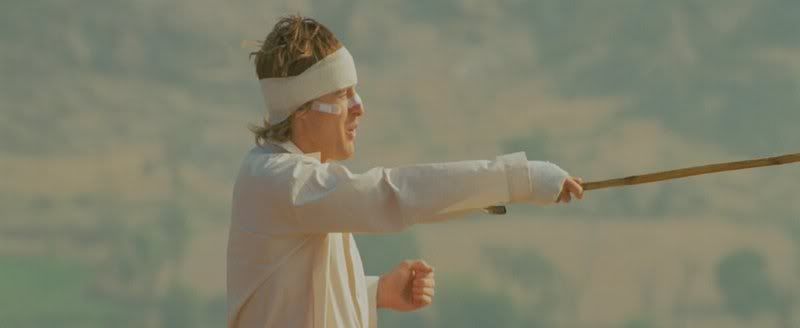
whoo!
____________________


Ry,

No, the camera's not the whole show, but the objects and Anderson's dollhouse placement of them are largely about "subjectivity" as well. Critics have already sucked their teeth at the literal "baggage" that trails the brothers everywhere they go. Well, the obviousness that they're so up in arms about is what fleshes these characters out. The props and bric-a-brac convey plot/character/backstory nuggets (like Bill Murray's family portrait in Rushmore) not just for efficiency's sake. They trouble and redirect some of our less charitable tendencies. Wes has a crucial understanding about people: We size each other up, from head to toe, mercilessly. We make instant judgments. Ry, you mention that he makes his own worlds. Yes, and in his worlds, people are exactly what they wear, eat, carry or cast off. It's plain to see who's up to what in Wesworld, even though the characters are mostly flying blind as if they're in our prismatic, deceitful world. (And, of course, psychologically, they are.) Owen's bandages, Schwartzman's cheesy ‘stache and Brody's shades tell us up front what these guys are dealing with. Their journey in the film is toward seeing each other the way Anderson presents them to us -- as lost boys.

Oh, brother, right? I don't know too many people who would put up with such preciousness. I'm picturing Darjeeling playing on Comedy Central in the day room at Rikers Island a few years from now. Not much of a draw. But on the big, wide screen, this movie smashes prejudices against creampuff elites by the sheer force of gravity (the mise-en-scene) and inertia (the camera movement). In real life you can probably knock these dudes over with a light shove (well, probably not Brody) but Anderson's compositions ain't laying down for nobody. They are imposing, and yet nimble and feathery as needed. Athletes train forever to get this combination of power and grace.
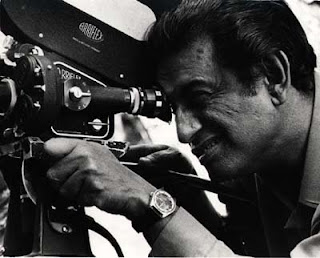
Which brings me to Satyajit Ray. You haven't seen too much (or any?) of his stuff, and it is absolutely not necessary for blissing out on this flick. But having watched Ray's Apu trilogy as many times as you are bound to see Darjeeling, I can say that Ray is Mr. Power and Grace. Anderson pays him tribute throughout this film, mostly by using film music composed by Ray and Ravi Shankar. However, the scene where the brothers take a whiff of the perfume and the joke about trains in the distance will both become even prettier when you see how affectionately they bow to Ray. I can't wait to send you these Apu films, along with his Devi, from 1960. I'm in the middle of that one right now, and it has all the rapture of that overhead baby shot in Darjeeling--arguably--no, no argument here: In-damn-disputably the most wondrous shot of an infant ever presented in a film. Those feet in the margins of the frame.

But that's all side stuff. The real fun of looking back on Darjeeling is how Anderson cleared that tightrope of silliness, reflexivity, grave seriousness and irony without a sweat. Let's get into that.

--Steve

____________________
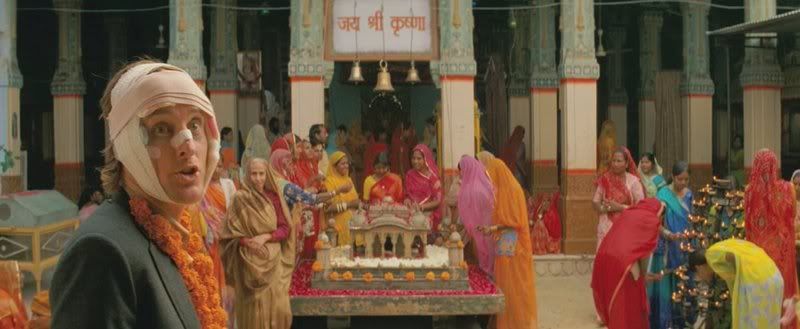
incredible!
____________________


My man,

During our exchange I was directed to Carina Chocano's positive review of Darjeeling, which opens with a remarkably smart paragraph that summarizes some of the problems of the criticism of Wes Anderson and echoes some of what you were getting into at the start of your last missive:

It's hard to approach a new film by Wes Anderson without feeling like you've walked into an argument. There's something about his dollhouse aesthetic, his storybook formality, his miniaturist's attention to detail and his dogged belief in the power of objects to elicit the most oblique and recondite emotions that seriously sets people off. Why is a question for another paragraph, but needless to say it's exactly this staunch commitment to artificiality that makes his work what it is.

In addition to the surface-as-essence approach to dressing characters and scenes in Wesworld, there's something about how that subjective camera shoots those objects that imbues them with character. How things are arranged, perhaps staged, to echo myself again, matters, because this new film, like all his others, is still “cluttered” with detail, for all its acclaimed “maturity” (from its supporters). How the details accrue in the picture is probably a good indicator of how Wes “clears the tightrope” of storytelling. As a practice, storytelling relies on affective details that trigger a response. If we can agree that art is about life, why shouldn't something this artful (and artificial) be as resonant as a piece of art that is artful in its artlessness? Is it just a matter of taste at that point? To argue aesthetics seems a silly dead end, especially since I don't know much about it outside thinking, “Well, that sure is pretty and it looks like it was a thoughtful choice -- on the part of the artist and consistent with the rest of the work of art.” Plus, “aesthetics” is such a broad topic to whittle down to film style. We can table that. What I'm curious about is why Wes Anderson's rhetoric ticks people off. Because I can eat it all day. His world is full of things. Even in slow motion the world is alive with motion and speed.

The idea that objects (including people) can "elicit the most oblique and recondite emotions" in and of themselves and their appearance should be a delight, not something to harp on: it is an offering. Walking out of the film on Friday my friend said, “I feel like I've been given a thoughtful gift.” I think this kind of reaction is what Wes is aiming for in how he shoots objects with his camera. The objects carry history that can produce associations. Opening this film with Bill Murray's Businessman missing the train in slow motion, while a young man, Adrian Brody's Peter, runs past him, is not meant as an inciting incident in some kind of narrative but simply to trigger a response and tell you how things are arranged in this movie (this world): it's all about the train. The train is the name of the movie. The train is the movie. So when Bill Murray can't catch the train, Anderson is showing you, in as simple terms as possible, this movie is also all about youth. That is, as much as a movie so fearful of death can be about youth, and vigor. When the brothers chuck their, ahem, luggage at the end (to catch the train), the act is not simply some metaphor about mourning sons finally getting rid of their fatherly baggage. Rather, the film is saying that it is more important to watch the movie (to catch the train) than to hold on to things; those things (or their ephemeral essence?) stay with you no matter what, forever. Owen Wilson's Francis says, “Dad's luggage isn't going to make it” and the three brothers smile, and they run faster. Just like his missing loafer, the luggage doesn't matter, in the end. Those things are just distractions anyways. This both calls attention to the objects and tells you not to get hung up on them. I guess what I'm trying to say is: sure, you can read the scene as a blatant metaphor for “growth” or something but that belittles what happens, and the things that matter are those characters and their actions. Besides, the characters are still covered with details, they still carry a lot on their faces and bodies. And having seen them through a whole film with those suitcases and handbags you know that they're more mnemonics than anything. And if we understand that memories are forever inside us then we realize that we don't need mnemonic aids. (Think of the funeral within the funeral: lives within lives and stories within stories.)

Still, Wes Anderson is of a tradition of filmmakers like Quentin Tarantino (or the French New Wave that so inspires both artists' work) that metabolize cinema. They take it up (all the time, from everywhere), digest it, and reproduce new films. This is perhaps most apparent in Darjeeling in the musical cues Anderson borrows from Satyajit Ray. (But the only reason I know that this music is from those films is because I was told ahead of time. I look forward to understanding the homage better, and I thank you for the offering.) What's funny is I can also understand the music as a signifier for this odd Western ideal of India the boys are seeking. The music in Wes Anderson is an object weighted with (and by) history as much as things like suitcases. Think of the British Invasion tunes, too: in a story about youthful brothers on a journey into the spiritual unknown, the first song with lyrics in the film is by The Kinks (a band comprised of brothers), called “This Time Tomorrow.” It's all about not knowing where the journey will take the passengers. The song, like Peter catching the train in slow motion, knows that to get anywhere you simply have to start going.

Which brings me back to thinking about how well the movie works. Most importantly, I think it's wicked smart: it understands movies, and stories, and how they work (internally as well as on an audience); the philosophy of the film is affirmative; it does not overplay its hand, or shoot for too big; every detail has a purpose (for story or for its affective resonance); it's fucking funny. However, one could argue I'm a biased party. I feel I “get” Wes Anderson movies. They “speak” to me. But what I've come to realize is that this affection I feel for them is not about identifying with the characters (the way I thought I did with Max in Rushmore back when I first saw it). More so that, in as much as art is about life, I find my life affirmed in these films: my dreams, my loves, my fears, and my understanding of all that -- my understanding and enjoyment of life. One might argue this is all we ever look for in films and that is not a criteria but I would also like to posit, in as uncontroversial a stance as possible, I hope, that as much as art is about life, so is philosophy about life -- and in that film is a work of art, film can be a work of philosophy. So when I say Wes Anderson films speak to me, perhaps I mean that I am attuned to his brand of philosophy (pace Cavell). Perhaps I've realized that life is never fixable, or able to be fixed, even in narrative; that life refuses itineraries, even if it is good to plan some things, or at least be prepared to deal with the unexpected turns in the night; that life keeps going, for everybody, always, before and after them, and especially during the present (no d’uh); that life is weighted but fast; that life can surprise and delight; that life is worth it, even if it's scary, and dangerous; and that life is funny.

Laugh with me,
Ry

____________________
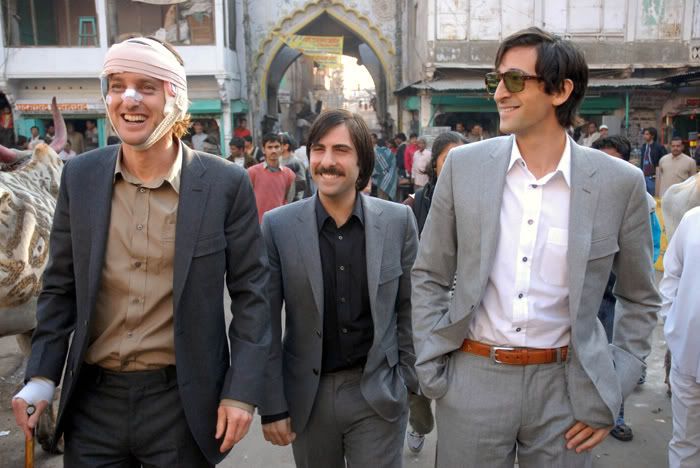
incredible!

Sunday, September 30, 2007

Susana: Buñuel at Play

by Steven Boone


a crafty eyeball

Luis Buñuel's Susana (1951) might be his worst, most entertaining film. After shooting his low-budget masterpiece, Los Olvidados in 1950, Buñuel was on rocky terms with Mexican audiences. That film represented Mexico as a nightmare in which failed social services and a hostile or indifferent economy resulted in children tossed aside like trash. Bunuel's producer, Oscar Dancigers, had agreed to let the aging surrealist make one personal film for every two commercial ones. Buñuel had delivered, with two crowd-pleasers, the musical Gran Casino (1946) and the screwball comedy The Great Madcap (1949). But the hostility toward Los Olvidados ended Danciger's and Buñuel's scheme just when it really got going. The director made Susana for another producer, Sergio Kogan. (The ironic postscript is that Los Olvidados went on to win the Palme d'Or at Cannes before its release to worldwide acclaim in 1952.)

With Susana, Buñuel honed an elegant "invisible" storytelling style that would reach perfection in Viridiana. This might account for the overacting and bombastic musical score: Maybe Buñuel was so caught up with camera choreography (on a tight 20-day schedule) that he let the performances run amok. Seen today, the bombast works as camp. It kind of fits this (literally) stormy melodrama about a female juvenile delinquent (Rosita Quintana) who single-handedly wrecks a wealthy Mexican rancher's home by seducing him, his son and his most trusted ranchero. Fernando Soler (who brings the most subtlety of the entire cast) plays the rancher as a tough-minded middle aged jefe who Susana reduces to a fool in love.

Buñuel uses the horny premise to indulge his leg fetish and favorite sacreligious themes. Buxom, hot-blooded Susana prays to the "God of prisons" to bust her out of juvie-- and He does. She escapes to don Guadalupe's ranch and proceeds to eat every man in sight. If you watch Susana without sound, it's as feverish and irrational as something like L'age d'Or. Buñuel's camera gets away with sensuality and eroticism less visually adroit directors wouldn't know how to manage.

Here's a sample of that craftiness, set to David Axelrod's song A Divine Image:


[Editor's Note: This is a belated submission to the Luis Buñuel blog-a-thon (hosted by Flickhead) that ran last week. I was planning on seeing Los Olvidados to contribute a tandem piece with Steve's delightful little appreciation, here, but life got in the way. So, if you want more on Buñuel from me, you'll have to wait. Luckily, thanks to a special gift from Senor Boone, I will be able to watch a lot of the Mexican films sooner than later. So stay tuned. -- RWK]

Thursday, September 27, 2007

Peter Berg brings America to The Kingdom. Get ready for the onslaught.

by Ryland Walker Knight


You tell me about fashion?

Despite its questionable politics, Peter Berg’s busiest film yet, The Kingdom, blows up a lot of stuff, and kills a lot of people, really well. Which is to say it never bores however bull-headed it may bluster. The flip side, of course, is that the film assaults its audience as much as its villains (and its heroes). Aping Paul Greengrass (the Bourne sequels) and producer Michael Mann’s recent work (Miami Vice), Berg’s always-already moving camera has neither the sense of style (composition, color, editing) nor the formal curiosities of his influences. Worst of all, though, The Kingdom has a simple bully mentality, not any generosity.

[For the rest of the review click here and you will be forwarded to The Daily Californian's website.]

You want to do what?

My review does not mention that in four minutes of screen time, maybe, Jeremy Piven steals every second he's given. I didn't see Smokin Aces but I heard he was a little toned down. I think we all know he's at his best (or most fun) when playing a jerk, or simply a frail human (on the inside; his physique is astonishing, impressive, fit). But he's no reason to see the movie. If you plan on seeing the movie go for the shoot out scenes. I think Berg is developing a nice filmography as a director but he may be relying on his version of the Greengrass aesthetic a little too much. Friday Night Lights succeeded because there were moments of calm littered throughout, and a few terse home-life scenes that dug deep, not because it was nonstop motion. The reason the third Bourne movie works well is because the plot is all MacGuffin. Every scene is exposition. This makes plot irrelevant. The film announces itself, all at once, as a deliberate recapitulation of the whole trilogy while renewing and rewriting its purpose. Also, Bourne is not about politics: it's about movement through the ever-encroaching modern world. Its motives are squarely ethical. The Kingdom, on the other hand, subverts its ethics/morals under the weight of its politics. And it's not like it's got some novel ideas. It's Syriana, but oddly right-wing; and it has a less complex (obfuscated?) plot. What's funny, though, is both The Kingdom and Syriana rely on their plots in a way Bourne Ultimatum does not, which makes Bourne's political implications (while oblique and vague) resonate in a more honest, less propagandized, fashion. If Greengrass argues for anything in the last installment it's that surveillance is scary-quick now and you are its prey at all times, even if you have magic in you like Jason Bourne. Also, the Manhattan car chase is fucking dope. The Kingdom doesn't have anything to rival that. But it does have a good, if slightly misguided, cast. (That enough side-commentary? Maybe I'll finally write more about why The Bourne Ultimatum actually does kick some butt at a later date. Now I've got to see about some Wes Anderson.)

UPDATE: Friday, September 28th, 2007:
Steven Boone has some similar thoughts over at The House Next Door. I think his first sentence says it all: "The Kingdom is a two-faced liar." (Also, the comments section is already contentious. I mean, wow!) So a few more words to the wise: Skip The Kingdom this weekend. Go see Morocco on Sunday at the PFA, if you live in or near Berkeley, California. And tonight you have the opportunity to see Seconds at the Castro, in San Francisco. (It's clear how I organize my film-going timeline, right?) Also, you could go see The Bourne Ultimatum since it's probably still playing in a lot of cities. Or, how's this, see both Bourne and The Kingdom and tell me if you think I'm way off base in my practice of evaluation regarding these two objects of interpretation and how they (kind of) speak to one another -- or how they use wildly different voices while (superficially) employing a similar visual vocabulary. (Another key distinction: The Kingdom is about how Jaime Foxx and his team engage the world they are temporarily inhabiting, whereas Jason Bourne literally runs through everything.) Okay, now I really need to write this thing up, right?

Monday, September 10, 2007

3:10 to Yuma

by Steven Boone


The first big action scene in James Mangold's 3:10 to Yuma remake is a spectacular, old-fashioned stage coach chase and robbery--old-fashioned, that is, until the filmmakers bust out the futuristic-looking, coach-mounted Gatling gun and the exploding horse. Yo, it's Yuma: Reloaded!

When the smoke clears, dapper villain Ben Wade (Russell Crowe) and his psychopathic toady, Charlie Prince (Ben Foster), methodically execute the survivors, all but twirling their mustaches as they deliver cruel kiss-off speeches. You know, stuff like, "Well, if it isn't my old friend [so-and-so]. Such a pity I must kill you now. It reminds me of that time many years ago..." Why do movie bad guys get bouts of logorrhea just when they're fixing to kill somebody? Looks like Mangold doesn't care. He clearly loves every last old-time Western trope and was determined to get them all into this one silly/serious, sprawling/unimaginative cowboy flick. Alongside this fanboy preoccupation, the film also squeezes in some post-Unforgiven revisionism. Strange brew.

If you caught the film's theatrical trailer, you've basically seen the whole show. Christian Bale is Dan Evans, a dirt poor rancher who volunteers to escort Wade, a murderous outlaw, to a frontier town where at 3:10PM a prison train will take him to justice. Along the way, Wade's robber gang, Dan's ornery son William (Logan Lerman), Keystone cop Pinkertons, Injun snipers and thuggish railroad workers complicate the journey. William tags along because his admiration for Wade and disdain for peaceable Dad provide the film with its main oedipal thrust. Wade is simply more charismatic and powerful than Evans. The latter signs on for this mission because he's desperate for cash in a season of drought, but also to prove (to himself as much as anyone) that upholding the law, toeing the line and doing unto others are not for suckers.


Screenwriters Michael Brandt and Derek Haas (working from the original film's Halstead Welles adaptation of an Elmore Leonard short story) add provocative new wrinkles to the premise by making Wade a sort of progressive antihero: He talks to women (including Dan's wife (Gretchen Mol)) with sensitivity and respect for their intelligence; he enchants William with literate, worldly accounts of his adventures in the big cities. And he can draw nudes, too. (At one point I expected to see a copy of The Village Voice tucked in his ammo belt.) Wade constantly points out that his captors, representatives of the state and big business, are really gunning for him because of the property he's stolen or destroyed over the years, not "all the lives I've taken." He also mentions all the slaughter his nemesis and chief escort, the bounty hunter Byron McElroy (Peter Fonda) has presided over in his time. These facts trouble Dan's sense of mission, since he's no friend of the bosses and barons:In the film's first scene, hired thugs burn down his barn to remind him of his debt to the landowner. Later, Wade kills one of these goons, who has joined the “Yuma” party as an armed guard. As in the Delmer Daves original, Dan and Wade find themselves awkwardly simpatico even as their personal codes line up for a direct collision.

Juicy stuff, so why doesn't it work so well here? Well, let's go back to that exploding horse. The horse blows up because a Pinkerton in the speeding stagecoach shoots her saddlebag loaded with dynamite, blasting her and her evil rider sky high. Yee haw. 3:10 to Yuma is chock full of moments like this, inducements to cheer some ridiculous physical feat for a 2007 audience calibrated to Hostel sequels and rollerblading Deceptagons. The subtle, psychologically intense drama Mangold tries to build in between the set pieces suffers in this cartoon climate.

Sometimes, Mangold's weakness for mannered, massively telegraphed performances (going back to his debut, Heavy, and some of the this-is-me-being-crazy turns in Girl, Interrupted) is the problem. As played by willowy pretty boy Lerman, Evan's son seems more interested in offering himself sexually to Wade than filling his shoes. Foster, who tried way too hard to embody a kung fu adept crackhead in the flick Alpha Dog, bursts even more blood vessels here as Wade's ace psycho. The wiry actor struts imperiously, huffs and tries to project menace the way Michael Jackson attempted not to shit himself facing off with Wesley Snipes in Bad. Worst of all: In a feat of straight-up miscasting, perennial sweetie-pie Luke Wilson cameos as a thug with brown teeth and a permanent sneer.


The real standout stars of this Yuma are not Bale or Crowe, who are both, predictably, great-ish in their tailored roles, but production designer Andrew Menzies, costumer Arianne Philips, cinematographer Phedon Papamichel (providing grand and glorious anamorphic lens flares as visual chorus) and actor Peter Fonda. Under Mangold's direction, Menzies, Philips and Papamichel deliver a lived-in Western canvas worthy of prime Peckinpah, Siegel or Eastwood, and Fonda inhabits this world more solidly than the horses, even the exploding one.

[PS: Check out Ryland's review over at The House Next Door.]