Showing posts with label Abbas Kiarostami. Show all posts

Friday, December 23, 2011

BANG BANG: Brian Darr

[BANG BANG is our week-long look back at 20!!, or "Twenty-bang-bang," or 2011, with contributions from all over aiming to cover all sorts of enthusiasms from film to music to words and beyond.]


5 x 5 by Brian Darr

2011 was a year filled with terrible and wonderful things for me. When it comes to film-watching, there was plenty that fell into the "wonderful" category. My relationship with the cinema, and especially the "new" cinema, is constantly changing, and finding a way to put together a coherent top ten list encapsulation was more of a struggle for me than ever this year. So in true obsessive fashion, I've made a "modular" top ten, exploiting various quirks of eligibility that diehard list-watchers and -makers may recognize, but that everyone else can just read as an excuse for a nice round top 25.


Five magnificent films that had a week-long "commercial" release in San Francisco in 2011. Definitely on my top ten list, no matter how you slice it.
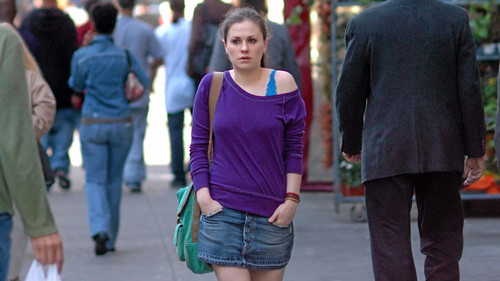
  • Margaret (Kenneth Lonergan, 2011) From the beautifully slo-mo opening sequence of Manhattanites in ritualized motion, reminiscent of James Benning's early collaborations with Bette Gordon, I suspected I was seeing something special. Drying my eyes during the closing credits, I knew for sure that I had. "You will weep and know why." If you've heard of this sprawling, 150-minute character drama about a teenager (Anna Paquin) struggling with every emotion under the sun in the wake of a traffic accident, you've probably also heard how it was given short shrift by a studio contractually obliged to release it but seemingly determined to take a loss on it. Though frustrations of the legal system is a sub-theme of the movie, (as are poetry, post-9/11 stress, burgeoning sexuality, opera, and a million other concerns) it's a shame that the story of Margaret's belated and shoddy distribution has overshadowed all other discussions about the film. To be expected when prints disappear from theatres after a week or two, and perhaps reversible now that the film is re-opening at a Greenwich Village theatre today; I hope a Frisco Bay venue tries the same gambit soon.
  • Uncle Boonmee Who Can Recall His Part Lives (Apichatpong Weerasethakul, 2010) Into the cave.
  • The Tree of Life (Terence Malick, 2011) Into the light. Multiple viewings and much ruminating have made its evident flaws insignificant in the face of its visionary design.
  • A Dangerous Method (David Cronenberg, 2011) Keira Knightley's polarizing performance in this impeccably composed, perfectly Cronenbergian film, led my way to a new understanding of my long-least favorite genre: the biopic. Historical figures perform specific functions for modern humans; why not allow actors to embody these functions by acting them out on screen?
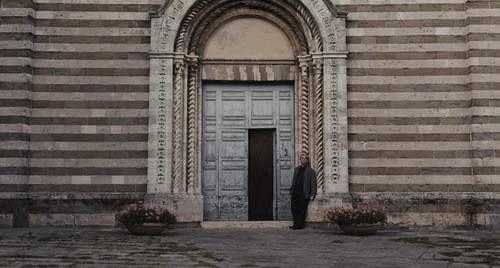
  • Certified Copy (Abbas Kiarostami, 2010) It's a bit strange that the San Francisco Film Critics Circle picked a largely English-language film for their 2011 Foreign Language Film award. I'll approve and attribute it to the masterful illusionism practiced by its Iranian director, its French star (Juliette Binoche), and the Tuscan countryside setting. All three create a mesmerizing surface beneath which there is even more to see, and contemplate. English-language films just don't do that, do they? Except for the exceptions.

Five superb films I saw in 2011 that screened in San Francisco for the first time this year. All had so-called "commercial" releases except the first one listed; it played for a week in New York but had only a handful of screenings at the San Francisco International Film Festival here.
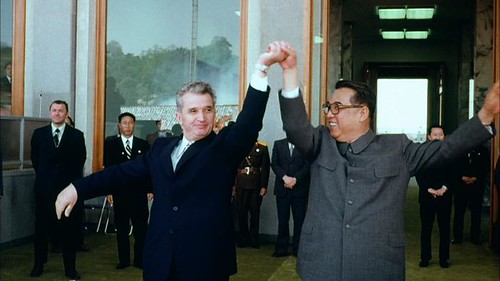
  • The Autobiography of Nicolae Ceaucescu (Andrei Ujica, 2010) "Look in my eyes; what do you see?...I'm the smiling face on your TV..." The past months have seen the final days of two of the world's most reviled dictators. We can hope, but not really expect, that they won't be replaced by others equally heinous somewhere in the world. But how often does tyranny conform to the images we expect from it? Such a question is at the center of this three-hour compilation of naked newsreel footage taken from the archives of the 1965-1989 Romanian leader's personal photographers. Kim Jong-il's father Kim Il-sung makes an astonishing cameo appearance.
  • The Time That Remains (Elia Suleiman, 2009) Palestinian director Suleiman applies the darkly absurdist, somewhat Tati-esque style he perfected in his previous film Divine Intervention to even more overtly autobiographical material. If its predecessor is any indication, it should only grow in my estimation with repeated viewings in the coming years.
  • The Arbor (Clio Barnard, 2010) A strange and remarkable work. The documentary tradition in theatre is long but little-known, so bringing some of its techniques for merging non-fiction material with acted performance into a cinematic sphere feels like a real breath of fresh air. It's particularly inspired in the service of its subject: the life and legacy of Yorkshire playwright Andrea Dunbar.
  • The Skin I Live In (Pedro Almodovar, 2011) I run hot and cold on Pedro's filmography, and had even skipped Broken Embraces after being disappointed by his previous two features. I'm back on board. Here, he forays into horror and science fiction without upsetting his delicate balance of telenovelistic melodrama and cinematic spectacle. To hint at why this film is something only Almodovar might have devised is to give too much of its plot away. I'll just say that maybe Bad Education could've been improved with a hint of Karl Freund's 1935 Mad Love in it.
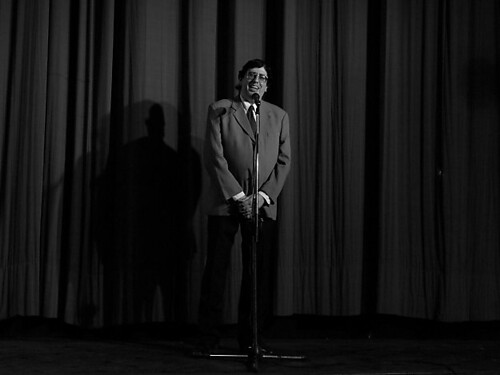
  • Inni (Vincent Morisset, 2011) Is this monochromatic, visually experimental shadow box a new way forward for the concert film? If you prefer imagining the Icelandic band's sustains ricocheting against the back of a darkened concert hall rather than off beautiful mountains and lakes (as in 2007's Heima), then this is the Sigur Rós movie for you.

Five beautiful films which I didn't see in 2011, but which were first publicly screened in San Francisco this year and were a big part of my conversations about cinema. Having seen them in 2010, I wish I'd made time to see them again when they played in local cinemas in 2011.
  • A Useful Life (Federico Veiroj, 2010) I never had to see a Uruguayan film before this one to fall in love with this neorealist-goes-expressionist oratorio for that tiny country's cinema culture and one average man's place in it. And out of it.
  • The Mysteries of Lisbon (Raul Ruiz, 2010) A fitting swan song for one of the most mysterious filmmakers I know. The impossible-to-peg Chilean died in August but not before gracing us with a beautiful, sprawling adaptation of a novel by 19th-century Romantic Camilo Castelo Branco. (No, I hadn't heard of hm before either.) Dig those digital split diopter shots!
  • Another Year (Mike Leigh, 2010) The British misanthrope-or-is-he's most Ozu-esque film to date.
  • Meek's Cutoff (Kelly Reichardt, 2010) One of the American filmmakers best at portraying the so-called "outsiders" (or should I say the 99%?) of our modern society points her camera into history, showing us the stratifications found among a small community of pioneers heading West circa 1845.
  • Essential Killing (Jerzy Skolimowski, 2010) Just as exciting as The Fugitive except far more ambiguous and ambivalent about its moral position. Pure cinema.

Five terrific films that I saw at San Francisco festivals or other alternative venues in 2011, that have yet to secure "commercial" distribution in this country, as far as I am aware. In alphabetical, not preferential, order.
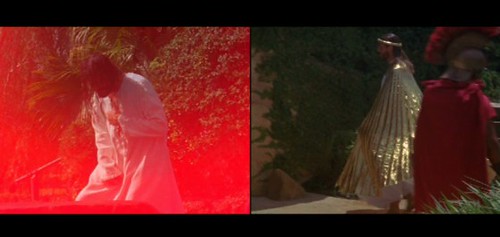
  • 28.IV.81 (Descending Figures) (Christopher Harris, 2011) A brightly-colored dual-projector comedy set amidst a Florida amusement park passion play where baseball caps mingle with Centurion helmets.
  • Chantrapas (Otar Iosseliani, 2010) Films about filmmaking are cinephile catnip, right? Well, this certainly trumps The Artist as an authentically moving tribute to a vanished mode of production left behind for a new life and search for meaning.
  • Disorder (Weikai Huang, 2009) Around Guangzhao in an hour. Dizzying in design, execution, imagery, editing style, and political audaciousness. Truly the closest thing to Dziga Vertov's vision for his kinoks the 21st Century has seen thus far in a single work.
  • HaHaHa (Hong Sangsoo, 2010) One of the funniest and most thought-provoking films from one of my favorite working directors. Need I say more?
  • Lethe (Lewis Klahr, 2009) Klahr's collage films can provide a closer look at vintage comic book art than even the most finicky collector is likely to take unless scrutinizing that line between "very fine" and "near mint". We see the visual DNA of colors and shading magnified, and at the same time we read between the panels, guided by the filmmaker's temporal and spatial dislocations. The standout of a strong set of new-ish work Klahr brought for local premieres this year, Lethe is a remix of a 1960s Doctor Solar story that becomes a noirish drama set to Gustav Mahler.

Five amazing films I saw in 2011 that have yet to screen publicly anywhere in San Francisco. In alphabetical, not preferential, order.
  • Almayer's Folly (Chantal Akerman, 2011) Entrancingly old-fashioned adaptation of Joseph Conrad's first novel, transposed to stuck-in-time Cambodia.
  • the Day He Arrives (Hong Sangsoo, 2011) Is Hong's return to black-and-white cinematography, eleven years and as many films after Virgin Stripped Bare By Her Bachelors, a sign that we should question the veracity of every scene, but this time around without a bifurcated structure to help guide us?
  • Ghost Dance (Mark Wilson, 2009) Named for the call to apocalyptic change performed by the Modoc (as beautifully described in Rebecca Solnit's book River of Shadows), this brief, but spectacularly ever-expanding animation recalls Eadweard Muybridge's own technological call for for a paradigm shift.
  • Longhorn Tremelo (Scott Stark, 2010) Begins and ends as a study of black shadows against mobile fields, but goes through a dazzling array of burnt-orange-and-white permutations in between. A version is viewable on vimeo, but I'd love to be able to see the full two-projector version somehow.
  • The Turin Horse (Bela Tarr, 2011) A Nietzche-inspired tour-de-force from one of the most forceful visions around.

THE DAY HE ARRIVES


____________________________

Brian Darr lives in San Francisco, where he watches movies, though he's been known to travel for cinema as well. He blogs here and twitters here.

Wednesday, December 21, 2011

BANG BANG: Eric Freeman

[BANG BANG is our week-long look back at 20!!, or "Twenty-bang-bang," or 2011, with contributions from all over aiming to cover all sorts of enthusiasms from film to music to words and beyond.]


Some Things I Found Interesting in Some Things I Saw This Year by Eric Freeman


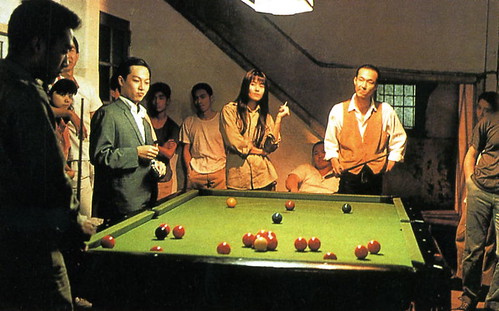
A Brighter Summer Day (dir. Edward Yang): I saw this in January at a mostly empty screening with no intermission in Berkeley, and it’s still probably the best thing I’ve seen all year, old or new. Read Rosenbaum's longer piece if you want more comprehensive breakdown. I’ll just note that what strikes me about ABSD (and Yi Yi, as well) is that the epic scope follows not from stunning natural vistas or loud pronouncements of import, as we’ve come to expect from the medium, but finding an interesting situation and treating the context and its characters with complete respect and as much depth as necessary. It’s an epic because it’s so true to the way people relate to one another.

World on a Wire (dir. Rainer Werner Fassbinder): If ABSD is the best movie I saw this year, then this one has proven to have fascinated me the most. It was my first Fassbinder, and since then I’ve steadily run through a good chunk of his career. One thing I love about this one, apart from the “what if we shot through four panes of glass?” aesthetic, is how RWF sets up shots where a pan finishes in a hilariously overdetermined setup. It’s the movie in microcosm: things may appear free-flowing, but everything has been decided already.

Martha Marcy May Marlene (dir. Sean Durkin): A disappointment even as I enjoyed it, if only because it’s so easy to see how it could be better. While the structure is indeed very clever, many of the match cuts fall flat because it’s immediately when and where the scenes take place. As the last shot proves, Durkin wants the audience to identify with Martha’s displacement, yet continually keeps her at remove. Which is all a way of saying that the film needs more moments of actual ambiguity, like the several shots of Martha walking through a dark hall, when it’s unclear where she is until she ends up in a room she herself might not have expected to enter.

Certified Copy (dir. Abbas Kiarostami): Ryland thinks this film is fundamentally a work of criticism, and I mostly agree with that statement. But I also think it comes across as more dismissive than it should, because in this case the criticism gets at important points about how relationships change over time, the value of authenticity in everything from art to interactions, and all sorts of other deep philosophical questions that we tend not to consider on a daily basis. So, yes, it’s criticism, but also proof that criticism isn’t really about the thing it directly addresses, but deeper conceptions and feelings about how people relate to the world around them.


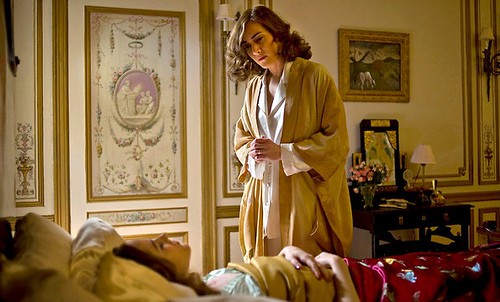
Mildred Pierce (dir. Todd Haynes): It’s no surprise that a director who regularly gets great performances from actresses does so well with Kate Winslet, who plays this role as a mix of her usual technical strength and the rare looseness usually lacking in her most awarded work. What’s less expected is that Evan Rachel Wood acquits herself so well. Veda can easily come off as a monster, but Wood instills her with enough relatable pride to seem human. Her best moment (and also the one that will make me seem particularly pervy for noting) comes when, directly after Mildred finds out about the affair with Monty, Veda gets out of bed fully naked, struts over to her vanity, and regards herself in the mirror, all as a sort of victory celebration after embarrassing her mother. It’s a triumphant moment for the character, the point at which she believes to have finally proven herself as a dominant woman. For different reasons, the scene makes the same case for the actress.

Drive (dir. Nicholas Winding Refn): I’m of the camp that takes this movie as a massive spastic fuckup, mostly because NWR has no idea what he was trying to do and not for some difficulty in melding tones and styles. But there are some delightful moments of clarity, especially the opening set-piece and the various music videos (not like music videos) that distill the latent emotions of the piece into perfect pairings of image and sound. For all the talk of Drive as an arthouse action movie, the best parts are almost always the most overtly commercial.

Rango (dir. Gore Verbinski): It’s become standard in some circles to say that the home-viewing experience is almost as good as the theater these days, but Rango is the first movie that ever made me think it could be true. I loved the movie in March, mostly for its gag-a-minute pace, but I don’t think I fully appreciate the visual dazzle until I saw it on the very excellent Blu-Ray transfer on a reasonably-sized TV. Multiplex projection standards are so poor that, for a detail-driven, wide-audience movie like this one, it’s almost preferable to watch it on a couch.


Bridesmaids (dir. Paul Feig): As the thinkpieces all said, an important step forward for the status of women in Hollywood comedies. Unfortunately, the movie itself is a sad commentary on exactly what those Hollywood comedies entail. Almost all the best parts are moments of emotional discord between Kristen Wiig and Maya Rudolph or throwaway lines from the amazing Melissa McCarthy -- the worst are the zany, insert-setpiece-here laugh-generators that could have been ported in from any Apatowville (or, worse yet, Farrelly Bros) creation. Turn this into a movie about adult friendship with regular laughs, and it might have felt a little more true to its characters. Instead, it’s all too familiar.

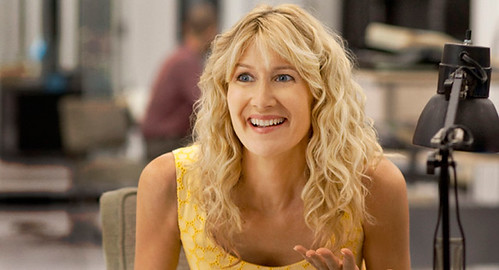
Enlightened (created by Mike White and Laura Dern): This HBO series isn’t especially cinematic, but it deserves mention on this list for Laura Dern’s performance as Amy Jellicoe, in my opinion the best acting work of the year. It’s easy to caricature Amy—the pilot arguably does it too often—as a hypocritical woman who believes herself to have found inner peace when she falls victim to the same sort of jealousies and grudges she did before getting a few weeks of new-age counseling. In Dern’s hands, however, Amy is fascinatingly complicated, oblivious enough to peacock a new friend in front of past confidants but introspective enough to acknowledge that pettiness a few hours later. In a TV landscape heavy on melodrama, Enlightened stands out as a series about the everyday difficulties of trying to be a better person in a world that tends to incentivize the opposite behavior. It’s about self-awareness and emotional processes, and those battles register on Dern’s face as often as they manifest in an external conflict.


________________________________

Eric Freeman writes regularly about sports at The Classical and Ball Don’t Lie, and intermittently elsewhere. Follow him on Twitter @freemaneric.

Wednesday, March 23, 2011

Viewing Log #78: Philogyny forever [3/15/2011 - 3/22/2011]

by Ryland Walker Knight


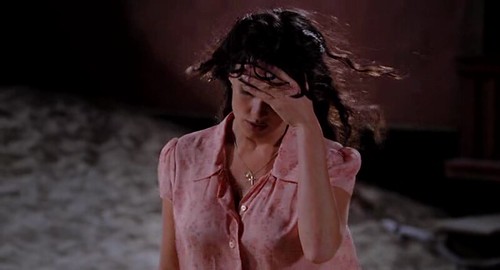
Peace is a name
—This guy...

  • Spanglish [James L. Brooks, 2004] Not quite a success, but noble yet. The framing device is too television and the narration far too choke-me. Sandler does his nervous thing well and is largely absent for a lot of the picture, which is a funny flip on the Ho'wood marketing plan, but it's maybe odd that his major function in the movie is to fawn; cool that he's a chef, sure, and that you see him cook some dishes in snippets, but that creative side isn't funneled into the rest of the character except that he's such a sensitive dad that the weight of his heralded genius* just seems like neurotic self-abnegation. The biggest surprise is just how caricature ugly Tea Leoni's character is compared to the saint-like Paz Vega who is literally an alien sent to fix humans (or at least catalyze reflection/education/change); doesn't hurt that Vega's a curvy lady, tho still movie star thin with the cheek bones to prove it, and Leoni's got this absurd fitness addict body the movie almost makes fun of; or, it's just too easy that the softer one's the mom. In any case, I still didn't mind a minute of it, really, because I'm an idiot for kindness and good lighting and a pretty face—just like the movie hopes I am/you are.
  • Broadcast News [James L. Brooks, 1987] # Sorry, but I gotta: Holly Hunter in all her polka dots is so god-damned adorable in this movie it's insane. Part of that is the character touch of her private crying jags, part of it is her mouth full of accent, part of it is that she is not needy the way Albert Brooks is; she keeps her real pain to herself (for the most part) and she's a real lady who is excellent at her job and the weight of that brilliance is understandable. Love that JLB is all about the right choice, too, but what keeps it from moral high-grounding is the way each choice is rooted in consequence. Makes it feel like ethics even though it isn't, quite, despite the word getting bandied about a few times. I wish there was more play with the medium of television on an image level but the bottom line is that I hope to watch this one with my sister before she goes to college.

  • How Do You Know [James L. Brooks, 2010] The bait-y punk in me wanted to tweet, "HOW DO YOU KNOW > CERTIFIED COPY ????" immediately after finishing this one (instead). Granted, it hit some sweet spots for me, but the construction is this rare patient thing that arranges characters like chess without seeming a game. That is, for however contrived it might be, it's just as up front about its fiction as the AK film below. Further, there's a number of set-pieces designed to make certain freaks with theoretical clouds hanging in their heads leap to attention. Simply put, it relates to the notion that the only audience for philosophy is the one performing it. But, of course, this is never a simple thing to reckon and the picture of education in Reese Witherspoon's character is as winsome as Brooks' commitment to the importance of compartmentalizing daily life. That is, there's a time and a place for everything. It's in that awful trailer and it's better than a gag in the flick: Rudd, backing from dad Jack with eyes up to heaven, pleading, "God, are you going to literally make me run from bad news?" He does. It's the right choice.

  • Certified Copy [Abbas Kiarostami, 2010] Rather lovely, yes, but also not a masterpiece, I'm afraid. In fact, the further I'm from it, the less generous I'm getting—though, I must admit, at first it put me in a trance**. That said, as I briefly "discussed" with Akiva, one of the interesting things that doesn't seem to get talked about is the role of gender in the turns this path takes. That is, how it determines these, to use Sicinski's word, pivots as much as any history or motivation behind this reality or these realities that may be false or may be true (all of which sure are some bogus words in this conversation). Maybe better: how does this lady control the events or rip agency from the man? She's driving the car to start, she directs their walk for the most part, she finds their turret of a honeymoon room; it's her fabrication, if we want to believe it so, and it's her anger, which is real no matter what's fake, that move this thing. Binoche is, as you might suspect, rather out of this world.

  • Caught up on the second season of Archer [Adam Reed, 2011] and it continues to be a fun way to waste a half hour.

Steam cleaning

* Akiva also pointed out this motif in Brooks, which is consistent in all three I just watched: Reese's softball player has these little sayings as a ritual to balance the heft of being excellent at something; Holly does her crying; Sandler can't quit moving his feet.

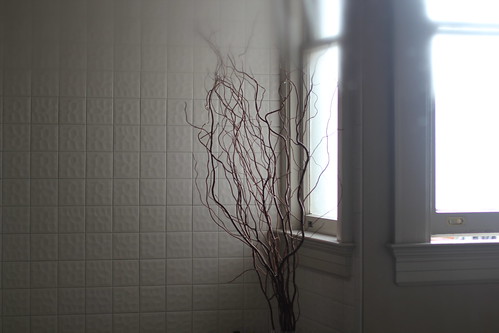
** When I got home I shot angles on/of my bathroom mirror for a half hour. Then again in the morning for longer, as evidenced above. All I could really do after that movie was listen to wordless music and think about geometry.

Monday, January 24, 2011

Viewing Log #70: The possessive element made my chest thump [1/18/11 - 1/23/11]

by Ryland Walker Knight


With life
—The world allows a lot

  • 30 Rock "Mrs. Donaghy" [S5E10] Love the concepts, and kind of loved that Weinerslav scene, but the mirroring across the studio is getting stale (as are the caricatures). I wanted to include this here simply to be able to say: Chris Parnell is always the best actor/comedian on the show. He's allowed to be a caricature, plain and simple, and it works every single time.

  • Two Lovers [James Gray, 2009] # Forgot how severe a downer this one is (somehow), how deep its truths cut. Yet Joaquin, as ever, made me laugh out loud a crazy number of times, as did some of the tossaway stuff his dad does. I'm still not in the "masterpiece" camp home to a lot of my friends, however, because of the cleverness of certain winks. Like, as much as its designed to excoriate the male psyche, it no doubt flatters it (or one kind of it), too. [I have no memory of what I wrote here.]

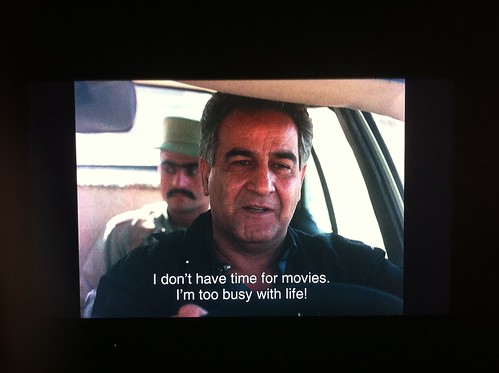
  • Close-Up [Abbas Kiarostami, 1990] # Still fabulous. Sabzian is too perfect, in all his roles, to ever be a villain. The BR disc is phenomenal not for clarity but for color. Throughout the picture, the colors pool, adding weight. But don't count out the jokes—especially all that bluster by the reporter, a perfect clown for this procession.

  • The Fighter [David O. Russell, 2010] I had a fine time watching it, even got some pangs of reflection when it comes to the self-reliance bits, but it's kind of a messy movie with a lot of competing, moving parts and a rather rote script. Worst thing is I don't think it was built to be something at odds with itself; instead, I think it's trying to serve too many agendas; or it's just kinda convoluted and cheesy in parts. The most curious thing, I find, is that fine line that separates the hamming Christian Bale does, which I dug, from the mugging Melissa Leo does, which I almost loathed. I think it's how Bale uses his eyes over against how Leo uses her mouth. People tell me they're both likely to win Oscars and that does not surprise me. (What Oscar result does anymore? ever?) I just wish Mila Kunis could/would beat Leo. [FWIW, the cinetrix kills it on the topic, as if that's a surprise.]


—Waves can surprise you

Tuesday, April 06, 2010

Letters sent and not sent

by Ryland Walker Knight


stolen from glenn

Though of course I would have loved to receive a review copy of the Letters from Fontainhas box set, for whatever reason I ultimately did not. This is not really a problem, to be honest, because I feel it's a certain duty of mine to buy the box. Or, I want to. That is, I learned a lot a couple years ago when Costa visited the PFA and I hope I can learn a few more things looking back at these films presented this way (instead of the, um, illicit way). Granted, these aren't exactly party pictures, and they aren't my favorite (that'd be Où gît votre sourire enfoui?), but they will be a fine addition to my nerd collection. Once I do get around to watching them, I will likely write a few more words about what it means to watch them now at this remove. That is, I want to see how time has shaped me as much as these people, since that's a definite part of the project at hand: the change in Vanda, and her cough, is one of the most obvious lines to trace aside from Costa's evolution as an image-maker, which I like to see as going from somewhat classical, everything's a bit perfect, to a grimey pragmatism, which renders a different and steady beauty, to a new realm of myth expressionism that makes shadows (and spot-lights) colors of time and character. I'll try to elucidate that when the time comes.


Speaking of letters from places, like home and not home, my still-mint Ackerman set needs watching, too, come to think of it, and that might just happen soonish. Heck, I may even buy that Gadamer book while I'm at it, since I added it to the widget at right, along with the trilogy and Close-Up and the Brakhage anthology (both Blu Ray). Which is to say that I think a Blu Ray player of some kind (perhaps the gaming kind) may be on my May birthday horizon.

[Top image stolen from Glenn, purveyor of delicious lasagna and, along with His Lovely Wife, an altogether generous host for a late Easter evening meal. Second image stolen from that invaluable blog the art of memory.]

Sunday, April 04, 2010

Viewing Log #40: A green fort in a city forked [3/29/10 - 4/4/10]

by Ryland Walker Knight


Lack
I shot some video, too

  • Lightning [Mikio Naruse, 1952] Pretty great, of course, and the lightning does surprise in a way I didn't expect. Didn't expect it to be as funny as it is, nor as bleak. But I'm told that's par for the course with Naruse. Now I'm definitely compelled to watch those copies of Repast and Flowing I have at home.
  • Hideko, the Bus Conductress [Mikio Naruse, 1941] Loved how aleatory and almost silly the whole thing was, and its brevity, but I was pooped and passed out for maybe half of it.

  • Groundhog Day [Harold Ramis, 1993] # The less said, the better, probably, but this time, aside from the usual hilarity (pretty much every interaction makes me laugh), I'm struck by the idea that, among other things, this is a movie about what it means to be an actor in a movie. You get all the chances you need, really, to perform in exactly the "right way." Does morality work like that, too?

  • Close-Up [Abbas Kiarostami, 1990] The new print that just ended a run at Film Forum, and will likely make its way West, is indeed beautiful. I'm sure the Criterion will look lovely. And what a lovely movie! Only the second Kiarostami I've seen (I know, right?) and it topped the other, Taste of Cherry, with ease (and I own that one). Maybe I'll say more about this one if I see it again back home, or simply at home on that upcoming disc. (I should probably see some Mohsen Makhmalbaf movies at some point, too, since he seems like quite a sweet human being.)

  • Street Angel [Frank Borzage, 1928] Yes, very romantic and histrionic, with a humungous set as backdrop. The conceit of lighting matches to see somebody's face in the fog on a wharf was pretty amazing. The final "redemption" was not. Still, worth seeing with a crowd of old people in the middle of the afternoon.

  • Lost "The Package" [S6E10, Paul Edwards, 2010] Saw this with a mighty fine crowd, and a few Dharma Beers in hand. In fact, I ordered a "Sawyer," which is a beer and a shot; I chose whiskey; as Chris said, not a sipping whiskey. But it was fun. And the episode was good, too, I suppose. Very happy to see Desmond back in the mix at last.

Not a gym mat