Showing posts with label Terrence Malick. Show all posts

Friday, December 23, 2011

BANG BANG: Brian Darr

[BANG BANG is our week-long look back at 20!!, or "Twenty-bang-bang," or 2011, with contributions from all over aiming to cover all sorts of enthusiasms from film to music to words and beyond.]



5 x 5 by Brian Darr

2011 was a year filled with terrible and wonderful things for me. When it comes to film-watching, there was plenty that fell into the "wonderful" category. My relationship with the cinema, and especially the "new" cinema, is constantly changing, and finding a way to put together a coherent top ten list encapsulation was more of a struggle for me than ever this year. So in true obsessive fashion, I've made a "modular" top ten, exploiting various quirks of eligibility that diehard list-watchers and -makers may recognize, but that everyone else can just read as an excuse for a nice round top 25.


Five magnificent films that had a week-long "commercial" release in San Francisco in 2011. Definitely on my top ten list, no matter how you slice it.
  • Margaret (Kenneth Lonergan, 2011) From the beautifully slo-mo opening sequence of Manhattanites in ritualized motion, reminiscent of James Benning's early collaborations with Bette Gordon, I suspected I was seeing something special. Drying my eyes during the closing credits, I knew for sure that I had. "You will weep and know why." If you've heard of this sprawling, 150-minute character drama about a teenager (Anna Paquin) struggling with every emotion under the sun in the wake of a traffic accident, you've probably also heard how it was given short shrift by a studio contractually obliged to release it but seemingly determined to take a loss on it. Though frustrations of the legal system is a sub-theme of the movie, (as are poetry, post-9/11 stress, burgeoning sexuality, opera, and a million other concerns) it's a shame that the story of Margaret's belated and shoddy distribution has overshadowed all other discussions about the film. To be expected when prints disappear from theatres after a week or two, and perhaps reversible now that the film is re-opening at a Greenwich Village theatre today; I hope a Frisco Bay venue tries the same gambit soon.
  • Uncle Boonmee Who Can Recall His Part Lives (Apichatpong Weerasethakul, 2010) Into the cave.
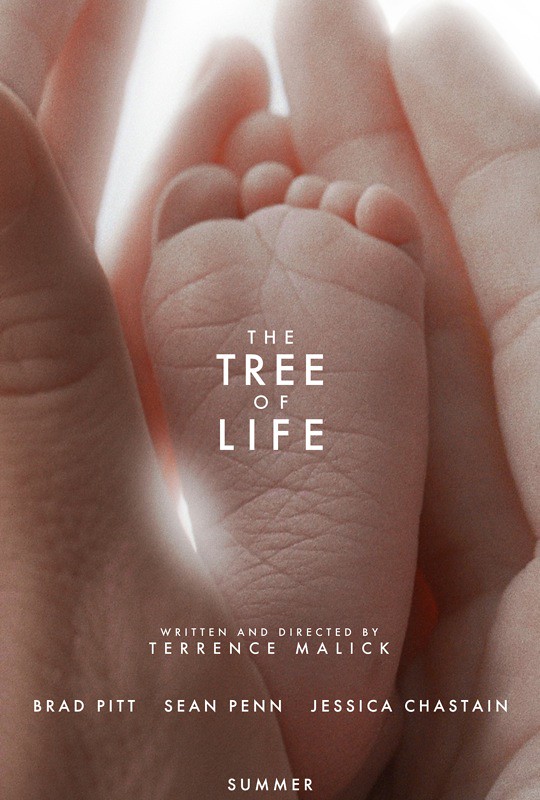
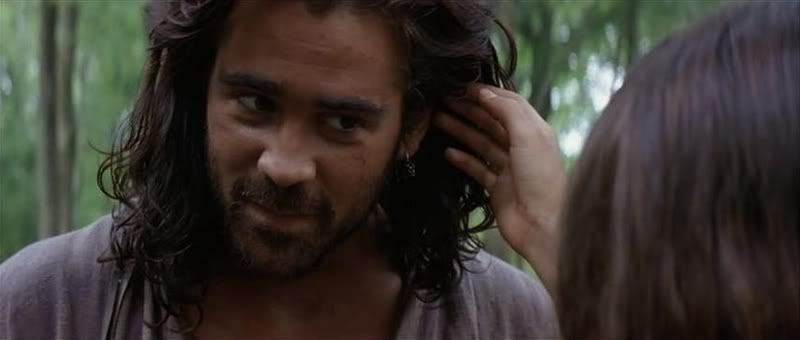
  • The Tree of Life (Terence Malick, 2011) Into the light. Multiple viewings and much ruminating have made its evident flaws insignificant in the face of its visionary design.
  • A Dangerous Method (David Cronenberg, 2011) Keira Knightley's polarizing performance in this impeccably composed, perfectly Cronenbergian film, led my way to a new understanding of my long-least favorite genre: the biopic. Historical figures perform specific functions for modern humans; why not allow actors to embody these functions by acting them out on screen?
  • Certified Copy (Abbas Kiarostami, 2010) It's a bit strange that the San Francisco Film Critics Circle picked a largely English-language film for their 2011 Foreign Language Film award. I'll approve and attribute it to the masterful illusionism practiced by its Iranian director, its French star (Juliette Binoche), and the Tuscan countryside setting. All three create a mesmerizing surface beneath which there is even more to see, and contemplate. English-language films just don't do that, do they? Except for the exceptions.
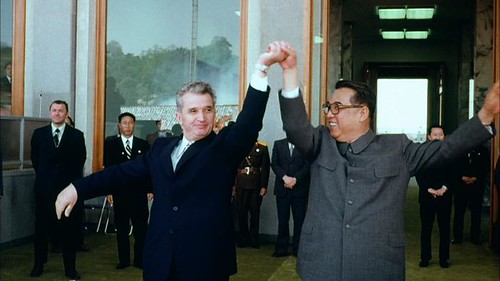

Five superb films I saw in 2011 that screened in San Francisco for the first time this year. All had so-called "commercial" releases except the first one listed; it played for a week in New York but had only a handful of screenings at the San Francisco International Film Festival here.
  • The Autobiography of Nicolae Ceaucescu (Andrei Ujica, 2010) "Look in my eyes; what do you see?...I'm the smiling face on your TV..." The past months have seen the final days of two of the world's most reviled dictators. We can hope, but not really expect, that they won't be replaced by others equally heinous somewhere in the world. But how often does tyranny conform to the images we expect from it? Such a question is at the center of this three-hour compilation of naked newsreel footage taken from the archives of the 1965-1989 Romanian leader's personal photographers. Kim Jong-il's father Kim Il-sung makes an astonishing cameo appearance.
  • The Time That Remains (Elia Suleiman, 2009) Palestinian director Suleiman applies the darkly absurdist, somewhat Tati-esque style he perfected in his previous film Divine Intervention to even more overtly autobiographical material. If its predecessor is any indication, it should only grow in my estimation with repeated viewings in the coming years.
  • The Arbor (Clio Barnard, 2010) A strange and remarkable work. The documentary tradition in theatre is long but little-known, so bringing some of its techniques for merging non-fiction material with acted performance into a cinematic sphere feels like a real breath of fresh air. It's particularly inspired in the service of its subject: the life and legacy of Yorkshire playwright Andrea Dunbar.
  • The Skin I Live In (Pedro Almodovar, 2011) I run hot and cold on Pedro's filmography, and had even skipped Broken Embraces after being disappointed by his previous two features. I'm back on board. Here, he forays into horror and science fiction without upsetting his delicate balance of telenovelistic melodrama and cinematic spectacle. To hint at why this film is something only Almodovar might have devised is to give too much of its plot away. I'll just say that maybe Bad Education could've been improved with a hint of Karl Freund's 1935 Mad Love in it.
  • Inni (Vincent Morisset, 2011) Is this monochromatic, visually experimental shadow box a new way forward for the concert film? If you prefer imagining the Icelandic band's sustains ricocheting against the back of a darkened concert hall rather than off beautiful mountains and lakes (as in 2007's Heima), then this is the Sigur Rós movie for you.
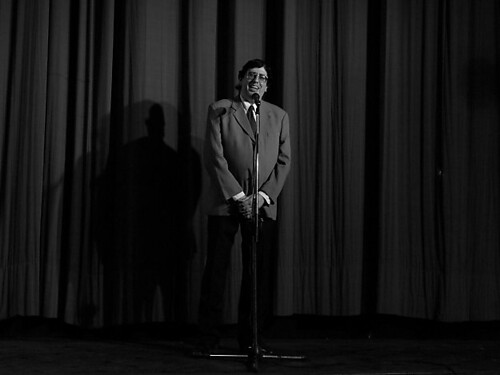

Five beautiful films which I didn't see in 2011, but which were first publicly screened in San Francisco this year and were a big part of my conversations about cinema. Having seen them in 2010, I wish I'd made time to see them again when they played in local cinemas in 2011.
  • A Useful Life (Federico Veiroj, 2010) I never had to see a Uruguayan film before this one to fall in love with this neorealist-goes-expressionist oratorio for that tiny country's cinema culture and one average man's place in it. And out of it.
  • The Mysteries of Lisbon (Raul Ruiz, 2010) A fitting swan song for one of the most mysterious filmmakers I know. The impossible-to-peg Chilean died in August but not before gracing us with a beautiful, sprawling adaptation of a novel by 19th-century Romantic Camilo Castelo Branco. (No, I hadn't heard of hm before either.) Dig those digital split diopter shots!
  • Another Year (Mike Leigh, 2010) The British misanthrope-or-is-he's most Ozu-esque film to date.
  • Meek's Cutoff (Kelly Reichardt, 2010) One of the American filmmakers best at portraying the so-called "outsiders" (or should I say the 99%?) of our modern society points her camera into history, showing us the stratifications found among a small community of pioneers heading West circa 1845.
  • Essential Killing (Jerzy Skolimowski, 2010) Just as exciting as The Fugitive except far more ambiguous and ambivalent about its moral position. Pure cinema.
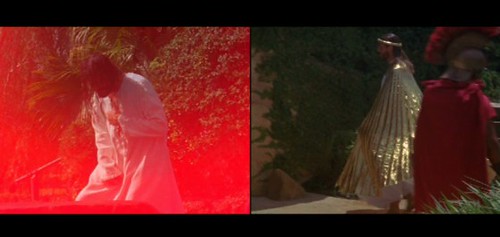

Five terrific films that I saw at San Francisco festivals or other alternative venues in 2011, that have yet to secure "commercial" distribution in this country, as far as I am aware. In alphabetical, not preferential, order.
  • 28.IV.81 (Descending Figures) (Christopher Harris, 2011) A brightly-colored dual-projector comedy set amidst a Florida amusement park passion play where baseball caps mingle with Centurion helmets.
  • Chantrapas (Otar Iosseliani, 2010) Films about filmmaking are cinephile catnip, right? Well, this certainly trumps The Artist as an authentically moving tribute to a vanished mode of production left behind for a new life and search for meaning.
  • Disorder (Weikai Huang, 2009) Around Guangzhao in an hour. Dizzying in design, execution, imagery, editing style, and political audaciousness. Truly the closest thing to Dziga Vertov's vision for his kinoks the 21st Century has seen thus far in a single work.
  • HaHaHa (Hong Sangsoo, 2010) One of the funniest and most thought-provoking films from one of my favorite working directors. Need I say more?
  • Lethe (Lewis Klahr, 2009) Klahr's collage films can provide a closer look at vintage comic book art than even the most finicky collector is likely to take unless scrutinizing that line between "very fine" and "near mint". We see the visual DNA of colors and shading magnified, and at the same time we read between the panels, guided by the filmmaker's temporal and spatial dislocations. The standout of a strong set of new-ish work Klahr brought for local premieres this year, Lethe is a remix of a 1960s Doctor Solar story that becomes a noirish drama set to Gustav Mahler.

Five amazing films I saw in 2011 that have yet to screen publicly anywhere in San Francisco. In alphabetical, not preferential, order.
  • Almayer's Folly (Chantal Akerman, 2011) Entrancingly old-fashioned adaptation of Joseph Conrad's first novel, transposed to stuck-in-time Cambodia.
  • the Day He Arrives (Hong Sangsoo, 2011) Is Hong's return to black-and-white cinematography, eleven years and as many films after Virgin Stripped Bare By Her Bachelors, a sign that we should question the veracity of every scene, but this time around without a bifurcated structure to help guide us?
  • Ghost Dance (Mark Wilson, 2009) Named for the call to apocalyptic change performed by the Modoc (as beautifully described in Rebecca Solnit's book River of Shadows), this brief, but spectacularly ever-expanding animation recalls Eadweard Muybridge's own technological call for for a paradigm shift.
  • Longhorn Tremelo (Scott Stark, 2010) Begins and ends as a study of black shadows against mobile fields, but goes through a dazzling array of burnt-orange-and-white permutations in between. A version is viewable on vimeo, but I'd love to be able to see the full two-projector version somehow.
  • The Turin Horse (Bela Tarr, 2011) A Nietzche-inspired tour-de-force from one of the most forceful visions around.

THE DAY HE ARRIVES


____________________________

Brian Darr lives in San Francisco, where he watches movies, though he's been known to travel for cinema as well. He blogs here and twitters here.

Monday, May 16, 2011

Cannes 2011 #3: There is no tunnel, only light

by Ryland Walker Knight


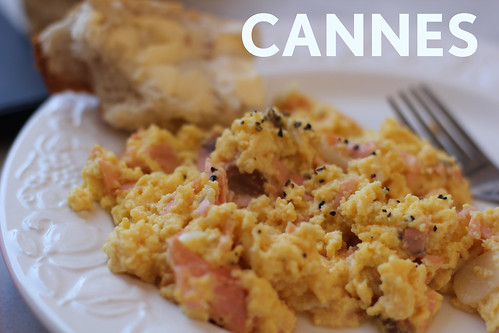
SAUMON FUMÉ

After Tree of Life I made some eggs (above) and wrote my mom a letter about the movie, which I am very happy to have seen but that made me miss a lot of people at home and elsewhere. Here's the link to Cargo again.

UPDATE:
If you want to see me still dazed (though also re-caffeinated) and bemused in the bustling lobby of the Palais after the film, watch this video at The Guardian.

Friday, March 25, 2011

Heft in here like still cold in the pipes water hitting your face

by Ryland Walker Knight


The visible and the invisible
—Like a ruler it both measures and defines the object

It's official, folks: I'm going to Cannes this year. I've been accredited as a correspondent/critic for the film magazine Cargo*, which is German in print but open to English on its blog, where I hope to write as often as possible about the films I see. Odds favor that I'll contribute some things to The Notebook for/with Danny, and I may have some other opportunities to write about my experience/s, but more on all that later. Hell, I don't know yet what we'll be seeing with any certainty. I sure do hope we see Tree of Life but all I can do right now is cross my fingers. (Well, that and save money.) In any event, what plays the festival and what doesn't play the festival—or, what I get to see, what I don't—doesn't matter to me as much as, simply, my good fortune to be in a position to make the trip. Not everybody gets to go to Cannes. So I promise to enjoy it, first of all, and, second of all, I promise to make my reports (whatever form they take) worthy of your time. That is, they won't just be tossed off viewing logs. I'll try to make real, cogent arguments for my Cargo blogging. I still might post a stray log (with links) here at home base, for fun, but I'm going to try to focus my energies outside my current, little routines.

Since I know you're super curious (doubt it) and since my parents like this photo, here's the picture that will grace my festival badge for Cannes and for the SF Int'l just prior to my departure. I suppose offering the image is not just narcissism but also a reference if, by some miracle, you happen to spot me at either festival and want to say hi. Funds are slim (cough, we do have a tip jar on the side bar), but I'd be willing to buy you a free drink and talk about things beyond the silver screen. Otherwise, you can find me on twitter, as ever. I don't begrudge twitter haters, or people who've grown bored with my shtick in said arena, but I will say that I may (though I may not) tweet my way through the two fests and you might want to tune in (follow? subscribe?) to keep abreast of all my observations in a more immediate, two-point-oh way. Odds are good on the twitter angle, too—San Francisco in particular as it's kind of like a warm up round before the real plunge (and I do hope to swim some, I'll have you know)—but I've still got a day job in the meantime and it requires a lot of energy so posting, as it has for a while, will remain largely light around here. Just so we're clear. Until such time as I may say grace again at your table, or just post a viewing log, I bid you fond farewells.


* My latest essay for the magazine, on David O. Russell and The Fighter in particular, can sort of be seen by clicking here. The title in German is "Demolierte Pathosformeln" and Google does me a hilarious service by translating it as "Demolished pathos formulas" (I did not submit a title, fwiw).

Wednesday, December 15, 2010

Convergence for your metabolism's liaison in light (12/15/10)

by Ryland Walker Knight


Terry Evans

Starts here

Monday, October 25, 2010

Viewing Log #55: September highlights

by Ryland Walker Knight


  • demonlover [Olivier Assayas, 2002] Look at this twitpic, and then read Glenn's thing maybe. Here, again, I risk the wrath of GK, and Kent Jones: it's a hoot, and largely fascinating, but also the owner of a rather empty punchline.
  • The Social Network [David Fincher, 2010] A problematic, thoroughly entertaining film I hope I never have to talk to anybody about ever again.
  • The Thin Red Line [Terrence Malick, 1998] # Here's some gushing and here's some mush-mouth. It's important to me.
  • The Last Picture Show [Peter Bogdonavich, 1971] As formal as it gets and so, so apt to anybody with an ear for confusion. You know, everybody.
  • A Brighter Summer Day [Edward Yang, 1991] Worth every minute. Loved how much of it's specifically about light, and shining lights (on things) and not seeing because of the lack of light, and how all the big acts of violence happen at night, in low light. If I see it again (and hopefully in a theatre again), I'll take real notes and maybe write a real poem about it.
  • Pretty much every single episode of Tim & Eric Awesome Show Great Job [T+E, 2007-2010] # Cuz I had to. And cuz I love it. Cuz they're the best. (Sure, it gets/got tiresome; but who gives a turd ya dingus?)
  • The Tim & Eric Awesome Show Great Job Crimbus Special and Tour Promo [T+E, 2010] The best thing in the world. Everything.
  • Enter The Void [Gaspar Noé, 2009] I tried to be positive at this joint and largely failed.
  • The first half of Season Three of The Sopranos [David Chase?, 2001] #, which is absolutely brutal and absolutely fantastic and rather often absolutely hilarious.
  • Danny Perez's visuals at the Panda Bear show; especially the wave and its square spots at the end.
  • Oedipus Wrecks [Woody Allen, 1989] A lot of fun, in part because it's "on the nose."
  • Life Lessons [Martin Scorsese, 1989] Rituals, process, it's all a lie to try to cover your patterns.
  • Will Success Spoil Rock Hunter? [Frank Tashlin, 1957] At the Castro, with Brian. The opening is my favorite part.

Tuesday, September 28, 2010

The things you made

by Ryland Walker Knight

Dear ewe,


this one

Earlier today, the good folks at GreenCine Daily hit "publish" on this little paean to what I've often told you is my favorite film. I tried to get at a few things in the piece, but, as can happen, I lost my way. I wanted to talk more about address and philosophy and arrogance but I figured (probably correctly) that this would have far exceeded my duties, or at least the desired scope, at hand. I decided somewhere in there that I'd write you a letter about what really interested me watching the film again last week.

Suffice to say, it looked great on that HD television upstairs, even if I worried I'd gotten the settings all wrong and that Caviezel's face was in fact stretched fat. Further, even through shitty components it looked better than the old Fox disc I've carted around for so long. Nothing will replace a theatrical screening. (Or my first, somewhere after Christmas in the latest days of 1998, amidst some pinballing around LA's belt of plain concrete with my mom for a New Year's Eve "celebration" with her folks. You can imagine how psyched I was, all of 16 and proud to know who Terrence Malick was, having seen his two almost-forgotten 1970s features on VHS tapes my dad'd either rented or bought.) In any case, the restoration looks great, as you'd expect from those Criterion folks. Big surprise.

What did surprise me was how watching it loud, as Terrence Malick instructs via text before the film, really changed it again. Over the past twelve years, I'd been so obsessed with the images and the words that I forgot how bombastic the action scenes are, how often you hear a warbler, how certain actors' breath sounds clipped or how bodies fording grass fields can sound like a record played backwards on low volume. The wind sounds like wind, not bad microphones. And the voice-over work became more mysterious. I was certain for so long that Sean Penn'd said those last lines, the famous ones about shining I entertained tattooing on my left arm, but now I'm not so certain. Not that it matters. Each timber carries a different affect. I wouldn't be surprised if Malick made a bunch of young men record the same words and chose whose tenor suited the light best after the fact in post-production.

(How indulgent a working method! Yet also: how typical of a bright mind. Amass as much evidence and build the best argument; or, gather your groceries and get creative.)

This unmoored voice, ascribable to any, seems the defining characteristic of the film. I'd bet not too many people would disagree. My dad, for instance, always complains he can't tell who's talking. He needs that clarity for a fiction to work, he needs a representative element. (Or so it seems from our talks.) Again, I don't think this is uncommon. What I find so fascinating, though is that position's opposite: the delicious confusion of an overlay, like the white noise of some shoegaze rock, or the layers Wes Anderson makes 100% literal in so many of his slow-motion tableaux. A phrase that got morphed in my essay was "splay valence." This means something very specific to me, so it hurt to be asked to change it for clarity's sake, and slabbing down "layering meaning through a variety of aesthetic effects" felt exactly anathema to the alliterative fun of my prior, um, contrivance. It's also a bad definition. What's so comforting about Malick's movies is consistent with all my favorite works of art: they confirm certain philosophies I harbor about the world, specifically about wanting the world and wanting to be in the world. That is, they confirm my desire to want to live. You know that about me: it's about life, about living, for me. It? Art, mostly, but more simply anything, including life itself. So many hours we've talked this summer about how you want to live, what we're doing independently to find and make and lead the lives we want. (Of course, it'd be better if we could congrue those aims more often, ie, live near each other, but the world doesn't allow for everything we want all the time, including our wanting it.) Which is a long, indulgent way back around to these voices and their seeking, their questions, how they aim to get at the world's (and life's) mysteries. And, as we talked about last night even, there's all kinds of answers to pour yourself into—but it's the forfeit-others choice that helps define things. What I (and I think you) find so phenomenal about The Thin Red Line, in the end, isn't that it simply "accepts the mystery" (I know you're growing to hate the Coens) when that voice asks for his soul to join him but precisely that we can ask for that, for our selves to cohere, and see the world we want. And then use our powers to foster this world.

Too bad there's always got to be money involved, eh?

A world of love,
ry

Wednesday, May 05, 2010

Convergence for birthday complexities (5/5/10)

by Ryland Walker Knight


—Being alive is knotty! But it keeps happening!

Friday, September 25, 2009

Whistle while you widget

by Ryland Walker Knight


bud ice
I don't have a license to sell you these.

After reading Shoals' relaunch of the FD widget earlier today, I asked him if he thought I'd do well to follow suit and bring some Amazonian presence back to my sidebar. The chat, though quick, was thorough, or thorough enough, and lead to the inevitable "Why not?" conclusion. It doesn't look too tacky, and if I make a feature out of it, writing little blurbs every now and again, maybe you'll be so kind as to start your Amazon purchases here, at VINYL IS HEAVY, so we (that is, I) can get a teeny-tiny kick-back every month. You know the drill: every bit helps in this economy! The occasional link here and there—and my old suggestion buttons at the bottom of the old sidebar in the old layout—brought in some unexpected and welcome beer money, and now that we're getting more eyes than ever, I thought, why not take up that old shameless shilling tag and put it to good use.

For our first batch of recommendations, we have some obvious VINYL favorites. And, note, that even if you don't buy any of these items, and buy something else, like, say, Gossip Girl Season 1 on DVD, you'll still be helping out if you start here. Thus, in no particular order, here's what we're hocking/highlighting:

hold our hands
hold his hand

  • The New World: The Extended Cut on Blu-Ray. I don't have a Blu-Ray player, or a PS3, but if I did this would be the first disc I'd buy because, as many of you may know, it's one of my favorite movies ever, and possibly my second-favorite film of this decade we're ending. It's gorgeous. And the disc is super cheap, which is a bonus. You can read more of my thoughts back at The House Next Door.

  • Stanley Cavell's The World Viewed, which I lost only two weeks into the new year on an A-train back to Bed-Stuy from a screening of the mostly-skipped-over California Dreamin, which is a fine little film that my buddy Keith Uhlich likes a great deal. At any rate, Cavell's book is seminal for my thinking. And I've leaned on it, not Bazin, for much of my ontological thoughts about the image. Here's our Stanley Cavell tag.

  • Manuel Göttsching's E2-E4, which I first mentioned in the first-ever convergence back on Feb 28th, 2009. It's a bit pricey, since it's only available as an import, but, man, it's something special. The beginnings of so much cool stuff, including LCD Soundsystem's indelible 45:33 mix (according to Wikipedia).

  • Arthur Russell's Love is Overtaking Me, which was compiled and released last year, which I made mention of back at this post. If you're feeling blue, or you want someone to touch you in your ears on your way inside, to your heart, maybe, then give this long-player a spin. The title track alone is worth the world.

  • The one, the only, the massive, the hilarious: Don Quixote. I've been reading Edith Grossman's translation for a couple months now thanks to a gift from my dad and, boy, this thing is a hoot. Sure, it's big and it'll eat up your time, and you'll be committing to an undertaking, but don't think of it that way: think of all the jokes you get on every page, in every sentence. And Grossman's translation is rightly renowned for its readability (and footnotes).

godard is a liar, but i'm not
—Sure do love you out there!

Thursday, February 12, 2009

10 Personal Touchstones in American Cinema

by Ryland Walker Knight


[Originally posted at the curator corner, where you can read the full post.]

the end?

Tuesday, June 24, 2008

Saluting is like pointing, kinda. Steven Boone on SpoutBlog.

by Ryland Walker Knight


sky

So my buddy Steven Boone has been writing for Spout Blog every Friday for a little more than a month, in case you had yet to see. You can check his archive here. But last week's "Felon Fest: Notes on Camp" is my favorite so far. And not just because he references a favorite film at the close of the piece but for Steve's careful, yet lively, prose. I told him via email that I want to read more of this kind of writing from him, that incorporates narrative into the criticism; if you can call this criticism. I guess this is closer to the Phillip Lopate personal essay. Which, I guess, is where Steve is going with his work for this column (and beyond; but I'll leave that to him to disclose). In any event -- not that it needs my recommendation -- I simply want to salute my friend. And point anybody who visits this blog (if there are some who still check in here) towards his recent output.

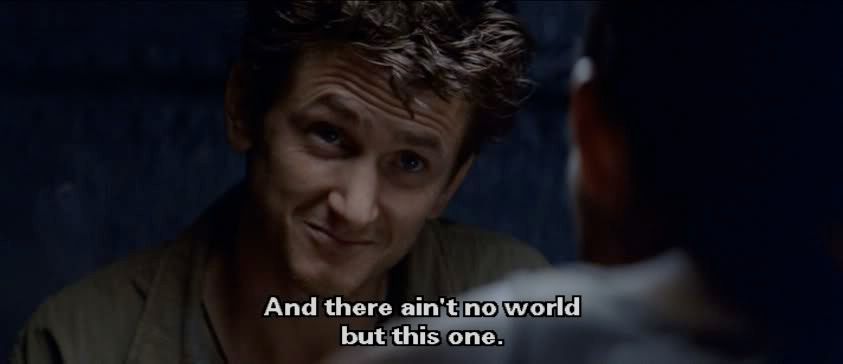
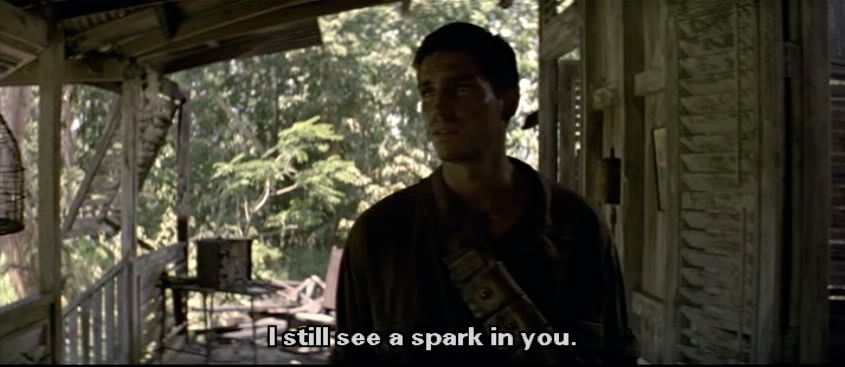
I also wanted to say that, like Steve, I'm always blown away by the encounters between Jim Caviezel and Sean Penn in The Thin Red Line. Those scenes are the heart of the picture. Trying to see what spark is left in the light of the world. Or how we may rekindle.

strike
look

Monday, April 28, 2008

The New World: Reverse Shot Goes Digital


spots
smoke
focus

It should probably come as no surprise that I wrote about Michael Mann for Reverse Shot's newest issue. He's been on my brain for a while now thanks to my thesis work and, well, his excellent films that invite scrutiny. You can read my contribution, "The Touch," by clicking here. And, of course, the intro is always a nice place to start, to give you an idea of what we were after in this latest symposium. You can read it clicking here. Hope you like. I invite any comments on my piece here since the main site does not; there's plenty to talk about. Or, if you read another, like Leo Goldsmith on VINYL-favorite David Lynch or Chris Wisniewski on VINYL-favorite Terrence Malick or my buddy Kevin B Lee on the immortal Ingmar Bergman, let me know. This is a very thoughtful and plain cool issue. --RWK

Thursday, February 14, 2008

A thought on "authorial intentionality" in film, in criticism

From Ryland:

Not sure if I 100% agree with Noel Carroll's reading of The General in Comedy Incarnate* (I have not finished, and I may not finish, reading the book) but I appreciate this brief characterization of "authorial intentionality" he offers in the introduction. Its something I'm hoping to incorporate into my idea of film criticism as a kind of phenomenological hermeneutics. But I really want to stay away from somebody like Heidegger, for now, because, at the least, that would require quite the diversion from my project. This is much more in line with what I'm after:

In addition to being impressed by Merleau-Ponty's work, I was also smitten by the phenomenological criticism of the so-called Geneva school, most especially by the writing of Georges Poulet. For Poulet, an author, by means of his emphases and selections, presents his "intentionality" to the reader -- the way in which his consciousness is directed toward the world. The task of analysis then is to identify these patterns of experience as they emerge in a text -- to notice toward what the author's attention is drawn, and, as well, to characterize the manner in which that attention is articulated. Discussing Balzac, Poulet locates an experiential pattern of recurring physical thrusts forward which he thematizes in terms of a movement toward the future; in Whitman, Poulet finds a mode of consciousness of the world that is marked by infinite receptivity as multitudes crowd into emptiness and things collect, meet up, and fill space. Both authors offer the reader a model of their "intentional consciousness," their fashion of encountering the Lebenswelt through reference to very fundamental modalities of experience.

The notion of "authorial intentionality" is immensely suggestive when it is transposed from the literary author to the film director. For essential to the notion of intentionality is directedness toward the objects of consciousness and that, of course, is arguably what a director does with cinematic apparatuses -- directs cameras towards objects and selects views and perspectives on situations through editing. Thus, cinematic technique can be a way in which a director may objectify, externalize, or incarnate his style of attending to or relating to the world -- articulating the temper of his consciousness of things on celluloid, his intentionality or mind embodied, so to speak, in silver nitrate. Though no allusion to Poulet's idea of authorial intentionality occurs overtly in the text -- perhaps for fear of sounding too literary -- this notion stood behind my analysis of Keaton's visual style, which I unequivocally thought of as rooted in his personal style -- his way of inhabiting the world.

I hope to make a similar argument, although tailored towards a different end (involving other concerns than bodily intelligence, like intelligibility, for instance), in favor of Terrence Malick and Michael Mann and their respective, most recent films (The New World and Miami Vice). Plus some stuff about what this kind of attention in a work of criticism means for the project of criticism and all that jazz. There's a lot at play already so I may wind up ditching my original plan to look at two later Hitchock films (North by Northwest and To Catch a Thief) that fit with the films of Malick and Mann for their individual interests (and the conversation between the films that such interests provoke) in what Stanley Cavell calls the mythical America, that place where pursuits of happiness are encouraged, and possible.

*Thankfully I got a copy from the UC Berkeley library. As is often the case with these "academic" works of criticism, to own a copy means forking over a rather large lump sum of your budget -- as you can see here on Amazon. I don't know why this always astounds me, but it does.

Monday, November 12, 2007

Are you an angry man? Are you envious?


Some words from Ryland Walker Knight to you, fine readers: Go to The House Next Door and read my early review of There Will Be Blood. It was difficult to know what to include in the review given the film does not open for more than a month (and then, only in New York and Los Angeles). But I think I got at something without spoiling too much, if anything, given a familiarity with the film's trailers. There's plenty more to discuss with this film and I look forward to other writers tackling its treasures/horrors. I'm sure somebody will talk about the scene in the ocean (yeah, really) in a beautiful way. And somebody's got to do something with the milkshake line (no, there's no boys at the yard). Simply put: it's a rich film, one that will astound many. And provide plenty of dialogue. I hope you see it on as big a screen as possible, with the loudest sound system possible -- it's the only way to do it justice. (I saw it at the Castro, along with Michael Guillen and, if it really was sold out, roughly 1400 other people, last Monday. I feel lucky: they have a huge screen and they always crank the sound. Part of the fun of their 70mm film festival is experiencing the screeching wails and dead-calm silence of 2001 when the volume is turned up to 11.)

While searching for links for the piece, I found this amazing shill bit featuring Jason Alexander (yeah, him) talking about Sam Shepard's play, God of Hell, which Alexander directed for the Geffen Playhouse in Los Angeles last year. Some of what he has to say applies to PTA's films, too, but I include it hear, mostly, because it made me laugh. Also, Tom Cruise is the best thing in Magnolia; imagine him doing this about his real passion, Scientology. Wouch.


* * *


Still haven't listened to In Rainbows but I plan on it soon, especially after Johnny Greenwood's amazing score for There Will Be Blood. Is it worth 10 cents? How much did you pay? Guess I'll go ahead and download the son-of-a-bitch.

* * *


I saw the Coens' new picture, No Country for Old Men this weekend. It, too, is brutal. But it's after something rather different. I hope to have more to say on the film in these webspaces soon. For now I'll hint with this: Tommy Lee Jones is perfect and the brothers' attention to language (as a social practice, as an element of characterization, as given to philosophy, as a music) is amazing. I like to think of Wes Anderson as the inheritor of Sturges but these New York Jews sure do have some of him in them. What's funny is I prefer this preoccupation with language in films like this one (and Hudsucker, which is more akin to Hawks) than I do in O Brother Where Art Thou?. But I should rewatch that picture. I may have to see this new one again before I can really argue for something instead of saying, "Jesus Christ. Er, God-damn. Oh, fuck it, the world holds too much evil sometimes." Stay tuned. In the meantime, the opening monologue:
I always knew you had to be willing to die to even do this job - not to be glorious. But I don't want to push my chips forward and go out and meet something I don't understand. You can say it's my job to fight it but I don't know what it is anymore. ...More than that, I don't want to know. A man would have to put his soul at hazard. ... He would have to say, okay, I'll be part of this world.

* * *

Wanted to share that, yes, Days of Heaven looks gorgeous on the new Criterion disc. It's wholly different than There Will Be Blood and No Country, but they form a nice trilogy to watch together in a week. If you can, I recommend it. Perhaps some screenshots will come later.

Wednesday, August 08, 2007

Late night realization. A spark in you, just before bed.

HERE IT IS: If I lost my eyes I would want to die; and I would be afraid to cry. I love my sight. And my life. And Terrence Malick's movies. Also, I mean it when I say, "I believe in America, and rivers."

HERE I SEE SOME MORE, snatched from Ludwig Wittgenstein's Philosophical Investigations:


103. The ideal, as we think of it, is unshakable. You can never get outside it; you must always turn back. There is no outside; outside you cannot breathe. --Where does this idea come from? It is like a pair of glasses on our nose through which we see whatever we look at. It never occurs to us to take them off.

126. Philosophy simply puts everything before us, and neither explains nor deduces anything.--Since everything lies open to view there is nothing to explain. For what is hidden, for example, is of no interest to us.
One might also give the name "philosophy" to what is possible before all new discoveries and inventions.

131. For we can avoid ineptness or emptiness in our assertions only by presenting the model as what it is, as an object of comparison--as, so to speak, a measuring-rod; not as a preconceived idea to which reality must correspond. (The dogmatism into which we fall so easily in doing philosophy.)


HERE WE BASK IN DELIGHT: This does zero justice to the beauty at hand, what with pixelation and the downsizing of widescreen genius. Luckily, spirits shine bright no matter the darkness, or how small the cracks through which light leaks.


[You're a magician to me. --RWK]