Showing posts with label The New World. Show all posts

Friday, September 25, 2009

Whistle while you widget

by Ryland Walker Knight


bud ice
I don't have a license to sell you these.

After reading Shoals' relaunch of the FD widget earlier today, I asked him if he thought I'd do well to follow suit and bring some Amazonian presence back to my sidebar. The chat, though quick, was thorough, or thorough enough, and lead to the inevitable "Why not?" conclusion. It doesn't look too tacky, and if I make a feature out of it, writing little blurbs every now and again, maybe you'll be so kind as to start your Amazon purchases here, at VINYL IS HEAVY, so we (that is, I) can get a teeny-tiny kick-back every month. You know the drill: every bit helps in this economy! The occasional link here and there—and my old suggestion buttons at the bottom of the old sidebar in the old layout—brought in some unexpected and welcome beer money, and now that we're getting more eyes than ever, I thought, why not take up that old shameless shilling tag and put it to good use.

For our first batch of recommendations, we have some obvious VINYL favorites. And, note, that even if you don't buy any of these items, and buy something else, like, say, Gossip Girl Season 1 on DVD, you'll still be helping out if you start here. Thus, in no particular order, here's what we're hocking/highlighting:
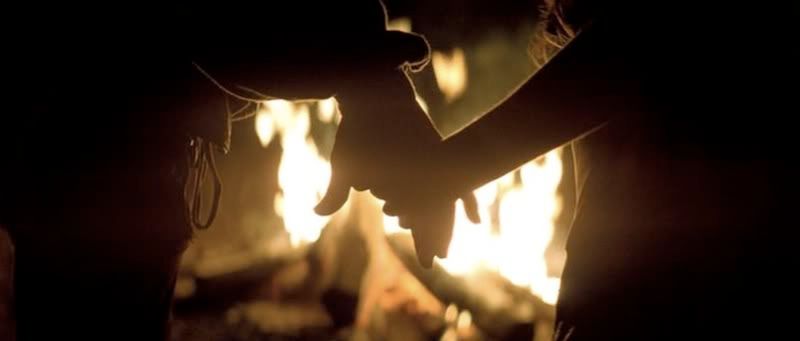
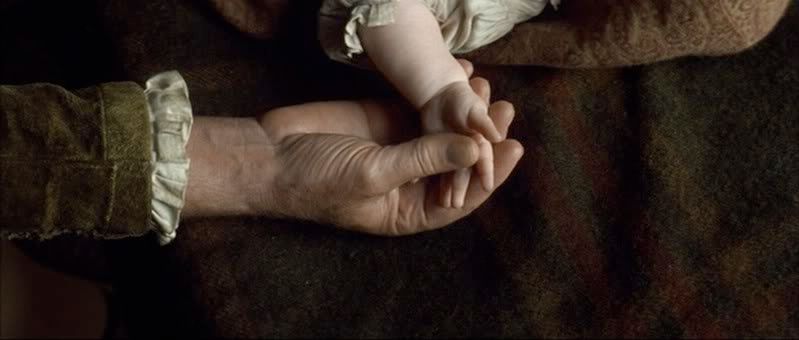
hold our hands
hold his hand

  • The New World: The Extended Cut on Blu-Ray. I don't have a Blu-Ray player, or a PS3, but if I did this would be the first disc I'd buy because, as many of you may know, it's one of my favorite movies ever, and possibly my second-favorite film of this decade we're ending. It's gorgeous. And the disc is super cheap, which is a bonus. You can read more of my thoughts back at The House Next Door.

  • Stanley Cavell's The World Viewed, which I lost only two weeks into the new year on an A-train back to Bed-Stuy from a screening of the mostly-skipped-over California Dreamin, which is a fine little film that my buddy Keith Uhlich likes a great deal. At any rate, Cavell's book is seminal for my thinking. And I've leaned on it, not Bazin, for much of my ontological thoughts about the image. Here's our Stanley Cavell tag.

  • Manuel Göttsching's E2-E4, which I first mentioned in the first-ever convergence back on Feb 28th, 2009. It's a bit pricey, since it's only available as an import, but, man, it's something special. The beginnings of so much cool stuff, including LCD Soundsystem's indelible 45:33 mix (according to Wikipedia).

  • Arthur Russell's Love is Overtaking Me, which was compiled and released last year, which I made mention of back at this post. If you're feeling blue, or you want someone to touch you in your ears on your way inside, to your heart, maybe, then give this long-player a spin. The title track alone is worth the world.

  • The one, the only, the massive, the hilarious: Don Quixote. I've been reading Edith Grossman's translation for a couple months now thanks to a gift from my dad and, boy, this thing is a hoot. Sure, it's big and it'll eat up your time, and you'll be committing to an undertaking, but don't think of it that way: think of all the jokes you get on every page, in every sentence. And Grossman's translation is rightly renowned for its readability (and footnotes).
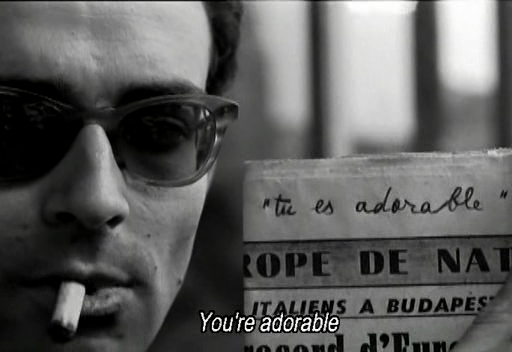
godard is a liar, but i'm not
—Sure do love you out there!

Thursday, February 14, 2008

A thought on "authorial intentionality" in film, in criticism

From Ryland:

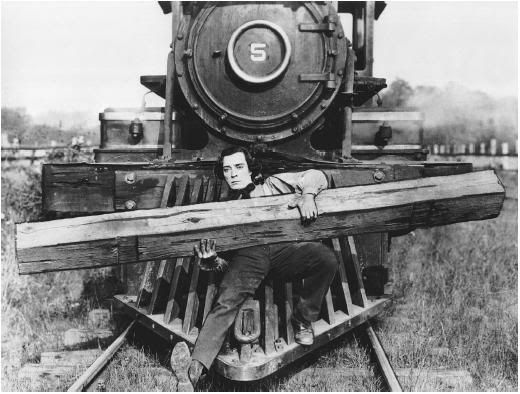
Not sure if I 100% agree with Noel Carroll's reading of The General in Comedy Incarnate* (I have not finished, and I may not finish, reading the book) but I appreciate this brief characterization of "authorial intentionality" he offers in the introduction. Its something I'm hoping to incorporate into my idea of film criticism as a kind of phenomenological hermeneutics. But I really want to stay away from somebody like Heidegger, for now, because, at the least, that would require quite the diversion from my project. This is much more in line with what I'm after:

In addition to being impressed by Merleau-Ponty's work, I was also smitten by the phenomenological criticism of the so-called Geneva school, most especially by the writing of Georges Poulet. For Poulet, an author, by means of his emphases and selections, presents his "intentionality" to the reader -- the way in which his consciousness is directed toward the world. The task of analysis then is to identify these patterns of experience as they emerge in a text -- to notice toward what the author's attention is drawn, and, as well, to characterize the manner in which that attention is articulated. Discussing Balzac, Poulet locates an experiential pattern of recurring physical thrusts forward which he thematizes in terms of a movement toward the future; in Whitman, Poulet finds a mode of consciousness of the world that is marked by infinite receptivity as multitudes crowd into emptiness and things collect, meet up, and fill space. Both authors offer the reader a model of their "intentional consciousness," their fashion of encountering the Lebenswelt through reference to very fundamental modalities of experience.

The notion of "authorial intentionality" is immensely suggestive when it is transposed from the literary author to the film director. For essential to the notion of intentionality is directedness toward the objects of consciousness and that, of course, is arguably what a director does with cinematic apparatuses -- directs cameras towards objects and selects views and perspectives on situations through editing. Thus, cinematic technique can be a way in which a director may objectify, externalize, or incarnate his style of attending to or relating to the world -- articulating the temper of his consciousness of things on celluloid, his intentionality or mind embodied, so to speak, in silver nitrate. Though no allusion to Poulet's idea of authorial intentionality occurs overtly in the text -- perhaps for fear of sounding too literary -- this notion stood behind my analysis of Keaton's visual style, which I unequivocally thought of as rooted in his personal style -- his way of inhabiting the world.

I hope to make a similar argument, although tailored towards a different end (involving other concerns than bodily intelligence, like intelligibility, for instance), in favor of Terrence Malick and Michael Mann and their respective, most recent films (The New World and Miami Vice). Plus some stuff about what this kind of attention in a work of criticism means for the project of criticism and all that jazz. There's a lot at play already so I may wind up ditching my original plan to look at two later Hitchock films (North by Northwest and To Catch a Thief) that fit with the films of Malick and Mann for their individual interests (and the conversation between the films that such interests provoke) in what Stanley Cavell calls the mythical America, that place where pursuits of happiness are encouraged, and possible.

*Thankfully I got a copy from the UC Berkeley library. As is often the case with these "academic" works of criticism, to own a copy means forking over a rather large lump sum of your budget -- as you can see here on Amazon. I don't know why this always astounds me, but it does.

Sunday, October 21, 2007

Close-Up catch up for the day.

by Ryland Walker Knight


Ana

When Matt announced his idea for "The Close-Up Blog-a-thon" I got excited. I thought I would contribute a whole bunch of posts like Odie. School, alas, takes a lot of time away from blogging since my schooling is a bunch of reading and a bunch of writing. Combine that with a renewed Netflix account and you've got a lot of time filling up. But I'm trying to slow my roll on the Netflix Q, and move from near-constant consumption to more respective production via reflection. That is, I want to write more about more of the movies I watch.

For instance, I'm taking a course called "The Action Film." It's a ton of fun. The filmography is packed with cool movies and we get to watch them in a big room on campus complete with powerful surround sound that was built in honor of the man who started UC Berkeley's Film department. Last week we watched John Woo's Hard Boiled. It was perhaps the most riotous screening yet, which is saying something a week after jailbird McTiernan's Predator. I thought I might try to write about that close-up at the end of the first firefight, where Chow Yun Fat gets blood splattered all over his flour-covered white face after he shoots a dude in the face at close range. It's a shocking moment and my classmates sure did jump. What's cool about it, though, is it's just another moment for Woo to color his melodrama. It's really no different from how Pedro Almodovar shoots a lot of Matador, which is also after the melodrama of classic Hollywood (like Sirk, like Duel in the Sun). But a whole essay seemed too much.

In the end I wrote up a music video. When they work, music videos can be really alive and beautiful, not just shill tactics. And it's really weird (cool?) to me that Juvenile's first hit single, "Ha," was even chosen as a marketable single. Sure, it's got a killer hook, but the fact that you can't hear/understand fuck-all he's saying around the hook (at least at first) is pretty odd for a lead single. On top of that, the video is a kind of minor masterpiece blending the artificial performances with this queasy-distanced "documentary" footage. So I fumbled around with it and came up with this piece.

Another thing that flashed in my head when thinking about close-ups were past posts here that focused on screenshots of close-ups (or any striking compositions) as a visual kind of criticism. I'll let the images do the talking, so I grouped some links to those here, in chronological order:

feel my heartbeat

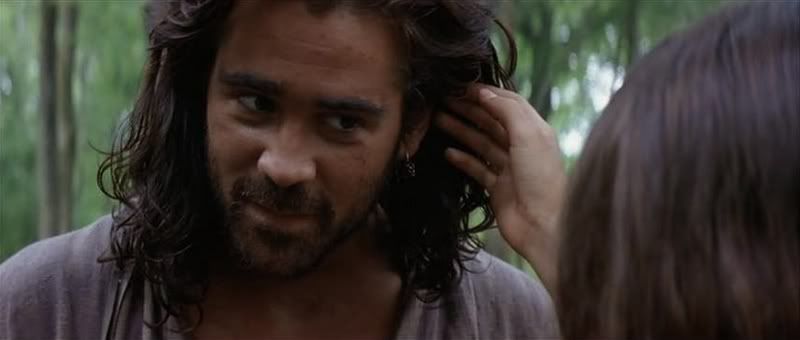
A Happy New World New Year looks at some rhyming images from Terrence Malick's masterpiece.

nothing

Born Under Punches: Véronique's hands offers some key images of Irène Jacob's tactile performance.


Evergreen syrup screenshot/s for the day peeks at a delicious moment in Claire Denis' Trouble Every Day that seems to get forgotten amongst all the bloodletting.


On A Dime Screenshots for the day delights in Zhang Ziyi's multifaceted facial expressions in one sequence from Wong Kar Wai's 2046.

Marcos

CINCO DE VINYL: Negotiating Battle in Heaven looks at Carlos Reygadas' second feature as more than just a bad-boy routine.

I think you're a fake

Fake screenshot for the day, or evening is a quote from The Life Aquatic.

she knows, homie

Claude Rains for the day is a brief reflection on a key moment in Hitchcock's Notorious.


Exploding heads, and hearts: 28 Weeks Later is thick with blood. tries its best to convey the weight of said film's brilliant opening sequence by grabbing key frames of blood, and eyes.

You can also simply click the tag "screenshot" below and see all these posts simultaneously, plus some others. But this looks pretty good, right? Oh yeah, here's the Juvenile video:

Tuesday, September 11, 2007

"America is a place, fictional no doubt, in which that happiness can be found."

by Ryland Walker Knight


I believe in America, and rivers.

September 11th is huge. So huge it compels people to place purple fliers in the shape of over-sized "9/11" on a deliciously green hill on the aptly named Memorial Glade outside Doe on campus here at UC Berkeley. I wanted to vomit. I said to my friend, "This is a real day, right? They don't do that kind of shit on December 7th, do they?" He replied that "they" do not and that today is, in fact, a real day. It felt good to be affirmed. But you know what? That misses the point, as funny as it may have been to me. The point is not that such displays are naive and silly. The point is that such displays are perfectly American. This place breeds that kind of ostentation, and entitlement. "These are my feelings, writ as large as possible, and you will have to deal with them. I will force them on you." Funny, I find the sentiment adorable, even rousing, in films like 25th Hour (a personal touchstone). But stapled purple fliers on a green hill? Please: there's no magic there. America is a magical place. It only exists as a myth, as a fiction, continually rewritten by its people through its events small and big, domestic and abroad: everything everywhere.

The words of the title of this post come from that Stanley Cavell essay on North by Northwest I mentioned in my brief missive about my Honors Thesis. It's a phrase that continues to astound me, and reverberate in my headspace, when I think about the kinds of American films I cherish. The New World is not a comedy, nor is it really a melodrama (who thinks they have a genre to slot it into?), but its core is in that Cavell aphorism. There is hope in the new world: possibilities abound for life to work. Even in death, America's afterlife thrives in the present. The waters run, the trees sway, the leaves fall. Things continue, and they are beautiful. John Rolfe returns home, anew, and America will embrace him, prepared to propel him forward. 25th Hour's fantasy finale is the same thing. It's also a spirit found in Preston Sturges films. With my fall disbursement I treated myself, finally, to that box set that came out last year. It's fantastic. But it is missing two crucial films: 1944's The Miracle of Morgan Creek and 1948's Unfaithfully Yours. The former stars Betty Hutton and Eddie Bracken and cannot be capsulated. The latter is available from Criterion Collection and it is phenomenal, hilarious, and dark. Both are as much about America and its arms-open plenum as the other films I cite. So, on a day like today, I say we salute that which we only continue to lose sight of: the foundational perfectionism, the gumption, and the hilarious hubris of America.


[Trailer 1: Unfaithfully Yours / Trailer 2: The Great McGinty]

[Pic: The Main Salmon River in Idaho, Salmon Falls. As I always say, "I believe in America, and rivers."]


UPDATE, 9/12/07, 5pm: Kevin Lee's most recent Shot-Down picture is Sturges' Unfaithfully Yours. You can read his take here or watch his video essay here. Kevin's project is nothing if not ambitious and extensive but I fear there's a tendency to foreground psychobiography, at least here, comparing Rex Harrison's conductor character to Sturges himself. This can only illuminate so much of the film. I much preferred reading the excerpts from the other sources, and figuring out what made those links between quotes significant for Kevin's argument. Perhaps I can offer more thoughts later after I re-watch the film. Still, do read Kevin's work: he is a fine writer, and committed.

Sunday, December 31, 2006

A Happy New World New Year

I offer a series of rhymes.


ripple effect
new ear
Where'd you get that?
Where'd I park?
St Smith


babytime
feel my heartbeat
best inter-splice ever
rice rain
Spirit, run free


[All taken from the New Line DVD without permission.]