Showing posts with label conversation. Show all posts

Monday, July 19, 2010

Always imagine new places. Notes on Inception [part one]

by Jennifer Stewart and Ryland Walker Knight
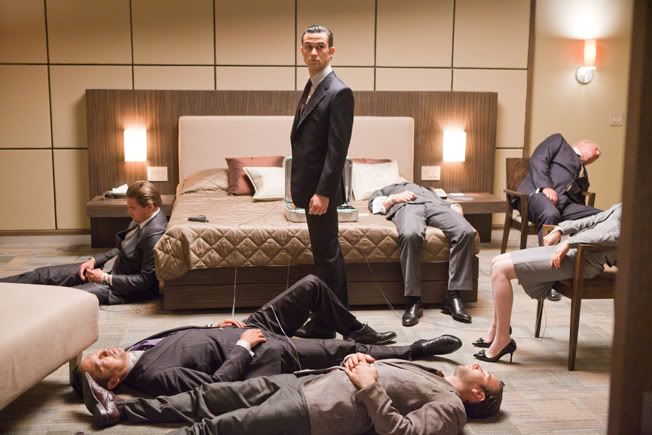


—Whare'd everybody go?

RY, et al:
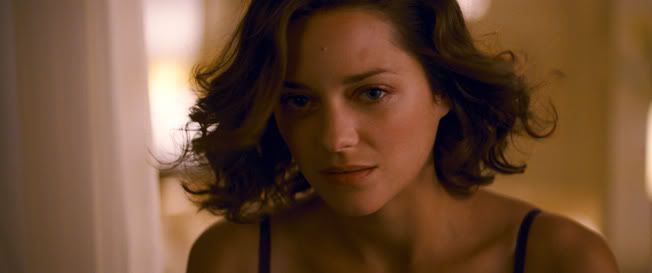
When WB encouraged Nolan to produce Inception in 3D, he opted instead for IMAX. Nolan argued that IMAX allowed a more submersive experience than the disjointed, unfocused composition of 3D. Absurd as 3D usually is, Inception's conceit to portray permeable, multivalent dreamworlds might've been the best candidate for it. There is something eerie and wrong about clear edges and sharp detail; where putting a dream on screen reveals the same contingencies and boundaries we know from waking life. Wouldn't the stark relief of foreground and blurred background of 3D better capture the tenuous, indistinct phenomenology of dreams? As Dom (DiCaprio) is at pains to emphasize to Ariadne (Page), it is not the details of the dream that matter, but the feel.

My theatre experience of Inception was hence an appreciative, but partial submersion. The best things to say about it bespeak Nolan's strengths: it looks fantastic, and Nolan is not afraid of challenging the audience to keep up, frame by frame, or risk losing the thread that tracks how we got here. In Momento, we followed the thread backwards to see where Leonard (Guy Pearce) started, and his body bears the inscriptions to trace back our steps. Her name suggests Ariadne herself is Inception's spindle of threat, anchored securely outside before unwinding as we progress deeper and deeper into the labyrinth.

Why these heavy-handed cues, though, Nolan? Given the film's refreshing willingness to dispense with almost any Basil Exposition of how the technology in Inception's world works, I guess Nolan wanted blunt mythos more than techno-speculative theoreticals. Which is great, but so then what's the film about? Part cautionary tale (careful what you manipulate in the dreams of another, lest it come true), part Jungian safari (look, Fischer's P2 subconscious is set on Hoth!), Inception is mostly a chance to give the movie screen a sorta (not really) new kind of depth, inspired by Nolan's idea of how characters in this fictional world might manage and manipulate multilevelled dream reality. In other words, Nolan takes the idea of layers of dream reality (dreams within dreams, where time and resistance slow down exponentially as we descend), and processes it through an onscreen analogy. The analogy is that reality is always checked by the body's morphology: we're assured of coming back up through the layers, so long as we can synchronize the body's kinetic interpretation of its true environment. The body can figure out where it is, even if the mind has lost itself.

It does make for an interesting way of tethering the characters to their various avatars, fragmented through multiple virtualities. Moreover, it lets Nolan design and realize those impressive set pieces (literally) turned upside-down by what's happening in the first dream (and only sometimes by what's happening in waking life, as when Dom is plunged into the bathtub in the opening sequence). It also lets Nolan play around a little with the consequences, in psychological espionage terms, of how 2-dimensional mediums (paper or any flat surface; like, say, a movie screen) can represent 3-dimensionality, but not without accruing paradoxes. And so Arthur (Gordon-Levitt) tips his surprised pursuer off one platform of the Escher-esque staircase, revealed by a camera move to be - hey! - severed from its next segment. These tactics remind us that Inception's frames are all heist genre, right down to the usual dramatic tragedy of the lead character's superlative penchant for deceiving and stealing from others explained by - that's right - his own experience of guilt, loss, and betrayal. Ry is right on that this is geometry morseso than architecture, for we're dealing with the aporias of using 2-dimensional vantage points on 3-dimensional worlds. The problem of what's concealed and revealed how the subconscious interprets and exploits this unstable world, is Nolan's own infectious idea.

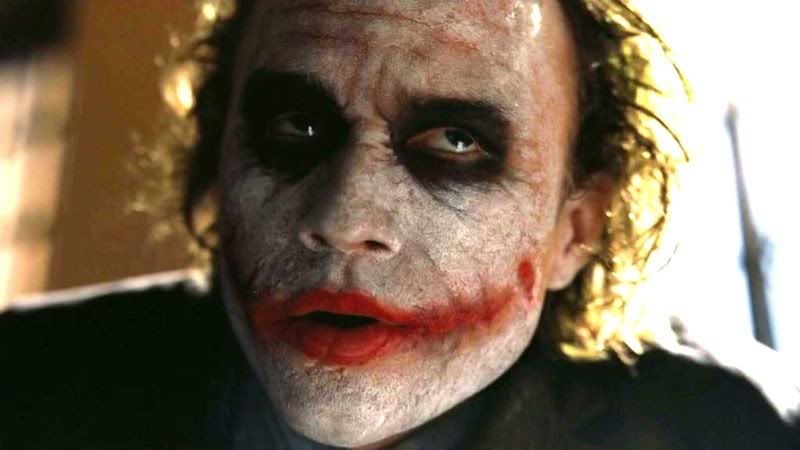
That he used this idea to stage a heist genre film is kinda interesting, but unless you find these picture/dreamwork puzzles engaging enough, the film is unsurprisingly generic. The dramatic structure follows Nolan's 2008 blockbuster The Dark Knight, in terms of when and how the real film's peril and threat dawn. In TDK, Nolan designed a gothic urban landscape, reaching a boiling point with the affects of entropic forces. The Joker's maniacal psychopathology twisted Harvey Dent's commitment to procedural justice, producing Two-Face's appetite for impartial, brutal chance. That film got to me, because I felt the peril of its threat to undermine - for real - the faith in the coherency of justice and political right (already shaky, but we avoid worrying about it). I loved that Nolan gave me that experience, and missed it in Inception. Dom (maybe more Wantanabe's Saito) losing himself forever on the shores of P3 dreamworld just didn't have the same urgency and affect, as Joker blowing up our fragile dependence on the legitimacy of political right. Even Dom imperiling the team wasn't enough, because his emotional vulnerability was too cliche. I know it was corny, but TDK scared me and convinced me that those civilians were going to blow up their inmate counterparts. Again, Nolan got me there. Whereas Inception got me to Hoth. Meh.

—JKS
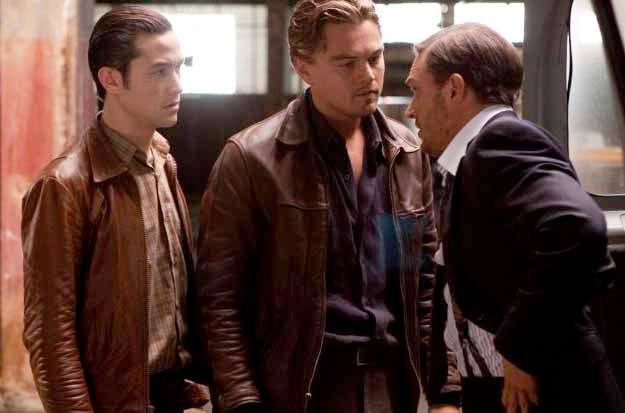

—Off the rack, really?

Jen:
I'm at a disadvantage to start this thing because I simply don't value Nolan as you do. I'm afraid my replies may veer towards simple petulance without a lot of words about what it is I do like in movies as opposed to what it is I don't like in his movies in particular. So I'll just get this out of the way: Nolan's style bugs me, as it did with TDK, because it's mostly a reliance on the volume levels of Hans Zimmer's score and Final Cut's dexterity. Put otherwise, it's loud and choppy. The best shot in the entire film is the one where the camera stays rooted to a dolly track pulling back down a hallway that's getting gimbaled around to fling its action—Joseph Gordon Levitt's the only graceful actor in the piece, too, fwiw, though Tom Hardy charmed me silly—against different surfaces. Which I hope gets us to your initial query: why not 3D?

I'm with you: part of the fun of Avatar was precisely because the 3D helped the immersive feeling, and played into the conceit of putting your mind into another body. Cameron directs the eye plenty, but the depth of field in and around that neon jungle felt great. Inception, as it is, only immerses you by never stopping the soundtrack except to punctuate, making silence a clarity. Sure, the bedroom's often empty when I wake up. But, good grief, this isn't Lynch; Nolan's obsessed with score, not sound, and score's like a pointer; Lynch just drops the dread on you in bass tones; Nolan wants to control you. Yet every single one of Nolan's movies is vague enough that anybody with a hint of imagination can project just enough to fill in the picture. At least Cameron's honest about his authority/autocrat aim. Nolan's a smoke and mirrors man. He already made his thesis statement with The Prestige and it's largely successful because it's about his own methods and tactics, as close to auto-criticism as we'll get from him. That is, it's almost a mea culpa for "playing games" with his audience/s.

You'd think a movie about dreams, not magic, would be the one to offer analysis but if it does hold a mirror all it tells me is that Nolan likes guns, suits, symmetry, action movies, slow motion, the little particles (of glass or liquid, like rain) visible in slow motion, video games, 2001, Raiders, Empire (yes), talking, Michael Caine, being a dad, obvious metaphors and jejune psychology, home, being rich, and handheld cameras at all the wrong times. Can't really blame him. I like almost all those things. Hell, I enjoyed my time with Inception, which I saw in IMAX at 9:30am when I could still swallow. I didn't find it confusing, but I did find it fun to see certain stunts (all the zero-g stuff in the hotel) and I'd feel compromised if I didn't tell you that stories about guilt get at me. But effective (or overpowering) filmmaking/scoring doesn't necessarily ring synonymous with exceptional. Especially when you've got Leo doing his best to sell all of that other kind of exposition.

The most intriguing way into Inception for me is through the other Leo film from earlier this year, Shutter Island. I hadn't read the book (in part because I can't stand Lehane's idea of drama) so it was all a "surprise" (though it wasn't, either) and it all looked great in a way that no Nolan picture ever has, or will. That is, its images are better—and the images feed the other formal elements—and the score's better, too, while we're at it—and so is Leo. All of which is to say that Scorsese is a better director: he actually sets up spaces, limits, characters, and his dream sequences feel like dreams because they blend senses and burn into water through technicolor plasticity. They what? They work like dreams. They confuse but they make sense. They're part of a point of view. (The whole movie adopts Leo's fracturing, actually, which is another feather in its formal, bravura cap.) When that point of view is revealed as compromised it makes sense how it operated and the consequent scene in the lighthouse holds much more movie-movie weight (Kingsley as director/producer, movies as opportunities for emotional catharsis, movies as therapy) than anything in the dive-deep "ideas" behind/inside Inception's take on the movies. —They're all action all the time? Violence everywhere always? A trap? Even idyll? Put otherwise, what's new here? It's a film of its sources exclusively. Anonymous cityscapes still look like cityscapes and an army of snowbound soldiers just looks like a level from Goldeneye. Yet another angle, though Cairns already said it: nothing that follows tops folding Paris into a circuit of no clouds.

But I've strayed from an actual, considerate response. I've just gabbed about me. The point being, I liked this one more than the Batman movies in large part because I like the tropes more. But it still doesn't "excuse" spatial incoherence (I know that it's a dream, but this movie's not interested in representing dreams, as you pointed out) or bad writing (Nolan's brother's not the problem after all) or a propensity to drag things out well past necessary (150 minutes again?).

Tell me I'm missing something.
—Ry

—But I'm from you...

Wednesday, May 26, 2010

At the net #1: On y va

by Ryland Walker Knight and Ignatiy Vishnevetsky


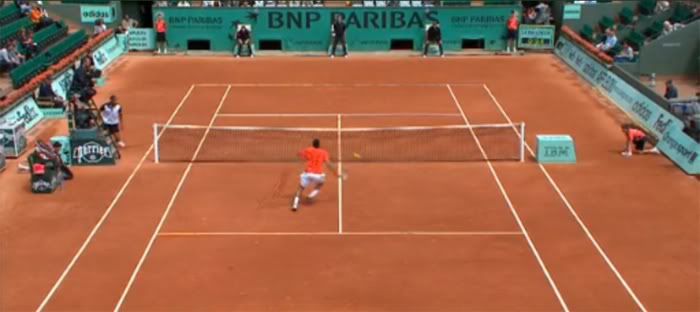
Ryland launches —— My disadvantage: I have never played tennis. As a kid, I never watched it. For a long time, I'd only glance at a match if it was on before a basketball or baseball game. My only interest, as it happens, was how Godard used the game as a metaphor in any number of his films. But, truth be told, it wasn't until Une Catastrophe that I started to investigate that more. So I watched Soigne ta droite (this didn't hurt the blossomed interests), rewatched that opening to Pierrot, and started to watch the game on live broadcasts. I began to learn what worked in the game and what didn't; I began to understand the acclaim for and the appeal of Federer.

Somewhere in there, I read David Foster Wallace's essay on Federer, which I don't doubt influenced my favor for both artists. Also, I saw Federer win a few slams somewhere in there. A lot of DFW's essay is about technique, and he was a player as a youth, which is why I lead with my disadvantage, but it's also about this man that some call a scientist. As recently as last week, the color commentator of the Madrid open went to commercial saying, "The passion of the south has defeated the icy precision of the master from the north." He was referring, of course, to Rafael Nadal, who claimed that tournament (I'd argue Federer lost that match more than Nadal won it) with his tic-heavy power game that, I'm told, is designed for dirt and has earned him that goofy nickname (is there another kind?), "The King of Clay."

Which, of course, is why I proposed this exchange: The French Open started today (Sunday). While awards were handed out in the south at Cannes, a different kind of dance got going up north in Paris. Roland Garros is played on clay and the big story coming into the tourney is, as it has been since 2006, whether or not Federer can beat Nadal. This presumes a lot of trouncing on the road to the final, that both will get there, that we don't have to worry about what happens until then. What I'm curious to do this week is to trade some notes on what we see (presuming we get to see much) of not just the titans but also, say, Solderling and Murray. (Also, are you into the women's side of things?)

Since you've got more of a background in this arena, maybe you can introduce some other terms and factors and style evaluations. To get us started, I'll say that though the passion of Nadal is sometimes infectious, his play seems bound up in brutish will as much as talent and the pleasure I get from watching him play is akin to those Morel movies you dig; whereas I love watching Federer play because he's both such a brain and such a ballerina, but not without punch or fire or deadly kill (or drop) shots, which might help me compare him to that plastic master Godard, but I'm not satisfied with that comparison. Whose cinema is graceful, sneaky-fast, not quite showy but confident, attuned to the body, often beautiful and often non-stop wondershowzen?


Ignatiy answers —— When I was a kid we played tennis and I hated it. I took my tennis racquets with me when I moved out and sold them to a pawn shop when I was 19, and probably didn’t think about tennis for a couple of years afterward. Now I think about tennis all the time. It’s funny how you come around to things like that. Singles tennis now strikes me as the greatest sport: the most athletic, the most dramatic. It is very simple and pure—two people, a ball, movement. I don’t know if you saw this, but today (Wednesday) there was a moment in the Tsonga / Ouanna match, very brief, where they were slipping and sliding right alongside the net, almost as if the ground beneath them was ice and not clay, very gracefully yet also very desperately. And there, for me, lies the drama of tennis: emotional desperation—the desire not only to win, but to not be beaten—expressed through physical grace.

I don’t follow women’s tennis too well, because, at the moment, it seems to me that the most interesting personalities (with a few exceptions) are in men’s singles (however, I look foward to being corrected on this matter).

As I think I’ve said to you before, I admire Federer because he is precise and also obviously human; he is like Chaplin, in that the movements of his body are able to express certain things people usually only feel, yet more articulately than most people could put them into words. Watching him play Falla today, it’s striking to see, in that kind of wide shot they’ll often use that makes the court look like a chessboard, how Falla must dash to keep up with Federer, who is merely hopping. Yet his movements don’t seem super-human (I mean this seriously when I say that there aren’t many sights more human to me than when Federer makes a shot from between his legs, which he did against Falla).

You’re right in that the French right now seems like the grand story of Federer against Nadal (who is more intense and bombastic), but there are also many subplots, and Soderling is certainly one, as is Tsonga, who strikes me as a bit over-confident (maybe it's his serves?) but whose serve-&-volley technique, which involves coming so close to the net, is kind of exciting to watch because of its immediacy.

Tuesday, January 12, 2010

Better not pout about a horizon

by Ryland Walker Knight


—Pascale can't lose though we lost her

Among so many dream projects, I've been meaning to get to know Rohmer's movies for some time now. Funny how news like yesterday's can make you want to jump so much quicker into such an endeavor. But, as it stands, I'm going to stick to my guns and, despite my love of words and pretty ladies, keep M. Schérer on the shelf for now. For now, among the standard rep-house coverage and viewing logs you've come to expect from me, I'm going to begin two other overdue re-acquaintance projects.

First off, thanks to Danny I've got now those two Eclipse box sets of Ozu (silent + late) as well as Early Summer at my disposal, not to mention my own copy of Tokyo Story, and I plan on making a biweekly habit of watching one of these films and writing about it. What's more, I'll get a bonus on Feb. 19th, when PFA screens That Night’s Wife, a 1930 silent crime melodrama. So, stay tuned for a newly christened series I hope to expand beyond just these discs as the year carries on, via Netflix and other, um, subterranean means: I'm going to start crafting An Ozu Zone. I think I'll get cracking at it as soon as next week, or as soon as I get a few other writing assignments completed. (Gotta have priorities, even in the blog life.)


Next month I'd like to start a participatory series. As I proposed on the new Facebook page for VINYL IS HEAVY (become a fan why don't you!), I was thinking it might be fun to set up a little reading and watching group structured by one of my favorite Stanley Cavell books, Cities of Words. There are a lot of things motivating this idea. First, as I said, I think it'd be fun. Second, this book (along with Pursuits of Happiness) kind of changed my life when I met it and read it for the first time three years ago in my first seminar back at Berkeley. Third, I love the movies and texts that Cavell converses with and highlights for us. Fourth, the book is structured like a semester, as Cavell writes in his preface, which will provide a good structure for our eventual discussions—as I envision the comments section exploding with thoughtful parries and volleys—about such topics as Freud and The Lady Eve (to say snakes and sharks and moms and dads and sex) or Aristotle and The Awful Truth (to say questions of audience and appeal and sameness and difference) or—get this—Shakespeare and Rohmer and their respective winter tales, which I, no doubt, will try my best to link to Desplechin's, which, clearly, tells me I may well wind up jumping into some Rohmer before long after all.

I say "next month" above because that kind of lag time not only allows me a head start but also gives you enough time to go out and buy the Cavell book, or borrow it from a local library, and maybe even get cracking on some of the films, too—though I would by all means stress the fun of watching the films strictly in tandem with the chapters written about them. In any case, here you have it: I'm giving you two full weeks to get ready to play your part. Now, don't get me wrong, I can't presume that many of my readers out there will actually follow me on this silly little autodidact trip but, believe me, I think it'd be worth everybody's time. And we all might learn a few extra things along the way with a lively comments conversation. Even if you don't read and watch along with me and wind up just reading the write-ups here, I do hope you join me for some fun filosofy lip flappin below the fold/s.


And if all that fails to generate some talk, I'll tell you right now: I'm also planning on recapping/analyzing Lost every week of its final season. That I don't have to worry about people joining in on, do I?

Wednesday, July 22, 2009

Public Enemies: We Spray Spots.

by Ryland Walker Knight


fire away, charioteer

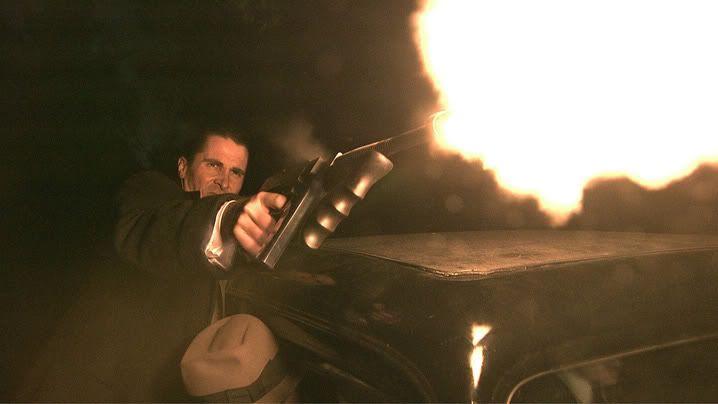
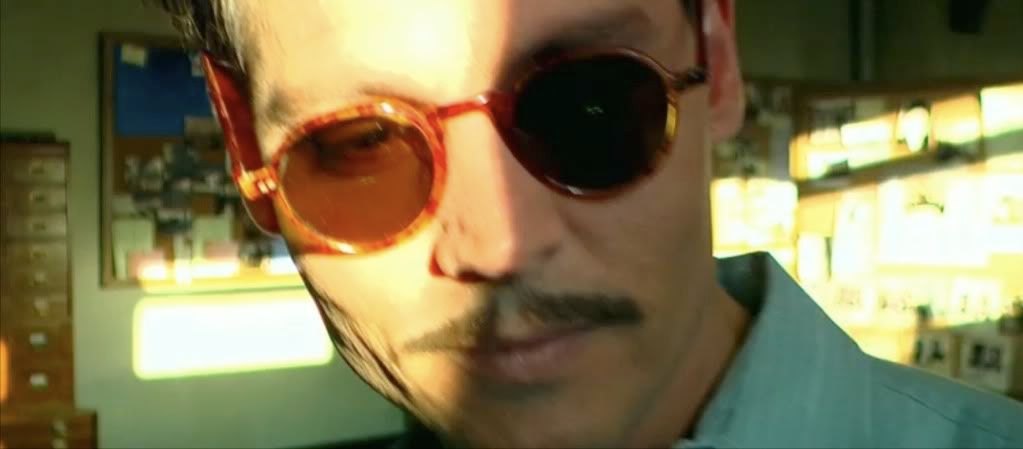
What began in giddy anticipation as Michael Mann's Public Enemies fast approached through June, with talk of something like a symposium, turned out to be that series of set dispatches by Ignatiy Vishnevetsky (one, two, three) and this: a subsequent, massive e-mail exchange between Ignatiy, Kasman and yours very truly. The movie's moment may be past in blog-time but that doesn't stop us from throwing our belated lot in with the crowd of almost equal parts praise and derision. For one thing, for us, it's one of the real highlights of the summer. For another, who says we need to be so timely? In any case, we know this thing is long, but we do hope you like it, and try to read it all. Or, I really do, if only because I know Danny took a lot of time to cobble together these broad range missives. And to think that we could still miss talking about so much.

hold on tight
staring at the sun

For my money—big shocker here—Manohla wrote the best review of the weeklies. And to re-link, here's the Log's post and Martha's enthusiasms.

Thursday, January 15, 2009

The Che letters. Part One: Questions, Declarations, Navigations

by Mark Haslam


to the people

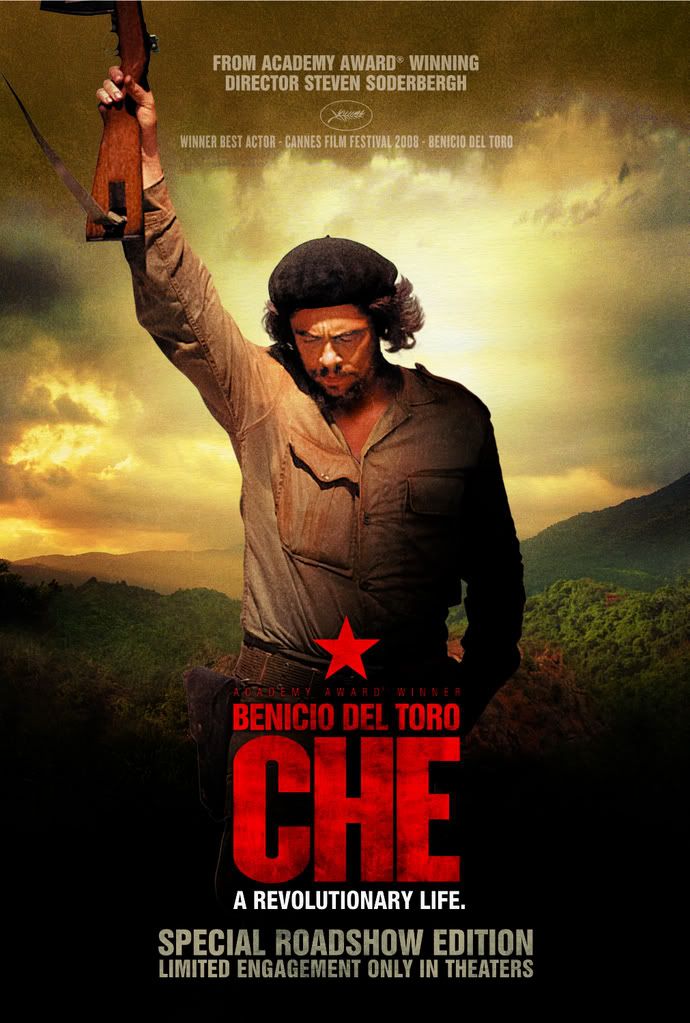
[Ed Note: Here begins our ensemble attempt to wrangle our, let's be blunt, surprising enthusiasms for this film. Since the film is so large (without ballooning), we thought it appropriate to situate our understanding in this epistolary form, a series of calls and responses, that may speak to the nature of Soderbergh's film and its ostensible subject—and how these braided objects nail their aims across manifold divides. Our aim, it should be obvious, is to make the polymath sing. Update: Click for Part Two and/or the whole series]

cuba
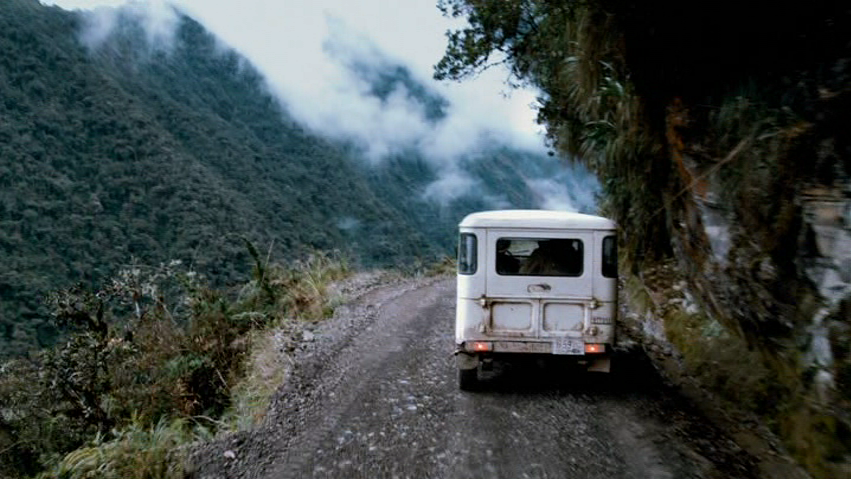
bolivia

[Preamble notes from Mark: (1) Bay Areans, CHE: THE ROADSHOW is coming to us, hitting the Embarcadero tomorrow, Friday the 16th. And as a special treat, cuz you're all special, Soderbergh will be in house to answer our questions. For those in the East Bay not willing to cross the bridge or duck into BART, it will open as two films at the Shattuck Cinemas in Berkeley next Friday, the 23rd. (2) It may be useful to keep Pedro Costa's seminar (at ROUGE) on closed doors in mind. (3) Also owe a look to: The Cry at Zero.]

so wistful
mexico city

“Che is not about Che."

Ry,

After a single viewing of Che, this is all that seemed appropriate to say; the one thing that I (to whom confidence comes but rarely) am pretty damn confident of saying. And here it's remained, at the top of a piece of paper, awaiting the explication it seems to deny. And the question it implies produces a response both silent and choral, a nothing and an everything: “What is it about?”

Our first approach faulters. We stumble, or stop, and wonder, how do we approach Che? So much criticism up to this point, positive and negative, tends to description and observation (itself an impressive feat, given the scope and scale) over analysis or thesis; few attempts at a true approach to understanding the film have been made. But then: do we approach in the first place? And if not...? Aha, an avenue: only in resisting representation does the film approach its figure. The non-approach must be our approach, too.

thru the woods

—certain films...are like doors, even if there are no doors in them. They resemble doors that don't let you enter as the protagonist of the film. You are outside. You see a film, you are something else...
For distance is a thing: tangible, like numbers. Especially for Soderbergh. Gaps, spaces, in-betweens...these are bricks, mortar. An absence or offsetting of one thing in relation to another, we come to see neither—or both, but only in the periphery—as our focus lands on distance. Indeed, it is focus, which seems so central to the film's technique that calls our attention to this: a camera—zooming in, zooming out—enacting distance.

But distance comes in many forms. If Cuba gives us Che, at times, at a physical proximity, distance is produced elsewhere. Take the battle sequences that are overlaid with Guevara discussing the ideologies, tactics, or justifications for the images we're seeing. His words don't explicate but complicate. Che doesn't speak in terms concrete enough for explanation. He is all ideal, totally abstract. Indeed, few figures in recent history have been as subject to abstraction as Ernesto Guevara, because, with him, it's easy: a man so determined by his ideals, so apparently detached from the material world, from his own body, that he already seems a vessel....
So, these sequences which might've been exciting and rousing are emptied out, abstracted. Again and again the image becomes an image of distance.
look at a remove

—that also is very important in the cinema, to love at a distance.

None of this is not distancing. I mean, it isn't aloof to us. We're not cast into indifference. I feel Che precisely because I am not asked to—better yet, I am asked to not feel for Che. The camera builds distances and in doing so builds avenues—long entrances. Entrances that are also closed doors. We see a film, we are something else... And the film, I think, like its subject, finds its center in love. But love undergoes a revision: think of Che's line that nobody is indespensible. This isn't intimate love. It's a re-vision of love—and, for that matter, equally of pain—that requires a response more than just reflex.

Our next approach then is a careful step, in step with the film, backwards. The images are abstracted: image distanced from itself. Meaning has been displaced, and the images, even those of triumph, now emptied out, take on the form of a lament. This is made clear in Bolivia, where everything feels, literally, dry, tapped. Even a downpour has no sense of moisture. In Cuba, death was Guevara's neighbor; present but only in the abstract, as one beyond your wall. Here, death is his house. “To survive here you have to fight like you're already dead.” This is the precise cry, the lament, love—a distance from yourself, an exile from yourself.

I can't help but think of those lovely moments of Che taking photographs of Bolivians. This is how he sees—through people. His revision (a second viewing) of self. Watching his body being carried away in a helicopter, their upward gazes correspond to his gaze, on the boat to Cuba, directed at Fidel.

carried away

—...and there are two distinct entities.

I think, too, of a Caetano Veloso's lyric (one redeployed in Jorge Castaneda's Che biography, Compañero) that says, “Navigating is necessary, living is not.” This is a film to navigate. Because it's a film that navigates with no intention of arrival. It resists. Is itself and not itself. Is exiled within the very place of its exile. The non-approach is seeing the film from over there. And seeing the film as a door at best ajar. The farther back we go, the less that we see, the less that's shown, the more possible it is to open the closed doors. We have to recognize the two ever dividing entities, Che and Che, us and Che, Che and us.

I offer this up as a way, maybe, to begin talking about Che. A way of approaching, and if we're brave, opening, the closed doors. As Costa says, opening these doors is work. So let's work, Ry. I want to navigate. Tell me!

Ever one last re-vision,
Mark

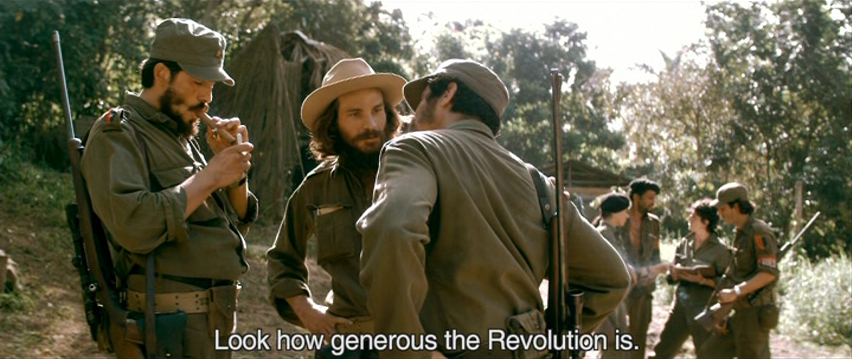
generous

Saturday, January 03, 2009

VINYL IS PODCAST #10: An unfocused invitation to holler on criteria. [In two parts]

by Dan Callahan, Ryland Walker Knight, Kevin B Lee, and Keith Uhlich


approaching
[PART ONE]


[Podomatic stream]
[Direct audio download]
[iTunes subscription available]
[Simple syndication subscription]


an experiment in language
[PART TWO]


[Podomatic stream]
[Direct audio download]
[iTunes subscription available]
[Simple syndication subscription]

RWK here. For our first East Coast podcast, I was joined by some of my best friends in this (surprisingly little, and ever tight-knit) critical community that I'm jumping into to talk about, as I thought only natural, our criteria for judgment and evaluation. My initial plan was to ask these gentlemen to provide a brief historical account of how their individual criteria developed to our current conversation and how they navigate the distinction between taste and value in their work. This aim was lead astray. This is a good thing. We four wound up talking around this question, or prompt, and, I hope, answered it in another (that is, less explicit) fashion. The curious listener will find how each of our spoken words signals an evaluation as much as these written words forever perform value judgments. It's all about language, always, it appears—and how we develop different vocabularies for different registers of conversation. These are the things I like to think about. So this was fun for me, even though I talk the least among our party (which is a first, I think, for this podcast). I'm continually more interested in how we think about things rather than why, because the former subtends the latter in a subtle way. The problem, then, as ever, is how to account for that, for everything, and how to argue for your favorites as much as revere them (or the opposite). And I think we do a pretty good job here. Please, tell us things. —Thanks for listening!

multiplicity!

Tuesday, October 21, 2008

Bite me. New York City keeps calling.

by Ryland Walker Knight


Abel Ferrara proves "cool" still happens. It's about strength. Vitality is rare these daze. I know I'm fighting to find it in me every ordinary day down the line. I guess anybody reading this in NYC already knows: go see Mary, like, yesterday over here. [via Ray Pride, x-posted on fN!]

Monday, August 04, 2008

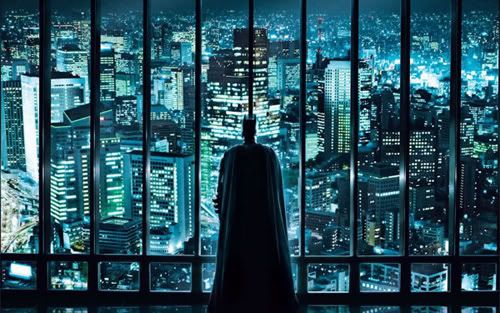
We burned the forest down. The Dark Knight, back and forth. Part Two.


hit me

[This is the second part of a rather lengthy email conversation between Jennifer Stewart and Ryland Walker Knight. The first part can be found here. I think there's plenty to continue with after Jen's second response (some things I'd challenge, again, finicky for particulars as I am), but I don't want to keep posting about a film I'm not so certain earns even this much digital ink, much less all the rest that's been, ahmn, generated, when plenty of other, better movies make less money and are seen by even less people but deserve to be seen by everybody because I think they can inspire, too -- and provide even more (substantial) uplift. Also: I didn't give Pirates this much public attention last summer, and that/those movie/s are way cooler, way more interesting. So, as I said before: we encourage more conversation, so long as it's civil. That's what this movie's about, right? Civility in an insane, unstable world of terror? Something like that. Also, again, for redundancy's sake: There are
spoilers throughout. Consider yourself warned!]

growl

Well, well, Jen,

First of all: there's nothing wrong with being affected by a film. I'm not trying to advocate for my experience (in lieu of yours or others) by any means. But I am curious why it's this film -- even, why these films? I don't think I can answer that, fully, nor do I think you really want to dive in deep (in public) into what motivates or attracts you to activating this kind of response; nor do I think it that appropriate, per se, for our aims here. Your investment, however, exposes the straw man of my first missive. It's easy to fall back on issues with Nolan's filmmaking style. After some more careful thought I've come to realize that while I felt a charge at the close of the picture, sure -- it's nervy and long and loud -- my resistance boils down to the fact that I wasn't as immersed in the story as you were, which manifested itself in my gripes with the action scenes.

I still have problems with Nolan's approach to action, but let me first get into your invitation to talk story. The Dark Knight is a fairly straight forward scapegoat myth. For all this talk of it being dark, it's a pretty hopeful film. I think that's why it's such a big hit: unlike those silly Spiderman movies, Nolan's commitment to "realism" really gives the film gravity, which makes the lows that much lower (others say darker) and the highs that much higher. What I've come to realize is that the things I find dark and troubling about the picture are not what's in the story, or how the story is told, but how Nolan points his finger outside the story, the film, through all those cultural signifiers like wiretapping and terrorism. I just don't know if its politics are as right on as the myth framework makes them out to be. And, of course, I think this claim to "realism" is dubious given Nolan's odd mise-en-scene.

timing

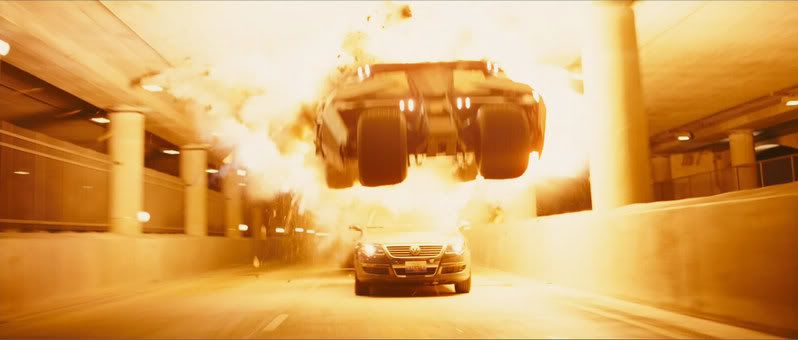
However, Nolan's timing is pretty great, which busts up my prior attacks. If his action sequences are not about movement (doesn't seem to be the case; most of the screen is a dark wash), then they could easily be about timing (he edits not on movement but on impacts and explosions), or, more broadly, about time. Things collide and splinter and fly based on certain speeds in these set pieces. Think of Batman jumping in front of the bazooka, and that mack truck flipping; think of the opening heist's precision. This plays on a thematic level, too: all the Joker's tests, indeed plans, are structured around countdowns. He puts the city on the clock. This gets at finitude. What's complicated about this is that for all his talk of chaos, for lack of rules, the Joker is following one of the biggest rules, and setting a concrete rule, of the world. He laughs at Batman: "It's only a matter of time before you break your one rule." Like you said, Jen, Joker overestimates his understanding of the impulse to do good in the world, thinking time is the best pressure cooker tool. Perhaps this film is arguing that time can work for you as much as against you. Perhaps it is about circumstantial ethics after all. Or, perhaps, this kind of generous reading misses the boat completely by getting away from the power of the myth underlining all this silly action film phenomenology-ontology-hermeneutics.

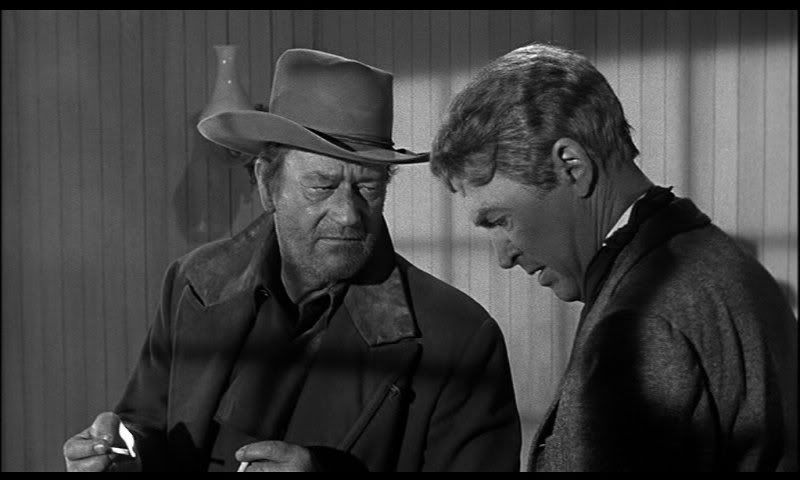
I don't know. I don't quite think so. I'm still intrigued by how this film, and Fincher's and PTA's, are the ones that activate your intrigue in personal limits, but I don't know what that has to do with time other than how those films figure time (and its loss in Fight Club, in TWBB), but I think it has a lot more to do with myth (even though the two are related; myth seems to stand outside time). I guess what I'm saying is our reactions so far seem to say more about us than they do about the film. Except you've out done me: not only were you moved by the film, you came up with a reason that made sense: all that empty space as indicative of the moral peril of the film. All I can counter is that I find that much more effective, and convincing, in other films about this scapegoat myth; most immediately in something like The Man Who Shot Liberty Valance. (This entails a complicated argument but I'm thinking Rene Girard thanks to talking with FRG, so: cf. "The Unity of Violence" section for a brief gloss.)

But I don't want this to turn into a pissing match. That doesn't get anywhere. What I mean is that I think the lie in Liberty Valence seems darker, and more emotional, to say it comes with more weight and consequence than the lie in The Dark Knight -- all of which may be a product of the construction of the films. And, for me, that starts (but doesn't stop) with the female anchor for these two tales. I didn't buy the love stories of The Dark Knight precisely because I didn't buy that a woman like Maggie Gyllenhaal (as written, as acted, as lit by Wally Pfister) could precipitate that kind of love triangle. Vera Miles may not have that much more to do in Ford's picture but she certainly looks and acts and is motivated to be that kind of woman. And here I go again making unfair comparisons. It's funny: every time I sit down to think about what it is I dig about the picture I come up with other problems I have with it. Maybe I'm thinking too hard about it -- or too harsh. Maybe I'm just not being honest enough with myself. Maybe I do need some theory (affect, time-image, etc) to get at what I dig on a visceral level. Maybe I just had some fanboy in my heart fighting to be heard and I can't listen. Maybe I need to see it in IMAX to really just let go and let it throw me around. What do you think?

the r. knight

prison hurts
free as a bird, now

Ry,

I hope I earned that generous response you gave, my man. Truth be told I'm scared to say much more about TDK, because it would risk more sympathetic invitation which may or may not come off. I think you're right about the story's ability to grip me but let you slip. Somewhere therein is the answer to your question, why this film. I could say more about why this kind of story - or a movie that dealt as it did with these ideas of identity and civic faith - did grip me, but as you suggested, that's probably at best interesting to you in a non-public conversation between us. Indeed, there's a whole dimension of film experience available only to friends in dialogue.

Regretfully I have not yet seen The Man Who Shot Liberty Valance, but I'd be interested to hear how the same kind of myth is told in a way that invites comparison and evaluation with TDK. The myth part sounds right to me, but the scapegoat part sounds a little insufficient. Part of the myth in TDK is the implied logic and consequences of the unique position Bruce Wayne afforded (quite literally) himself. He created an essentially anonymous identity in order to operate outside the law, yet ultimately in the name of justice. So already we have an uncontained excess jeopardizing the balance of the original system (as Rachel corrected Harvey about what happens when you "elect" someone to hold the privilege of power outside democracy: you create a Caesar and power is never restored to the demos). With Batman working for, but outside, the Law, one problem is that the Law gets too dependent on Batman's advantage of being unencumbered by due process (Batman is conveniently if not cheaply able to secure Lau's *ahem* extradition).

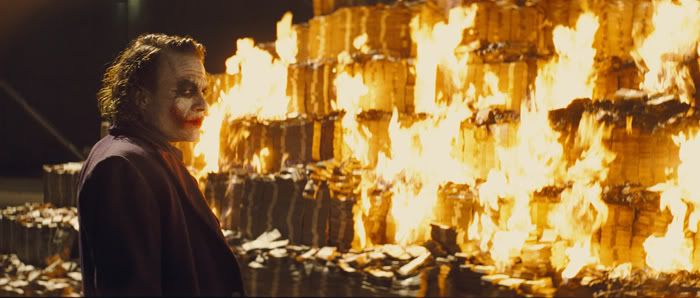
Another problem is that other versions of oneself (anonymous figures outside conventions of institutionalized morality) start popping up, the only difference being, these don't necessarily embrace the pretense of working for Justice. As Joker says, Batman completes him. Or he's just too fun to get rid of. The film sees Batman desperately wanting to hand over the power of (re)scaling justice to a properly elected hero. But Joker gets to Harvey Dent first. Here's where I could develop my earlier thought that, ultimately, TDK asks what a face is. The Batman myth is about the consequences of abandoning faith, that justice can be done by the faces its institutions make available. Harvey Dent, an elected DA, restores that faith. But Batman has already caused the jeopardy that ultimately corrodes Dent. Joker wanted Batman to reveal himself: it was only a matter of time before someone operating with Batman's logic exposes the easy vulnerability of his contradiction (you can't be outside the law yet simultaneously constrained by it. All Joker's talk of chaos is that rather simple point). The Dark Knight, then, is a proper Tragedy. Batman isn't scapegoated so much as revealed, and perhaps redeemed. He accepts responsibility by taking the previously unseen truth his masquerade allows: an explanation of moreso than resistance to the corrosion of Justice.

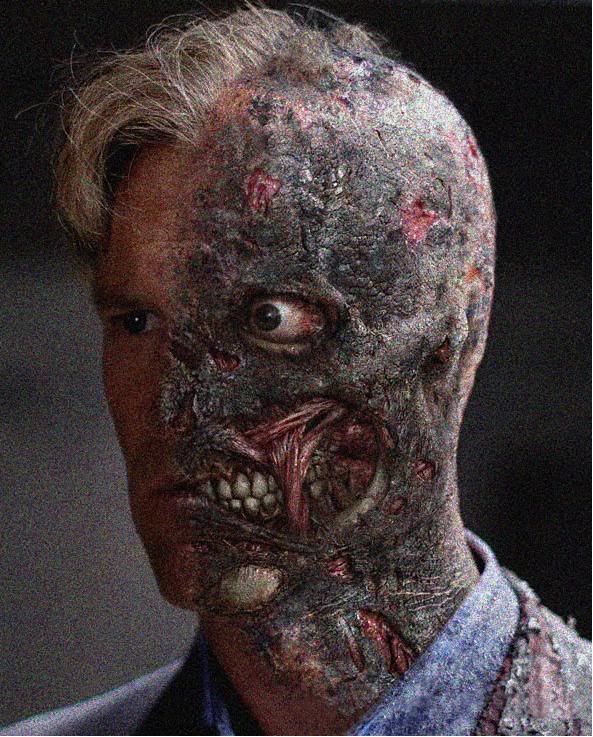
I'm not sure what to say cinematically about all this - the story as such is just that. Hence all my discomfort looking for ways to speak critically of being gripped by the story, for I suspect cinematic quality and story quality are somewhat irrelevant to each other (someone less gentle than I might mention Revenge of the Sith to you here....). In terms of how TDK uses its images to play out this story? Well, it's written plainly on each of Batman and Joker's, and Harvey's two faces. Harvey becomes the anguished split Batman ignored: the reality of only half a sanctioned face. Upon first reveal of the special effects Nolan chose for Dent's face, I was actually a little disappointed (ugh, skeletor face? How cliche). But now I like it more as a symbol of pure erosion as well as revelation: what makes a face (facade) appealing includes concealment, lest those ligaments be seen sufficiently as their own gruesome alternative. This is what Joker was attempting to reveal about Batman: he is just a gruesome enabler, of weakened justice garbed in the masquerade of its Knight.

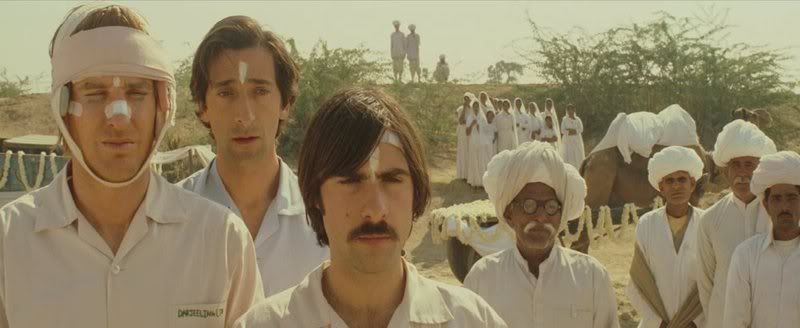
Thanks, Knight, for making me think a little more. As for my own redemption, there's other films like The Darjeeling Limited, and There Will Be Blood, which aren't really about their ostensible "stories" but which occasion nothing less than an equal pleasure. To wit, perhaps part of my esteem for TDK is that it was totally convention narrative cinema, and I'd forgotten how much pleasure is still possible therein (hence identifying Fight Club as my antecedent).

My trouble is that I am much less confident trying to be a film writer outside the conventions of narrative cinema. Though I haven't given up yet.
~jk

swoop solo

Saturday, July 26, 2008

We burned the forest down. The Dark Knight, back and forth. Part One.


money for nothing and tricks for free

[This is the first part in a rather lengthy email conversation between Jennifer Stewart and Ryland Walker Knight. For readability, the call and response pairs will be split up. I'll update each intro with links as we pump out the rest. For now, though, here we are, looking all around, trying to make some sense of that first weekend. There are
spoilers throughout. Consider yourself warned! Certain forms of hyperbole will not be tolerated in the comments thread although we are curious if you have a thoughtful response to offer in order to continue our conversation. Just, please, don't make me turn on comment moderation. Nobody wants that.]

watch it wash away

Jen --

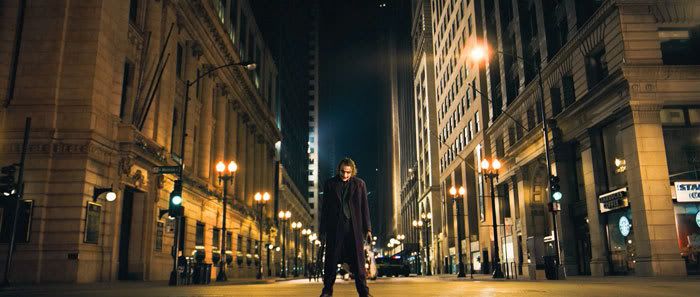
From the top: I dig it. I don't think it's the masterpiece some have claimed, but neither would I call it a bankrupt endeavor, just complicated. As a picture of the modern city (and its consequent perils), in a time such as ours, this is probably as good as a pop artifact can get. The Dark Knight may not have Michael Mann's poetry of imbalance (an unfair comparison despite the opening heist's nod to Heat), but Christopher Nolan's nearly anonymous Gotham has all the right sheen and transparency, grime and emptiness, shadows and nightfall terrors to scare you of its dark arena of violence. It's the insistence on the city -- in swirling helicopter shots most of the time -- that makes it more than a Batman movie and less a Batman movie than before.

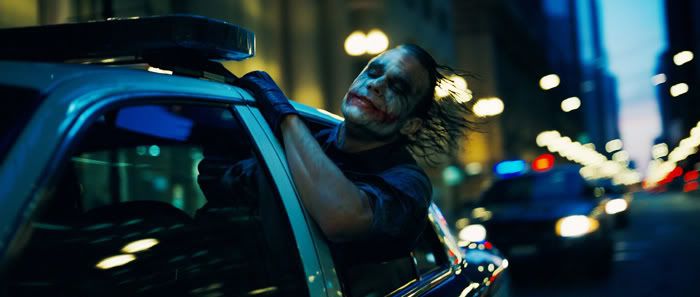
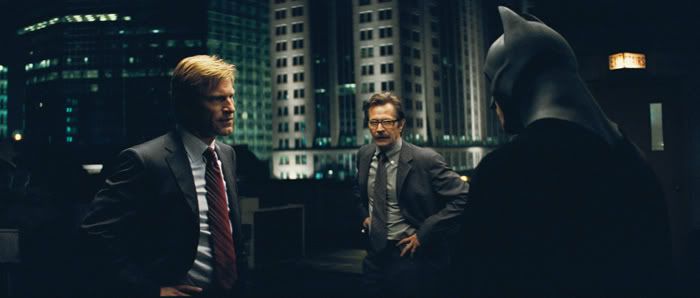
After all, it's the first Batman movie where Batman is just another part of the ensemble. Christian Bale may get top billing but he's by no means the star, much less that interesting (a shame). The real acting fireworks, so to speak, happen between the poles of Heath Ledger's typically hyperbolic Joker and Gary Oldman's beautifully understated Jim Gordon. Oldman's portrayal of decency grounds all the anarchic overflow of Ledger's embodied chaos.

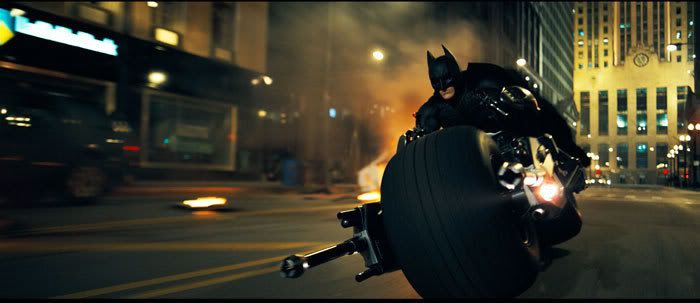
However, all too often chaos is more a talking point than an element of the action. That's probably my biggest problem with the movie: Nolan doesn't really know how to shoot action scenes. Or, more pointedly, he doesn't shoot fight scenes well. For all the kinetic activity, those handheld close ups make these encounters less about movement than about fractured collisions that can't find a visual resolution in space. Which is a silly, hifalutin way to say, it's too often cluttered and fussy, if oddly dynamic. I'm puzzled by his close-in action mise-en-scene, and (I worry) not in a good way. That said, the film is edited pretty well and the timing on the wide shots inside action sequences is pretty spectacular. That mack truck flipping has a real weight -- which is aided by the sound design. Again, it's hard to compare him to Michael Mann, or even Paul Greengrass, but those guys are more interested in space as an arena full of possibilities and energy (something I dig); Nolan's idea of space is more pragmatic, logical, showing an interest in the where but not the how. For instance: I dig that the climactic high rise site is open and under construction, open to plain sight, as it gets at the illusion of spectacle (and how we make or account for appearance in this Gotham) once more. And I dig how the sonar plays into that, too, but all the encounters within that structure are pretty straight forward, a series of scenes of Batman deploying pawns in the way of the final showdown.

What makes the action interesting, in the end, is how Nolan gives each sequence significance before and after, pointing away from the action. (I think this is why I liked The Prestige so much: it isn't an action picture. The Prestige is about magic, about manipulation, about spectacle, about perception; and here all his editing patterns make more sense. He's forming a way of seeing there (looking for details) that doesn't quite cohere in The Dark Knight.) In the most simple sense, the context for the action in The Dark Knight is the current mood of the country: the fear of unknowable threats, of ultimatums without rules. There's a lot of easy allegories to draw. But that's all abstracted enough into ideas about chaos (those talking points) and seriousness so that I trust the film will play when the next administration's getting ushered out of office. However, all that falls to the Joker, in monologue form, which speaks to Nolan's interest in story. I think he fashions himself a storyteller more than a filmmaker; at bottom, it's how Nolan and his brother Jonathan escalate the consequences of the plot with each successive sequence that makes The Dark Knight so compelling. If ever I was to appropriate that Bordwell term, it'd be here: Nolan has mastered "intensified continuity."

Okay. On the one hand, I'm impressed you were so ready to let this film whip you around and rattle your soul. On the other, I don't think the film earns the boat scene with Tiny Lister or Walter Chaw's description of Maggie Gyllenhaal's resigned acceptance as "the single most heartbreaking moment of 2008 cinema." Further, what I find so dark is not really all the terror and wreckage throughout the film but the final lie Batman concocts under the assumption that people won't be able to withstand the morally complex truth of Harvey Dent's rather literal fall.

But this makes it sound like I only dislike the picture. And I don't. For the most part I dig it. I'm just caught up in my formal/aesthetic criteria here and not moving to how this picture, and its popularity, might be significant, if, by nature, blown way out of proportion. Maybe we can get into that a little more as we progress.

--ry

stranger

Ry,
I'm in a strange spot. I've come to the tentative conclusion that my feelings for The Dark Knight are, well, just that. They're oddly resistant to qualification, yet smolder indignantly to hostile, very well-written reviews like Adam Nayman's for Reverse Shot. Not that I'm unthankful for you sending Nayman my way. But somehow it and Dark Knight has spawned a kind of crisis for me. Either I don't know who I am as a viewer, or I don't know what matters in film criticism. So I might be asking you to guide me back to the light. But first, hear my plight.

The problem is that Dark Knight really got to me. And like, 5 movies total have ever gotten to me. One of them was last year, at the Castro Theatre's special advance screening of There Will Be Blood. Previous was David Fincher's Fight Club, which I saw opening week, in 1999's Ottawa. What they all have in common, is that I was really shaken by each of them. And it was sublime.

I knew from Ledger's first scene that DK might deliver another such catharsis. I'm speaking of an intense kind of - for lack of a better word - pleasure, and it makes most or even (*gulp*) every other film experience pale in comparison. No, I think I mean that. I love Contempt and Battle in Heaven and Gosford Park and many other films. I can still conjure Reygadas' 360 sequence shot from Battle; the tingles it and other moments in that film gave me. (Still haven't seen Silent Light....). And I don't want to mitigate what those films are to me. Yet I don't know how to compare them to Nolan's Dark Knight, because DK created moral peril which actually, really threatened me. And that was riveting. I walked out not able to think of precedents, unlike TWBB's immediate conjuring of The Shining and 2001. But, then, on my second screening, when, in the interrogation cell, Joker laughs at Batman's missive fists and desperate demands to know Harvey and Rachel's whereabouts, it came to me like lightening: Tyler Durden. Fincher's and not Mann's or Greengrass' sense of action (more on that shortly).

Unlike Nayman, I had problems with Begins and thought its sequel better realized (casting REALLY helped). I'm tempted to say Nayman's problems with DK can be explained simply as, the film wasn't what he'd decided he wanted. Yet his impressive review made me second-guess my own enjoyment of the film. Could I have been wrong somehow?

A growing problem for me with film criticism is how easily formal concerns along with a kind of privileged ethics are made exclusive and essential. For example, I want to care about your worries over how Nolan realizes action. But I mostly have a hard time following them. I do like your point that if the action is shot closed-in, then we get fractured collisions (of say, body segments) rather than framed total movements. But why is that a problem? To me this simply signals different themes and concerns - quite literally, a different perspective on the action. Does action require a total view of bodily encounters, in order to "find a resolution in space"? You said 'twas all really just complaining the actions shots were cluttered and fussy. I guess I just don't see that. Or, even granting your premise, don't see why something else would necessarily be... better, somehow? In fight sequences, Nolan's camera goes in close so that Batman can appear and disappear suddenly - the sense of his superlative movement is created by these cuts that let his outline outstep the frame, even when centered in it. Fincher liked showing us local reactions to blows, and Nolan may be after something similar, which means the total scene of bodies having room to manifest the forces both impacted and exchanged during a fight just isn't the right profile for the shots. I'm likely in over my head here, so perhaps I should just say: you seem to be assuming there's a way to shoot action scenes, and Nolan ain't done it. Help us (me) scrutinize with your eyes: Who or where does that premise come from, and why should I care about it, especially when in order to see anything amiss in the film, it seems to first need assuming?

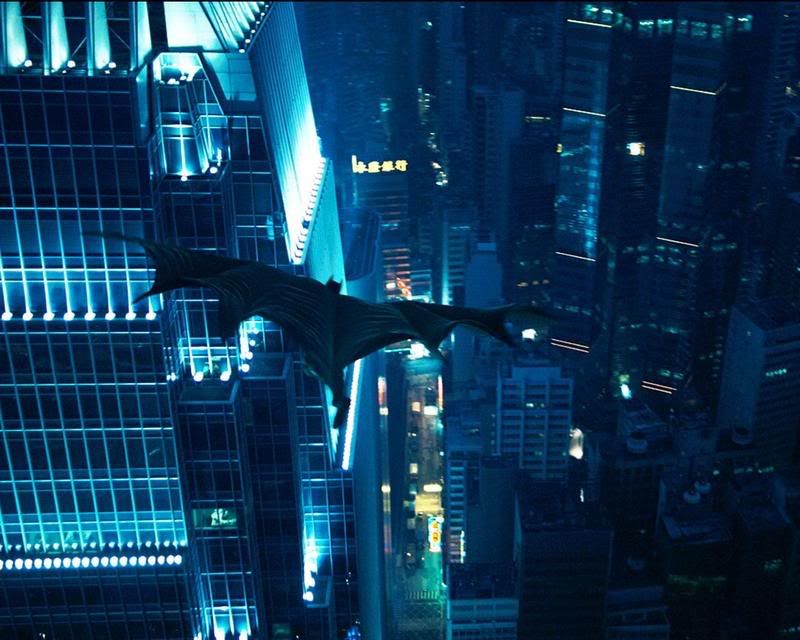
That said, I'm happy to say I strongly agree with you that Dark Knight ain't doing anything dark through themes of chaos, and certainly not as film-noir dark as some have hastily claimed. The triumph of DK's big moment is that Joker assumed more chaos than he could engineer: people are more attuned, less individualistic, if a little less civilized (in the bad, Rousseau sense of loosing sympathetic trust) than he imagined. Chaos in the film is simply Joker's attempt to remove some of the (already perhaps flimsy) partitions supporting an ordered edifice of civil morality. (Civil morality as in the ideological commitments to the sense of fairness that underly law, the courts, and the judiciary - also, the related concepts of what one should rationally desire and fear). Joker's desire not just to lay bare but to rip down these partitions - revealing the panic-inducing expanse of amorphous, unscripted moral interpolation - is seen realized in Gotham's inner and outer design. Nothing has proper walls: Dent's office, Bruce Wayne's bunker and penthouse -- all pillars and receding perspective lines, shelves and desks with only open, surface conspicuity. Even in Lau's Hong Kong architectural marvel, the walls and drawers are glass, revealing everything and waiting to be shattered. The precariousness of moral infrastructure: you take a vote on a ferry, but ooops, this isn't enough to resolve the threat. (Wasn't democracy suppose to be our political panacea?) I guess we could call the result 'chaos,' but despite his speech to (by now) Two-Face, Joker is certainly, definitely, a planner. He is an engineer, a scientist, and he'll say what it takes to realize his experiments. Joker's response to the ferry passengers' inadvertent solution to the prisoner's dilemma (why did I have no jade and all cathartic relief at that moment? Is there something wrong with me?), is to lament that all must be done oneself. I agree with Nayman that Gotham is the anonymous hero of the film, for the film sacrifices the false stability and irrational vulnerability of electing heroes to be "the face" of, say Justice. The city needs much more than one "white knight" who is willing to let his face bear the investment of justice. One wall can't hold up an edifice. One face can't take that much.

You said Nolan may be more of a storyteller, than a film maker. Well, I like stories. I like them a lot, because they shake me and I'm not sure but that might be one awesome reason to be alive. Images shake me too, and they can tell a story with images and/or with actors. Ledger and Eckhart and Oldman and those huge empty spaces with transparent partitions, was some of the best shaking I've had.

glass between us

Monday, April 21, 2008

Blogs as public transportation, conversation and self-examination.

by Ryland Walker Knight


peeking out

Girish asks every blogger's favorite question, "Why do you blog?" and there's already a lot of generous, thoughtful replies, as ever. Here's my rambling auto-critique. It doesn't do itself justice. It doesn't even answer the question that well. But I figured it'd been a while since I put anything up over here so here y'are. Now, back to work on that blasted Honors Thesis.

I dropped out of college four years ago. My college career has been one long, stupid story that began eight years ago at UC Santa Cruz in 2000. After that waste of time, I had a part-time pit stop at a junior college from 2001-03 before transferring to UC Berkeley for the 03-04 school year. I finally realized, with the help of some financial headaches, that I had never enjoyed any of my university level learning. I was, for the most part, happiest in auto-didact mode. I left school and began bouncing around, away from Berkeley, to Seattle and New York and back, not really "doing" much beyond working, reading on public transportation and watching movies.

Like many young people, or so I imagine, I put a lot of value in my taste during that period of my life. I was proud to like this or that; angry if you did not. I bullied my ex-girlfriend and our friends into new opinions, routinely steered conversation back to those silly topics of movies and music and books only to show off some new bit of knowledge I'd gleaned. I think my impulse to return to school, in the summer of 06, stemmed from that snobbery, when I'm honest with myself. I noticed that I hadn't written anything in a long time and before that I'd only written fiction outside of school. (Like the good drop out I was, I wrote a novel--a really awful novel--during my time away.) At work, I spent a lot of time arguing movies on the craigslist forums, where I first encountered, and struck an accord with, Steven Boone and Brian Darr. So, with encouragement from my forum friend Suzi, I went over to that blogspot account I'd started after dropping out and decided I would blog about movies, if only to try to hone my writing skills for my return to school. Looking back at some of those early entries it's a wonder to see how much stronger my writing is, how much more comfortable a writer I am, now. I tried not to self-promote my blog out of timidity, really, although I was much more active on certain blogs' comments threads then. Never did I think I could attract an audience. Much less the eyes of Matt Zoller Seitz, who, by November that year, asked me (and Steve) to start writing for The House Next Door. I think that's when I started to get serious about the blog, about writing.

Then I went back to school. The other day my good friend Cuyler said, "Surprisingly? We've learned a lot in a year and a half." I replied, "Yeah, but it feels like intangibles." School taught me, more than anything, a humility and generosity (that I'm still trying to put into practice) I did not have before. I think I'm a better reader now, sure -- I'm definitely a more generous reader, even though, on occasion, kneejerk habits pop up -- but I think I have a better take on living, too. Even if I still procrastinate; and even if get turned off by certain things (ahem, fellow students/sections) to the detriment of my studies (ahem, GPA).

So why blog? It's a question I ask a lot, too. Part of it, I'll admit, is a kind of careerism. I'm hanging on to that pipe dream that I may, one day, get paid real money to write something. (Or, more simply, that I may write for more outlets when I'm done with schoolwork in the coming months and I get to choose what I write about and when I want to write it.) In the meantime I can throw together little arguments when I please and maybe strike up a conversation about the object at hand. But I often find that the comments threads on other blogs are rarely as generous or humble as the threads we enjoy here at your blog, Girish. Even at my own, when I do get a random thought shared. For this reason I've kind of retreated from blogging in 2008. As much as blogs offer one a public forum to practice writing, there's always the danger of trolls and nihilist cretins out there trying to shut down conversations with posture. I stifle those urges, generally, because I don't want to perpetuate pointless arguments of taste. What I hope to offer is good criticism that argues for the real value of a film, or a book, or a song, or a poem, or a play, or a photograph; that is to say, of life. I'd like my blog to incorporate as much of my worldly interests as possible. I hope I go river rafting this summer. And if I do, I hope to share. Cuz, as fun as movies are, there's a lot else out there. Like Michael Jackson's Off The Wall. Say, Girish, while we're in the arena of almost-dance music, have you happened to listen to Cut Copy? Over on that other (silly) blog Cuyler and I started, freeNIKES!, I've linked to some of their songs. I wholly recommend both of their full length records. They're very 80s in a good way: not glib or facile but smart and fun. Here's my favorite song on their new album. It's superficially saccharine but these boys really know some things.

Thanks again for the stimulating post. It's a big question ("why?"s generally are, aren't they?) so I hope this epic, tangential, indulgent answer isn't boring. Also, thanks, Michael and Tucker, for your honest, open replies. Made me comfortable to share mine.

Sunday, April 13, 2008

turkey and cheese

by Steven Boone


Thursday, January 17, 2008

Welcome Notes.


Welcome aboard

RWK: This is a post to welcome some estrogen into our midst here at VINYL IS HEAVY as I have extended invitations to not one, not two, but three fine young ladies to contribute posts on a regular basis (whatever that means). During the first week of the month of the year I mentioned, rather tangentially, that the first new member of our crew, Claire Twisselman, who I will let explain herself below, had been added to the masthead. Today I welcome publicly Sanaz Yamin, bookmaker extraordinaire, and Bryn Esplin, a dear and fellow Pavement lover. I met Bryn about a year ago in a section for a class lectured by this guy. Sanaz was in the course, too, but not our section. However, it was not until this past fall semester, in another class taught by that guy, that we three became buddies on the real. They are two of the funniest people I know. Plus, they've got taste and style. Here's hoping they blow up the sphere this year, too. Stay tuned for all kinds of cool from all three as we venture forth in 2008.

Claire's got a nerd alert: I'd read VINYL IS HEAVY since the summer when I met Ryland by chance in Los Angeles, one day into 2008. I'm flattered he decided to allow me to write for his blog because I'm not a film major -- and I'm not a rhetoric major -- but an English major. I'm an English major who likes movies more than books, when I'm honest with myself. (I also like fish tacos more than grilled cheese sandwiches but I eat more grilled cheese, so go figure.) Anyways, I'll try not to genuflect too much but I gotta say that I'm pretty pleased to explore the blogosphere in public now after a year of lurking. I don't know that much about movies. And I've never read any Stanley Cavell except what Ryland's quoted here. But I'm game. So thanks, Ryland, for welcoming me! I hope I can live up to the call!

be- Vinyl is heavy, and so am I.

Long-time listener, first-time caller here, and I couldn’t be more excited about contributing to ViH.

I’m terrible with introductions. Barring such a phobia, I would have introduced myself to my gracious host, Ryland, long ago; instead, I sat silently during hours of lecture, making metaphors, moons and eyes at him from afar. A fellow UC Berkeley Rhetoric major, I’m an ardent admirer of generous criticism, believing it neither oxymoronic nor indulgent. I hope to contribute to all avenues of ViH: film, music, images, discourse, and fish tacos, believing them inextricable and delicious. Besides unmanned explorations into the things themselves, I hope to also examine the contexts and the ways in which we enjoy or maybe even despise them.

My introduction, tardy, reluctant, inevitable, has gotten my voice this far: a soft, silent swagger, much more my style.

Sanaz says: First and foremost, thank you, Mr. Ryland, for welcoming me. And thank you, Bryn, for sending me your intro before I wrote mine. As well as agreeing that generous criticism is not oxymoronic, I would also like to add that neither are expert amateurs nor blind viewers. As a recently freed member of the latter and a hopeful prisoner of the former, I've come to view VINYL IS HEAVY as a venue for criticism, conversation, elucidation and interpretation. I couldn't be happier than strolling down this street with this company. Perhaps we could call ourselves "the Ambulators."

Monday, January 14, 2008

Catching up with 2007.

by Ryland Walker Knight


her blinding face
boy faces out
faces of brothers
his hidden face
It is a characteristic criticism of Emerson to say that he lacks a sense of tragedy; for otherwise how can he seem so persistently to preach cheerfulness? But suppose that what Emerson perceives, when he speaks of his fellow citizens as existing in a state of secret melancholy, is that in a democracy, which depends upon a state of willingness to act for the common good, despair is a political emotion, discouraging both participation and patience. So when Emerson asks of the American Scholar that he and she raise and cheer us, he is asking for a step of political encouragement, one that assures us that we are not alone in our sense of compromise with justice, that our sense of an unattained self is not an escape from, it is rather an index of, our commitment to the unattained city, one within the one we sustain, one we know there is no good reason we perpetually fail to attain.
-- Stanley Cavell, Cities of Words: Pedagogical Letters on a Register of the Moral Life

Go to The House to read a kinda-lengthy wrap up of what tickled me in 2007. While it's got pretty much the same format as what I used last year, this time I actually made a list at the end. Still can't rank anything, though, so it's an alphabetical list. I figure that most of the year-end lists and awards are redundant and silly to start with so why not throw my lot in with them? I guess the impetus to not make a list is because it's the same tired grammar most of film criticism continues to use. Not that I think a Better-Than List is worth much; it's still a posture. Not that my awards aren't a posture; my argument is with overbearing seriousness. (For example: I think it's awesome that my buddy Keith lists the Aqua Teen movie-film alongside The Horse.) Not that I'm not serious, but I like some levity; I like to laugh. Every film on my list, even the Reygadas, gave me a chuckle. But there's more of this over there so click this link if you didn't click that link at the beginning.

Also worth reading is Brian Darr's terrific Bay Area rep round up at Hell On Frisco Bay. It helps me to realize that as cool as New York City is (and it's definitely cool), San Francisco and the greater Bay Area have a lot to brag about. It helps to have a blogging buddy like Brian, too, with his calendar-scouring acumen pointing at things I don't always think to check up on. However, during this, my final, semester, I will probably only find time to attend screenings at the PFA. Thankfully, though, their newest calendar is pure dope: on Friday I got to go see Andrei Rublev on a big screen for the first time and during the afternoon of February the 17th I will see Out 1: Spectre, the shorter version (240 minutes) of the best film I saw and hardly wrote a thing about in 2007, Out 1: Noli me tangre (773 minutes). Plus: La Chinoise on my mom's birthday and a mini Terrence Davies retrospective (with the auteur in person at almost every screening, including a shot-by-shot discussion of Distant Voices, Still Lives). On to more merry movie watching and illuminating film writing in 2008.

Mais oui!
look at her
Does this look fake to you?
confetti junk comes alive
green world
up is down
swarm, flap, peck, kill
burn!
the end!
explode!
new lenses