Showing posts with label Godard. Show all posts

Monday, December 20, 2010

Viewing Log #64: No mad dream weaver [12/14/10 - 12/19/10]

by Ryland Walker Knight


Nape
Deaf/dumb
—They come reversed

  • I Know Where I'm Going! [P&P, 1945] # ...and I know who's going with me. Also, this part (h/t, DC). Silly distinction but: maybe my favorite of P&P's (ironic) propaganda era?

  • The Bad and The Beautiful [Vincente Minnelli, 1952] Love the cast, love the photography, bored by the story. Probably the best shot of somebody driving crazy in a movie, and there are some arrangements in certain frames that tickle the eye, but it's a lousy script peopled only by rote hubris.
  • Spy Game [Tony Scott, 2001] # Could have hinged an entire film on the two minutes spent skipping over how Redford throws away Pitt's love object (that lady's hardly anything else) into that Chinese prison; instead, Tony goes for the cheezeball atonement angle that doesn't resolve the mud of intentions. Along with the consistent sentimentality, there's the stuck-in-a-room-of-exposition staple, but the film's fun enough to breeze through all of that. At my most generous, I'd argue it's about Hollywood actors as liars, preying on their audience's willful blind eye to fantasy. At my least, I'll call it kinda simple compared to the other dreams T.S. gave us last decade.

  • I Am Love [Luca Guadagnino, 2009] # Yep: again. This time on BluRay. It looks fabulous, and the details are there. This time, of all three times I've seen it this year, I paid particular attention to the mother-daughter relationship as the bridge to Tilda's/Emma's actualization. More pointedly: somehow I hadn't thought about the daughter's haircut as prelude to Emma's and felt rather chagrinned. Guess the first couple of times I was too busy looking for the (air) quotes and marveling at Tilda's face.

  • Film Socialism [JLG, 2010] There's a common, let's call it, "lay complaint" that Godard speaks in code. Here's the first movie whose constellation of associations might just fit that bill for most of its audience. That is, despite the (simple?) pleasures afforded by its construction, the film demands a lot of familiarity with a lot of things and not just with JLG and his pet projects. Though I'm not fluent in all the languages required to enter this hermeneutic circle, I like to think I'm approaching fluent in the language of the image et du français (not to mention "Philosophie und verstehen"), which helps my entry, but I'm still barred. Or, I am at one arm's length. Or, I need more visits to this well. Or, etc. Still love that digital, though! Still love that editing, though! (Still, thanks to M.S. for the "proper" subs and for the salient review.) Some day I'll watch it again on a much larger screen; some day I'll catch up. Until then, I'll hold tight my own understanding of it as a, um, crie de resentiment or something.

  • Fantastic Mr. Fox [Wes Anderson, 2009] # Appreciates, seriously.

Fore, not aft
Wed to the window

Sunday, November 21, 2010

Viewing Log #60: Vitalism dialectics [11/15/10 - 11/21/10]

by Ryland Walker Knight


Top right
—On your way up to poetry

  • The first half of the first season of Mad Men [2007]. When we all lived in Berkeley, we watched the pilot and I was beside myself with (obtuse and undue) disbelief at how on-the-nose all the anachronisms were, how the jokes felt forced. And I kept bad mouthing it, wrote it off. And I still hate its weird cultural cache. But because of a certain someone I decided to go for a second try. And it's not bad. But I still don't get why people, including so-and-so, think it's so great. Jon Hamm's something, sure, but it's not all that cinematic (slick art direction isn't image-making, really) nor is it written all that well. Yet I am entertained. I cannot front on that front. It's easy to gobble up on rainy days. I'll have more to say, maybe, when I finish the season. I'll have even more to say, I imagine, once I get a few talking points (or just plain pointers) from that goof who goosed me onto this path. For now? It makes perfect sense why Christina Hendricks got famous. (Hamm, too, duh.)

  • 30 Rock "College" [wr: Josh Siegal & Dylan Morgan, 2010] I thought she was saying, "Lizzard." Was she saying, "Lizzard"?

  • Sauve qui peut (la vie) [JLG, 1979] Love the aesthetic, as ever, and wish I could make a feature with this much freeze-frame "animation," but I just don't think it's all that interesting; nor do I think it's any great leap beyond, say, Vivre Sa Vie in terms of ideas. The real treat, as I can tell, is Nathalie Baye's fits and fights and her tank top at the breakfast table. Also, her first appearance on the bike is one of the more beautiful things I've ever seen in moving images precisely because he (JLG) arrests it so.

  • Unstoppable [Tony Scott, 2010] Yet "purer" than Pelham, as Danny said, because of its focus; yet obviously more mobile as well. But at bottom this thing wins due to its actors and their charisma as much as the all-over always-moving cover-everything Scott style I adore. It's a good time, Chris Pine's got a good career ahead, and Denzel's getting fat. See it in a theatre while you can. But don't think too hard on it ya loons.

Exodus
—We go where?

Wednesday, May 26, 2010

At the net #1: On y va

by Ryland Walker Knight and Ignatiy Vishnevetsky


Ryland launches —— My disadvantage: I have never played tennis. As a kid, I never watched it. For a long time, I'd only glance at a match if it was on before a basketball or baseball game. My only interest, as it happens, was how Godard used the game as a metaphor in any number of his films. But, truth be told, it wasn't until Une Catastrophe that I started to investigate that more. So I watched Soigne ta droite (this didn't hurt the blossomed interests), rewatched that opening to Pierrot, and started to watch the game on live broadcasts. I began to learn what worked in the game and what didn't; I began to understand the acclaim for and the appeal of Federer.

Somewhere in there, I read David Foster Wallace's essay on Federer, which I don't doubt influenced my favor for both artists. Also, I saw Federer win a few slams somewhere in there. A lot of DFW's essay is about technique, and he was a player as a youth, which is why I lead with my disadvantage, but it's also about this man that some call a scientist. As recently as last week, the color commentator of the Madrid open went to commercial saying, "The passion of the south has defeated the icy precision of the master from the north." He was referring, of course, to Rafael Nadal, who claimed that tournament (I'd argue Federer lost that match more than Nadal won it) with his tic-heavy power game that, I'm told, is designed for dirt and has earned him that goofy nickname (is there another kind?), "The King of Clay."

Which, of course, is why I proposed this exchange: The French Open started today (Sunday). While awards were handed out in the south at Cannes, a different kind of dance got going up north in Paris. Roland Garros is played on clay and the big story coming into the tourney is, as it has been since 2006, whether or not Federer can beat Nadal. This presumes a lot of trouncing on the road to the final, that both will get there, that we don't have to worry about what happens until then. What I'm curious to do this week is to trade some notes on what we see (presuming we get to see much) of not just the titans but also, say, Solderling and Murray. (Also, are you into the women's side of things?)

Since you've got more of a background in this arena, maybe you can introduce some other terms and factors and style evaluations. To get us started, I'll say that though the passion of Nadal is sometimes infectious, his play seems bound up in brutish will as much as talent and the pleasure I get from watching him play is akin to those Morel movies you dig; whereas I love watching Federer play because he's both such a brain and such a ballerina, but not without punch or fire or deadly kill (or drop) shots, which might help me compare him to that plastic master Godard, but I'm not satisfied with that comparison. Whose cinema is graceful, sneaky-fast, not quite showy but confident, attuned to the body, often beautiful and often non-stop wondershowzen?


Ignatiy answers —— When I was a kid we played tennis and I hated it. I took my tennis racquets with me when I moved out and sold them to a pawn shop when I was 19, and probably didn’t think about tennis for a couple of years afterward. Now I think about tennis all the time. It’s funny how you come around to things like that. Singles tennis now strikes me as the greatest sport: the most athletic, the most dramatic. It is very simple and pure—two people, a ball, movement. I don’t know if you saw this, but today (Wednesday) there was a moment in the Tsonga / Ouanna match, very brief, where they were slipping and sliding right alongside the net, almost as if the ground beneath them was ice and not clay, very gracefully yet also very desperately. And there, for me, lies the drama of tennis: emotional desperation—the desire not only to win, but to not be beaten—expressed through physical grace.

I don’t follow women’s tennis too well, because, at the moment, it seems to me that the most interesting personalities (with a few exceptions) are in men’s singles (however, I look foward to being corrected on this matter).

As I think I’ve said to you before, I admire Federer because he is precise and also obviously human; he is like Chaplin, in that the movements of his body are able to express certain things people usually only feel, yet more articulately than most people could put them into words. Watching him play Falla today, it’s striking to see, in that kind of wide shot they’ll often use that makes the court look like a chessboard, how Falla must dash to keep up with Federer, who is merely hopping. Yet his movements don’t seem super-human (I mean this seriously when I say that there aren’t many sights more human to me than when Federer makes a shot from between his legs, which he did against Falla).

You’re right in that the French right now seems like the grand story of Federer against Nadal (who is more intense and bombastic), but there are also many subplots, and Soderling is certainly one, as is Tsonga, who strikes me as a bit over-confident (maybe it's his serves?) but whose serve-&-volley technique, which involves coming so close to the net, is kind of exciting to watch because of its immediacy.

Friday, May 29, 2009

The hand that we have been dealt.

by Ryland Walker Knight


edges
eyes

After some hummus and half a cucumber sliced, but before any beer, I found my way on the eve of another move (via twitter, of course) to a thread on The Auteurs about a topic I'm particularly, well, obsessed with—in fact, that I have been obsessed with for some time: cinema's shift to digital. So I gave it some more words, jotted rather quickly, which I quote below. It should be noted that this is not so much a full argument as a volley, an invitation to more, as ever.
For this record, while I'm here, as if it needed repeating on this interweb: I find INLAND EMPIRE to be truly beautiful. I love the smear. Likewise, Mann knows what's up. The paradoxical mechanics of aperture and shutter speeds makes Mann's argument that much more interesting, too, since a lot of what seems to have motivated his shift is his interest in the speed (and the ramping up of the speed) of story and of action to the point where it gets hardly representational. I think this impatience operates differently in Soderbergh, though both men are interested in working and how one works and how much one works. It's never a question of why one works. One simply works. That is, if they do not work, then they die. What's cool about Mann is how much he's after a vividness of the world over against the remove of Soderbergh; both are fascinating, but the world Mann makes is the world I want to live in; or, at least, the world I want to see every day. Then again, one might say that those are the same (though different, of course).

I'm sure my friend Danny would love it if you kept the conversation to the thread you can find by clicking those words above, but I would love it even more if you continued a conversation with me here! Expect more Michael Mann stuff soon, when that new movie opens.

shadows

I feel compelled to say that this conversation, by necessity, ignores both the broader history of digital trends in cinema and the particular efforts of some genius frogs who have been playing with grain and mauling light like this for some time: Godard and, more importantly, Chris Marker. (To say nothing of Costa and Jia and their projects.) But I don't have time for that right now. Now is the time to hunt for that beer, to fly off a little ways into a brighter dumber haze.

waves

Sunday, May 10, 2009

Convergence for a Sunday send off (5/10/09)

by Ryland Walker Knight


hidden, sought

take off

Tuesday, December 16, 2008

VINYL IS PODCAST #8: Find the best thing possible.

by Ryland Walker Knight and Daniel Coffeen


[Podomatic stream]
[Direct audio download]
[iTunes subscription available]
[Simple syndication subscription]

RWK here. When people ask me why I started this podcast, I routinely answer that producing these episodes is, in the most basic sense, a creative and fun way to hang out with smart people I like to talk to and to laugh with and to learn from—to just plain enjoy—aside from the fact that it's kinda easier (lazier? nah...) to just get together and rap on mess than it is to form coherent sentences that do not ramble and tumble and spill everywhere. As I wrangle my life into boxes and suitcases, I found time today to talk with my Good Personal Friend (and former professor) Daniel Coffeen. We had a few ideas and a few directions to try to pursue, but, as this fell together rather quickly (that is, last minute), we just winged it and let our talk meander all over our mind-maps through all kinds of topics: speed, affect, The Bourne Ultimatum, figures, Faces, cubist film, Esther Kahn, hurt, laughing, fear, Bad Lieutenant, the architecture of seeing, separation, Lola Montes, looking for a projection, creativity, pedagogy (and its failure) and glasses and a will to passion, among other jokes. The talk may get off topic (and veer too far into me), but I think this works (despite my constant stammering through a billion associations at once) for the simple fact that it was fun and we rully do enjoy each other's thoughtful (and hilarious) company. That, and I think we share some real good thinks. We hope you feel the same! Please, tell us things. For instance: don't you kinda agree with Nathan Lee? Please read more from the ever-estimable Craig Keller.

As for the songs this week: I'm too tired (defo too lazy) to load them up tonight. If you really want them, let me know. Otherwise, just enjoy the show! Cast that smile along with those ears over this way. Because, of course, that word "possible" is both an outcome and a value-judgment. Just like "catastrophe"...

vom yr mom!

Monday, July 14, 2008

Fireworks. Pierrot le fou.

by Claire Twisselman

[Part of VINYL IS HEAVY's Bastille Day celebration. Click here to see our index. Click here to view all the entries at once. Click here to see Claire's accompanying image essay.]


left
right

Seeing Pierrot le fou in a big, dark theatre was a turning point for me with movies. I don't think my story is particularly out of the ordinary (see here). Godard is an often-traveled road into more serious film interest. His films are fun, playful, smart, rigorous, sometimes boring, hip, sexy, gorgeous and contradictory candy. And I eat it up. I've read -- and heard others say -- that Godard is a young person's filmmaker; that he's more important to young people than older people. I don't know if this is true, but I do know that his exuberance in the 1960s (like most young people, I haven't yet seen much past Week End) is pretty infectious. His movies are giddy for movies. I've since grown to like Masculin-Feminin more than Pierrot, but Pierrot will always remain dear for kick starting my fascination with a lot of French cinema. Or, at least, what the Criterion Collection has made available.

Originally, I told Master Knight that I wanted to write this when Pierrot was released by Criterion. But, as can be the case, I put school first, hanging out with friends second, reading the internet third and writing about movies for the internet a quite distant fourth. (Something I hope to "correct" in the coming year.) Part of my interest has been that the Criterion Collection has played a big part in my burgeoning cinephilia -- along with the ever-expanding blogosphere, Netflix, certain friends' eager recommendations and the rep scene I'm starting to pay attention to. The other reason I wanted to write about Pierrot is because the first time I saw it was in Berkeley, at the Pacific Film Archive, while visiting a friend who insisted we go (1) because the film was rare and is hilarious and (2) because film historian David Thomson introduced the film. Ryland has since told me that he was at the same screening.

All I knew going in was it was going to be a cool French New Wave film with jump cuts and widescreen images and a doomed love story. That's what my friend told me at least. What I didn't expect was how funny the film is. There's a lot of sight gags but my favorite may be up front when Jean-Paul Belmondo's Ferdinand, so mad at the banal "party" his wife has dragged him to, winds up throwing cake at her.

cake

That is, until the final moment with cartoon dynamite and Ferdinand's last second realization that he doesn't want to go up in smoke. Of course, he's too late. If love affairs are all about timing, and this film is certainly about love (that is, an idea or myth of love), then Ferdinand is at once a brilliant, terrible, hopeless and athletic romantic-comic. Or maybe that's just Jean-Paul Belmondo. Who, of course, is Godard's stand-in (his ideal or mythic alter ego), who Godard kills with tongue planted firmly in (blue painted) cheek.

blue
yellow
red
technicolor

It's certainly easy to think of this movie as Godard killing his already-ended marriage to Anna Karina. It's no doubt a turning point for the director, an awakening to new dimensions of cinema's duty to its audience: which is to say to the world. But, of course, part of what makes Godard interesting is how unsubtle his films shift. Things abut, they don't bleed. He's no Eisenstein but his movies rely on juxtapositions so that it's easy to ignore the in-camera mise-en-scene. Think of the central relationship of Pierrot, a cute flake and her hapless devotee. They're doomed from the beginning. They are their own fireworks. Everywhere they go they leave wreckage. They are ill at ease. In one light, they are Godard's cinema, his bi-polar desires for politically and philosophically aware films over against a B-movie impulse for guns and cars and pure sensation. In another light, the couple is simply an argument about what love does to people, how its impulses sway and push and pull and distort and blow up the world.

But they, that perfectly not perfect couple, brim with possibilities. And that's the appeal of the cinema, too. Furthermore: like Godard's cinema, they take and take and take: they steal their way south. Everything they do is commented on as from some place else, be it a movie or a country or a book or a song. Pierrot le fou is a great argument for recycling! How vomiting up your psyche can be sexy! How theft can turn into production! How (not) to fall in love. And how to look good doing it (or not doing it). The bottom line: keep moving. My favorite Godard movies are the ones that insist on pushing forwards. Although kind of brilliant, La Chinoise is like a stuck-in-a-rutt headache, its Leaud analog, Masculin-Feminin, runs all over the place, even if it spends a lot of time indoors. Also fitting that after his Technicolor adventure here with Pierrot he went back to cheap black and white (with Willy Kurant instead of Raoul Coutard lensing) for a more "documentary" approach. In a lot of ways it seems Pierrot le fou, and not Week End, is the real turning point for Godard's career. The last ditch effort to purge the romance from his system before he could concentrate on more rigorously formal, um, "exercises" -- not fun like the old days, the received wisdom tells me. But I seem to miss or refuse to hear those things. I'm certain that as I continue to look beyond the Criterion Collection and the distinctly New Wave period films I'll find yet more rich material from Godard. Except, I'll have to forge ahead knowing he left a lot of that goofy giveaway pop sensibility behind when he traded in Karina for Wiazemsky. In any event, there's bound to be fireworks in my future, just a different style.

dead
look
cherry cola
blood

Looking at, for and with desire in Contempt.

by Jennifer Stewart

[Part of VINYL IS HEAVY's Bastille Day celebration. Click here to see our index. Click here to view all the entries at once. Ed's note: Jen plans a few revisions which she hopes to finish sooner rather than later but in the spirit of this enterprise, I thought I'd offer her initial thoughts for now since they're a good starting point and valued contribution to our little project here.]


substitute

Le cinéma substitue à notre regard un monde qui s'accorde à nos desires. Le Meprise est l’histoire de ce monde.

As Contempt’s camera turns on us, its narrator ends the prologue with this claim about cinema and what awaits us on the other end of the lens. Since seeing this stunning-looking film at the Castro Theatre, on a rare hot evening in San Francisco a few weeks ago, I’ve been thinking about its self-proclamation. What follows are my current thoughts – still developing, not quite a reading, but some thoughtful rumination on film and desire. If cinema substitutes for our gaze a world according to our desires, one immediate question should be: how does film know what we desire?

The usual answer is that film does this manifestly. Here, we’d say film presents bodies and dynamics we want to see played out because these confirm stories that offer to stabilize desire into objects and roles we can imagine ourselves in. But it doesn’t take much to see how unsatisfying such an answer quickly becomes, especially for a film like Contempt. If anything, Contempt stages conflicts and problems of desire, collateral with problems and conflicts of film-making. We look at Brigitte, to be sure, and we see her as the kind of beautiful thing film can present. But her presentation is exactly the key, for she (and everyone else in the film) is not a character (to be “identified” with or not) so much as a portrait of the consequences of exchanging (or, failing to exchange) the looks that confirm an understanding of loving and/or desiring, and of being loved and/or desired. What happens between Paul and Camille, arguably, is a breakdown in their ability to return a sustained world between them where desire and love is signaled and consummated. In that moment where Paul blithely hands Camille over to Prokosch, sending her alone with him to his villa, Camille shuts off. The camera shows us the whole silent exchange; a watershed moment between this couple, the precipitating consequences thereof which the rest of the film unfolds. What’s beautiful about Contempt is that this visual language of desire is told as embedded in a world saturated with cinema. It presents the texture and reference of cinema everywhere, as living or naturalized mythology on the walls and in the livelihood of its characters. Contempt enriches the idea of a world in which desire occurs, by showing its fragility.

So why not say, film stages not a manifest but a latent constitution of desire. I mean, it is the emblematic form of cinema itself - a camera 'seeing' in a frame - which has effected the substitution, because it provides a world in which our gaze is directed. The substitution then is simply a world exchanged for a framed world: a world scoped out for us. A world showing us where and how to look. Put that way, pornography is cinema’s logical extension, because it leads and places the eye exclusively (in sex acts made graphic on the screen) – you have no where else to look.

butt

Contempt plays with this. Camille makes a game of asking Paul to look at pieces of her in the mirror – her ankle, her knee, he thighs, her breasts, her face – and asks of each how he likes them. They look into a mirror out of shot while the camera roves along Camille’s naked body. In both senses a body is framed before we look upon it as presented for desire. If pornography is one end of this scale of directing the eye, cinema more usually arouses through affective implication: through shots whose vantage points are themselves part of the suspension of a film’s (if you like) meaning. By suspension, I mean an affective pregnancy, of the fact that the experience of watching will quite literally move through our bodies; provoking, stimulating, arousing, paralyzing, dulling. This is to some extent because watching will simultaneously be an active process of conscious and unconscious connections, as we draw out resources with which to track the film. Most of these will be fleeting and flashed, multifarious and peripheral. And, different occasions of viewing a film can triage a different stream of this fluid. My point is that suspension nicely captures how unqualified watching can be. Its affective power lies in this suspension, for it is this affect we resolve or try to tell, when we try to speak (coherently) about a film.

Contempt is a sequence of suspended desire. The film within it trying to be made (The Odyssey) collapses, and the consummation of desire and love between Paul and Camille collapses, but Contempt looks on.

substitute

Tuesday, July 01, 2008

ANNOUNCEMENT: Bastille Day on VINYL.

by Ryland Walker Knight


grand fromage

No, we're not making a record. At least not a real, live long player. Rather, we're gonna write some essays. Or, simply, assemble some blog posts. My buddy Claire over there may get a little murderous again by looking at Anna Karina in Pierrot le fou. You may remember Jennifer Stewart's contribution to our email chain with Kevin Lee (we talked about desire and the gaze and all that); well, Jen's writing something about Contempt, which is about desire and the gaze (among other things) by her lights. Being a big fan of Claire Denis, I may write about how un-patriotic her movies are; how crucial Agnès Godard is to Denis' success; how her troupe of actors builds an interesting demi-monde of characters across the films she's made; how desire and the gaze may work in her pictures; how cool it is that she's, well, a female director -- and how that bolsters her significance in the Franco-film world specifically and the world of film generally. Or I may write something about Playtime, since I'll be seeing that in 70mm on July 8th or 9th. I'm hoping some of the rest of the gang can contribute but it's summer time and I can't get mad at anybody for enjoying the sunshine instead of the glare of a monitor. And, if any of our beloved, if mostly silent, readers want to offer any Francophilic thoughts on July 14th, let me know, either via links in the comments or via emails. Until then, go see Wall-E on a big screen when you aren't out and about, eating cheese or throwing cake or dancing in the woods or driving into the Mediterranean.

passion
splash

Sunday, March 30, 2008

MILES GODARD NOCTURNE

by Steven Boone


Jean-Luc Godard's Alphaville is a gorgeously photographed low-budget science-fiction film with an okay story. What it could use is some Miles Davis. If you've seen Louis Malle's Elevator to the Gallows, you know what I'm talking about. This Alphaville montage is set to Black Satin, from the Davis album On the Corner.

Monday, August 20, 2007

No Claire Denis?

by Ryland Walker Knight


When Ed Copeland asked us to nominate 25 non-English films for a list to be voted upon by others I kind of dashed off my list. I have expressed some of my issues with lists here before. They rarely feel complete. Which is an impossible goal anyways, right? So my thought process was: I'll type out a bunch and then whittle it down to 25 or so. I initially only had about 30. I was surprised. Losing five wasn't too tough, actually, it was coming up with 30 I felt I could stand behind without any qualms that I found most difficult. So here's my list, silly as it may be, in the order they appeared in the email sent to Ed. After the first two the order is rather arbitrary but you can probably follow my train of thought.

Mirror
Rules of the Game
Playtime
Out 1
Celine & Julie Go Boating
L'eclisse
Persona
Fanny & Alexander
The Enigma of Kaspar Hauser
Stalker
Diary of a Country Priest
Au Hasard Balthazar
Contempt
Pierrot le fou
Masculin-Feminin
La Dolce Vita
8 1/2
2046
Talk to Her
Double Life of Veronique
Seven Samurai
Beau Travail
Law of Desire
Chung Kuo Cina
J'ai Pas Sommeil

I guess a fair ammount of my choices did not make the final list. The most shocking, to me, at least, was the absence of a single Claire Denis film (where you at Travis?!), and Bresson's Diary of a Country Priest. (And, yes, this list means I have now seen both Playtime and Celine and Julie. I cannot begin to express myself yet. I may have to shell out for both, though, when that fall disbursement comes through the pipeline.) But, you know, whatever, the list is good, fun. Lists are good and fun, even when they are frustrating endeavors for nerds like me who can obsess over idiotically banal, and minor, details. That is, nerds who niggle. (What a fun phrase! Alliteration!) If I were to spend more than five minutes on a list it would probably strain to look a lot "cooler" with less director repetitions and a broader scope of time, perhaps stretching back to include something like Le Million or throwing in one of those Mizoguchi films I fretted about a couple months, or so, ago. Or, if only we could stretch the timeline to include some Carlos Reygadas and Apichatpong Weerasethakul up in this. See: it's all silly. So, there's my list, for what it's worth. I know I'll think harder, and probably longer, about my next ballot for this project.

BTW: Jim Emerson is hosting the individual lists in the comments of this post on Scanners. He's a kind fellow. Enjoy. This is a helluva learning tool for a young film nut looking to broaden his or her horizons beyond the googleplex and Coca Cola. There's shit like art houses and red wine out there, too, and they're both delicious. But then again so is Coca Cola. Also, as Darren Hughes points out in the comments at Ed's site, this list shows how much the Criterion Collection has effected the shaping of the modern canon (notice the links above?). But let's not bring that word up again. That was really silly, right Zach?

Saturday, October 14, 2006

Week End


by Steven Boone

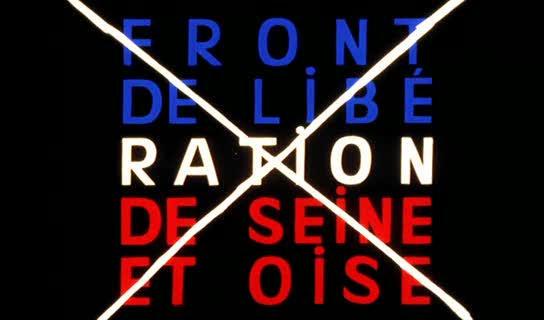
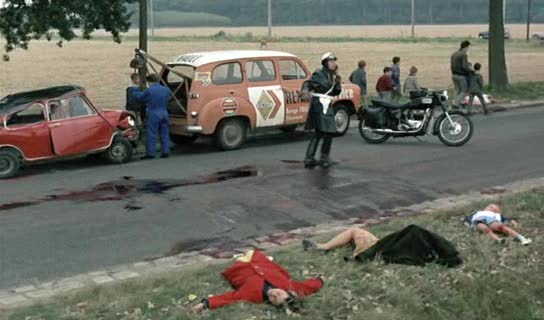
WEEK END is Jean-Luc Godard’s 1967 film about a hateful bourgeois couple traveling through a rural stretch of France strewn with dead bodies and burning vehicles. Looks like the end of the world. It’s the tumultuous late '60s, but this particular doomsday feels strangely like a JACKASS stunt, or those smarmy thetruth.com anti-smoking commercials. With rape and cannibalism. WEEK END takes not taking itself seriously way too seriously.

I’ve always found Godard pretty tedious, even when he’s serving up airy souffles like BREATHLESS and BAND OF OUTSIDERS. He loves cinema, sure, but nowhere near as much as he hates the hypocrisy and self-delusion of the ruling classes worldwide. (Damn. He should have been a union organizer or a terrorist. Maybe he was at some point.) His lucid politics, his ideas about civilization versus barbarism, his idea of a joke (amateur Python), his solidarity with the oppressed, his pessimism about human connection... all these rueful observations he expresses in apocalyptic rants, gags, verbal riffs and visual non sequiturs that resurface later as damning correlatives to said riffs. But, for all the operatic tracking shots, he has little rhythm and no heart. If that’s your thing, eat up. In the dark of the theater, I prefer singers over scientists.

Godard’s brilliance and right-on radicalism don’t add up to an essential filmmaker. WEEK END plays the way I suspect the elaborate social provocations of Euro auteurs like Noe, Haneke, Ozon and von Trier will come off in the near future—like snotty tantrums. Storytelling, what’s that? Actually, all of these guys know how to tell a story, but they’re too smart(-ass) to bother most of the time. The film-of-ideas is just as tiring to me as the novel-of-ideas. Everything’s random access, nothing you need settle down to watch in the dark. Hang it in a gallery or lay it on the coffee table, but feel free to look away, drift and return the way you might if Godard himself were crowding you, dispensing his wisdom along with a tiny whiff of bourbon.


WEEK END messes around with title cards and jarring sound transitions in the manner of later films like FIRST NAME: CARMEN and EVERY MAN FOR HIMSELF. While his mouthpiece characters resist all forms of hegemony in word and deed, his picture and sound follow suit, refusing to cooperate with Hollywood’s soothing formal dictates. An absurdly long, xxx-rated monologue about a sexual threesome accompanies the ultimate stylistic sin: The camera zooms in and out at random while an ominous music cue drops out intermittently, senselessly. Might as well be gonzo porn scraps. But as the backlit protagonist in her underwear drones out the story to her lover, the effect satisfies neither a porn nor cinema jones. It’s just Godard being rebellious, nerd-naughty.

Later, he orchestrates an even longer shot tracking an endless traffic jam out of the Old Testament. All kinds of surreal and gory events pass through the frame in “real” time. All I could think of was the amount of money and manpower it must have taken to pull this silly scene off. Maybe that’s what Godard wants us to think about.


A child of the Nazi occupation of France, Godard has admitted to being a cinematic resistance fighter down to his socks. WEEK END is what happens when a resistance fighter sprays the machine gun so indiscriminately he kills even the thing he is presumably fighting for—in this case, true cinematic poetry.

01967: 105 minutes: dir. by Jean-Luc Godard: written by Jean-Luc Godard