Showing posts with label Larry David. Show all posts

Sunday, September 18, 2011

Viewing Log #84: So rid of all your stories [9/9/11 - 9/18/11]

by Ryland Walker Knight

Security

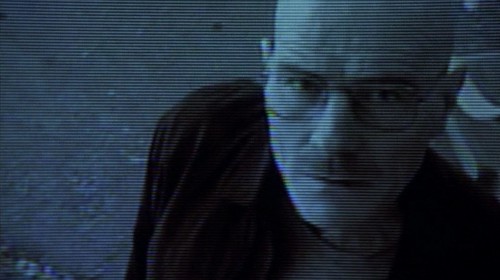
  • Breaking Bad Season 1, [Vince Gilligan, 2008] So far, I'm a fan of the farcical elements that sharpen the edges of the drama and elevate the show past one of the stupidest (or most roll-your-eyes) pitches you can imagine. Oh, a failed chemist now teaches high school and has cancer and, get this, to pay for his chemo he starts selling the purest crystal meth ever thanks to his skills in and knowledge of chemistry? Yeah, that sounds like a party—when does it air? That train of thought is why I never watched. But my friend told me it was funny, actually, and since the first three seasons are all on Netflix Instant at present I thought I'd give it a shot. Turns out she was right and I was wrong! It's not dumb, it's funny. But it's dark, a black comedy. However, I can imagine things only get heavier as Walter White turns into more of a heavy. For now, I'm enjoying all the play on that line we draw between right and wrong, legal and not, good and evil. Plus, it's about money in the late oughts and that's bonus points right there.

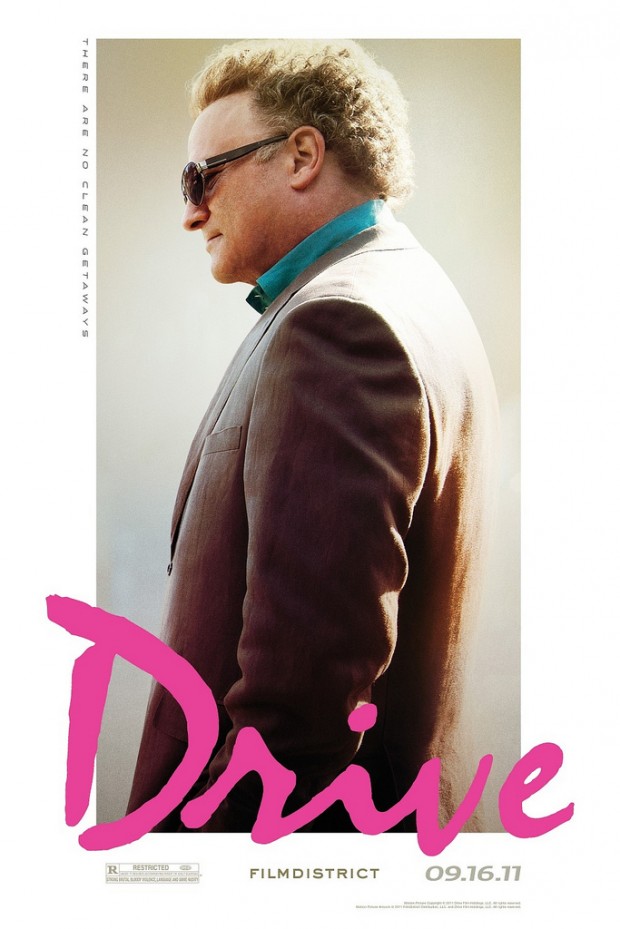
  • Drive [N.W.Refn, 2011] # I gave it a second chance and I'm still unimpressed. It simply doesn't add up. For a while, after I read the Sallis book a couple times, I thought it might be interesting to write an article all about adaptation using this as an intriguing example (as part of the pitch, too, I'll be honest). But the adaptation's strengths are lost in the haze of what Refn's after, which I think can be simplified to one of the weirdest ways to say, "I love you," to his wife (1). Even disregarding that mostly useless extrapolation of projection-as-interpretation, the object itself is rather basic, though pretty, and altogether empty—a film of integers arrayed, not added up, instead of the matrix of significance it seems to pose as in all those extra beats and drawn out googly eyes scenes. That is, there are a lot of "symbols" that don't add up to any kind of meaning. The most interesting motif—the satin scorpio jacket—is ruined, near the close, with that line of dialog that acts like a "looky here!" instead of letting the images and editing reinforce that the jacket is his armor, what keeps him alive, if not a second skin. He's not wearing it at all times, but when he's not wearing it, he's holding it across an arm. Or he's draping it on the kid, which is both an everyday gesture (keep the kid warm) and a gesture of protection (shielding the boy) (2). After all (spoiler), our "real hero" is stabbed in the gut while he's wearing this "trademark" and he doesn't die; that gratuitous act of violence just bloodies him, and the festishistic camera glides up his stoic face to reify this guy as alone, like so many "heroes" before. What Danny calls soulless, I call boring. I might even call it rote. But I must cop to the fact that I spent a lot of time anticipating the movie, and gabbing with my friends about it afterwards, but more in SF than Cannes because I felt I had to explain myself a lot more. Point is, there's obviously things there (Refn knows how to compose shots, if not film action) if it spawned this many words, this many hours of thinking and talking. Thing is, I still want more to warrant it all.

  • The Driver [Walter Hill, 1978] # Hoberman called it schematic in his review of the Refn picture. I think it's great. My favorite scene might be the one where he trashes their orange Benz to prove his skills behind the wheel. And Isabelle Adjani is super hot. Total score. I've got "deeper thoughts" but this is all you get here.

  • Curb Your Enthusiasm "Larry vs Michael J. Fox" [Alec Berg, 2011 "Thank God he didn't hand you his dick, you know what I mean? He coulda been shaking and shook that dick up, hand you the dick and the dick shot sperm in your face." Finally, a few truly great Leon moments and lines. And what an amazing guest spot: so awesome MJF can make fun of himself like that. And what about that "Paris" set? Priceless.
  • Curb Your Enthusiasm "Mister Softee" [Larry Charles, 2011] A weaker link, but, granted, this one had some good Leon moments, too, to spice up the rather "predictable" convergence of threads.

  • Contagion [Steven Soderbergh, 2011] American movie of the year? Maybe. Truly digital, truly D-G capitalism-as-schizophrenia, truly mosaic. A cheap shot of a human villain in Law, but it's the filmmaking (moviemaking? it's digital, after all...) that elevates the often obvious script. That and the actors. But more later. UPDATE: Here's more.

  • The Runaways [Floria Sigismondi, 2011] It starts well, with all that messy sex stuff and Michael Shannon doing something flamboyant instead of all nervous everywhere, but it sure hits a wall when they get famous and it tries to slow down to get serious as if those two things were dependent on one another. Was really ready for this to join Whip It as this fall's grrl movie I have a place for in my heart but this one just isn't that one.
the man
—The real star of the picture

(1) Refn basically said as much to Durga during their interview.

(2) Cambomb gave me this reading.

Sunday, November 22, 2009

Viewing Log #21: Bleed heat by night [11/16/09 - 11/22/09]

by Ryland Walker Knight


—Bring yourself, roll

  • Curb Your Enthusiasm, 7th Season [Larry David, 2009] Hard to beat "The Table Read," no doubt, among so many episodes this season, but, once again, LD proves how smart he is about people's petty shit and everybody's desire for a fairytale—despite knowing all too well that most things in life, as it turns out, aren't just jokes but lies. Or, a house of cards and red herrings. I feel like a human again.
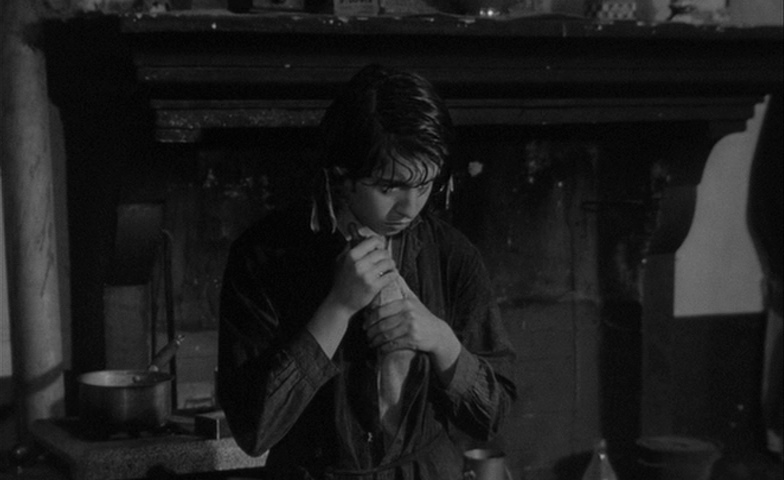
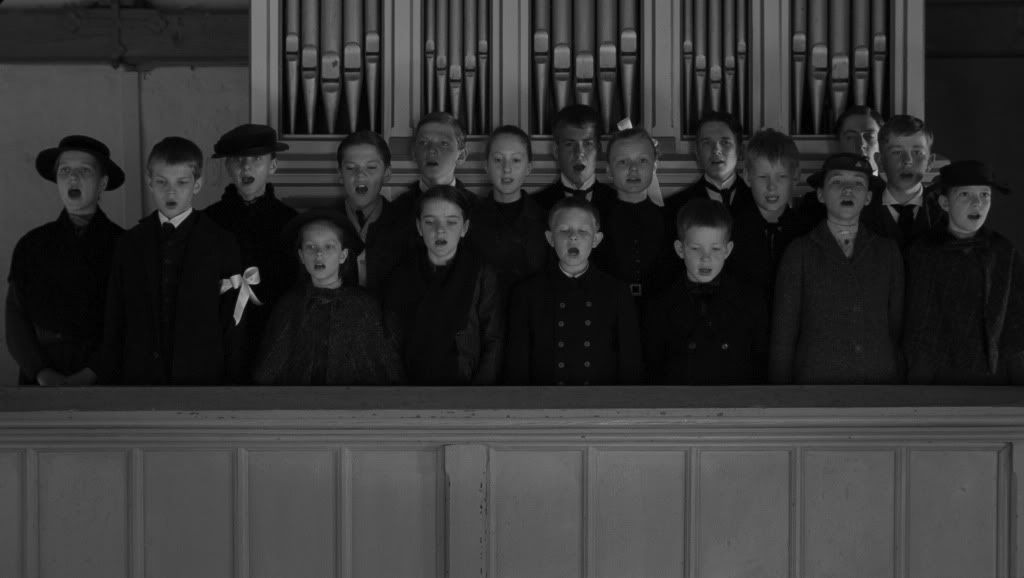
  • The White Ribbon [Michael Haneke, 2009] Almost exactly what I expected, but it's the first Haneke film I've wanted to see a second time. The film's ambiguities, in ways I've not felt from this hectoring hooey hocker's work before, feel ambiguous. Since I'm still sussing the political-historical mumbo jumbo, my perhaps-predictable excitement is primarily perceptible: Haneke's digital shift is an aesthetic tool, strictly technological, to register the world in luminescent darkness even more stunning than Public Enemies's wood-bound fire-fight. This light doesn't dazzle, though dazzle it does; rather, in these corridors and on these farms, light and its lack seep and spread, hint even, or slab the world into a plastic fresco at noon. A field of wheat waving is gorgeous, of course, but so is the older brother in the corner, his nightgown a ghostgown and his head missing in the shadows. We're left with voices, and contours. I could watch this movie outside, eating cheese next summer, and be okay.

  • Je t'aime, je t'aime [Alain Resnais, 1968] The stutter of time, and proof of proofs that you don't need "special effects" to make great, hard Sci-Fi. However, it's also "Sci-Fi" in that it's a film of referentiality, and of an index, of how top-down maps don't work (and least of all with the brain). A heart-soul, however invisible, lives in dimensions. More in a separate post soon.
  • Mouchette [Robert Bresson, 1967] # Anybody who calls Bresson boring is, like, the worst. This movie, though hard, is, like, the best. Here the cinema (or maybe just the camera?) poaches life, or can; here the cinema captures spirits, or uses them; here the cinema clacks at the world. It's stubborn, like its subject, and everything's a row. DVD can't help it, as Bresson's cinema desires celluloidal textures felt by the flicker first, but the extras are pretty great on this Criterion disc. (Godard's trailer, for instance, is a treasure.) And I know in my bones that all I got when I saw the film at Film Forum ages ago was that, shucks, the world is rotten. Now I want to read some Baudelaire, and never slap any body.

  • The Magnificent Ambersons [Orson Welles, 1942] Big admission: this was the first time. What a doozy and dizzy quilt of a movie. Even though you can see some seams, it's still wholly fascinating, and surprisingly touching. Matter of fact, it's super sad. —Boy did I hate that guy who wouldn't quit guffawing at the so-perceived anachronisms. Just because its about history doesn't make it a relic itself. I could, and maybe should, watch this movie a ton. Definitely one of the great "house movies" in movies.

  • Muriel [Alain Resnais, 1963] # Still knotty, still devastating, always too fast. A blink of a movie containing so much in its elisions. Here's the jump cut, for Heaven's sake. More, still, back here.


—Marked by lightness, a shining shroud

Sunday, November 15, 2009

Viewing Log #20: Sporting lint [11/9/09 - 11/15/09]

by Ryland Walker Knight


Autumn's not autumnal here. #1
Autumn's not autumnal here. #2
—All things shining.

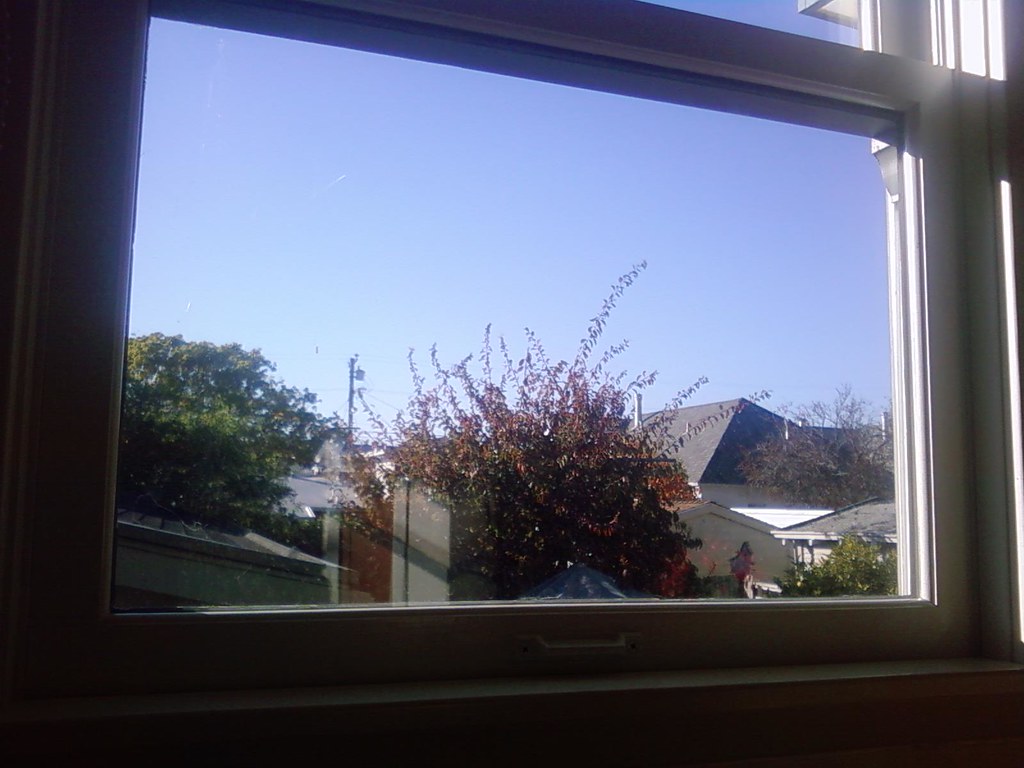
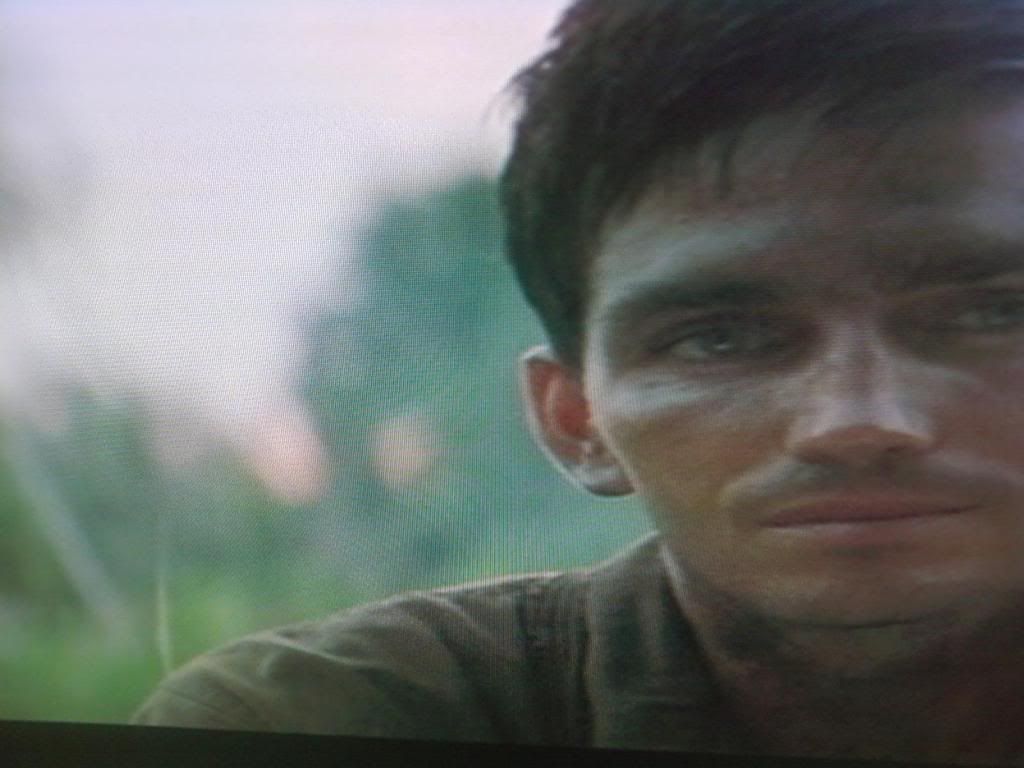
Most of the week was spent not watching movies. But, as happens with an active calendar, the wait for the weekend brought me some special sights made richer by my recess. More Resnais, mostly, but also some time for some TV comedy. If you follow me on twitter (@ryknight), you know that I watched some Curb Your Enthusiasm earlier this week, but this week's episode, seen live on the East Coast feed with Cuy, was even better. We laughed hard, we laughed a lot. I also laughed plenty during Stavinsky... [Alain Resnais, 1974] despite its melancholy and its slow downturn. I'll say more in another post. Ditto for Muriel [Resnais, 1963] and Night and Fog [Resnais, 1955], which proved a tough pair. One's a knot, the other a nightmare. You can watch the nightmare "history lesson" by clicking here. The Dark Knight [Christopher Nolan, 2008] # sure still has plenty of night time fire frights, but it's hardly as effective in the bright autumn sunshine of a lazy Sunday afternoon in San Francisco. After a stroll for some Blue Bottle, we caught the big chase, the jailbreak, the wild dog window shot, and the hospital bit; we concurred that Heath was cut, and probably due to his junky habits as much as genetics. Then we watched a couple of Party Down episodes. Not only is Lizzy Caplan too cute and Ryan Hansen a surprise scene stealer, but Steven Weber is too funny in his guest spot creeping up all creepy like with his lazy eye and pitch-perfect accent. Clearly, I've been missing out on something hilarious. Now, naturally, after a doze, I'm fading to sleep under that familiar spell of The Thin Red Line [Terrence Malick, 1998] #.


—of course a sentry

Monday, November 02, 2009

Qu'est-ce que c'est? Convergence?

by Ryland Walker Knight


surprise foe

serial killer
Surprise fowl marked for murder

Viewing Log #18: Saints break stains and blue runs red [10/26/09 - 11/1/09]

by Ryland Walker Knight


take light

This second week back in the Bay has been awfully full of commitments that have kept me from the movies. I've spent most of the week looking at Jeanne Dielman, 23, quai du Commerce, 1080 Bruxelles [Chantal Akerman, 1975] # in preparation for an overdue image-essay that will hit The Auteurs shortly. Once again I'm reminded of how amazing the film is, but, also, how little passion I have for it; I regard it through a veil, almost, of painful echoes. I have found time for some television this week, though, with the finale of this latest Peep Show series as well as another Curb Your Enthusiasm (and one yet to catch up on from last night)—not to mention NBC stuff, like 30 Rock, which keeps proving its smarts week in, week out, by playing dumb. Other than that, there was only one other movie of my stack that I got to, and tardily, last night: I Know Where I'm Going! [Powell & Pressburger, 1945]. Given my fatigue, it shouldn't surprise you that, though I loved the picture, I don't have much to say to account for its typically gorgeous tale of restraint. The obvious thing to say is that its use of off-screen space is fantastic: you can feel the pull of all that sits beyond grasp or fogged-galed-rained out of sight, the way conduction works. Fate, these filmmakers would have you believe, is an equation, a leveling, maybe, where the world finds its balance.

le fou
—Le fou, for real