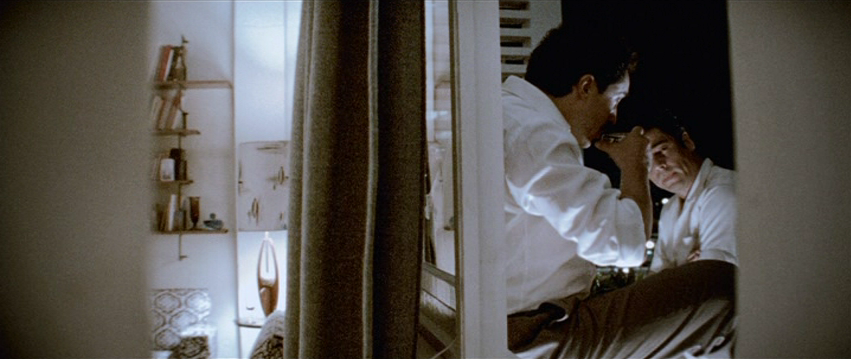
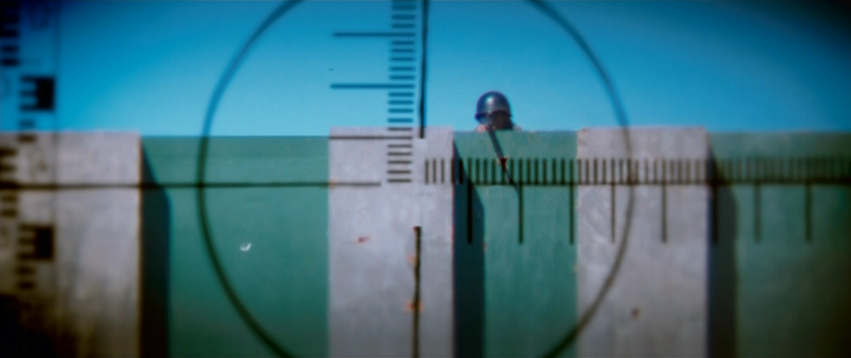
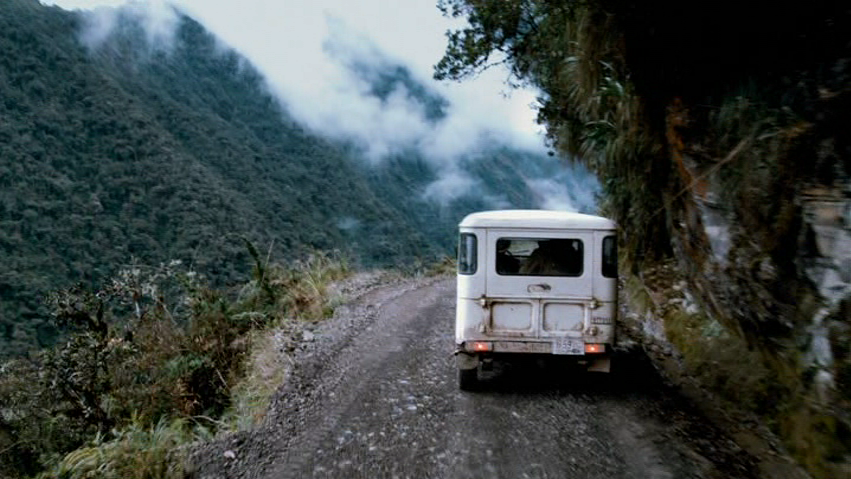
Showing posts with label Steven Soderbergh. Show all posts

Sunday, September 18, 2011

Viewing Log #84: So rid of all your stories [9/9/11 - 9/18/11]

by Ryland Walker Knight

Security

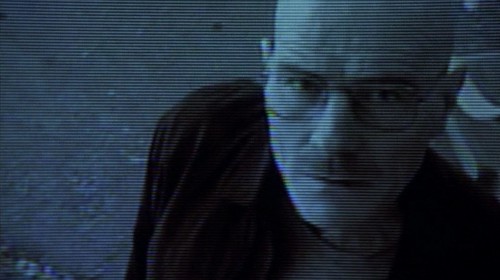
  • Breaking Bad Season 1, [Vince Gilligan, 2008] So far, I'm a fan of the farcical elements that sharpen the edges of the drama and elevate the show past one of the stupidest (or most roll-your-eyes) pitches you can imagine. Oh, a failed chemist now teaches high school and has cancer and, get this, to pay for his chemo he starts selling the purest crystal meth ever thanks to his skills in and knowledge of chemistry? Yeah, that sounds like a party—when does it air? That train of thought is why I never watched. But my friend told me it was funny, actually, and since the first three seasons are all on Netflix Instant at present I thought I'd give it a shot. Turns out she was right and I was wrong! It's not dumb, it's funny. But it's dark, a black comedy. However, I can imagine things only get heavier as Walter White turns into more of a heavy. For now, I'm enjoying all the play on that line we draw between right and wrong, legal and not, good and evil. Plus, it's about money in the late oughts and that's bonus points right there.

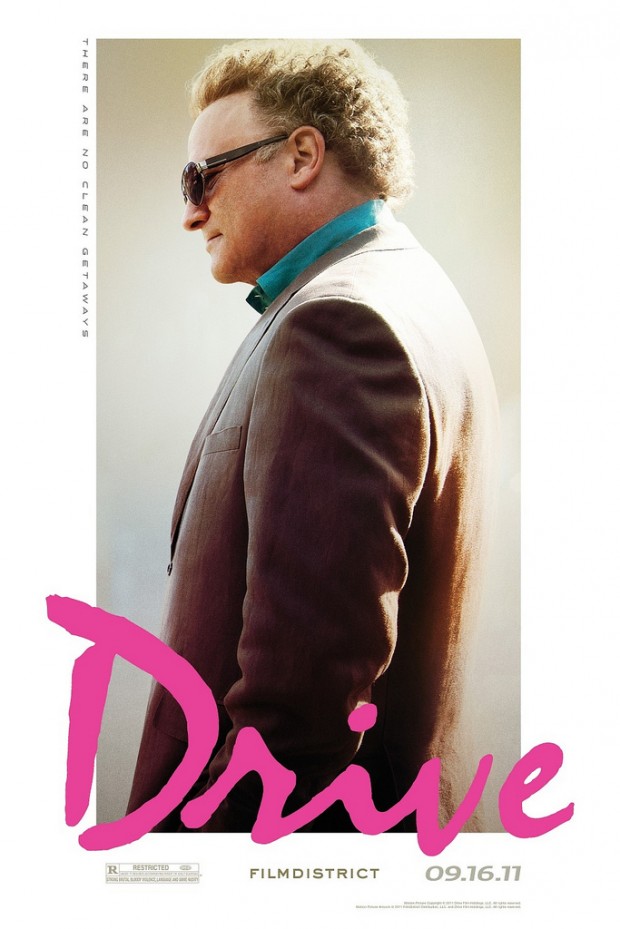
  • Drive [N.W.Refn, 2011] # I gave it a second chance and I'm still unimpressed. It simply doesn't add up. For a while, after I read the Sallis book a couple times, I thought it might be interesting to write an article all about adaptation using this as an intriguing example (as part of the pitch, too, I'll be honest). But the adaptation's strengths are lost in the haze of what Refn's after, which I think can be simplified to one of the weirdest ways to say, "I love you," to his wife (1). Even disregarding that mostly useless extrapolation of projection-as-interpretation, the object itself is rather basic, though pretty, and altogether empty—a film of integers arrayed, not added up, instead of the matrix of significance it seems to pose as in all those extra beats and drawn out googly eyes scenes. That is, there are a lot of "symbols" that don't add up to any kind of meaning. The most interesting motif—the satin scorpio jacket—is ruined, near the close, with that line of dialog that acts like a "looky here!" instead of letting the images and editing reinforce that the jacket is his armor, what keeps him alive, if not a second skin. He's not wearing it at all times, but when he's not wearing it, he's holding it across an arm. Or he's draping it on the kid, which is both an everyday gesture (keep the kid warm) and a gesture of protection (shielding the boy) (2). After all (spoiler), our "real hero" is stabbed in the gut while he's wearing this "trademark" and he doesn't die; that gratuitous act of violence just bloodies him, and the festishistic camera glides up his stoic face to reify this guy as alone, like so many "heroes" before. What Danny calls soulless, I call boring. I might even call it rote. But I must cop to the fact that I spent a lot of time anticipating the movie, and gabbing with my friends about it afterwards, but more in SF than Cannes because I felt I had to explain myself a lot more. Point is, there's obviously things there (Refn knows how to compose shots, if not film action) if it spawned this many words, this many hours of thinking and talking. Thing is, I still want more to warrant it all.

  • The Driver [Walter Hill, 1978] # Hoberman called it schematic in his review of the Refn picture. I think it's great. My favorite scene might be the one where he trashes their orange Benz to prove his skills behind the wheel. And Isabelle Adjani is super hot. Total score. I've got "deeper thoughts" but this is all you get here.

  • Curb Your Enthusiasm "Larry vs Michael J. Fox" [Alec Berg, 2011 "Thank God he didn't hand you his dick, you know what I mean? He coulda been shaking and shook that dick up, hand you the dick and the dick shot sperm in your face." Finally, a few truly great Leon moments and lines. And what an amazing guest spot: so awesome MJF can make fun of himself like that. And what about that "Paris" set? Priceless.
  • Curb Your Enthusiasm "Mister Softee" [Larry Charles, 2011] A weaker link, but, granted, this one had some good Leon moments, too, to spice up the rather "predictable" convergence of threads.

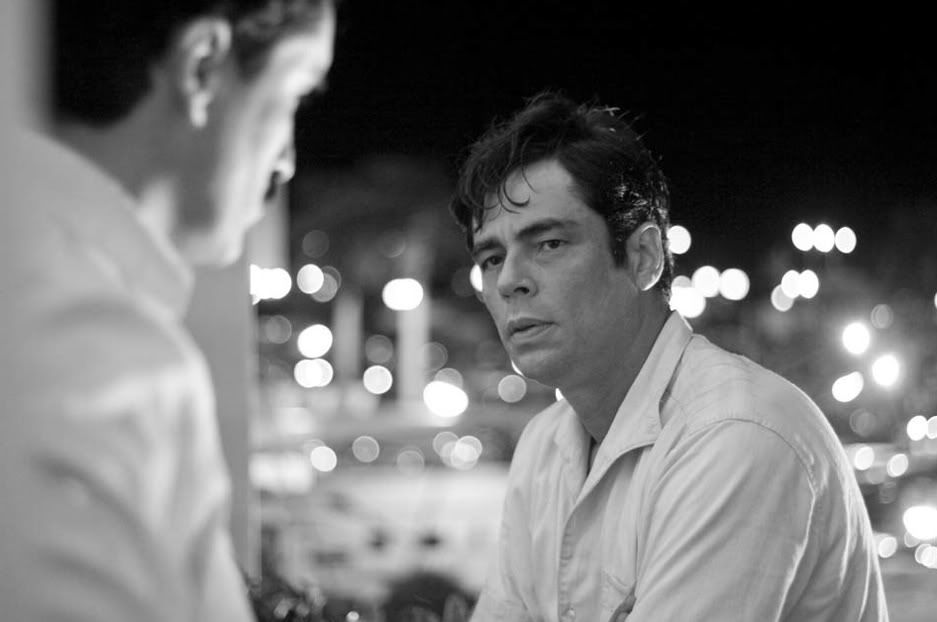
  • Contagion [Steven Soderbergh, 2011] American movie of the year? Maybe. Truly digital, truly D-G capitalism-as-schizophrenia, truly mosaic. A cheap shot of a human villain in Law, but it's the filmmaking (moviemaking? it's digital, after all...) that elevates the often obvious script. That and the actors. But more later. UPDATE: Here's more.

  • The Runaways [Floria Sigismondi, 2011] It starts well, with all that messy sex stuff and Michael Shannon doing something flamboyant instead of all nervous everywhere, but it sure hits a wall when they get famous and it tries to slow down to get serious as if those two things were dependent on one another. Was really ready for this to join Whip It as this fall's grrl movie I have a place for in my heart but this one just isn't that one.
the man
—The real star of the picture

(1) Refn basically said as much to Durga during their interview.

(2) Cambomb gave me this reading.

Sunday, February 21, 2010

Viewing Log #34: Lateral Collateral [2/15/10 - 2/21/10]

by Ryland Walker Knight


This past week I watched a bit of all of Wes Anderson's movies here and there*, I looked at A Serious Man and The Informant! again, and a whole bunch of basketball games, as well as a basketball movie on hulu. I also wrote a bunch about Wes Anderson, and then rewrote it a lot, and need to give my text one final pass right now. (More on this soon.) I read some Philip Larkin and some Cavell and even wrote some poems of my own. I worked a lot and my brain got tired in a different way. I plan to work out more in the coming months by swimming laps because running only hurts my knees ever since I fell. I still walked the dog in the sun and in the rain. I drank a fair number of beers on a few different nights. I danced at Soul Night and Barry introduced me to those DJs and they seem like swell dudes. Pretty packed. Still plenty left on the dining room table.


—Here's another goodrn, Tom

*Since people like lists, here's how I'd rank the Wes films in preferential order, which, of course, doesn't mean it's anything but my taste, which I think should be shown to favor the formal and the hilarious first. Do you remember just how funny these movies are? I'll expand on this more later, but, the gist is this: making comedy makes sense (in nonsense) as much as light of the world and its problems, is hard, should be a bigger part of so-called serious art and, for that matter, a bigger part of so-called serious people's canon.
  • The Life Aquatic with Steve Zissou, 2004
  • Rushmore, 1998
  • Fantastic Mr. Fox, 2009
  • Bottle Rocket, 1996
  • The Darjeeling Limited, 2007
  • The Royal Tenenbaums, 2001


This coming week I have some sure-fire movie-going bets, though, including the Dorsky night at PFA, which means Lost will get pushed back a bit, and I want to see Shutter Island three days ago, and I may even brave My Son, My Son if I have the time. What's more, there's a ton of SFIAAFF screeners to get to, like the new Hong, which I plan to write about in the near future. Anyways, back to editing before bedtime, before another week of madness. Here's hoping that, with the right attention and application and sleep schedule, everything heals.

Tuesday, February 16, 2010

Make tomorrow yesterday, love ice and sun

by Ryland Walker Knight


—Click for treats

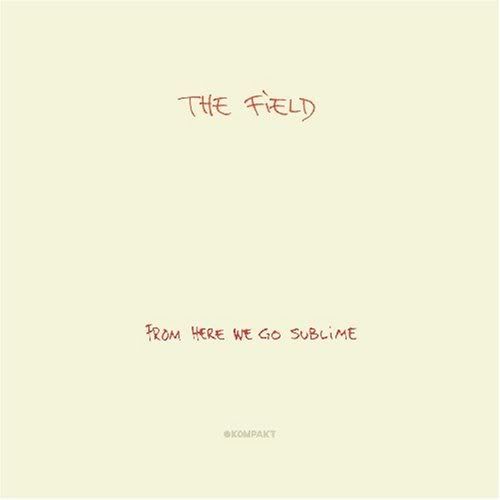
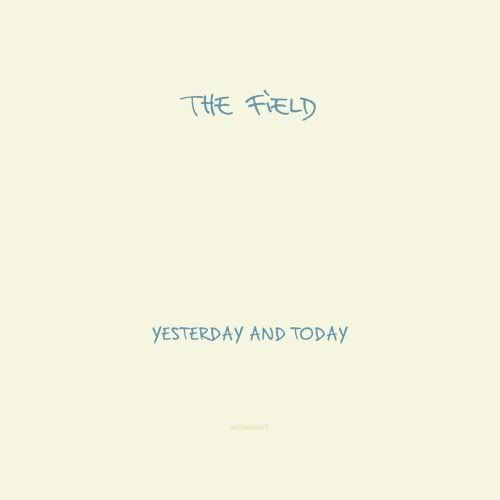
Sunday afternoon I learned about The Field. First thought: How could this dude elude me for so long? Mostly my fault, if we want to say fault, since I don't exactly go looking for music the same way I used to at the start of our last decade (ie, read Pfork). However, how come it took somebody new to hip me to this? Turns out my friends all already thought I was hip to it. They just figured I wouldn't need a nudge in this direction because it suits my musical temperament so well. That is, it has its pop roots—it's dance music after all, there's a cover of "Everybody's Got To Learn Sometime" on the newer record—but it's weird and illegible enough to intrigue other parts of my brain. Dance music, and minimal dance music at that, gets a bad rap for being "repetitive" but that's precisely where the fun lies. Not just because it builds a beat to vibe with and dance to but also because repetition is an order to play with just like anything else: the differences, exciting and terrible and awesome and so many things, emerge over time. Put otherwise: these two albums have been on repeat a lot because they tickle my brain as much as my sides; they stimulate concepts up top and feelings below in the body. (This was also my so-called "over-intellectualized" argument in favor of Midtown 120 Blues last fall, too.)

Also, for all my love of Cut Copy and Pavement and Prince and any other wacky pop, I'm pretty into minimal-architectural sounds that arrange a space (a field!) of play. For a long time all I did was listen to Fennesz. That was like living in a cave, however, and putting The Field on repeat is like living a perpetual drive across the Golden Gate bridge with the sunroof open and not minding the fog's chill because you know there's sunshine ahead.

Unlock your far out
—Suits living West of it all, too

This also gave me good reason to update the widget after a long time off that tip. I've added the two albums that headline this post, the Cavell book we should all be reading together, and two of the best American films last year (The Informant! and Fantastic Mr. Fox), about which I'll have more to say in the not-too-distant future in other outlets. As ever, thanks for reading, and for any Amazon purchases you make (I know there are some of you out there indulging/helping me! and that's great!), and, duh, stay tuned for more. Heaven knows that I'll be around, maxin' with or without socks, dreaming about words and sequenced spaces.

No sock shadow puppet here

Sunday, January 31, 2010

Viewing Log #31: Foam forts make islands, traps [1/25/10 - 1/31/10]

by Ryland Walker Knight


Parade 2
Parade 1

  • Casa de Lava [Pedro Costa, 1994] # I'm about to start it. Seems fitting, given the Tourneur I watched and the box set coming out soon, about which I hope to say more when the time comes. Until then, I'll enjoy this masterful other mode he worked with first. And Inês de Medeiros. What a babe.
  • Band of Brothers "Crossroards" Episode 5 [Tom Hanks, 2001] The most theoretical episode so far with Winters literally writing history and bullets becoming letters at one match sound cut. But, as ever, the pathetic appeal is always thick, even in this quieter and calmer and altogether well constructed cliffhanger. Biggest surprise of this episode was easily Jimmy Fallon showing up for about five seconds of screen time.

  • Youth Runs Wild [Mark Robson, 1944] After a fabulous collage opener, all kinds of headlines and newsreels jumbled and layered, it got kinda boring. And I fell asleep. Shucks.
  • I Walked With A Zombie [Jacques Tourneur, 1943] # Stunning on such a screen despite the scratchy print. Despite all the murk moving, it's a crisp picture. More Monday.

  • Scarface [Brian De Palma, 1983] # Watched the first half. It starts so well, actually funny and wild and silly, but it quickly takes on Tony's worst qualities and does its own tailspin. Or so it seemed as I gave up and went over to watch the Warriors lose to the Bobcats.

  • The Informant! [Steven Soderbergh, 2009] # Still my favorite American film of last year. Precisely because it's so American, and funny. Lots there I'm not going into here. Maybe later, but probably not; probably, if you're really curious, you should just ask me about it. UPDATE: Actually, I'll probably publish some thoughts on it at the newly-launched website Thought Catalog, where I will join fellow VINYL-head Daniel Coffeen to contribute pieces on somewhat of the regular.

  • Band of Brothers "Replacements" Episode 4 [David Nutter, 2001] Nicely coiled episode that keeps things contained to one "Bull" character getting left behind, or having to stay behind, enemy lines after an ambush. That said, the same manipulative stuff irks me, and I'm mostly intrigued by Winters' calm ascent more than anything. I'll keep watching, of course, to see more visceral action scenes (but why the wash out standard, Steve and Tom?) and to see who all the old guys from the preludes are in this grand-scale re-enactment.
  • Casino [Martin Scorsese, 1995] # Finished it, as I tweeted, and boy does it drive itself down. A lot of scenes are hilarious, and others would be if they weren't so brutal. It shows life as perpetually preposterous, spectacle of death to the end one bloody baseball bat at a time. And, to reiterate my tweets, the cinema-as-a-gamble thing is crazy despairing, however beautiful, and I don't want it to make as much sense as it does.

Sunday, December 27, 2009

Viewing Log #26: No, not caprice: it takes idle time. [12/21/09 - 12/27/09]

by Ryland Walker Knight


Cargo No.4, 1
—Pride: pp.14-15

  • A Serious Man [Coens, 2009] I just tweeted: "A SERIOUS MAN is so scary it hurts. Just about the most nihilistic film I've ever seen. Like NO COUNTRY times BURN AFTER READING to the nth." And I think it's kind of good? Don't quite know yet, but I do know that to toss it off as simply just nasty is to not reckon the nasty. In fact, I'd say that's exactly what they're predicting you'll do; what they might say is a "problem" at large. I don't think they're advocating a blind eye. The scary thing is that they might be advocating a bullet brunch. Or, that some lives aren't just quiet desperation: some lives are, in fact, pointless. Whether you eat the bullet is up to you, of course, but it's a debate you have to have every day. Luckily, or so it would appear, each of these guys has "somebody to love" and that makes them choose this world every morning. I walked out desperate for life. I should probably write some more about this one. Or, at the least, have a few good talks over a few good beers with a few good men I trust and love.

  • Inglourious Basterds [Quentin Tarantino, 2009] # Wound up watching the digital copy in full. Looked good, but it was too easy to minimize while snacking.
  • Black Book [Paul Verhoeven, 2006] # On a rainy and ugly day, I thought I'd see some real struggle and some real womanhood. [click here.]

  • Inglourious Basterds [Quentin Tarantino, 2009] # Started it on my computer, then later in the day looked at the Blu Ray. Looked great, of course, but, as I tweeted, this movie demands celluloid's texture. Motes don't quite mote, and smoke won't quite curl, the same in digital's clarity.
  • 2001 [Stanley Kubrick, 1968] # Works really well on Blu Ray; so alien, such a painting. I skipped around a lot and saw some beautiful things. "Jupiter And Beyond" is something wholly new, something Avatar can't touch (in any medium).
  • North by Northwest [Alfred Hitchcock, 1959] # I dozed, but the Blu Ray's colors were out of control beautiful: all those greens popped so loud against all that grey.
  • Le chant de styrène [Alain Resnais, 1958] # Off the Marienbad Blu Ray, watched without the soundtrack, which made it that much less representational and more just a bunch of color and movement plays.

  • Black Book [Paul Verhoeven, 2006] Carice van Houten isn't only a pretty face, a total babe, but she's also a damn good (and game) actress. It's kind of crazy how good this movie is—and that I never heeded suggestions that I go see it in theatres—crazy in that way where you shock yourself at how much you love something. (The movie's pretty shocking, too, of course.) The holiday week forced me to break up the movie, which is a bummer, but it's so strong scene-to-scene—with almost every single interaction a bit of two-face; almost everything's about performance and/or artifice in some fashion or another—that it doesn't hurt the film too much to see it in pieces. It also helps that Verhoeven is such a pulpy goof who makes straight up entertaining movies. (Since I'm in a hierarchical mindset these daze as the decade winds down, I also want to say that 2006 was an especially strong year for this decade; and this movie's right up there on my list.)

  • Taken [Pierre Morel, 2008] Plenty stupid. But the right kind of calories for dinner. Kinda makes me excited for this piece of junk. Funny that Zach threw up some notes the same day.
  • The Girlfriend Experience [Steven Soderbergh, 2009] Tight little package. Sometimes funny, sometimes not, mostly a mirror for its often affectless actress and that wild time of October '08. Good lunchtime flick. My man GK kills his scene. Maybe better than I'm allowing it, honestly, in that it's got a mission and it nails it. (Cough.) I mean, it hammers her home (or not) in more ways than one, though it's also a tad one-note and defeatist.

Styrène'd
—Get lit up already

Sunday, October 25, 2009

Viewing Log #17: Burn off by now already [10/19/09 - 10/25/09]

by Ryland Walker Knight


—What's a womb? That's a home?

  • The Informant! [Steven Soderbergh, 2009] Totally daft-deft stab at greed. Maybe the most ironic film of the decade? Easily the best thing Sodeyface has done since The Limey. But where most of the rest of S.S.'s career is about self-aware charisma, Matt Damon's Whitacre isn't charismatic so much as crazy, a perfect boob, caught inside his own tape loop confessional; it's still about acting, but this film is more about delusions than anything. I feel like I could go see it again tomorrow and the next day—and then the next day, too.

  • Antichrist [Lars Von Trier, 2009] I watched the prologue, then struggled to stay awake for the next twenty minutes of Charlotte Gainsbourg jumping all over Willem Defoe. I'll have to get back to you on this one.

  • 36 vues du Pic Saint Loup [Jacques Rivette, 2009] Damned flawless. Boy do I wish I'd seen this on film for the first time (you were right, DP), but I trust that pleasure, yet to be had, will come to pass a lot sooner than I expect. I will write more soon, maybe, after I finish some projects.
  • Bright Star [Jane Campion, 2009] I'll have more to say later, in another space, but in this right here I'll say, hey, this is nice; and, for good measure—I'd say this if she was a stranger—Martha's recent piece at The Auteurs gets at this sweet thing but good. Further, it was great to see on a big screen, and mostly alone, as my reintroduction to cinema-going in a big city.

  • Eyes Wide Shut [Stanley Kubrick, 1999] # Total fkng masterpiece. Very Rivette, it strikes me, now, with its hidden worlds and masks. Otherwise, very Kubrick, duh, with its fluid and (near) fish-eyed camera; with its dissolves; with its compassionate distrust of the human (and excoriation of male pride); with its color and compositional eye; with its musical arrangement; with its acetate wit; and with its quite "flawless" acting. Another rarity that deflates fantasies but keeps hope alive that marriage is a viable way of life in this world of temptation and commodity-fixation.


—Out to dry

Wednesday, February 04, 2009

The Che letters. Part Two: Canyons, Circles, Exiles

by Ryland Walker Knight


what a drag

[A note: Here we continue what Mark began back in Part One. (To see all the letters, click here.) We hope the letters continue, as we push forward into 2009, because we find this epic so typical of our (yes, fetishistic) interests in cinema as a tool for and of history; and of our aims as intellectually curious people of and in the world in general. I should like to say that these missives are hardly "polished" for a couple of reasons but that should become transparent soon enough. For instance: we are not done. Stay tuned for Part Three in the coming weeks.]

sex machine

Mark,

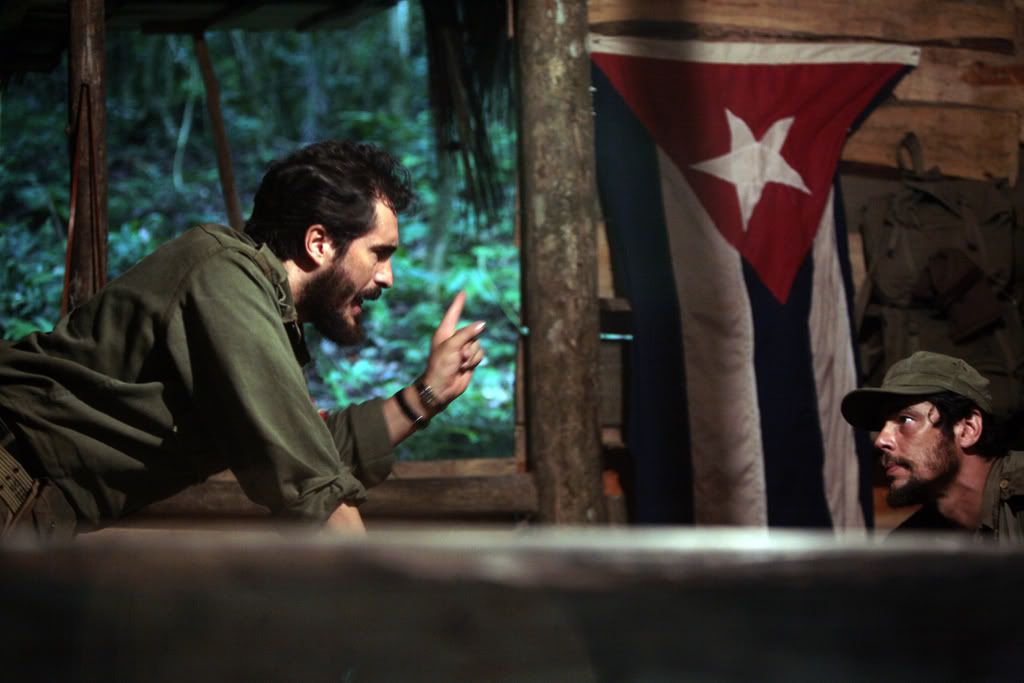
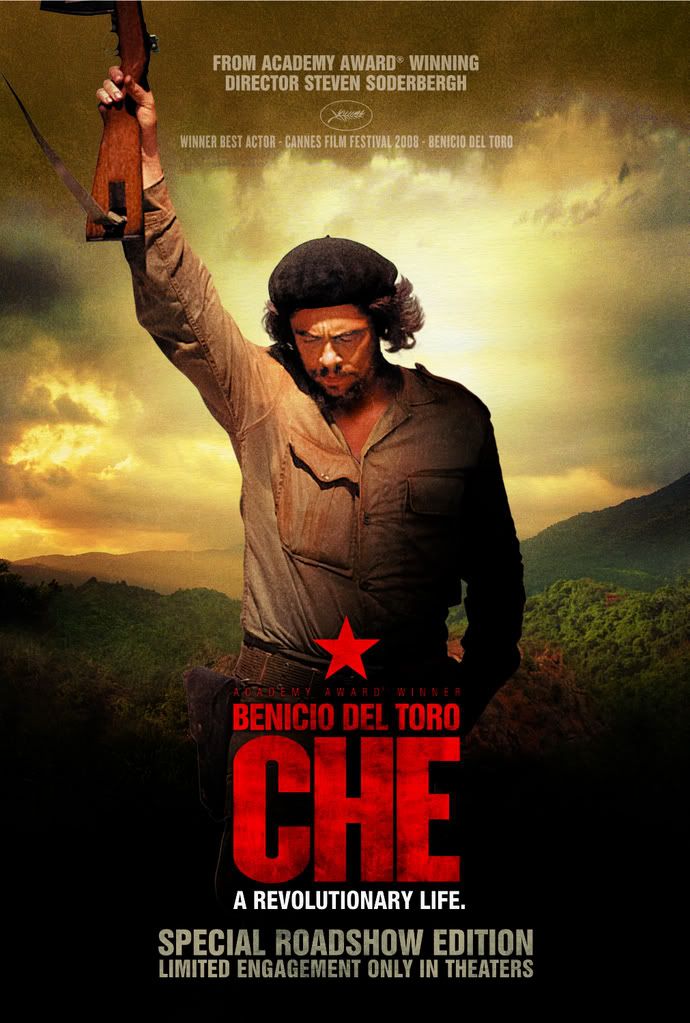
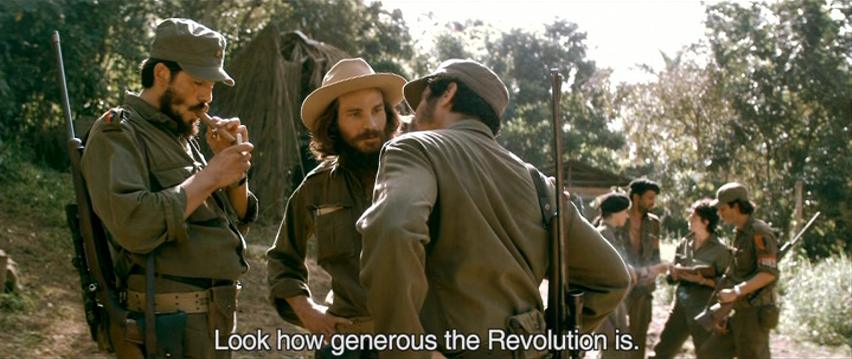
Your impulse to talk around the subject as a way to talk with the subject seems to mirror how Soderbergh's film works, of course, but what makes the film so curious to my eyes and ears is, first of all, how committed to its subject it remains. For all its distance, Che is rather intimate. For all its landscapes, the close-up figures into a large part of its argument. However, the close-up operates in (if not diametric then perhaps) divergent registers across the film's intermission rift. In Cuba, the close-up is pure affection, luminescent and loving expression; in Bolivia, close-ups catalogue and segregate elements of the whole. In both halves, these sets form a crucial part of Che's balance-equation in that their uses are explicitly related not just to form but how we witnesses will figure our "hero" at hand.

Reading Hoberman's essay in The Virginia Quarterly Review shortly after reading your first missive made me think twice about your preliminary assumption-declaration that "Che is not about Che." His essay begins with two weighty words for this man: "Ecce homo," which, of course, nods at Nietzsche and declares, with a colon, "this man." This man, Che, who means so many things. Hoberman lists a number of them, all fine labels, all fine in concert with each other, just as our sense of Ernesto Guevara is folded by so many forces of history and commerce and theory and philosophy and tradition and understanding and all tied to a single image appropriated (I want to say "abused" or even "slaved") into base, reductive, limited symbolism. My list here, as a response to Hoberman's, is an attempt to account for all those contradictory angles played in some name that really only means one thing at bottom: "man." It's redundant: this movie is about man, not just this man, but, of course, it can only ever be "about" this man in particular. And, as Hoberman astutely points, this man is a means for Soderbergh to explore personal obsessions such as process and technique. Look at any one of Soderbergh's films and you will find he is, indeed, or more than less, "a highly intelligent technician who sets himself a problem and goes about solving it."

guns
before butter

Again, your question: how, if at all, do we approach Our Man, That Man, This Che? If we may see Che as mathematics, as Soderbergh has arranged it to rise and fall like the sun, that ever-reliable reminder of our finitude, then perhaps we should do well to grant science its place at this martyr's table of conversation. No doubt the masses have silkscreened the Guevara myth to a new death, or depth. No wonder the aura is drained. No surprise Benjamin comes to mind. No way to get around the repetition of Che. No modulation subsumed in total, the differences are shifts, the revolution a series without end: a perpetual reformation.

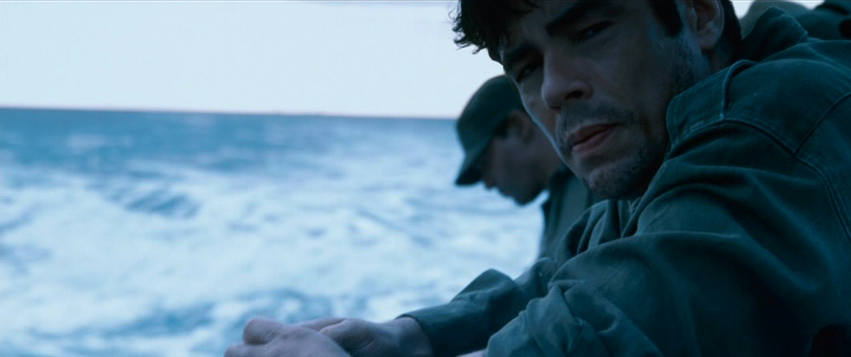
Others have said we must let the singular stand free, we must cherish and preserve these rarities. This challenge has largely been ignored by many of our (intelligent and critically thinking) colleagues. The exciting thing about Che is that, as a hermeneutical situation unto itself (as any work of art is, or can and should be), it rejects a lot of the strict language of closed or isolated subjects—here I think of Sartre as the great mis-reader of Heidegger, and of Gadamer's lucid restorations—but rather an appeal to vulnerability, to the allowance for failure that participation wills us towards, or simply makes impossible to avoid. Here is my humble proposition that the freedom Che argues for, while not that of Che's per se, is one where (useless though it may resound) tragedy looms. However, I do not want to say the film is defeatist. It may deny, but it ends on a boat, looking to the future (from the past), past a spray of light that triggers a reverse shot back at Our Che, standing bowed on the starboard side sharing fruit and looking wary at us, we whose gaze forges him as we wish.

The film is opaque yet transparent. A typically "academic" double move. And, indeed, Soderbergh's work is attacked as "academic." When will this cease to be a pejorative? When will the many under-readers—it's funny that those who tread the surface are hardly interested in a hermeneutics of surfaces and seek only to uncover the unknowable with an arrogance unavailable to my wary posture—begin to appreciate the fact that over-reading is, well, a virtue born of thoughtful attention to the world and its multifarious blossoming forth? When might we see the "real" revolution something like our blogosphere provides? When shall we shuck the calendar's arbitrariness to slow our rollout? When a real Marxism props up somewhere? —When will we get around to talking about the film?

dead eye

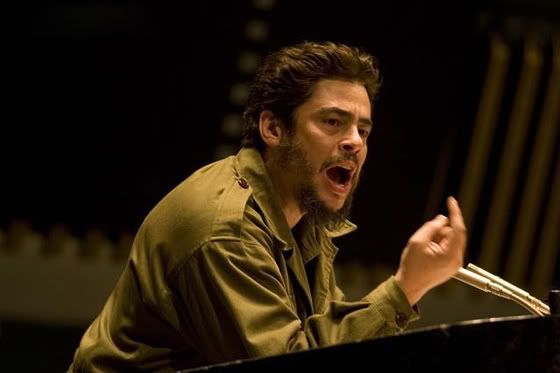
I often wonder if my interest in film has mutated into an interest in what film, or a film, provides in aftermath. I know this cannot be fully true as I do, indeed, keep watching. My watching has slowed so much in the past years because my watching now involves countless re-watching, revisions of my visions. I've said before on this blog (well, in a podcast) that the hermeneut's project is a compulsion, and it may not be healthy; I meant this to encompass cinephilia; this is old news. All of this to say: I do enjoy watching Che. I find Cuba gorgeous, if occasionally on the nose and a tad "cute," and I find Bolivia devastating, and quite often yet more beautiful than its counterpart for all its drain, its pale weight of time and its canyon-cinema-circles. I find Benecio Del Toro's performance pitched perfectly between sex symbol and myopic asshole. I find Soderbergh's mise-en-scène has not been this rigorous since his under-loved revision of Solaris—which features similar arguments about beautiful, stubborn men contending with martyrdom and love and the process of history, or memory-making (all themes shared by his great, deft The Limey; in fact these themes emerge present in all his films). I find the whole 257 minutes easily "too much" and nowhere near "perfect"—it's a "rush job" as much as Hoberman's "act of will" although it cannot nor should it ever be rushed. I find it impossible to recommend.

Che is foreign to itself like Che is forever foreign to his environment. His yearn for a united South America (present before Cuba, if hardly seen here, and announced throughout Bolivia) can never translate in practical terms for the simple fact that his fellows can never look past his face, his spectacle as a figure or a symbol. His comrades do not see his true singularity, his freedom of himself. Soderbergh may know he has no place in the world Guevara sought to build but he also knows that what we all look to Che for is that image of freedom that, as it is unavoidably poetic, comes only from exile. It's a negative freedom, if I understand, and, in a hilarious completion of one circle, a positively American picture that asserts our rights as humans to be a little crazy, to shuck rationale. Because, of course, freedom concerns our world, and not just humans; a space unanswerable to conceptual schemes, to maps of thought; a space given to productivity, to becoming made possible by our limits. Fitting, then, that Che is situated by a pair of maps. Boundaries mean something. Che sought transcendence and all he got was an ignoble death in a hut. His myth, on the other hand, necessarily separate, keeps gaining. If Soderbergh's film can do anything in that space, perhaps it can remind us that this was a man and that man, like this world, will pass into history; however, if we look to build something we have already taken a step towards something.

Until then,
ry

a lesson

Thursday, January 15, 2009

The Che letters. Part One: Questions, Declarations, Navigations

by Mark Haslam


to the people

[Ed Note: Here begins our ensemble attempt to wrangle our, let's be blunt, surprising enthusiasms for this film. Since the film is so large (without ballooning), we thought it appropriate to situate our understanding in this epistolary form, a series of calls and responses, that may speak to the nature of Soderbergh's film and its ostensible subject—and how these braided objects nail their aims across manifold divides. Our aim, it should be obvious, is to make the polymath sing. Update: Click for Part Two and/or the whole series]

cuba
bolivia

[Preamble notes from Mark: (1) Bay Areans, CHE: THE ROADSHOW is coming to us, hitting the Embarcadero tomorrow, Friday the 16th. And as a special treat, cuz you're all special, Soderbergh will be in house to answer our questions. For those in the East Bay not willing to cross the bridge or duck into BART, it will open as two films at the Shattuck Cinemas in Berkeley next Friday, the 23rd. (2) It may be useful to keep Pedro Costa's seminar (at ROUGE) on closed doors in mind. (3) Also owe a look to: The Cry at Zero.]

so wistful
mexico city

Che is not about Che."

Ry,

After a single viewing of Che, this is all that seemed appropriate to say; the one thing that I (to whom confidence comes but rarely) am pretty damn confident of saying. And here it's remained, at the top of a piece of paper, awaiting the explication it seems to deny. And the question it implies produces a response both silent and choral, a nothing and an everything: “What is it about?”

Our first approach faulters. We stumble, or stop, and wonder, how do we approach Che? So much criticism up to this point, positive and negative, tends to description and observation (itself an impressive feat, given the scope and scale) over analysis or thesis; few attempts at a true approach to understanding the film have been made. But then: do we approach in the first place? And if not...? Aha, an avenue: only in resisting representation does the film approach its figure. The non-approach must be our approach, too.

thru the woods

—certain films...are like doors, even if there are no doors in them. They resemble doors that don't let you enter as the protagonist of the film. You are outside. You see a film, you are something else...

For distance is a thing: tangible, like numbers. Especially for Soderbergh. Gaps, spaces, in-betweens...these are bricks, mortar. An absence or offsetting of one thing in relation to another, we come to see neither—or both, but only in the periphery—as our focus lands on distance. Indeed, it is focus, which seems so central to the film's technique that calls our attention to this: a camera—zooming in, zooming out—enacting distance.

But distance comes in many forms. If Cuba gives us Che, at times, at a physical proximity, distance is produced elsewhere. Take the battle sequences that are overlaid with Guevara discussing the ideologies, tactics, or justifications for the images we're seeing. His words don't explicate but complicate. Che doesn't speak in terms concrete enough for explanation. He is all ideal, totally abstract. Indeed, few figures in recent history have been as subject to abstraction as Ernesto Guevara, because, with him, it's easy: a man so determined by his ideals, so apparently detached from the material world, from his own body, that he already seems a vessel....

So, these sequences which might've been exciting and rousing are emptied out, abstracted. Again and again the image becomes an image of distance.

look at a remove

—that also is very important in the cinema, to love at a distance.

None of this is not distancing. I mean, it isn't aloof to us. We're not cast into indifference. I feel Che precisely because I am not asked to—better yet, I am asked to not feel for Che. The camera builds distances and in doing so builds avenues—long entrances. Entrances that are also closed doors. We see a film, we are something else... And the film, I think, like its subject, finds its center in love. But love undergoes a revision: think of Che's line that nobody is indespensible. This isn't intimate love. It's a re-vision of love—and, for that matter, equally of pain—that requires a response more than just reflex.

Our next approach then is a careful step, in step with the film, backwards. The images are abstracted: image distanced from itself. Meaning has been displaced, and the images, even those of triumph, now emptied out, take on the form of a lament. This is made clear in Bolivia, where everything feels, literally, dry, tapped. Even a downpour has no sense of moisture. In Cuba, death was Guevara's neighbor; present but only in the abstract, as one beyond your wall. Here, death is his house. “To survive here you have to fight like you're already dead.” This is the precise cry, the lament, love—a distance from yourself, an exile from yourself.

I can't help but think of those lovely moments of Che taking photographs of Bolivians. This is how he sees—through people. His revision (a second viewing) of self. Watching his body being carried away in a helicopter, their upward gazes correspond to his gaze, on the boat to Cuba, directed at Fidel.

carried away

—...and there are two distinct entities.

I think, too, of a Caetano Veloso's lyric (one redeployed in Jorge Castaneda's Che biography, Compañero) that says, “Navigating is necessary, living is not.” This is a film to navigate. Because it's a film that navigates with no intention of arrival. It resists. Is itself and not itself. Is exiled within the very place of its exile. The non-approach is seeing the film from over there. And seeing the film as a door at best ajar. The farther back we go, the less that we see, the less that's shown, the more possible it is to open the closed doors. We have to recognize the two ever dividing entities, Che and Che, us and Che, Che and us.

I offer this up as a way, maybe, to begin talking about Che. A way of approaching, and if we're brave, opening, the closed doors. As Costa says, opening these doors is work. So let's work, Ry. I want to navigate. Tell me!

Ever one last re-vision,
Mark

generous

Wednesday, August 27, 2008

Throw a rock, board a plane. Fly that flag and sing.

by Ryland Walker Knight


Yuba
Rum
Fire
Oranges

Spent Tuesday in the sun with those guys and that girl; Wednesday is her birthday. The Yuba River was low but still perfect. I'm a bit burnt and worn out. I should be in bed. I need my sleep with all the activity to come this weekend. But, you know, fuck it. This little adventure should be a lot of fun. Definitely something new. Guess I have to come to terms with the fact that, since the TIFF schedule says it's hosting the North American Premiere, I won't get to see the new Denis; ditto Che. However, I'm sure there will be other high profile pictures. For instance, Lucrecia Martel's La Mujer Sin Cabasa is not on the TIFF docket; ditto Waltz with Bashir. On top of the new stuff, there will be Zizek to contend with (or let go and enjoy) and a bunch of fellow film fiends to meet. I still have yet to decide if I'll make the time to blog from Telluride but my guess is that I'll write a journal by hand (in some fashion) and transcribe the cool stuff for a longer essay, or some other form of criticism (dun dun dun), once I'm home. Seems like the only way when they say we'll be busy from 8am to midnight every day. And when I'm really tired, and I'm too jazzed to sleep, like now, I can settle into two books, among millions, every kid should read after s/he graduates college. I mean, de Certeau's is what every book should be called -- and it's not some new age mess; it's a thoughtful account of how we operate in all the systems big and banal that we encounter each day through (dig this) what he likes to call "a science of the singular." Then there's Burroughs, a man it's taken me some time to understand. I don't know if do, yet; I may soon. Returning-to-class Daniel understands, or claims to, and I grant him what he's related here. (See: it's about singularity, too.) As I get ready to fly into Denver, a city careening, I hope I find some Johnsons, and not Vampires, on my trip. I trust I will see both. As ever, I'm just hoping for a decent ratio around me and that I don't play Vampire too much, or (uh-oh) too often.