Showing posts with label Cary Grant. Show all posts

Sunday, February 07, 2010

Viewing Log #32: Dancin on our tongues [2/1/10 - 2/7/10]

by Ryland Walker Knight


casa
Stairs

  • Fantastic Mr. Fox [Wes Anderson, 2009] # For a refresher/clarifier before the super sunday daze of dips and bottled beers. Again, as ever: every single shot brims with pretty, with information, with affect. If only the bad guys weren't so simple...

  • The Sopranos "Johnny Cakes" [Tim Van Patten, 2006] # Weird to see 2006 so clearly as they show it here: greedy, duplicitous, blind and hypocritical. Or that's the image I like to rear-project. But there's also Vito's final admission, his true desires coming to the fore, and that dawning's nice to see.
  • The Sopranos "Luxury Lounge" [Danny Leiner, 2006] # SO funny, but good grief some ugly things, like Artie's bullshit, are just so ugly. In any case, Kingsley and Bacall are fucking great, of course, but the fish-out-of-water jokes with Carmine and Chris are the best. Also, robbing Bacall? Priceless. Oh, and, for what it's worth, that rabbit that Artie cooks looks amazing. Even at 10pm.
  • Playtime [Jacques Tati, 1967] # Only a few scenes on Blu Ray at my dad's. The palate on this edition is so subtle! All the pale folders and cubicle walls don't zing; they're almost like a clouded neon, like "maybe look at me." Also, duh, this is probably what I'm going to start answering when people ask me what my favorite movie is. I know, I know, Malick means a lot to me, but, hell, this is what I'm talking about.

  • The Philadelphia Story [George Cukor, 1940] # Pure pleasure from start to finish. Cary's a little heavier here, somehow, than in His Girl Friday (same year) and, lemme tell ya, it works. Though that could be attributable to Jimmy Stringbean Stewart and lil Kate standing next to him. More here.

  • Lost "LA X" (Parts 1+2) [Jack Bender + Paul A. Edwards, 2010] Dug it, a lot. More here.

  • Casa De Lava [Pedro Costa, 1994] # Finished it up a day later. Sometimes I miss this style from him, because he's so good at it, but as Edwin has said, I appreciate Costa's vision of cinema almost as much as some of his films. And it's funny to see this earlier vision, so realized already, so jettisoned after Ossos. More coming.

Strawberry hill 1

Friday, February 05, 2010

Our City Our Words: Emerson + Philadelphia, or the helpmeet

by Ryland Walker Knight


—Character teaches above our wills

The moral crisis or question highlighted in this week's scenes (chapters, texts) is humility, or learning to be humble, in the face of one's world-life-lover. Put otherwise, at all events these passages enact a humbling, or shaming, as equally as they name such instances so. But Cavell does not argue that we need feel shamed by the genius of another, or our helpmeet, over and over; rather, the shaming scene inspires further communion, deeper conversation. That is, the conversation we enjoy with our respective others, whether in private with a lover or in private with a friend (sometimes the same thing) or in public with either, will be refreshed. There's never a tabula rasa but there is this renewal. (It should be clear I am more talking along the lines of the film under our noses, this Philadelphia Story, and Cavell's coined remarriage comedies, rather than attacking Emerson to start. I think this reversal may make sense as we gambol forth—this is a film blog after all, or before all.) In fact, erasure is exactly the opposite aim of these scenes of humbling. In The Philadelphia Story, the aim is explicitly exposure: Cary Grant's majestic C.K. Dexter Haven tells Katherine Hepburn's imperious Tracy Lord "to get those eyes open." Open, as Cavell puts it, to the fact that Tracy "does not desire what she protests to desire" (42). Here we are to understand perfectionism not just (not ever?) as "Self-Reliance" but also as "self-recognition"—and that such will only ever be instigated by one's interaction with the other. The trick is then to find another who not only inspires such alerts to acknowledgment (instead of aversion) but does it with a sense of humor, one whose sense of you is helpful and, cross your fingers, fun and funny.

We're dealing with a comedy, here, so the helpmeet is necessarily a comic figure. The helpmeet is a friend (that friend) that reflects what we've forgotten or clouded with a grin. Granted, not every helpmeet will wind up a Cary Grant. Not everybody can beam and wink like that guy. These are idols on the screen, not shadows, products of a star system. There is more about Cary Grant in particular in Pursuits of Happiness ("what becomes of this mortal on film?"), and there is more about Katherine Hepburn here, including an aside to acknowledge her "garçonne" quality, which was made explicit in her first onscreen interaction with Grant in Scarlett Sylvia (a not-quite film) wherein she plays a girl dressing/posing as a boy. The focus on Hepburn is apt since the moral crisis of humility is hers to bear throughout The Philadelphia Story. It's up to her to recognize her helpmeet, her Dext, in the noontime bright of day. It's up to her to find a way to feel "like a human, like a human being," as she tells her father before her remarriage. This
perfectionism, like writing, is a personal action/activity and choice.


This notion of the personal, or where we draw that line in praxis, gets at something Cavell spells out later in this book about the audience of philosophy, which I included in the last Conjunction, no.8: in a chapter about Plato, Cavell reiterates his claim "that the only audience of philosophy is one performing it" (331). It's pithy, but huge. In fact, it's been driving a lot of my own curiosities of late. How much am I writing (to say participating in a philosophical and/or critical conversation) strictly with myself? —Far too often, I scare myself. Yet, clearly, a good number of you are willing to arrogate to me and my troubles with words and images. (This is eternally flattering.) This preoccupation with my perhaps-indulgent investment in my own work also seems a marker of my current moods, which Emerson famously says do not believe in each other, during this new era I inhabit; an era that amounts to a terrifically and, I'm understanding, excitingly transitional time in my life. Trust: there's plenty of humility over here.

But to speak of myself isn't simply to speak of myself. It's an invitation, of course, to share my experience and somehow bridge our mutual skepticism of one another's minds. That is, it's a way to get at a universal language. And of course it fails. However, such failure is telling, another instance of education we'd do well to hear and heed.
The idea of "character" in Emerson always (so far as I recall) refers simultaneously to something about the worth and stamp of an individual's (or human group's) difference from others and to the physical traces of writing (or expression more generally). So "Character teaches above our wills" means simultaneously that writing conveys meaning beyond our intention, and quite generally that we express in every gesture more than our will accomplishes or recognizes. (33)
One of the sticking points for our Tracy in The Philadelphia Story is precisely her character. The film investigates her evaluation of her own character, which evolves, prompted by others' evaluation of her character, which, this being a comedy with a satisfying remarriage ending, evolves in its own right. Tracy goes from a series of "dressing downs" (Cavell's characterization of the scenes)—at the words of her ex husband, C.K. Dexter Haven, and subsequently of her father, Seth Lord—to a finale where Dext tells her he'll "risk it" (the remarriage, her new self-regard with those eyes now opened) and where, after she proclaims herself a human after all, her father tells her he feels "proud" (of her, of her changes, of her remarriage, we might say of this entire event, this life).

—How? Well, as I said above, it's a process of exposure. The entire film, as predicted by Tracy's little sister, Dinah, is an annulment of its proposed marriage in favor of another, truer union. It's getting Tracy to not just open her eyes but open them on her life and her true desires. That is to say this perfectionist bent is a process of making oneself intelligible both to others and to one's self. Evaluation, here, is premised on a certain pragmatism, not positives and negatives; i.e., what works. And it is work. The joy of The Philadelphia Story is how little work Cary Grant's Haven seems to do, though, as his non-rival George (Tracy's nominal fiancé) says, it certainly seems like he has a hand in every bit. Again, this majestic hands-off quality is a bigger part of Pursuits of Happiness's chapter on the film. But I would like to propose something that Cities of Words does not (or only alludes to) in this chapter: that C.K. Dexter Haven is a Socratic figure. His actions are largely pushing back words, posing questions. His "dressing down" of Tracy is not just scolding her back for being a scold but showing her scold to be such, to be exactly opposite of their purpose together—to help each other. That is, they reach a place where they equally regard one another as their helpmeet. That's Haven's magic: he offers a safety net, in a sense, as his name can signify, simply by reminding her that she's open with him for a reason. She brings her confession to him, not George, and her humility of imagined transgressions with Mike (the herein under-appreciated Jimmy Stewart) from the night before is proof he is not the one for her. Only Dext sits there, half-lit in the car, to tell her she's beautiful; she only hears him; and it's tribute to Hepburn that we see this at that moment. Her character, as an actress, is without reproach, a true equal for Grant, as it should be. For that's part of the satisfaction of many of these remarriage comedies: to see two beautiful people fulfill one another's promise of a life left open to what lies ahead. Who doesn't want that?


—e.g., look at their clothes

[You will no doubt excuse my tardiness with this post, I trust, as you will no doubt understand that obligations such as employment, a dog and some involved dinners both accompanied and alone (to say nothing of headaches) got in the way of its final composition. However, given the toll that Lost seems to take (though, truth be told, I'm doing my best to spend no more than a half-hour on those bits of folly), I think it might prove beneficial to me if we agree to convene for Cavell on Fridays such as today.]

[Next week: Locke + Adam's Rib, or consent]

Sunday, August 09, 2009

Viewing Log #6: After midnight, searching [8/3/09 - 8/9/09]

by Ryland Walker Knight


for me
for you
—Whatever this world can give to me

  • Notorious [Alfred Hitchcock, 1946] # Yearning to hear those words, to find a way back from poison, how to restore faith. He says it early: Actions speak louder.
  • The Leopard Man [Jacques Tourneur, 1943] Fine vignettes of terror to instigate a lot of early "gaze" theory, but it doesn't hang together all that well. Still, each "hunt" is gripping and frightful.
  • Who Killed Who? [Tex Avery, 1943] Sunday morning cartoons discovered on youtube after reading a Rosenbaum entry way too early. I made note of these over on the tumblr microsite. Watching these in kind of rapid succession kind of gave me a headache but I was laughing a lot, too.
  • The Shooting of Dan McGoo [Tex Avery, 1945] click
  • Red Hot Riding Hood [Tex Avery, 1943] click
  • Little Rural Red Riding Hood [Tex Avery, 1949] click

  • Duplicity [Tony Gilroy, 2009] Not as knotty as some would have you believe, but easily sexy and fun and a little smart and, most surprising, none of it's done with condescension. Gilroy's not hiding any so-called "twist," either, with that credit sequence finger pointing or the emerging ("fractal") structure.

  • I Love You Man [John Hamburg, 2009] About as apt a double bill as can be imagined. This movie makes me feel good and I'm not ashamed one iota. I don't care if it's a simple thing; it works. Maybe more words will come of this.
  • Shaun of the Dead [Edgar Wright, 2004] # "Alright, gay..." There's a real picture of friendship couched inside this zom-rom-com, which makes it easy for me to get nostalgic for a few worlds I've lived in (not just the most recently departed). But, beyond that, it was nice to see again how smart the movie really is at all events. —So many long takes!

  • The Body Snatcher [Robert Wise, 1944] Just the beginning bit. Karloff is great, but I was tired and the Tourneur is real hard to follow. (In fact, I looked back at the zombies instead.)
  • I Walked with a Zombie [Jacques Tourneur, 1943] # Hadn't seen since seeing those Costa pictures. What a tight, humble movie. What night, what walking, what tall grass and what big eyes. In what darkness do we see?

  • A Man Escaped [Robert Bresson, 1956] # As hopeful as anything. Like comfort food, only healthier.

  • The Curse of the Cat People [Gunther von Fritsch and Robert Wise, 1944] Kind of silly, though occasionally pretty. No real consequences here.
  • Cat People [Jacques Tourneur, 1942] # A standby for all time. The dimensions of desire are deep and wide and violent. More said with pictures.

spent

Wednesday, August 05, 2009

Holiday in His Eye [UPDATED]

by Ryland Walker Knight


the holiday in his eye

To get as Mobius strip as possible, here's a quick pointer to a links post I did at The Auteurs today about all the Cary Grant in the world of blogs and rep houses.

UPDATED: For those not in Brooklyn, nor with patience for Netflix/the internet, there's a full day of Cary Grant on TCM this Sunday, the 9th.

Sunday, July 26, 2009

Viewing Log #4: Tastes like the tap [7/20/09 - 7/26/09]

by Ryland Walker Knight


who's a diamond?

  • A Matter of Life and Death [Powell & Pressburger, 1946] Gorgeous fantasy in delicious technicolor, weird-to-great propaganda. Nivens' charm is unending and the Cardiff-lensed images pool light in otherworldly ways, as you'd expect. The loveliest P&P theme is the beauty of the imagination—though it can spell peril, too, with actual consequence.
  • The International [Tom Tykwer, 2009] Like everybody else, I dug the Guggenheim roundelay, and the cynicism. The pathos can't cut it, but it's conceptually perfect, as most Tykwer movies are, and, although it's not exactly tautologically fun, the redundancy is almost a non-issue when thinking "story" or "screenplay." Ignatiy wrote some smart notes and I'll push it further: it's about half a movie. Wish I'd seen it theatrically. —Tosser comparison: I prefer Bourne 3.
  • Duelle [Jacques Rivette, 1976] Those aren't women, they're goddesses. Amazingly sexy, and fun, everything coils and weaves; it's a circulatory system coursing—and you can see the veins. Also, of course, we sing: Lubtchansky. For serious. More soon, I hope, after Noroit.
  • Charade [Stanley Donen, 1963] Tons of fun. I wrote that bit for Mike, yes, but also for Arne.
  • Love Affair [Leo McCarey, 1939] Irene Dunne is amazing, the movie's a little daft, but the chemistry between my favorite wife and Mr Boyer is just fabulous—even if the DVD looked lousy.

pointers
pointing

Wednesday, July 22, 2009

Charade, a game of names.

by Ryland Walker Knight


punch and judy

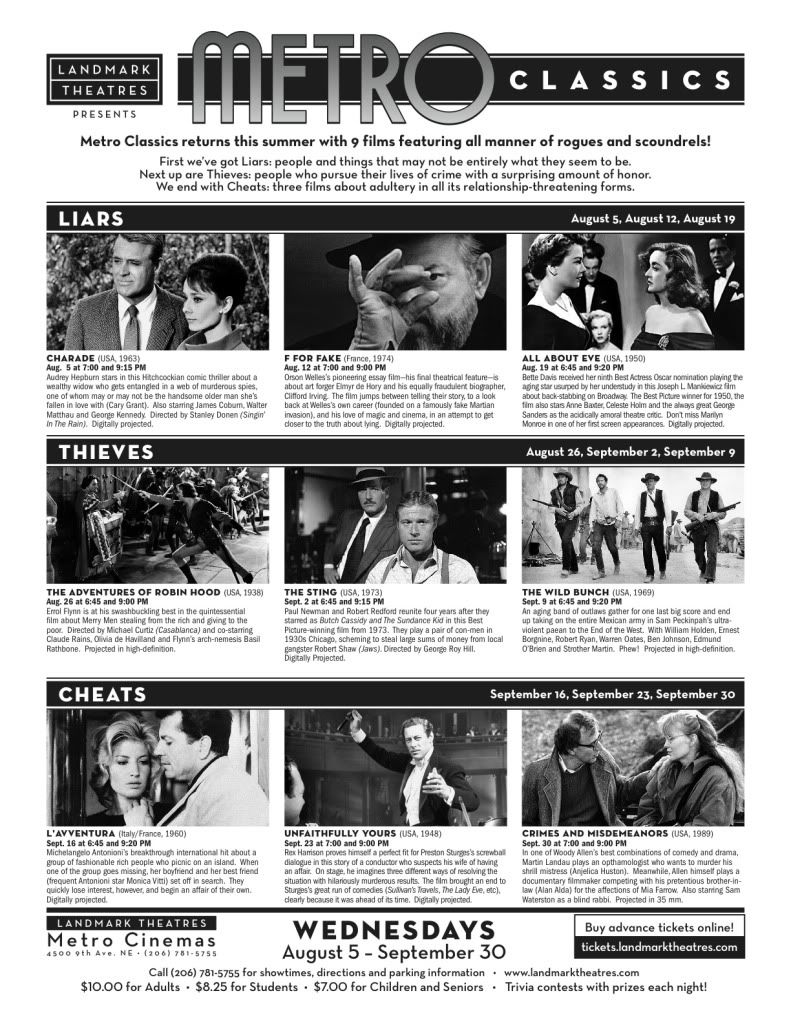
[Charade plays Wednesday, August 5th, at Seattle's Metro Theatre to kick off this summer season of Liars, Thieves and Cheats, which you can read more about both here at home and over at the Metro Classics Blog proper.]

man in the mirror

Confection at every angle, Charade is a blast. It hops around Paris, and different sets of violence, playing with all our ideas about movie stars and how we identify them (and identify with them) without getting boring or even haughty, though Hepburn sure does try. It's not much in cinematic terms, just pragmatic mostly, but this is a film about charisma; thus, its stars shine and all move well. Every mark is hit, every note struck, every twist signaled, every swoon chimed.

The best joke in the picture may be, simply, a mustache, but there's plenty of fun in how much fun Audrey Hepburn has with herself—she's forever complaining of hunger, ordering food and not eating, or then diving in all elbows to cope. But she stays thin. She's a movie star. Just like Cary Grant stays charming, always, even when we think he may be wrong. Grant, in 1963, proves just as nimble and canny as ever, eager to play any game he's put into by Hepburn or the other goons hanging around town, each with little sense of humor and less imagination. He wins through ingenuity, no doubt, and a fear of the serious. Though he doesn't throw matches at women, he's cruel, shrewd; but he gets results and he gets girls batty. There's a lesson there, I'm sure. Something about enjoying pursuit and holding all the cards—or the thrill of juggling. Grant, before all, was a vaudeville tumbler.

carry it

Another possibility: Fall seven times, get up eight? Whatever the case, Charade also pokes fun at names and knowing, at what a name might mean, and how little we know the ones we think we love. There's no reason to it, of course, you just choose. Finding the best option (what's a solution?) may be altogether easy: just look around you. The devil, they say, is in the details. Sometimes truth, too. If you get lucky, you pull the right switch and everything falls into place.

out spot
light it up
looking at it
—Somebody has to have seen it!

Tuesday, July 21, 2009

Liars, Thieves and Cheats: New Metro Classics Calendar

by Ryland Walker Knight


click me
Click me!

Sean Gilman brings us news of the brand, spanking new Metro Classics Calendar over at the brand, spanking new Metro Classics Blog. This season's series has all kinds of goodies, and the new blog already has a good primer on its inspiration. If you remember, we did a kind of internet interview a little while back for the previous calendar, which you can read here. I'll save more extensive table setting to Mikey, who will probably pop up here before too long with his own kind of preview. For now, here's the place mats. Of the new line-up I'd most like to see F For Fake projected, but, as the case is, I'll have you know that I'm gonna ladle out some thoughts on the series opener, Charade, just as soon as I can grab some images I like.

Sunday, July 12, 2009

Viewing Log #2: Beyond The Pail [7/5/09 to 7/12/09]

by Ryland Walker Knight


the pail
—It's been too hot to go outside.

  • The Big Sleep [Howard Hawks, 1946] # A classy picture, a funny picture. The shamus protagonist makes perfect sense for Hawks. Something to chew on: Bacall's a dime, no doubt, but Vickers (the lil sister) has sass for days, and that kills me.
  • Gentlemen Prefer Blondes [Howard Hawks, 1953] # Finished on my computer, and thoroughly enjoyed. As deep as Marilyn's eyebrows are active—and lively, too. Again, about the forms of intelligence we are keen to, which, here, is made clear by way of talking about "keen on"...
  • Beyond A Reasonable Doubt [Fritz Lang, 1956] Pitiless and spare, drained of sentiment but full of life, despite Lang's will to the conceptual (as Rivette argues), this one can be read in the flames of the car wreck: we're pawns, owned by the world and at its mercy; we're elements among many bustling and bursting. Weird way to start a day.
  • Gentlemen Prefer Blondes [Howard Hawks, 1953] Just twenty minutes, then the disc messed up. Gave up, wrote other things.
  • Monkey Business [Howard Hawks, 1952] The old married couple version (inversion?) of Bringing Up Baby, and maybe even smarter. Proof Ginger Rogers still had it, and that Grant can do almost anything when it comes to physical humor. Also, Hawks is, like, the best.
  • L'intrus [Claire Denis, 2005] # For Cuy; watch freeNIKES! soon.
  • La Frontiere de l'aube [Philippe Garrel, 2007] Not quite as frightening as the Robson, but just as down. I never want to fall (away from the world) like that. But, of course, Lubtchansky makes nightmares look like dreams. So serious.
  • The Seventh Victim [Mark Robson, 1943] Death looms, provides an out. Bizarre that this got made, and just plain bizarre. Don't know how much I "agree" with it, but I sure did enjoy its wacky frights of darkness.
  • US Go Home [Claire Denis, 1994] # (a few minutes here and there) Youth is a dance. Or it should be.
  • Nenette et Boni [Claire Denis, 1996] Finally, yes. (My apologies, MK.) As I noted, this picture "makes me miss smells. Stinks, even. Also, my sister." Love the way Greg dances in the pizza van.
  • My Favorite Wife [Garson Kanin, 1940] # Irene Dunne sure is something, as is Grant, as ever, and I sure did laugh a lot, but it's pretty damned goofy. Way goofier and slapdash than The Awful Truth. Watched this on youtube, FYI.
  • Stalker [Andrei Tarkovsky, 1979] # Another greatest movie ever made. Vicarious applies to me, sure, but it applies to these three dudes, too, don't you think?

the can

Sunday, July 05, 2009

Viewing Log #1: Settling OK [6/24/09 to 7/4/09]

by Ryland Walker Knight


falling

[I hope to make this a weekly feature, for me as much as for you, since it seems I'm able to watch a lot more over here, and I'd like to track my thought a little better than simply within my moleskins since, in theory, among other things, the internet is forever. And I don't want to use Twitter for this for some reason. I must say: watching all these, that is being this indulgent, has been super fun.]

jumping

  • Laura [Otto Preminger, 1944] Knotty and endlessly interpretable. One of those movies you can tell straight away is sure to be a classic. Also, the whodunit is hardly a hard puzzle, and that is hilariously on point.
  • Christmas in July [Preston Sturges, 1940] # Kind of perfect, and surprisingly pictorial for Sturges. Really appreciate both how prol-trumpeting and how brisk the picture winds up: luck is swift, and stretches beyond class; in fact, it may even leaves class behind. Perfect for the 4th.
  • Ishtar [Elaine May, 1987] Really doesn't deserve the bad rap. Elaine May is smarter than most movie people, especially the brand of comedy coming out of Ho'wood now. All her pictures are about the world, not just bedrooms.
  • Ma Vie Sexuelle... [Arnaud Desplechin, 1996] # (scattered twenty minutes) For fun, but chiefly for an image.
  • Daisy Kenyon [Otto Preminger, 1947] This made me sad. Dana Andrews is good, and Joan is something else, but Henry Fonda is spectacular. Also, I hate phones, too.
  • Public Enemies [Michael Mann, 2009] # Second time was better. More soon elsewhere.
  • Esther Kahn [Arnaud Desplechin, 2000] # (twenty more minutes) For an ongoing project.
  • Holiday [George Cukor, 1938] # Oh, I want that life. Cary Grant, man, is undoubtedly the best.
  • Transformers 2: Rise of the Fallen [Michael Bay, 2009] I said plenty, if not too much over here.
  • Marnie [Alfred Hitchcock, 1964] # (scattered hour or so) Was interrupted a lot. Its formal rigor still amazes me.
  • Rebecca [Alfred Hitchcock, 1940] # Too long, too talky. Still, some great stuff, as ever, but Selznick's fingers are felt too much.
  • Bonjour Tristesse [Otto Preminger, 1958] Simply fabulous. So wobbly and ironic. Nivens is too, too good for his own (the movie's) good. And Seberg... why hello.
  • The Passionate Friends [David Lean, 1949] Better than Brief Encounter. Yup, I said it. I mean, come on, this one has Claude Rains. Perfect for early AM grogginess and transitional sadness.
  • Esther Kahn [Arnaud Desplechin, 2000] # (maybe twenty minutes) For an ongoing project.
  • A New Leaf [Elaine May, 1971] # One of the great films, I'm fairly certain. Why can't there be more black as hell comedies? I'd like to write more about this one, and about comedy in general, and why the best ones organize money in complicated ways.

Friday, February 13, 2009

Breadlines & Champagne! UPDATED. TWICE.

by Ryland Walker Knight


mimosas?

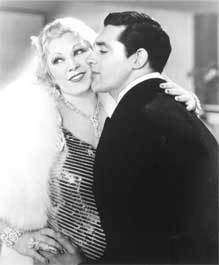
To counter our chill with a laugh (and a hug?), Film Forum has programmed the Breadlines and Champagne series, a month-long celebration of Great Depression cinema. The fun begins this weekend with an opening night screening of Wesley Ruggles' 1933 film, I'm No Angel, which stars Mae West and Cary Grant and costs a mere 35 cents (or a quarter for members). The weekend continues with two Franks: Borzage's Hooverville classic, Man's Castle, and Capra's punchy American Madness. I was lucky enough to catch a screening of the new print of the Borzage and wrote up some quick thoughts for The Auteurs' Notebook, which you will be able to read shortly in that webspace by clicking here. The short of it goes something like this: Borzage smears the frame with light to point beyond it, back at the world, and beyond that, too, to the skies we see and seek, where we are free to dream and project our wishes. (Shhh: at bottom, the film is interested in the freedom the cinema can offer, the uplift possible, and our capacities as agents even in the dark!)

But don't stop there. Scroll down that page and you'll see all kinds of fun double bills, all at a 2-for-1 discount, including one helluva Valentine's Day, programmed by Bruce Goldstein to pair My Man Godfrey (service would save the day, wouldn't it) with Easy Living (perhaps most famous now for its early Sturges screenplay). If that kind of night out (complimented by a meal and drinks, if not flowers, I trust) does not warm the soul, I cannot imagine what will. Of course, two days earlier there's a new print of Young Mister Lincoln screening with The Tall Target, if your soul needs that kind of uplift. Night Nurse plays Feb 17, Hawks' Scarface on the 21st and King Kong helps close the month before five more double bills to start March. I'm going to try to enjoy as many as my meager wallet and my stuffed social calendar will allow. (And if that's not enough for you, there's something called The Human Condition coming back by popular demand April 8th. That one might tell you some things.) [x-posted at the curator corner]

stop. think about it.

UPDATE: My piece on Man's Castle is available over here, and I've left a comment below the "essay" that furthers my thought a bit, or questions what I've written, in an inviting way (I hope).

UPDATE THE SECOND: My first piece published at SpoutBlog can be found through this link. It's called "Valentine's and Breadlines: Love in the Depression" and it concerns a few of the romantic comedies I've seen in the past week at the Film Forum. Please, read it. Please, tell me things. Please, enjoy your Saturday.

Saturday, February 16, 2008

Sex appeal is a big deal.

by Ryland Walker Knight


naomi, not tippi
scarlett and javier, not grace and jimmy
paltrow and downey, not kelley and grant
seth, not cary

I think whoever decided to put Naomi Watts in a Tippi Hedren beehive, whether they knew it or not, was out to slay me. Marnie is a favorite -- and ever more as I continue to reflect on its smarts (as much as on its imbalanced structure). As far as movies about unfolding a psychoanalytic logic in dense plotting go, I think Vertigo may, indeed, be the better picture, but there's something so off about Kim Novak that I never have an urge to watch it again. Now, if Tippi had played Madeline, it would have been a distinctly different picture (a different brand of obsession), but her insecurities are much more endearing, Naomi Watts style, than the fussy "hot girl" posture Novak inhabits. Another way to put it, I'll wager, is that Novak isn't as good looking as Grace Kelley. Yes, of course, that's a fruitless comparison. But, in all seriousness, I think it has something to say for how To Catch a Thief works so well. Maybe more important: look at how different an actor Jimmy Stewart is around Kelley in Rear Window. (I think his range is underrated, or often neglected, in conversations that favor his particular line-reading, um, habits.) This, of course, signals how the men each of these three ladies play off constitute different dynamics, in varying registers, of attractiveness (as a screen couple, as individual screen stars, as something or somebodies I want to watch) and efficacy (as actors, as crucial to the films they star in, as couples). Which is another cool thing to think about: how a star's (or any person's) sexiness is constituted by the other star (or person) that s/he plays with/off. That whole "it takes two" thing.

Sex appeal is a big deal. Especially in movies; definitely in Hitchcock*. These Vanity Fair restagings (more here) seem to understand this, and are, for the most part, pretty cool. Although that beehive looks pretty good to these eyes, the Rear Window remake may be the sexiest photo. It's pretty clear Seth Rogen's North by Northwest run is the most unsexy, which is a bummer, since Cary Grant is so damned sexy (to go along with his funny). Robert Downey Jr is a good looking guy, and a special kind of actor, but the new To Catch a Thief still life seems a little off the mark, too -- but not for lack of sexy. I think it speaks to the confidence and breezy charm of Cary Grant more than the look of consternation on Downey's face (and Grace Kelley's regal beauty is a world away from Gweneth Paltrow's too-skinny Hollywood good looks). Even when Grant is peeved he looks at ease, comfortable. It's why that crop-dusting scene is so funny, while scary: he's wearing a suit, he's waiting, he's a little impatient, but he's game. Seth Rogen is game but that expression he's wearing, along with the way the suit is falling about him (unflattering), makes him look less than comfortable in his own skin, much less the costume-skin of a legend. Really, though, the best of this project has to be the revision of Psycho with Marion Cotillard. (Dig that Janet Leigh's character is named Marion Crane.) And, no, not because she's naked, as the dude on Film School Rejects said, "but I love the fact that it recreates the scene in blocks." But we shouldn't ignore Cotillard's lithe limbs**. This famous murder is definitely some kind of punishment for being sexy. And, you know, stealing mad money.

But my interest in Hitchcock has way less to do with sex than all of this, than a lot of criticism, actually, which makes this post yet more silly and transparent. It's clearly a concern for the man (again: why so many blondes? why this fear of women?) but what I find most striking -- at least now, at my refined, ripe, naive, silver age -- is the evolution of his interest in America as such a powerful locus of challenging moral forces. But, wait, you say: To Catch a Thief takes place in France! Yes, it does. But America is very much on its mind: people are always telling Cary Grant's John Robie to go back to America; Grace Kelley's Frances Stevens beckons him away from France; Robie becomes a stand in for America, as he is characterized as a trickster, like many mythical Americans, always scheming to achieve his rightful (in his eyes, at least) slice of the devil's pie. What that pie is, exactly, I'll leave, for now, to you to decide.

laid down
stay here

*This is not to say that I think "ugly" people shouldn't be in films. Rather, there's a certain kind of star cinema that relies on an audience's projection of sexual desire.

**I had no idea Cotillard was this radiant, having not seen La Vie En Rose, which I fear being one long downward spiral of pain. But I may rent it yet since I haven't seen anything with her, except stills like this, and I had no idea I should be super excited (on a superficial level at least) to see her act with Johnny Depp and Christian Bale in the new Michael Mann movie, Public Enemies (due 2009).

and she
is
America, too

[Eva Marie Saint ain't half bad, either.]
[This America is a cross roads of faces and lands.]
[This America is North by Northwest, a no-place, a myth, an end.]

big nose
bigger nose
big faces
the end

Thursday, February 14, 2008

A Black and White Valentine's Day.

by Ryland Walker Knight


I don't...
EH?
Encore!
Heels up!
Different But The Same
The Same But Different

To you, my little prairie flower:
I'm thinking of you every hour.
Though now you're just a friend to me,
I wonder what the end will be.
Oh you would make my life divine,
If you would change your name to mine.*

The Awful Truth: Maybe the best Valentine's Day movie ever. Or, one of the best. Or, the best I've ever watched on a Valentine's Day. Of course Cary Grant is amazing but, really, Irene Dunne is quite the star: at one point she dresses like a galaxy. May your loved ones hold you tight tonight and every night. Right? Smile. [These and two more]

*As delivered by Dan (Ralph Bellamy) to Lucy (Irene Dunne)

Friday, February 08, 2008

My Friday Screen Test. There's talk of Cary Grant and Richard E Grant, liquids and words and films; there's even a Claire Denis reference.

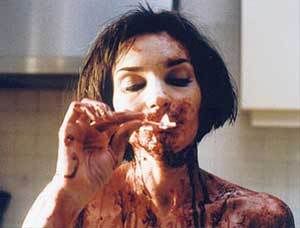
Maybe you've heard of Adam Ross' Friday Screen Test series? Every Friday he "interviews" a blogger about their interests in film and film writing. Today he posted my responses to his queries. It's fun. You should read it. You can read it by clicking here. There's talk of Cary Grant and Richard E Grant, liquids and words and films; there's even a Claire Denis reference. I filled out the questionnaire a while back, actually, so the DVD question is a little off. Since then I got a few DVDs for Christmas and just last week got that Charles Burnett set from Milestone as well as Syndromes and a Century. Anyways, read the rest of Adam's blog, too; he's a swell dude. Big up yourself. And big ups to Beatrice Dalle, again, always. She lites my fire. --RWK