Showing posts with label Jacques Rivette. Show all posts

Monday, April 26, 2010

Viewing Log #42: What's broken's broken but glue's going around [4/19/10 - 4/25/10]

by Ryland Walker Knight
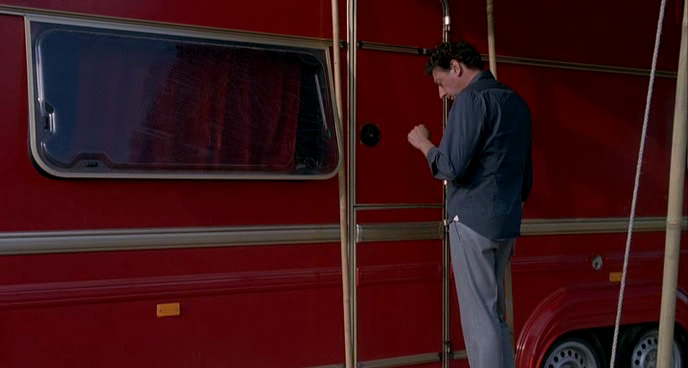

not a knock knock
what's in the background

  • Treme "Right Place, Wrong Time" [S1E3, Ernest Dickerson, 2010] A marked, knowing improvement that casts a shadow on a lot of bad behavior and surprises with some real evil behavior and a genuine apology. Also, a beautiful final shot capping a beautiful final scene. Still don't like the scraggly keyboardist dude.

  • Marwencol [Jeff Malmberg, 2010] Watched it in pieces over the week. It plays next week at the festival. I recommend it. I'll try to write something a little longer in a bit. Here's the film's website.

  • Party Down "Steve Guttenberg's Birthday" [S2E5, Bryan Gordon, 2010] Not sure why Starz is showing this one now on demand, but of course I'll watch it. Guttenberg's great, really commits, and Ryan Hansen is perfect as that bleached idiot. And this one had not just a McLovin cameo but also Lizzy Caplan in a hot tub and jokes about people in AA having "real" drinking problems that Ron doesn't have; funniest is that you kind of believe him, that AA's just a put-on for him.
  • Party Down "Jackal Onassis Backstage Party" [S2E1, Bryan Gordon, 2010] Everything I loved about the first season, minus Jane Lynch. Except Megan Mullally is an apt substitute in a different (ok: shorter, stupider) way. Still love Lizzy Caplan's insecurity and her smile (like a lot of boys, I trust), and Adam Scott is pretty underrated for his tight-wad act. I'm sure it'll unravel, though, as tensions and jokes mount.

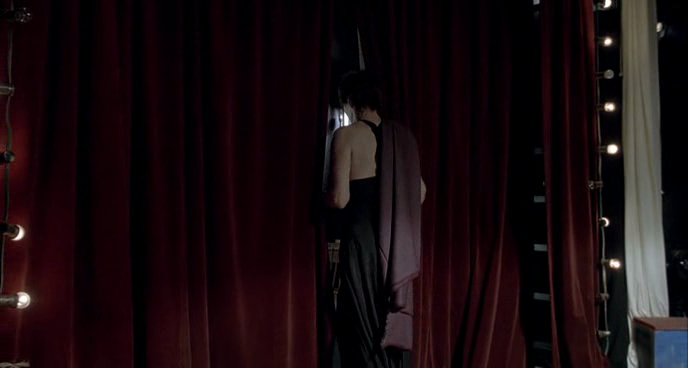
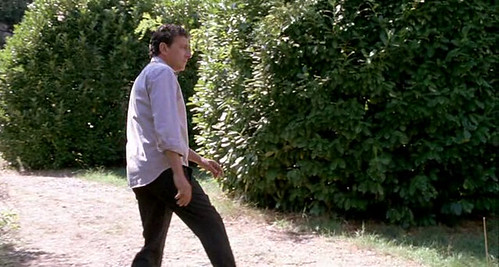
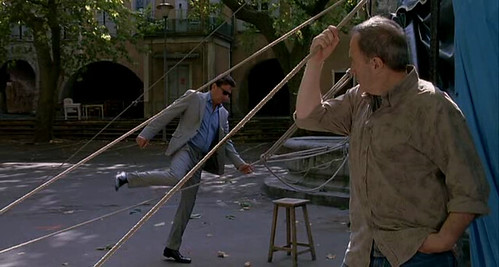
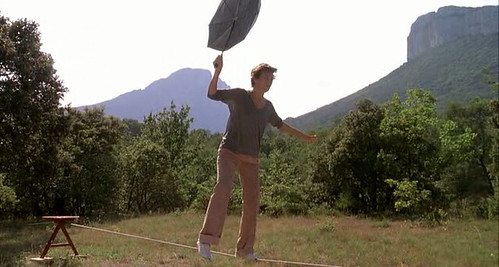
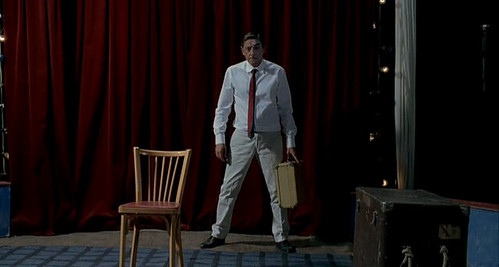
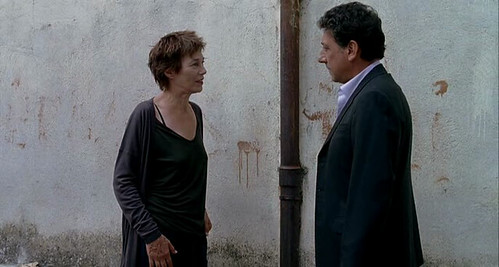
  • 36 vues du Pic St. Loup [Jacques Rivette, 2009] # Big surprise, I know: on film it's even better. The colors mean a ton, as does the graceful slide of most camera set ups. Even the static ones aren't static—they likely push somewhere, or open another space through simple framing or an edit. My favorite edit is the one along that wall when Birkin's getting ready to leave; she walks across the pipe dividing her and Sergio Castellitto and then past him off camera; he turns, smirks, and follows; there's an edit to five more, different feet of wall adjacent; a new tact of conversation begins, however hesitant, until Sergio disagrees and exits in the opposite direction (the way he came in). My favorite camera move is the one from outside the tent, watching Sergio walk over wires to stay in the frame as he approaches André Marcon in the foreground, then their little dance plays out in medium, then Sergio moves into the tent with the camera to find Birkin alone on a riser surrounded by blue. That's the other joy of this little, dense film: Sergio Castellitto dances through it, enters every scene as an interloper from the background and then stirs things up or plays a bit in a messy way. It reaches its apogee when he takes the stage. I should try to write some more about why I love this thing, but all the regulars are there: acting, physical comedy, some wordplay (in secondary languages), a cohesive mise-en-scene that makes jokes out of every scene's structure, sadness mixed with hilarity, and brevity. Also, just my luck that got to see it with Danny. Then I made this from materials at home.

  • Lost "The Last Recruit" [S6E13, Stephen Semel, 2010] Certainly entertaining, but still table setting. We watched it with a lot of noise, so that might also explain why I only did some images in this post.
  • The Holy Girl [Lucrecia Martel, 2002] # Looking at a certain scene for a certain piece of writing that should have been done ages ago.

  • Treme "Meet De Boys on the Battlefront" [S1E2, Jim McKay, 2010] The first half had me not just let down but actively pissed off at its narrow ideas; but the murder and a few other things in the second half made me think twice about writing it off. Clarke Peters sure is something.

a real world

Saturday, April 24, 2010

SFIFF53 #3: 36 Vues

by Ryland Walker Knight


I.

36vues29
36vues33
—C'est un entrée


II.

36vues30
36vues51
—Ce sont des corps de blagues


III.

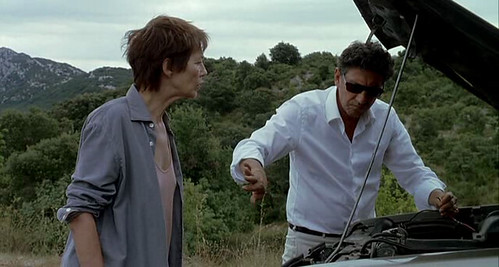
36vues43
—C'est un mur vrai, vraiment debout


IV.

36vues02
—C'est ça


V.

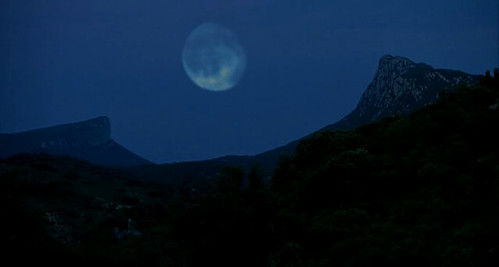
36vues75
—Ce n'est pas une lune

Thursday, April 15, 2010

SFIFF53 #1: Waiting for the lights

by Ryland Walker Knight


Next week, as I'm sure you know by now, the 53rd San Francisco International Film Festival commences. There will be a big Opening Night at the Castro, where Jean-Pierre Jeunet's latest, Micmacs, will play and probably delight a lot of the audience. It's fine, it's cute, it's what you expect from the guy behind Amélie: it's absurdly "sweet" despite its revenge hijinks. Even I walked out of it smiling, surprised at least in part by its delicious final shot, which felt like the most natural thing in the picture, a literal bit of animation that signals exactly what this director should be doing: making real cartoons, not just a bunch of goofy faces. But, hey, the grey hairs will love it. You know the type, the kind who think "French cinema" is a genre.

In any case, there's a slew of other French flicks on hand (as soon as the next day, even) at the festival this year to prove that, as one of the three great national cinemas, those frogs contain multitudes, too. And, of course, the two films I'm most excited to see on a big screen—on film!—are French: Jacques Rivette's 36 vues du Pic St. Loup (or Around a Small Mountain), which is sublime and deft and smart, and Alain Resnais' Wild Grass, which I've been waiting to see, despite certain avenues open to me, since Danny wrote that bit of rapture from Cannes last year. Since SFIFF is basically the end of the line in terms of festival tours, many words have already been spilt on this pair, but I'm going to go for it all over again, so keep an eye out for that. Then there's other Frenchies to watch out for, including: a new Claire Denis (always anticipated over here) starring Huppert, some young lady's movie about some dad, that rescue job about a failed swan song, a Bruno Dumont, a Eugene Green (he counts, right?), a Sylvie Testud, a Gainsbourg biopic. Yet, stamp be damned, there's other countries making movies to attend. It's an international festival after all.

Mexico's Alamar is quite nice, and quiet, and a real pleasure. It's about three generations fishing together, primarily, and I don't want to say much more about it other than you'll get a better familial vibe in this one than Micmacs, but that's not saying much either. And the picture that Roger Ebert's highlighting at his event, Julia, takes place in part in Mexico, despite starring that British wonder woman, Tilda Swinton, as an American. There's borderlines of all kinds in that film, which I love, and am tempted to see again on film instead of on Netflix Watch Instantly. More exciting, though, is the screening of I Am Love, which boasts one of the best trailers I've seen in recent years, which I've watched approximately fifteen times. If you haven't watched it (if I haven't forced it on you yet), I'm embedding it below.


[You can also watch it in even higher quality over here.]

I love this thing for a few reasons. First of all, I love Tilda Swinton. Next, I like a lot of the images, with all those colors and all those hesitations, but I also like the words chosen to let through, like "fabbrica" and that little speech Waris Ahluwalia gives to close the spot. The close, too—and the clothes—that rush of multiple zooms—is a thrill—and scored so well, as is the whole spot. I also like stories about temptation, and lust's complication of love, as much as I love stories simply about love. And a Vertigo shout out? Sure hope the movie lives up to my anticipation. To say the least.

Moving along, but sticking with the editing theme, the one Live & Onstage event that really has me excited is the Walter Murch "State of Cinema" afternoon. Murch is a smart man and I've never seen him talk, though I hear he's been talking around the Bay a lot of late, so I may stop by that to hear what this once-pioneer sees in a "prehistory" of cinema of his own design/imagination. Maybe he'll have some things to say about the current festival, too, and where he sees good form. Hell, maybe he's seen the Rivette and he can say something about what it's like to whittle things. Which is what I'm going to do to this preview post right now.

The point is the festival is practically upon me and us and it should be fun, full of great films I'm happy to finally see after skimming so many articles and closely reading a few others. If anything, it'll be worth it for those New Wavers and their wacky attacks on what's cinema. Is is all a show? Does it need an audience? Is it the neon haze from the marquee carried inside and glossed onto the screen? Is it clownish? Is it creepy? Can I see it all?


—Hang time

Last year, my pal Mark Haslam was still living and teaching in California and he covered SFIFF52. You can click here to read what he wrote. This year, now that I'm back home after a wild ride around the country in 2009, I'm happy to have my credentials and my sanity (or some) and enough free time (or some) to follow suit. Like Mark, I'll use a catalog-count as I write my way through the festival. Unlike Mark, though, you might see some of my coverage at places other than VINYL IS HEAVY; that is, in addition to the words I write here; but more on that later. If you see some goof who looks like this walking around the festival, don't hesitate to say, "Hi," and compare notes over some coffee.

Thursday, December 31, 2009

Make a deal with your shine blocker.

by Ryland Walker Knight


A legend

a.
It doesn't hurt me
We block back the dark, moony
Dedicate, hound

b.
All the men she knew
None were fair or true
So she ran away and up
And up past the board blue

c.
Dance and flight and plain naked
alone, one's own property
purposed to light, to home, but not
done with that flipp'd flicker's flapp'n
all wind, wind post'd by you
who will not cannot shall not
sit still
in any calendar.

Monday, December 07, 2009

Viewing Log #23: Hit by a truck [11/30/09 - 12/6/09]

by Ryland Walker Knight


Broken but home 2

[Spent a lot of last week running around town, and working on a non-cinematic (ahem, paid) writing project, so movies took a necessary back seat. I read instead. And, yeah, with this work and the basketball options in high definition (not to mention a visit to Oracle Saturday night), I just couldn't bring myself to watch any number of films.]


  • Va Savoir [Jacques Rivette, 2001] # Started over a little late. Too late, as it happens, to finish before my lids got too heavy. But this time I got a good hour into the picture, and find a developing idea: as much as I love La Belle Noiseuse, Rivette's '00s work is way more interesting, to say more mysterious, than his '90s work. Any takers?

  • Mélo [Alain Resnais, 1986] Everything's a front, and a bad one. These idiots just can't get anything right, except for a somersault. More in another recherche shortly. [link]

  • Fantastic Mr. Fox [Wes Anderson, 2009] # Still delightful, ebullient. A true celebration of difference and singularity set to a great score, at a great pace, and overflowing with detail. Not sure if it rivals Playtime, as Brody writes, but that artistic generosity Wes brings his pictures constantly yields affective registers—both subtle and bombastic, always joyful—rarely paralleled in current cinema. No other film this year had my eyes ricocheting across the frame as much or as often. More in The Notebook, shortly.

  • A Christmas Tale [Arnaud Desplechin, 2008] # For my piece in The Notebook, coming shortly.

Monday, November 09, 2009

Viewing Log #19: Sea salt swordfish [11/2/09 - 11/8/09]

by Ryland Walker Knight


ceilings
light cloud sound
— Beaming and leaning

  • Last Year at Marienbad [Alain Resnais, 1961] # I could watch this movie a million times. A lot funnier than I remembered, though I remembered it being funny, I think. Another reason to own a Blu-ray player, no doubt. I wrote a smarter, funnier response over here.

  • City of Sadness [Hou Hsiao-hsien, 1989] Not quite the emotional experience I'd expected, though it easily lives up to its title, this picture made me feel, for lack of a better word, small. That is, my political world is much smaller, or narrower, and thankfully/paradoxically/obviously less totalitarian. Not that the picture need be enjoyed strictly for its political-historical import. Plenty, as ever with HHH, is just about life, about living, about letting things happen. There's so much communion in its eating scenes. That baby working its clumsy way around that table was out of this world delightful. The interstitial "exposition" inserts bouncing off of, and sometimes replacing, the inter-titles—as modes of communicating for the deaf but still-sponge-worthy Tony Leung, whose end-of-an-era bridge type acts like a silent cinema stand-in—made my Bazin crush flutter up. Fine first rep feature back in town. —Read Brian at Hell On Frisco Bay.

  • Wings of Desire [Wim Wenders, 1987] # The morning after I grabbed one image before conking out, I watched the whole thing over coffee and toast under grey clouds behind the kitchen. Startled, I'm writing this before my Auteurs piece, and here I'll say that I'm confused and moved in equal measure. It stirred up a bunch of memories; it feels, for better or worse, more formative than many other films.

  • Va Savoir [Jacques Rivette, 2001] The first half-hour, until Sergio meets the delicious blonde in the library. Then I got tired of the headphones and went to bed. So far: love how Balibar narrates her life. Nice echo of Léaud in Out 1. Also, this earlier Sergio appearance changes 36 vues a bit.
  • Wild Combination: A Portrait of Arthur Russell [Matt Wolf, 2008] Surprisingly artful, though its structure is pretty standard. I was moved, as ever, by Arthur's story and Wolf does some fine juxtapositions and compositions of his own, layering light in nice ways. Can imagine it plays well for audiences of both fans and neophytes, though the fans may want more than 73 minutes and the neophytes are probably won over and content with what's been assembled.
  • Jeanne Dielman, 23, quai du Commerce, 1080 Bruxelles [Chantal Akerman, 1975] # Shopping, duh, for pix. Lookey here why dontcha.

world of echo

Sunday, October 25, 2009

Viewing Log #17: Burn off by now already [10/19/09 - 10/25/09]

by Ryland Walker Knight


—What's a womb? That's a home?

  • The Informant! [Steven Soderbergh, 2009] Totally daft-deft stab at greed. Maybe the most ironic film of the decade? Easily the best thing Sodeyface has done since The Limey. But where most of the rest of S.S.'s career is about self-aware charisma, Matt Damon's Whitacre isn't charismatic so much as crazy, a perfect boob, caught inside his own tape loop confessional; it's still about acting, but this film is more about delusions than anything. I feel like I could go see it again tomorrow and the next day—and then the next day, too.
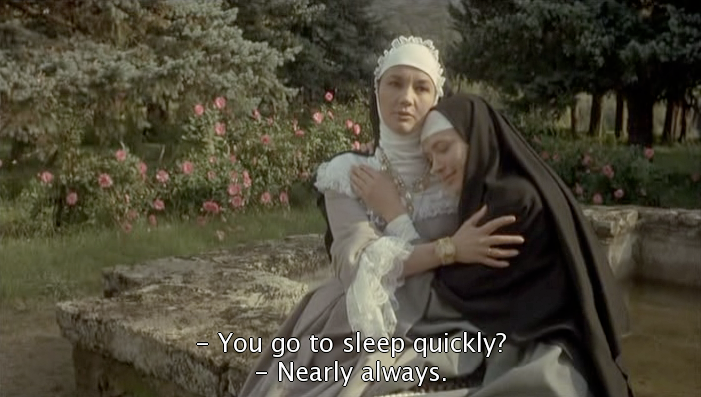
  • Antichrist [Lars Von Trier, 2009] I watched the prologue, then struggled to stay awake for the next twenty minutes of Charlotte Gainsbourg jumping all over Willem Defoe. I'll have to get back to you on this one.

  • 36 vues du Pic Saint Loup [Jacques Rivette, 2009] Damned flawless. Boy do I wish I'd seen this on film for the first time (you were right, DP), but I trust that pleasure, yet to be had, will come to pass a lot sooner than I expect. I will write more soon, maybe, after I finish some projects.
  • Bright Star [Jane Campion, 2009] I'll have more to say later, in another space, but in this right here I'll say, hey, this is nice; and, for good measure—I'd say this if she was a stranger—Martha's recent piece at The Auteurs gets at this sweet thing but good. Further, it was great to see on a big screen, and mostly alone, as my reintroduction to cinema-going in a big city.

  • Eyes Wide Shut [Stanley Kubrick, 1999] # Total fkng masterpiece. Very Rivette, it strikes me, now, with its hidden worlds and masks. Otherwise, very Kubrick, duh, with its fluid and (near) fish-eyed camera; with its dissolves; with its compassionate distrust of the human (and excoriation of male pride); with its color and compositional eye; with its musical arrangement; with its acetate wit; and with its quite "flawless" acting. Another rarity that deflates fantasies but keeps hope alive that marriage is a viable way of life in this world of temptation and commodity-fixation.


—Out to dry

Sunday, October 04, 2009

Viewing Log #14: Holy haunts are private [9/28/09 - 10/4/09]

by Ryland Walker Knight


what's he hear?
what's he feel?
— Where do you heal? Where could he be?

  • Elena and her men [Jean Renoir, 1956] It's Ingrid's show, no doubt, but I was more taken by the sly Mel Ferrer and his lanky-limber rogue. That said, it's a fine metaphor for the star system, and Ingrid's go-anywhere constitution; she's great at aloof twined with cunning. Renoir says he had to improvise the whole thing, for the most part, interpreting history into a comedy, and, I think, it works thanks largely to his cast and his cousin Claude behind the camera. Still, the weakest of this set, I'd wager.
  • French Cancan [Jean Renoir, 1954] Vibrant, generous paean to a world of fun, to the joyful life we'd all like to lead rich with love and dancing and art and sex and (did I say?) fun. Gabin beams.

  • Partie de campagne [Jean Renoir, 1936] # Wanted to see the transition, again, and the river recede from me.
  • Loulou [Maurice Pialat, 1980] A wreck, stumbling on a wall (or laying in a bed, ahem). However: very exciting to see an earlier, softer Huppert still arriving at her powers to command a camera's attention. Her performance stings especially in this little man because she's able to unmask and mask so many multivalent, contradictory motivations-impulses-emotions in such close proximity, as can often be the case in life's mess. But what's intriguing about Pialat's interest in actors, and images, isn't any allegiance to "the document" (despite many long takes and the realist weight of a sudden slap) but to selection and contiguity, how one thing follows another—often in rhymes—while "hiding" his timing since, though the editing can pop and the ellipses alarm, you forget about the camera.

  • Ne Touchez Pas La Hache [Jacques Rivette, 2007] # Games fail like words and we brand each other's souls—we maze traps like Waco, Texas! Balibar's a wraith and Depardieu's a blood-pumping prosthetic: each barely attached to their own life. The walls are curtains, or wrought iron; the limits ceaselessly solecistic. After all, it is but a poem.

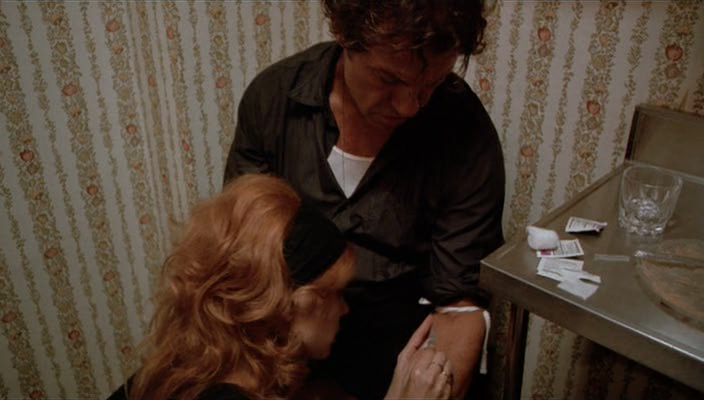
  • Bad Lieutenant [Abel Ferrara, 1992] # Guess I didn't wait so long again after all! But I only watched a few things, to get the feel and a few images. Really: maybe the best movie ever. "Where! Were! YOU?!" —Steve, via text: "Captures the fast-fading old new york with stunning fidelity. many great scenes caught in available light, ambient sound. jesus is in the details."
  • The Brothers Bloom [Rian Johnson, 2008] It's all about Ruffalo, despite the allure of Brody and Weisz. The film says so, after all, giving him the director's chair (or Fellini hat) and, it seems, unlimited means to stage events in the world. It's a goof of a movie (a little simple and didactic, maybe), but it is winning. And Ruffalo, master wincer, sells every turn. His spot-lit farewell says it all: satisfied, resigned, and understanding his worth. A good actor is a miracle.
  • Tall Enough [Barry Jenkins, 2009] Watch it here. I could make a crack about advertising really easily, but that'd undersell Barry's fine-line achievement. This is about as charming a short as I could imagine from a project such as this, and it proves, as ever, Barry knows what he's doing with a camera. G'head, get your Denis on, man: it looks great.

  • Partie de campagne [Jean Renoir, 1936] Just amazing. Even in pieces, le maitre makes a whole natural world swing-swim into view, into action, falling away in time as our petty obligations web us into roles we don't want. Best? Jokes abound!
  • Dogville [Lars Von Trier, 2003] # The first half. Started this because somebody I adore (and respect) loves this movie and I want to understand why; because back in 2003 it made me pretty mad in (I'm learning) pretty dumb ways. That said, I fell asleep.

  • Bad Lieutenant [Abel Ferrara, 1992] # Cuz I'm an idiot masochist, apparently. Also, it'd been a few years. Maybe never can go long enough between viewings. But, hell, this is a fucking movie. Even more than Unforgiven, this is the H.W.-headache movie. Also, truly Catholic.

what's he smiling about?
—Answer yourself

Monday, September 28, 2009

Viewing Log #13: Slobber somehow [9/21/09 - 9/27/09]

by Ryland Walker Knight


crafsmanship
velcro
—Money talks

  • Ashes of Time Redux [WKW, 1994/2008] Started this a couple nights prior but was gladly interrupted by two fun-loving phone calls. Started over, fitting WKW, and felt the slow-mo, loss-hardened fronts enough; the fights were fun flurries of blur and I dig the literal adventure of perception with "the good" Tony Leung, but I get why, um, certain friends tossed out the "snoozer" label; further, it's not made for laptop viewing, nor even a 32-inch tube television. It desires size.

  • La Belle Noiseuse: Divertimento [Jacques Rivette, 1991] As with Spectre, Rivette adopts the interruption, practicing a kind of cinematic enjambment, that distills and skews the original with a brisker rhetoric. And it becomes even less about painting. But it's still about objects, and forms, and the nowhere/anywhere zone of the artist. Birkin is forever fab.
  • The Golden Coach [Jean Renoir, 1953] Flabbergastingly abstract, oddly enough, despite its head-on and up-front theatricality. A few scant lines of dialogue pitch the project a tad more pointed than necessary, but, as ever with le maitre, it can't fully (truly? ever?) go wrong. Anna Magnani demands her space, and owns it. There's about five books of theory waiting to be unpacked in this phaeton of ornaments and luster. Good grief this is fantastic.

  • Go Go Tales [Abel Ferrara, 2007] Whirligig desperation and lots of flesh—always on the go—paint an increasingly cramped space with affective (and endearing) verve for expression and for dreams and for our fight for passion in the face of commerce-capitalism. Dogs, too, get crucial roles.
  • Home from the Hill [Vincente Minnelli, 1960] Watched with Annie, DVR'd off TCM, because she names it as her favorite movie, tied with Tender Mercies, and, shucks: it's pretty good. Broad, maybe, and now-a-days hokey, but more complicated than it lets on. Nothing to rival the final reel of Some Came Running, but certain shots linger, like the black kids in the shadows watching the decadent bar-b-q; or the sulphur valley of yellow kept at bay, but only so; or the way Peppard ambles through the grocery store, juggling. Mitchum, too, of course, is strong as ever: some tower of pride fighting the world and its image of him.

  • Sunrise [F.W. Murnau, 1927] # For an image essay at The Auteurs about the beautiful new Masters Of Cinema double disc I was lucky enough to get gaga over.
  • Le Coup de Berger [Jacques Rivette, 1956] What a fun, sad little film. All those movements up, the camera as vertical as horizontal, only to pin these people down—to lock our lady in her place. It would be devastating were it not for the clockwork pacing and cut'm-loose attitude. Chess, they say, is a game for adults.

  • The Southerner [Jean Renoir, 1945] Terrible DVD, great film. Zachary Scott's something of a liability, though he's pretty, but the same warmth shines through all of le maitre's images. Way more southern, and true, than many American-directed "versions" (like, say, Gone With The Wind) of the south, no doubt. For one, it's about people, not ideas. For another, when the going gets tough, it doesn't look like set dressing: it looks like the world.

  • Entre les murs [Laurent Cantet, 2008] An especially fun film for a language nut like me. It's typical, maybe, but I loved it. The formal structure is seamless, despite its crowded frames, and the film/Cantet/Bégaudeau understands pedagogy as a blur of navigation and negotiation—as a chaos, even, as Mark wrote earlier in the year—spurred by language's promiscuity. It's not romantic, nor dry: Cantet complicates the image's desire for the real, as characters-students-teachers-forms never ossify like the walls that surround them, and life bullies forward. Also, time flies.

flesh is flesh
words make meanings without images

Monday, September 21, 2009

Viewing Log #12: Ply Your Hand Much Lighter [9/14/09 - 9/20/09]

by Ryland Walker Knight


tous
finger
—Misdirection, always.

  • Paris nous appartient [Jacques Rivette, 1960] No wonder he didn't get famous right away: this is a bleak bit of minor key orchestration-condemnation. Not only are we pawns, but we're imbeciles complicit in apocalypse as we search for understanding. Such a tragic metaphysical hermeneutics.

  • Woman Is The Future of Man [Sang-soo Hong, 2003] I fell asleep shortly after the dudes get lunch, but, as with the other Hong film I've seen, Virgin Stripped Bare By Her Bachelors, I dug the patience and the sense of humor. Will definitely finish this one.
  • The Forest for the Trees [Maren Ade, 2003] Only the first 20 minutes. Couldn't handle it. Adrian is right: sides-of-a-coin with Happy-Go-Lucky. I'm terrified of what comes after what I saw. Maybe I'll work up to it some strong day.

  • La Belle Noiseuse [Jacques Rivette, 1991] Simply amazing. Would love to share more thoughts. But, as is, I'm stunned to silence except for hints. Last time this happened was with Esther Kahn. It's a real phenomenological film: you see thought inscribe itself. RW did a fine job laying out some of the film's mysteries and delights in a recent post you can find here. Makes me think, more and more, that Rivette is the great feminist director—without even aiming for that kind of title or claim. —More smart things from the horse's mouth, translated by David Phelps.

  • Paris nous appartient [Jacques Rivette, 1960] I got through about half before I fell asleep. Just past that walk though the night, into a new cynicism about the structures of this friend group—this network, this complicit pattern of neglect and discretion and secrecy.

the hand

Wednesday, September 16, 2009

Convergence for your totem trials (9/17/09)

by Ryland Walker Knight


la belle noiseuse

ne touchez pas la hache
—Everybody's got a noiseuse.

Sunday, September 13, 2009

Viewing Log #11: I will drive us into the woods [9/7/09 - 9/13/09]

by Ryland Walker Knight


not escaped
not at rest

  • Code 46 [Michael Winterbottom, 2003] # Samantha Morton is my wife. Or, she's just perfect at this bruised thing. The most poignant sex scene in movies?
  • Suspiria [Dario Argento, 1977] Couldn't finish it, or start over, when I realized my eyes weren't lying last night: the DVD Netflix sent me is some half-assed non-mastered bullshit that looks like VHS. Will have to wait for the next time it screens theatrically since all I'm getting from this thing right now is color and The Goblins—and if half of that is blanched and degraded, no thanks.

  • In The Cut [Jane Campion, 2003] # A revelation. A totally different, more complex movie than the one I saw in 2003. (Or, you know, I'm different.) Now I see plenty about being othered and threats of skepticism—and, um, gendered trust issues—that were beyond me before. Also, I had a couple of pretty awesome, in-depth talks about it before (enticing) and after (enriching) this second viewing. And, yes, it's sexy. Maybe, though, the wrong thing to watch before bedtime.
  • Suspiria [Dario Argento, 1977] Started this and fell asleep shortly after the maggots, somehow, despite all that wailing.
  • The Rainmaker [Francis Ford Coppola, 1997] # More rainy day do-nothing cable vision. But this one was better, tho equally dated and moderately maudlin, because of FFC's patience and crisp image-making. Quite a corporate movie, in any case, which seems fitting. Damon's got terrible hair and this is prime Jon Voight scene-gobbling.
  • 12 Monkeys [Terry Gilliam, 1995] # So 1995 it's wild, and, really, just not as smart as it wants to be. I tweeted about this to some displeasure.

  • La Religieuse [Jacques Rivette, 1966] Finished this. Wow: liberty is falling out of the world? Tough stuff. And, as ever, a perfectly "closed" and "pure" mise-en-scene that keeps things conceptual, no matter the brute and stark (physical) soul-pillaging unfolding in the frame. Karina is amazing, devoted.

  • Gloria [John Cassavetes, 1980] # As I noted, I fell asleep shortly into the watch instantly viewing. Gena is kind of my hero, too, and I'm a boy.
  • La Religieuse [Jacques Rivette, 1966] The first twenty minutes or so. Crazy theatrical. Quick take: want to see how it plays off Ne Touchez Pas La Hache and its irony, its repression.
  • La Bête Humaine [Jean Renoir, 1938] Hastily, drowzily: more noire than bête, it's a fittingly anxious downer that begins in a furnace and plows nose-first into the grave, sooty future. It's best in wordless process, documenting the grime of the job, which becomes any job—plain labor's crud—turning me around a query: perhaps its narrative drive (its locomotion) is too psychological? The score, always operatic, undercuts that, though.

  • Le Crime de M. Lange [Jean Renoir, 1936] Since I don't know much about history's specifics (most especially a timeline), I don't want to take the obvious allegorical/political reading too far. Better to trumpet the fluid camera, the charm of each character, the celebratory dinner that ambles out into the crime, the document of a banding bonding. Another "best movie ever."
  • L'avventura [Michelangelo Antonioni, 1960] # For Mike, for this. Watching it again makes me feel like I've grown up a lot since the last time (somewhere in early 2006). We men may be evil, but I'd say the circuit of complicity fits. Still, after all that horseplay, I'd never expect a caress like that.

I love you
marry me
—Let's see how good a kissers we are

Monday, September 07, 2009

Viewing Log #10: Tally up the alley cat aggression [8/31/09 - 9/6/09]

by Ryland Walker Knight


showing
enter
—Enter the void.

  • Nickelodeon [Peter Bogdanovich, 1976] Before I fell asleep I was enjoying this goofy run-on sentence of an homage. It's got the right tone, even if, Barry Lyndon aside, I often feel Ryan O'Neal is a rather tone-deaf performer. I probably won't make an extreme effort to see the second hour.
  • Le Pont du Nord [Jacques Rivette, 1981] I've been watching this in pieces, just as I've been reading Don Quixote kind of slowly. This picture is more grim, though it has its laughs. And it has plenty to marvel at, like the spiderweb gun or the eye-slashing bit with Pascale attacking posters.

  • Little Murders [Alan Arkin, 1971] Motherfucker this movie is dark. And hilarious. And smart. Gould has to be one of the greatest, coolest actors ever. Arkin's cameo is insane, a gut buster. Thought of Charlie Kaufman a lot, and I almost want to watch Synecdoche again, somehow.
  • Boudu Saved From Drowning [Jean Renoir, 1932] Watched it twice, and it's kind of perfect, a film teeming with contradictions, with activity abutting stability. But I don't think it's as simple as freedom is the disregard for appearance. I think it's bigger, it's a process and a river; freedom is to not ignore the bank along your float.

  • The Princess Bride [Rob Reiner, 1987] # I guffawed twice, and generally smiled. Andre The Giant is great, maybe perfect; Faulk can do no wrong. It's so easy.
  • The Lower Depths [Jean Renoir, 1936] It fits: if Gabin is a pauper king, Jouvet is a royal bum. Despite the perpetually open world, there's always something dropping out from beneath people in a Renoir film. Further, the fairy tale of these worlds (still "realist") only opens one happy ending and its invariably clouded, however ebullient. Maybe the weakest I've seen, but it holds life all the same. Lots of mobility.

  • The Story of Marie and Julien [Jacques Rivette, 2003] Watched it twice in two days. Wanted to pay better attention to that cat, and how the clocks were used. Also, Béart is really great on top of really great looking. Not sure if it can equal Duelle or Noroit, though it has a delicious ending.

  • Grand Illusion [Jean Renoir, 1937] # Made me want to just watch Renoir films for a little while. Talk about timing, and teams, and a screen teeming. Still, I get the feeling he's better than this elsewhere (besides Rules).

escargot my car go
I work on what I love, I work the service on my vertince
And I work till this here little flat line closes the curtains

Sunday, August 02, 2009

Viewing Log #5: Frankly curious, hungry [7/27/09 - 8/2/09]

by Ryland Walker Knight


dark side of the moon
sun flare
—Past gold, into dust like scythes of light

  • Heaven Can Wait [Warren Beatty & Buck Henry, 1978] # Co-written by Elaine May, if you remember. And co-starring Julie Christie, as I'm sure you can't forget. She sells everything, and not solely because she's a gorgeous creature. (Annie wasn't feelin' it, btw; her loss.)
  • The Grapes of Wrath [John Ford, 1940] # How's this for a come down? I said a few things in the comments at this post, but, now, looking at the dates in this list, it's amazing that this picture is "contemporary" with that Fleming ark of the antebellum.
  • Funny People [Judd Apatow, 2009] Said plenty at fN!, but I want to say here that it's such a fine line between the camera loving its subject and the director congratulating himself. I wanted more from that trio of competitive bile.
  • RocknRolla [Guy Ritchie, 2008] Wasn't up for anything I'd have to think about, so this puffer was easy to down despite its blatant bullshit because, well, it's macho and it's entertaining and Thandie Newton is a dime. Mark Strong is classy, typically perfect, but this one ain't no Revolver—by a mile.
  • Wedding Crashers [David Dobkin, 2005] # Only about 45 minutes, and on cable, which butchers the dirty fun.
  • Gone With The Wind [Victor Fleming, 1939] A bizarre meld of expressions, and big as a plantation to be sure (broad as hell, too), but Gable kept me going. More and more I think him a fine actor, with real valiance and wit. A true He-Man type, but the wounds show up nevertheless.
  • Noroit [Jacques Rivette, 1976] I don't know. Perhaps as "purely negative" as that Lang picture he loves. Halting and arrested, this is about as uninviting a picture as you'll see. Rivette braids revenge and self-destruction in a complete nowhere world that has lost its treasure, and sense of order, until the cataclysmic finale, which is basically a zero sum game. Will have to watch again. Lafont's pants are hilarious; she's kind of terrifying. That, too, it seems, is the movie.

Qualen is the man

Sunday, July 26, 2009

Viewing Log #4: Tastes like the tap [7/20/09 - 7/26/09]

by Ryland Walker Knight


who's a diamond?

  • A Matter of Life and Death [Powell & Pressburger, 1946] Gorgeous fantasy in delicious technicolor, weird-to-great propaganda. Nivens' charm is unending and the Cardiff-lensed images pool light in otherworldly ways, as you'd expect. The loveliest P&P theme is the beauty of the imagination—though it can spell peril, too, with actual consequence.
  • The International [Tom Tykwer, 2009] Like everybody else, I dug the Guggenheim roundelay, and the cynicism. The pathos can't cut it, but it's conceptually perfect, as most Tykwer movies are, and, although it's not exactly tautologically fun, the redundancy is almost a non-issue when thinking "story" or "screenplay." Ignatiy wrote some smart notes and I'll push it further: it's about half a movie. Wish I'd seen it theatrically. —Tosser comparison: I prefer Bourne 3.
  • Duelle [Jacques Rivette, 1976] Those aren't women, they're goddesses. Amazingly sexy, and fun, everything coils and weaves; it's a circulatory system coursing—and you can see the veins. Also, of course, we sing: Lubtchansky. For serious. More soon, I hope, after Noroit.
  • Charade [Stanley Donen, 1963] Tons of fun. I wrote that bit for Mike, yes, but also for Arne.
  • Love Affair [Leo McCarey, 1939] Irene Dunne is amazing, the movie's a little daft, but the chemistry between my favorite wife and Mr Boyer is just fabulous—even if the DVD looked lousy.

pointers
pointing

Sunday, July 19, 2009

Viewing Log #3: Celebrity tenants [7/13/09 - 7/19/09]

by Ryland Walker Knight


size
up
—Scale me, mount of shale; here, that's how

  • In A Lonely Place [Nick Ray, 1950] # More vicarious stuff, as I'm missing something grand again. I like how Steve described Bogie: "Mean X-rated expressions." Read Glenn and Hoberman, too, if you have yet to.
  • Celine and Julie go boating [Jacques Rivette, 1974] # Because I can. Because those girls are good to dream about. Because it's FUN.
  • Kings and Queen [Arnaud Desplechin, 2005] # Cuz a got a lovely note about it, I watched the last half hour. Then I skipped back to Amalric's dance before bed to wash the loneliness from my head-mouth. Listen: Marly Marl.
  • Harry Potter and the Half-Blood Prince [David Yates, 2009] Oh, my. What a waste, as usual, of all that talent (surrounding and guiding our boy in the middle); alternately, of all that money; further, of space (re: the kids). More here.
  • US Go Home [Claire Denis, 1994] # Trying to decipher the opening monologue sans soustitres.
  • Esther Kahn [Arnaud Desplechin, 2000] # For an ongoing project.
  • The Man Who Shot Liberty Valance [John Ford, 1962] # Looking for law talk, in skim mode.
  • Cadillac Records [Darnell Jackson, 2008] # Watched with the grandma, on her behalf, though I never thought I would sit through it again. It's still hack cinema, through and through, from screenplay to execution, but Jeffrey Wright is a pleasure and so are all of those songs.
  • Scarface [Howard Hawks, 1932] # Grimey, angry, ugly. A real treat. Muni is sick, gross. She's all elbows, perfect in her lust.
  • US Go Home [Claire Denis, 1994] # Greg's dance, and some other points of interest.
  • The Man Who Shot Liberty Valance [John Ford, 1962] # Still one of my favorites, and it keeps getting richer as I keep getting older.

celebrity tenants

Monday, March 16, 2009

Masks keep shrinking.

by Ryland Walker Knight

I got some advice from my friend Justin: he said, in much more elaborate terms, to go ahead and join twitter. He made such a good (persistent) argument that I followed suit. You can "follow" me, if you like, by clicking right here. I'm wary as all get out, of course, but branding is what it is: a tool. Just like this "Something like a CV" post I threw up semi-covertly. Oh, and, I'm still waiting for my page to look like I want it to look. So, you know, be patient with me. Jacque and his mask will soon enough be something of a patron mascot. Finally, I've added the widget over on the sidebar for those skeptical, smart few who just don't want to play this new 2.0 game. [fN!]

Monday, July 28, 2008

Float my boat. A double bill for the ages.

by Ryland Walker Knight


steps
sidewalk

Sight and Sound asked 52 film critics and programmers and professors to put together a dream double bill and write a few words about their choices. You can see them all here in a pdf. I wrote something similar over a year ago for The House, a 5 for the Day post. I was proud my selections were adventurous and intuitive links between the films. Since then I think I've refined my ideas about the double bill and am not quite as interested in those kinds of outlandish pairings, although I dig the idea of cinephile parlour games like how can you link this film with that (real nerd shit). Also, those I chose were all relatively recent pictures. One of the cool things about this Sight & Sound group is that it skews towards older cinema as much as current cinema. But, still, there's one in particular, from Brad Stevens, that I would gladly pay money for: Céline et Julie vont en bateau with INLAND EMPIRE. Here's his little graf --
"Nothing analyses a film better than another film," wrote French critic Nicole Brenez. And, although the result would run for an unwieldy six hours, the best way to fully appreciate Inland Empire [sic]--among the most misunderstood films of recent years--may be to watch it with Céline et Julie vont en bateau. These masterpieces set out to liberate women from the narrative traps in which cinema has traditionally imposed them. Both Rivette and Lynch deconstruct the act of storytelling from an explicitly feminist perspective, showing their heroines negotiating, and ultimately escaping from, houses of fiction. But whereas Rivette takes female solidarity as his starting point and ends by suggesting that the narrative is about to begin again, Lynch brings in female solidarity only during the final stages: the prerequisite for its existence being an acknowledgment, both devastating and joyous, that narratives are no longer possible.

A few things pop to mind: This bill would definitely run more than six hours; that word deconstruct sure does make me itch; I dig the term negotiate; his final sentence is a killer. One can only hope that New Yorker releases that DVD of Céline et Julie before too long, before everything switches again to Blu-Ray, before I plop down that money for BFI's Region 2 disc or pirate some other whack copy. Seriously: how come I missed it twice inside a year right before I moved back to the Bay? When are you going to show it again, PFA? I feel like I need to see it in a theatre. Right? I saw INLAND EMPIRE twice in two days at the California. I think that's another aspect to the double bill that doesn't get talked about enough: where you see the pictures matters. Because, for all my home programming, there's nothing quite like seeing a double bill big and loud in the dark with other people and little time for bathroom breaks. Last spring's pairing of Où gît votre sourire enfoui? and Sicilia! (with the short 6 bagatellas in between) was pure bliss: the entire program's running time (188 minutes) is less than one sitting of either the Rivette or the Lynch and packs just as much joyful whallop as either of those lengthier master works, although this pair is very much about how we don't escape narrative despite our desires to stand apart and strike new ground. Marriage is a story. Life is a story. We tell stories. Also: both these pairs could be seen as "about" their media, too: what do film and digital offer that the other does not? It seems significant that Costa's picture is a video work about editing celluloid, "starring" two older, married people just as much as the brazen surrealism of Lynch seems that much more unbounded in digital form. (Just as Miami Vice makes an argument on behalf of the speed of video; just as The Dark Knight's use of IMAX makes an argument for the requisite size of cinema as analogous to its impact/effectiveness; just as, to complete the circle, William Lubtchansky's photography argues for the tangible grain of celluloid as realer than real, an inherently film-specific kind of pictorial beauty that surpasses reality into sublimity; just as you could make that last clause's argument for any of these filmmakers.)

So, again, what double bills would you want to see? Look at this transition while you think about it:

laughs
flakes

UPDATE: The internet is beautiful, nefarious.

hidden
sought